Within Cold Fusion
Why Cold Fusion Collapsed After Its 1989 Debut
Conflicting replications and missing nuclear signatures turned the Fleischmann-Pons announcement from a sensation into a scientific credibility crisis.
On this page
- What Fleischmann and Pons originally claimed
- Why replication results quickly became disputed
- How the failed consensus fed later suppression claims
Page outline Jump by section
Introduction
Cold fusion’s 1989 credibility crisis was not simply the result of laboratories “failing to replicate” one experiment. The deeper problem was that Martin Fleischmann and Stanley Pons had announced an extraordinary combination of claims — substantial excess heat from electrochemical cells, attributed to nuclear fusion, alongside reported nuclear products — yet the different strands of evidence did not cohere. Within weeks, some laboratories reported encouraging heat, neutron or tritium observations, while others found nothing. More damagingly, the nuclear signatures expected from ordinary deuterium fusion were vastly too small to account for the reported heat.[OSTI]osti.govCold fusion research (Technical Report) | OSTI.GO VCold fusion research (Technical Report) | OSTI.GOVNovember 1, 1989…
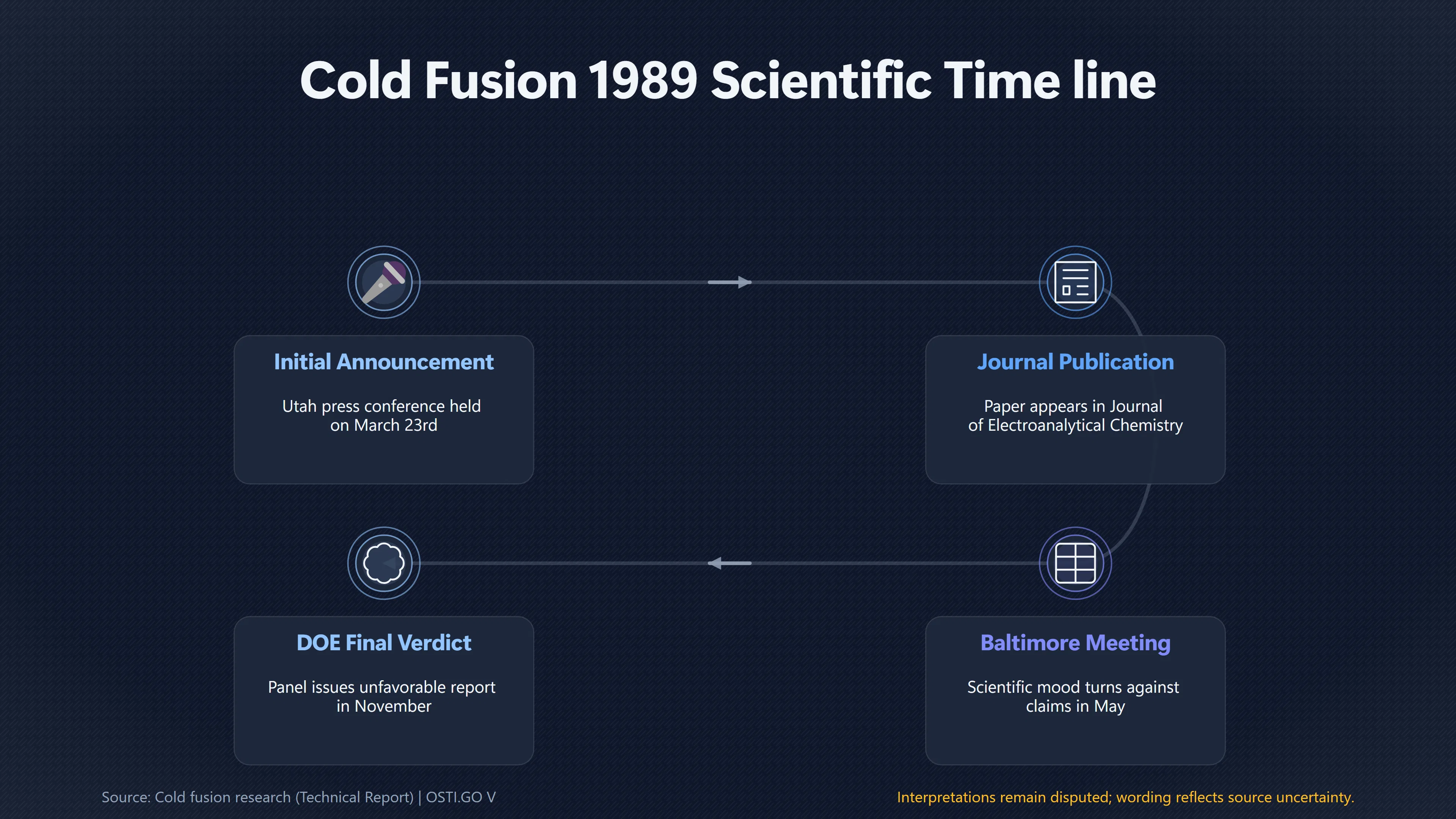
By November 1989, the US Department of Energy’s review panel judged the evidence unpersuasive, although it stopped short of declaring every reported anomaly disproved and explicitly left room for modest, carefully controlled research. That distinction is important to cold fusion’s later place in suppressed-scientist narratives: there was a genuine and unusually rapid collapse of scientific confidence, but the contemporary record also documents substantial experimental reasons for it.[OSTI]osti.govCold fusion research (Technical Report) | OSTI.GO VCold fusion research (Technical Report) | OSTI.GOVNovember 1, 1989…
What Fleischmann and Pons originally claimed
The experiment sounded deceptively simple. Fleischmann, an eminent electrochemist, and Pons, chairman of chemistry at the University of Utah, electrolysed heavy water — water containing deuterium rather than ordinary hydrogen — using palladium cathodes. Palladium can absorb large quantities of hydrogen isotopes. They proposed that loading deuterium into its lattice somehow allowed deuterium nuclei to approach closely enough to undergo nuclear reactions at approximately room temperature. Their preliminary paper, Electrochemically induced nuclear fusion of deuterium, appeared in the Journal of Electroanalytical Chemistry in April 1989.[ScienceDirect]sciencedirect.comScienceDirect Electrochemically induced nuclear fusion of deuteriumElectrochemically induced nuclear fusion of deuterium - ScienceDirectApril 10, 1989…
What transformed the experiment from an unusual electrochemistry result into a global sensation was the interpretation of the heat. Fleischmann and Pons claimed their cells sometimes produced more thermal power than conventional chemistry could plausibly explain. If that excess really came from fusion, the result potentially offered nuclear-scale energy without the enormous temperatures and machinery associated with conventional fusion research. The University of Utah publicly announced the work at a press conference on 23 March, before the journal article had appeared. Contemporary and later histories identify competition, priority and patent considerations as part of the circumstances surrounding the unusually public unveiling.[nature.com]nature.comRevisiting the cold case of cold fusion | NatureRevisiting the cold case of cold fusion | NatureMay 27, 2019…
The crucial scientific issue, however, was never heat alone. Calling unexplained heat fusion required evidence that a nuclear reaction was actually occurring. Known deuterium-deuterium fusion produces characteristic particles and isotopes, including neutrons and tritium. Those products therefore offered an independent test: if watts of excess heat represented conventional D-D fusion, corresponding nuclear products should appear in enormous and readily measurable quantities.
That consistency test quickly became one of the central problems for the Utah claim. Even early reported neutron rates were far below what would have been required to explain the claimed heat by known fusion reactions. Steven Jones of nearby Brigham Young University was simultaneously pursuing a much smaller claimed fusion effect based principally on neutron measurements, not useful heat; contemporary reporting described his claimed fusion rate as roughly a billion times below that associated with the Fleischmann-Pons energy claim. The two propositions were therefore scientifically very different despite being bundled together in the public label “cold fusion”.[Wiley Online Library]agupubs.onlinelibrary.wiley.comOnline Library Cold fusion iced at APS MeetingWiley Online LibraryCold fusion iced at APS Meeting - Maggs - 1989 - Eos, Transactions American Geophysical Union - Wiley Online Library…
Why replication results quickly became disputed
The announcement triggered an extraordinary worldwide experimental rush. Laboratories attempted to obtain suitable palladium, heavy water and neutron detectors and reconstruct experiments from limited information. Results initially looked confusing rather than uniformly negative. Some researchers announced apparent excess heat or possible nuclear products, giving cold fusion a brief period in which confirmation seemed conceivable. Texas A&M researchers, for example, reported positive heat observations and later tritium and neutron results.[UPI]upi.comTexas researchers alone in supporting 'cold fusionTexas researchers alone in supporting 'cold fusion' - UPI ArchivesMay 23, 1989…
But other well-equipped groups were rapidly obtaining negative results. The Department of Energy’s later chronology records Caltech reporting no excess heat at the American Physical Society meeting on 1 May. At the Santa Fe cold-fusion workshop later that month, positive calorimetry reports from Texas A&M and Stanford stood alongside negative results from Caltech, MIT, Argonne National Laboratory, the Naval Weapons Center, EG&G Idaho, the University of British Columbia and Chalk River Nuclear Laboratories.[NCAS PDF Directory]files.ncas.orgOpen source on ncas.org.
This mattered because repeatability is especially important when an experiment claims a phenomenon far outside established expectations. An effect that occurs only under poorly understood material conditions is not automatically imaginary; palladium composition, deuterium loading, surface condition and experimental history could in principle matter. But such explanations have scientific force only when researchers can identify the relevant condition and use it to predict when the phenomenon will and will not appear. During 1989, cold-fusion experiments did not reach that stage.
Baltimore changed the scientific mood
The American Physical Society meeting in Baltimore on 1–3 May became the symbolic turning point. An improvised cold-fusion programme drew roughly 40 speakers discussing attempts to confirm or test the claims. Contemporary reporting in the American Geophysical Union’s Eos described opinion as nearly unanimous against the large heat-producing fusion claimed by Fleischmann and Pons, although much smaller possible nuclear effects were not treated as equivalently settled.[Wiley Online Library]agupubs.onlinelibrary.wiley.comOnline Library Cold fusion iced at APS MeetingWiley Online LibraryCold fusion iced at APS Meeting - Maggs - 1989 - Eos, Transactions American Geophysical Union - Wiley Online Library…
The speed of this reversal later became central to arguments that cold fusion had been rejected socially before the experiments had matured. There is some basis for describing the atmosphere as unusually hostile: only about six weeks separated the Utah press conference from Baltimore, and contemporary press coverage records aggressive public criticism. But rapid judgement was also possible because researchers were not merely asking whether every detail of Fleischmann and Pons’s electrochemistry had been duplicated. They could test consequences of the nuclear interpretation independently — especially neutron, gamma-ray and other fusion-product production. Those tests were already creating severe quantitative difficulties for the claim.[Wiley Online Library]agupubs.onlinelibrary.wiley.comOnline Library Cold fusion iced at APS MeetingWiley Online LibraryCold fusion iced at APS Meeting - Maggs - 1989 - Eos, Transactions American Geophysical Union - Wiley Online Library…
The missing nuclear signatures were more damaging than a simple null result
The strongest criticism was not “our cell did not get hot”. It was that the claimed heat and the nuclear evidence did not agree with each other.
Ordinary D-D fusion has known reaction products. If the large excess heat reported by Fleischmann and Pons arose through those familiar reactions, detectors should have registered nuclear products at rates corresponding to the energy output. Instead, neutron claims generally involved tiny signals near background, while other laboratories established increasingly restrictive upper limits. The DOE panel ultimately found that in no reported experiment were fusion-product yields commensurate with the claimed excess heat.[NCAS PDF Directory]files.ncas.orgPDF Directory Cold Fusion Research: ExecutiveNCAS PDF DirectoryCold Fusion Research: Executive Summary…
That discrepancy created an awkward choice. Either the calorimetric excess heat was mistaken, or an entirely unfamiliar nuclear mechanism was producing large amounts of energy while somehow suppressing the familiar products of deuterium fusion. The latter possibility was not logically impossible, but it made the hypothesis considerably more extraordinary: cold fusion would no longer merely be conventional fusion unexpectedly enabled by a metal lattice; it would require qualitatively new nuclear behaviour. The DOE panel emphasised precisely this theoretical difficulty.[NCAS PDF Directory]files.ncas.orgPDF Directory Cold Fusion Research: ExecutiveNCAS PDF DirectoryCold Fusion Research: Executive Summary…
Tritium did not solve the problem. Some groups reported it, but quantities were again far too small to account for claimed thermal power, and contamination or concentration effects had to be excluded. At the May Santa Fe workshop, even researchers reporting positive results faced this mismatch. Contemporary reporting noted that electrodes associated with excess heat had failed to yield the expected helium evidence, while tritium reports remained unconfirmed and quantitatively insufficient to explain the heat.[The Washington Post]washingtonpost.comThe Washington Post COLD FUSION TESTS REMAIN MYSTERYThe Washington Post COLD FUSION TESTS REMAIN MYSTERY
The difficulty of detecting extremely small nuclear signals also opened numerous routes to false positives. Background neutrons, cosmic rays, detector noise and natural radioactive contaminants can matter when the claimed signal is tiny. A 1989 paper, for example, examined conventional mechanisms capable of generating fast neutrons in experimental environments containing deuterium. Such considerations did not prove that every positive neutron report was erroneous; they raised the evidential standard required before a signal close to background could establish a new nuclear process.[ScienceDirect]sciencedirect.comScienceDirect Conventional sources of fast neutrons in “cold fusion” experimentsScienceDirect Conventional sources of fast neutrons in “cold fusion” experiments

Calorimetry became the second battlefield
Heat measurements posed a different set of problems. Electrolysis cells have electrical energy entering them, gases leaving or recombining, evaporation, changing electrolyte concentrations and temperature gradients. A credible excess-heat measurement therefore depends not merely on observing that a cell becomes warm, but on accounting accurately for the complete energy balance.
Nathan Lewis and colleagues at Caltech subjected the published calorimetric evidence to that kind of analysis. Their 1989 Science paper reported no anomalous power production in either heavy-water or ordinary-water control systems and identified potential errors in open-cell calorimetry that could make temperature changes look like unexplained power.[CaltechAUTHORS]authors.library.caltech.eduOpen source on caltech.edu.
A substantial UK investigation at Harwell Laboratory approached the problem with multiple calorimeter designs and sensitive neutron and gamma-ray detection. Published in Nature in November 1989, it reported no sustained evidence supporting the Fleischmann-Pons or Jones claims. The researchers highlighted possible artefacts including neutron-counter noise, cosmic-ray background variation, calorimeter calibration errors and changes in tritium concentration during electrolysis.[Nature]nature.comUpper bounds on 'cold fusion' in electrolytic cells | NatureUpper bounds on 'cold fusion' in electrolytic cells | Nature
These experiments help explain why the replication crisis cannot accurately be reduced to scientists blindly reproducing a single recipe, getting zero and abandoning the subject. Different laboratories attacked different parts of the claim: calorimetric excess power, neutron production, gamma radiation, tritium and other expected products. By late 1989, the problem was cumulative. Positive observations existed, but they were intermittent and mutually inconsistent; negative experiments were becoming more sophisticated; and no robust relationship had emerged between excess heat and nuclear products.[Nature]nature.comUpper bounds on 'cold fusion' in electrolytic cells | NatureUpper bounds on 'cold fusion' in electrolytic cells | Nature
The DOE verdict was negative but more qualified than later retellings
The US government’s response provides an unusually useful snapshot of where the evidence stood before the controversy hardened into decades of competing narratives. After the March announcement, Energy Secretary James Watkins asked the Energy Research Advisory Board to evaluate cold fusion. Its panel examined published and unpublished material, attended the Santa Fe workshop, visited laboratories and held public meetings before issuing its final report in November.[OSTI]osti.govCold fusion research (Technical Report) | OSTI.GO VCold fusion research (Technical Report) | OSTI.GOVNovember 1, 1989…
Its conclusions were strongly unfavourable to the headline claim. Most experimenters conducting calorimetric measurements were finding neither excess heat nor fusion products. Some reported excess heat, but either no nuclear products or quantities far below those implied by the heat. Reproducibility and predictability remained serious problems. The panel concluded that the evidence did not persuasively demonstrate a new nuclear process or establish cold fusion as a useful energy source.[NCAS PDF Directory]files.ncas.orgPDF Directory Cold Fusion Research: ExecutiveNCAS PDF DirectoryCold Fusion Research: Executive Summary…
Yet the report is also important for what it did not say. It acknowledged contradictory claims and did not assert that every alleged cold-fusion phenomenon had been conclusively disproved. Nor did it recommend banning the subject. It opposed a special cold-fusion funding programme or dedicated research centres but was sympathetic to modest support for carefully focused experiments through ordinary funding channels. It specifically encouraged better calorimetry, closed cells with total gas recombination, alternative measurement techniques, better-characterised materials, exchange of samples between laboratories and cooperative tests designed to resolve conflicting results.[NCAS PDF Directory]files.ncas.orgPDF Directory Cold Fusion Research: ExecutiveNCAS PDF DirectoryCold Fusion Research: Executive Summary…
That distinction complicates both extreme versions of the story. The panel did not vindicate cold fusion, but neither did it decree that researchers must never investigate it again. Its position was closer to: the extraordinary interpretation has not been demonstrated; do not build a major programme around it; pursue tightly controlled tests if worthwhile.

How the crisis became evidence for later suppression claims
For supporters who remained convinced that anomalous heat was real, the events of 1989 supplied powerful ingredients for a suppression narrative. The discovery had been announced with enormous expectations; some laboratories did report positive observations; the scientific mood turned hostile with remarkable speed; and within months a US government panel recommended against special funding. Later cold-fusion advocates could therefore point to an identifiable moment when a once-celebrated research programme became professionally marginal. A modern Nature retrospective, written by researchers who undertook a fresh multi-institutional investigation, described the failed reproductions as having effectively led to the subject’s disqualification from mainstream study.[Nature]nature.comRevisiting the cold case of cold fusion | NatureRevisiting the cold case of cold fusion | NatureMay 27, 2019…
But “scientific stigma” and “suppression of a demonstrated discovery” are not interchangeable claims. The replication record of 1989 contained genuine ambiguity — particularly scattered excess-heat and tritium reports — yet the decisive weakness was not merely that establishment scientists disliked an unconventional idea. The positive observations failed to converge into a reproducible package in which excess energy and nuclear products appeared together at physically compatible levels. The DOE review explicitly based its judgement on that internal inconsistency as well as on negative experiments.[NCAS PDF Directory]files.ncas.orgPDF Directory Cold Fusion Research: ExecutiveNCAS PDF DirectoryCold Fusion Research: Executive Summary…
There is therefore a historically defensible middle position. Cold fusion acquired stigma unusually quickly, and the intense press coverage, patent competition, disciplinary rivalry and hostile public rhetoric made the episode far messier than an idealised picture of slow, dispassionate scientific self-correction. Communication itself became part of the crisis: historical scholarship has documented how press releases, newspapers, faxes and informal circulation of results raced ahead of normal journal publication.[Sage Journals]journals.sagepub.comSage Journals From Fax to Facts: Communication in the Cold Fusion SagaSage JournalsFrom Fax to Facts: Communication in the Cold Fusion Saga - Bruce V. Lewenstein, 1995…
At the same time, the experimental objections were substantive. Caltech’s calorimetry work, Harwell’s broad negative tests, numerous unsuccessful laboratory replications and the glaring mismatch between claimed heat and nuclear products existed independently of later institutional mythology.[caltech.edu]authors.library.caltech.eduOpen source on caltech.edu.
That is why the 1989 replication crisis occupies such an important position in later stories about allegedly suppressed unconventional-energy researchers. It provides a documented example of a field losing legitimacy and institutional support with exceptional speed. What it does not provide by itself is evidence that cold fusion had been successfully established and was then deliberately concealed, still less evidence of a programme targeting researchers physically. Those stronger propositions require evidence beyond the replication crisis. The surviving 1989 record instead shows a more complicated event: spectacular claims, genuine but conflicting positive reports, rapid and sometimes combative scepticism, increasingly stringent negative experiments, and ultimately a failure to produce the reproducible, quantitatively consistent nuclear evidence that would have been needed to sustain the original announcement.[osti.gov]osti.govCold fusion research (Technical Report) | OSTI.GO VCold fusion research (Technical Report) | OSTI.GOVNovember 1, 1989…
Amazon book picks
Further Reading
Books and field guides related to Why Cold Fusion Collapsed After Its 1989 Debut. Use these as the next step if you want deeper reading beyond the article.

Too hot to handle : the race for cold fusion
First published 1990. Subjects: Cold fusion, Research, Utah, Fusion reactors, Nuclear fusion.
Fire from Ice: Searching for the Truth Behind the Cold Fusion...
Discusses the furor over the announcement that scientists had succeeded in producing controlled nuclear fusion at ordinary temperatures,...
Cold Fusion: The Scientific Fiasco of the Century
Professor Huizenga, Co-Chairman of the U.S. Department of Energy Cold Fusion Panel that investigated the claims of Pons and Fleischmann--...
eBay marketplace picks
Marketplace Samples
Live-tested eBay searches with available results related to this page.
Selected fromUFO poster oneBay.co.uk.




Endnotes
1.
Source: osti.gov
Title: Cold fusion research (Technical Report) | OSTI.GO V
Link:https://www.osti.gov/biblio/5144772
Source snippet
Cold fusion research (Technical Report) | OSTI.GOVNovember 1, 1989...
Published: November 1, 1989
2.
Source: agupubs.onlinelibrary.wiley.com
Title: Online Library Cold fusion iced at APS Meeting
Link:https://agupubs.onlinelibrary.wiley.com/doi/abs/10.1029/89EO00150
Source snippet
Wiley Online LibraryCold fusion iced at APS Meeting - Maggs - 1989 - Eos, Transactions American Geophysical Union - Wiley Online Library...
3.
Source: files.ncas.org
Title: PDF Directory Cold Fusion Research: Executive
Link:https://files.ncas.org/erab/execsumm.htm
Source snippet
NCAS PDF DirectoryCold Fusion Research: Executive Summary...
4.
Source: sciencedirect.com
Title: ScienceDirect Electrochemically induced nuclear fusion of deuterium
Link:https://www.sciencedirect.com/science/article/pii/0022072889800063
Source snippet
Electrochemically induced nuclear fusion of deuterium - ScienceDirectApril 10, 1989...
Published: April 10, 1989
5.
Source: nature.com
Title: Revisiting the cold case of cold fusion | Nature
Link:https://www.nature.com/articles/s41586
Source snippet
Revisiting the cold case of cold fusion | NatureMay 27, 2019...
Published: May 27, 2019
6.
Source: calteches.library.caltech.edu
Title: Magazine Whatever Happened to Cold Fusion?
Link:https://calteches.library.caltech.edu/3782/
Source snippet
Caltech MagazineWhatever Happened to Cold Fusion? - Caltech Magazine...
7.
Source: upi.com
Title: Texas researchers alone in supporting ‘cold fusion’
Link:https://www.upi.com/Archives/1989/05/23/Texas-researchers-alone-in-supporting-cold-fusion/4585611899200/
Source snippet
Texas researchers alone in supporting 'cold fusion' - UPI ArchivesMay 23, 1989...
Published: May 23, 1989
8.
Source: files.ncas.org
Link:https://files.ncas.org/erab/apx2a.htm
9.
Source: osti.gov
Title: Cold confusion (Conference) | OSTI.GO V
Link:https://www.osti.gov/biblio/6026306
10.
Source: files.ncas.org
Title: PDF Directory Cold Fusion Research: Title Page
Link:https://files.ncas.org/erab/sec5.htm
11.
Source: sciencedirect.com
Title: ScienceDirect Conventional sources of fast neutrons in “cold fusion” experiments
Link:https://www.sciencedirect.com/science/article/abs/pii/0370269389905455
12.
Source: authors.library.caltech.edu
Link:https://authors.library.caltech.edu/records/59rpm-qts14/latest
13.
Source: nature.com
Title: Upper bounds on ‘cold fusion’ in electrolytic cells | Nature
Link:https://www.nature.com/articles/342375a0
14.
Source: sciencedirect.com
Link:https://www.sciencedirect.com/science/article/abs/pii/S1572665724007641
15.
Source: nature.com
Link:https://www.nature.com/articles/d41586-019-01716-3
16.
Source: large.stanford.edu
Link:https://large.stanford.edu/courses/2015/ph241/chung2/
17.
Source: onlinelibrary.wiley.com
Link:https://onlinelibrary.wiley.com/doi/10.1002/9781118043493.ch43
18.
Source: sciencedirect.com
Title: First reliable tritium data by Packham et al. analyzed by TNCF model
Link:https://www.sciencedirect.com/science/article/abs/pii/S0360319999000671
19.
Source: nature.com
Title: Damning verdict on cold fusion | Nature
Link:https://www.nature.com/articles/382572a0
20.
Source: nature.com
Link:https://www.nature.com/articles/344401a0.pdf
21.
Source: nature.com
Title: Is cold fusion hot? | Nature
Link:https://www.nature.com/articles/342487b0
22.
Source: sciencedirect.com
Title: Conventional sources of fast neutrons in “cold fusion” experiments
Link:https://www.sciencedirect.com/science/article/pii/0370269389905455
23.
Source: nature.com
Title: Cold fusion ideas | Nature
Link:https://www.nature.com/articles/340105b0
24.
Source: nature.com
Title: Upper limits on neutron and γ-ray emission from cold fusion | Nature
Link:https://www.nature.com/articles/340029a0
25.
Source: nature.com
Title: Measurement of γrays from cold fusion | Nature
Link:https://www.nature.com/articles/339667a0
26.
Source: digital.archives.caltech.edu
Title: OH Barnes C coldfusion
Link:https://digital.archives.caltech.edu/collections/OralHistories/OH_Barnes_C_coldfusion/
27.
Source: nature.com
Title: Problems with the γ-ray spectrum in the Fleischmann et al. experiments | Nature
Link:https://www.nature.com/articles/339183a0
28.
Source: time.com
Title: Science: Putting The Heat on Cold Fusion
Link:https://time.com/archive/6702522/science-putting-the-heat-on-cold-fusion/
29.
Source: sciencedirect.com
Link:https://www.sciencedirect.com/science/article/pii/002207288980141X
30.
Source: time.com
Title: Science: A Chronology of Nuclear Confusion
Link:https://time.com/archive/6702439/science-a-chronology-of-nuclear-confusion/
31.
Source: content.time.com
Title: 0,33009,957604 7,00
Link:https://content.time.com/time/subscriber/article/0%2C33009%2C957604-7%2C00.html
32.
Source: nature.com
Title: What to say about cold fusion | Nature
Link:https://www.nature.com/articles/338701a0
33.
Source: nature.com
Title: Observation of cold nuclear fusion in condensed matter | Nature
Link:https://www.nature.com/articles/338737a0
34.
Source: nature.com
Title: Consensus on cold fusion still elusive | Nature
Link:https://www.nature.com/articles/338616a0
35.
Source: nature.com
Title: Cold fusion causes frenzy but lacks confirmation | Nature
Link:https://www.nature.com/articles/338447a0
36.
Source: nature.com
Link:https://www.nature.com/articles/s41563
37.
Source: nature.com
Title: news070326 12
Link:https://www.nature.com/news/2007/070326/full/news070326-12.html
38.
Source: nature.com
Link:https://www.nature.com/articles/338701a0.pdf
39.
Source: nature.com
Link:https://www.nature.com/articles/344365a0.pdf
40.
Source: nature.com
Link:https://www.nature.com/articles/338605a0.pdf
41.
Source: nature.com
Link:https://www.nature.com/articles/489034a
42.
Source: nature.com
Link:https://www.nature.com/articles/d41586-019-01683-9
43.
Source: nature.com
Link:https://www.nature.com/articles/s41392-024-01952-8
44.
Source: sciencedirect.com
Title: Cold Fusion Research
Link:https://www.sciencedirect.com/topics/engineering/cold-fusion-research
45.
Source: sciencedirect.com
Title: Production of helium in cold fusion experiments
Link:https://www.sciencedirect.com/science/article/pii/B9780128159446000014
46.
Source: sciencedirect.com
Title: Search for cold-fusion events
Link:https://www.sciencedirect.com/science/article/pii/0038109889901087
47.
Source: sciencedirect.com
Link:https://www.sciencedirect.com/science/article/abs/pii/0013468689871270
48.
Source: sciencedirect.com
Link:https://www.sciencedirect.com/topics/engineering/fleischmann
49.
Source: files.ncas.org
Link:https://files.ncas.org/erab/intro.htm
50.
Source: osti.gov
Title: 10136825 ANw2Qg
Link:https://www.osti.gov/servlets/purl/10136825-ANw2Qg/
51.
Source: osti.gov
Link:https://www.osti.gov/biblio/6651977
52.
Source: osti.gov
Link:https://www.osti.gov/etdeweb/servlets/purl/20785230
53.
Source: calteches.library.caltech.edu
Link:https://calteches.library.caltech.edu/3616/
54.
Source: calteches.library.caltech.edu
Link:https://calteches.library.caltech.edu/610/
55.
Source: beckmaninstitute.caltech.edu
Title: non tech 14
Link:https://beckmaninstitute.caltech.edu/documents/29006/non-tech-14.pdf
56.
Source: campuspubs.library.caltech.edu
Link:https://campuspubs.library.caltech.edu/118/1/1989-1990.pdf
57.
Source: thesis.caltech.edu
Title: Choe w 2002
Link:https://thesis.caltech.edu/6972/3/Choe_w_2002.pdf
58.
Source: beckmaninstitute.caltech.edu
Title: non tech 3
Link:https://beckmaninstitute.caltech.edu/documents/29011/non-tech-3.pdf
59.
Source: digital.archives.caltech.edu
Title: OH Delbruck M
Link:https://digital.archives.caltech.edu/collections/OralHistories/OH_Delbruck_M
60.
Source: calteches.library.caltech.edu
Link:https://calteches.library.caltech.edu/569/
61.
Source: campuspubs.library.caltech.edu
Link:https://campuspubs.library.caltech.edu/117
62.
Source: cco.caltech.edu
Link:https://www.cco.caltech.edu/~tacit/shows20140429.html
63.
Source: authors.library.caltech.edu
Title: PNAS 1992 Verma 9479 83
Link:https://authors.library.caltech.edu/records/qsgek-f6t48/files/PNAS-1992-Verma-9479-83.pdf
64.
Source: cnk.people.caltech.edu
Link:https://cnk.people.caltech.edu/test-new-page/courses
65.
Source: tacit.caltech.edu
Link:https://tacit.caltech.edu/shows/past/
66.
Source: authors.library.caltech.edu
Link:https://authors.library.caltech.edu/records/3h9r6-eby90/files/nihms878338.pdf
67.
Source: feeds.library.caltech.edu
Link:https://feeds.library.caltech.edu/people/Lewis-N-S/article.html
68.
Source: feeds.library.caltech.edu
Link:https://feeds.library.caltech.edu/people/Lewis-N-S/combined.html
69.
Source: journals.sagepub.com
Title: Sage Journals From Fax to Facts: Communication in the Cold Fusion Saga
Link:https://journals.sagepub.com/doi/10.1177/030631295025003001
Source snippet
Sage JournalsFrom Fax to Facts: Communication in the Cold Fusion Saga - Bruce V. Lewenstein, 1995...
70.
Source: washingtonpost.com
Title: The Washington Post COLD FUSION TESTS REMAIN MYSTERY
Link:https://www.washingtonpost.com/archive/politics/1989/05/25/cold-fusion-tests-remain-mystery/7552d1da-3f40-4d56-9023-52c14791feb6/
71.
Source: electrochem.xmu.edu.cn
Link:https://electrochem.xmu.edu.cn/CN/abstract/abstract11029.shtml
72.
Source: scribd.com
Title: Cold Fusion
Link:https://www.scribd.com/document/654764697/Cold-Fusion-the-Scientific-Fiasco-of-the-Century
73.
Source: jglobal.jst.go.jp
Link:https://jglobal.jst.go.jp/en/detail?JGLOBAL_ID=200902036460677200
74.
Source: washingtonpost.com
Title: SIGNIFICAN T ERRORS REPORTED IN UTAH FUSION EXPERIMENTS
Link:https://www.washingtonpost.com/archive/politics/1989/05/02/significant-errors-reported-in-utah-fusion-experiments/13c37ec4-bf21-47a0-9516-cd3c9e5826e6/
75.
Source: washingtonpost.com
Title: RESEARCHER S DEFEND RESULTS OF FUSION TESTS
Link:https://www.washingtonpost.com/archive/politics/1989/04/26/researchers-defend-results-of-fusion-tests/12d1130c-9e4d-4fee-8e0b-f0d5150333d6/
76.
Source: washingtonpost.com
Title: TABLETO P FUSION TEST VERIFIED, STANFORD RESEARCHERS REPORT
Link:https://www.washingtonpost.com/archive/politics/1989/04/19/tabletop-fusion-test-verified-stanford-researchers-report/b5fd40a0-1187-4c69-bb0a-a75413b4c1b3/
77.
Source: colab.ws
Title: Electrochemically Induced Nuclear Fusion of Deuterium | Co Lab
Link:https://colab.ws/articles/10.1016%2F0022-0728%2889%2980006-3
78.
Source: paperzz.com
Title: Electrochemically induced nuclear fusion of deuterium
Link:https://paperzz.com/doc/7931142/electrochemically-induced-nuclear-fusion-of-deuterium—l
79.
Source: books.google.com
Title: Cold Fusion
Link:https://books.google.com/books/about/Cold_Fusion.html?id=jC5mQgAACAAJ
80.
Source: books.google.com
Title: Cold Fusion
Link:https://books.google.com/books/about/Cold_Fusion.html?id=WFgYAQAAMAAJ
81.
Source: scribd.com
Link:https://www.scribd.com/document/118208154/Cold-Fusion
82.
Source: openlibrary.org
Title: Cold fusion
Link:https://openlibrary.org/books/OL16778290M/Cold_fusion
83.
Source: inspirehep.net
Title: Electrochemically Induced Nuclear Fusion of Deuterium
Link:https://inspirehep.net/literature/277790
84.
Source: wikizero.net
Title: Cold fusion
Link:https://www.wikizero.net/wiki/en/Cold_fusion
85.
Source: science.org
Title: human protein atlas booklet 2021 11 19
Link:https://www.science.org/cms/asset/6e791b9b-1e57-4e50-bf12-2572f2036aad/human_protein_atlas_booklet_2021_11_19.pdf
86.
Source: ouci.dntb.gov.ua
Link:https://ouci.dntb.gov.ua/en/works/96PJojW4/
87.
Source: pdc.co.jp
Link:https://www.pdc.co.jp/an_instant_reply/2017/10/04/cold/
Additional References
88.
Source: youtube.com
Link:https://www.youtube.com/watch?v=fsLfrMsyRg0
Source snippet
Cold fusion 1989 fleischmann pons replication crisis Cold Fusion: The Forgotten Breakthrough That Promised Unlimited Clean Energy...
89.
Source: youtube.com
Title: Cold Fusion Controversy: The Fight for Unlimited Energy
Link:https://www.youtube.com/watch?v=xx-EgGrQ5-o
Source snippet
Fusion in a Jar: the 10 Weeks Science Lost Its Mind (1989)...
90.
Source: researchgate.net
Link:https://www.researchgate.net/publication/6091111_Analysis_of_the_Published_Calorimetric_Evidence_for_Electrochemical_Fusion_of_Deuterium_in_Palladium
91.
Source: researchgate.net
Link:https://www.researchgate.net/publication/238611750_Analysis_of_the_published_calorimetric_evidence_for_electrochemical_fusion_of_deuterium_in_palladium_Technical_report_Cold_fusion
92.
Source: researchgate.net
Link:https://www.researchgate.net/publication/381254095_Consistency_of_Helium_Production_with_the_Excess_Power_in_the_Palladium-D2O_Electrochemical_System
93.
Source: researchgate.net
Link:https://www.researchgate.net/publication/265085076_Social_Aspects_of_Cold_Fusion_23_Years_Later
94.
Source: onlineethics.org
Link:https://onlineethics.org/cases/chapter-2-laboratory-practices
95.
Source: wanttoknow.info
Link:https://www.wanttoknow.info/newenergyinventionsnewsarticles-0-100000
96.
Source: latimes.com
Link:https://www.latimes.com/archives/la-xpm-1989-05-02-mn-2583-story.html
97.
Source: coldfusionvideos.org
Link:https://coldfusionvideos.org/