Within Mallove
Did the 2025 Court Ruling Change Mallove's Motive?
A 2025 ruling exposed a serious prosecution disclosure failure but did not supply evidence that Mallove was killed over unconventional energy.
On this page
- What the disclosure violation involved
- Why a murder conviction was ordered vacated
- What the ruling changes about suppression claims
Page outline Jump by section
Introduction
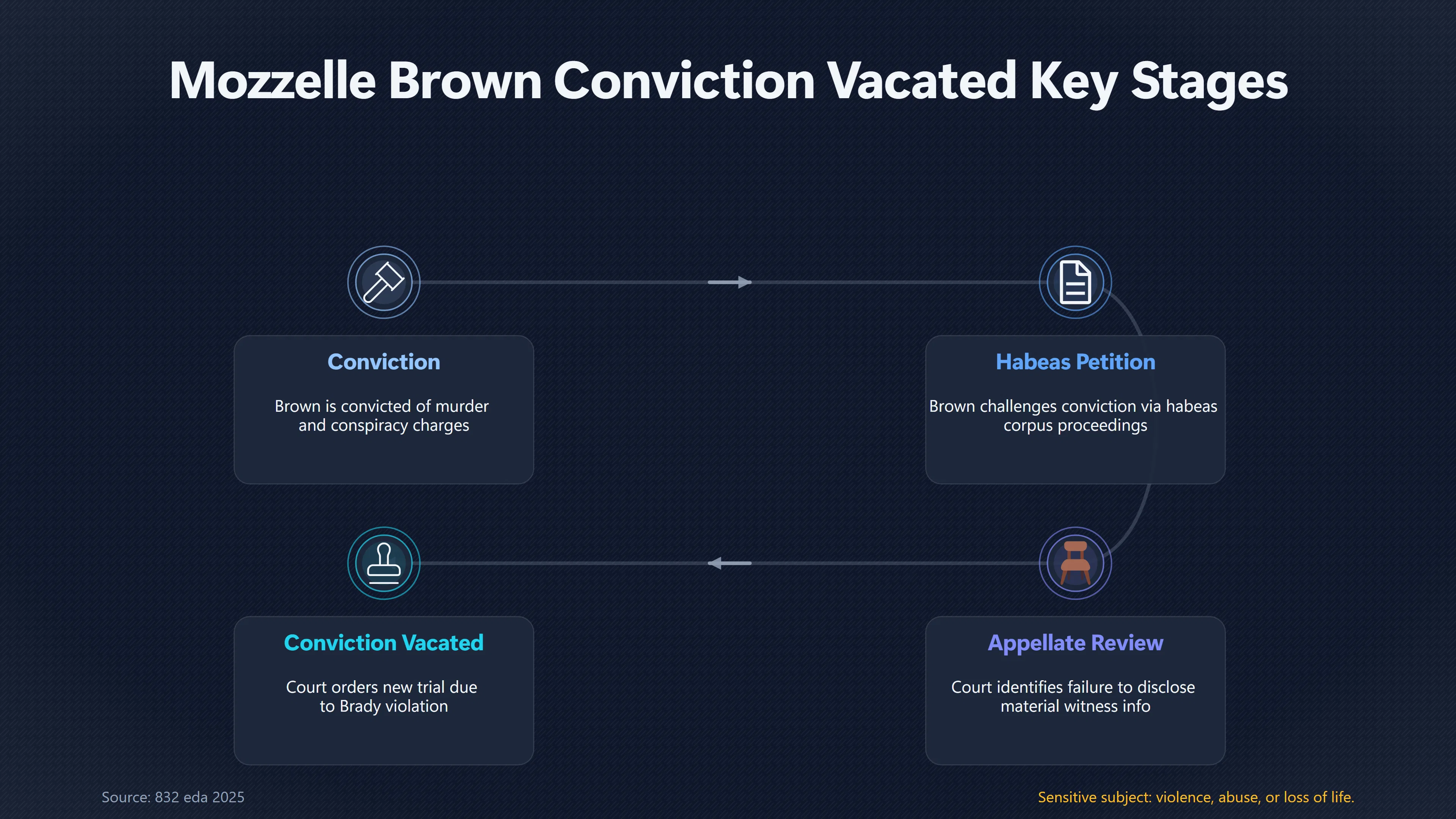
The 2025 Connecticut appellate ruling in the Eugene Mallove murder case exposed a serious failure in the prosecution of Mozzelle Brown, the man convicted in 2014 of murder and conspiracy to commit murder. The court concluded that prosecutors had failed to disclose information that could have been used to challenge the credibility of Candace Foster, a crucial cooperating witness. Because that information was material under the constitutional disclosure rule established by Brady v. Maryland, the court ordered Brown’s convictions vacated and directed that he receive a new trial.[Connecticut Judicial Branch]jud.ct.govConnecticut Judicial Branch HomeConnecticut Judicial BranchHome - CT Judicial Law Libraries' NewsLogJanuary 24, 2025…
That is a significant finding about the fairness of Brown’s prosecution. It is not, however, a finding that investigators concealed evidence about Mallove’s unconventional-energy work, nor does it establish that his advocacy of cold fusion, antigravity or other disputed technologies motivated his killing. The suppressed information concerned Foster’s incentive to testify and the credibility of the prosecution’s case against Brown. The distinction is essential when assessing claims that the 2025 ruling somehow vindicated a scientific-suppression explanation for Mallove’s death.
What the disclosure violation involved
The case was Brown v. Commissioner of Correction, decided by the Connecticut Appellate Court on 28 January 2025. Brown was challenging his convictions through habeas corpus proceedings, arguing in part that the prosecution had violated his due-process rights by failing to disclose an agreement or understanding between prosecutor Paul Narducci and Foster. The lower habeas court had rejected Brown’s position, but the Appellate Court concluded that it had applied the wrong approach and went on to decide the constitutional question itself.[Justia Law]law.justia.comJustia LawBrown v. Commissioner of Correction:: 2025:: Connecticut Appellate Court Decisions:: Connecticut Case Law:: Connecticut Law…
The dispute was subtler than the discovery of a secret written plea bargain. Narducci maintained that Foster had received no specific promise or formal offer before testifying. But his later testimony established that he had told Foster and her lawyer about how cooperating witnesses were ordinarily treated: people who testified truthfully and accurately could have that cooperation considered by prosecutors when determining a recommendation, and their cooperation could be brought to the sentencing judge’s attention.[Justia Law]law.justia.comJustia LawBrown v. Commissioner of Correction:: 2025:: Connecticut Appellate Court Decisions:: Connecticut Case Law:: Connecticut Law…
That mattered because constitutional disclosure law is not confined to signed plea agreements. The Connecticut court stressed that an informal understanding between prosecutors and a cooperating witness can itself be evidence favourable to the defence if it gives the witness a reason to expect favourable treatment. A prosecutor cannot avoid disclosure merely by stopping short of making a precise sentencing promise.[Justia Law]law.justia.comJustia LawBrown v. Commissioner of Correction:: 2025:: Connecticut Appellate Court Decisions:: Connecticut Case Law:: Connecticut Law…
The Appellate Court therefore concluded that Narducci’s representations created an informal understanding that consideration could follow Foster’s testimony. Those statements should have been disclosed to Brown’s defence because they could have strengthened its attempt to impeach Foster — that is, to show jurors a reason why she might have had a personal incentive to give testimony helpful to the prosecution.[Justia Law]law.justia.comJustia LawBrown v. Commissioner of Correction:: 2025:: Connecticut Appellate Court Decisions:: Connecticut Case Law:: Connecticut Law…
There was an additional problem. At Brown’s trial, Foster told jurors that no promises or consideration had been offered. She acknowledged hoping for consideration, but when defence counsel asked whether what happened in Brown’s courtroom would affect what happened to her, she answered that, in her opinion, it would not. The appellate court found that the undisclosed prosecution statements would have put those answers in a materially different light.[Justia Law]law.justia.comJustia LawBrown v. Commissioner of Correction:: 2025:: Connecticut Appellate Court Decisions:: Connecticut Case Law:: Connecticut Law…
In other words, jurors knew Foster hoped for favourable treatment. They did not know that the prosecutor had explained a practice under which truthful cooperating witnesses could in fact have their assistance considered in the formation of an offer and brought to a sentencing court’s attention. That was the disclosure failure at the heart of the 2025 ruling.
Why Brown’s murder conviction was ordered vacated
A failure to disclose useful defence information does not automatically overturn a conviction. Under Brady, suppressed evidence must also be material: broadly, there must be a reasonable probability that disclosure could have produced a different result, sufficient to undermine confidence in the verdict. The appellate court therefore had to assess how important Foster was to the case against Brown.[Justia Law]law.justia.comJustia LawBrown v. Commissioner of Correction:: 2025:: Connecticut Appellate Court Decisions:: Connecticut Case Law:: Connecticut Law…
Its conclusion was unusually important for understanding what the ruling does — and does not — mean. Foster was not merely a peripheral witness. The court described her testimony as crucial because she was the only trial witness with firsthand knowledge of the specific events surrounding Mallove’s killing and Brown’s alleged violent conduct. Schaffer did not testify against Brown, there was no forensic evidence tying Brown to the crime scene, and Brown had not confessed to police. Other witnesses corroborated portions of the prosecution narrative, but they did not duplicate Foster’s direct account.[Justia Law]law.justia.comJustia LawBrown v. Commissioner of Correction:: 2025:: Connecticut Appellate Court Decisions:: Connecticut Case Law:: Connecticut Law…
According to the trial evidence summarised by the appellate court, Foster said that Chad Schaffer became angry after learning that possessions were being thrown into a dumpster at the recently vacated property. She testified that Schaffer later returned with blood on his clothing and that Brown subsequently drove Schaffer and Foster towards the property. Foster described returning to the scene, seeing Mallove alive but badly injured, and witnessing further violence and efforts to make the incident appear to be a robbery.[Justia Law]law.justia.comJustia LawBrown v. Commissioner of Correction:: 2025:: Connecticut Appellate Court Decisions:: Connecticut Case Law:: Connecticut Law…
That account was central enough that a stronger attack on Foster’s motives could reasonably have mattered to jurors. The court expressly distinguished between jurors being told that Foster simply hoped for consideration and learning that prosecutors themselves had told her how cooperation could lead to consideration. In the court’s assessment, disclosure would have given Brown’s lawyer a substantially stronger impeachment argument.[Justia Law]law.justia.comJustia LawBrown v. Commissioner of Correction:: 2025:: Connecticut Appellate Court Decisions:: Connecticut Case Law:: Connecticut Law…
The Appellate Court consequently found all the necessary elements of a Brady violation. It reversed the habeas judgment and ordered the habeas court to grant Brown’s petition, vacate his murder and conspiracy convictions and order a new trial.[Justia Law]law.justia.comJustia LawBrown v. Commissioner of Correction:: 2025:: Connecticut Appellate Court Decisions:: Connecticut Case Law:: Connecticut Law…
The Connecticut Supreme Court subsequently denied certification to appeal, as later Connecticut appellate decisions record when citing Brown: 230 Conn. App. 384, 330 A.3d 134, certification denied, 351 Conn. 921, 333 A.3d 103 (2025).[Connecticut Judicial Branch]jud.ct.govConnecticut Judicial BranchCONNECTICUTFebruary 4, 2026…

What the ruling did not find
The most important limit is straightforward: Brown v. Commissioner of Correction was a ruling about Brown’s right to a fair trial, not a judicial reinvestigation of why Eugene Mallove was killed.
Nothing in the appellate court’s identified constitutional violation concerned cold fusion, UFOs, antigravity research, energy technology, Mallove’s criticism of scientific institutions or an organisation attempting to silence him. The suppressed evidence was information bearing on Foster’s incentive and credibility as a cooperating prosecution witness. The remedy followed because Foster was important to proving Brown’s participation, not because the court discovered a previously concealed alternative motive for Mallove’s murder.[Justia Law]law.justia.comJustia LawBrown v. Commissioner of Correction:: 2025:: Connecticut Appellate Court Decisions:: Connecticut Case Law:: Connecticut Law…
The ruling also did not hold that Foster’s later favourable treatment independently proved a pre-existing secret bargain. The court was careful on precisely this point. After Brown’s trial, Foster ultimately obtained a plea agreement, but the judges stated that later favourable treatment does not, by itself, prove that a hidden deal existed before a witness testified. Their finding of an informal understanding rested specifically on what Narducci acknowledged telling Foster beforehand.[Justia Law]law.justia.comJustia LawBrown v. Commissioner of Correction:: 2025:: Connecticut Appellate Court Decisions:: Connecticut Case Law:: Connecticut Law…
That distinction prevents two opposite overstatements. It would be wrong to minimise the decision as a mere technicality: the court found a constitutional violation serious enough to undermine confidence in murder convictions and require a new trial. But it would be equally wrong to treat that violation as evidence that prosecutors had been concealing the “real” reason for Mallove’s death. The appellate record identifies what was withheld, and it was impeachment evidence concerning a cooperating witness.
Did the ruling weaken the documented motive?
It weakened confidence in one particular jury verdict against one particular defendant. It did not erase the evidence describing how the killing arose.
Indeed, the appellate opinion itself repeated the prosecution evidence connecting the events to the recently vacated property. Foster testified that Schaffer became angry after learning that belongings were being discarded there. According to her account, he left, returned with bloodstained clothing and later participated with Brown in returning to Mallove and attempting to make the crime look like a robbery.[Justia Law]law.justia.comJustia LawBrown v. Commissioner of Correction:: 2025:: Connecticut Appellate Court Decisions:: Connecticut Case Law:: Connecticut Law…
The opinion also records a major piece of case history independent of Brown’s overturned verdict: Schaffer had faced his own prosecution and, during his 2012 trial, entered an Alford plea to first-degree manslaughter and third-degree robbery. He received a twenty-year sentence suspended after fifteen years, followed by probation.[Justia Law]law.justia.comJustia LawBrown v. Commissioner of Correction:: 2025:: Connecticut Appellate Court Decisions:: Connecticut Case Law:: Connecticut Law… An Alford plea allows a defendant to accept conviction without making an ordinary admission of factual guilt, so it should not be described as equivalent to a conventional confession. Nevertheless, Schaffer’s separate disposition was not undone by the 2025 ruling concerning Brown.
Nor did the appellate judges find that the entire prosecution case consisted solely of Foster’s testimony. They noted evidence from other witnesses who placed Brown or Foster at relevant locations, described Brown possessing property taken from Mallove, reported incriminating statements and described destruction of stolen items. What made the Brady violation material was that Foster alone supplied firsthand evidence of crucial details of Brown’s alleged participation in the killing.[Justia Law]law.justia.comJustia LawBrown v. Commissioner of Correction:: 2025:: Connecticut Appellate Court Decisions:: Connecticut Case Law:: Connecticut Law…
That distinction is especially important in the wider discussion of allegedly suspicious deaths among unconventional-energy researchers. Vacating Brown’s conviction means that the state failed to provide him the constitutionally fair trial to which he was entitled. It does not logically convert deficiencies in proof against Brown into affirmative evidence for a different killer or motive.
Why the ruling can be misread as evidence of suppression
Mallove’s case is unusually vulnerable to that interpretation because two different meanings of “suppression” can easily become conflated.
In the legal ruling, suppression means that the prosecution failed to disclose evidence favourable to a criminal defendant as required by Brady. The suppressed material concerned what a cooperating witness had been told about possible consideration for truthful testimony.[Justia Law]law.justia.comJustia LawBrown v. Commissioner of Correction:: 2025:: Connecticut Appellate Court Decisions:: Connecticut Case Law:: Connecticut Law…
In theories surrounding Mallove’s death, by contrast, suppression usually means an alleged effort to obstruct unconventional scientific or energy research, sometimes extending to claims that researchers were deliberately killed.
Those propositions are not interchangeable. Proof of prosecutorial suppression in the constitutional-disclosure sense does not provide proof of technological or scientific suppression in the conspiratorial sense. Establishing the latter would require separate evidence connecting Mallove’s scientific activities to the planning, perpetrators or motive for his death.
The 2025 opinion provides no such connection. Its factual discussion remains centred on the people already implicated in the criminal investigation, the rental property, Schaffer’s anger over possessions at that property, the alleged staging of a robbery, Foster’s eyewitness account and the reliability of the evidence used against Brown.[Justia Law]law.justia.comJustia LawBrown v. Commissioner of Correction:: 2025:: Connecticut Appellate Court Decisions:: Connecticut Case Law:: Connecticut Law…

What the 2025 ruling actually changes
The ruling materially changes how confidently Brown’s conviction can be cited. After the appellate decision, it is no longer accurate simply to point to his 2014 jury verdict as an unqualified judicial resolution of his guilt: the conviction was ordered vacated because the trial was constitutionally compromised.[Connecticut Judicial Branch]jud.ct.govConnecticut Judicial Branch HomeConnecticut Judicial BranchHome - CT Judicial Law Libraries' NewsLogJanuary 24, 2025…
It also exposes a genuine governance failure. Prosecutors have an obligation to disclose material evidence capable of affecting the credibility of important state witnesses. The Brown decision emphasises that this obligation cannot be avoided by semantic distinctions between a formal “deal” and a less explicit understanding. Where the state gives a cooperating witness reason to expect that truthful testimony may produce favourable consideration, that information can be constitutionally significant impeachment evidence.[Justia Law]law.justia.comJustia LawBrown v. Commissioner of Correction:: 2025:: Connecticut Appellate Court Decisions:: Connecticut Case Law:: Connecticut Law…
But the evidential consequence should remain proportionate to the finding. The decision supports three conclusions simultaneously: Brown’s prosecution contained a serious constitutional disclosure failure; Foster’s credibility should have been tested with information the defence did not receive; and the resulting convictions could not safely stand. It does not support a fourth conclusion — that the court uncovered evidence of an unconventional-energy assassination.
For the question of Mallove’s motive, therefore, the 2025 ruling is important chiefly as a caution against overstating certainty. It complicates the prosecution history and removes one murder conviction as an unquestioned endpoint. What it does not do is supply the missing evidential bridge between Mallove’s unconventional-energy advocacy and his death. On that much narrower but central question, the ruling changes the reliability of one prosecution outcome, not the documented basis for claiming a scientific-suppression motive.
Amazon book picks
Further Reading
Books and field guides related to Did the 2025 Court Ruling Change Mallove's Motive?. Use these as the next step if you want deeper reading beyond the article.
Convicting the Innocent: Where Criminal Prosecutions Go Wrong
On January 20, 1984, Earl WashingtonÑdefended for all of forty minutes by a lawyer who had never tried a death penalty caseÑwas found gui...
Prosecution Complex: America's Race to Convict and Its Impact...
American prosecutors are asked to play two roles within the criminal justice system: they are supposed to be ministers of justice whose o...
Just Mercy
#1 NEW YORK TIMES BESTSELLER • NOW A MAJOR MOTION PICTURE STARRING MICHAEL B. JORDAN AND JAMIE FOXX • A powerful true story about the pot...
Gideon's Trumpet
The classic bestseller from a two-time Pulitzer Prize-winning journalist that tells the compelling true story of one man's fight for the...
eBay marketplace picks
Marketplace Samples
Live-tested eBay searches with available results related to this page.
Selected fromUFO poster oneBay.co.uk.




Endnotes
1.
Source: law.justia.com
Link:https://law.justia.com/cases/connecticut/court-of-appeals/2025/ac46658.html
Source snippet
Justia LawBrown v. Commissioner of Correction:: 2025:: Connecticut Appellate Court Decisions:: Connecticut Case Law:: Connecticut Law...
2.
Source: law.justia.com
Link:https://law.justia.com/cases/federal/appellate-courts/ca2/23-8093/23-8093-2026-06-30.html
3.
Source: law.justia.com
Title: 832 eda 2025
Link:https://law.justia.com/cases/pennsylvania/superior-court/2026/832-eda-2025.html
4.
Source: law.justia.com
Link:https://law.justia.com/cases/connecticut/court-of-appeals/2026/ac46562.html
5.
Source: law.justia.com
Link:https://law.justia.com/cases/ohio/ninth-district-court-of-appeals/2026/31314.html
6.
Source: law.justia.com
Link:https://law.justia.com/cases/connecticut/court-of-appeals/2026/ac47645.html
7.
Source: law.justia.com
Link:https://law.justia.com/cases/connecticut/court-of-appeals/2026/ac47765.html
8.
Source: law.justia.com
Title: 779 mda 2024
Link:https://law.justia.com/cases/pennsylvania/superior-court/2026/779-mda-2024.html
9.
Source: law.justia.com
Link:https://law.justia.com/cases/connecticut/court-of-appeals/2025/ac46768.html
10.
Source: law.justia.com
Link:https://law.justia.com/cases/connecticut/court-of-appeals/2025/ac48218.html
11.
Source: law.justia.com
Link:https://law.justia.com/cases/connecticut/court-of-appeals/2025/ac47195.html
12.
Source: law.justia.com
Link:https://law.justia.com/cases/connecticut/court-of-appeals/2023/ac45756.html
13.
Source: law.justia.com
Link:https://law.justia.com/cases/connecticut/supreme-court/2022/sc20474.html
14.
Source: law.justia.com
Link:https://law.justia.com/cases/texas/supreme-court/2021/19-0497.html
15.
Source: law.justia.com
Link:https://law.justia.com/cases/new-york/other-courts/2021/2021-ny-slip-op-30299-u.html
16.
Source: law.justia.com
Link:https://law.justia.com/cases/new-york/other-courts/2020/2020-ny-slip-op-20119.html
17.
Source: law.justia.com
Link:https://law.justia.com/cases/maryland/court-of-appeals/2018/54-17.html
18.
Source: docs.justia.com
Link:https://docs.justia.com/cases/federal/district-courts/maryland/mddce/1%3A2013cv00474/228511/19
19.
Source: law.justia.com
Link:https://law.justia.com/cases/federal/district-courts/new-york/nysdce/1%3A2011cv06690/385198/159/
20.
Source: docs.justia.com
Link:https://docs.justia.com/cases/federal/appellate-courts/ca2/09-4991/920110105
21.
Source: law.justia.com
Link:https://law.justia.com/cases/federal/appellate-courts/ca2/09-4991/09-4991_opn-2011-03-27.html
22.
Source: law.justia.com
Link:https://law.justia.com/cases/connecticut/court-of-appeals/2007/104ap425.html
23.
Source: law.justia.com
Link:https://law.justia.com/cases/connecticut/supreme-court/2007/281cr35.html
24.
Source: law.justia.com
Link:https://law.justia.com/cases/new-york/other-courts/2006/2006-51639.html
25.
Source: law.justia.com
Link:https://law.justia.com/cases/new-york/appellate-division-fourth-department/2004/2004-02026.html
26.
Source: law.justia.com
Link:https://law.justia.com/cases/connecticut/supreme-court/2000/cr97.html
27.
Source: law.justia.com
Title: supreme court
Link:https://law.justia.com/cases/montana/supreme-court/1985/
28.
Source: law.justia.com
Title: court of appeals
Link:https://law.justia.com/cases/connecticut/court-of-appeals/2021/
29.
Source: law.justia.com
Link:https://law.justia.com/cases/federal/district-courts/indiana/inndce/2019/?page=2
30.
Source: law.justia.com
Link:https://law.justia.com/cases/federal/district-courts/indiana/inndce/2016/
31.
Source: law.justia.com
Title: court of appeals
Link:https://law.justia.com/cases/connecticut/court-of-appeals/2012/
32.
Source: law.justia.com
Link:https://law.justia.com/cases/federal/appellate-courts/ca11/2026/
33.
Source: everything.explained.today
Title: Eugene Mallove
Link:https://everything.explained.today/Eugene_Mallove/
34.
Source: jud.ct.gov
Title: Connecticut Judicial Branch Home
Link:https://jud.ct.gov/lawlib/lawlibnews/Posts/Post.aspx?Id=6178
Source snippet
Connecticut Judicial BranchHome - CT Judicial Law Libraries' NewsLogJanuary 24, 2025...
Published: January 24, 2025
35.
Source: jud.ct.gov
Link:https://www.jud.ct.gov/lawjournal/Docs/Appellate/2025/5/ap230_8631.pdf
Source snippet
CONNECTICUT LAW JOURNAL 2...
36.
Source: jud.ct.gov
Link:https://www.jud.ct.gov/lawjournal/Docs/Misc/2025/43/CLJ10212025.pdf
Source snippet
Connecticut Judicial BranchCONNECTICUTFebruary 4, 2026...
Published: February 4, 2026
37.
Source: jud.ct.gov
Link:https://jud.ct.gov/lawlib/lawlibnews/Default.aspx?ArchMY=202501
38.
Source: hallapproved.com
Link:https://hallapproved.com/ct/cases/supreme/2025/10322038/
39.
Source: jud.ct.gov
Title: archive AROap12
Link:https://www.jud.ct.gov/external/supapp/archiveAROap12.htm
40.
Source: jud.ct.gov
Link:https://www.jud.ct.gov/lawjournal/LJArchive.aspx
41.
Source: jud.ct.gov
Link:https://www.jud.ct.gov/lawjournal/CR/CRArchive.aspx
42.
Source: uapmurders.com
Link:https://uapmurders.com/uaps/Details/Eugene_Mallove/
43.
Source: fight.fudgie.org
Link:https://fight.fudgie.org/search/people/
Additional References
44.
Source: concordmonitor.com
Title: End of an era for cold fusion journal Infinite Energy
Link:https://www.concordmonitor.com/2026/07/27/infinite-energy-magazine-disappears-cold-fusion-nh-eugene-mallove/
Source snippet
Concord MonitorJuly 27, 2026 — GRANITE GEEK: INFINITE ENERGY MAGAZINE HAS PROVED TO BE FINITE, AFTER ALL Image: Avatar photo by David Bro...
Published: July 27, 2026
45.
Source: openaccess.city.ac.uk
Title: city.ac.uk City Research Online
Link:https://openaccess.city.ac.uk/view/subjects/RC.expanded_type.html
Source snippet
& Cook, R.[Button: view all authors] (2017). Typical integration of emotion cues from bodies and faces in Autism Spectrum Disorder. Cogni...
46.
Source: queenslandjudgments.com.au
Title: Queensland Judgments
Link:https://www.queenslandjudgments.com.au/?trk=public_post_comment-text
Source snippet
QLD Courts Case Law and JudgmentsJuly 27, 2026 — QUEENSLAND REPORTS - LATEST * ### Latest Reports * ### Next Reports * ### HCA Appeals RE...
Published: July 27, 2026
47.
Source: queenslandjudgments.com.au
Title: Queensland Judgments
Link:https://www.queenslandjudgments.com.au/?hr=findAnyone
Source snippet
QLD Courts Case Law and JudgmentsJuly 29, 2026 — LATEST QCA JUDGMENTS * Published 28 Jul 2026 * #### R v NAH [2026] QCA 140, 28 Jul 2026...
Published: July 29, 2026
48.
Source: courts.state.md.us
Title: state.md.us Court Opinions: Index
Link:https://www.courts.state.md.us/cgi-bin/indexlist.pl?court=both&order=bytitle&submit=Submit&year=all
Source snippet
Opinions: IndexJuly 29, 2026 — 1995 TO PRESENT INDEX LISTING OF APPELLATE COURT OPINIONS Wed Jul 29 18:51:07 EDT 2026 CASE PDF docket/ter...
Published: July 29, 2026
49.
Source: nebraskalegislature.gov
Link:https://nebraskalegislature.gov/laws/display_html.php?begin_section=29-3001&end_section=29-3004
50.
Source: oregonlegislature.gov
Link:https://www.oregonlegislature.gov/bills_laws/ors/anc001.html
51.
Source: justice.gov
Link:https://www.justice.gov/archives/usam/criminal-resource-manual-165-guidance-prosecutors-regarding-criminal-discovery
52.
Source: youtube.com
Link:https://www.youtube.com/watch?v=Ao6ZLt36aVg
Source snippet
6 Banned Inventions That Were Too Dangerous to Continue...
53.
Source: youtube.com
Title: 6 Banned Inventions That Were Too Dangerous to Continue
Link:https://www.youtube.com/watch?v=sNkhK4qm8YY
Source snippet
Arrest made in 2004 Norwich murder of scientist...