Within Mallove
How the 2009 Witness Breakthrough Changed the Case
New witness statements in 2009 shifted investigators away from earlier suspects and toward people connected with Mallove's former tenants.
On this page
- Jill Sebastian's account of bloody clothing
- Keishon Dullivan's report of Schaffer's admission
- How the new statements redirected investigators
Page outline Jump by section
Introduction
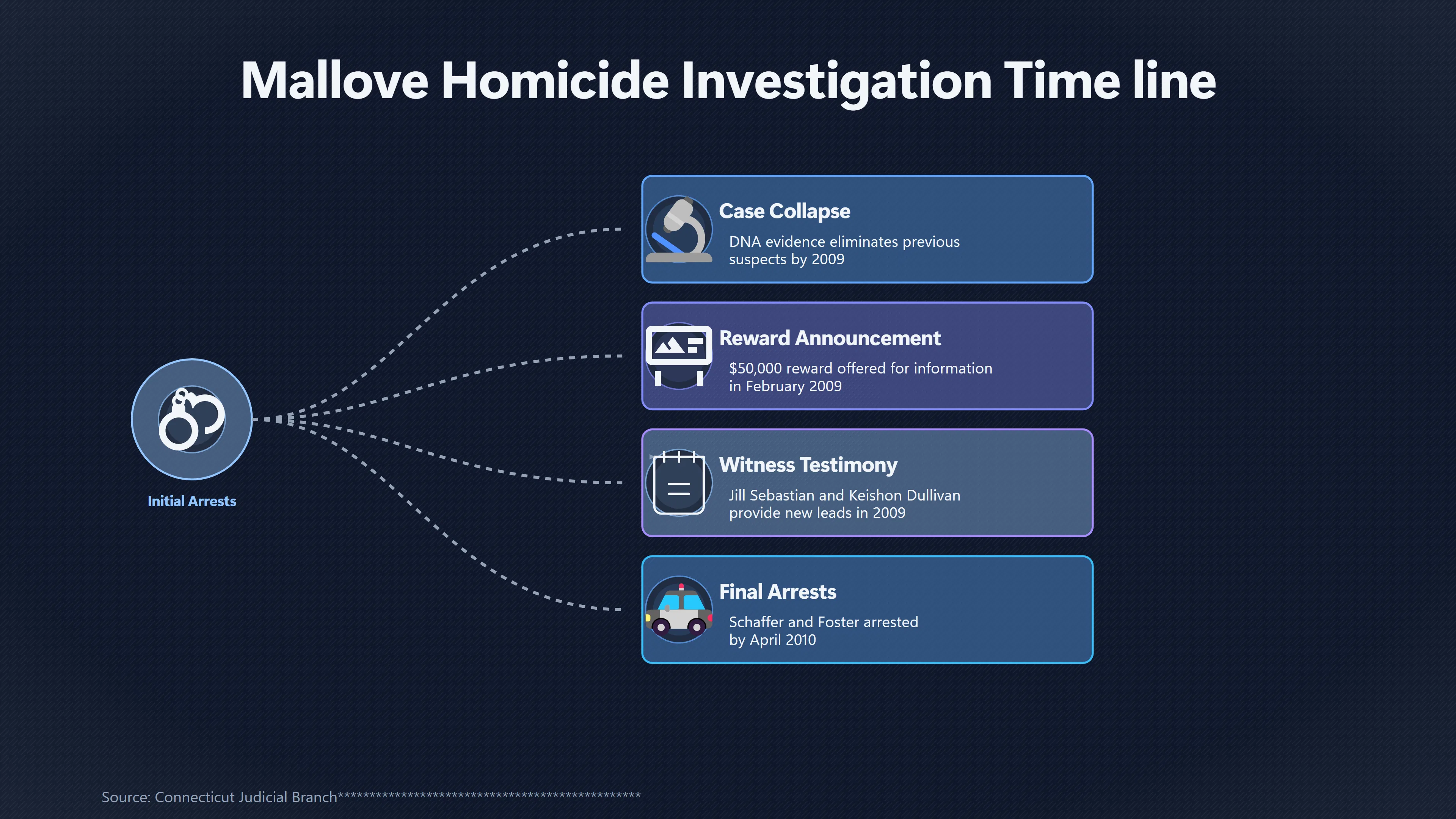
The decisive change in the Eugene Mallove murder investigation came in 2009, five years after his death. By then, the prosecution of two earlier suspects had collapsed: investigators had eliminated Gary McAvoy and Joseph Reilly as sources of DNA profiles associated with the homicide, and the state dropped the charges against them. The case then turned back towards people investigators had encountered much earlier — members of the circle surrounding the tenants Mallove had evicted from 119 Salem Turnpike in Norwich, Connecticut.[Justia Law]law.justia.comJustia LawBrown v. Commissioner of Correction:: 2025:: Connecticut Appellate Court Decisions:: Connecticut Case Law:: Connecticut Law…
The catalyst was new witness information. Jill Sebastian told police that she had seen Chad Schaffer’s bloody clothing around the time of the 2004 killing and that Candace Foster had admitted lying about Schaffer’s whereabouts. Sebastian’s boyfriend, Keishon Dullivan, separately reported seeing blood on Schaffer’s basketball jersey and said Schaffer had admitted assaulting Mallove and taking his possessions to make the attack look like a robbery. Those statements did not by themselves solve the homicide, but they changed its investigative direction. They gave detectives a reason to re-examine the former tenants’ circle, old physical evidence and an alibi that had helped keep Schaffer outside the main focus of the original inquiry.[Justia Law]law.justia.comJustia LawBrown v. Commissioner of Correction:: 2025:: Connecticut Appellate Court Decisions:: Connecticut Case Law:: Connecticut Law…
Why the case was ready to change direction
The importance of the 2009 witnesses becomes clearer when compared with the position investigators had occupied immediately beforehand. McAvoy and Reilly had been arrested in connection with Mallove’s death after circumstances including suspicious injuries, apparent blood stains and a witness identification connected Reilly to a green van near Mohegan Sun. A court found probable cause in 2005, but the subsequent investigation eliminated both men as sources of relevant DNA profiles. The charges were eventually dropped.[Justia Law]law.justia.comJustia LawBrown v. Commissioner of Correction:: 2025:: Connecticut Appellate Court Decisions:: Connecticut Case Law:: Connecticut Law…
That left detectives effectively reconsidering the homicide. According to journalist David Kushner’s detailed reconstruction of the investigation, Detective James Curtis revisited possible leads after the earlier case fell apart, including contacts from Mallove’s scientific and professional life. Those inquiries did not produce the breakthrough. Instead, it came from Norwich and from people socially connected to a man who had already spoken with police in 2004: Chad Schaffer.[David Kushner]davidkushner.comDavid Kushner The Coldest Case – David KushnerDavid KushnerThe Coldest Case – David KushnerJuly 7, 2016…
There was also a deliberate attempt to generate new information. On 11 February 2009, Connecticut authorities announced a $50,000 reward for information leading to the arrest and conviction of whoever was responsible. The official announcement said that Norwich police, the New London State’s Attorney’s Office and the Connecticut State Police Eastern District Major Crime Squad had formed a Mallove Homicide Task Force. Investigators had developed some credible information, it said, but still needed additional facts and leads to move the case forward.[CT.gov]portal.ct.gov50000 reward being offered from homicide investigation norwich 2004CT.gov50000 Reward Being Offered from Homicide Investigation Norwich 2004February 11, 2009…
The reward campaign is significant because Kushner reports that Sebastian approached police in May after a conversation concerning a billboard advertising the reward. The official record independently confirms the central point: it was Sebastian’s information in 2009 that directed investigators towards possible involvement by the former tenants.[CT.gov]portal.ct.gov50000 reward being offered from homicide investigation norwich 2004CT.gov50000 Reward Being Offered from Homicide Investigation Norwich 2004February 11, 2009…
Jill Sebastian’s account put Schaffer back in focus
Sebastian’s information mattered because it challenged the account investigators had received from Schaffer and Foster immediately after the killing.
The Connecticut Appellate Court’s later summary of the case records that Schaffer originally told police he had never met Mallove and that his family had experienced no personal problems with him during the eviction. Foster supplied an apparently helpful alibi, telling investigators that Schaffer had been with her and their child at their ArtSpace apartment for the entire day and evening of 14 May 2004.[Justia Law]law.justia.comJustia LawBrown v. Commissioner of Correction:: 2025:: Connecticut Appellate Court Decisions:: Connecticut Case Law:: Connecticut Law…
Sebastian’s 2009 account undermined that picture. According to the court record, she told police that she had seen Schaffer’s bloody clothing in the apartment. More importantly, she said Foster had admitted that she had lied about Schaffer being home on the night Mallove was killed and had disposed of Schaffer’s bloodied pyjama trousers.[Justia Law]law.justia.comJustia LawBrown v. Commissioner of Correction:: 2025:: Connecticut Appellate Court Decisions:: Connecticut Case Law:: Connecticut Law…
Kushner’s reconstruction provides additional detail about what prompted Sebastian to speak. He reports that Schaffer and Foster had recently been visiting her home when Sebastian mentioned the reward billboard. Schaffer became visibly upset and left the room with Foster; Sebastian said she overheard Foster reassuring him that investigators did not know anything. Sebastian then told Detective Curtis about the bloody clothes she remembered seeing around the time of the killing.[David Kushner]davidkushner.comDavid Kushner The Coldest Case – David KushnerDavid KushnerThe Coldest Case – David KushnerJuly 7, 2016…
That recollection was potentially powerful because it connected three previously separate elements: Schaffer, the date of the murder and physical signs consistent with recent violence. It also called into question Foster’s 2004 alibi for him. Instead of merely suggesting that an evicted tenant might have had a grievance, Sebastian supplied information indicating that people within Schaffer’s own social circle had observed circumstances inconsistent with the story originally given to police.
The distinction is important. The investigative breakthrough was not simply the realisation that Mallove had evicted Schaffer’s family; police already knew about the eviction in 2004. What changed in 2009 was the arrival of witnesses who supplied evidence suggesting that Schaffer’s earlier account could be false.[Justia Law]law.justia.comJustia LawBrown v. Commissioner of Correction:: 2025:: Connecticut Appellate Court Decisions:: Connecticut Case Law:: Connecticut Law…
Keishon Dullivan added an alleged admission
Sebastian’s account became considerably more significant when investigators obtained information from her boyfriend, Keishon Dullivan. The later Connecticut court record describes Dullivan as having lived with Sebastian, Schaffer and Foster at the ArtSpace apartments.
Dullivan told police that he had seen Schaffer’s basketball jersey covered in blood on the apartment floor. That observation broadly reinforced Sebastian’s recollection of bloody clothing, but his account went further. According to the appellate record, Dullivan said Schaffer told him that he had assaulted Mallove with Mozzelle Brown at 119 Salem Turnpike and that Mallove’s possessions had been taken in order to stage the attack as a robbery.[Justia Law]law.justia.comJustia LawBrown v. Commissioner of Correction:: 2025:: Connecticut Appellate Court Decisions:: Connecticut Case Law:: Connecticut Law…
That alleged admission transformed the informational value of the witness evidence. Bloody clothing alone could require explanation but does not establish where blood came from or why it was present. Dullivan’s statement supplied an alleged narrative connecting Schaffer directly to Mallove, Brown and the crime scene. It also supplied an explanation for an otherwise potentially misleading feature of the homicide: the removal of Mallove’s property.
The significance of Dullivan’s evidence persisted into the later prosecutions. Reporting on subsequent proceedings records testimony from Dullivan concerning incriminating behaviour and statements within the group after the killing. The Connecticut Appellate Court likewise later described Sebastian and Dullivan as witnesses whose evidence corroborated portions of Foster’s eventual account.[New Energy Times]newenergytimes.comNew Energy Times Printer-friendly versionNew Energy TimesPrinter-friendly version - TheDay.comAugust 19, 2024…
There are limits to what should be inferred from this. Sebastian and Dullivan were reporting memories and alleged statements years after the homicide; neither was an eyewitness to the complete sequence of violence later described by Foster. Indeed, when reviewing Brown’s conviction in 2025, the Connecticut Appellate Court stressed that Foster remained the only witness with firsthand knowledge of the specific events leading to Mallove’s murder and the nature and extent of Brown’s alleged violence.[Justia Law]law.justia.comJustia LawBrown v. Commissioner of Correction:: 2025:: Connecticut Appellate Court Decisions:: Connecticut Case Law:: Connecticut Law…
But that limitation does not diminish their importance to the 2009 investigative breakthrough. Their role was not to provide a complete eyewitness reconstruction. It was to give detectives credible reasons to reopen a line of inquiry that had previously gone nowhere.
The witness statements made old evidence look different
Once Sebastian’s information focused attention on Schaffer, Detective Curtis began reconsidering evidence already collected from 119 Salem Turnpike. This illustrates why the breakthrough was more consequential than a single new tip: new testimony changed the meaning of old material.
Kushner reports that Curtis spent roughly two months reviewing the physical evidence and crime-scene photographs. One photograph showed a small sun-shaped key chain bearing the name “Brittany” lying near the dumpster Mallove had been using while clearing the property. Police had collected the keys in 2004 but had never identified their owner.[David Kushner]davidkushner.comDavid Kushner The Coldest Case – David KushnerDavid KushnerThe Coldest Case – David KushnerJuly 7, 2016…
Curtis noticed that grass clippings covered other objects in the yard but not the keys. His inference was that they had been deposited after the grass was cut, making their presence potentially relevant to the period surrounding the homicide. When police questioned Foster in June 2009, Kushner reports, she identified them as Schaffer’s keys; Brittany was the name of a daughter he had with a previous girlfriend.[David Kushner]davidkushner.comDavid Kushner The Coldest Case – David KushnerDavid KushnerThe Coldest Case – David KushnerJuly 7, 2016…
The key chain is useful for understanding the mechanics of the investigative turn even though the later appellate opinion’s concise factual history centres more heavily on the witness statements. Sebastian’s tip caused detectives to look again at Schaffer; the renewed scrutiny gave an overlooked object from the crime scene new significance; questioning Foster then opened another route into the events of 14 May 2004.
This was therefore a cumulative breakthrough rather than a single “smoking gun”. Witness recollections, a challenged alibi, an alleged admission and reconsidered physical evidence reinforced the decision to concentrate on Schaffer’s circle.
Foster’s original alibi began to unravel
The next major consequence of the 2009 statements was that police returned to Candace Foster. Her position was especially important because she had supplied Schaffer’s original alibi.
The later court record says Foster gave police her first written statement after Sebastian and Dullivan came forward and was placed in witness protection with her two children. Her account did not immediately stabilise into one consistent version: the Connecticut Appellate Court records that she gave investigators several different accounts of what happened. Her final statement, dated 23 March 2010, included an admission that she herself had kicked Mallove and struck him with a pipe.[Justia Law]law.justia.comJustia LawBrown v. Commissioner of Correction:: 2025:: Connecticut Appellate Court Decisions:: Connecticut Case Law:: Connecticut Law…
According to the factual history subsequently adopted by the courts, Foster said that Schaffer left the ArtSpace apartment on 14 May 2004 after learning from his mother that someone at their former Salem Turnpike residence was throwing possessions into a dumpster. Schaffer was angry because belongings remained there. When he returned, Foster said, his clothing bore visible blood stains.[Justia Law]law.justia.comJustia LawBrown v. Commissioner of Correction:: 2025:: Connecticut Appellate Court Decisions:: Connecticut Case Law:: Connecticut Law…
The later account went far beyond the alibi Foster had supplied in 2004. She described returning towards 119 Salem with Schaffer and Brown and hearing Schaffer say that the scene had to be made to look like a robbery. She subsequently admitted involvement herself and said that Mallove’s van was driven away and abandoned at Foxwoods.[Justia Law]law.justia.comJustia LawBrown v. Commissioner of Correction:: 2025:: Connecticut Appellate Court Decisions:: Connecticut Case Law:: Connecticut Law…
For the narrow question of what happened in 2009, the important point is chronological: Foster’s eventual detailed account followed the Sebastian and Dullivan breakthrough rather than preceding it. Their information helped investigators reopen the Schaffer line; renewed questioning then produced progressively more extensive statements from a person who had originally provided him with an alibi.
How the new statements redirected investigators
The contrast between the case immediately before and after the 2009 witness breakthrough is unusually clear in the subsequent judicial record.
Before it, the investigation had spent years pursuing McAvoy and Reilly. After DNA evidence failed to sustain that direction and the charges were dropped, the case lacked an established perpetrator. Sebastian then directed investigators towards the former tenants’ circle; Dullivan supplied corroborating observations and an alleged confession; Foster’s old alibi came under renewed scrutiny; and investigators began developing a case around Schaffer, Foster and Brown.[Justia Law]law.justia.comJustia LawBrown v. Commissioner of Correction:: 2025:: Connecticut Appellate Court Decisions:: Connecticut Case Law:: Connecticut Law…
The sequence can be summarised as a change in evidential structure:
- The earlier theory rested heavily on suspicious circumstances surrounding McAvoy and Reilly, including injuries, blood-like stains and a vehicle identification, but ultimately failed to produce the necessary forensic connection.[Justia Law]law.justia.comJustia LawBrown v. Commissioner of Correction:: 2025:: Connecticut Appellate Court Decisions:: Connecticut Case Law:: Connecticut Law…
- Sebastian’s 2009 information introduced bloody clothing and an alleged admission that Foster had lied about Schaffer’s whereabouts.[Justia Law]law.justia.comJustia LawBrown v. Commissioner of Correction:: 2025:: Connecticut Appellate Court Decisions:: Connecticut Case Law:: Connecticut Law…
- Dullivan’s account added another reported sighting of bloody clothing plus Schaffer’s alleged admission that he and Brown had assaulted Mallove and removed property to simulate robbery.[Connecticut Judicial Branch]jud.ct.govConnecticut Judicial Branch****************Connecticut Judicial Branch****************
- Renewed investigation of Schaffer’s circle led to Foster’s changing statements and eventual admission of her own involvement.[Justia Law]law.justia.comJustia LawBrown v. Commissioner of Correction:: 2025:: Connecticut Appellate Court Decisions:: Connecticut Case Law:: Connecticut Law…
- By April 2010, Schaffer and Foster had been arrested in connection with the homicide. Schaffer later pleaded guilty to first-degree manslaughter and third-degree robbery.[Justia Law]law.justia.comJustia LawBrown v. Commissioner of Correction:: 2025:: Connecticut Appellate Court Decisions:: Connecticut Case Law:: Connecticut Law…
That chronology is particularly relevant to claims that Mallove’s death was connected to his advocacy of cold fusion or other unconventional-energy research. After the earlier suspects were cleared, investigators did explore Mallove’s wider contacts, according to Kushner’s account. Yet the evidence that actually broke the case open did not emerge from disputes over his scientific work. It came from witnesses within the social circle of people associated with his former tenants and pointed back to the Salem Turnpike property dispute and the people around it.[David Kushner]davidkushner.comDavid Kushner The Coldest Case – David KushnerDavid KushnerThe Coldest Case – David KushnerJuly 7, 2016…

What the 2009 breakthrough establishes — and what it does not
The strongest conclusion supported by the record is narrower than saying that Sebastian and Dullivan “solved” the murder. Their statements supplied the investigative bridge between a collapsed prosecution and the later case against Schaffer, Foster and Brown.
The subsequent legal history also cautions against treating every later allegation as unquestionable fact. Foster gave multiple versions of events, and her credibility became central to Brown’s prosecution. In January 2025, the Connecticut Appellate Court ruled that the state had failed to disclose material information concerning an informal understanding that Foster could receive consideration for cooperating. The court ordered Brown’s murder and conspiracy convictions vacated and directed that he receive a new trial.[Justia Law]law.justia.comJustia LawBrown v. Commissioner of Correction:: 2025:: Connecticut Appellate Court Decisions:: Connecticut Case Law:: Connecticut Law…
That ruling is important to the evidential assessment, but it does not erase the documented 2009 chronology. The same appellate decision expressly recounts Sebastian approaching police, her report of Schaffer’s bloody clothing and Foster’s false alibi, Dullivan’s account of a blood-covered jersey and Schaffer’s alleged admission, and the subsequent development of Foster’s statements.[Justia Law]law.justia.comJustia LawBrown v. Commissioner of Correction:: 2025:: Connecticut Appellate Court Decisions:: Connecticut Case Law:: Connecticut Law…
The lasting significance of the 2009 breakthrough is therefore investigative rather than conspiratorial. Five years after Mallove’s death, witnesses who had lived within Schaffer’s circle supplied information that contradicted the original alibi and connected him to bloody clothing, an alleged admission and the apparent staging of a robbery. Those disclosures gave investigators a new reason to revisit both witnesses and old crime-scene material. Within the following year, the investigation that had once concentrated on McAvoy and Reilly had been redirected towards Schaffer, Foster and Brown — the circle connected directly to Mallove’s former tenants.[Connecticut Judicial Branch]jud.ct.govConnecticut Judicial Branch****************Connecticut Judicial Branch****************
Amazon book picks
Further Reading
Books and field guides related to How the 2009 Witness Breakthrough Changed the Case. Use these as the next step if you want deeper reading beyond the article.
The Seven Sins of Memory: How the Mind Forgets and Remembers
Rating: 3.5/5 from 5 Google Books ratings
A New York Times Notable Book: A psychologist's "gripping and thought-provoking" look at how and why our brains sometimes fail us (Steven...
Convicting the Innocent: Where Criminal Prosecutions Go Wrong
On January 20, 1984, Earl WashingtonÑdefended for all of forty minutes by a lawyer who had never tried a death penalty caseÑwas found gui...
Picking Cotton: Our Memoir of Injustice and Redemption
Rating: 4.5/5 from 6 Google Books ratings
The New York Times best selling true story of an unlikely friendship forged between a woman and the man she incorrectly identified as her...
Actual Innocence
Ten true tales of people falsely accused detail the flaws in the criminal justice system that landed these people in prison.
eBay marketplace picks
Marketplace Samples
Live-tested eBay searches with available results related to this page.
Selected fromUFO poster oneBay.co.uk.




Endnotes
1.
Source: law.justia.com
Link:https://law.justia.com/cases/connecticut/court-of-appeals/2025/ac46658.html
Source snippet
Justia LawBrown v. Commissioner of Correction:: 2025:: Connecticut Appellate Court Decisions:: Connecticut Case Law:: Connecticut Law...
2.
Source: jud.ct.gov
Title: Connecticut Judicial Branch****************
Link:https://jud.ct.gov/external/supapp/Cases/AROap/AP230/AP230.93.pdf
3.
Source: jud.ct.gov
Link:https://www.jud.ct.gov/lawjournal/Docs/Appellate/2025/5/ap230_8631.pdf
Source snippet
CONNECTICUT LAW JOURNAL 2...
4.
Source: davidkushner.com
Title: David Kushner The Coldest Case – David Kushner
Link:https://davidkushner.com/article/the-coldest-case/
Source snippet
David KushnerThe Coldest Case – David KushnerJuly 7, 2016...
Published: July 7, 2016
5.
Source: portal.ct.gov
Title: 50000 reward being offered from homicide investigation norwich 2004
Link:https://portal.ct.gov/despp/press-releases/2009/50000-reward-being-offered-from-homicide-investigation-norwich-2004
Source snippet
CT.gov50000 Reward Being Offered from Homicide Investigation Norwich 2004February 11, 2009...
Published: February 11, 2009
6.
Source: newenergytimes.com
Title: New Energy Times Printer-friendly version
Link:https://www.newenergytimes.com/v2/inthenews/2014/THEDAY-Judge-Finds-Evidence-Mallove.pdf
Source snippet
New Energy TimesPrinter-friendly version - TheDay.comAugust 19, 2024...
Published: August 19, 2024
7.
Source: newenergytimes.com
Title: New Energy Times
Link:https://newenergytimes.com/v2/news/2009/NET32833xj%24.shtml
8.
Source: everything.explained.today
Title: Eugene Mallove
Link:https://everything.explained.today/Eugene_Mallove/
Additional References
9.
Source: zpe.quest
Title: Dead Inventors, Vanishing Scientists & The Energy They Knew
Link:https://zpe.quest/
Source snippet
July 3, 2026 — Investigative timeline Classified research · Suppressed patents · Unexplained deaths · Aerospace · Energy suppression DEAD...
Published: July 3, 2026
10.
Source: researchgate.net
Title: (PDF) The Search for Technosignatures: a Review of Possibilities
Link:https://www.researchgate.net/publication/405089220_The_Search_for_Technosignatures_a_Review_of_Possibilities
Source snippet
Matlo, G. and Bangs, C. (2019). Stellar Engineering. SCB Distributors. Matlo, G. L. (1986). World ships and white dwarfs. Journal of th...
11.
Source: casemine.com
Link:https://www.casemine.com/judgement/us/6799af1f03415e3e7f4ad6d8
Source snippet
Brown v. Comm'r of Corr. | AC 46658 | Conn. App. Ct. | Judgment | Law | CaseMine...
12.
Source: youtube.com
Title: The Eugene Mallove Story Cold Fusion
Link:https://www.youtube.com/watch?v=cevv7c3Nrlg
Source snippet
Eugene Mallove investigation Norwich police Arrest made in 2004 Norwich murder of scientist...
13.
Source: youtube.com
Title: Eugene Mallove’s Missing Shoes Are Clue In His Murder
Link:https://www.youtube.com/watch?v=w2OxNZEyKGs
Source snippet
Arrest made in 2004 Norwich murder of scientist...
14.
Source: researchgate.net
Link:https://www.researchgate.net/publication/355971855_Blood_Pressure_and_Safety_Events_With_Vericiguat_in_the_VICTORIA_Trial
15.
Source: researchgate.net
Link:https://www.researchgate.net/publication/315477998_2017_PLOS_ONE_2016_Reviewer_and_Editorial_Board_Thank_You_PLoS_ONE_123_e0174259_doi101371journalpone0174259
16.
Source: 101soundboards.com
Link:https://www.101soundboards.com/sounds/46418141-he-stated-that-hes-talked-to-veronica-after-she-dropped-off-her-son-near-the-church
17.
Source: thecinemaholic.com
Link:https://thecinemaholic.com/dr-eugene-mallove-murder-where-are-candace-foster-chad-schaffer-and-mozzelle-brown-now/
18.
Source: fr-academic.com
Link:https://fr-academic.com/dic.nsf/frwiki/600548