Within UFO Stigma
What UFO Research Cost James Mc Donald's Reputation
James McDonald shows how a respected scientist could pursue UFO cases without losing credentials yet still face serious reputational costs.
On this page
- Mc Donald's standing inside mainstream atmospheric science
- How his UFO advocacy changed professional perceptions
- What his case can and cannot prove about scientific stigma
Page outline Jump by section
Introduction
James E. McDonald is one of the strongest historical examples of the professional cost a mainstream scientist could incur by taking UFO reports seriously. An atmospheric physicist at the University of Arizona, McDonald entered the controversy with an established research career, national scientific advisory work and recognised standing in meteorology. He did not lose his professorship or scientific credentials after becoming a prominent UFO advocate. What changed was how readily his judgement on an unrelated scientific question could be attacked through his association with UFOs.[NCAS PDF Directory]files.ncas.orgPDF Directory Mc Carthy Dissertation: James E. Mc Donald ObituaryNCAS PDF DirectoryMcCarthy Dissertation: James E. McDonald Obituary…
That distinction matters. McDonald’s experience documents reputational stigma more clearly than formal expulsion from science. He gained access to Congress and the American Association for the Advancement of Science (AAAS), but also encountered sceptical colleagues, a dispute over research funding and, eventually, congressional ridicule in which his UFO views were invoked against his credibility as an atmospheric scientist. His case therefore shows both the reach and the limits of professional stigma — and provides no evidence by itself for claims that his 1971 death resulted from anything other than the reported suicide.
McDonald entered the UFO debate with a serious scientific reputation
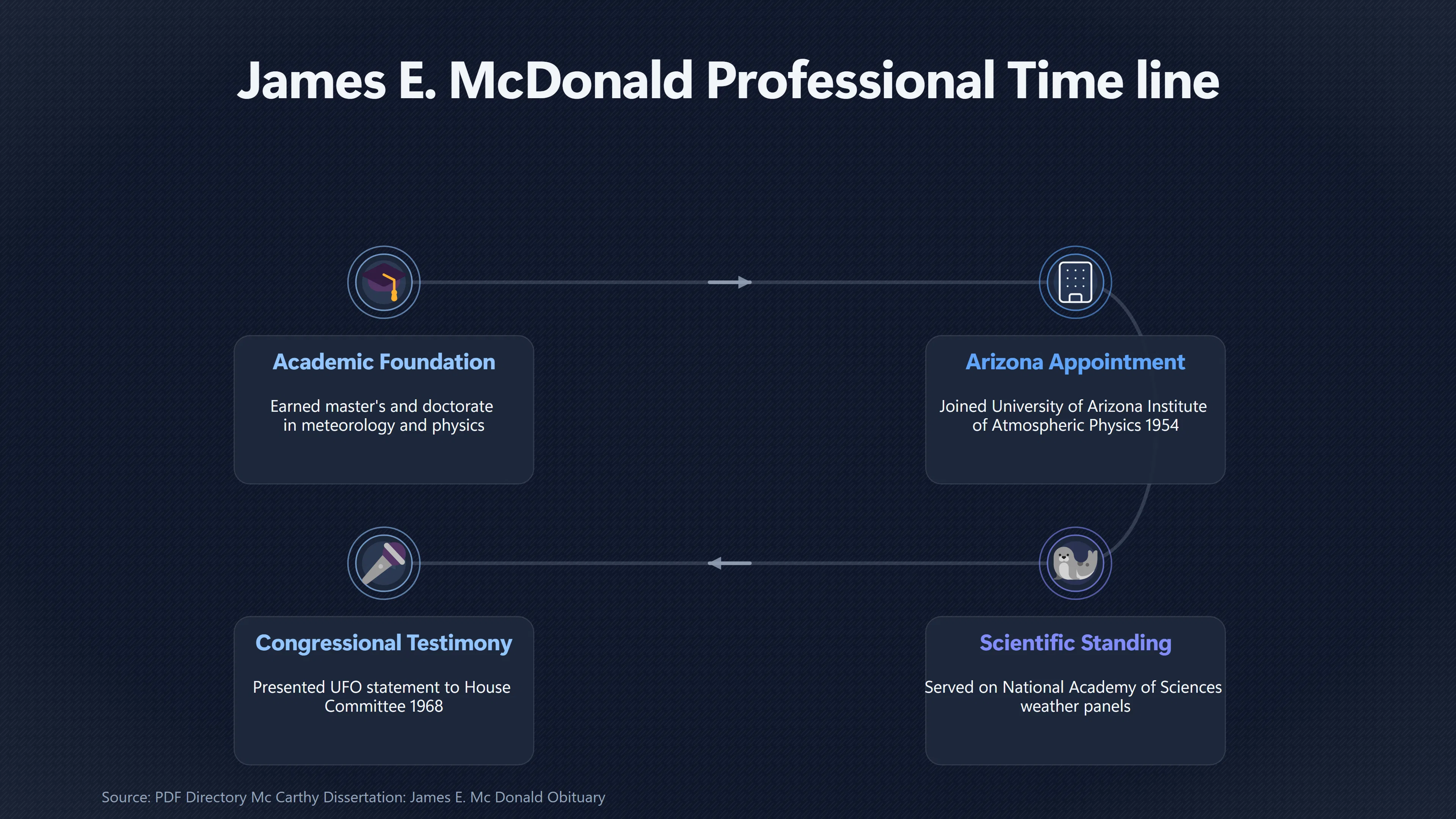
McDonald’s significance depends on understanding what his professional identity looked like before UFO research came to dominate public perceptions of him. He earned a master’s degree in meteorology from the Massachusetts Institute of Technology and a doctorate in physics from Iowa State University. After work at Iowa State and the University of Chicago, he joined the University of Arizona’s Institute of Atmospheric Physics in 1954, initially as associate director. By the late 1950s he was a professor of meteorology and senior physicist at the institute. The American Meteorological Society’s obituary identified him as a Fellow and remembered a substantial career in atmospheric research, teaching and weather modification.[NCAS PDF Directory]files.ncas.orgPDF Directory Mc Carthy Dissertation: James E. Mc Donald ObituaryNCAS PDF DirectoryMcCarthy Dissertation: James E. McDonald Obituary…
His résumé submitted to the House Committee on Science and Astronautics in 1968 makes the point even more clearly. Alongside his University of Arizona posts, McDonald listed membership of the National Academy of Sciences’ Panel on Weather and Climate Modification, the ESSA-Navy Project Stormfury Advisory Panel, the National Science Foundation’s advisory panel for weather modification and the American Meteorological Society’s Commission on Publications. His professional memberships included the AAAS, American Meteorological Society, American Geophysical Union and Royal Meteorological Society.[NICAP]nicap.orgSource details in endnotes.
This makes McDonald a particularly useful case for studying stigma. His scientific legitimacy did not depend on persuading anyone about UFOs. He already possessed the conventional markers of a successful academic scientist. Even after his UFO campaign became highly visible, the University of Arizona retained him as a professor and senior physicist. His case is therefore not a simple story of a fringe researcher being excluded from mainstream science.
The University of Arizona’s surviving archive also demonstrates the scale of his UFO activity. Its James E. McDonald collection contains correspondence, case reports, interviews and other material from his investigations, including exchanges with government officials and researchers and case files involving pilots, air-traffic personnel, police officers, scientists and other witnesses. The archive covers his dealings with both Project Blue Book and the University of Colorado investigation directed by Edward Condon.[University of Arizona Libraries]lib.arizona.eduOpen source on arizona.edu.
UFO advocacy made his scientific judgement part of the argument
McDonald initially framed the UFO question as a failure of investigation rather than simply as a demand that scientists accept extraterrestrial visitation. His central contention was that a small residue of reports from apparently credible observers could not be dismissed merely because most UFO sightings had conventional explanations. In his 1968 congressional statement, he argued that science had treated a potentially important problem as nonsense before investigating it adequately.[NCAS PDF Directory]files.ncas.orgNCAS PDF DirectoryUFO Symposium 1968: McDonald StatementMarch 12, 1968…
He nevertheless went considerably further than scientists who merely wanted better data. By 1967 he was publicly treating an extraterrestrial explanation as a serious — at times, in his judgement, the least unsatisfactory — possibility. The Condon Report itself quoted a 1967 statement in which McDonald said he saw no sensible alternative to the hypothesis that the objects were extraterrestrial probes. Such claims made his position easier for critics to characterise not simply as methodological openness but as belief in alien spacecraft.[NCAS PDF Directory]files.ncas.orgPDF Directory Condon Report, Section IINCAS PDF DirectoryCondon Report, Section II: Summary of the Study…
That distinction became professionally consequential. McDonald was effectively making two arguments at once: that existing investigations were scientifically inadequate, and that the strongest unexplained cases might point towards something genuinely extraordinary. A colleague could agree with the first proposition without accepting the second. The stronger his public statements became, the easier it was for opponents to substitute a debate about McDonald’s judgement for a debate about particular observations.
His campaign was nevertheless conducted in venues that complicate any claim that he had simply been banished from respectable science. Congress heard his lengthy UFO statement in July 1968. The AAAS subsequently held a UFO symposium in December 1969 involving McDonald alongside J. Allen Hynek, Carl Sagan and other scientists representing differing positions. McDonald’s contribution, later published as “Science in Default”, attacked what he regarded as 22 years of inadequate investigation. The symposium proceedings eventually appeared in the Sagan and Thornton Page volume UFO’s: A Scientific Debate.[NCAS PDF Directory]files.ncas.orgNCAS PDF DirectoryUFO Symposium 1968: McDonald StatementMarch 12, 1968…
That is an important corrective to an overly simple persecution narrative. McDonald’s advocacy exposed him to ridicule, but it did not make him literally voiceless. Major scientific and political institutions still gave him platforms. The professional cost lay more subtly in what attachment to the UFO issue could do to perceptions of his judgement.
The Condon dispute put McDonald against the emerging consensus
The University of Colorado study was the decisive institutional backdrop to McDonald’s later UFO advocacy. Its director, physicist Edward Condon, concluded that further extensive study of UFOs was unlikely to advance science and recommended against establishing a government UFO programme on the scale of the Colorado project. Although the report acknowledged that UFO witnesses were generally normal and responsible people, its overall conclusion encouraged scientific institutions to regard the research question as substantially exhausted.[NCAS PDF Directory]files.ncas.orgPDF Directory Condon Report, Section IINCAS PDF DirectoryCondon Report, Section II: Summary of the Study…
McDonald reached almost the opposite conclusion. He argued that the report’s unresolved cases, omissions and investigative weaknesses supported further study rather than closure. In “Science in Default” he concentrated on cases that he believed had not been investigated rigorously enough and challenged fellow scientists to examine the underlying material rather than simply accepting Condon’s conclusion.[Reddit]reddit.comScience in Default: Twenty-Two Years of Inadequate UFO InvestigationsScience in Default: Twenty-Two Years of Inadequate UFO Investigations - James E. McDonald, 1969June 16, 2023…
The disagreement mattered for McDonald’s reputation because the Condon Report gave scepticism an institutional reference point. Once its conclusions were broadly accepted, continuing to argue vigorously for UFO research could appear less like keeping an open scientific question alive and more like rejecting an expert assessment that had already settled it.
Yet McDonald’s position was not wholly excluded from academic discussion. The AAAS symposium itself was evidence of disagreement over whether the subject deserved further scientific attention. Historical analysis of the symposium indicates that McDonald and Hynek represented its more favourable positions towards UFO research, while other participants were considerably more conservative or sceptical. The meeting did not, however, produce a major shift in scientific participation in the subject.[NCAS PDF Directory]files.ncas.orgNCAS PDF DirectoryMcCarthy Dissertation: VI. THE 1969 AAAS UFO SYMPOSIUM…
This combination — access to prestigious forums without conversion of the wider scientific community — is central to understanding McDonald’s predicament. He could still speak as a scientist, but he increasingly spoke from the losing side of an argument over whether UFO investigation was itself a worthwhile scientific enterprise.
The funding controversy shows a more concrete professional vulnerability
McDonald’s UFO work also became entangled with a dispute over research funding. Aviation journalist and UFO sceptic Philip J. Klass questioned the Office of Naval Research (ONR) about how McDonald could devote extensive time to UFO investigation while holding an ONR-supported atmospheric-research contract. Contemporary correspondence reconstructed from the surviving records shows Klass explicitly asking whether the ONR knew about McDonald’s heavy commitment to UFO research when it awarded a cloud-physics grant.[NCAS PDF Directory]files.ncas.orgPDF Directory SHGPDF Directory SHG
This episode is useful because it moves the stigma question beyond vague claims of “ridicule”. Once UFO research intersected with grants, travel and institutional responsibilities, critics had a concrete route through which to challenge McDonald’s professional conduct. McDonald himself anticipated eventually seeking formal support for UFO investigation; surviving correspondence also indicates that some UFO-related activity had become intertwined with research travel and existing funding arrangements.[NCAS PDF Directory]files.ncas.orgPDF Directory SHGPDF Directory SHG
The episode should not be inflated into evidence that McDonald was expelled from academic science or stripped of his university position. He was not. But it demonstrates how a controversial research interest could create additional scrutiny around ordinary professional questions — allocation of time, grant purposes and institutional support — that would matter to any working academic.
It also helps explain why McDonald’s case is stronger evidence for reputational risk than for a centrally organised campaign of scientific suppression. Named critics challenged him, institutional funding questions arose, and his UFO advocacy became inseparable from assessments of his professional judgement. Those mechanisms are visible in surviving records without requiring a hidden explanation.
Congressional ridicule made the reputational cost unmistakable
Perhaps the clearest example came outside a UFO hearing altogether. McDonald opposed the American supersonic transport (SST) programme on atmospheric grounds, warning about possible environmental effects of high-altitude aircraft. In March 1971, Representative Silvio Conte attacked McDonald’s credibility by bringing his UFO views into the SST debate.
The Congressional Record preserves Conte’s argument. After quoting McDonald’s UFO position, Conte asked whether the SST opposition could do no better than a man who spent considerable time discussing “little men flying around the sky”. Significantly, Conte immediately added that he was not saying McDonald lacked qualifications in atmospheric science.[GovInfo]govinfo.govGPO CRECB 1971 pt6 2CONGRESSIONAL RECORD-HOUSE March 18, 1971March 28, 2024…
That qualification makes the episode especially revealing. McDonald’s formal expertise and his reputational credibility could be treated as two different things. His opponent did not need to prove that McDonald’s atmospheric research was incompetent. Association with UFOs supplied a rhetorical shortcut for encouraging an audience to distrust him on another subject.
This is arguably the most concrete evidence of what UFO research cost McDonald’s reputation. The stigma was portable. It could follow him from UFO meetings into an unrelated policy dispute and be used publicly to weaken the authority that normally accompanied his academic position.
It also illustrates why measuring scientific stigma solely by firings, lost degrees or revoked memberships misses much of the phenomenon. A scientist may retain every formal credential while finding that one controversial interest becomes a permanent footnote attached to his credibility. McDonald’s scientific standing survived; his ability to control how that standing was perceived did not remain entirely in his hands.
What McDonald’s case can — and cannot — prove
McDonald’s history supports a fairly strong conclusion about professional stigma. A recognised scientist could investigate UFO reports, remain employed and continue participating in scientific institutions, yet pay a substantial reputational price. His UFO views attracted organised criticism, became entangled with questions about research funding and were eventually used in Congress as grounds for questioning his credibility on an unrelated scientific controversy.[NCAS PDF Directory]files.ncas.orgPDF Directory SHGPDF Directory SHG
It also shows that the boundary of acceptable scientific inquiry was more complicated than a simple prohibition. McDonald testified before Congress, addressed an AAAS symposium and retained his University of Arizona position. His conventional scientific work was sufficiently respected that the American Meteorological Society’s obituary continued to identify him as a Fellow and emphasised his contributions to atmospheric science.[NCAS PDF Directory]files.ncas.orgPDF Directory Mc Carthy Dissertation: James E. Mc Donald ObituaryNCAS PDF DirectoryMcCarthy Dissertation: James E. McDonald Obituary…
The case therefore supports several narrower propositions better than a sweeping one. UFO advocacy could damage perceived scientific judgement; ridicule could migrate into unrelated professional disputes; critics could turn questions about controversial research into questions about grants and credibility; and institutional access did not necessarily protect a scientist from reputational marginalisation.
What it does not establish is that McDonald’s conclusions about UFOs were correct. Professional mistreatment and evidential correctness are separate questions. A scientist can be mocked unfairly and still be mistaken about the phenomenon under investigation. Conversely, the existence of conventional explanations for many UFO reports does not make ridicule a substitute for examining the remaining evidence.
Nor does McDonald’s professional experience establish a covert programme to eliminate UFO researchers. This distinction is particularly important because McDonald died by suicide in June 1971 at the age of 51. Contemporary reporting described the death as an apparent suicide, while the American Meteorological Society recorded his death without suggesting foul play. The University of Arizona’s extensive surviving papers provide a substantial archival record of his work.[NCAS PDF Directory]files.ncas.orgPDF Directory Mc Carthy Dissertation: James E. Mc Donald ObituaryNCAS PDF DirectoryMcCarthy Dissertation: James E. McDonald Obituary…
Within the wider history of claims about suspicious deaths among UFO and unconventional-propulsion researchers, McDonald is consequently a stronger case for documented social and professional pressure than for alleged physical suppression. His life supplies unusually concrete evidence of how scientific stigma worked: not by erasing his qualifications, but by making “the UFO scientist” an identity that opponents could place ahead of “the atmospheric physicist”.
That is ultimately what makes McDonald historically instructive. His experience shows that the relevant question is not simply whether a scientist was permitted to investigate UFOs. He plainly was. The more revealing question is what happened to the value of his scientific reputation once he publicly committed himself to a subject that much of mainstream science had decided was not worth pursuing. On that narrower question, the historical record shows a genuine and sometimes severe reputational cost.
Amazon book picks
Further Reading
Books and field guides related to What UFO Research Cost James Mc Donald's Reputation. Use these as the next step if you want deeper reading beyond the article.
The UFO Experience: A Scientific Inquiry
Cited by the New York Review of Books as "the best brief for visitation," this classic study presents an analysis of UFO reports and conc...
UFOs and Government: A Historical Inquiry
Governments around the world have had to deal with the UFO phenomenon for a good part of a century. How and why they did so is the subjec...
The Demon-Haunted World: Science as a Candle in the Dark
Are we on the brink of a new Dark Age of irrationality and superstition? In this book, the writer shows how scientific thinking is necess...
eBay marketplace picks
Marketplace Samples
Live-tested eBay searches with available results related to this page.
Selected fromUFO poster oneBay.co.uk.
Endnotes
1.
Source: files.ncas.org
Title: PDF Directory Mc Carthy Dissertation: James E. Mc Donald Obituary
Link:https://files.ncas.org/mccarthy/obit.html
Source snippet
NCAS PDF DirectoryMcCarthy Dissertation: James E. [McDonald Obituary]({{ 'mc-donald-f859b7/' | relative_url }})...
2.
Source: nicap.org
Link:https://nicap.org/books/1968Sym/1968_UFO_Symposium.pdf
Source snippet
"NICAP[http://web..."](http://web...")...
3.
Source: lib.arizona.edu
Link:https://lib.arizona.edu/special-collections/collections/james-e-mcdonald-papers
4.
Source: files.ncas.org
Link:https://files.ncas.org/ufosymposium/mcdonald.html
Source snippet
NCAS PDF DirectoryUFO Symposium 1968: McDonald StatementMarch 12, 1968...
Published: March 12, 1968
5.
Source: files.ncas.org
Title: PDF Directory Condon Report, Section II
Link:https://files.ncas.org/condon/text/sec-ii.htm
Source snippet
NCAS PDF DirectoryCondon Report, Section II: Summary of the Study...
6.
Source: files.ncas.org
Link:https://files.ncas.org/mccarthy/chap06.html
Source snippet
NCAS PDF DirectoryMcCarthy Dissertation: VI. THE 1969 AAAS UFO SYMPOSIUM...
7.
Source: reddit.com
Title: Science in Default: Twenty-Two Years of Inadequate UFO Investigations
Link:https://www.reddit.com/r/UFOs/comments/14ah4m7
Source snippet
Science in Default: Twenty-Two Years of Inadequate UFO Investigations - James E. McDonald, 1969June 16, 2023...
Published: June 16, 2023
8.
Source: files.ncas.org
Title: PDF Directory SHG
Link:https://files.ncas.org/mccarthy/chap05.html
9.
Source: govinfo.gov
Title: GPO CRECB 1971 pt6 2
Link:https://www.govinfo.gov/content/pkg/GPO-CRECB-1971-pt6/pdf/GPO-CRECB-1971-pt6-2.pdf
Source snippet
CONGRESSIONAL RECORD-HOUSE March 18, 1971March 28, 2024...
Published: March 18, 1971
10.
Source: news.arizona.edu
Title: look inside special collections veronica reyes escudero
Link:https://news.arizona.edu/employee-news/look-inside-special-collections-veronica-reyes-escudero
11.
Source: lib.arizona.edu
Title: world ufo day july 2
Link:https://lib.arizona.edu/about/news/world-ufo-day-july-2
12.
Source: history.com
Title: u s air force closes the book on ufos 45 years ago
Link:https://www.history.com/articles/u-s-air-force-closes-the-book-on-ufos-45-years-ago
13.
Source: nicap.org
Link:https://www.nicap.org/chronos/1969fullrep.htm
14.
Source: ufos.wiki
Title: James E. Mc Donald
Link:https://ufos.wiki/figure/james-e-mcdonald/
15.
Source: nicap.org
Link:https://www.nicap.org/bluebook/51-69.htm
16.
Source: nicap.org
Link:https://www.nicap.org/crit.htm
17.
Source: nicap.org
Title: hall IUR1994
Link:https://www.nicap.org/papers/hall-IUR1994.htm
18.
Source: nicap.org
Title: UF O Report* Mc Donald, James E., “UFOs
Link:https://www.nicap.org/reports/790827marshallco_clark.htm
19.
Source: files.ncas.org
Link:https://files.ncas.org/condon/text/appndx-a.htm
20.
Source: condon.ncas.org
Link:https://condon.ncas.org/text/intro.htm
21.
Source: condon.ncas.org
Link:https://condon.ncas.org/text/s5chap03.htm
22.
Source: ufo.se
Title: 1042 mcdonald james edward 1920 1971
Link:https://www.ufo.se/index.php/fakta/lexikon/1042-mcdonald-james-edward
23.
Source: ufo.se
Link:https://www.ufo.se/index.php/a
24.
Source: time.com
Title: Investigations: Saucers’ End
Link:https://time.com/archive/6632970/investigations-saucers-end/
25.
Source: files.ncas.org
Link:https://files.ncas.org/condon/text/s5chap02.htm
26.
Source: files.ncas.org
Link:https://files.ncas.org/ufosymposium/ncasintro.html
27.
Source: nicap.org
Link:https://www.nicap.org/mcdonald/McDonaldUN1967Transcript.htm
28.
Source: studylib.net
Title: 1968 ufo symposium
Link:https://studylib.net/doc/7531720/1968_ufo_symposium
Source snippet
UFO Symposium Hearings: Science & Astronautics Committee, 1968...
29.
Source: en.ikwipedia.org
Title: Philip J. Klass
Link:https://en.ikwipedia.org/wiki/Philip_J._Klass
30.
Source: enigmalabs.io
Title: Edward Condon | Enigma Labs
Link:https://enigmalabs.io/library/81c10540-a1df-4b23-8884-59e2721a8e0e
31.
Source: es.scribd.com
Link:https://es.scribd.com/doc/250674675/Sagan
32.
Source: exonews.org
Link:https://exonews.org/tag/j-allen-hynek/
33.
Source: wikizero.org
Title: Carl Sagan
Link:https://www.wikizero.org/wiki/en/Carl_Sagan
34.
Source: daviddarling.info
Link:https://www.daviddarling.info/encyclopedia/U/UFOs.html
35.
Source: dlab.epfl.ch
Title: Carl Sagan
Link:https://dlab.epfl.ch/wikispeedia/wpcd/wp/c/Carl_Sagan.htm
36.
Source: online.pre.education.nsw.gov.au
Title: list Books By Topic
Link:https://online.pre.education.nsw.gov.au/prc/booklist/listBooksByTopic.html?topicId=1
Additional References
37.
Source: youtube.com
Title: World In Action, with Professor James E. Mc Donald & the Condon Committee
Link:https://www.youtube.com/watch?v=ut65ifaenvs
Source snippet
Commentary on the Condon Committee findings with Prof. McDonald & Major Keyhoe...
38.
Source: youtube.com
Title: Keyhoe & Mc Donald Expose Condon UFO Report
Link:https://www.youtube.com/watch?v=Z-GGGJhi7Ko
Source snippet
James E. McDonald UFO atmospheric physicist James E. McDonald: The UFO Scientist Who Wouldn’t Back Down...
39.
Source: nature.com
Link:https://www.nature.com/articles/s42003-024-07267-2
40.
Source: youtube.com
Title: Commentary on the Condon Committee findings with Prof. Mc Donald & Major Keyhoe
Link:https://www.youtube.com/watch?v=EoBQnIxAcyM
Source snippet
Keyhoe & McDonald Expose Condon UFO Report...
41.
Source: nixonlibrary.gov
Link:https://www.nixonlibrary.gov/research/guide-holdings
42.
Source: youtube.com
Title: ‘Science In Default’ by Professor James E. Mc Donald
Link:https://www.youtube.com/watch?v=krMjwsEl0PA
Source snippet
World In Action, with Professor James E. McDonald & the Condon Committee...
43.
Source: youtube.com
Title: James E. Mc Donald: The UFO Scientist Who Wouldn’t Back Down
Link:https://www.youtube.com/watch?v=5gwQqhSS4tk
Source snippet
'Science In Default' by Professor James E. McDonald...
44.
Source: researchgate.net
Link:https://www.researchgate.net/publication/356422234_Extraterrestrial_Ethics
45.
Source: researchgate.net
Link:https://www.researchgate.net/publication/371163445_The_Scientific_Investigation_of_Unidentified_Aerial_Phenomena_UAP_Using_Multimodal_Ground-Based_Observatories
46.
Source: inspiringquotes.us
Link:https://www.inspiringquotes.us/author/8861-james-e-mcdonald