Within Peer Review
Did Li and Torr Really Publish Antigravity?
The published papers proposed subtle gravity-superconductor couplings, not a demonstrated device that reduced weight or produced repulsive gravity.
On this page
- What the 1991 and 1992 papers actually claimed
- How theoretical field coupling became an antigravity story
- Which dramatic claims the papers never demonstrated
Page outline Jump by section
Introduction
Ning Li and Douglas G. Torr did publish serious, peer-reviewed papers about gravity and superconductors. They did not, in their 1991 and 1992 papers, report a working antigravity machine, demonstrate that a superconductor lost weight, or show that gravity could be screened or reversed. What they published was much narrower: theoretical calculations asking how the extremely weak gravitomagnetic effects associated with general relativity might couple to electromagnetic behaviour inside an idealised superconductor.[Physical Review Journals]1991:Open source on aps.org.
That distinction matters because Li’s later reputation in UFO and antigravity literature often works backwards. Later ideas about gravity generation, spinning superconductors and anomalous weight measurements are projected onto the earlier papers, turning mathematical field couplings into an already-achieved technological breakthrough. Contemporary and later popular accounts helped make that leap attractive, while subsequent technical criticism and experimental limits made the scientific picture considerably less dramatic.[WIRED]wired.comantigravityWIREDBreaking the Law of Gravity | WIREDMarch 1, 1998
What the 1991 and 1992 papers actually claimed
The first key paper was Li and Torr’s January 1991 article, “Effects of a gravitomagnetic field on pure superconductors”, in Physical Review D. Gravitomagnetism is a weak-field consequence of general relativity in which moving or rotating mass produces effects that can be described, under certain approximations, with equations resembling those of magnetism. The resemblance is mathematically useful, but a gravitomagnetic field is not an ordinary magnetic field and its existence does not imply a means of cancelling Earth’s gravitational attraction.
Li and Torr considered what would happen when external magnetic and gravitomagnetic fields interacted with an idealised pure superconductor. Their calculation produced coupled internal fields: an applied magnetic field could be accompanied by a tiny gravitomagnetic perturbation, while an applied gravitomagnetic field could contribute to the electromagnetic response. The authors described a small residual magnetic field and mutually induced perturbation fields inside the material.[Physical Review Journals]1991:Open source on aps.org.
That is a substantially different claim from “a superconductor produces antigravity”. The 1991 article concerned the internal response of a superconductor to fields in a theoretical model. Its abstract did not report a rotating disc, a measured weight reduction, levitation caused by modified gravity, a propulsion experiment or a gravitational force pointing away from the Earth.[Physical Review Journals]1991:Open source on aps.org.
The September 1992 Physical Review B paper, “Gravitational effects on the magnetic attenuation of superconductors”, extended the programme. Li and Torr examined two standard idealisations of superconductivity: perfect electrical conductivity and perfect diamagnetism, the latter associated with expulsion of magnetic flux in the Meissner effect. Their model suggested that, once gravitational terms were included, these properties could be related through a conductivity-permeability treatment. Their abstract concluded cautiously that the result suggested the “possible importance” of gravitational effects for understanding superconductivity.[Physical Review Journals]aps.orgPhysical Review Journals Gravitational effects on the magnetic attenuation of superconductors | Phys. Rev. BPhysical Review Journals Gravitational effects on the magnetic attenuation of superconductors | Phys. Rev. B
Again, what is striking is what the paper did not claim. Its published abstract does not announce gravitational shielding, loss of weight, reactionless propulsion or a practical antigravity generator. It presents a theoretical relationship involving gravitational corrections to superconducting electrodynamics. Calling that an “antigravity paper” may be convenient shorthand for the broader research programme, but it gives a misleading impression of what the actual article established.
There is nevertheless a reason the work attracted attention. Ordinary gravitomagnetic effects are extraordinarily weak, so any credible mechanism by which coherent quantum matter could amplify their observable consequences would be scientifically interesting. Li and Torr were exploring precisely that possibility. The legitimate scientific question was therefore unusual and ambitious; the mistake in many retellings is converting “could superconductivity make a gravitational coupling unusually important?” into “superconductivity has been shown to cancel gravity.”

How field coupling became an antigravity story
The transition was gradual rather than the result of a single misquotation. Li and Torr’s research programme moved from relatively restrained calculations about coupled fields towards more provocative questions about whether superconducting coherence could produce observable gravitational effects. Their 1993 paper, “Gravitoelectric-electric coupling via superconductivity”, in Foundations of Physics Letters, explicitly continued the 1991–92 line of work. Its references include both earlier Li–Torr papers alongside literature on gravitation, superconductivity and quantum effects.[Ouci]dntb.gov.uaOuci Gravitoelectric-electric coupling via superconductivityOuci Gravitoelectric-electric coupling via superconductivity
This created fertile ground for a linguistic shortcut. “Gravitoelectric”, “gravitomagnetic”, “coupling”, “superconductivity” and “field generation” are technical terms, but outside specialist physics they readily become “gravity control”. Gravity control, in turn, becomes “antigravity”. Once that translation is made, the existence of peer-reviewed papers can appear to authenticate a much stronger proposition than referees actually assessed.
A second ingredient was the emergence during the 1990s of claims by Eugene Podkletnov concerning apparent weight reductions above superconducting apparatus. The stories were easily combined because both involved superconductors and gravity, even though a theoretical coupling calculation and an experimental claim of gravitational shielding are not equivalent evidence. A 1998 Wired feature illustrates how closely the subjects became linked in popular coverage, describing Li and Torr as having predicted that superconductors could affect gravity before discussing Podkletnov’s claimed observations.[WIRED]wired.comantigravityWIREDBreaking the Law of Gravity | WIREDMarch 1, 1998
The same article also shows how powerful the word “antigravity” could be in transforming a technical dispute. In its account of Podkletnov, Wired noted that newspaper coverage had called his apparatus the world’s first “antigravity device”, although Podkletnov himself distinguished his alleged gravitational shielding from antigravity. That episode is useful for reading the Li story because it demonstrates the broader media environment in which several technically distinct ideas — gravitational shielding, gravitomagnetism, anomalous weight changes and artificial gravity — were being compressed into one memorable category.[WIRED]wired.comantigravityWIREDBreaking the Law of Gravity | WIREDMarch 1, 1998
By 1999, Discover-style popular coverage could present Li working with a spinning superconducting disc and introduce the subject under the banner of “antigravity devices”. This was a later stage of the research story, not a description of what had experimentally occurred in the 1991 Physical Review D paper.[Taming Gravity]taminggravity.comTaming Gravity Zero GravityTaming GravityZero Gravity - Antigravity devices…
The chronology therefore matters:

-
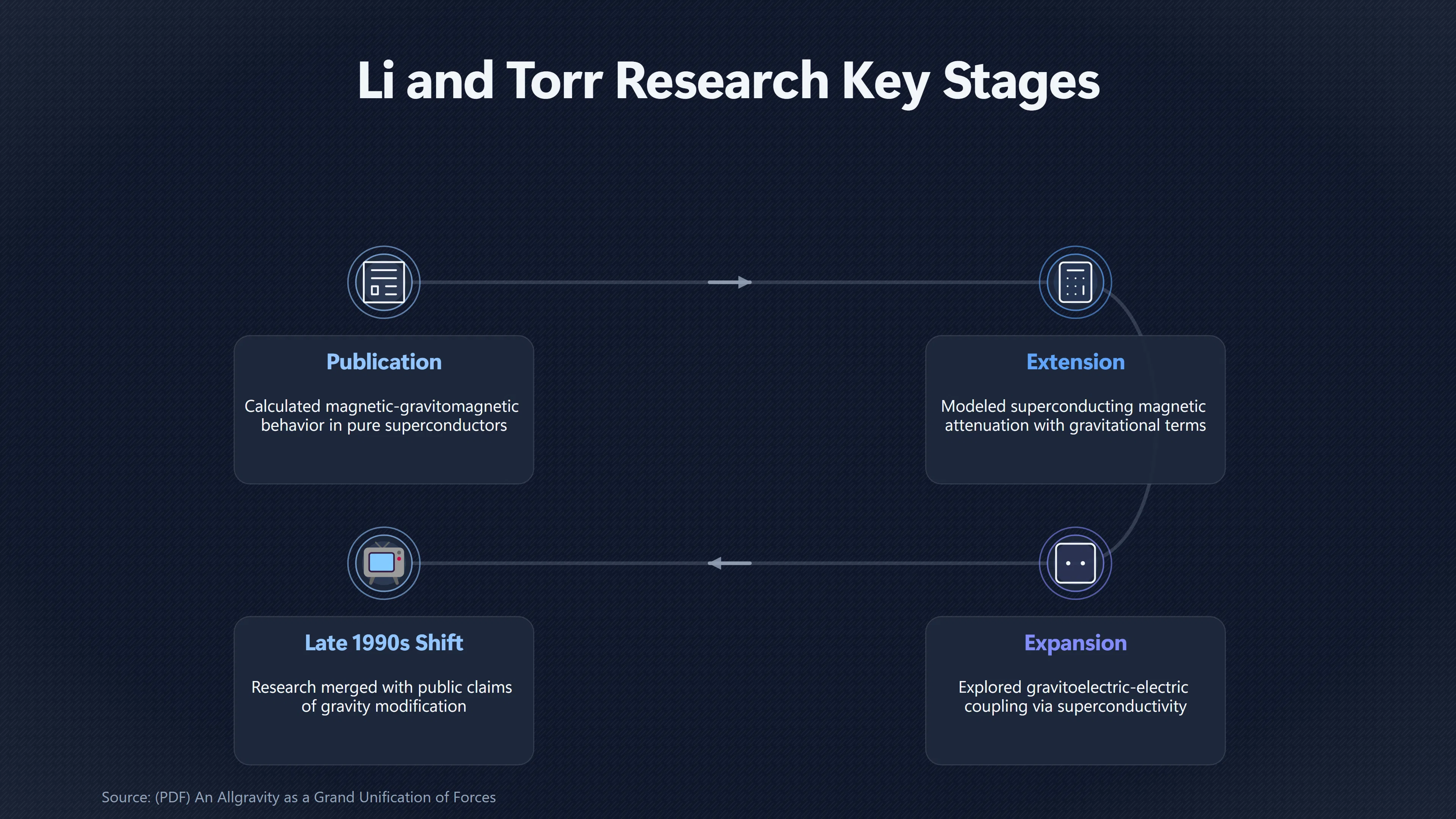
1991: Li and Torr theoretically calculated magnetic–gravitomagnetic behaviour inside a pure superconductor. Physical Review Journals
-
1992: they developed a theoretical model connecting superconducting magnetic attenuation with gravitational terms. Physical Review Journals
-
1993: they extended the programme to gravitoelectric–electric coupling through superconductivity. Ouci
-
Later 1990s: superconducting-gravity research became entangled publicly with claimed anomalous-weight experiments and increasingly explicit discussion of gravity modification. WIRED
Collapsing those stages into “Li published peer-reviewed proof of antigravity in 1991” removes exactly the distinctions needed to judge the evidence.
The technical criticism was part of the peer-reviewed record too
Another distortion occurs when the peer-reviewed status of Li and Torr’s papers is treated as though it settled the underlying physics. Peer review put their calculations into the scientific literature; it did not make their assumptions immune from challenge.
Mark Kowitt directly addressed their work in the 1994 Physical Review B paper “Gravitomagnetism and magnetic permeability in superconductors”. Later technical summaries describe his central objection as a problem with using the near-zero macroscopic magnetic permeability associated with superconducting behaviour in the way required to obtain Li and Torr’s large predicted gravitomagnetic effects. PubMed
The dispute did not simply end there. Later reviews note arguments defending aspects of the Li–Torr treatment, showing that this was an actual technical controversy rather than a clean one-paper debunking. But another criticism, attributed to E. G. Harris’s 1999 comment on the 1993 gravitoelectric paper, challenged the magnitude of the predicted effect on different grounds. A later US Defense Intelligence Reference Document reviewing superconductors and gravity summarised Harris’s argument as reducing the estimated external gravitoelectric effect by roughly 20 orders of magnitude after correcting the distance scale used in the calculation. UFO Transparency
That enormous difference is particularly important when assessing antigravity retellings. The central scientific dispute was not whether somebody had secretly watched a machine float. It concerned whether mathematical assumptions in a proposed coupling model had enormously exaggerated a gravitational effect that conventional physics would otherwise predict to be minute.
Later specialist literature continued to describe the Li–Torr results as disputed rather than established. A 2005 Physica C paper discussing gravitational-wave interactions with superconductors explicitly noted that both Kowitt and Harris had argued against the credibility of Li and Torr’s estimates, while also discussing why questions about microscopic versus macroscopic permeability remained relevant to the theoretical debate. ScienceDirect
This is a useful corrective to a common appeal to authority. “Published in Physical Review” is meaningful: these were not anonymous internet claims. But the scientifically appropriate next question is, what happened to the claim after publication? In this case, other researchers scrutinised the assumptions and disputed the predicted magnitude. That continuing criticism belongs to the same scientific record as the original papers.
The later experiment did not demonstrate weight loss
The clearest check against retrospective exaggeration came from work involving Li herself. In 1997, Ning Li, David Noever, Tony Robertson, Ron Koczor and Whitt Brantley published “Static test for a gravitational force coupled to type II YBCO superconductors” in Physica C. YBCO, or yttrium barium copper oxide, is a high-temperature superconductor. The study explicitly investigated proposed gravity–superconductor coupling using sensitive gravimetric measurements. ScienceDirect
The experiment is especially valuable because its result was a limit, not an antigravity detection. With bulk YBCO superconductors magnetically levitated, the researchers found changes in acceleration smaller than two parts in 108 of ordinary gravitational acceleration. They concluded that this placed new constraints on the strength and range of a proposed coupling between static superconductors and gravity. NASA’s technical-record entry describes the publication in the same terms. ScienceDirect
That result does not settle every conceivable experiment involving rotating or dynamically driven superconductors; the test was explicitly static. But it does rule out portraying Li’s published experimental record as a straightforward progression from theoretical prediction to demonstrated gravitational shielding. When Li participated in a sensitive published test of a static effect, the team reported no large anomalous gravitational acceleration.
This distinction is particularly relevant to later stories in which Li’s early papers are treated as documentary proof that she had already discovered a practical technology before disappearing from public view. Whatever later research she pursued, the accessible peer-reviewed sequence does not contain the missing middle step such a narrative requires: a replicated experiment showing a macroscopic repulsive gravitational force.
What the papers never demonstrated
Read together, the publications support a much more precise set of statements than “Ning Li invented antigravity”. Li and Torr genuinely investigated unconventional gravitational consequences of superconductivity; their calculations were published in established physics journals; the predicted magnitude and interpretation of the effects became technically disputed; and later experimental work involving Li imposed a strong limit on one static superconducting-gravity anomaly. ScienceDirect+3Physical Review Journals+3Physical Review Journals
The 1991 and 1992 papers themselves did not demonstrate:
- an object becoming measurably lighter because of superconductivity;
- gravitational shielding between the Earth and a test mass;
- reversal of Earth’s gravitational attraction;
- a self-contained source of repulsive gravity;
- thrust or propulsion without conventional reaction mass;
- a flying or hovering antigravity vehicle;
- experimental confirmation of their theoretical coupling at technologically useful strength;
- or evidence that UFO-like craft operated using the proposed physics.
Those distinctions do not make the original research uninteresting. They make it easier to see what was genuinely unusual about it. Li and Torr were asking whether collective quantum behaviour in superconductors could alter the observable consequences of weak gravitational couplings. That was sufficiently concrete to generate equations, peer-reviewed publications, criticism and experiments. It was also sufficiently speculative that its predicted magnitude remained open to serious challenge. ResearchGate
For the wider history of controversial gravity research, this case is therefore more revealing as an example of claim inflation than as evidence of a suppressed antigravity breakthrough. There is a real scientific core beneath the legend, which is precisely why the legend is persuasive. But the strongest documentary evidence is the papers themselves, and those papers draw a clear boundary: theoretical gravity–superconductor coupling is not the same thing as experimentally demonstrated antigravity.
Amazon book picks
Further Reading
Books and field guides related to Did Li and Torr Really Publish Antigravity?. Use these as the next step if you want deeper reading beyond the article.
The Demon-Haunted World: Science as a Candle in the Dark
Rating: 4.5/5 from 43 Google Books ratings
NEW YORK TIMES BESTSELLER • From the renowned astronomer and author of Cosmos comes a “powerful [and] stirring defense of informed ration...
The Skeptics' Guide to the Universe
An all-encompassing guide to skeptical thinking from podcast host and academic neurologist at Yale University School of Medicine Steven N...
eBay marketplace picks
Marketplace Samples
Live-tested eBay searches with available results related to this page.
Selected fromantigravity poster oneBay.co.uk.

Related eBay result
Anti Gravity Machine Framed Wall Art Poster Canvas Print Picture
Related eBay result
Antigravity pen 1965 Framed Wall Art Poster Canvas Print Picture


Endnotes
2.
Source: sciencedirect.com
Link:https://www.sciencedirect.com/science/article/pii/S0921453497014627
Source snippet
Static test for a gravitational force coupled to type II YBCO superconductors - ScienceDirect...
3.
Source: researchgate.net
Link:https://www.researchgate.net/publication/298460654_Gravity-Superconductors_interactions_Theory_and_experiment
4.
Source: sciencedirect.com
Link:https://www.sciencedirect.com/science/article/abs/pii/S0921453405007458
5.
Source: ntrs.nasa.gov
Link:https://ntrs.nasa.gov/search.jsp?R=19990039542
6.
Source: researchgate.net
Link:https://www.researchgate.net/publication/403975508_Unified_Classical_Resonance_Cosmology_UCRC_20_A_fully_classical_scale-invariant_wave-mechanical_framework_invoking_no_quantum_postulates
7.
Source: pod.wave.co
Link:https://pod.wave.co/podcast/american-alchemy/top-nasa-scientist-shows-me-antigravity-proof-shocking-result-revealed
8.
Source: researchgate.net
Link:https://www.researchgate.net/publication/365579617_Superconductor_Meissner_Effects_for_Gravito-Electromagnetic_Fields_in_Harmonic_Coordinates_Due_to_Non-Relativistic_Gravitational_Sources
9.
Source: researchgate.net
Title: (PDF) An Allgravity as a Grand Unification of Forces
Link:https://www.researchgate.net/publication/354776340_An_Allgravity_as_a_Grand_Unification_of_Forces
10.
Source: researchgate.net
Link:https://www.researchgate.net/publication/354521867_A_simple_investigation_of_Static_test_for_a_gravitational_force_coupled_to_type_II_YBCO_superconductors_by_Li_and_coworkers
11.
Source: researchgate.net
Link:https://www.researchgate.net/publication/319672551_Theoretical_Study_of_Anomalous_Forces_Externally_Induced_by_Superconductors
12.
Source: researchgate.net
Link:https://www.researchgate.net/publication/312593700_THE_PROBLEM_OF_FINDING_OF_EIGENVECTORS_FOR_4P-SH-SAW_PROPAGATION_IN_6_mm_MEDIA
13.
Source: researchgate.net
Title: (PDF) On the possibility of strong coupling between electricity and gravitation
Link:https://www.researchgate.net/publication/287041399_On_the_possibility_of_strong_coupling_between_electricity_and_gravitation
14.
Source: researchgate.net
Title: (PDF) Gravity-Superconductors Interactions: Historical Background
Link:https://www.researchgate.net/publication/281439915_Gravity-Superconductors_Interactions_Historical_Background
15.
Source: researchgate.net
Title: 263885183 GRAVITOMAGNETISM IN SUPERCONDUCTORS AND COMPACT STARS
Link:https://www.researchgate.net/publication/263885183_GRAVITOMAGNETISM_IN_SUPERCONDUCTORS_AND_COMPACT_STARS
16.
Source: researchgate.net
Title: 259308236 A novel variable focus lens for HFGW
Link:https://www.researchgate.net/publication/259308236_A_novel_variable-focus_lens_for_HFGW
17.
Source: researchgate.net
Link:https://www.researchgate.net/publication/257331914_Manipulation_of_gravitational_waves_for_communications_applications_using_superconductors
18.
Source: researchgate.net
Link:https://www.researchgate.net/publication/228616053_Gravitational_Wave_Generation_and_Detection_Using_Acoustic_Resonators_and_Coupled_Resonance_Chambers
19.
Source: researchgate.net
Title: (PDF) On the Mechanism for a Gravity Effect using Type II Superconductors
Link:https://www.researchgate.net/publication/383610375_On_the_Mechanism_for_a_Gravity_Effect_using_Type_II_Superconductors
20.
Source: wired.com
Title: rants raves 63
Link:https://www.wired.com/1998/07/rants-raves-63/
21.
Source: wired.com
Title: rants raves 23
Link:https://www.wired.com/1998/06/rants-raves-23/
22.
Source: wired.com
Link:https://www.wired.com/sitemap/1998/3/1/
23.
Source: sciencedirect.com
Link:https://www.sciencedirect.com/journal/physica-c-superconductivity-and-its-applications/vol/281/issue/2
24.
Source: sciencedirect.com
Title: Static test for a gravitational force coupled to type II YBCO superconductors
Link:https://www.sciencedirect.com/science/article/abs/pii/S0921453497014627
25.
Source: sciencedirect.com
Title: Reverse Engineering Podkletnov’s Experiments
Link:https://www.sciencedirect.com/science/article/pii/S1875389211005803
26.
Source: sciencedirect.com
Link:https://www.sciencedirect.com/science/article/pii/S2211379721008834
27.
Source: sciencedirect.com
Link:https://www.sciencedirect.com/topics/physics-and-astronomy/corotation
28.
Source: wired.com
Link:https://www.wired.com/author/charles-platt/?page=2
29.
Source: researchgate.net
Link:https://www.researchgate.net/publication/386695026_Superconductor_in_a_weak_static_gravitational_field
30.
Source: researchgate.net
Link:https://www.researchgate.net/publication/277311313_Gravitoelectromagnetic_Theories_and_Their_Applications_to_Advanced_Science_and_Technology
31.
Source: researchgate.net
Link:https://www.researchgate.net/publication/234969235_Review_of_Claims_of_Interaction_Between_Gravitation_and_High-Temperature_Superconductors
32.
Source: researchgate.net
Link:https://www.researchgate.net/publication/402834861Unified_Classical_Resonance_Model_UCRM_Resonant_Plasmoids_Bio-ELFPsionics_Sixth_Oscillator_Remote_ViewingESP_Anomalous_Cognition_Gravity_Control_and_Zero-Point_Energy_Rectification-_The_MC-BE-CIRE_Hy/download
33.
Source: researchgate.net
Link:https://www.researchgate.net/publication/1971465_Gravitomagnetic_Fields_in_Rotating_Superconductors_to_Solve_Tate%27s_Cooper_Pair_Mass_Anomaly
34.
Source: researchgate.net
Link:https://www.researchgate.net/publication/234969415_Testing_the_Li-Torr-Chiao_conjecture_A_novel_HFGW_detector
35.
Source: researchgate.net
Title: (PDF) Review of Electrogravitics & Electrokinetics Propulsion View Show
Link:https://www.researchgate.net/publication/275336156_Review_of_Electrogravitics_Electrokinetics_Propulsion
36.
Source: researchgate.net
Link:https://www.researchgate.net/publication/387798044_Gravitational_Communication_Fundamentals_State-of-the-Art_and_Future_Vision
37.
Source: youtube.com
Title: NASA Anti-Gravity Files Revealed: The Ning Li Story
Link:https://www.youtube.com/watch?v=ADUHLhrmEys
Source snippet
Eugene Podkletnov - 2020 Gravity Modification Research...
38.
Source: youtube.com
Title: Eugene Podkletnov
Link:https://www.youtube.com/watch?v=hNGFu_hKUng
Source snippet
Superconductors & Gravity Control | Gary Stephenson...
41.
Source: pubmed.ncbi.nlm.nih.gov
Title: Pub Med Effects of a gravitomagnetic field on pure superconductors
Link:https://pubmed.ncbi.nlm.nih.gov/10013404/
Source snippet
Effects of a gravitomagnetic field on pure superconductors - PubMed...
42.
Source: pubmed.ncbi.nlm.nih.gov
Title: Pub Med Gravitational effects on the magnetic attenuation of superconductors
Link:https://pubmed.ncbi.nlm.nih.gov/10004334/
Source snippet
Gravitational effects on the magnetic attenuation of superconductors - PubMed...
44.
Source: taminggravity.com
Title: Taming Gravity Zero Gravity
Link:https://taminggravity.com/archive/archive-zero-gravity-antigravity-devices-discover/
Source snippet
Taming GravityZero Gravity - Antigravity devices...
45.
Source: pubmed.ncbi.nlm.nih.gov
Title: Pub Med Gravitomagnetism and magnetic permeability in superconductors
Link:https://pubmed.ncbi.nlm.nih.gov/10009347
Source snippet
Gravitomagnetism and magnetic permeability in superconductors - PubMedJanuary 1, 1994...
Published: January 1, 1994
46.
Source: ufotransparency.com
Link:https://ufotransparency.com/files/decade-2020s-aatip-dird-documents-2018-2019-dird-14-dird-the-role-of-superconductors-in-gravity-rese
47.
Source: taminggravity.com
Title: Gravity Propulsion: Harnessing Artificial Gravity for Effortless Travel
Link:https://taminggravity.com/gravity-propulsion-harnessing-artificial-gravity-for-effortless-travel/
48.
Source: taminggravity.com
Title: The Unstoppable Inspiration of Dr. Ning Li (RIP)
Link:https://taminggravity.com/the-unstoppable-inspiration-of-dr-ning-li-rip/
49.
Source: taminggravity.com
Title: Taming Gravity Followup
Link:https://taminggravity.com/taming-gravity-followup/
50.
Source: archive.ph
Link:https://archive.ph/O3Pgg
51.
Source: inspirehep.net
Title: Superconductors and Gravity
Link:https://inspirehep.net/literature/2054233
52.
Source: mdpi.com
Title: Superconductors and Gravity
Link:https://www.mdpi.com/2073-8994/14/3/554
53.
Source: pmc.ncbi.nlm.nih.gov
Link:https://pmc.ncbi.nlm.nih.gov/articles/PMC7915057/
54.
Source: shroomery.org
Title: Taming Gravity
Link:https://www.shroomery.org/forums/showflat.php/Number/18327190
55.
Source: jzalter4u.wordpress.com
Title: taming gravity archive
Link:https://jzalter4u.wordpress.com/2011/07/08/taming-gravity-archive/
56.
Source: pmc.ncbi.nlm.nih.gov
Link:https://pmc.ncbi.nlm.nih.gov/articles/PMC5253913/
57.
Source: zamandayolculuk.com
Link:https://www.zamandayolculuk.com/html-3/electrostatic_propulsion.htm
59.
Source: taminggravity.com
Title: Archive: “Breaking the Law of Gravity” – By Charles Platt – Wired
Link:https://taminggravity.com/archive/archive-breaking-the-law-of-gravity-by-charles-platt-wired/
60.
Source: journals.aps.org
Link:https://journals.aps.org/prb/issues/49/1
61.
Source: journals.aps.org
Link:https://journals.aps.org/prb/issues/46/9
62.
Source: journals.aps.org
Link:https://journals.aps.org/prd/issues/43/2
63.
Source: deepdyve.com
Link:https://www.deepdyve.com/lp/american-physical-society-aps/effects-of-a-gravitomagnetic-field-on-pure-superconductors-6alMKHnwD6
64.
Source: link.aps.org
Title: Phys Rev D.43.457
Link:https://link.aps.org/doi/10.1103/PhysRevD.43.457
65.
Source: journals.aps.org
Link:https://journals.aps.org/prb/recent?ei=ntuwkjqa&page=8577
66.
Source: ufotransparency.com
Link:https://ufotransparency.com/files/all
67.
Source: uapmurders.com
Link:https://uapmurders.com/uaps/Details/Ning_Li/
68.
Source: jzalter4u.wordpress.com
Title: taming gravity follow up
Link:https://jzalter4u.wordpress.com/2007/11/18/taming-gravity-follow-up/
69.
Source: ouci.dntb.gov.ua
Link:https://ouci.dntb.gov.ua/en/works/4OrJ6Gq7/
70.
Source: ouci.dntb.gov.ua
Link:https://ouci.dntb.gov.ua/en/works/7AK8N5wl/
71.
Source: taminggravity.com
Link:https://taminggravity.com/news-archive/archive/
72.
Source: taminggravity.com
Title: taming gravity review
Link:https://taminggravity.com/taming-gravity-review/
73.
Source: taminggravity.com
Title: Popular Archives
Link:https://taminggravity.com/category/popular/
74.
Source: taminggravity.com
Link:https://taminggravity.com/taming-gravity-ecology/
75.
Source: wikidata.org
Title: Gravitoelectric-electric coupling via superconductivity
Link:https://www.wikidata.org/wiki/Q55922207
76.
Source: inspirehep.net
Link:https://inspirehep.net/literature/1359113
77.
Source: science.gov
Link:https://www.science.gov/topicpages/p/physicists%2Bdefence%2Bresearch
78.
Source: thelivingmoon.com
Title: Taming Gravity
Link:https://thelivingmoon.com/41pegasus/02documents/Taming_Gravity.html
Additional References
79.
Source: osti.gov
Link:https://www.osti.gov/biblio/5986002
Source snippet
Effects of a gravitomagnetic field on pure superconductors (Journal Article) | OSTI.GOV...
80.
Source: youtube.com
Title: Superconductors & Gravity Control | Gary Stephenson
Link:https://www.youtube.com/watch?v=msrhrssRmCE
Source snippet
[Ning Li antigravity]({{ 'li-s-experiments/' | relative_url }}) superconductor physics The Scientist That "Discovered Antigravity" Then Disappeared Completely - An Unsolved Mystery...
81.
Source: youtube.com
Title: The Scientist That “Discovered Antigravity” Then Disappeared Completely
Link:https://www.youtube.com/watch?v=eS_rEzKdzBA
Source snippet
The disappearance of America's leading anti-gravity researcher...
82.
Source: shinysideout.com.au
Link:https://www.shinysideout.com.au/13-ning-li.html
83.
Source: facebook.com
Link:https://www.facebook.com/NTDLifeOfficial/posts/anti-gravity-researcher-speaks-on-scientist-death-case/1304416865207129/
84.
Source: reddit.com
Link:https://www.reddit.com/r/Physics/comments/dxamb/bbc_news_sciencenature_boeing_tries_to_defy/
85.
Source: deepdyve.com
Link:https://www.deepdyve.com/lp/springer-journals/comments-on-gravitoelectric-electric-coupling-via-superconductivity-by-2QiSKtiNoe
86.
Source: scribd.com
Link:https://www.scribd.com/document/979635932/FOIA-00159-2018
87.
Source: locationsunknown.org
Link:https://locationsunknown.org/foia-reading-room/the-deep-end/ufos-aliens/defense-intelligence-reference-documents
88.
Source: reddit.com
Link:https://www.reddit.com/r/UFOs/comments/1gp23io/did_garry_nolan_tie_a_patent_that_matches_the_ufo/