Within Motive Evidence
Was the Research Important Enough to Threaten Anyone?
Claims of motive grow stronger when the disputed work produced valuable results, sensitive data, intellectual property or a concrete pending release.
On this page
- Working results versus ambitious claims
- Patents contracts publications and sensitive data
- What would make the stakes visible to an adversary
Page outline Jump by section
Introduction
In claims that UFO, unconventional-propulsion or antigravity researchers were deliberately silenced, the importance of the research is often treated as self-evident: if gravity control, reactionless propulsion or a revolutionary energy source really worked, powerful interests would surely want it controlled. That reasoning establishes a conceivable motive, but not yet a credible one.
The suppression hypothesis becomes materially stronger only when there is evidence that the researcher possessed something consequential and transferable: a reproducible experimental effect, a prototype, technically specific data, valuable intellectual property, a defence contract, or results approaching publication or disclosure. It becomes stronger again if records show that an identifiable organisation knew what the researcher possessed and took steps to control access to it. Real national-security systems do restrict genuinely sensitive research and inventions, through classification, contractual controls, export regulation and patent-secrecy procedures.[gov.uk]GOV.UKDefence research security23, 2026…
That provides a useful test for alleged suspicious deaths. The relevant question is not simply, “Would antigravity be important?” Obviously it would. The question is: had this particular researcher advanced far enough that another actor had something concrete to protect, acquire or prevent from becoming public?
Working results matter more than ambitious claims
There is an enormous evidential difference between researching a potentially revolutionary idea and possessing a revolutionary result. This distinction is especially important in antigravity research because the field contains projects spanning everything from peer-reviewed theoretical physics to extraordinary performance claims that have never been independently reproduced.
NASA’s Breakthrough Propulsion Physics programme illustrates the distinction. Established in 1996, it deliberately investigated subjects such as gravity-electromagnetism coupling, propellantless propulsion, vacuum-energy concepts, warp drives and wormholes. Yet NASA’s stated emphasis was on finding credible, affordable experiments capable of making measurable progress precisely because the ultimate propulsion goals were regarded as far from practical realisation.[NASA Technical Reports Server]ntrs.nasa.govTechnical Reports Server NASA Breakthrough Propulsion Physics ProgramNASA Technical Reports ServerNASA Breakthrough Propulsion Physics Program - NASA Technical Reports Server (NTRS)June 1, 1998… The mere fact that a government laboratory studies an extraordinary concept therefore does not establish that the concept works, much less that it has become strategically disruptive.
The controversy around Eugene Podkletnov’s superconducting “gravity shielding” claims makes the same point more sharply. His reported weight reductions attracted enough interest to enter serious aerospace discussion; in 2002, The Guardian, reporting on a Jane’s Defence Weekly story, noted Boeing’s interest in gravity research through its Phantom Works operation.[The Guardian]theguardian.comThe Guardian Gravity | Space | The GuardianThe GuardianGravity | Space | The GuardianJuly 29, 2002… But interest is not validation. NASA’s own public explanation later stressed that independent scientists had not successfully replicated Podkletnov’s claimed effect and consequently regarded it with considerable scepticism.[Cosmicopia]cosmicopia.gsfc.nasa.govCosmicopia NASA's Cosmicopia – Ask UsNASA's Cosmicopia – Ask Us - General Physics - GravityMarch 6, 2007…
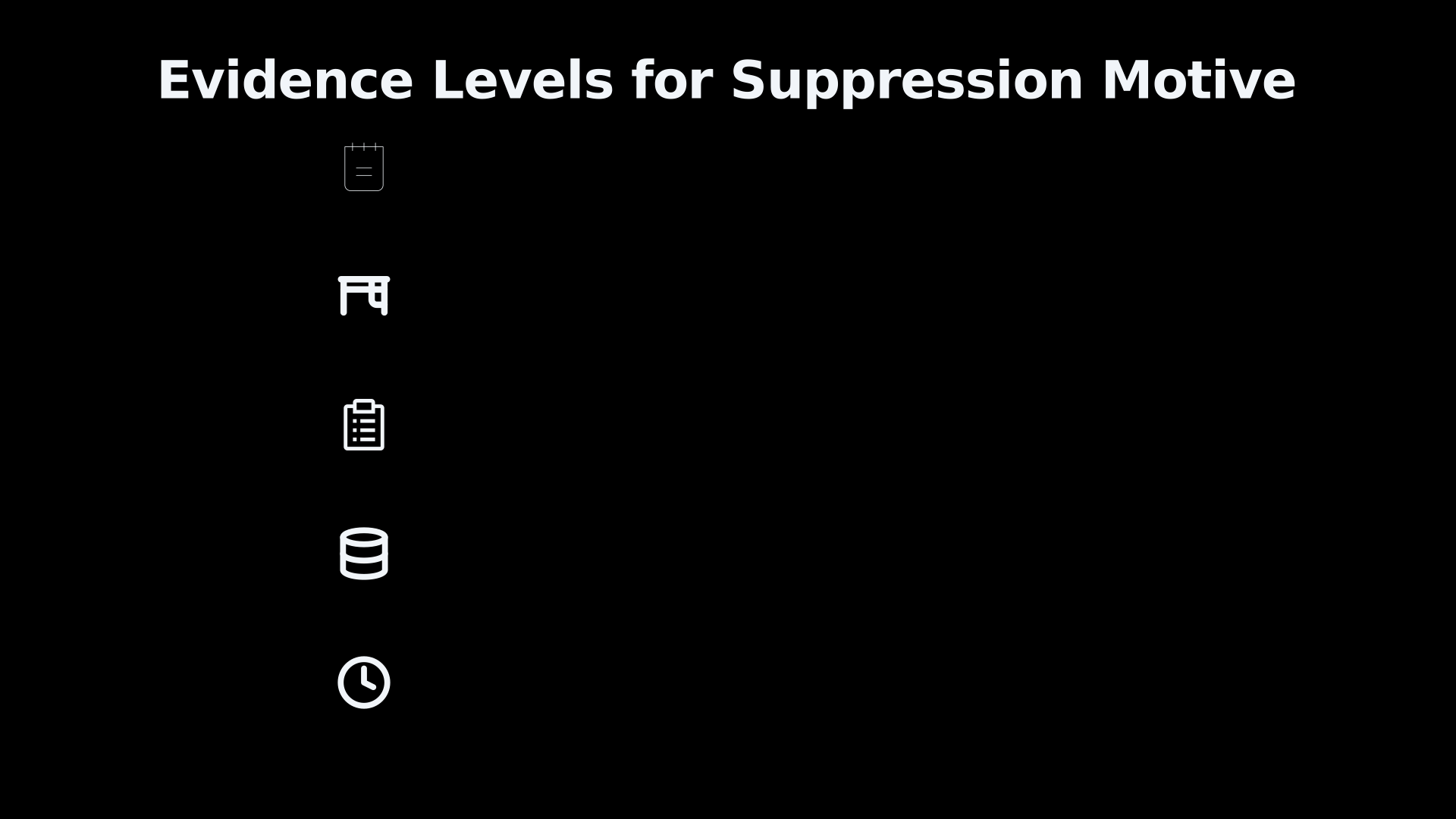
For a suppression-motive assessment, therefore, several levels of “importance” should not be confused:
- A transformative idea shows why the subject might attract attention.
- Institutional or corporate interest shows that someone considered it worth investigating.
- Funding demonstrates willingness to spend resources testing it.
- A reproducible anomalous result would establish a much higher technological stake.
- A working prototype or independently verified performance would raise the stakes dramatically.
- A near-term transfer, patent, publication or disclosure could create a specific reason for an interested actor to act at a particular time.
The last three categories are much more probative of motive than the first three. An aerospace company quietly investigating gravity modification is evidence that the subject had strategic interest; it is not evidence that gravity control had been achieved.
That distinction also guards against circular reasoning. A researcher’s failure to publish cannot automatically be interpreted as evidence that the unpublished results were spectacular. Failed experiments, inconclusive results, proprietary work, funding changes and ordinary career transitions can also produce silence. Suppression becomes a better explanation only when independent evidence indicates that important results actually existed.
Ning Li shows both the stakes and the evidential limit
Ning Li is particularly useful because her case contains more markers of consequential research than many stories in the antigravity literature, while also demonstrating why those markers cannot by themselves prove violent suppression.
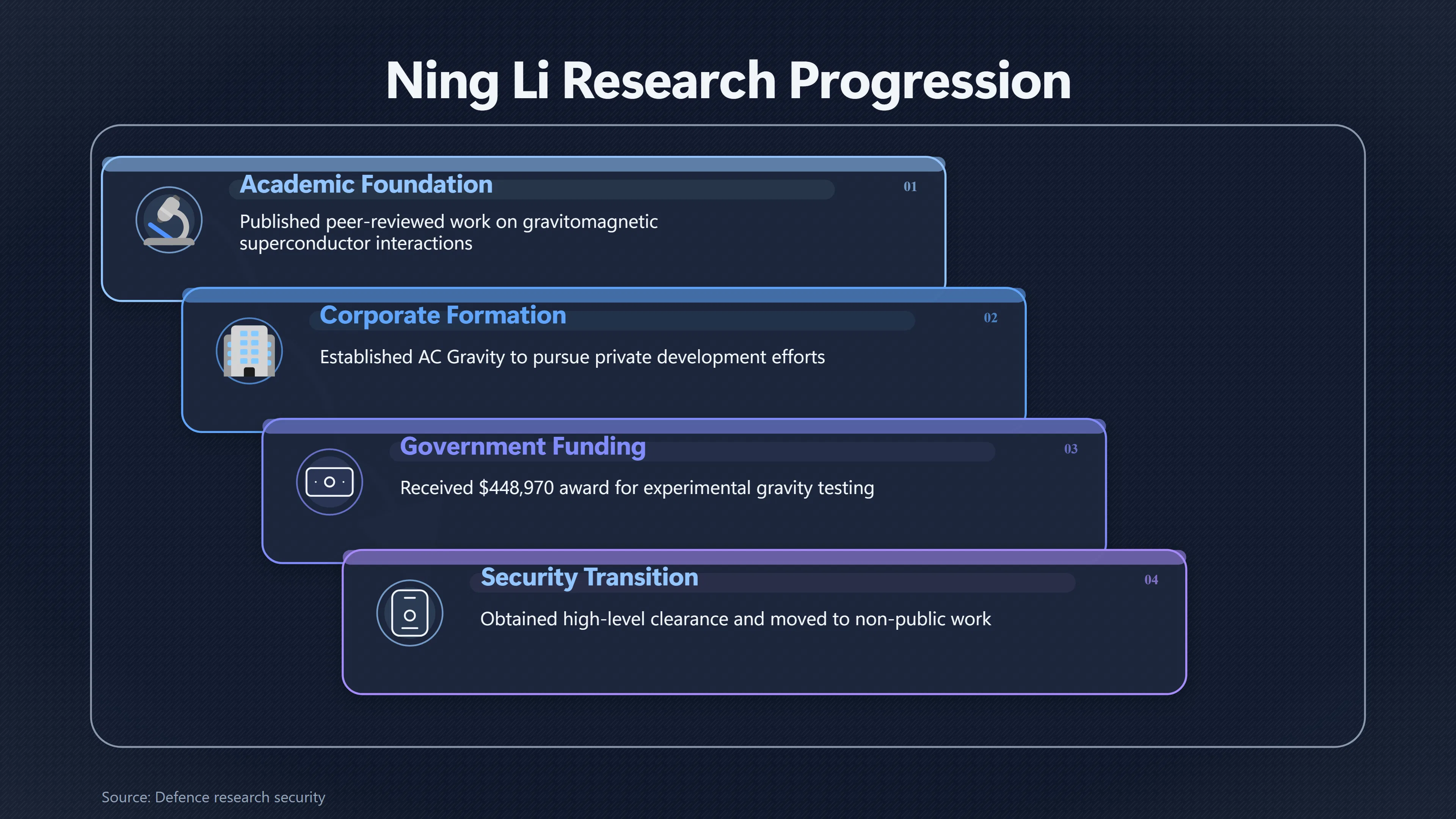
Li and Douglas Torr published peer-reviewed work on gravitomagnetic effects in superconductors. Their 1991 Physical Review D paper investigated how superconductors would interact with gravitomagnetic and magnetic fields; the work is independently catalogued by both the American Physical Society and the US Department of Energy’s Office of Scientific and Technical Information.[APS Journals]journals.aps.orgPhys Rev D.43.457APS JournalsEffects of a gravitomagnetic field on pure superconductors | Phys. Rev. DJanuary 15, 1991… Whatever judgement one makes about later claims derived from this line of research, Li was not simply promoting an undocumented invention outside the scientific literature.
The story subsequently moved closer to the kind of evidence that matters for a suppression-motive analysis. Li left the University of Alabama in Huntsville and formed AC Gravity. Contemporary government-contract information reproduced in later investigations records a $448,970 US government award beginning in April 2001 for an experimental effort intended to test predictions concerning gravitational effects associated with superconductors. The stated objective was experimental confirmation that could validate the theory and support further development.[UFOs Scientific Research]ufos-scientificresearch.blogspot.comUFOs Scientific Research Unidentified Anomalous PhenomenaUFOs Scientific ResearchUnidentified Anomalous Phenomena - scientific research: Anomalous Aerospace Phenomena; and "anti-gravity"February… The Huntsville Business Journal independently reports the Department of Defense award and says Li’s former physics-department chairman Larry Smalley joined her venture.[Huntsville Business Journal]huntsvillebusinessjournal.comOpen source on huntsvillebusinessjournal.com.
Those facts make Li’s research more consequential than a bare antigravity claim. There was peer-reviewed theoretical work, an incorporated development effort and government money for an experiment. From the perspective of motive analysis, that is a genuine increase in stakes.
But a crucial piece remains missing from the public record: demonstrated experimental success. The existence of the contract proves that the government considered the idea worth testing; it does not prove that the test produced gravity control. The absence of publicly released final results creates an information gap, not evidence that the missing results were positive.
The later history also shows why “research disappeared” and “researcher was eliminated” must remain separate propositions. Reporting based on an interview with Li’s son says that she continued sensitive government work and stopped discussing it publicly after obtaining a high-level security clearance. More importantly for claims surrounding her fate, the same account says she remained in Huntsville and was struck by a vehicle in 2014 in an accident witnessed by her husband, sustaining severe brain injury before dying years later in 2021.[Huntsville Business Journal]huntsvillebusinessjournal.comOpen source on huntsvillebusinessjournal.com.
Li’s story therefore supports a narrower proposition that is both interesting and well grounded: unconventional gravity research can move from open academic work into defence-linked, non-public work. It does not establish that researchers who make that transition are killed. Indeed, her case demonstrates how genuine secrecy can itself generate a false disappearance narrative when outsiders cannot see what happened to the work.
Patents, contracts and sensitive data leave footprints
If revolutionary research really creates a suppression motive, one would expect the perceived value of the information to become visible somewhere around it. The strongest evidence need not be a public declaration that a technology “works”. It may instead appear indirectly through attempts to control who can see, publish, patent, acquire or transfer it.
This is not speculative. Governments have formal systems specifically designed for such circumstances.
Under US law, 35 U.S.C. §181 allows the government to impose secrecy on a patent application when disclosure of the invention could be detrimental to national security. The statute applies both where the government already has a property interest and, through referral to designated defence agencies, in certain cases where it does not. Secrecy can prevent publication of the application and issuance of the patent, with continuing orders subject to statutory procedures.[Legal Information Institute]law.cornell.eduLegal Information Institute35 U.S. Code § 181Secrecy of certain inventions and withholding of patent | U.S. Code | US Law | LII / Legal Information Institute… USPTO rules likewise specify that when a defence agency determines disclosure would harm national security, the Commissioner for Patents issues a secrecy order.[USPTO]uspto.gov120-Secrecy Orders120-Secrecy Orders
The UK has an analogous mechanism. The Intellectual Property Office checks patent applications for national-security and public-safety concerns, and section 22 directions can restrict disclosure to third parties and overseas patent filing. The IPO specifically notes that applications associated with classified government contracts may require such handling.[GOV.UK]GOV.UKNational security checks on patent applicationsNational security checks on patent applications
These mechanisms are significant for evaluating antigravity-suppression stories because they demonstrate two things at once. First, governments genuinely do have reasons and lawful mechanisms for preventing strategically sensitive inventions from becoming public. It would therefore be naïve to assume that every militarily important technological result must appear openly in journals or patent databases. Second, the existence of formal suppression mechanisms raises the evidential standard for claims of clandestine violence. If someone argues that a researcher was killed to protect an invention, it is reasonable to ask whether there is evidence of the less extreme control mechanisms that governments and companies ordinarily possess.
The same principle applies to defence contracts. Current UK Ministry of Defence guidance states that defence research can involve classified material, need-to-know restrictions, Security Aspects Letters, contractual disclosure conditions and controls protecting information, data and assets. It explicitly recognises threats from actors seeking to steal research for military, technological, political or economic advantage.[GOV.UK]GOV.UKDefence research security23, 2026…
US export-control rules make another useful distinction. Research intended for open publication can qualify as fundamental research, whereas technology deliberately kept proprietary or restricted can become subject to export controls. Government-funded work can also carry pre-publication review, dissemination limits and other national-security controls.[Bureau of Industry and Security]bis.govBureau of Industry and Security EAR 734 | Bureau of Industry and SecurityBureau of Industry and Security EAR 734 | Bureau of Industry and Security
Consequently, a credible high-stakes research trail might include contract clauses, classification changes, security clearances, patent-secrecy orders, export-control correspondence, acquisition attempts, restricted laboratory access or documented disputes over publication. These do not prove a murder motive. They establish something more basic that must come first: that identifiable actors considered the information worth controlling.
A pending release can make motive time-specific
The timing of disclosure matters because motive becomes more persuasive when an alleged adversary faces a deadline.
Suppose a researcher has spent ten years claiming to possess an antigravity device but has never produced independent testing, technical documentation or a working demonstration. A death during year ten does not automatically acquire a strong research-related motive merely because the claim was dramatic.
The assessment changes if there is independent evidence that, immediately before the death, the researcher had completed reproducible testing and was about to provide the apparatus to another laboratory; had submitted a technically detailed patent application; had arranged a public demonstration for qualified observers; had delivered data to a journalist; was negotiating a sale with a rival state or company; or was preparing to publish information previously subject to contractual restrictions.
That creates what might be called a motive window. An adversary would no longer merely dislike the researcher’s long-term ambitions. Something would be about to happen that could impose a concrete cost.
This is why documentation of pending disclosure can be more informative than years of public rhetoric. US regulations themselves recognise publication status as consequential: material arising from fundamental research is treated differently when researchers remain free to publish it, while accepted proprietary or national-security restrictions alter its regulatory position.[Bureau of Industry and Security]bis.govBureau of Industry and Security EAR 734 | Bureau of Industry and SecurityBureau of Industry and Security EAR 734 | Bureau of Industry and Security Universities have therefore historically negotiated contract terms concerning publication and dissemination specifically to preserve the open status of fundamental research.[Government Accountability Office]gao.govOpen source on gao.gov.
For suspicious-death cases, the analogous question is straightforward: what was about to leave the researcher’s control, and who knew it? A dated manuscript, scheduled demonstration, patent filing, data transfer, investor agreement or documented meeting can transform a timeless conspiracy narrative into a testable hypothesis. Without such an event, the proposed motive often has no clear reason to culminate when the death occurred.
What would make the stakes visible to an adversary?
A useful suppression theory needs evidence not merely that the research could have been valuable but that somebody in a position to act had reason to believe it was valuable. This is where institutional records become especially important.
US and UK research-security policy confirms that governments actively assess sensitive technologies because foreign states and other actors seek economically or militarily valuable knowledge. The US Government Accountability Office has reported government concerns about foreign entities targeting sensitive university research and the transfer of technological know-how.[Government Accountability Office]gao.govOpen source on gao.gov. UK defence guidance similarly describes attempts to steal information and material in order to gain military, technological or economic advantage.[GOV.UK]GOV.UKDefence research security23, 2026…
Against that real-world baseline, evidence of a credible suppression motive would become substantially stronger if a case contained several mutually reinforcing signals:
- Demonstrated technical value. Independent replication, credible measurement, successful prototype testing or expert validation would show that the research had progressed beyond speculation.
- A transferable asset. Designs, source code, manufacturing instructions, experimental samples, proprietary datasets, patentable methods or a unique apparatus would give an adversary something identifiable to obtain or contain.
- Documented institutional interest. Contracts, procurement records, technical evaluations, due-diligence documents, meetings, acquisition approaches or security reviews would show that outside actors knew about the work.
- A concrete conflict over control. Publication restrictions, intellectual-property disputes, demands for secrecy, rejected acquisition offers, threats of litigation, revoked access or documented attempts to retrieve material would show competing interests rather than merely hypothetical ones.
- An approaching loss of control. A scheduled publication, demonstration, patent disclosure, investor transaction or transfer of information would explain why intervention might suddenly become urgent.
- Evidence surviving the researcher’s death. Laboratory notebooks, correspondence, replicated devices, collaborators’ records and independent copies of data would allow investigators to establish what actually existed. If an allegedly revolutionary breakthrough disappears entirely with one person, assessing its value becomes much harder.
None of these factors alone establishes homicide. Their importance is cumulative. A researcher with a working prototype, a defence evaluation, a documented secrecy dispute and an imminent independent demonstration presents a qualitatively different motive question from a researcher who repeatedly said that powerful interests feared an invention but never supplied independently verifiable evidence that it worked.

Real secrecy is not evidence of lethal suppression
The most important complication is that genuine secrecy can make weak conspiracy arguments look stronger than they are.
National-security restrictions are real. Patent applications can be withheld. Defence research can be classified. Researchers can face publication controls. Sensitive technical information can be restricted to people with appropriate clearance. Export-control systems can limit transfers of technology and know-how.[cornell.edu]law.cornell.eduLegal Information Institute35 U.S. Code § 181Secrecy of certain inventions and withholding of patent | U.S. Code | US Law | LII / Legal Information Institute… Those facts make it entirely plausible that some unconventional propulsion research could become non-public if it crossed into a genuinely sensitive technological area.
But secrecy is evidence of information control, not automatically evidence of murder.
Indeed, established security mechanisms suggest many alternatives to killing a scientist: classify the work, impose contractual disclosure restrictions, purchase or license the intellectual property, place a patent under secrecy controls, restrict access, limit exports, move development into a secure programme or prosecute unauthorised disclosure where the law permits. A proposed assassination motive becomes more convincing only if there is evidence explaining why these ordinary mechanisms were inadequate or unavailable.
This distinction is particularly valuable in UFO and antigravity cases because the perceived magnitude of the technology can otherwise do all the argumentative work. “Gravity control would transform warfare and transport” is a reasonable statement about hypothetical consequences. It does not tell us whether a particular deceased researcher had achieved gravity control.
The evidence has to move in the opposite direction: from what the researcher demonstrably possessed, to who demonstrably knew about it, to what that actor demonstrably stood to lose, and only then to whether the conflict bears any evidential relationship to the death.
The decisive threshold is consequence plus demonstrated interest
Consequential research can create a credible suppression motive, but “consequential” must be established rather than assumed. The strongest cases would contain a convergence of technical validation, valuable intellectual property or data, identifiable institutional attention and a specific event threatening to move the information beyond someone’s control.
Ning Li’s history demonstrates why this standard is useful. Her research reached peer-reviewed journals, attracted government-backed experimentation and subsequently became less publicly visible. Those facts establish unusually concrete stakes for an unconventional-gravity project.[APS Journals]journals.aps.orgPhys Rev D.43.457APS JournalsEffects of a gravitomagnetic field on pure superconductors | Phys. Rev. DJanuary 15, 1991… Yet they do not establish that the underlying technology worked as hoped, and the later account of her life does not support the popular picture of a scientist simply disappearing after a breakthrough. The gap between those propositions is precisely where careful analysis is needed.
Conversely, official patent, defence-research and export-control systems demonstrate that genuinely sensitive science can attract organised efforts to restrict dissemination.[gov.uk]GOV.UKNational security checks on patent applicationsNational security checks on patent applications That makes documented suppression of information entirely plausible in principle. It does not make every suspicious death surrounding unconventional research an example of lethal suppression.
For the broader question of allegedly suspicious deaths and disappearances among UFO and antigravity researchers, research importance should therefore function as an evidential filter rather than a presumption. A revolutionary claim supplies a possible motive. A validated result supplies a potential asset. Records showing that an identifiable actor recognised and sought to control that asset create a credible conflict. Evidence connecting that conflict to the researcher’s death is still required before a suppression theory becomes an explanation rather than a possibility.
Amazon book picks
Further Reading
Books and field guides related to Was the Research Important Enough to Threaten Anyone?. Use these as the next step if you want deeper reading beyond the article.
Skunk Works: A Personal Memoir of My Years at Lockheed
The former head of Lockheed's SKUNK WORKS reveals the amazing story of the secret aircraft that changed the course of history - from the...
The Pentagon's Brain: An Uncensored History of DARPA, America...
Discover the definitive history of DARPA, the Defense Advanced Research Project Agency, in this Pulitzer Prize finalist from the author o...
The Demon-Haunted World
Rating: 4.5/5 from 43 Google Books ratings
NEW YORK TIMES BESTSELLER • From the renowned astronomer and author of Cosmos comes a “powerful [and] stirring defense of informed ration...
The Idea Factory: Bell Labs and the Great Age of American Inn...
The definitive history of America’s greatest incubator of innovation and the birthplace of some of the 20th century’s most influential te...
eBay marketplace picks
Marketplace Samples
Live-tested eBay searches with available results related to this page.
Selected fromantigravity poster oneBay.co.uk.



Endnotes
1.
Source: GOV.UK
Title: Defence research security
Link:https://www.gov.uk/government/publications/defence-research-security/defence-research-security
Source snippet
23, 2026...
2.
Source: ntrs.nasa.gov
Title: Technical Reports Server NASA Breakthrough Propulsion Physics Program
Link:https://ntrs.nasa.gov/archive/nasa/casi.ntrs.nasa.gov/19980201240.pdf
Source snippet
NASA Technical Reports ServerNASA Breakthrough Propulsion Physics Program - NASA Technical Reports Server (NTRS)June 1, 1998...
Published: June 1, 1998
3.
Source: cosmicopia.gsfc.nasa.gov
Title: Cosmicopia NASA’s Cosmicopia – Ask Us
Link:https://cosmicopia.gsfc.nasa.gov/qa_gp_gr.html
Source snippet
NASA's Cosmicopia -- Ask Us - General Physics - GravityMarch 6, 2007...
Published: March 6, 2007
4.
Source: journals.aps.org
Title: Phys Rev D.43.457
Link:https://journals.aps.org/prd/abstract/10.1103/PhysRevD.43.457
Source snippet
APS JournalsEffects of a gravitomagnetic field on pure superconductors | Phys. Rev. DJanuary 15, 1991...
Published: January 15, 1991
5.
Source: uspto.gov
Title: 120-Secrecy Orders
Link:https://www.uspto.gov/web/offices/pac/mpep/s120.html
6.
Source: GOV.UK
Title: National security checks on patent applications
Link:https://www.gov.uk/guidance/national-security-checks-on-patent-applications/
7.
Source: GOV.UK
Title: Manual of Patent Practice
Link:https://www.gov.uk/guidance/manual-of-patent-practice-mopp/section-22-information-prejudicial-to-national-security-or-safety-of-public
8.
Source: bis.gov
Title: Bureau of Industry and Security
Link:https://www.bis.gov/press-release/remarks-prepared-delivery-assistant-secretary-export-enforcement-matthew-s.-axelrod-academic-security
9.
Source: patentsgazette.uspto.gov
Link:https://patentsgazette.uspto.gov/week24/OG/TOC.htm
10.
Source: patentsgazette.uspto.gov
Link:https://patentsgazette.uspto.gov/week20/OG/TOC.htm
11.
Source: uspto.gov
Link:https://www.uspto.gov/web/offices/pac/mpep/documents/1000_1002_02_k_1.htm
12.
Source: uspto.gov
Title: 706-Rejection of Claims
Link:https://www.uspto.gov/web/offices/pac/mpep/documents/0700_706.htm
13.
Source: uspto.gov
Title: 803-Restriction — When Proper
Link:https://www.uspto.gov/web/offices/pac/mpep/documents/0800_803_03_b.htm
14.
Source: uspto.gov
Title: 115-Review of Applications for National Security and Property Rights Issues
Link:https://www.uspto.gov/web/offices/pac/mpep/s115.html
15.
Source: uspto.gov
Link:https://www.uspto.gov/web/offices/pac/mpep/s101.html
16.
Source: uspto.gov
Link:https://www.uspto.gov/web/offices/pac/mpep/s121.html
17.
Source: uspto.gov
Title: mpep 0100
Link:https://www.uspto.gov/web/offices/pac/mpep/mpep-0100.html
18.
Source: uspto.gov
Title: 130-Examination of Secrecy Order Cases
Link:https://www.uspto.gov/web/offices/pac/mpep/s130.html
19.
Source: uspto.gov
Link:https://www.uspto.gov/web/offices/pac/mpep/s1120.html
20.
Source: uspto.gov
Title: 724-Trade Secret, Proprietary, and Protective Order Materials
Link:https://www.uspto.gov/web/offices/pac/mpep/s724.html
21.
Source: uspto.gov
Link:https://www.uspto.gov/web/offices/pac/mpep/s111%E2%80%91114.html
22.
Source: uspto.gov
Title: mpep index p
Link:https://www.uspto.gov/web/offices/pac/mpep/mpep-index-p.html
23.
Source: uspto.gov
Link:https://www.uspto.gov/web/offices/pac/mpep/s1504.html
24.
Source: uspto.gov
Title: 102-Information as to Status of an Application
Link:https://www.uspto.gov/web/offices/pac/mpep/s102.html
25.
Source: uspto.gov
Link:https://www.uspto.gov/web/offices/pac/mpep/s2155.html
26.
Source: uspto.gov
Link:https://www.uspto.gov/web/offices/pac/mpep/s2120.html
27.
Source: uspto.gov
Link:https://www.uspto.gov/web/offices/pac/mpep/s715.html
28.
Source: uspto.gov
Link:https://www.uspto.gov/web/offices/pac/mpep/s2152.html
29.
Source: prod-web-alb-tg.uspto.gov
Link:https://prod-web-alb-tg.uspto.gov/web/offices/pac/mpep/s2720.html
30.
Source: uspto.gov
Link:https://www.uspto.gov/web/offices/pac/mpep/s2731.html
31.
Source: patentsgazette.uspto.gov
Title: item 316
Link:https://patentsgazette.uspto.gov/week52/OG/TOCCN/item-316.htm
32.
Source: GOV.UK
Title: www.gov.uk Defence research security
Link:https://www.gov.uk/government/publications/defence-research-security
33.
Source: patentsgazette.uspto.gov
Link:https://patentsgazette.uspto.gov/week39/OG/TOC.htm
34.
Source: GOV.UK
Title: the patent office annual report and accounts 2024 to 2025
Link:https://www.gov.uk/government/publications/the-patent-office-annual-report-and-accounts-2024-to-2025
35.
Source: GOV.UK
Title: www.gov.uk New espionage offences: factsheet
Link:https://www.gov.uk/government/publications/national-security-bill-factsheets/espionage-etc-national-security-bill-factsheet
36.
Source: GOV.UK
Title: www.gov.uk Journalistic freedoms: National Security Bill factsheet
Link:https://www.gov.uk/government/publications/national-security-bill-factsheets/journalistic-freedoms-national-security-bill-factsheet
37.
Source: uspto.gov
Title: data and statistics
Link:https://www.uspto.gov/learning-and-resources/data-and-statistics
38.
Source: ntrs.nasa.gov
Link:https://ntrs.nasa.gov/citations/20250002186
39.
Source: GOV.UK
Title: www.gov.uk Patented technologies reportable to other organisations
Link:https://www.gov.uk/government/publications/patented-technologies-reportable-to-other-organisations/patented-technologies-reportable-to-other-organisations
40.
Source: uspto.gov
Title: Appendix L
Link:https://www.uspto.gov/web/offices/pac/mpep/mpep-9015-appx-l.html
41.
Source: GOV.UK
Title: www.gov.uk Security requirements for selling to or working with Dstl
Link:https://www.gov.uk/guidance/security-requirements-for-selling-to-or-working-with-dstl
42.
Source: GOV.UK
Title: www.gov.uk Research integrity (JSP 732)
Link:https://www.gov.uk/government/publications/research-integrity-jsp-732
43.
Source: GOV.UK
Title: www.gov.uk National security patents
Link:https://www.gov.uk/government/publications/national-security-patents
44.
Source: uspto.gov
Title: ppac meetings
Link:https://www.uspto.gov/about-us/organizational-offices/public-advisory-committees/ppac-meetings
45.
Source: uspto.gov
Title: annual reports
Link:https://www.uspto.gov/about-us/performance-and-planning/uspto-annual-reports
46.
Source: uspto.gov
Title: Patent and Trademark Office Consolidated Notices
Link:https://www.uspto.gov/web/offices/com/sol/og/2019/week53/TOCCN/item-331.htm
47.
Source: nasa.gov
Title: Self-Guided Beamed Propulsion for Breakthrough Interstellar Missions
Link:https://www.nasa.gov/general/self-guided-beamed-propulsion-for-breakthrough-interstellar-missions/
48.
Source: uspto.gov
Title: financial and performance
Link:https://www.uspto.gov/about-us/financial-and-performance
49.
Source: GOV.UK
Link:https://www.gov.uk/guidance/the-patent-act-1977/section-23-security-and-safety-restrictions-on-applications-abroad-by-united-kingdom-residents
50.
Source: ntrs.nasa.gov
Link:https://ntrs.nasa.gov/search.jsp?R=20180006589
51.
Source: ntrs.nasa.gov
Link:https://ntrs.nasa.gov/archive/nasa/casi.ntrs.nasa.gov/20070004897.pdf
52.
Source: ntrs.nasa.gov
Link:https://ntrs.nasa.gov/archive/nasa/casi.ntrs.nasa.gov/20060000022.pdf
53.
Source: ntrs.nasa.gov
Link:https://ntrs.nasa.gov/search.jsp?R=20040171927&hterms=breakthrough+propulsion+physics
54.
Source: ntrs.nasa.gov
Link:https://ntrs.nasa.gov/search.jsp?R=20040070788
55.
Source: uspto.gov
Title: Mail Stop L&R; Foreign Filing FAX Number
Link:https://www.uspto.gov/news/og/2004/week20/patmail.htm
56.
Source: independent.ie
Title: Boeing throws its weight behind anti-gravity plan | Irish Independent
Link:https://www.independent.ie/world-news/europe/boeing-throws-its-weight-behind-anti-gravity-plan/26042935.html
57.
Source: ntrs.nasa.gov
Link:https://ntrs.nasa.gov/citations/20020068834
58.
Source: uspto.gov
Title: Changes to Implement Patent Business Goals
Link:https://www.uspto.gov/web/offices/com/sol/og/1999/week44/patgol2.htm
59.
Source: ntrs.nasa.gov
Link:https://ntrs.nasa.gov/search.jsp?R=19990023211
60.
Source: ntrs.nasa.gov
Link:https://ntrs.nasa.gov/archive/nasa/casi.ntrs.nasa.gov/19990046249.pdf
61.
Source: ntrs.nasa.gov
Link:https://ntrs.nasa.gov/search.jsp?R=19990047463
62.
Source: ntrs.nasa.gov
Link:https://ntrs.nasa.gov/citations/19980017317
63.
Source: ntrs.nasa.gov
Link:https://ntrs.nasa.gov/citations/19980003825
64.
Source: ntrs.nasa.gov
Link:https://ntrs.nasa.gov/citations/19970009634
65.
Source: uspto.gov
Title: Miscellaneous Changes in Patent Practice
Link:https://www.uspto.gov/web/offices/com/sol/og/1996/week43/patchan.htm
66.
Source: uspto.gov
Title: Changes to Implement 18-Month
Link:https://www.uspto.gov/web/offices/com/sol/og/1995/week33/pat18mo.htm
67.
Source: journals.aps.org
Link:https://journals.aps.org/prb/abstract/10.1103/PhysRevB.46.5489
68.
Source: uspto.gov
Title: Patent Law Foreign Filing Amendments
Link:https://www.uspto.gov/news/og/con/files/cons101.htm
69.
Source: ntrs.nasa.gov
Link:https://ntrs.nasa.gov/search?q=Breakthrough+Propulsion+Physics+Workshop
70.
Source: techport.nasa.gov
Link:https://techport.nasa.gov/projects/10880
71.
Source: ntrs.nasa.gov
Link:https://ntrs.nasa.gov/search?q=Breakthrough+Propulsion+Physics
72.
Source: legislation.gov.uk
Link:https://www.legislation.gov.uk/ukpga/2023/32/notes/division/2/index.htm
73.
Source: journals.aps.org
Link:https://journals.aps.org/prb/recent?ei=ntuwkjqa&page=8577
74.
Source: law.cornell.edu
Title: Legal Information Institute35 U.S. Code § 181
Link:https://www.law.cornell.edu/uscode/text/35/181
Source snippet
Secrecy of certain inventions and withholding of patent | U.S. Code | US Law | LII / Legal Information Institute...
75.
Source: bis.gov
Title: Bureau of Industry and Security EAR 734 | Bureau of Industry and Security
Link:https://www.bis.gov/regulations/ear/734
76.
Source: theguardian.com
Title: The Guardian Gravity | Space | The Guardian
Link:https://www.theguardian.com/science/2002/jul/29/spaceexploration.netnotes
Source snippet
The GuardianGravity | Space | The GuardianJuly 29, 2002...
Published: July 29, 2002
77.
Source: ufos-scientificresearch.blogspot.com
Title: UFOs Scientific Research Unidentified Anomalous Phenomena
Link:https://ufos-scientificresearch.blogspot.com/2019/02/anomalous-aerospace-phenomena-and-anti.html
Source snippet
UFOs Scientific ResearchUnidentified Anomalous Phenomena - scientific research: Anomalous Aerospace Phenomena; and "anti-gravity"February...
78.
Source: ufos-scientificresearch.blogspot.com
Title: UFOs Scientific Research Unidentified Anomalous Phenomena
Link:https://ufos-scientificresearch.blogspot.com/2019/02/
Source snippet
UFOs Scientific ResearchUnidentified Anomalous Phenomena - scientific research: February 2019...
Published: February 2019
79.
Source: huntsvillebusinessjournal.com
Link:https://huntsvillebusinessjournal.com/news/2023/07/30/solving-the-mystery-of-huntsvilles-brilliant-scientist-disappearing/
80.
Source: law.cornell.edu
Title: Legal Information Institute37 CFR § 5.2
Link:https://www.law.cornell.edu/cfr/text/37/5.2
81.
Source: gao.gov
Link:https://www.gao.gov/products/gao
82.
Source: gao.gov
Link:https://www.gao.gov/assets/a254194.html
83.
Source: gao.gov
Link:https://www.gao.gov/products/gao-22-105727
84.
Source: bis.gov
Title: EA R 740 | Bureau of Industry and Security
Link:https://www.bis.gov/regulations/ear/740
85.
Source: en.ikwipedia.org
Title: Eugene Podkletnov
Link:https://en.ikwipedia.org/wiki/Eugene_Podkletnov
86.
Source: staging.dev.bis.gov
Link:https://staging.dev.bis.gov/regulations/ear/740
87.
Source: bis.gov
Link:https://www.bis.gov/search/results?searchBar=russia+belarus+rule
88.
Source: archive.ph
Link:https://archive.ph/O3Pgg
89.
Source: bis.gov
Link:https://www.bis.gov/speech/assistant-secretary-export-enforcement-matthew-s.-axelrod-national-association-college-university-attorneys-2022
90.
Source: justapedia.org
Title: Eugene Podkletnov
Link:https://justapedia.org/wiki/Eugene_Podkletnov
91.
Source: orbitaceromendoza.blogspot.com
Link:https://orbitaceromendoza.blogspot.com/2019/02/?m=0
92.
Source: gao.gov
Link:https://www.gao.gov/products/gao-14-690t
93.
Source: copaseticflow.blogspot.com
Title: Update on the NMSU Superconductor Gravity Experiment
Link:https://copaseticflow.blogspot.com/2012/06/update-on-nmsu-superconductor-gravity.html
94.
Source: gao.gov
Link:https://www.gao.gov/assets/a97179.html
95.
Source: gao.gov
Link:https://www.gao.gov/assets/a117533.html
96.
Source: gao.gov
Link:https://www.gao.gov/products/gao
97.
Source: gao.gov
Link:https://www.gao.gov/assets/a254223.html
98.
Source: patents.justia.com
Link:https://patents.justia.com/patent/20060027709
99.
Source: patents.justia.com
Link:https://patents.justia.com/patent/6960975
100.
Source: gao.gov
Link:https://www.gao.gov/assets/a240569.html
101.
Source: wired.com
Link:https://www.wired.com/1998/03/antigravity/
102.
Source: gao.gov
Link:https://www.gao.gov/products/t-nsiad
103.
Source: gao.gov
Title: nsiad 95 140
Link:https://www.gao.gov/products/nsiad
104.
Source: gao.gov
Link:https://www.gao.gov/products/129889
105.
Source: law.cornell.edu
Title: edu10 CFR § 780.53
Link:https://www.law.cornell.edu/cfr/text/10/780.53
106.
Source: law.cornell.edu
Title: edu10 CFR Part 780
Link:https://www.law.cornell.edu/cfr/text/10/part-780
107.
Source: law.cornell.edu
Title: edu35 U.S. Code Chapter 17 Part II
Link:https://www.law.cornell.edu/uscode/text/35/part-II/chapter-17
108.
Source: law.cornell.edu
Title: edu30 U.S. Code § 181
Link:https://www.law.cornell.edu/uscode/text/30/181
109.
Source: law.cornell.edu
Title: edu10 CFR § 780.51
Link:https://www.law.cornell.edu/cfr/text/10/780.51
110.
Source: law.cornell.edu
Title: edu10 CFR § 780.3
Link:https://www.law.cornell.edu/cfr/text/10/780.3
111.
Source: law.cornell.edu
Title: edu35 U.S. Code § 186
Link:https://www.law.cornell.edu/uscode/text/35/186
112.
Source: law.cornell.edu
Title: edu2 U.S. Code § 181
Link:https://www.law.cornell.edu/uscode/text/2/181
113.
Source: law.cornell.edu
Title: edu10 CFR § 780.50
Link:https://www.law.cornell.edu/cfr/text/10/780.50
114.
Source: law.cornell.edu
Link:https://www.law.cornell.edu/uscode/text/35
115.
Source: law.cornell.edu
Title: edu10 CFR Part 780
Link:https://www.law.cornell.edu/cfr/text/10/part-780/subpart-E
116.
Source: law.cornell.edu
Title: edu10 U.S. Code § 181
Link:https://www.law.cornell.edu/uscode/text/10/181
117.
Source: law.cornell.edu
Title: edu35 U.S. Code § 185
Link:https://www.law.cornell.edu/uscode/text/35/185
118.
Source: law.cornell.edu
Title: edu35 U.S. Code Part II
Link:https://www.law.cornell.edu/uscode/text/35/part-II
119.
Source: media.bis.gov
Title: what deemed export
Link:https://media.bis.gov/learn-support/deemed-exports/what-deemed-export
120.
Source: bis.gov
Link:https://www.bis.gov/search/results?searchBar=deemed+exports
121.
Source: bis.gov
Link:https://www.bis.gov/search/results?searchBar=export+controls+EaR
122.
Source: bis.gov
Link:https://www.bis.gov/search/results?searchBar=ear+de+minimis+rule
123.
Source: bis.gov
Link:https://www.bis.gov/search/results?searchBar=%22is+informed%22
124.
Source: bis.gov
Link:https://www.bis.gov/search/results?searchBar=empty+boxes+into+a+country
125.
Source: bis.gov
Link:https://www.bis.gov/search/results?searchBar=fundamental
126.
Source: bis.gov
Link:https://www.bis.gov/search/results?searchBar=%22foreign+direct+product+rule%22
127.
Source: dev.bis.gov
Title: news updates
Link:https://dev.bis.gov/news-updates?countries=&date=&lSfilter=&news=&order=&search=&type=NodeSpeech
128.
Source: bis.gov
Link:https://www.bis.gov/search/results?searchBar=rule+briefings
129.
Source: bis.gov
Link:https://www.bis.gov/search/results?searchBar=Export+controls+enforcement
130.
Source: bis.gov
Link:https://www.bis.gov/search/results?searchBar=See+Part+for+a+Description+of+All+License+Exceptions
131.
Source: bis.gov
Link:https://www.bis.gov/search/results?searchBar=removal+of+entity+from+meu
132.
Source: bis.gov
Link:https://www.bis.gov/search/results?searchBar=7A003.A.2
133.
Source: bis.gov
Link:https://www.bis.gov/search/results?searchBar=Aukus+license+Exemption
134.
Source: uapmurders.com
Link:https://uapmurders.com/uaps/Details/Ning_Li/
135.
Source: arxiv.org
Link:https://arxiv.org/pdf/physics/0108005
136.
Source: pdf-drive.to
Link:https://pdf-drive.to/dl/nasa-technical-reports-server-ntrs-19990046249-on-the-mechanism-for-a-gravity-effect-using-type-2-superconductors
137.
Source: a.osmarks.net
Title: Eugene Podkletnov
Link:https://a.osmarks.net/content/wikipedia_en_all_maxi_2020-08/A/Eugene_Podkletnov
138.
Source: law.cornell.edu
Title: edu35 U.S. Code § 183
Link:https://www.law.cornell.edu/uscode/text/35/183
139.
Source: law.cornell.edu
Title: edu35 U.S. Code § 182
Link:https://www.law.cornell.edu/uscode/text/35/182
140.
Source: law.cornell.edu
Title: edu35 U.S. Code § 184
Link:https://www.law.cornell.edu/uscode/text/35/184
Additional References
141.
Source: osti.gov
Link:https://www.osti.gov/biblio/5986002
Source snippet
Effects of a gravitomagnetic field on pure superconductors (Journal Article) | OSTI.GOV...
142.
Source: youtube.com
Link:https://www.youtube.com/watch?v=SSs-GI75nF8
Source snippet
The disappearance of America's leading anti-gravity researcher...
143.
Source: youtube.com
Title: 6,000 Patents Hidden By The Government | U.S. Invention Secrecy Act
Link:https://www.youtube.com/watch?v=sNR_6aBQyDk
Source snippet
10 Inventions That Were Erased From History — And Why They Disappeared...
144.
Source: youtube.com
Title: The disappearance of America’s leading anti-gravity researcher
Link:https://www.youtube.com/watch?v=Qsbz8_G9WcU
Source snippet
6,000 Patents Hidden By The Government | U.S. Invention Secrecy Act...
145.
Source: sec.gov
Link:https://www.sec.gov/Archives/edgar/data/1069308/000156459021043099/acer-ex101_48.htm
146.
Source: sec.gov
Link:https://www.sec.gov/Archives/edgar/data/1829247/000149315222034931/ex10-5.htm
147.
Source: oversight.gov
Link:https://www.oversight.gov/reports/3-year-exposure-privacy-act-protected-data-revealed-uspto-mismanagement-safeguarding
148.
Source: osti.gov
Link:https://www.osti.gov/pages/biblio/1998801
149.
Source: osti.gov
Link:https://www.osti.gov/pages/biblio/1484551-img1185-fig
150.
Source: justice.gov
Link:https://www.justice.gov/usao-edpa/pr/former-glaxosmithkline-scientist-pleads-guilty-stealing-trade-secrets-benefit-chinese