Within Motive Evidence
Who Actually Had a Reason to Silence Them?
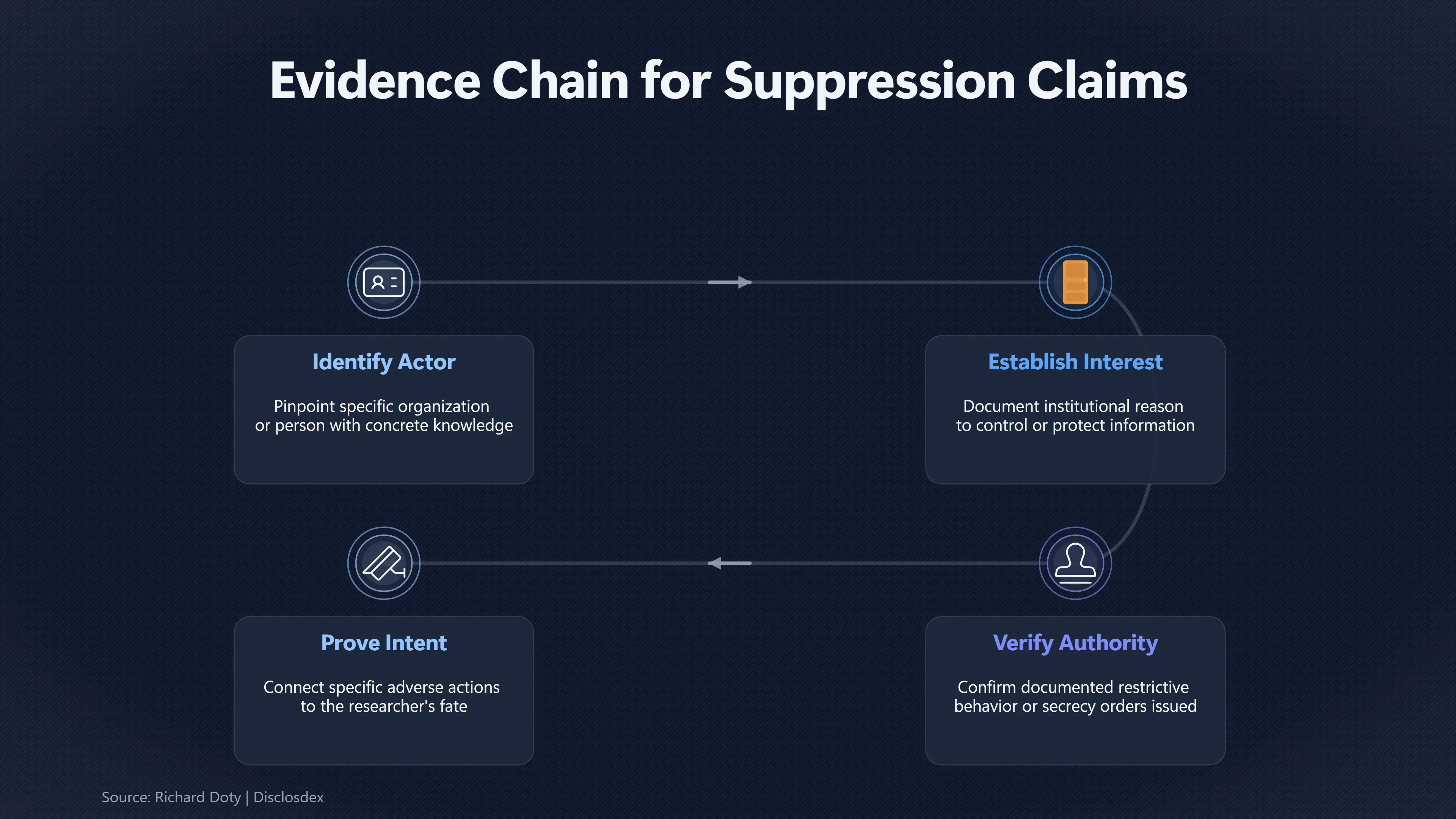
A credible suppression theory needs an identifiable actor whose knowledge, interests and conduct can be documented.
On this page
- From vague interests to identifiable actors
- Records that show who knew about the work
- Evidence that concern became adverse intent
Page outline Jump by section
Introduction
A credible suppression theory needs an actor, not merely an interest. In allegations that UFO, unconventional-propulsion or antigravity researchers were silenced, phrases such as “the government”, “the military-industrial complex”, “oil interests” or “intelligence” are too broad to establish motive. The useful question is narrower: which identifiable organisation or person knew what the researcher was doing, possessed something concrete to protect, and demonstrated concern about disclosure or continued research?
The historical record shows that such actors can sometimes be identified. US defence agencies have statutory mechanisms for restricting inventions on national-security grounds; the Department of Defense directly funded Ning Li’s gravity research; and Air Force counter-intelligence personnel demonstrably took an interest in Paul Bennewitz when his observations touched a sensitive military environment.[cornell.edu]law.cornell.eduLegal Information Institute35 U.S. Code § 181Secrecy of certain inventions and withholding of patent | U.S. Code | US Law | LII / Legal Information InstituteJuly 19, 1952… What the record does not establish is the crucial further proposition that these interests produced killings. Identifying a genuine motive to control information is therefore an important filter, but it is the beginning of a suppression case rather than its conclusion.
From vague interests to identifiable actors
The most common weakness in alleged scientist-suppression narratives is a jump from technological significance to murderous motive. If effective gravity control really existed, it might have military, aerospace and commercial consequences. That proposition can identify broad constituencies that could care about the research, but it cannot tell us who actually did.
A stronger analysis moves through increasingly specific levels. First comes general interest: a military service would predictably care about a radically new propulsion system. Next comes documented institutional knowledge: a particular defence office funded, reviewed or received information about the research. More significant still is documented restrictive authority or behaviour: classification, a secrecy order, publication restrictions, counter-intelligence activity or an attempt to redirect somebody away from sensitive information. Only after those steps does it become reasonable to investigate whether adverse conduct had any connection to a researcher’s death or disappearance.
Thomas Townsend Brown’s Project Winterhaven is useful because it shows the difference. Brown did not merely speculate privately about electrogravitics. His 1952–53 proposal explicitly sought a joint-services research and development contract and envisaged a Department of Defense relationship involving a prime contractor and multiple research organisations.[Thomas Townsend Brown]thomastownsendbrown.comThomas Townsend Brown LibraryThomas Townsend BrownLibrary - ElectrohydrodynamicsJanuary 1, 1953… A later congressional hearing record reproduced material describing Brown’s proposal to the military and the contemporary interest surrounding electrogravitics.[Congress.gov]congress.govCHRG 107shrg80649S. HRG. 107–564November 11, 2025…
That establishes potential military awareness and a conceivable strategic interest. It does not establish a campaign to silence Brown. Indeed, there is an important alternative explanation for institutional reluctance: subsequent research has generally treated the Biefeld–Brown force as an electrohydrodynamic phenomenon associated with charged particles rather than demonstrated control of gravity. Experimental and theoretical work has reproduced the force while investigating ionic mechanisms.[arXiv]arxiv.orgarXiv An analysis of the Brown-Biefeld effectAn analysis of the Brown-Biefeld effectNovember 5, 2010… An agency declining or restricting a speculative propulsion proposal is therefore not, by itself, evidence that officials secretly believed it worked.
This distinction matters throughout the subject. A credible candidate actor is one for whom knowledge can be demonstrated independently of the alleged conspiracy. Contracts, grant files, security clearances, patent proceedings, correspondence and counter-intelligence records are substantially stronger evidence than reasoning backwards from a researcher’s death to whichever institution appears most powerful.
Records that show who knew about the work
Ning Li provides one of the clearest examples of how documentary evidence can narrow the field without proving a sinister outcome. Li’s work at the University of Alabama in Huntsville concerned claimed gravitational effects associated with superconductors. After leaving academia and forming AC Gravity, her company received $448,970 in US government funding in 2001 for an experimental effort intended to test theoretical predictions about generating gravitational effects with a superconducting disc. Contemporary programme information identifies the awarding organisation as the US Army Aviation and Missile Command and gives an effective period from April 2001 to September 2002.[UFOs Scientific Research]ufos-scientificresearch.blogspot.comUFOs Scientific Research Unidentified Anomalous PhenomenaUFOs Scientific ResearchUnidentified Anomalous Phenomena - scientific research: Anomalous Aerospace Phenomena; and "anti-gravity"February…
That evidence changes the motive question substantially. It is unnecessary to speculate that an unspecified intelligence organisation somehow discovered Li’s research: an identifiable component of the defence establishment was paying for it. Later reporting found that Li gave a 2003 presentation, “Measurability of AC Gravity Fields”, in a defence-connected setting and that her public publication trail then largely ceased.[Huntsville Business Journal]huntsvillebusinessjournal.comHuntsville Business JournalUncovering The Mystery Of Huntsville’s Brilliant Anti-gravity Scientist - Huntsville Business Journal…
The strongest evidence about what happened next comes not from conspiracy literature but from Li’s son, George Guangyu Men. In a 2023 investigation by the Huntsville Business Journal, Men said that his mother obtained a top-secret clearance and could no longer discuss her work as she had while in academia. The reporter also described unsuccessful Freedom of Information Act attempts to obtain results from the 2001 defence-funded work.[Huntsville Business Journal]huntsvillebusinessjournal.comHuntsville Business JournalUncovering The Mystery Of Huntsville’s Brilliant Anti-gravity Scientist - Huntsville Business Journal…
Those facts support a relatively modest but important conclusion: there was an identifiable national-security actor with both knowledge of Li’s research and an institutional reason to control information about it. They make “classified defence work” considerably more plausible than a vague claim that powerful interests must have noticed her.
They simultaneously weaken the more dramatic suppression story. Li did not mysteriously vanish after her grant. According to her son’s account, she remained in Huntsville and continued classified work. In 2014 she was struck by a vehicle while crossing a road on the University of Alabama in Huntsville campus; her husband witnessed the accident. She suffered serious lasting injuries and died in 2021 after years of care.[Huntsville Business Journal]huntsvillebusinessjournal.comHuntsville Business JournalUncovering The Mystery Of Huntsville’s Brilliant Anti-gravity Scientist - Huntsville Business Journal… The same evidence that identifies the Department of Defense as an organisation with a genuine secrecy interest therefore provides no demonstrated motive for eliminating Li. If anything, continued employment would suggest that the institution’s immediate interest was in retaining and restricting access to expertise, not destroying it.
That is an important corrective to suppression theories. When an organisation can obtain secrecy through contracts, classification, security clearances or employment restrictions, homicide is not automatically the most rational—or evidentially supported—mechanism.
The state already has mechanisms for restricting technology
The strongest evidence that US national-security institutions sometimes have a motive to prevent technical information becoming public does not come from UFO cases at all. It is written into law.
Under 35 U.S.C. §181, publication of a patent application or issuance of a patent can be withheld when an interested government agency considers disclosure detrimental to national security. The provision applies both to inventions in which the government has a property interest and, under specified procedures, to privately developed inventions in which it does not. Orders can be renewed when the responsible agency determines that the national interest continues to require secrecy.[Legal Information Institute]law.cornell.eduLegal Information Institute35 U.S. Code § 181Secrecy of certain inventions and withholding of patent | U.S. Code | US Law | LII / Legal Information InstituteJuly 19, 1952…
This is not merely dormant statutory language. US Patent and Trademark Office figures obtained through Freedom of Information Act requests showed thousands of secrecy orders in force in the 2000s and 2010s. At the end of fiscal year 2018 there were 5,792, including orders affecting inventions developed without a government property interest.[Federation of American Scientists]fas.orgFederation of American Scientists Invention Secrecy Hits Recent HighFederation of American ScientistsInvention Secrecy Hits Recent High - Federation of American ScientistsOctober 31, 2018… Earlier figures likewise showed that defence agencies were major originators of secrecy orders; in fiscal year 2009, for example, the Navy accounted for 39 new orders and the National Security Agency for 12.[Federation of American Scientists]fas.orgFederation of American Scientists Invention Secrecy at Highest in a DecadeFederation of American Scientists Invention Secrecy at Highest in a Decade
This gives researchers a much more precise model of what an authentic government motive looks like. The motive is not necessarily “this invention threatens the existing order”. It can be as ordinary and documentable as preventing a potentially militarily useful technology from becoming available to foreign governments.
It also changes what evidence should be sought in an alleged antigravity suppression case. If a researcher really possessed a breakthrough considered militarily sensitive, investigators should look for the institutional traces that comparable sensitive technologies generate: patent-security review, government contracts, export-control issues, classified programme participation, security clearances, publication review, restricted technical reports or correspondence with an identifiable defence office. The absence of all such traces does not prove that no covert interest existed, but it makes claims of intense official concern harder to substantiate.
Most importantly, documented secrecy mechanisms show why evidence of secrecy cannot simply be converted into evidence of murder. The government already possesses lawful administrative tools for restricting dissemination. A theory proposing a much more extreme intervention has to explain why those tools were insufficient and provide evidence that somebody decided to go beyond them.
When concern becomes adverse intent
The evidential threshold rises sharply when the claim moves from “an organisation wanted information controlled” to “an organisation wanted a person silenced”. Funding and classification establish knowledge and interests; they do not establish hostility.
The Paul Bennewitz affair is instructive precisely because it provides something unusually difficult to find in alleged UFO suppression cases: an identifiable counter-intelligence actor associated with deliberate intervention against a named civilian. Bennewitz lived near Kirtland Air Force Base and used electronic equipment while investigating unusual activity around the military complex. Air Force Office of Special Investigations (AFOSI) Special Agent Richard Doty became involved with him. Doty’s association with the Kirtland case is documented, and Doty later acknowledged feeding Bennewitz UFO-related disinformation intended to divert him from information AFOSI wanted protected.[Disclosdex]disclosdex.comRichard Doty | DisclosdexRichard Doty | Disclosdex…
The case should not be stretched beyond what it demonstrates. Bennewitz was not an antigravity scientist who was assassinated, and Doty’s later extraordinary UFO claims are themselves problematic because he has openly described participating in disinformation. But as a mechanism example, the affair is valuable: it illustrates the evidential difference between imagining that an agency might interfere and identifying personnel, an operational reason for concern and actual interference.
In a suspected scientist-suppression case, comparable evidence would be highly significant. A warning from an identified security officer, documented surveillance, instructions to cease publication, deliberate dissemination of false information, threats traceable to an interested party, efforts to seize technical material or communications discussing how to neutralise a researcher would move a theory from abstract motive towards adverse intent.
Without that transition, even authentic government attention remains ambiguous. An agency can investigate somebody because it wants their technology, fears espionage, needs to protect an existing classified programme, suspects a security breach or simply wants to understand what the person has observed. Those motives may produce secrecy and intrusive conduct without implying an intention to cause physical harm.
Commercial disruption is a weaker motive unless someone acted on it
Claims involving aerospace, energy or defence companies require the same discipline. A genuine gravity-control technology would obviously have potentially disruptive economic consequences. Yet saying that an invention “would destroy the aerospace industry” or “would make fossil fuels obsolete” does not identify a perpetrator.
The problem is that revolutionary technology can create opposite incentives simultaneously. An incumbent aerospace company might lose value if its existing products became obsolete, but it could gain enormously by acquiring the new technology. A defence contractor might prefer secrecy, but also have a powerful incentive to employ the inventor, obtain intellectual property or win government development contracts. A government might fear uncontrolled proliferation while simultaneously spending money to develop the same capability.
Brown’s Project Winterhaven makes this tension unusually visible. His proposal envisaged bringing research institutions and contractors into a government-supported development structure rather than presenting industry and the inventor as natural enemies.[Thomas Townsend Brown]thomastownsendbrown.comThomas Townsend Brown LibraryThomas Townsend BrownLibrary - ElectrohydrodynamicsJanuary 1, 1953… Li’s case similarly shows the Department of Defense funding experimental gravity research rather than simply attempting to make it disappear.[UFOs Scientific Research]ufos-scientificresearch.blogspot.comUFOs Scientific Research Unidentified Anomalous PhenomenaUFOs Scientific ResearchUnidentified Anomalous Phenomena - scientific research: Anomalous Aerospace Phenomena; and "anti-gravity"February…
Consequently, a commercial-motive claim becomes persuasive only when general economic exposure can be tied to a specific conflict: an acquisition offer that was rejected, litigation over ownership, a patent dispute, termination of funding following a disclosure disagreement, corporate espionage, documented pressure on a publisher, threats, or internal correspondence describing the researcher’s work as a problem requiring action.
Without evidence of that kind, “established industry had billions to lose” is not a case-specific motive. It is an economic hypothesis that could be applied to almost any proposed disruptive invention.
Foreign intelligence is plausible in principle but needs the same proof
Advanced propulsion also creates an obvious foreign-intelligence hypothesis. If one state believed another state’s researcher had developed a militarily transformative propulsion or energy technology, obtaining the research, recruiting the scientist or preventing a rival from exploiting it could all be rational objectives.
Yet this possibility can become a convenient evidential escape hatch. Once domestic institutions fail to provide a convincing suspect, an unspecified foreign service can be inserted into the story precisely because its activities are difficult to observe. That makes the theory harder to falsify rather than better supported.
The Li case again demonstrates the distinction. Her work was funded through a US defence relationship, and her son described subsequent classified employment. Those are positive pieces of evidence identifying who demonstrably knew about her work.[Huntsville Business Journal]huntsvillebusinessjournal.comHuntsville Business JournalUncovering The Mystery Of Huntsville’s Brilliant Anti-gravity Scientist - Huntsville Business Journal… By contrast, nationality, international scientific contacts or the general fact that foreign intelligence services seek advanced technology would not establish that a particular foreign service targeted her.
For foreign-intelligence motive to become case-specific, investigators would need evidence such as documented approaches to the scientist, counter-intelligence warnings, unusual attempts to acquire restricted material, intercepted communications, prosecutions, expulsions, financial transfers or testimony independently corroborated by records. The evidential standard should not become lower merely because the proposed actor operates secretly.
Amy Eskridge shows why motive claims need independent corroboration
The death of Huntsville researcher Amy Eskridge illustrates the difficulty especially clearly. Her 2022 obituary confirms that she was president and chairwoman of the Institute for Exotic Science and describes her scientific interests and University of Alabama in Huntsville background.[Legacy.com]legacy.comamy eskridge obituaryamy eskridge obituary Her work and public statements have subsequently become incorporated into allegations that researchers connected with unconventional propulsion were being targeted.
For the narrow question of motive, however, the publicly accessible evidence is much less developed than in Li’s case. There is no comparably clear public record establishing that a named government programme possessed Eskridge’s technology, regarded her personally as a security problem and decided to intervene against her. Recent reporting on renewed allegations surrounding deaths of scientists has also recorded a sharply different perspective from Eskridge’s family: they said she suffered chronic pain and cautioned against treating scientists’ deaths as inherently mysterious.[KSL]ksl.comOpen source on ksl.com.
This does not settle every disputed detail surrounding her death. It does establish why retrospective motive construction is hazardous. A researcher’s interest in exotic propulsion, proximity to NASA or defence institutions, and expressed fears about suppression can justify investigating whether a particular organisation had taken an adverse interest in them. They cannot substitute for evidence that such an organisation actually did so.
The decisive records would be those identifying the other side of the alleged conflict: Who contacted her? Who issued an instruction? Who wanted particular information withheld? What programme or company was threatened? What action did that actor take? Until those questions produce corroborated answers, the identity of a supposed suppressor remains an allegation rather than an evidential finding.
A motive that can actually be tested
Across UFO and antigravity suppression claims, the most useful distinction is therefore not between “believers” and “sceptics”, but between different strengths of evidence.
An actor moves from speculative to credible when the record can answer three increasingly demanding questions:
- Who knew? A contract, briefing, security file, meeting, patent review, correspondence or funding relationship identifies the person or organisation with actual knowledge of the work.
- What did they need to protect? The evidence identifies a concrete interest—classified capabilities, technical intelligence, intellectual property, an existing secret programme or prevention of foreign access—rather than a generic desire to preserve power.
- What shows adverse intent? Surveillance, threats, disinformation, publication restrictions, coercive approaches or communications about stopping the individual show that passive interest became intervention.
Only after those points are established does the alleged death or disappearance become relevant to a stronger causal inquiry. Even then, investigators still need evidence connecting the actor’s adverse intent to the event itself.
The available record demonstrates that governments have sometimes regarded advanced technologies as sufficiently sensitive to restrict their publication, that defence agencies have funded unconventional gravity research, and that military counter-intelligence has interfered with at least some civilians investigating activity around sensitive installations.[cornell.edu]law.cornell.eduLegal Information Institute35 U.S. Code § 181Secrecy of certain inventions and withholding of patent | U.S. Code | US Law | LII / Legal Information InstituteJuly 19, 1952… Those facts make secrecy and information control historically real mechanisms rather than purely imaginary ones.
They do not, however, establish a documented programme of murdering antigravity or UFO researchers. That distinction is the central test. The strongest suppression theory will not be the one with the most powerful hypothetical enemy, but the one that can name an actor, demonstrate what that actor knew, identify what it stood to protect, and show through independent records that its concern progressed from secrecy or competition to adverse action against the particular researcher.

Amazon book picks
Further Reading
Books and field guides related to Who Actually Had a Reason to Silence Them?. Use these as the next step if you want deeper reading beyond the article.
The Pentagon's Brain: An Uncensored History of DARPA, America...
Discover the definitive history of DARPA, the Defense Advanced Research Project Agency, in this Pulitzer Prize finalist from the author o...
Skunk Works: A Personal Memoir of My Years at Lockheed
The former head of Lockheed's SKUNK WORKS reveals the amazing story of the secret aircraft that changed the course of history - from the...
The Demon-Haunted World
Rating: 4.5/5 from 43 Google Books ratings
NEW YORK TIMES BESTSELLER • From the renowned astronomer and author of Cosmos comes a “powerful [and] stirring defense of informed ration...
The Puzzle Palace: Inside the National Security Agency, Ameri...
Behind the scenes at the National Security Agency, which is many times larger than the CIA and spends many billions more per year, is the...
eBay marketplace picks
Marketplace Samples
Live-tested eBay searches with available results related to this page.
Selected fromUFO poster oneBay.co.uk.



Endnotes
1.
Source: disclosdex.com
Title: Richard Doty | Disclosdex
Link:https://disclosdex.com/people/richard-doty
Source snippet
Richard Doty | Disclosdex...
2.
Source: congress.gov
Title: CHRG 107shrg80649
Link:https://www.congress.gov/107/chrg/CHRG-107shrg80649/CHRG-107shrg80649.pdf
Source snippet
S. HRG. 107–564November 11, 2025...
Published: November 11, 2025
3.
Source: arxiv.org
Title: arXiv An analysis of the Brown-Biefeld effect
Link:https://arxiv.org/abs/1011.1393
Source snippet
An analysis of the Brown-Biefeld effectNovember 5, 2010...
Published: November 5, 2010
4.
Source: arxiv.org
Title: arXiv Force on an Asymmetric Capacitor
Link:https://arxiv.org/abs/physics/0211001
5.
Source: legacy.com
Title: amy eskridge obituary
Link:https://www.legacy.com/us/[obituaries
6.
Source: ksl.com
Link:https://www.ksl.com/article/news/utah/police-and-courts/deaths-of-several-scientists-in-recent-months-sparks-federal-investigation/51486507
7.
Source: legacy.com
Title: amy eskridge memorial
Link:https://www.legacy.com/us/obituaries/legacyremembers/amy-eskridge-memorial?id=35311909
8.
Source: pwg.gsfc.nasa.gov
Link:https://pwg.gsfc.nasa.gov/stargaze/SGbull.htm
9.
Source: legacy.com
Link:https://www.legacy.com/obituaries/name/eskridge/amy
10.
Source: disclosdex.com
Link:https://disclosdex.com/people/townsend-brown
11.
Source: academia.edu
Title: Review of Electrogravitics and amp Electrokinetics Propulsion
Link:https://www.academia.edu/22314400/Review_of_Electrogravitics_and_amp_Electrokinetics_Propulsion
12.
Source: academia.edu
Link:https://www.academia.edu/76936506/The_Invention_Secrecy_Act_The_USPTO_as_a_Gatekeeper_of_National_Security
13.
Source: law.cornell.edu
Title: Legal Information Institute35 U.S. Code § 181
Link:https://www.law.cornell.edu/uscode/text/35/181
Source snippet
Secrecy of certain inventions and withholding of patent | U.S. Code | US Law | LII / Legal Information InstituteJuly 19, 1952...
Published: July 19, 1952
14.
Source: huntsvillebusinessjournal.com
Link:https://huntsvillebusinessjournal.com/news/2023/07/30/solving-the-mystery-of-huntsvilles-brilliant-scientist-disappearing/
Source snippet
Huntsville Business JournalUncovering The Mystery Of Huntsville’s Brilliant Anti-gravity Scientist - Huntsville Business Journal...
15.
Source: thomastownsendbrown.com
Title: Thomas Townsend Brown Library
Link:https://thomastownsendbrown.com/hydro/winter.htm
Source snippet
Thomas Townsend BrownLibrary - ElectrohydrodynamicsJanuary 1, 1953...
Published: January 1, 1953
16.
Source: ufos-scientificresearch.blogspot.com
Title: UFOs Scientific Research Unidentified Anomalous Phenomena
Link:https://ufos-scientificresearch.blogspot.com/2019/02/anomalous-aerospace-phenomena-and-anti.html
Source snippet
UFOs Scientific ResearchUnidentified Anomalous Phenomena - scientific research: Anomalous Aerospace Phenomena; and "anti-gravity"February...
17.
Source: fas.org
Title: Federation of American Scientists Invention Secrecy Hits Recent High
Link:https://fas.org/publication/invention-secrecy-2018/
Source snippet
Federation of American ScientistsInvention Secrecy Hits Recent High - Federation of American ScientistsOctober 31, 2018...
Published: October 31, 2018
18.
Source: fas.org
Title: Federation of American Scientists Invention Secrecy at Highest in a Decade
Link:https://fas.org/publication/invention_secrecy_2009/
19.
Source: obits.al.com
Title: amy eskridge obituary
Link:https://obits.al.com/us/obituaries/huntsville/name/amy-eskridge-obituary?id=35311909
20.
Source: wikidisc.org
Title: Paul Bennewitz | Wiki Disc
Link:https://www.wikidisc.org/wiki/Paul_Bennewitz
21.
Source: disclosuremonitor.com
Title: Amy Eskridge | Disclosure Monitor
Link:https://disclosuremonitor.com/people/amy-eskridge-antigravity-researcher
22.
Source: huntsvillebusinessjournal.com
Title: 8 Huntsville Companies Among Latest Recipients Of Innovate Alabama Grants
Link:https://huntsvillebusinessjournal.com/news/2025/10/31/8-huntsville-companies-among-latest-recipients-of-innovate-alabama-grants/
23.
Source: smw.ai
Title: townsend brown
Link:https://smw.ai/research/townsend-brown
24.
Source: huntsvillebusinessjournal.com
Title: Artemis Program Key To Huntsville’s Role In The Expanding Aerospace Industry
Link:https://huntsvillebusinessjournal.com/news/2024/12/19/artemis-program-key-to-huntsvilles-role-in-the-expanding-aerospace-industry/
25.
Source: isgb.blogspot.com
Link:https://isgb.blogspot.com/2023/08/?m=0
26.
Source: teflonrabbit.com
Title: project winterhaven
Link:https://teflonrabbit.com/article/project-winterhaven
27.
Source: huntsvillebusinessjournal.com
Title: “Go Team Artemis!” Huntsville Area NASA Partners Celebrate Historic Mission
Link:https://huntsvillebusinessjournal.com/news/2022/11/29/go-team-artemis-huntsville-area-nasa-partners-celebrate-historic-mission/
28.
Source: ufouap.com
Title: amy eskridge
Link:https://www.ufouap.com/case-files/amy-eskridge/
29.
Source: ufotrail.blogspot.com
Link:https://ufotrail.blogspot.com/2021/12/ongoing-nicap-research-foia-request.html
30.
Source: ufotrail.blogspot.com
Title: nicap plus 65
Link:https://ufotrail.blogspot.com/2021/10/nicap-plus-65.html
31.
Source: orbitaceromendoza.blogspot.com
Link:https://orbitaceromendoza.blogspot.com/2019/02/?m=0
32.
Source: ufotrail.blogspot.com
Title: The UFO Trail: UFO Misinformation: Relevant as It Ever Was
Link:https://ufotrail.blogspot.com/2018/07/ufo-misinformation-relevant-as-it-ever.html
33.
Source: fas.org
Title: Invention Secrecy Activity Rises Slightly
Link:https://fas.org/publication/invention-secrecy-2017/
34.
Source: fas.org
Title: Secret Inventions on the Rise
Link:https://fas.org/publication/inventions-2015/
35.
Source: fas.org
Title: Number of Secret Inventions Grew Last Year
Link:https://fas.org/publication/invention-secrecy-2013/
36.
Source: thomastownsendbrown.com
Link:https://www.thomastownsendbrown.com/hydro/
37.
Source: fas.org
Title: Invention Secrecy on the Rise
Link:https://fas.org/publication/invention_secrecy_2011/
38.
Source: ttbrown.com
Title: Thomas Townsend Brown Effect
Link:https://www.ttbrown.com/forum/viewtopic.php?start=15&t=583
39.
Source: ttbrown.com
Title: Project Winterhaven
Link:https://www.ttbrown.com/forum/viewtopic.php?start=30&t=355
40.
Source: ttbrown.com
Title: Project Winterhaven
Link:https://www.ttbrown.com/forum/viewtopic.php?t=355
41.
Source: ttbrown.com
Title: Project Winterhaven
Link:https://www.ttbrown.com/forum/viewtopic.php?p=2724&sid=15e8e8e5fadc3b8ce65695af7b17048f
42.
Source: wired.com
Link:https://www.wired.com/1998/03/antigravity/
43.
Source: law.cornell.edu
Title: edu35 U.S. Code § 205
Link:https://www.law.cornell.edu/uscode/text/35/205
44.
Source: fas.org
Title: Secrecy Archives
Link:https://fas.org/publication-term/secrecy/
45.
Source: thomastownsendbrown.com
Title: The Philadelphia Experiment
Link:https://thomastownsendbrown.com/tpx/philly1.htm
46.
Source: thomastownsendbrown.com
Link:https://www.thomastownsendbrown.com/ecomm/
47.
Source: thomastownsendbrown.com
Link:https://thomastownsendbrown.com/stress/wizard1.htm
48.
Source: thomastownsendbrown.com
Link:https://www.thomastownsendbrown.com/misc/timeline.htm
49.
Source: uapmurders.com
Link:https://uapmurders.com/uaps/Details/Ning_Li/
50.
Source: uapmurders.com
Link:https://uapmurders.com/uaps/Details/Paul_Bennewitz/
51.
Source: ufos-scientificresearch.blogspot.com
Title: Unidentified Anomalous Phenomena
Link:https://ufos-scientificresearch.blogspot.com/2019/02/
52.
Source: prabook.com
Title: Paul Bennewitz (
Link:https://prabook.com/web/paul.bennewitz/2176990
53.
Source: law.cornell.edu
Title: edu35 U.S. Code Chapter 17 Part II
Link:https://www.law.cornell.edu/uscode/text/35/part-II/chapter-17
54.
Source: law.cornell.edu
Title: edu35 U.S. Code § 122
Link:https://www.law.cornell.edu/uscode/text/35/122
55.
Source: law.cornell.edu
Title: edu35 U.S. Code Part II
Link:https://www.law.cornell.edu/uscode/text/35/part-II
56.
Source: law.cornell.edu
Title: edu35 U.S. Code § 368
Link:https://www.law.cornell.edu/uscode/text/35/368
57.
Source: law.cornell.edu
Title: edu35 U.S. Code § 186
Link:https://www.law.cornell.edu/uscode/text/35/186
58.
Source: law.cornell.edu
Title: edu37 CFR Part 5
Link:https://www.law.cornell.edu/cfr/text/37/part-5
59.
Source: law.cornell.edu
Title: edu37 CFR § 5.11
Link:https://www.law.cornell.edu/cfr/text/37/5.11
60.
Source: law.cornell.edu
Title: edu10 CFR § 780.51
Link:https://www.law.cornell.edu/cfr/text/10/780.51
61.
Source: en-academic.com
Link:https://en-academic.com/dic.nsf/enwiki/125570
62.
Source: facebook.com
Link:https://www.facebook.com/RedHorseLeather1/posts/thomas-townsend-brown-born-in-1905-was-an-electrical-engineer-who-made-waves-in-/1322825469846566/
63.
Source: facebook.com
Link:https://www.facebook.com/groups/httpsshorturl.atgk6ec/posts/609369828155002/
64.
Source: Wikipedia
Title: Paul Bennewitz
Link:https://en.wikipedia.org/wiki/Paul_Bennewitz
65.
Source: conspira.fi
Title: institute for exotic science
Link:https://conspira.fi/entity/institute-for-exotic-science
66.
Source: thomastownsendbrown.com
Link:https://www.thomastownsendbrown.com/stress/gravsit.htm
68.
Source: law.cornell.edu
Title: edu35 U.S. Code § 182
Link:https://www.law.cornell.edu/uscode/text/35/182
69.
Source: law.cornell.edu
Title: edu35 U.S. Code § 183
Link:https://www.law.cornell.edu/uscode/text/35/183
70.
Source: thelivingmoon.com
Title: Project Winterhaven
Link:https://www.thelivingmoon.com/47john_lear/02files/Project_Winterhaven.html
71.
Source: gao.gov
Link:https://www.gao.gov/products/52686
Additional References
72.
Source: youtube.com
Title: Mirage Men: How the US Government Faked an Alien Invasion | Full Documentary
Link:https://www.youtube.com/watch?v=XS8WGTqBBik
Source snippet
'Mislead the Public' Ep. 3 Official Clip | UFO | SHOWTIME Documentary Series...
73.
Source: youtube.com
Title: ‘Mislead the Public’ Ep. 3 Official Clip | UFO | SHOWTIME Documentary Series
Link:https://www.youtube.com/watch?v=kOT39FXstho
Source snippet
The U.S. Government Kept Thousands of Patents Secret — Here's Why...
74.
Source: uspto.gov
Link:https://www.uspto.gov/web/offices/pac/mpep/s121.html
75.
Source: fbi.gov
Link:https://www.fbi.gov/how-we-can-help-you/more-fbi-services-and-information/freedom-of-information-privacy-act/vault
76.
Source: fbi.gov
Link:https://www.fbi.gov/how-we-can-help-you/more-fbi-services-and-information/freedom-of-information-privacy-act/
77.
Source: fbi.gov
Link:https://www.fbi.gov/how-we-can-help-you/more-fbi-services-and-information/freedom-of-information-privacy-act/requesting-fbi-records
78.
Source: gao.gov
Link:https://www.gao.gov/products/gao-26-107971
79.
Source: archives.fbi.gov
Link:https://archives.fbi.gov/archives/richmond/press-releases/2012/richmond-man-arrested-and-detained-for-stealing-truck-with-white-house-audio-equipment
80.
Source: youtube.com
Title: The Ning Li Disappearance | Noah Logan
Link:https://www.youtube.com/watch?v=SUeQWs1vWDw
Source snippet
Mirage Men: How the US Government Faked an Alien Invasion | Full Documentary...
81.
Source: uspto.gov
Title: 115-Review of Applications for National Security and Property Rights Issues
Link:https://www.uspto.gov/web/offices/pac/mpep/s115.html