Within Suicide Claims
How Much Does a Prior Suicide Attempt Matter?
A documented earlier attempt can make a later staged-suicide theory harder to sustain without making homicide impossible.
On this page
- Why earlier self harm changes the evidential baseline
- What suicide risk guidance can and cannot establish
- How assassination claims must account for behavioral continuity
Page outline Jump by section
Introduction
In a disputed death, a documented earlier suicide attempt is not proof that the later death was also suicide. It is, however, unusually important evidence. Previous attempts are recognised by the World Health Organization (WHO) and the US Centers for Disease Control and Prevention (CDC) as major risk factors for subsequent suicide, while longitudinal research confirms that people who have attempted suicide remain at elevated risk afterwards.[who.int]who.intOpen source on who.int.
That matters directly when a UFO or antigravity researcher is later claimed to have been assassinated and the death staged as suicide. If an earlier attempt was independently documented before the fatal event, an assassination theory cannot reasonably treat the final suicide ruling as an isolated invention. It must account for an already existing pattern of suicidal behaviour. James E. McDonald, the atmospheric physicist and prominent UFO advocate who died in 1971, is the clearest case in this branch: contemporary reporting records a fatal suicide after an earlier, non-fatal shooting attempt only months before.[Arizona Daily Star]tucson.comOpen source on tucson.com.
Why an earlier attempt changes the baseline
The importance of a prior attempt is statistical rather than deterministic. WHO describes a previous suicide attempt as an important risk factor for suicide in the general population, and its suicide data guidance has characterised previous attempts as an especially strong risk factor. The CDC likewise lists a previous attempt among individual-level factors that increase suicide risk while stressing that suicide is rarely attributable to a single circumstance.[World Health Organization]who.intOpen source on who.int.
Research broadly supports that distinction. A systematic review and meta-analysis of psychological-autopsy studies found a previous attempt documented in 28.5% of people who died by suicide compared with 6.0% of controls. Another longitudinal meta-analysis found that previous self-injurious thoughts and behaviours significantly predicted later suicidal outcomes, with attempt history among the stronger predictors of subsequent attempts and suicide death. But that review also found predictive performance much weaker than the popular description of previous attempts as a near-diagnostic warning sign might suggest.[PubMed Central (PMC)]nih.govOpen source on nih.gov.
This produces an important distinction for contested researcher deaths. A prior attempt changes the prior probability: suicide is no longer being proposed solely because of an ambiguous final scene. There is evidence that the person had previously engaged in suicidal behaviour. Yet it does not settle the specific event: investigators must still determine what actually happened on the day of death.
The distinction can be expressed simply:
No documented previous attempt: a suicide explanation must be supported principally by evidence surrounding the fatal event and the person’s wider circumstances.
Documented previous attempt: the suicide explanation also has behavioural evidence predating the fatal event, so a staged-suicide hypothesis must explain why that earlier episode does not support continuity.
Strong contradictory forensic evidence: a prior attempt cannot override physical evidence establishing that somebody else caused the death.
That last qualification is crucial. Staged suicides really occur. US criminal-justice literature includes cases in which deaths initially presented as suicide were subsequently assessed as homicide, and forensic guidance emphasises comprehensive scene, body and decedent-profile investigation rather than deciding manner of death from one biographical fact.[Office of Justice Programs]ojp.govOpen source on ojp.gov.
McDonald shows why chronology matters
James E. McDonald is particularly useful because the prior-attempt question is not hypothetical. He was an established atmospheric physicist at the University of Arizona and became one of the most scientifically prominent advocates for serious investigation of UFO reports. His professional standing and UFO advocacy later made his death attractive to theories that researchers in sensitive fields had been deliberately removed.
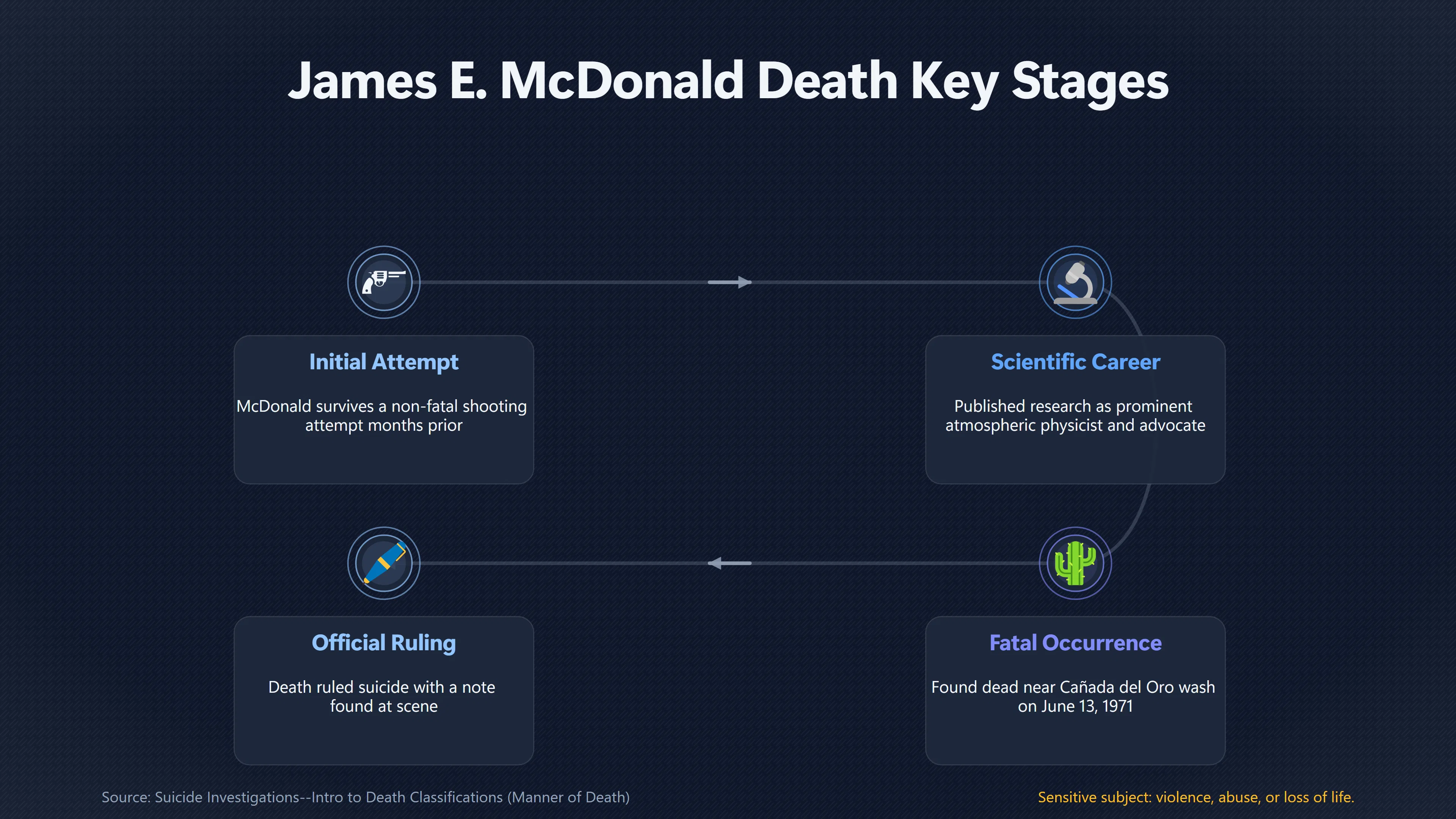
The documented sequence is more difficult to reconcile with a simple assassination narrative. An archived Arizona Daily Star account states that McDonald had attempted suicide several months before his death by shooting himself in the head and had left a note. On 13 June 1971 he was found dead near the Cañada del Oro wash outside Tucson; a revolver was found beside him, and the death was ruled suicide. The same newspaper archive reports that he left a note on the fatal occasion as well.[Arizona Daily Star]tucson.comOpen source on tucson.com.
A contemporary New York Times report, preserved in bibliographical records, also reported his June 1971 death as suicide. Meanwhile, the Bulletin of the American Meteorological Society published an obituary documenting McDonald’s substantial scientific career, making clear that the person at the centre of the later controversy was indeed an accomplished atmospheric scientist rather than merely a figure from UFO popular culture.[Wikidata]wikidata.orgOpen source on wikidata.org.
The earlier shooting therefore changes the assassination question substantially. A hypothesis in which McDonald was killed because of his UFO work cannot merely argue that the June scene could have been staged. Possibility is a low evidential threshold. It has to explain why a man who had already survived an apparent self-inflicted gunshot, with a reported note, then became the victim of a separate homicide engineered to imitate precisely the behavioural pattern already present in his recent history.
That is not logically impossible. An assassin who knew about the earlier attempt might regard suicide as an especially convincing cover story. But this creates an additional evidential requirement rather than supplying evidence for murder. There would need to be independent indications of third-party involvement — forensic inconsistencies, credible witness evidence, records of intervention, demonstrable manipulation of the scene or some comparable evidence — strong enough to outweigh the straightforward continuity between the two events.

The method can strengthen continuity
Prior-attempt evidence is not all equally informative. Timing, documentation, intent and similarities between episodes can matter.
A large Swedish cohort study followed 48,649 people admitted to hospital following attempted suicide. It found that 5,740 — about 12% — subsequently died by suicide during the long follow-up period. Risk varied markedly according to the method used in the original attempt, and people often used the same method in the later fatal event. The authors concluded that the method of an earlier attempt itself carried information about subsequent suicide risk.[BMJ]bmj.comOpen source on bmj.com.
This does not mean that matching methods prove continuity in an individual case. Population studies cannot establish the manner of a particular death. But the finding is relevant to the evidential logic surrounding McDonald: an earlier apparent attempt involving a firearm followed relatively soon by a fatal shooting is not a meaningless coincidence that can simply be removed from the case narrative.
Recency matters as well. Modern studies continue to find particularly elevated risk after episodes of self-harm. A 2026 population study of 77,647 young people found the greatest rates of repeated self-harm and suicide attempts during the first month after the initial hospital-treated episode, although elevated risk persisted over the following year. The population differs greatly from McDonald, so its numerical estimates should not be transplanted onto him; its relevance is narrower — suicidal behaviour can recur over comparatively short periods rather than representing a one-off event with no bearing on subsequent risk.[PubMed]nih.govOpen source on nih.gov.
For a disputed historical death, the evidential weight therefore increases when an alleged earlier attempt is well documented, close in time to the death and clearly intentional, particularly if other contemporary evidence points in the same direction. Conversely, an anecdotal story about vague self-harm many years earlier should carry much less weight.
What suicide-risk guidance cannot establish
The strongest corrective to overinterpretation comes from suicide-prevention guidance itself. Risk factors are designed to identify elevated risk across people and populations; they are not forensic tests capable of reconstructing a particular death.
The CDC explicitly says risk factors can increase the likelihood of suicide but may not be direct causes. NICE, the UK’s National Institute for Health and Care Excellence, goes further in its clinical guidance on self-harm: it says risk-assessment scales should not be used to predict future suicide or repetition of self-harm, and clinicians should not sort people into simplistic low-, medium- or high-risk categories for that purpose.[CDC]cdc.govOpen source on cdc.gov.
The research literature explains why. The longitudinal meta-analysis of self-injurious thoughts and behaviours found statistically meaningful associations with later suicidal outcomes but poor ability to identify which particular individuals would subsequently die by suicide. In other words, knowing that somebody attempted suicide before death changes a rational assessment of the evidence, but it cannot tell an investigator what happened in the final minutes of that person’s life.[PubMed Central (PMC)]nih.govOpen source on nih.gov.
This is especially important in conspiracy-oriented historical research, where two opposite errors are possible. One is to erase documented suicidal behaviour because it complicates an assassination theory. The other is to treat a previous attempt as sufficient reason to dismiss every anomaly surrounding the later death. Neither approach matches the evidence.
A prior attempt does not outrank the death scene
Medicolegal investigation operates on a different level from epidemiological risk assessment. The US National Institute of Justice’s 2024 death-investigation guide describes a process involving evaluation and documentation of the scene, examination of the body, collection of decedent-profile information and collaboration between medicolegal investigators and law enforcement.[Office of Justice Programs]ojp.govOpen source on ojp.gov.
That provides a useful hierarchy for disputed researcher cases. Previous suicidal behaviour belongs in the decedent’s history and can strongly inform interpretation, but it cannot substitute for physical investigation.
If a later re-examination produced reliable evidence that a weapon could not have been used by the deceased, that injuries were incompatible with self-infliction, that the body had been moved, that another person’s biological evidence was present in an incriminating context, or that records demonstrated third-party involvement, a previous suicide attempt would not neutralise those findings. Genuine homicide can coexist with a victim’s history of suicidal behaviour.
Conversely, allegations of assassination do not become forensic evidence simply because a researcher had controversial interests, criticised government agencies or worked on unconventional subjects. When a prior attempt is documented, the evidential burden on the alternative account becomes greater: it needs affirmative evidence that distinguishes homicide from an already plausible behavioural explanation.

Assassination claims must explain behavioural continuity
The most useful way to treat a previous suicide attempt is therefore neither as a trump card nor as background trivia. It is evidence that an alternative theory has to explain.
For a staged-suicide claim involving a researcher such as McDonald, several questions become decisive. Was the earlier attempt documented before the fatal death, rather than reconstructed afterwards? Was suicidal intent established or merely assumed? How close was it to the death? Were the circumstances or methods similar? Were there contemporaneous notes, medical records or witnesses? Most importantly, does independent forensic evidence from the fatal event contradict suicide strongly enough to overcome that continuity?
McDonald’s case is unusually consequential because the earlier attempt was reported independently of later internet-era assassination speculation and occurred only months before his death. The available historical record therefore supplies something that many alleged suspicious-death cases lack: a documented pre-existing pathway towards the official manner of death.[Arizona Daily Star]tucson.comOpen source on tucson.com.
That does not mathematically prove that nobody killed him. Historical evidence rarely permits such absolute conclusions. It does mean that an argument based primarily on his prominence in UFO research, professional disputes or the abstract possibility of a staged scene is incomplete. Those facts may provide a proposed motive, but motive is not evidence that a homicide occurred.
The deeper lesson for alleged UFO and antigravity researcher assassinations is methodological. A theory of murder should explain more of the established chronology than the suicide explanation does, not simply reinterpret the final death in isolation. Where a documented prior attempt closely precedes a death officially ruled suicide, behavioural continuity becomes part of that chronology. Any assassination hypothesis that omits it is omitting evidence that materially changes the comparison between competing explanations.[World Health Organization]who.intOpen source on who.int.
Amazon book picks
Further Reading
Books and field guides related to How Much Does a Prior Suicide Attempt Matter?. Use these as the next step if you want deeper reading beyond the article.
Why People Die by Suicide
Drawing on extensive clinical and epidemiological evidence, as well as personal experience, Thomas Joiner provides the most coherent and...
Night Falls Fast: Understanding Suicide
In this book the author dispels the silence and shame that surround the subject of suicide and provides a better understanding of the sui...
The Suicidal Mind
Presenting cases - recounted in the patients' own words - that reveal the inner workings of the suicidal mind, Shneidman looks at suicide...

Suicide: The Forever Decision
Provides positive advice and encouragement to the person thinking about committing suicide.
eBay marketplace picks
Marketplace Samples
Live-tested eBay searches with available results related to this page.
Selected fromUFO poster oneBay.co.uk.




Endnotes
1.
Source: cdc.gov
Link:https://www.cdc.gov/suicide/risk-factors/
Additional References
2.
Source: youtube.com
Title: Suicide Investigations–Intro to Death Classifications (Manner of Death)
Link:https://www.youtube.com/watch?v=f_oj74hijvw
Source snippet
Psychological Autopsy in Forensic | Types Psychological Autopsy | History of Psychological Autopsy...
3.
Source: youtube.com
Title: Clinician’s Guide to Psychological Autopsies with Elizabeth Pol | S4 E45
Link:https://www.youtube.com/watch?v=xRH72F5yIrU
Source snippet
Suicide Risk Factors | What You Need to Know...
4.
Source: youtube.com
Link:https://www.youtube.com/watch?v=AdZu61O9Gfw
Source snippet
Clinician's Guide to Psychological Autopsies with Elizabeth Pol | S4 E45...
5.
Source: youtube.com
Title: Suicide Risk Factors | What You Need to Know
Link:https://www.youtube.com/watch?v=A-2TNit-Oks
Source snippet
Suicide Investigations--Intro to Death Classifications (Manner of Death)...
6.
Source: newenglishreview.org
Link:https://www.newenglishreview.org/articles/james-e-mcdonald-ufos-and-nasa/
7.
Source: files.ncas.org
Link:https://files.ncas.org/mccarthy/obit.html