Within UFO Research Deaths
Why Early Records Matter More Than Later Retellings
Accounts created near an event often preserve facts that later retellings omit, rearrange or reinterpret to fit a suppression narrative.
On this page
- Chronology as an evidential safeguard
- How later narratives reshape known facts
- Mc Donald's case as an example
Page outline Jump by section
Introduction
In claims that UFO or antigravity researchers were silenced, the most important evidence is often the least dramatic: records produced before a death acquired a conspiratorial meaning. Contemporary newspaper reports, professional obituaries, correspondence, official files and documents preserved in archives can establish a chronology that later retellings cannot legitimately rearrange. They are not automatically truthful or complete, but they fix what was recorded, by whom and when. Historians therefore treat such primary material as the starting point for testing later interpretations, rather than allowing a decades-later narrative to determine which earlier facts count.[nationalarchives.gov.uk]nationalarchives.gov.ukNational Archives Working with sourcesNational ArchivesWorking with sources - The National Archives…
James E. McDonald is a particularly revealing example. He really was a prominent atmospheric physicist, a fierce critic of official UFO investigations and a researcher who encountered genuine government secrecy. Yet later suggestions that his 1971 death was an assassination become substantially harder to sustain when the sequence of events known around the time of his death is restored. The distinction matters throughout the wider literature on allegedly suspicious deaths: a real history of secrecy or professional conflict does not, by itself, supply evidence of murder.
Chronology is an evidential safeguard
A conspiracy account can contain individually correct facts and still mislead through ordering. A researcher criticised a government programme; intelligence agencies held files on UFOs; the researcher later died; therefore the death is presented as the endpoint of a suppression campaign. Chronology tests that construction by asking a more restrictive question: what evidence existed before each step of the proposed causal chain?
This is why records created near an event carry special evidential value. The Library of Congress describes primary sources as the “raw materials of history”: original documents or objects produced during the period being studied, distinct from later accounts that retell or interpret events at a distance. The UK National Archives similarly advises examining who produced a document, when, why, for whom and how it compares with other sources from the same period.[National Archives]nationalarchives.gov.ukNational Archives Working with sourcesNational ArchivesWorking with sources - The National Archives…
“Contemporary” does not mean “infallible”. A hurried newspaper report may repeat an early police assessment that later changes. An official agency may conceal information. A family member may know facts an institution does not. A later oral history may supply genuine details absent from surviving paperwork. The evidential advantage is narrower: early documents constrain later storytelling because their dates cannot be moved after the fact.
For alleged suppression cases, several chronological distinctions are especially useful:
- Facts already documented before the death should be separated from explanations proposed decades afterwards.
- Information reported immediately after the death should be distinguished from details first appearing in biographies, documentaries, websites or discussion forums much later.
- Evidence of surveillance, classification or institutional hostility should be kept separate from evidence concerning the actual cause of death.
- Later discoveries can revise an early account, but they need independent documentation rather than gaining credibility merely because they fit a suppression theory.
This is especially important in the UFO field because official secrecy was not imaginary. A CIA historical study acknowledges substantial early intelligence interest in UFO reports and describes episodes in which the agency concealed its involvement. It also records McDonald’s clash with classification: he had seen a report on the CIA-sponsored Robertson Panel at Wright-Patterson Air Force Base in June 1966, but when he returned later that month he was denied further access on the ground that the document was classified. McDonald subsequently accused the CIA and Air Force of secrecy and demanded disclosure.[CIA]cia.govcias role in the study of ufosCIA's Role in the Study of UFOs, 1947-1990 - CSI…
That history is relevant. But it establishes a dispute over information, not an assassination programme. Treating the first as proof of the second is precisely the kind of inferential leap that chronological source comparison is designed to expose.
How later narratives reshape known facts
Later conspiracy accounts rarely need to invent every detail. More often, they alter the weight, proximity or relationship of facts that were already known.
One common change is the removal of inconvenient intermediate events. A death that looks startling when presented as “outspoken UFO scientist found shot in the desert” looks materially different if the chronology also contains a recent, separately documented suicide attempt. Another change is causal compression: years of arguments with officials can be reduced to “he challenged the cover-up and then he died”, even when important personal or medical developments occurred between those points.
A third technique is retrospective linkage. Details that originally belonged to different contexts acquire new significance once a conspiracy framework exists. An intelligence file becomes evidence that its subject was “targeted”; classification becomes evidence that lethal secrets were involved; an unfinished article becomes something a researcher was supposedly killed to prevent publishing. Each step may sound plausible in isolation, but the decisive question is whether the historical record actually connects them.
McDonald’s career illustrates why this distinction can be difficult. His UFO work was neither casual nor imaginary. University of Arizona Special Collections preserves an extensive McDonald archive containing correspondence, interviews, reports and Project Blue Book material. The university describes him as an internationally known atmospheric scientist who investigated UFO sightings, criticised the Condon Report and fought what he regarded as governmental impediments to proper research.[University of Arizona Libraries]lib.arizona.eduOpen source on arizona.edu.
His public statements were equally uncompromising. In testimony prepared for a 1968 US House symposium, McDonald argued that the scientific community had dismissed the UFO problem too readily and that it merited serious investigation.[NCAS Files]files.ncas.orgNCAS FilesUFO Symposium 1968: McDonald StatementMarch 12, 1968… Contemporary records also show that he explicitly suspected institutional debunking while stopping short, at least on some occasions, of the stronger claim later attributed to the story. A Reuters report preserved in the CIA’s files, for example, recorded McDonald in 1967 saying that he did not believe there was a CIA conspiracy to conceal extraterrestrial visitation, although he criticised official efforts to sweep the UFO problem aside.[CIA]cia.govSTATScientist Accuses CIA of World PlotSTATScientist Accuses CIA of World PlotMarch 25, 2026…
This distinction tends to blur in retrospective narratives. Real secrecy becomes “the cover-up”; opposition to McDonald’s arguments becomes persecution; persecution becomes motive; motive becomes presumed murder. But each transition requires new evidence. The historical existence of secrecy cannot serve as a substitute for evidence connecting a particular death to secret activity.
Recent online discussions make the transformation visible. Posts from the 2020s sometimes place McDonald in compilations of allegedly eliminated UFO researchers, or ask whether FBI interest and unreleased material imply that he was murdered. Such posts are useful for tracing the modern claim, not for establishing what happened in 1971. They were written roughly half a century after his death and explicitly reinterpret older material through present-day disclosure debates.[Reddit]reddit.comPossible Grusch testimony on murders corroborationWas prominent UFO researcher James E. McDonald murdered? Why did the FBI have several files mentioning his UFO research? Many were never…
That temporal distance does not automatically make a claim false. It does change what the claim must do: it must explain why evidence unavailable to, or overlooked by, people in 1971 justifies overturning the earlier chronology.
McDonald’s case: what the early record fixes
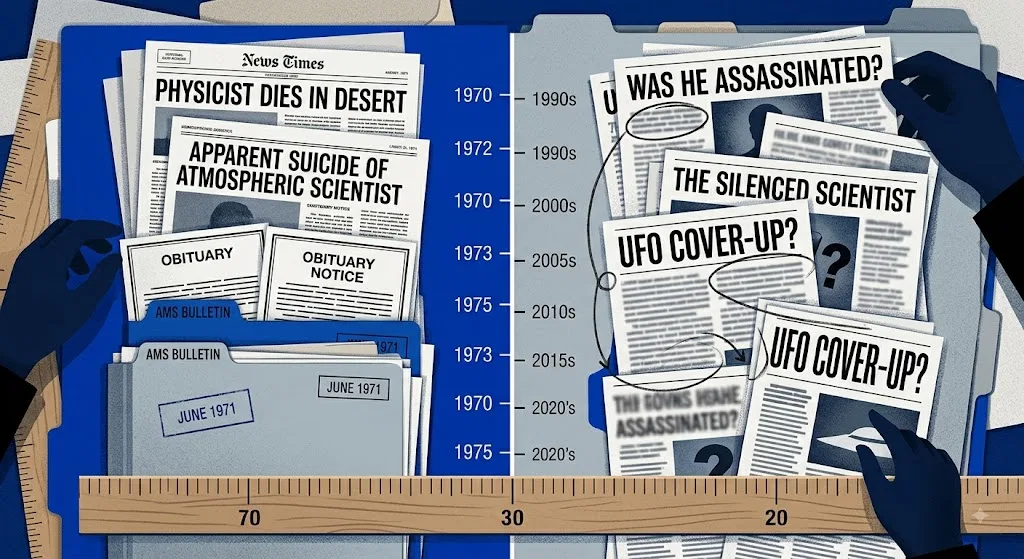
The least disputed starting point is McDonald’s identity and scientific standing. An obituary published in the Bulletin of the American Meteorological Society recorded that James Edward McDonald, a University of Arizona professor and AMS Fellow, died on 13 June 1971 at the age of 51. It summarised a conventional scientific career in atmospheric physics, cloud research and meteorology alongside his wider public interests.[NCAS Files]files.ncas.orgFiles Mc Carthy Dissertation: James E. Mc Donald ObituaryNCAS FilesMcCarthy Dissertation: James E. McDonald Obituary…
A New York Times report published on 16 June 1971, three days after his death, described him as a nationally known University of Arizona physicist and reported that he had been found dead in a desert area in what authorities regarded as an apparent suicide. That report is significant because the suicide interpretation was therefore not a late explanation devised after conspiracy speculation developed; it was part of the public record virtually immediately.[Kirk McDonald]kirkmcd.princeton.eduKirk Mc Donald Times MachineKirk Mc Donald Times Machine
The crucial chronological fact is that McDonald’s death was preceded by an earlier attempt to take his own life. Sources drawing on the biographical record place that first gunshot suicide attempt in April or early May 1971; he survived but suffered severe visual impairment. A contemporary diary entry by Jacques Vallée dated 7 May 1971 records that he had just been told McDonald had shot himself in the head and survived, evidence that knowledge of the attempt circulated among UFO researchers before McDonald’s death the following month.[dokumen.pub]dokumen.pubForbidden ScienceForbidden Science
That sequencing places a substantial burden on assassination theories. The proposition is no longer simply that a controversial UFO scientist was found shot. Any murder hypothesis must also account for an independently known earlier self-inflicted gunshot episode occurring weeks beforehand. The earlier attempt does not make later foul play logically impossible, but it makes the suicide explanation strongly continuous with events already under way before 13 June.
Later biographical summaries add further details — marital difficulties, hospital treatment, a recovered revolver and a note at the scene — but their evidential value varies according to their underlying sources. That is why the safest historical argument does not depend on every colourful detail. It depends first on the points that can be securely anchored: McDonald was active in UFO research; he had genuine disputes with government handling of UFO information; he suffered an earlier suicide attempt; and contemporary reporting treated his June death as another apparent suicide.[arizona.edu]lib.arizona.eduOpen source on arizona.edu.
The result is more nuanced than either a debunking caricature or a suppression story. McDonald faced serious professional controversy. His UFO research exposed him to ridicule, and the documentary record demonstrates that some government UFO material really was withheld or classified. These facts help explain why his death later became attractive to conspiracy writers. They do not provide evidence that officials caused it.
What disappears when the story is retold
The change becomes clearest when the contemporary sequence is compared with the compressed version that often circulates online.
The abbreviated narrative usually emphasises four points: McDonald was scientifically credible; he publicly challenged official UFO policy; intelligence agencies possessed UFO files and concealed some information; and he died from a gunshot wound. All four can be presented without fabricating a fact. Yet that sequence omits the strongest evidence against the implied causal relationship — particularly the prior suicide attempt.
Retellings can also convert uncertainty into insinuation through wording. A phrase such as “found dead in the desert” is factually compatible with suicide, homicide, accident or natural death. Isolated from the evidence surrounding it, however, the setting itself sounds mysterious. Similarly, placing “suicide” in quotation marks does not produce new forensic evidence; it signals suspicion while allowing the writer to avoid demonstrating homicide.
The problem is not unique to sceptical or conspiratorial writers. Every historical narrative selects material. The National Archives explicitly cautions researchers to ask about authorship, purpose, audience, reliability and how a document compares with other records.[National Archives]nationalarchives.gov.ukNational Archives Working with sourcesNational ArchivesWorking with sources - The National Archives… The relevant safeguard is therefore not blind faith in official documents but cross-source chronology: contemporary journalism, personal records, institutional archives and later scholarship should be compared rather than filtered through a single preferred interpretation.
McDonald’s own history provides an additional warning against simple binaries. The CIA’s retrospective account confirms that he had legitimate grounds to complain about secrecy surrounding the Robertson Panel and other UFO matters. The same historical record does not establish that this secrecy extended to murdering him.[CIA]cia.govcias role in the study of ufosCIA's Role in the Study of UFOs, 1947-1990 - CSI… A rigorous reconstruction can therefore accept that authorities concealed information while rejecting an unsupported leap from concealment to homicide.
What would justify overturning the early account?
Later evidence can defeat a contemporary explanation. Police determinations are sometimes wrong; classified files can be released; witnesses may disclose previously unknown actions; forensic review can identify inconsistencies that early investigators missed. Historical proximity is an advantage, not an immunity from correction.
For a decades-later murder claim in a case such as McDonald’s to become substantially stronger, however, it would need evidence that bears directly on the death rather than on the surrounding political atmosphere. Examples would include authenticated records of a plan to harm him, credible contemporaneous witnesses describing third-party involvement, forensic evidence inconsistent with suicide, proof that the purported suicide documentation was fabricated, or archival material tying named actors to both motive and operational action.
By contrast, several commonly cited points are only circumstantial:
Government secrecy. Demonstrated in parts of UFO history, but it does not identify a killer or establish a killing.
Official interest in a researcher. Surveillance, file-keeping or intelligence attention can document institutional concern without showing homicidal intent.
Professional ridicule or obstruction. Important to understanding a person’s circumstances, but not equivalent to physical coercion.
Research published shortly before or after a death. Temporal proximity can generate a hypothesis; it cannot establish causation on its own.
An unusual location or dramatic description of the body. Such details matter only when they conflict with forensic or investigative findings.
The standard is deliberately demanding because the allegation is demanding. “Authorities concealed some UFO information” and “authorities murdered this particular scientist” are claims of very different magnitude and require correspondingly different evidence.

Why early records matter more than later retellings
The strongest lesson from McDonald’s case is not that contemporary accounts must always win. It is that later theories must engage with the chronology they inherit.
McDonald is a poor fit for a simple story in which an inconvenient researcher was healthy and active until an inexplicable death suddenly removed him. His UFO advocacy was real; so were his battles with official secrecy. But evidence of his earlier suicide attempt existed before his fatal shooting, while reporting within days of his death already described the case as an apparent suicide.[dokumen.pub]dokumen.pubForbidden ScienceForbidden Science Those facts cannot responsibly be treated as later “official explanations” invented to answer conspiracy accusations that had not yet developed in their modern form.
At the same time, the record cautions against an equally simplistic conclusion that official institutions were transparent and therefore incapable of wrongdoing. CIA histories themselves acknowledge secrecy surrounding aspects of government UFO involvement, including the episode that angered McDonald in 1966.[CIA]cia.govcias role in the study of ufosCIA's Role in the Study of UFOs, 1947-1990 - CSI… The historically defensible position is narrower: genuine secrecy establishes a reason to investigate carefully, not a licence to assign responsibility for an unrelated death.
That distinction is the practical value of contemporary records across the broader subject of supposedly suspicious deaths and disappearances among UFO and unconventional-propulsion researchers. They preserve the sequence before hindsight supplies a plot. When a decades-later account omits a prior crisis, changes the order of events, treats institutional secrecy as proof of lethal intent or introduces a decisive allegation without contemporary corroboration, the discrepancy itself becomes evidence about how the conspiracy narrative was constructed.
Amazon book picks
Further Reading
Books and field guides related to Why Early Records Matter More Than Later Retellings. Use these as the next step if you want deeper reading beyond the article.
Historical Thinking and Other Unnatural Acts
Whether he is comparing how students and historians interpret documentary evidence or analyzing children's drawings, Wineburg's essays of...

The Craft of Research
Rating: 4.3/5 from 6 Google Books ratings
Since 1995, students, researchers, and professionals have turned to The Craft of Research for clear and helpful guidance on how to conduc...
The Historian's Craft
This work, by the co-founder of the "Annales School" deals with the uses and methods of history. It is useful for students of history, te...
The Landscape of History
What is history and why should we study it? Is there such a thing as historical truth? Is history a science? One of the most accomplished...
eBay marketplace picks
Marketplace Samples
Live-tested eBay searches with available results related to this page.
Selected fromUFO poster oneBay.co.uk.



Endnotes
1.
Source: archives.gov
Title: National Archives History in the Raw | National Archives
Link:https://www.archives.gov/education/research/history-in-the-raw.html
2.
Source: cia.gov
Title: cias role in the study of ufos 1947 1990
Link:https://www.cia.gov/resources/csi/studies-in-intelligence/studies-in-intelligence-1997/cias-role-in-the-study-of-ufos-1947-1990/
Source snippet
CIA's Role in the Study of UFOs, 1947-1990 - CSI...
3.
Source: lib.arizona.edu
Link:https://lib.arizona.edu/special-collections/collections/james-e-mcdonald-papers
4.
Source: files.ncas.org
Link:https://files.ncas.org/ufosymposium/mcdonald.html
Source snippet
NCAS FilesUFO Symposium 1968: McDonald StatementMarch 12, 1968...
Published: March 12, 1968
5.
Source: cia.gov
Title: STATScientist Accuses CIA of World Plot
Link:https://www.cia.gov/readingroom/docs/CIA-RDP75-00149R000500070001-2.pdf
Source snippet
STATScientist Accuses CIA of World PlotMarch 25, 2026...
Published: March 25, 2026
6.
Source: reddit.com
Title: Possible Grusch testimony on murders corroboration
Link:https://www.reddit.com/r/UFOs/comments/1575fg3/possible_grusch_testimony_on_murders/
Source snippet
Was prominent UFO researcher James E. McDonald murdered? Why did the FBI have several files mentioning his UFO research? Many were never...
7.
Source: reddit.com
Title: 23 Scientists gone (another scientist added to the list)
Link:https://www.reddit.com/r/UFO_scientists/comments/1tesyfl/23_scientists_gone_another_scientist_added_to_the/
Source snippet
23 Scientists gone (another scientist added to the list)...
8.
Source: files.ncas.org
Title: Files Mc Carthy Dissertation: James E. Mc Donald Obituary
Link:https://files.ncas.org/mccarthy/obit.html
Source snippet
NCAS FilesMcCarthy Dissertation: James E. [McDonald Obituary]({{ 'mc-donald-f859b7/' | relative_url }})...
9.
Source: dokumen.pub
Title: Forbidden Science
Link:https://dokumen.pub/forbidden-science-volume-two-fifth-americannbsped-0578032317-9780578032313.html
10.
Source: history.com
Title: ufo sightings cia robertson condon
Link:https://www.history.com/articles/ufo-sightings-cia-robertson-condon
11.
Source: archives.gov
Title: What’s an Archives? | National Archives
Link:https://www.archives.gov/about/info/whats-an-archives.html
12.
Source: archives.gov
Title: Intrinsic Value in Archival Material | National Archives
Link:https://www.archives.gov/research/alic/reference/archives-resources/archival-material-intrinsic-value.html
13.
Source: cia.gov
Title: How To Investigate a Flying Saucer
Link:https://www.cia.gov/stories/story/how-to-investigate-a-flying-saucer/
14.
Source: education.blogs.archives.gov
Title: considering context in primary sources john trumbull
Link:https://education.blogs.archives.gov/2013/09/17/considering-context-in-primary-sources-john-trumbull/
15.
Source: history.com
Title: Project Blue Book
Link:https://www.history.com/articles/project-blue-book
16.
Source: cia.gov
Link:https://www.cia.gov/readingroom/document/0000613256
17.
Source: cia.gov
Title: FOREIG N-CRISES PANEL SET UP BY CIA CHIEF | CIA FOIA (foia.cia.gov)
Link:https://www.cia.gov/readingroom/document/cia-rdp99-00498r000100150024-2
18.
Source: cia.gov
Link:https://www.cia.gov/readingroom/document/cia-rdp93b01137r000400010020-1
19.
Source: cia.gov
Title: PERMANEN T PANELS, TECHNICAL COORDINATING COMMITTEE | CIA FOIA (foia.cia.gov)
Link:https://www.cia.gov/readingroom/document/cia-rdp74b00535r000100030008-3
20.
Source: cia.gov
Title: the cias role in the study of ufos 1947 90
Link:https://www.cia.gov/resources/csi/studies-in-intelligence/archives/vol-40-no-5/the-cias-role-in-the-study-of-ufos-1947-90/
21.
Source: cia.gov
Title: studies in intelligence 1997
Link:https://www.cia.gov/resources/csi/studies-in-intelligence/studies-in-intelligence-1997/
22.
Source: files.ncas.org
Link:https://files.ncas.org/ufosymposium/contents.html
23.
Source: ncas.org
Link:https://www.ncas.org/mccarthy/obit.html
24.
Source: vault.fbi.gov
Link:https://vault.fbi.gov/search?SearchableText=mind+control&=&b_start%3Aint=450
25.
Source: vault.fbi.gov
Link:https://vault.fbi.gov/search?SearchableText=Robert+Jones&=&b_start%3Aint=30
26.
Source: vault.fbi.gov
Title: search?Searchable Text=Israel
Link:https://vault.fbi.gov/search%3FSearchableText%3DIsrael
27.
Source: lib.arizona.edu
Link:https://lib.arizona.edu/special-collections/collections/all/a-z/M?page=3
28.
Source: ufos.wiki
Title: James E. Mc Donald
Link:https://ufos.wiki/figure/james-e-mcdonald/
29.
Source: ufo.se
Title: 1042 mcdonald james edward 1920 1971
Link:https://www.ufo.se/index.php/fakta/lexikon/1042-mcdonald-james-edward
30.
Source: cia.gov
Title: SCIENTIST S REFUTE CLAIMS OF ‘UFO’ SIGHTINGS | CIA FOIA (foia.cia.gov)
Link:https://www.cia.gov/readingroom/document/cia-rdp81r00560r000100010014-6
31.
Source: cia.gov
Title: MAYB E THERE IS NO UFO! | CIA FOIA (foia.cia.gov)
Link:https://www.cia.gov/readingroom/document/0000214608
32.
Source: cia.gov
Link:https://www.cia.gov/readingroom/document/0005516065
33.
Source: cia.gov
Title: PANE L FOR FUTURE SATELLITE RECONNAISSANCE OPERATIONS | CIA FOIA (foia.cia.gov)
Link:https://www.cia.gov/readingroom/document/cia-rdp63-00313a000500090048-6
34.
Source: cia.gov
Title: FINA L REPORT OF AD HOC COMMITTEE ON NIS PROGRAM | CIA FOIA (foia.cia.gov)
Link:https://www.cia.gov/readingroom/document/cia-rdp78-05597a000400010035-4
35.
Source: nationalarchives.gov.uk
Title: National Archives Working with sources
Link:https://www.nationalarchives.gov.uk/education/students/study-resources/working-with-records/
Source snippet
National ArchivesWorking with sources - The National Archives...
36.
Source: loc.gov
Link:https://www.loc.gov/programs/teachers/getting-started-with-primary-sources
37.
Source: kirkmcd.princeton.edu
Title: Kirk Mc Donald Times Machine
Link:https://kirkmcd.princeton.edu/JEMcDonald/jem_obit_nytimes_061671c.pdf
38.
Source: guides.library.harvard.edu
Link:https://guides.library.harvard.edu/HistSciInfo/primary
39.
Source: fgs-project.com
Title: Obituaries | Terrell County, TXGen Web
Link:https://www.fgs-project.com/txgenwebcounties/terrell/obit/obit2.htm
40.
Source: guides.loc.gov
Title: primary sources
Link:https://guides.loc.gov/student-resources/primary-sources
41.
Source: scribd.com
Link:https://www.scribd.com/document/933725503/4880516
42.
Source: nationalarchives.gov.uk
Title: What are archives?
Link:https://www.nationalarchives.gov.uk/help-with-your-research/start-here/what-are-archives/
43.
Source: nationalarchives.gov.uk
Title: Archives and data protection: why archives and what is in scope
Link:https://www.nationalarchives.gov.uk/archives-sector/legislation/archives-data-protection-law-uk/data-protection/
44.
Source: nationalarchives.gov.uk
Link:https://www.nationalarchives.gov.uk/archives-sector/advice-and-guidance/managing-your-collection/archive-basics/introduction/
45.
Source: nationalarchives.gov.uk
Title: Why archives matter
Link:https://www.nationalarchives.gov.uk/archives-sector/our-archives-sector-role/the-governments-vision-for-archives-in-england/why-archives-matter/
46.
Source: sciencedirect.com
Title: Oral History
Link:https://www.sciencedirect.com/topics/social-sciences/oral-history
47.
Source: silverland.info
Title: James Edward Mc Donald
Link:https://www.silverland.info/ufo-s-people/james-edward-mc-donald/
48.
Source: t.co
Title: f Eslx Vt8CZ
Link:https://t.co/fEslxVt8CZ
Additional References
49.
Source: youtube.com
Title: UFO Researcher ENDS SELF, [Missing Scientist]({{ ‘missing-scientist/’ | relative_url }}) Conspiracy GETTING CRAZY | Tim Pool
Link:https://www.youtube.com/watch?v=aZZ9RugkX04
Source snippet
James E McDonald UFO death conspiracy James E. McDonald: The UFO Scientist Who Wouldn’t Back Down...
50.
Source: youtube.com
Link:https://www.youtube.com/watch?v=6xSil34LddA
Source snippet
Richard Dolan on James McDonald: Life, Death, & UFOs (1/15/19)...
51.
Source: youtube.com
Link:https://www.youtube.com/watch?v=1d–WxTUkXE
Source snippet
11 UFO Scientists are Missing... and More are Coming...
52.
Source: youtube.com
Title: Richard Dolan on James Mc Donald: Life, Death, & UFOs (1/15/19)
Link:https://www.youtube.com/watch?v=cOcO6Av41Rk
Source snippet
Father of 11th dead or missing scientist rejects suspicions about her death | NewsNation Live...
53.
Source: youtube.com
Link:https://www.youtube.com/watch?v=HzYns1zmYe4
Source snippet
UFO Researcher ENDS SELF, Missing Scientist Conspiracy GETTING CRAZY | Tim Pool...
54.
Source: loc.gov
Link:https://www.loc.gov/programs/teachers/getting-started-with-primary-sources/finding/
55.
Source: nixonlibrary.gov
Link:https://www.nixonlibrary.gov/research/guide-holdings
56.
Source: loc.gov
Link:https://www.loc.gov/classroom-materials/informational-text/
57.
Source: loc.gov
Link:https://www.loc.gov/programs/teachers/classroom-materials/primary-source-sets/?c=160
58.
Source: loc.gov
Link:https://www.loc.gov/programs/teachers/classroom-materials/primary-source-sets?st=slideshow