Within Peer Review
What Ning Li's 1997 Gravity Test Actually Found
Li's gravimeter test found no gravitational change above two parts in 100 million, sharply limiting the proposed static effect.
On this page
- Why the YBCO experiment was a decisive test
- What the two parts in 100 million limit means
- What the experiment did not test
Page outline Jump by section
Introduction
Ning Li’s 1997 experiment is important because it turned a controversial claim about superconducting “antigravity” into a quantitative laboratory test. Li, David Noever, Tony Robertson, Ron Koczor and Whitt Brantley placed cold type-II YBCO superconductors beneath a sensitive gravimeter and looked for a static change in local gravitational acceleration. They found no gravitational change larger than two parts in 100 million — 2 × 10⁻⁸ of ordinary gravity. The peer-reviewed paper appeared in Physica C: Superconductivity in August 1997 and is also catalogued by NASA’s Technical Reports Server.[ScienceDirect]sciencedirect.comStatic test for a gravitational force coupled to type II YBCO superconductors - ScienceDirectAugust 1, 1997…
That result did not prove that every conceivable gravity–superconductor interaction was impossible. In particular, the experiment did not reproduce the rotating, strongly time-dependent configuration associated with some of the most dramatic contemporary claims. But for a static superconducting gravity-shielding or absorption effect, it was a powerful null result: effects previously discussed at roughly the 0.05% level would have been thousands of times larger than Li’s experimental limit.[ScienceDirect]sciencedirect.comA possibility of gravitational force shielding by bulk YBa2Cu3O7−x superconductor - ScienceDirectDecember 10, 1992…
Why the YBCO experiment was a decisive test
The immediate scientific context was the extraordinary claim published by Eugene Podkletnov and Risto Nieminen in Physica C in 1992. They reported that a small test object positioned above a levitating YBCO — yttrium barium copper oxide — superconducting disc appeared to lose about 0.05% to 0.3% of its weight, depending on the disc’s rotation speed. Podkletnov subsequently reported larger anomalies under other operating conditions.[ScienceDirect]sciencedirect.comA possibility of gravitational force shielding by bulk YBa2Cu3O7−x superconductor - ScienceDirectDecember 10, 1992…
Li and her colleagues therefore had something experimentally concrete to check. Their 1997 paper explicitly noted earlier reports of 0.05–2.1% anomalous weight changes and a reported static variation of roughly 5 parts in 10,000. Instead of merely debating possible gravity–superconductor mechanisms theoretically, they asked whether a sensitive gravimeter could detect a gravitational anomaly above cold bulk YBCO.[ScienceDirect]sciencedirect.comStatic test for a gravitational force coupled to type II YBCO superconductors - ScienceDirectAugust 1, 1997…
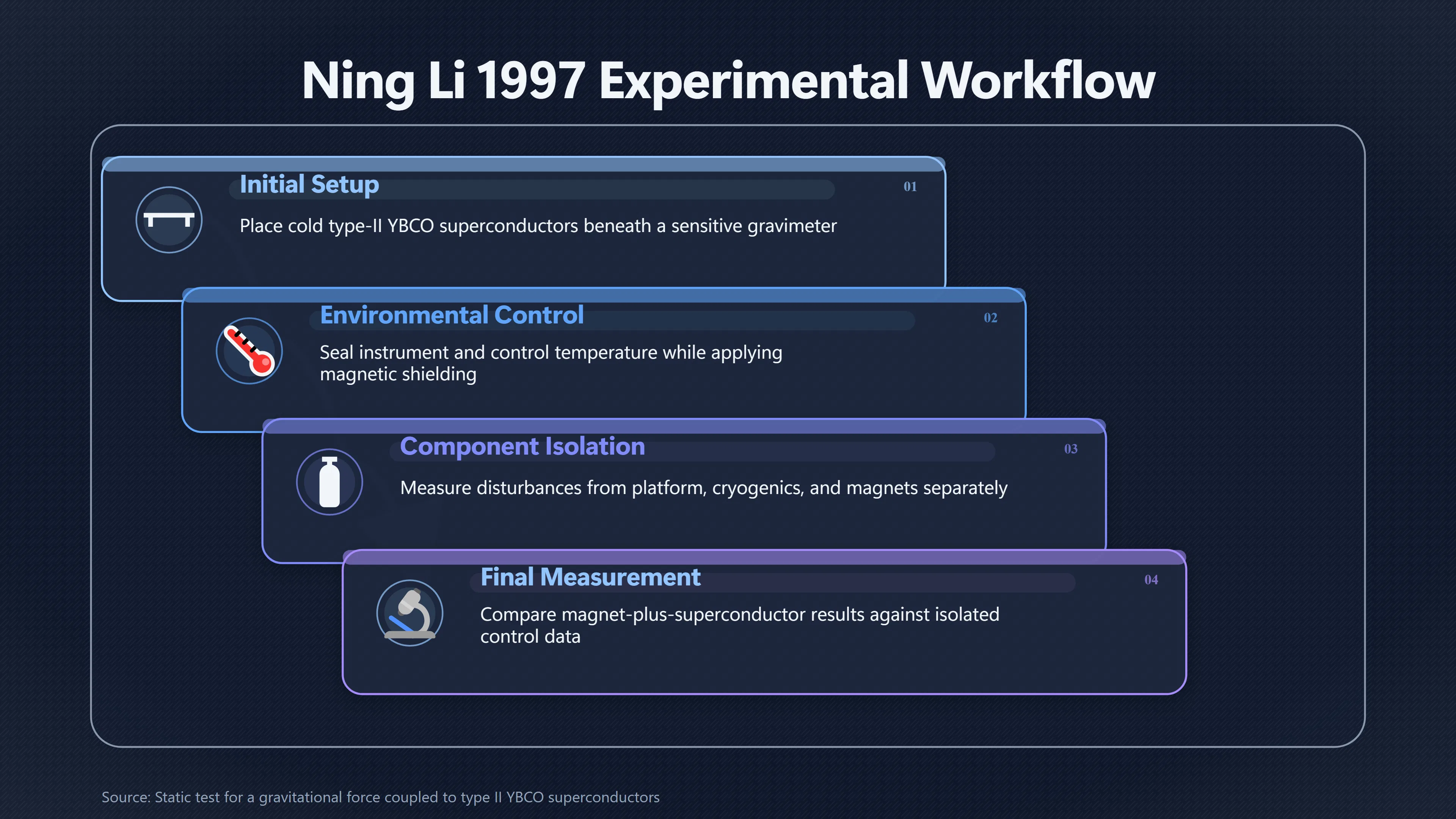
The apparatus was substantially more sensitive than an ordinary weighing experiment. The team used a modified LaCoste-Romberg relative gravimeter, which detects tiny changes in the gravitational force acting on an internal spring-mass system. Its nominal gravity-variation resolution was stated as one part in 10 billion, although practical operating noise and systematic effects meant that the final experimental limit was less stringent than that instrumental resolution. The gravimeter was checked against reference gravity values and tested by deliberately changing its altitude, following solar and lunar tidal variations and exposing its surroundings to a large temperature change.[Unpublished]unpublished.caPII: S0921-4534(97)01462-7…
The superconductors were not token laboratory samples. One configuration used a melt-textured YBCO disc about 10 centimetres across and 1.25 centimetres thick. Another assembled 48 single-domain YBCO hexagons into an array roughly 15 by 20 centimetres, closer to the footprint of the gravimeter. The material was cooled to 77 K with liquid nitrogen; depending on the run, it was either field-cooled or zero-field-cooled and could be magnetically levitated several centimetres above permanent magnets.[Unpublished]unpublished.caPII: S0921-4534(97)01462-7…
That mattered because the central experimental problem was not simply measuring a number. Cryogenic equipment, powerful magnets, vibration and moving apparatus can themselves disturb a gravimeter. A convincing test therefore had to distinguish a hypothetical gravitational signal from those much more mundane influences.
Li’s group attempted exactly that separation. The gravimeter sat on concrete blocks and remained stationary while components were moved beneath it on a platform. The instrument was sealed and temperature controlled; magnetic shielding and, in some measurements, a thick iron plate reduced magnetic interference. The team separately measured disturbances associated with the empty platform, liquid-nitrogen cryogenics, magnets alone, cold YBCO without a magnetic field, and finally the magnet-plus-superconductor combinations.[Unpublished]unpublished.caPII: S0921-4534(97)01462-7…
This control structure is the most scientifically significant feature of the experiment. A magnet or cryostat could produce a gravimeter excursion without changing gravity at all. By introducing those components separately, the researchers could estimate how large each non-gravitational contribution was before asking whether anything remained that uniquely followed the superconducting state.[Unpublished]unpublished.caPII: S0921-4534(97)01462-7…
What the two-parts-in-100-million limit means
The headline result was not a measured antigravity force. It was an upper bound. Li and colleagues concluded that the maximum possible static gravity change attributable to the superconducting configuration was less than 2 × 10⁻⁸ of normal gravitational acceleration. NASA’s later summary of the work repeated the same limit and noted the use of magnetic shielding, thermal control and buoyancy compensation.[Unpublished]unpublished.caPII: S0921-4534(97)01462-7…
Near Earth’s surface, gravitational acceleration is about 9.8 m/s². Two parts in 100 million therefore corresponds to an acceleration change of only about 2 × 10⁻⁷ m/s². The experiment could not say that the true effect was exactly zero; experiments never establish mathematical zero. It said that, under the tested static conditions, any anomalous gravitational contribution had to lie below that experimental ceiling.
The comparison with the earlier reported static effect makes the scale easier to appreciate. A change of 5 parts in 10,000 is 5 × 10⁻⁴, whereas Li’s limit was 2 × 10⁻⁸. The former is 25,000 times larger than the latter. Li and her co-authors themselves described their measurement as an improvement of roughly four to five orders of magnitude over earlier balance measurements that lacked comparable thermal and magnetic compensation.[Unpublished]unpublished.caPII: S0921-4534(97)01462-7…
The original Podkletnov-Nieminen paper had reported changes of 0.05–0.3%, or approximately 5 × 10⁻⁴ to 3 × 10⁻³ of an object’s normal weight. Those values likewise sit vastly above the 1997 static gravimeter limit. The comparison is not a literal replication comparison because the experimental configurations differed, particularly regarding rotation. It does, however, show why a straightforward interpretation in which cold YBCO itself passively shields an appreciable fraction of Earth’s gravity became very difficult to sustain.[ScienceDirect]sciencedirect.comA possibility of gravitational force shielding by bulk YBa2Cu3O7−x superconductor - ScienceDirectDecember 10, 1992…
The experiment also illustrates why “null result” can be misleading language. Nothing exotic was detected, but scientifically the measurement produced useful information: it carved away a large region of possible effect sizes. A static gravity reduction of one part in a thousand, ten thousand or even a million under those experimental conditions was incompatible with the measurements. Whatever room remained for an unconventional effect was much smaller.
The controls mattered as much as the final number
The paper’s individual control measurements show why the final 2 × 10⁻⁸ limit should not be confused with the gravimeter simply displaying a perfectly flat line.
Moving the empty experimental platform produced apparent changes below roughly 1–3 × 10⁻⁶ cm/s². Cryogenic effects from boiling liquid nitrogen were below about 2 × 10⁻⁶ cm/s². Magnets alone could produce apparent changes below about 6 × 10⁻⁶ cm/s², while cold zero-field-cooled YBCO without magnetic effects gave changes below about 2 × 10⁻⁶ cm/s². Static magnetically pinned superconducting configurations produced apparent contributions in roughly the 2–5 × 10⁻⁶ cm/s² range.[Unpublished]unpublished.caPII: S0921-4534(97)01462-7…
Those observations created an attribution problem. YBCO is strongly diamagnetic in its superconducting state, so inserting it changes the magnetic environment around the gravimeter. The authors explicitly recognised that subtracting a “magnet only” measurement from a “magnet plus superconductor” measurement could mix a hypothetical gravitational signal with ordinary magnetic shielding caused by the YBCO. They estimated that the superconductor could shield roughly 20–90% of the magnetic field depending on its magnetic history.[Unpublished]unpublished.caPII: S0921-4534(97)01462-7…
Their conclusion was therefore deliberately framed as a limit rather than a detection: after accounting for these effects, the maximum static gravitational contribution was below two parts in 100 million. This is a more cautious result than claiming that every tiny movement of the gravimeter had been perfectly explained, but it is also scientifically stronger than treating an unexplained instrumental excursion as evidence of altered gravity.
The experimental precautions are particularly relevant to the history of superconducting antigravity claims because conventional environmental effects had already been raised as possible explanations. Li’s paper noted earlier discussion of buoyancy and air currents, and its own design addressed atmospheric pressure, temperature, vibration and magnetic contamination directly.[Unpublished]unpublished.caPII: S0921-4534(97)01462-7…
What the experiment did not test
The most important qualification is contained in the paper’s title: this was a static test. The YBCO was not spinning in the configuration for which Li and colleagues established their headline limit.
That distinction matters because the competing speculative mechanisms did not all predict the same experimental signature. A simple gravitational “shield” or absorption mechanism could potentially be constrained strongly by a stationary superconductor. By contrast, Li and Douglas Torr’s proposed gravitomagnetic effects depended on dynamical quantities associated with motion and changing fields. Li’s 1997 paper explicitly said that the static result more strongly constrained simple shielding or gravitational-absorption interpretations than mechanisms requiring a time-dependent gravitomagnetic potential.[Unpublished]unpublished.caPII: S0921-4534(97)01462-7…
Nor was the experiment an exact reproduction of Podkletnov’s rotating-disc apparatus. Podkletnov and Nieminen’s 1992 experiment reported a rotation-dependent effect, with a test mass above a levitating superconducting disc apparently losing 0.05–0.3% of its weight. A later Podkletnov account claimed substantially larger changes — approaching 2% — under particular rotating and electromagnetic conditions.[ScienceDirect]sciencedirect.comA possibility of gravitational force shielding by bulk YBa2Cu3O7−x superconductor - ScienceDirectDecember 10, 1992…
Li and colleagues were explicit about this boundary. Their paper ended by saying that a rotating version of the experiment would be reported in subsequent work. The 2 × 10⁻⁸ figure therefore should not be quoted as though the team had reproduced every feature of the rotating Podkletnov experiment and excluded every proposed superconducting gravity effect to that level.[Unpublished]unpublished.caPII: S0921-4534(97)01462-7…
The paper did explore more than one electromagnetic condition. It reported measurements involving both DC and low-strength AC magnetic fields, field-cooled and zero-field-cooled YBCO, different superconducting geometries and measurements near the superconducting transition. Some AC configurations showed gravimeter variations at only a few nanogals in the plotted results. But these still were not equivalent to a rapidly rotating superconducting disc operating under the full conditions of the more dramatic claims.[Unpublished]unpublished.caPII: S0921-4534(97)01462-7…
That distinction cuts both ways. It prevents overstating the null result, but it also prevents using untested dynamic configurations to erase what the experiment actually established. A hypothesis predicting a substantial static gravitational attenuation from superconducting YBCO has to confront Li’s limit; merely pointing out that some other hypothetical mechanism requires rotation does not invalidate that measurement.

The antigravity claim after 1997
For the peer-reviewed history of controversial gravity research, Li’s experiment is unusually informative because the researcher associated with unconventional gravity–superconductor theories also participated in an experiment that produced a stringent null constraint. This is different from a simple story in which an outside sceptic dismissed an unconventional theory without testing it.
The published record shows a conventional scientific sequence: anomalous observations were reported; competing physical explanations were proposed; a more sensitive instrument was brought to bear; major sources of systematic error were isolated; and the resulting measurement substantially reduced the permissible size of a static anomaly. The article was published as an eight-page research paper in Physica C, volume 281, pages 260–267, after being received on 2 April and accepted on 30 May 1997. NASA subsequently preserved the journal reprint in its Technical Reports Server.[Unpublished]unpublished.caPII: S0921-4534(97)01462-7…
This also clarifies what “peer-reviewed antigravity research” means in this particular case. Podkletnov and Nieminen’s anomalous-weight paper really did appear in the peer-reviewed Physica C, as did Li and colleagues’ later test. Peer review therefore establishes that unconventional gravity claims entered the scientific literature and were investigated seriously enough to warrant experimental scrutiny. It does not mean that the literature ultimately confirmed gravitational shielding. Tampere University’s research record identifies the 1992 Podkletnov-Nieminen article as a refereed journal article, while the later Physica C paper provides the much tighter static constraint.[Tampere University Research Portal]researchportal.tuni.fiTampere University Research PortalA Possibility of Gravitation Force Shielding by Bulk YBa2Cu3O7-x Superconductor - Tampere University Re…
Within the wider history of claims linking antigravity research to secrecy, UFO technology or suspicious events involving researchers, that distinction is essential. The 1997 paper is strong documentary evidence that NASA-affiliated researchers genuinely investigated an unconventional superconducting-gravity hypothesis. It is not experimental evidence that they possessed functioning antigravity technology. The published measurement points in almost the opposite direction for the configuration it actually tested.
The most defensible summary is consequently narrower but more useful than either extreme. Li’s 1997 experiment did not establish that gravity manipulation is impossible, and it did not fully test the rotating configurations invoked in some superconducting-antigravity claims. What it did establish was a remarkably stringent experimental boundary: for static YBCO superconductors under the tested conditions, any gravitational anomaly was smaller than two parts in 100 million of Earth’s normal gravitational acceleration. For the proposed static “gravity shielding” effect, that limit — rather than the existence of the experiment alone — is the central scientific result.[ScienceDirect]sciencedirect.comStatic test for a gravitational force coupled to type II YBCO superconductors - ScienceDirectAugust 1, 1997…
Amazon book picks
Further Reading
Books and field guides related to What Ning Li's 1997 Gravity Test Actually Found. Use these as the next step if you want deeper reading beyond the article.
Gravity: An Introduction to Einstein's General Relativity
Einstein's theory of general relativity is a cornerstone of modern physics. It also touches upon a wealth of topics that students find fa...
The Demon-Haunted World: Science as a Candle in the Dark
Rating: 4.5/5 from 43 Google Books ratings
NEW YORK TIMES BESTSELLER • From the renowned astronomer and author of Cosmos comes a “powerful [and] stirring defense of informed ration...
eBay marketplace picks
Marketplace Samples
Live-tested eBay searches with available results related to this page.
Selected fromgravity physics poster oneBay.co.uk.

Endnotes
1.
Source: sciencedirect.com
Link:https://www.sciencedirect.com/science/article/pii/S0921453497014627
Source snippet
Static test for a gravitational force coupled to type II YBCO superconductors - ScienceDirectAugust 1, 1997...
Published: August 1, 1997
2.
Source: ntrs.nasa.gov
Link:https://ntrs.nasa.gov/search.jsp?R=19990039542&hterms=superconductors
Source snippet
NASA Technical Reports ServerStatic Test for a Gravitational Force Coupled to Type 2 YBCO Superconductors - NASA Technical Reports Server...
3.
Source: sciencedirect.com
Link:https://www.sciencedirect.com/science/article/abs/pii/092145349290055H
Source snippet
A possibility of gravitational force shielding by bulk YBa2Cu3O7−x superconductor - ScienceDirectDecember 10, 1992...
Published: December 10, 1992
4.
Source: unpublished.ca
Link:https://unpublished.ca/sites/default/files/letter/263060/NL%203-3.pdf
Source snippet
PII: S0921-4534(97)01462-7...
5.
Source: ntrs.nasa.gov
Link:https://ntrs.nasa.gov/search.jsp?R=19990104365
Source snippet
NASA Technical Reports ServerTest Status for Proposed Coupling of a Gravitational Force to Extreme Type II YBCO Ceramic Superconductors...
6.
Source: ntrs.nasa.gov
Link:https://ntrs.nasa.gov/search.jsp?R=19990039542
Source snippet
NASA Technical Reports ServerStatic Test for a Gravitational Force Coupled to Type 2 YBCO Superconductors - NASA Technical Reports Server...
7.
Source: sciencedirect.com
Link:https://www.sciencedirect.com/science/article/pii/S0921453402022840
8.
Source: sciencedirect.com
Title: Static test for a gravitational force coupled to type II YBCO superconductors
Link:https://www.sciencedirect.com/science/article/abs/pii/S0921453497014627
9.
Source: sciencedirect.com
Link:https://www.sciencedirect.com/journal/physica-c-superconductivity-and-its-applications/vol/281/issue/2
10.
Source: sciencedirect.com
Title: Alternative explanation of “gravitational screening” experiments
Link:https://www.sciencedirect.com/science/article/pii/0921453495004947
11.
Source: sciencedirect.com
Title: Alternative explanation of “gravitational screening” experiments
Link:https://www.sciencedirect.com/science/article/abs/pii/0921453495004947
12.
Source: sciencedirect.com
Title: Superconductivity of trigonal Ba Si2
Link:https://www.sciencedirect.com/science/article/pii/0921453495000828
13.
Source: sciencedirect.com
Link:https://www.sciencedirect.com/science/article/pii/092145349290055H
14.
Source: sciencedirect.com
Link:https://www.sciencedirect.com/science/article/pii/092145349290055H/pdf?md5=bfc751b87889117434dec5c029c2d522&pid=1-s2.0-092145349290055H-main.pdf
15.
Source: sciencedirect.com
Title: Gravitational-magnetic-electric field interaction
Link:https://www.sciencedirect.com/science/article/pii/S2211379718314128
16.
Source: sciencedirect.com
Title: NAS A breakthrough propulsion physics program
Link:https://www.sciencedirect.com/science/article/pii/S0094576599000454/pdf?md5=319c44c42d46bdc84bf89b7db0baa40c&pid=1-s2.0-S0094576599000454-main.pdf
17.
Source: sciencedirect.com
Title: Reverse Engineering Podkletnov’s Experiments
Link:https://www.sciencedirect.com/science/article/pii/S1875389211005803
18.
Source: everything.explained.today
Title: Eugene Podkletnov
Link:https://everything.explained.today/Eugene_Podkletnov/
19.
Source: researchportal.tuni.fi
Link:https://researchportal.tuni.fi/en/publications/a-possibility-of-gravitation-force-shielding-by-bulk-yba2cu3o7-x-/
Source snippet
Tampere University Research PortalA Possibility of Gravitation Force Shielding by Bulk YBa2Cu3O7-x Superconductor - Tampere University Re...
20.
Source: wiki-gateway.eudic.net
Title: Gravitational shielding
Link:https://wiki-gateway.eudic.net/wikipedia_en/Gravitational_shielding.html
21.
Source: zamandayolculuk.com
Link:https://www.zamandayolculuk.com/html-3/electrostatic_propulsion.htm
22.
Source: researchportal.tuni.fi
Link:https://researchportal.tuni.fi/fi/publications/a-possibility-of-gravitation-force-shielding-by-bulk-yba2cu3o7-x-/
23.
Source: science.gov
Link:https://www.science.gov/topicpages/m/magnetic%2Blevitation%2Bexperiments
24.
Source: science.gov
Link:https://www.science.gov/topicpages/m/mm%2Bwide%2Bybco.html
25.
Source: science.gov
Link:https://www.science.gov/topicpages/y/ybco%2Bmelted%2Bsamples
26.
Source: science.gov
Link:https://www.science.gov/topicpages/b/bulk%2Bhigh-temperature%2Bsuperconductor
27.
Source: science.gov
Link:https://www.science.gov/topicpages/h/high-quality%2Bybco%2Bfilms
28.
Source: science.gov
Link:https://www.science.gov/topicpages/e/electromagnetic%2Blevitation%2Bspyce
29.
Source: a.osmarks.net
Title: Gravitational shielding
Link:https://a.osmarks.net/content/wikipedia_en_all_maxi_2020-08/A/Gravitational_shielding
Additional References
30.
Source: americanalchemymagazine.substack.com
Title: the ning li cover up they got completely
Link:https://americanalchemymagazine.substack.com/p/the-ning-li-cover-up-they-got-completely?triedRedirect=true
Source snippet
Upon researching Ning Li, there is much in the public domain that is incorrect. Indeed, the dominant narrative running throu...
31.
Source: wiki.naturalphilosophy.org
Link:https://www.wiki.naturalphilosophy.org/index.php?title=Ning_Li
Source snippet
Li - Natural Philosophy WikiJuly 20, 2026 — Ning Li --- Residence | United States Nationality | Chinese / USA Known for | Antigravity, Su...
Published: July 20, 2026
32.
Source: arxiv.org
Link:https://arxiv.org/abs/cond-mat/9701074
33.
Source: youtube.com
Title: The Mysterious Demise Of Dr. Ning Li | Jim Landrith
Link:https://www.youtube.com/watch?v=CQJMBdT5WEk
Source snippet
Eugene Podkletnov on Gravitational Shielding in Rotating Superconductors...
34.
Source: youtube.com
Title: The disappearance of America’s leading anti-gravity researcher
Link:https://www.youtube.com/watch?v=Qsbz8_G9WcU
Source snippet
Superconductors & Gravity Control | Gary Stephenson...
35.
Source: youtube.com
Title: Superconductors & Gravity Control | Gary Stephenson
Link:https://www.youtube.com/watch?v=msrhrssRmCE
Source snippet
The Mysterious Demise Of Dr. Ning Li | Jim Landrith...
36.
Source: researchgate.net
Link:https://www.researchgate.net/publication/354521867_A_simple_investigation_of_Static_test_for_a_gravitational_force_coupled_to_type_II_YBCO_superconductors_by_Li_and_coworkers
37.
Source: researchgate.net
Link:https://www.researchgate.net/publication/351775909_Gravitational-magnetic-electric_interaction_in_controlling_relative_permittivity_and_permeability
38.
Source: researchgate.net
Link:https://www.researchgate.net/publication/1967822_Weight_Measurements_of_High-Temperature_Superconductors_during_Phase_Transition_in_Stationary_Non-Stationary_Condition_and_under_ELF_Radiation
39.
Source: eurekamag.com
Link:https://eurekamag.com/research/073/952/073952032.php