Within Peer Review
Could Superconductors Amplify Tiny Gravity Effects?
Li and Torr explored whether coherent superconducting matter could make normally minuscule relativistic gravity effects large enough to detect.
On this page
- What gravitomagnetism means in weak field relativity
- Why superconducting coherence seemed promising
- Where the proposed amplification ran into criticism
Page outline Jump by section
Introduction
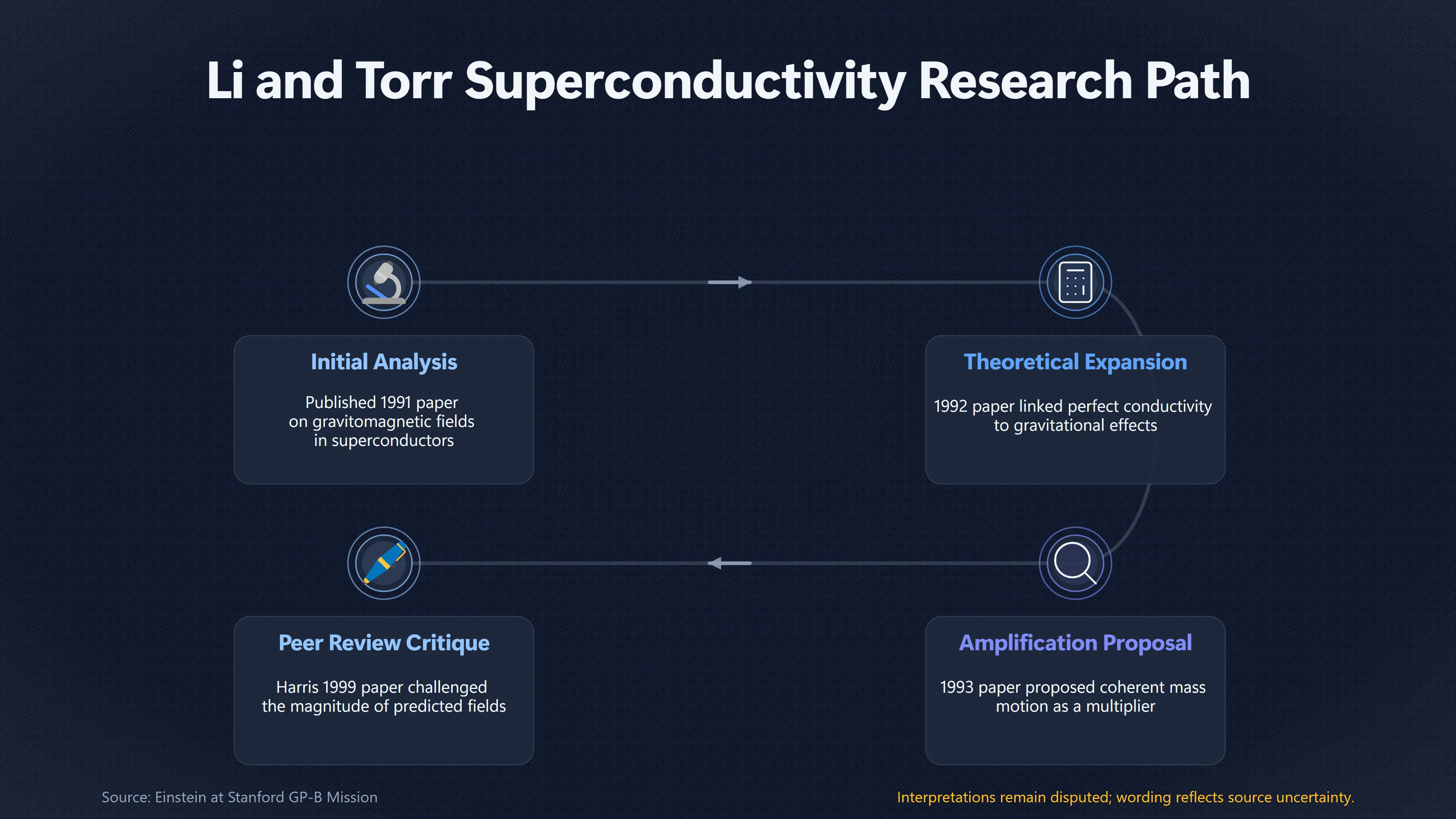
The central scientific gamble in Ning Li and Douglas G. Torr’s superconducting-gravity work was not that gravitomagnetism itself was exotic. Gravitomagnetism is a standard weak-field consequence of general relativity: moving or rotating mass produces effects analogous, in a limited mathematical sense, to the magnetic effects of moving electric charge. The difficulty is that laboratory-scale gravitomagnetic fields are fantastically weak. Earth’s frame-dragging field has required satellite experiments and years of precision measurement to resolve.[Einstein at Stanford]einstein.stanford.eduEinstein at Stanford GP-B MissionEinstein at StanfordGP-B Mission - Overview…
Li and Torr therefore needed an amplification mechanism. Their proposal was that the macroscopic quantum coherence of a superconductor could organise matter in a way that made normally negligible gravitational couplings detectable. Their 1991–93 papers developed electromagnetic and gravitational analogues together, eventually arguing that coherent lattice-ion motion and spin alignment could generate measurable gravitomagnetic effects.[Physical Review Journals]journals.aps.orgPhys Rev D.43.457Physical Review JournalsEffects of a gravitomagnetic field on pure superconductors | Phys. Rev. DJanuary 15, 1991…
That amplification claim is the crucial dividing line between an interesting application of established relativity and a potential route towards gravity engineering. It is also where the strongest criticism landed. Edward G. Harris subsequently argued that assumptions used to obtain experimentally accessible fields made the predicted effects many orders of magnitude too large.[FTP Utah Math]ftp.math.utah.eduFTP Utah Math Foundations of Physics LettersFTP Utah MathFoundations of Physics LettersJanuary 18, 2025…
What gravitomagnetism actually means
In the weak-field, slow-motion limit of general relativity, Einstein’s equations can be written in a form that bears a useful resemblance to Maxwell’s equations for electromagnetism. Ordinary mass produces the familiar gravitational attraction, while moving mass and angular momentum introduce additional effects often grouped under the name gravitoelectromagnetism. Its magnetic-like component is called the gravitomagnetic field.
The analogy should not be taken too literally. Gravity is not simply electromagnetism with mass substituted for electric charge, and the full theory remains general relativity. But the approximation gives physicists an intuitive way to describe effects such as frame-dragging, in which a rotating massive body slightly alters the motion of nearby objects and gyroscopes. Gravity Probe B was designed specifically to measure the frame-dragging caused by Earth’s rotation, while analyses of the LAGEOS and LARES laser-ranged satellites have provided another experimental route to Earth’s gravitomagnetic field.[stanford.edu]einstein.stanford.eduEinstein at Stanford GP-B MissionEinstein at StanfordGP-B Mission - Overview…
This established physics is important because it separates Li and Torr’s starting point from the extraordinary interpretation later attached to their work. They did not need to invent gravitomagnetism. The speculative step was instead the proposition that superconducting matter could make its effects extraordinarily larger or more accessible than conventional matter would.
That was an enormous experimental hurdle to overcome. General relativity predicts readily measurable gravitational effects from planets, stars and other astronomical masses, but ordinary laboratory masses generate gravitomagnetic fields so small that exploiting them technologically is effectively impossible. Even modern experimental work looking for unconventional electromagnetic-gravitational couplings stresses the enormous gap between ordinary laboratory fields and anything resembling useful gravity control.[arXiv]arxiv.orgIn-Depth Search for a Coupling between Gravity and Electromagnetism with Steady FieldsFebruary 23, 2024…
In other words, simply demonstrating that a spinning mass has a gravitomagnetic field would not lead to antigravity. The physics already says that it does. The decisive question was whether superconductivity provided an exceptional multiplier.
Why superconducting coherence seemed promising
Superconductors offered Li and Torr an unusual physical system because they display quantum behaviour on macroscopic scales. Below the superconducting transition temperature, electrical resistance disappears and the electromagnetic response of the material becomes governed by a coherent superconducting state. The Meissner effect, in which magnetic flux is expelled from the superconducting bulk apart from a characteristic penetration region, is one of its most conspicuous manifestations.
That macroscopic coherence made superconductors tempting laboratories for gravity–quantum coupling. Instead of asking what the gravitational field of isolated microscopic particles would be, researchers could ask whether an enormous number of constituents behaving collectively might produce a qualitatively different response.
Li and Torr’s 1991 Physical Review D paper, “Effects of a gravitomagnetic field on pure superconductors”, put this idea into a coupled electromagnetic-gravitomagnetic calculation. They considered external magnetic and gravitomagnetic fields and obtained internal solutions in which the fields could mutually induce small perturbations. They also found that a particular combination of the magnetic and gravitomagnetic fields decayed exponentially over a characteristic penetration distance.[Physical Review Journals]journals.aps.orgPhys Rev D.43.457Physical Review JournalsEffects of a gravitomagnetic field on pure superconductors | Phys. Rev. DJanuary 15, 1991…
That paper is sometimes described loosely as an antigravity proposal, but its actual result was subtler. It was primarily an analysis of how magnetic and gravitomagnetic terms would behave inside superconducting matter under the authors’ assumptions. The paper explicitly described the induced perturbations as small.[OSTI]osti.govEffects of a gravitomagnetic field on pure superconductors (Journal Article) | OSTI.GOV…
Their 1992 Physical Review B paper pushed the proposed connection further. Li and Torr argued that when gravitational terms were included, two defining properties associated with ideal superconductors — perfect electrical conductivity and perfect diamagnetism — could be connected within their theoretical model. Their published abstract described the result cautiously, saying it suggested a possible importance of gravitational effects for understanding superconductivity.[Physical Review Journals]journals.aps.orgOpen source on aps.org.
The more consequential amplification argument emerged from how they treated the motion of the superconducting material itself.
The proposed multiplier was coherent mass motion
Electric and gravitational interactions have a crucial difference for Li and Torr’s argument. Electric charge comes in positive and negative varieties, whereas ordinary gravitational mass does not have an equivalent pair of positive and negative gravitational charges that can simply cancel.
Their 1993 paper, “Gravitoelectric-Electric Coupling via Superconductivity”, built on a model in which the lattice ions themselves played an important role in carrying quantised angular momentum. Torr and Li argued that free-electron and bound-ion electrical currents could largely cancel magnetically while the corresponding mass currents would not cancel in the same way. They then proposed that coherent alignment of lattice-ion spins could generate a detectable gravitomagnetic field. A changing magnetic vector potential, in their treatment, could also lead to a detectable gravitoelectric response.[Ouci]ouci.dntb.gov.uaOuci Gravitoelectric-electric coupling via superconductivityOuci Gravitoelectric-electric coupling via superconductivity
This is the mechanism that made the programme potentially transformative. A microscopic gravitational interaction is useless for propulsion or laboratory gravity manipulation if it remains microscopic. But if superconductivity could make huge numbers of microscopic contributions act coherently rather than randomly, their combined field might conceivably rise above experimental noise.
The distinction can be put simply:
ordinary matter: gravitational coupling exists, but the laboratory signal is effectively negligible;
Li–Torr proposal: superconducting coherence organises mass-related degrees of freedom so that their contributions become collectively detectable;
technological leap: if that collective effect became sufficiently large and controllable, gravity would cease to be merely something measured astronomically and could become a laboratory field.
The first statement is conventional physics. The second was Li and Torr’s contested theoretical proposal. The third is the extrapolation that fuelled later interest in “antigravity”.
This explains why amplification mattered more than the mere appearance of gravitomagnetic terminology in the papers. Without an enhancement mechanism, gravitomagnetism offers no realistic path from general relativity to a laboratory gravity-control device.
The scale problem was the whole problem
A useful comparison is Earth itself. Earth possesses an immense amount of rotating mass, yet its frame-dragging effect is so small that measuring it required extraordinarily sensitive techniques. Gravity Probe B placed precision gyroscopes in a 642-kilometre orbit specifically to detect the tiny relativistic precession associated with Earth’s curved and rotating spacetime.[Einstein at Stanford]einstein.stanford.eduEinstein at Stanford GP-B MissionEinstein at StanfordGP-B Mission - Overview…
Satellite laser ranging provides another measure of the difficulty. Analyses combining LAGEOS, LAGEOS II and LARES data have extracted the Lense–Thirring precession by modelling many much larger orbital perturbations. A 2020 analysis reported a measurement of Earth’s gravitomagnetic field at approximately the one-per-cent level using three laser-tracked satellites.[MDPI]mdpi.comUniverse | Special Issue: Frame-Dragging and GravitomagnetismUniverse | Special Issue: Frame-Dragging and Gravitomagnetism…
Against that scale, the attraction of superconducting amplification becomes obvious. A laboratory ceramic disc contains almost no mass compared with a planet. Conventional general relativity therefore gives no reason to expect such an object to produce a technologically significant gravitomagnetic field merely because it is rotating.
Li and Torr were effectively proposing a way around this scale barrier: the relevant collective quantum state might make gravitational terms behave differently from the naïve classical expectation.
But this also created a stringent credibility test. An amplification large enough to convert a conventionally invisible gravitational interaction into an easily measurable one cannot be treated as a minor correction. Its mathematical origin, physical assumptions and numerical magnitude have to survive unusually careful scrutiny.
Where the amplification ran into criticism
That scrutiny produced objections during the 1990s. The most important for understanding the proposed mechanism is Edward G. Harris’s peer-reviewed critique, “Comments on ‘Gravitoelectric-Electric Coupling via Superconductivity’ by Douglas G. Torr and Ning Li”, published in Foundations of Physics Letters in 1999. The bibliographic record places it in volume 12, pages 201–208.[FTP Utah Math]ftp.math.utah.eduFTP Utah Math Foundations of Physics LettersFTP Utah MathFoundations of Physics LettersJanuary 18, 2025…
Harris did not argue that gravitomagnetism was fictitious. His criticism went directly to the quantity that made the Li–Torr proposal interesting: the magnitude of the predicted superconducting effect. His abstract states that Torr and Li had claimed experimentally detectable gravitomagnetic and gravitoelectric fields, but that reviewing their calculations showed that unrealistic assumptions made those fields “too large by many orders of magnitude”.[ResearchGate]researchgate.netOpen source on researchgate.net.
Later technical discussions identify a particularly important issue in the 1993 calculation: the very small distances used in estimating the field from lattice constituents. One subsequent Physica C discussion reports Harris’s objection that Torr and Li used observer distances of 10−6 cm in one part of the calculation and 10−13 cm elsewhere, values he regarded as physically unreasonable for deriving the macroscopic field.[ScienceDirect]sciencedirect.comOpen source on sciencedirect.com.
A later US Defense Intelligence Agency survey of superconductors in gravity research described Harris’s correction as even more damaging numerically. According to that review, applying a physically appropriate estimate reduced the proposed external gravitoelectric field by roughly 20 orders of magnitude. The DIA document consequently distinguished Harris’s objection from an earlier dispute about superconducting permeability and treated the magnitude criticism as the more serious challenge to the Li–Torr amplification.[The Black Vault]documents2.theblackvault.comThe Black Vault UNCLASSIFIED//re N: 8pr IIJIAL "!II! 8.f LYThe Black Vault UNCLASSIFIED//re N: 8pr IIJIAL "!II! 8.f LY
That does not amount to an experimental proof that every possible superconducting-gravity coupling is zero. It means something narrower and more important for this mechanism: the published calculation that was supposed to lift an extraordinarily weak gravitational effect into a detectable regime faced a peer-reviewed challenge precisely at the point where that enormous numerical enhancement entered.
If an enhancement falls by something like twenty orders of magnitude after correcting its length scale, the scientific character of the proposal changes completely. A potentially measurable laboratory effect becomes, once again, an effect far below ordinary experimental accessibility.
Coherence alone does not guarantee a large gravitational field
There is a broader conceptual lesson behind this dispute. Quantum coherence can produce striking macroscopic phenomena, but coherence is not itself an arbitrary force multiplier.
A superconductor unquestionably makes quantum electromagnetic behaviour visible on human scales. It does not automatically follow that every interaction experienced by its microscopic constituents receives a comparable macroscopic enhancement. The size of any gravitational response still has to follow from a self-consistent coupling between the superconducting state and gravity.
Later reviews of superconductors and gravity continue to investigate whether coherent quantum matter can exhibit subtle gravitational responses. Contemporary work considers weak-field gravity, Ginzburg–Landau descriptions, gravitational perturbations and possible back-reaction of superconducting condensates. But these studies generally speak in terms of slight local effects, favourable experimental configurations or extremely difficult measurements rather than an established giant gravitomagnetic amplification.[arXiv]arxiv.orgarXiv Superconductors and gravityarXiv Superconductors and gravity
That distinction also prevents a common misunderstanding of the Meissner effect. A superconductor’s expulsion of magnetic flux is an experimentally established electromagnetic property. It does not follow merely from the formal analogy between magnetism and gravitomagnetism that a superconductor must similarly expel, shield or amplify gravity. Any gravitational analogue has to be derived from an appropriate theory and then tested experimentally.
Indeed, modern theoretical treatments continue to disagree about precisely how gravitational analogues should be formulated in superconducting matter. Work on gravitational-wave interactions with superconductors, for example, uses tensor gravitational fields and curved-spacetime descriptions rather than simply replacing electromagnetic quantities with gravitational ones.[arXiv]arxiv.orgarXiv Interaction of Gravitational Waves with SuperconductorsarXiv Interaction of Gravitational Waves with Superconductors
The later “gravitomagnetic London moment” revived the same attraction
The underlying idea did not disappear with the criticism of Li and Torr. In the 2000s, Martin Tajmar and Clovis de Matos explored a related proposal involving a gravitomagnetic London moment.
The ordinary London moment is real: a rotating superconductor develops a magnetic field related to its angular velocity. Tajmar and collaborators investigated whether an unexpectedly large gravitomagnetic counterpart might accompany rotation of superconducting material. Their early experimental reports claimed anomalous acceleration signals around rotating superconductors, while explicitly stressing that confirmation would be necessary before interpreting them as a new gravitomagnetic phenomenon.[arXiv]arxiv.orgarXiv Experimental Detection of the Gravitomagnetic London MomentarXiv Experimental Detection of the Gravitomagnetic London Moment
An European Space Agency study description captured the same fundamental scale problem that confronted Li and Torr. It noted that weak-field general relativity allows a gravitomagnetic correction to the London moment but that a straightforward calculation makes the expected conventional effect far too small for ordinary laboratory exploitation.[European Space Agency]esa.intARI studyARI study
The significance for Li and Torr’s mechanism is not that the later work verified their theory; it did not. Rather, it shows why superconductors have repeatedly attracted unconventional gravity research. They provide a real macroscopic quantum phenomenon — the electromagnetic London response — alongside a gravitational analogy whose conventional magnitude is vanishingly small. The temptation is therefore to search for some additional quantum mechanism that dramatically increases the gravitational side.
That missing enhancement remains the decisive issue.
What the peer-reviewed record actually establishes
The strongest defensible reading of this literature lies between two misleading extremes.
It would be wrong to dismiss Li and Torr’s programme merely because it later became associated with antigravity and UFO speculation. Their superconducting-gravity calculations appeared in established physics journals, including Physical Review D and Physical Review B, and dealt with real concepts from general relativity and superconductivity.[Physical Review Journals]journals.aps.orgPhys Rev D.43.457Physical Review JournalsEffects of a gravitomagnetic field on pure superconductors | Phys. Rev. DJanuary 15, 1991…
It would be equally wrong to treat publication as confirmation that superconductors generate technologically useful gravitational fields. The critical question was always quantitative: could superconducting coherence amplify an interaction that conventional gravity predicts to be extraordinarily weak?
The published criticism indicates that at least one central route to that large amplification depended on assumptions capable of inflating the calculated field by many orders of magnitude.[ResearchGate]researchgate.netOpen source on researchgate.net.
That is why “superconducting gravitomagnetism” and “antigravity” should not be treated as synonyms. Gravitomagnetism is part of established weak-field relativity. Superconductors are genuine macroscopic quantum systems. Studying interactions between the two is a legitimate research question. What remains unestablished is the extraordinary middle step needed for gravity engineering: a reproducible superconducting mechanism that boosts those relativistic effects from their normally minute scale to a large, controllable laboratory force.
For the wider history of controversial gravity research, that distinction is the essential one. The Li–Torr papers demonstrate that unconventional gravity–superconductor coupling entered the peer-reviewed scientific literature. They do not demonstrate that the amplification required for practical antigravity survived theoretical criticism or experimental validation.
Amazon book picks
Further Reading
Books and field guides related to Could Superconductors Amplify Tiny Gravity Effects?. Use these as the next step if you want deeper reading beyond the article.
Gravitation
First published in 1973, Gravitation is a landmark graduate-level textbook that presents Einstein’s general theory of relativity and offe...
Gravity: An Introduction to Einstein's General Relativity
Einstein's theory of general relativity is a cornerstone of modern physics. It also touches upon a wealth of topics that students find fa...
eBay marketplace picks
Marketplace Samples
Live-tested eBay searches with available results related to this page.
Selected fromantigravity collectible oneBay.co.uk.


Endnotes
1.
Source: einstein.stanford.edu
Title: Einstein at Stanford GP-B Mission
Link:https://einstein.stanford.edu/MISSION/mission1.html
Source snippet
Einstein at StanfordGP-B Mission - Overview...
2.
Source: mdpi.com
Title: Universe | Special Issue: Frame-Dragging and Gravitomagnetism
Link:https://www.mdpi.com/journal/universe/special_issues/Frame_Dragging_Gravitomagnetism
Source snippet
Universe | Special Issue: Frame-Dragging and Gravitomagnetism...
3.
Source: ftp.math.utah.edu
Title: FTP Utah Math Foundations of Physics Letters
Link:https://ftp.math.utah.edu/pub/tex/bib/toc/foundphyslett.html
Source snippet
FTP Utah MathFoundations of Physics LettersJanuary 18, 2025...
Published: January 18, 2025
4.
Source: researchgate.net
Link:https://www.researchgate.net/publication/346408561_Fisher_information_and_the_weak_equivalence_principle_of_a_quantum_particle_in_a_gravitational_wave
5.
Source: arxiv.org
Link:https://arxiv.org/abs/1910.09908
6.
Source: arxiv.org
Link:https://arxiv.org/abs/2402.15640
Source snippet
In-Depth Search for a Coupling between Gravity and Electromagnetism with Steady FieldsFebruary 23, 2024...
Published: February 23, 2024
7.
Source: osti.gov
Link:https://www.osti.gov/biblio/5986002
Source snippet
Effects of a gravitomagnetic field on pure superconductors (Journal Article) | OSTI.GOV...
8.
Source: researchgate.net
Link:https://www.researchgate.net/publication/383610375_On_the_Mechanism_for_a_Gravity_Effect_using_Type_II_Superconductors
9.
Source: ftp.math.utah.edu
Title: FTP Utah Mathfoundphyslett.dvi
Link:https://ftp.math.utah.edu/pub/tex/bib/foundphyslett.pdf
10.
Source: sciencedirect.com
Link:https://www.sciencedirect.com/science/article/abs/pii/S0921453405007458
11.
Source: arxiv.org
Title: arXiv Superconductors and gravity
Link:https://arxiv.org/abs/2203.09417
12.
Source: arxiv.org
Title: arXiv Interaction of Gravitational Waves with Superconductors
Link:https://arxiv.org/abs/2207.08062
13.
Source: arxiv.org
Title: arXiv Experimental Detection of the Gravitomagnetic London Moment
Link:https://arxiv.org/abs/gr-qc/0603033
14.
Source: arxiv.org
Link:https://arxiv.org/abs/gr-qc/0610015
15.
Source: researchgate.net
Title: (PDF) On the energy balance of Newtonian Gravitation
Link:https://www.researchgate.net/publication/404476520_On_the_energy_balance_of_Newtonian_Gravitation
16.
Source: ftp.math.utah.edu
Link:https://ftp.math.utah.edu/pub/tex/bib/foundphyslett.html
17.
Source: researchgate.net
Title: (PDF) An Ambitwistor for Kerr I: Zig-Zag Symplectic Perturbation Theory
Link:https://www.researchgate.net/publication/367217459_An_Ambitwistor_for_Kerr_I_Zig-Zag_Symplectic_Perturbation_Theory
18.
Source: researchgate.net
Link:https://www.researchgate.net/publication/354521867_A_simple_investigation_of_Static_test_for_a_gravitational_force_coupled_to_type_II_YBCO_superconductors_by_Li_and_coworkers
19.
Source: researchgate.net
Title: (PDF) Gravity-Superconductors Interactions: Historical Background
Link:https://www.researchgate.net/publication/281439915_Gravity-Superconductors_Interactions_Historical_Background
20.
Source: researchgate.net
Title: 298460654 Gravity Superconductors interactions Theory and experiment
Link:https://www.researchgate.net/publication/298460654_Gravity-Superconductors_interactions_Theory_and_experiment
21.
Source: news.stanford.edu
Title: s gravity probe b confirms two einstein theories
Link:https://news.stanford.edu/stories/2011/05/stanfords-gravity-probe-b-confirms-two-einstein-theories
22.
Source: researchgate.net
Link:https://www.researchgate.net/publication/225356280_Towards_a_one_percent_measurement_of_frame_dragging_by_spin_with_satellite_laser_ranging_to_LAGEOS_LAGEOS_2_and_LARES_and_GRACE_gravity_models
23.
Source: einstein.stanford.edu
Title: hl 111209
Link:https://einstein.stanford.edu/highlights/hl_111209.html
24.
Source: einstein.stanford.edu
Title: hl 021609
Link:https://einstein.stanford.edu/highlights/hl_021609.html
25.
Source: sciencedirect.com
Title: Electromagnetic dark energy and gravitoelectrodynamics of superconductors
Link:https://www.sciencedirect.com/science/article/abs/pii/S0921453407013895
26.
Source: researchgate.net
Title: 1971387 Gravitoelectromagnetism and Dark Energy in Superconductors
Link:https://www.researchgate.net/publication/1971387_Gravitoelectromagnetism_and_Dark_Energy_in_Superconductors
27.
Source: researchgate.net
Link:https://www.researchgate.net/publication/1971465_Gravitomagnetic_Fields_in_Rotating_Superconductors_to_Solve_Tate%27s_Cooper_Pair_Mass_Anomaly
28.
Source: sciencedirect.com
Title: Determination of frame-dragging using Earth gravity models from CHAMP and GRACE
Link:https://www.sciencedirect.com/science/article/pii/S1384107606000182
29.
Source: researchgate.net
Title: (PDF) Experimental Detection of the Gravitomagnetic London Moment
Link:https://www.researchgate.net/publication/1970877_Experimental_Detection_of_the_Gravitomagnetic_London_Moment
30.
Source: researchgate.net
Link:https://www.researchgate.net/publication/222415234_Gravitomagnetic_London_moment_and_the_graviton_mass_inside_a_superconductor
31.
Source: researchgate.net
Link:https://www.researchgate.net/publication/257331914_Manipulation_of_gravitational_waves_for_communications_applications_using_superconductors
32.
Source: sciencedirect.com
Title: Gravitomagnetic London moment and the graviton mass inside a superconductor
Link:https://www.sciencedirect.com/science/article/abs/pii/S0921453405006210
33.
Source: sciencedirect.com
Link:https://www.sciencedirect.com/science/article/abs/pii/S0921453405000390
34.
Source: researchgate.net
Title: (PDF) Gravito-Electromagnetic Properties of Superconductors
Link:https://www.researchgate.net/publication/1944840Gravito-Electromagnetic_Properties_of_Superconductors-A_Brief_Review-
35.
Source: sciencedirect.com
Title: Gravitomagnetic field of a rotating superconductor and of a rotating superfluid
Link:https://www.sciencedirect.com/science/article/abs/pii/S0921453402023055
36.
Source: sciencedirect.com
Link:https://www.sciencedirect.com/journal/physica-c-superconductivity-and-its-applications/vol/281/issue/2
37.
Source: sciencedirect.com
Title: Static test for a gravitational force coupled to type II YBCO superconductors
Link:https://www.sciencedirect.com/science/article/pii/S0921453497014627
38.
Source: sciencedirect.com
Title: Static test for a gravitational force coupled to type II YBCO superconductors
Link:https://www.sciencedirect.com/science/article/abs/pii/S0921453497014627
39.
Source: researchgate.net
Link:https://www.researchgate.net/publication/1968324_Gravitomagnetic_Fields_in_Rotating_Superconductors_due_to_Fractal_Space-Time
40.
Source: researchgate.net
Link:https://www.researchgate.net/publication/234969235_Review_of_Claims_of_Interaction_Between_Gravitation_and_High-Temperature_Superconductors
41.
Source: researchgate.net
Link:https://www.researchgate.net/publication/386695026_Superconductor_in_a_weak_static_gravitational_field
42.
Source: researchgate.net
Link:https://www.researchgate.net/publication/277311313_Gravitoelectromagnetic_Theories_and_Their_Applications_to_Advanced_Science_and_Technology
43.
Source: researchgate.net
Link:https://www.researchgate.net/publication/252995513_Superconductors_as_gravitational_wave_detectors
44.
Source: researchgate.net
Link:https://www.researchgate.net/publication/1962554_Coupling_of_Gravitation_and_Electromagnetism_in_the_Weak_Field_Approximation
45.
Source: researchgate.net
Link:https://www.researchgate.net/publication/226975085_Gravitomagnetism_and_Its_Measurement_with_Laser_Ranging_to_the_LAGEOS_Satellites_and_GRACE_Earth_Gravity_Models
46.
Source: sciencedirect.com
Link:https://www.sciencedirect.com/science/article/pii/S2211379721008834
47.
Source: sciencedirect.com
Title: Frame-dragging, gravitomagnetism and Lunar Laser Ranging
Link:https://www.sciencedirect.com/science/article/pii/S1384107609001109
48.
Source: sciencedirect.com
Title: The Gravity Probe B Relativity Mission
Link:https://www.sciencedirect.com/science/article/pii/S0273117799009825
49.
Source: sciencedirect.com
Title: Gravitational-magnetic-electric field interaction
Link:https://www.sciencedirect.com/science/article/pii/S2211379718314128
50.
Source: sciencedirect.com
Title: NAS A breakthrough propulsion physics program
Link:https://www.sciencedirect.com/science/article/pii/S0094576599000454/pdf?md5=319c44c42d46bdc84bf89b7db0baa40c&pid=1-s2.0-S0094576599000454-main.pdf
51.
Source: sciencedirect.com
Link:https://www.sciencedirect.com/science/article/abs/pii/S0921453402022840
52.
Source: sciencedirect.com
Link:https://www.sciencedirect.com/topics/engineering/load-introduction
53.
Source: dia.mil
Title: File Id
Link:https://www.dia.mil/FOIA/FOIA-Electronic-Reading-Room/FileId/237631/
54.
Source: arxiv.org
Link:https://arxiv.org/pdf/gr-qc/0203033
55.
Source: arxiv.org
Title: cond mat
Link:https://arxiv.org/pdf/cond-mat/0406761
56.
Source: arxiv.org
Link:https://www.arxiv.org/pdf/0707.3806v6
57.
Source: arxiv.org
Link:https://arxiv.org/pdf/gr-qc/0607086
58.
Source: arxiv.org
Link:https://arxiv.org/pdf/gr-qc/0204012
59.
Source: arxiv.org
Link:https://arxiv.org/pdf/2206.07574
60.
Source: arxiv.org
Link:https://www.arxiv.org/pdf/gr-qc/0609117v2
61.
Source: einstein.stanford.edu
Title: hl 060807
Link:https://einstein.stanford.edu/highlights/hl_060807.html
62.
Source: waterocket.explorer.free.fr
Title: Experimental Detection
Link:https://waterocket.explorer.free.fr/pdf/Experimental_Detection.pdf
63.
Source: journals.aps.org
Title: Phys Rev D.43.457
Link:https://journals.aps.org/prd/abstract/10.1103/PhysRevD.43.457
Source snippet
Physical Review JournalsEffects of a gravitomagnetic field on pure superconductors | Phys. Rev. DJanuary 15, 1991...
Published: January 15, 1991
64.
Source: journals.aps.org
Link:https://journals.aps.org/prb/abstract/10.1103/PhysRevB.46.5489
65.
Source: ouci.dntb.gov.ua
Title: Ouci Gravitoelectric-electric coupling via superconductivity
Link:https://ouci.dntb.gov.ua/en/works/7nJwBNL7/
66.
Source: documents2.theblackvault.com
Title: The Black Vault UNCLASSIFIED//re N: 8pr IIJIAL “!II! 8.f LY
Link:https://documents2.theblackvault.com/documents/dia/AAWSAP-DIRDs/DIRD_14-DIRD_The_Role_of_Superconductors_in_Gravity_Research.pdf
67.
Source: esa.int
Title: ARI study 06 1301
Link:https://www.esa.int/gsp/ACT/doc/ARI/ARI%20Call%20doc/Study%20descriptions/ARI_study_06-1301.pdf
68.
Source: scholarworks.smith.edu
Link:https://scholarworks.smith.edu/authors.html
69.
Source: inspirehep.net
Title: Superconductors and Gravity
Link:https://inspirehep.net/literature/2054233
70.
Source: journals.aps.org
Link:https://journals.aps.org/prl/abstract/10.1103/PhysRevLett.106.221101
71.
Source: scribd.com
Title: Superconductors in Gravity Research | PDF | Force | Superconductivity
Link:https://www.scribd.com/document/915427065/Defense-Intelligence-Reference-Document-the-Role-of-Superconductors-in-Gravity-Research
72.
Source: esa.int
Link:https://www.esa.int/Enabling_Support/Preparing_for_the_Future/Discovery_and_Preparation/Towards_a_new_test_of_general_relativity
73.
Source: zamandayolculuk.com
Link:https://www.zamandayolculuk.com/html-3/electrostatic_propulsion.htm
74.
Source: journals.aps.org
Link:https://journals.aps.org/prb/issues/46/9
75.
Source: journals.aps.org
Link:https://journals.aps.org/prd/issues/43/2
76.
Source: deepdyve.com
Link:https://www.deepdyve.com/lp/american-physical-society-aps/effects-of-a-gravitomagnetic-field-on-pure-superconductors-6alMKHnwD6
77.
Source: wikidata.org
Title: Gravitoelectric-electric coupling via superconductivity
Link:https://www.wikidata.org/wiki/Q55922207
78.
Source: link.aps.org
Link:https://link.aps.org/doi/10.1103/PhysRevLett.134.181402
79.
Source: link.aps.org
Title: Phys Rev B.49.704
Link:https://link.aps.org/doi/10.1103/PhysRevB.49.704
80.
Source: esa.int
Link:https://www.esa.int/gsp/ACT/doc/ARI/ARI%20Study%20Report/ACT-RPT-PHY-ARI-031301-Mesoscopic%20Quantum%20Systems-Koln.pdf
81.
Source: inspirehep.net
Link:https://inspirehep.net/literature/1359113
82.
Source: science.gov
Link:https://www.science.gov/topicpages/y/ybco%2Bmelted%2Bsamples
83.
Source: frontiersin.org
Link:https://www.frontiersin.org/journals/physics/articles/10.3389/fphy.2022.941858/full
84.
Source: uapmurders.com
Link:https://uapmurders.com/uaps/Details/Ning_Li/
85.
Source: ouci.dntb.gov.ua
Link:https://ouci.dntb.gov.ua/en/works/4OrJ6Gq7/
86.
Source: thesis.caltech.edu
Link:https://thesis.caltech.edu/view/option/physics.html
Additional References
87.
Source: youtube.com
Title: Superconductors & Gravity Control | Gary Stephenson
Link:https://www.youtube.com/watch?v=msrhrssRmCE
Source snippet
Gravitomagnetism superconductor gravity control frame dragging Martin Tajmar on Gravitomagnetism in Superconductors...
88.
Source: youtube.com
Link:https://www.youtube.com/watch?v=Yfkt2cWrG90
Source snippet
Superconductors & Gravity Control | Gary Stephenson...
89.
Source: nature.com
Link:https://www.nature.com/articles/s41598-026-43749-5
90.
Source: youtube.com
Title: NASA Anti-Gravity Files Revealed: The Ning Li Story
Link:https://www.youtube.com/watch?v=ADUHLhrmEys
Source snippet
APEC 3/12, Part #2 – Ron Evans – Gravitomagnetism & Its Role In Gravity Propulsion...
91.
Source: energy.gov
Link:https://www.energy.gov/science/doe-explainssuperconductivity
92.
Source: youtube.com
Title: Martin Tajmar on Experimental Gravitomagnetic Research
Link:https://www.youtube.com/watch?v=c6kNAeFWzkA
Source snippet
NASA Anti-Gravity Files Revealed: The Ning Li Story...
93.
Source: pubmed.ncbi.nlm.nih.gov
Title: Pub Med Gravitational effects on the magnetic attenuation of superconductors
Link:https://pubmed.ncbi.nlm.nih.gov/10004334/
94.
Source: scirp.org
Link:https://www.scirp.org/journal/paperinformation?paperid=82200
95.
Source: tsijournals.com
Link:https://www.tsijournals.com/articles/reality-of-gravitylike-fields-part-ii-analysis-of-gravitomagnetic-experiments.pdf
96.
Source: facebook.com
Link:https://www.facebook.com/gourab.ghosh.391082/posts/anti-gravity-technology-scientist-amy-eskridge-died-on-on-june-11-2022-at-the-ag/2201784964009453/