Within Peer Review
How Harris Recut the Gravitoelectric Effect Claim
Edward Harris's published criticism became central to claims that the predicted external effect had been overstated by enormous orders of magnitude.
On this page
- What Torr and Li had proposed in 1993
- How Harris challenged the predicted external effect
- Why the magnitude dispute matters for antigravity claims
Page outline Jump by section
Introduction
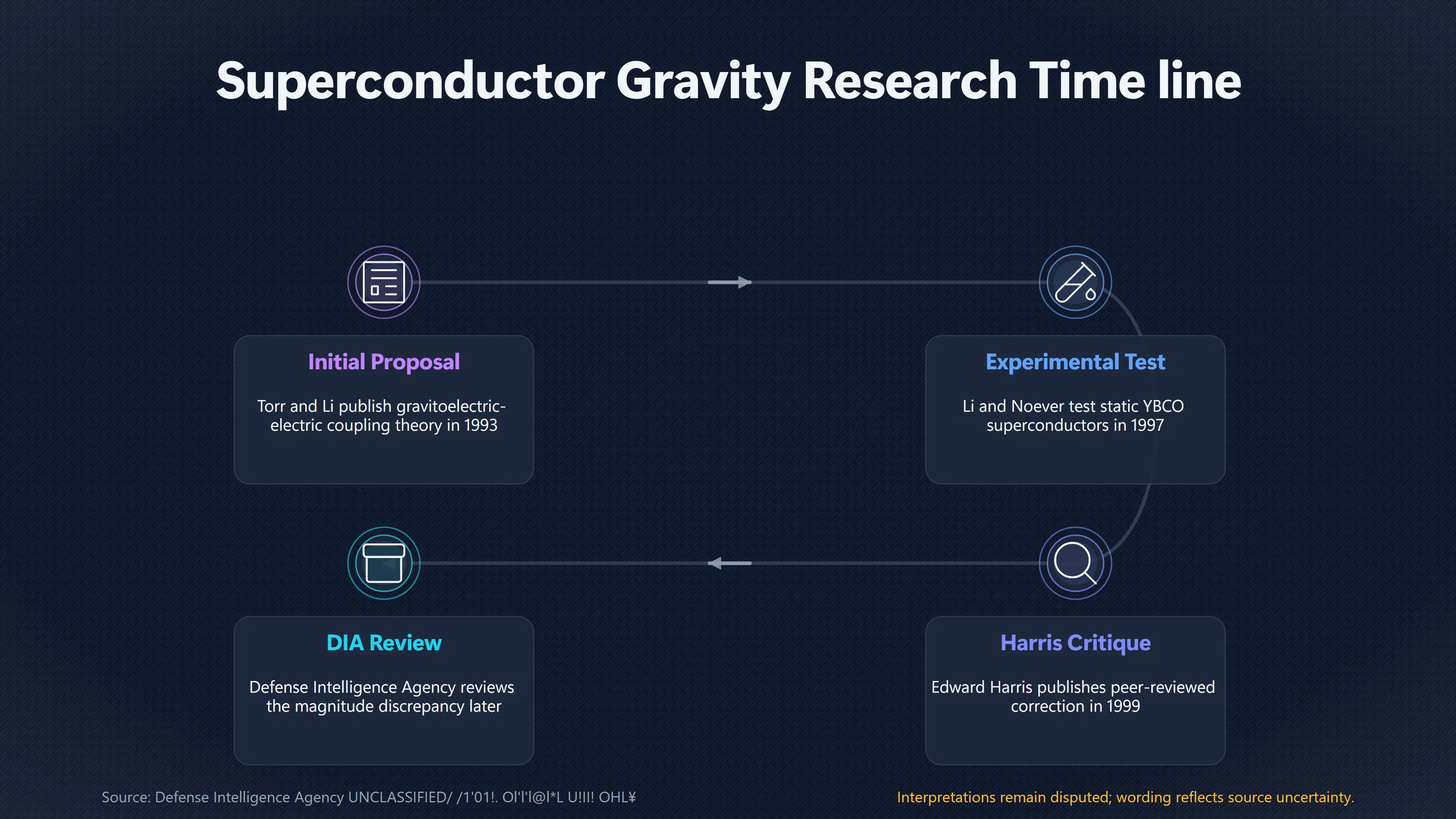
Edward G. Harris’s 1999 critique is one of the most important peer-reviewed checks on the strongest interpretation of Douglas G. Torr and Ning Li’s superconducting-gravity work. Torr and Li had argued in 1993 that superconductivity could couple electrical behaviour to gravity strongly enough to produce experimentally detectable gravitomagnetic and gravitoelectric fields. Harris revisited their calculation and concluded that its large predicted fields arose from unrealistic assumptions; a later US Defense Intelligence Agency review characterised his correction to the external gravitoelectric field as roughly 20 orders of magnitude.[Springer]link.springer.comComments on “Gravitoelectric-Electric Coupling via Superconductivity“ by Douglas G. Torr and Ning Li | Foundations of Physics Let…
That distinction matters enormously. Harris was not showing that every conceivable interaction between superconductivity and gravity was impossible. His narrower point was more damaging to practical “antigravity” interpretations: the particular calculation being cited as a route to a sizeable, externally usable gravitational field did not survive scrutiny at anything like its original magnitude. The episode is therefore a useful example of how peer review can contain both an extraordinary proposal and a later published challenge to the assumptions that made it extraordinary.
What Torr and Li had proposed in 1993
Torr and Li’s paper, “Gravitoelectric-electric coupling via superconductivity”, appeared in Foundations of Physics Letters, volume 6, in 1993. It followed their earlier papers on gravitomagnetic effects and magnetic attenuation in superconductors. The 1993 work argued that currents associated with superconducting matter could have a gravitational counterpart: electrical charge currents could largely cancel while mass currents, because gravity couples to mass rather than positive and negative electrical charge in the same fashion, need not cancel.[Ouci]ouci.dntb.gov.uaOuci Gravitoelectric-electric coupling via superconductivityOuci Gravitoelectric-electric coupling via superconductivity
Their published abstract described two particularly striking possibilities. Coherent motion associated with lattice ions was proposed as a source of a detectable gravitomagnetic field, while a time-dependent applied magnetic vector potential was proposed as a means of producing a detectable gravitoelectric field. In the weak-field analogy with electromagnetism used in this literature, “gravitoelectric” essentially denotes the gravity-like component corresponding most closely to an ordinary gravitational acceleration field; it should not be confused with a new conventional electric force.[ResearchGate]researchgate.netResearchGate(PDF) On the Mechanism for a Gravity Effect using Type II SuperconductorsJanuary 1, 1999…
The important word was detectable. General relativity already permits gravitomagnetic and related weak-field phenomena, so merely calculating such a field was not revolutionary. The extraordinary element was the proposed magnitude. Ordinary laboratory masses produce gravitational effects so feeble that turning these weak-field analogues into a practical source is normally prohibitive. The attraction of the Torr–Li proposal was precisely the suggestion that coherent superconducting matter might change that experimental scale.
That is also why the paper later acquired significance well beyond specialist discussions of superconductivity. If an electromagnetic drive could create an appreciable gravitational field outside a superconducting material, the idea would potentially connect laboratory condensed-matter physics with propulsion and gravity-control concepts. But that interpretation depended on the numerical enhancement being physically legitimate rather than an artefact of the calculation.
How Harris recut the external-field calculation
Harris’s response, “Comments on ‘Gravitoelectric-Electric Coupling via Superconductivity’ by Douglas G. Torr and Ning Li”, appeared in the April 1999 issue of Foundations of Physics Letters, pages 201–208. Springer records the paper as received on 4 May 1998, and the journal bibliography confirms its placement in volume 12, number 2. Harris was based in the Department of Physics and Astronomy at the University of Tennessee.[Springer]link.springer.comComments on “Gravitoelectric-Electric Coupling via Superconductivity“ by Douglas G. Torr and Ning Li | Foundations of Physics Let…
His published conclusion was unambiguous: after reviewing Torr and Li’s calculations, he found that “unrealistic assumptions” made their calculated fields too large by many orders of magnitude. Crucially, this was a criticism appearing in the scientific literature itself, not merely sceptical commentary from journalists or later internet discussion.[Springer]link.springer.comComments on “Gravitoelectric-Electric Coupling via Superconductivity“ by Douglas G. Torr and Ning Li | Foundations of Physics Let…
A later Defense Intelligence Agency survey of superconductors and gravity gives a more specific account of Harris’s objection. According to that review, Torr and Li had effectively used arbitrary and extremely small distances between a lattice ion and the observer when estimating the external effect. Such microscopic distances can make an individual source term appear large, but they are not an appropriate distance scale for calculating the macroscopic gravitational field seen by an observer outside the superconductor. The DIA report says Harris’s corrected estimate of the induced external gravitoelectric field was about 20 orders of magnitude smaller.[Defense Intelligence Agency]dia.milDefense Intelligence Agency UNCLASSIFIED/ /1'01!. Ol'l'l@l*L U!II! OHL¥Defense Intelligence Agency UNCLASSIFIED/ /1'01!. Ol'l'l@l*L U!II! OHL¥
Twenty orders of magnitude is not an ordinary theoretical disagreement. It is a factor of roughly 1020: something estimated as one unit at the original scale would become about 0.00000000000000000001 units after such a reduction. A discrepancy that large changes the physical interpretation of the proposal rather than merely refining its engineering requirements.
The central conceptual problem can be stated simply. A microscopic lattice spacing may be relevant when calculating interactions experienced locally by neighbouring constituents of a material. But an alleged external gravity-like field must be calculated at the actual observation point, with the spatial distribution of the source treated consistently. One cannot automatically transfer the strength of a microscopic near-field quantity to a macroscopic observer outside the material. Harris’s criticism attacked precisely the bridge between those two scales.[Defense Intelligence Agency]dia.milDefense Intelligence Agency UNCLASSIFIED/ /1'01!. Ol'l'l@l*L U!II! OHL¥Defense Intelligence Agency UNCLASSIFIED/ /1'01!. Ol'l'l@l*L U!II! OHL¥
Why Harris’s criticism was harder to dismiss
Harris was not the first physicist to challenge the Torr–Li programme. M. Kowitt had published “Gravitomagnetism and Magnetic Permeability in Superconductors” in Physical Review B in 1994, questioning assumptions concerning the magnetic permeability used in the earlier superconducting calculations. The later DIA historical review describes that dispute as less decisive because Li and Torr responded and subsequent discussion questioned Kowitt’s objection.[UFO Transparency]ufotransparency.comUFO TransparencyDIA's Superconductor Gravity Research Analysis, Defense Intelligence Agency (DIA) · 2022 · UFO TransparencyMarch 25, 2022…
The same review treats Harris differently. It describes his paper as the more effective critique because it directly attacked the numerical construction of the large external effect. Rather than disputing superconductivity as such, Harris argued that the calculation exaggerated what an outside observer should experience. The DIA review further states that it found no evident published rebuttal from Li or Torr to Harris’s criticism.[Defense Intelligence Agency]dia.milDefense Intelligence Agency UNCLASSIFIED/ /1'01!. Ol'l'l@l*L U!II! OHL¥Defense Intelligence Agency UNCLASSIFIED/ /1'01!. Ol'l'l@l*L U!II! OHL¥
That last point should be phrased carefully. Absence of an evident rebuttal is not itself proof that Harris was correct in every technical detail, and the DIA document is a historical technical survey rather than an experimental adjudication of the underlying theory. But it does show that, a decade later, an official review of this specialised literature regarded Harris’s magnitude correction as a major unresolved problem for the Torr–Li claim.
Later specialist literature likewise continued to cite Harris as one of the objections to unusually strong gravity–superconductor coupling. A 2005 Physica C paper discussing proposed manipulation of gravitational waves noted that both Kowitt and Harris had independently argued against the credibility of Li and Torr’s results, while acknowledging that the broader question had generated continuing theoretical discussion.[ScienceDirect]sciencedirect.comManipulation of gravitational waves for communications applications using superconductors - ScienceDirectDecember 1, 2005…
The experimental record points in the same cautious direction
Harris’s paper was theoretical criticism, so it should not be presented as an experiment disproving every superconducting-gravity effect. There is, however, an important experimental comparison close in time to his critique.
In 1997, Li herself joined David Noever, Tony Robertson, Ron Koczor and Whitt Brantley in a Physica C experiment testing for gravitational effects associated with static type-II YBCO superconductors. Using a sensitive gravimeter while bulk superconductors were magnetically levitated, the group reported changes in acceleration of less than two parts in 108 of ordinary gravitational acceleration. Their conclusion was that the result placed new limits on the strength and range of the proposed coupling between static superconductors and gravity.[NASA Technical Reports Server]ntrs.nasa.govNASA Technical Reports ServerStatic Test for a Gravitational Force Coupled to Type 2 YBCO Superconductors - NASA Technical Reports Server…
That experiment did not reproduce Harris’s calculation and did not test every dynamic configuration envisioned by Torr and Li. A static superconducting sample in a DC magnetic field is not identical to the time-dependent arrangement considered in the 1993 gravitoelectric proposal. It would therefore be too strong to claim that the 1997 measurement experimentally proved Harris’s 20-order correction.
What it does establish is that the surrounding peer-reviewed record was already moving away from any simple inference that superconductivity automatically generated a large external gravitational anomaly. The 1993 theoretical paper suggested detectability; the 1997 experiment found no static acceleration change above a stringent limit; and Harris’s 1999 analysis argued that the theoretical external field itself had been vastly overestimated.[dntb.gov.ua]ouci.dntb.gov.uaOuci Gravitoelectric-electric coupling via superconductivityOuci Gravitoelectric-electric coupling via superconductivity
Why the magnitude dispute matters for antigravity claims
The Harris episode illustrates a distinction that often disappears in later accounts of controversial gravity research: the existence of a mathematical coupling is not the same thing as the existence of a technologically useful force.
A gravitational term may be perfectly legitimate yet microscopically small. For propulsion or “gravity control”, magnitude is everything. A field twenty orders of magnitude weaker than initially estimated is not merely a less efficient version of the same technology. At laboratory scales it can move the phenomenon from the realm of conceivable instrumentation into one where ordinary environmental disturbances and measurement limitations overwhelm the predicted signal.
This is particularly important when interpreting the peer-reviewed status of Li and Torr’s work. Their papers demonstrate that gravity–superconductor coupling was a real subject of theoretical scientific discussion. Harris’s paper demonstrates something equally important: the peer-reviewed literature did not collectively endorse the large-effect interpretation. The same publication system that admitted the unconventional proposal also published a direct calculation arguing that its experimentally interesting magnitude depended on unrealistic assumptions.[Springer]link.springer.comComments on “Gravitoelectric-Electric Coupling via Superconductivity“ by Douglas G. Torr and Ning Li | Foundations of Physics Let…
Nor does Harris’s criticism establish the opposite extreme — that superconductors can have no unusual gravitational physics whatsoever. Subsequent researchers have continued to investigate gravitoelectromagnetic analogies and the behaviour of macroscopic quantum systems in gravitational fields. Modern treatments still examine coupled equations and possible superconducting responses, generally in regimes where the gravitational terms are exceedingly small.[ResearchGate]researchgate.netOpen source on researchgate.net.
The narrower historical judgement is stronger because it requires fewer assumptions: the specific Torr–Li route to a large external gravitoelectric field was subjected to published criticism that reduced the claimed magnitude enormously. Anyone citing the 1993 paper as peer-reviewed evidence for practical antigravity therefore needs to account for the 1999 Harris paper as part of the same scientific record.
What the Harris paper does — and does not — establish
For assessing controversial gravity research, Harris’s challenge is best understood in three layers.
First, the original research was genuine scientific literature. Torr and Li’s 1993 paper was a published theoretical proposal, connected to their earlier peer-reviewed work on superconductivity and gravitation. It should not be rewritten retrospectively as though it were merely an internet antigravity claim.[Ouci]ouci.dntb.gov.uaOuci Gravitoelectric-electric coupling via superconductivityOuci Gravitoelectric-electric coupling via superconductivity
Second, peer review did not freeze the proposal as an accepted result. Harris later revisited the calculation in the same journal and concluded that unrealistic assumptions inflated the predicted fields by many orders of magnitude. A subsequent US government technical review summarised the external gravitoelectric discrepancy as approximately 1020.[Springer]link.springer.comComments on “Gravitoelectric-Electric Coupling via Superconductivity“ by Douglas G. Torr and Ning Li | Foundations of Physics Let…
Third, the dispute is about a calculation, not evidence of suppression. Nothing in Harris’s paper or the publication history establishes that a functioning gravity-control technology existed and was subsequently hidden. On the contrary, the surviving literature records an ordinary scientific sequence: an unconventional theoretical prediction, criticism of its assumptions, experimental attempts to constrain related effects, and continued disagreement over more speculative extensions.
That is especially relevant within the wider history linking UFO narratives, advanced propulsion research and claims about scientists associated with unusual gravity work. Harris’s critique provides a documented scientific reason why the mere existence of the Torr–Li papers cannot bear the evidential weight sometimes placed upon them. The intriguing historical fact is that serious researchers really did investigate gravity–superconductor coupling. The equally important scientific fact is that one of the calculations used to make that programme appear technologically dramatic was later challenged at the level of roughly twenty orders of magnitude.[Defense Intelligence Agency]dia.milDefense Intelligence Agency UNCLASSIFIED/ /1'01!. Ol'l'l@l*L U!II! OHL¥Defense Intelligence Agency UNCLASSIFIED/ /1'01!. Ol'l'l@l*L U!II! OHL¥
Amazon book picks
Further Reading
Books and field guides related to How Harris Recut the Gravitoelectric Effect Claim. Use these as the next step if you want deeper reading beyond the article.
Gravitation
First published in 1973, Gravitation is a landmark graduate-level textbook that presents Einstein’s general theory of relativity and offe...
Gravity: An Introduction to Einstein's General Relativity
Einstein's theory of general relativity is a cornerstone of modern physics. It also touches upon a wealth of topics that students find fa...
eBay marketplace picks
Marketplace Samples
Live-tested eBay searches with available results related to this page.
Selected fromgravity physics poster oneBay.co.uk.

Endnotes
1.
Source: link.springer.com
Link:https://link.springer.com/article/10.1023/A%3A1021621425670
Source snippet
Comments on “Gravitoelectric-Electric Coupling via Superconductivity“ by Douglas G. Torr and Ning Li | Foundations of Physics Let...
2.
Source: dia.mil
Title: Defense Intelligence Agency UNCLASSIFIED/ /1’01!. Ol’l’l@l*L U!II! OHL¥
Link:https://www.dia.mil/FOIA/FOIA-Electronic-Reading-Room/FileId/237631/
3.
Source: researchgate.net
Link:https://www.researchgate.net/publication/383610375_On_the_Mechanism_for_a_Gravity_Effect_using_Type_II_Superconductors
Source snippet
ResearchGate(PDF) On the Mechanism for a Gravity Effect using Type II SuperconductorsJanuary 1, 1999...
Published: January 1, 1999
4.
Source: sciencedirect.com
Link:https://www.sciencedirect.com/science/article/abs/pii/S0921453405007458
Source snippet
Manipulation of gravitational waves for communications applications using superconductors - ScienceDirectDecember 1, 2005...
Published: December 1, 2005
5.
Source: ntrs.nasa.gov
Link:https://ntrs.nasa.gov/search.jsp?R=19990039542
Source snippet
NASA Technical Reports ServerStatic Test for a Gravitational Force Coupled to Type 2 YBCO Superconductors - NASA Technical Reports Server...
6.
Source: sciencedirect.com
Link:https://www.sciencedirect.com/science/article/pii/S0921453497014627
Source snippet
Static test for a gravitational force coupled to type II YBCO superconductors - ScienceDirect...
7.
Source: researchgate.net
Link:https://www.researchgate.net/publication/365579617_Superconductor_Meissner_Effects_for_Gravito-Electromagnetic_Fields_in_Harmonic_Coordinates_Due_to_Non-Relativistic_Gravitational_Sources
8.
Source: researchgate.net
Title: (PDF) Entrevista
Link:https://www.researchgate.net/publication/405750940Entrevista-_Dr_Edward_Harris
9.
Source: researchgate.net
Title: (PDF) On the energy balance of Newtonian Gravitation
Link:https://www.researchgate.net/publication/404476520_On_the_energy_balance_of_Newtonian_Gravitation
10.
Source: link.springer.com
Link:https://link.springer.com/article/10.1007/s12098-024-05065-6
11.
Source: researchgate.net
Link:https://www.researchgate.net/publication/354521867_A_simple_investigation_of_Static_test_for_a_gravitational_force_coupled_to_type_II_YBCO_superconductors_by_Li_and_coworkers
12.
Source: researchgate.net
Link:https://www.researchgate.net/publication/355313427_Performances_of_Various_Order_Selection_Criteria_for_Autoregressive_Process
13.
Source: link.springer.com
Link:https://link.springer.com/article/10.1140/epjc/s10052-020-08530-6
14.
Source: researchgate.net
Link:https://www.researchgate.net/publication/346408561_Fisher_information_and_the_weak_equivalence_principle_of_a_quantum_particle_in_a_gravitational_wave
15.
Source: researchgate.net
Link:https://www.researchgate.net/publication/332740872_An_interplay_of_topology_and_quantized_geometric_phase_for_two_different_symmetry-class_Hamiltonians
16.
Source: researchgate.net
Link:https://www.researchgate.net/publication/327904063_An_Interplay_of_Symmetry_Topology_and_Quantized_Geometric_Phase_for_the_Kitaev_Chain_in_Presence_of_Interaction
17.
Source: researchgate.net
Link:https://www.researchgate.net/publication/327904063_An_Interplay_of_Symmetry_Topology_and_Quantized_Geometric_Phase_for_the_Kitaev_Chain_in_Presence_of_Interaction?_tp=eyJjb250ZXh0Ijp7InBhZ2UiOiJzY2llbnRpZmljQ29udHJpYnV0aW9ucyIsInByZXZpb3VzUGFnZSI6bnVsbCwic3ViUGFnZSI6bnVsbH19
18.
Source: researchgate.net
Link:https://www.researchgate.net/publication/324558262_Applications_of_Ultra-Cold_Atomic_Trapping_Methods_Towards_Cooling_of_Stored_Electrons
19.
Source: link.springer.com
Title: lrr 2014 4
Link:https://link.springer.com/article/10.12942/lrr
20.
Source: researchgate.net
Title: (PDF) On the possibility of strong coupling between electricity and gravitation
Link:https://www.researchgate.net/publication/287041399_On_the_possibility_of_strong_coupling_between_electricity_and_gravitation
21.
Source: researchgate.net
Title: (PDF) Gravity-Superconductors Interactions: Historical Background
Link:https://www.researchgate.net/publication/281439915_Gravity-Superconductors_Interactions_Historical_Background
22.
Source: researchgate.net
Title: 298460654 Gravity Superconductors interactions Theory and experiment
Link:https://www.researchgate.net/publication/298460654_Gravity-Superconductors_interactions_Theory_and_experiment
23.
Source: researchgate.net
Title: 259308236 A novel variable focus lens for HFGW
Link:https://www.researchgate.net/publication/259308236_A_novel_variable-focus_lens_for_HFGW
24.
Source: researchgate.net
Title: (PDF) No News from Stratigraphic Computing?
Link:https://www.researchgate.net/publication/254477574_No_News_from_Stratigraphic_Computing
25.
Source: researchgate.net
Link:https://www.researchgate.net/publication/257331914_Manipulation_of_gravitational_waves_for_communications_applications_using_superconductors
26.
Source: sciencedirect.com
Title: Gravitomagnetic field of a rotating superconductor and of a rotating superfluid
Link:https://www.sciencedirect.com/science/article/pii/S0921453402023055
27.
Source: researchgate.net
Title: Superconductors as gravitational wave detectors
Link:https://www.researchgate.net/publication/252995513_Superconductors_as_gravitational_wave_detectors
28.
Source: researchgate.net
Link:https://www.researchgate.net/publication/1965564_Conceptual_tensions_between_quantum_mechanics_and_general_relativity_Are_there_experimental_consequences_eg_superconducting_transducers_between_electromagnetic_and_gravitational_radiation
29.
Source: researchgate.net
Link:https://www.researchgate.net/publication/1965119_Superconductors_as_quantum_transducers_and_antennas_for_gravitational_and_electromagnetic_radiation
30.
Source: sciencedirect.com
Title: Local gravitoelectromagnetic effects on a superconductor
Link:https://www.sciencedirect.com/science/article/pii/S0921453400003403
31.
Source: sciencedirect.com
Title: Local gravitoelectromagnetic effects on a superconductor
Link:https://www.sciencedirect.com/science/article/abs/pii/S0921453400003403
32.
Source: sciencedirect.com
Link:https://www.sciencedirect.com/journal/physica-c-superconductivity-and-its-applications/vol/281/issue/2
33.
Source: sciencedirect.com
Title: Static test for a gravitational force coupled to type II YBCO superconductors
Link:https://www.sciencedirect.com/science/article/abs/pii/S0921453497014627
34.
Source: researchgate.net
Title: (PDF) Model results for the ionospheric E region: Solar and seasonal changes
Link:https://www.researchgate.net/publication/41086116_Model_results_for_the_ionospheric_E_region_Solar_and_seasonal_changes
35.
Source: ntrs.nasa.gov
Link:https://ntrs.nasa.gov/citations/19880062167
36.
Source: ntrs.nasa.gov
Link:https://ntrs.nasa.gov/citations/19880015425
37.
Source: ntrs.nasa.gov
Link:https://ntrs.nasa.gov/citations/19800046296
38.
Source: sciencedirect.com
Title: Space applications of superconductivity: digital electronics
Link:https://www.sciencedirect.com/science/article/pii/001122758090123X
39.
Source: sciencedirect.com
Title: On forensic likelihood ratios from low-coverage sequencing
Link:https://www.sciencedirect.com/science/article/pii/S1872497325000821
40.
Source: sciencedirect.com
Title: Galactic Halos
Link:https://www.sciencedirect.com/topics/earth-and-planetary-sciences/galactic-halos
41.
Source: sciencedirect.com
Link:https://www.sciencedirect.com/topics/earth-and-planetary-sciences/cryogenics
42.
Source: sciencedirect.com
Title: Gravitational-magnetic-electric field interaction
Link:https://www.sciencedirect.com/science/article/pii/S2211379718314128
43.
Source: sciencedirect.com
Title: NAS A breakthrough propulsion physics program
Link:https://www.sciencedirect.com/science/article/pii/S0094576599000454/pdf?md5=319c44c42d46bdc84bf89b7db0baa40c&pid=1-s2.0-S0094576599000454-main.pdf
44.
Source: researchgate.net
Link:https://www.researchgate.net/publication/277311313_Gravitoelectromagnetic_Theories_and_Their_Applications_to_Advanced_Science_and_Technology
45.
Source: researchgate.net
Link:https://www.researchgate.net/publication/239037906_The_role_of_intergranular_precipitates_in_controlling_creep_cavitation
46.
Source: researchgate.net
Link:https://www.researchgate.net/profile/Edward-Harris-4
47.
Source: researchgate.net
Link:https://www.researchgate.net/figure/Schematic-potential-diagram-of-the-RbF-ionic-excimer-The-excitation-and-emission-process_fig1_241497236
48.
Source: researchgate.net
Link:https://www.researchgate.net/publication/379336552_Potential_Cause-and-Effect_Relationship_between_Gut_Microbiota_and_Childhood_Neuroblastoma_A_Mendelian_Randomization_Analysis
49.
Source: researchgate.net
Link:https://www.researchgate.net/publication/386695026_Superconductor_in_a_weak_static_gravitational_field
50.
Source: link.springer.com
Link:https://link.springer.com/content/pdf/10.1023/A%3A1021621425670.pdf
51.
Source: ouci.dntb.gov.ua
Title: Ouci Gravitoelectric-electric coupling via superconductivity
Link:https://ouci.dntb.gov.ua/en/works/7nJwBNL7/
52.
Source: ufotransparency.com
Link:https://ufotransparency.com/files/decade-2020s-aatip-dird-documents-2018-2019-dird-14-dird-the-role-of-superconductors-in-gravity-rese
Source snippet
UFO TransparencyDIA's Superconductor Gravity Research Analysis, Defense Intelligence Agency (DIA) · 2022 · UFO TransparencyMarch 25, 2022...
Published: March 25, 2022
53.
Source: mdpi.com
Title: Superconductors and Gravity
Link:https://www.mdpi.com/2073-8994/14/3/554
54.
Source: bib-pubdb1.desy.de
Link:https://bib-pubdb1.desy.de/record/443237
55.
Source: jglobal.jst.go.jp
Link:https://jglobal.jst.go.jp/detail?JGLOBAL_ID=200902195923083500
56.
Source: wikidata.org
Title: Gravitoelectric-electric coupling via superconductivity
Link:https://www.wikidata.org/wiki/Q55922207
57.
Source: ouci.dntb.gov.ua
Link:https://ouci.dntb.gov.ua/en/works/4OrJ6Gq7/
58.
Source: ouci.dntb.gov.ua
Link:https://ouci.dntb.gov.ua/en/works/9ZkjEPO7/
59.
Source: inspirehep.net
Link:https://inspirehep.net/literature/1359113
60.
Source: science.gov
Link:https://www.science.gov/topicpages/e/electron-positron-ion%2Be-p-i%2Bplasma
61.
Source: science.gov
Link:https://www.science.gov/topicpages/b/bulk%2Bhigh-temperature%2Bsuperconductor
62.
Source: science.gov
Link:https://www.science.gov/topicpages/m/mm%2Bwide%2Bybco.html
63.
Source: science.gov
Link:https://www.science.gov/topicpages/y/ybco%2Bmelted%2Bsamples
64.
Source: science.gov
Link:https://www.science.gov/topicpages/a/acceleration%2Brotational%2Bacceleration
65.
Source: science.gov
Link:https://www.science.gov/topicpages/m/magnetically-enhanced%2Beffective%2Bgravity
66.
Source: science.gov
Link:https://www.science.gov/topicpages/h/high-quality%2Bybco%2Bfilms
67.
Source: openurl.ebsco.com
Link:https://openurl.ebsco.com/results?bquery=AU+Harris+G&link_origin=none&sid=ebsco%3Aocu%3Arecord
Additional References
68.
Source: youtube.com
Title: The Scientist Who Discovered Anti-Gravity and Then Completely Disappeared
Link:https://www.youtube.com/watch?v=eS_rEzKdzBA
Source snippet
The disappearance of America's leading anti-gravity researcher...
69.
Source: youtube.com
Title: The Mysterious Demise Of Dr. Ning Li | Jim Landrith
Link:https://www.youtube.com/watch?v=CQJMBdT5WEk
Source snippet
Eugene [Podkletnov]({{ 'podkletnov/' | relative_url }}) on Gravitational Shielding in Rotating Superconductors...
70.
Source: youtube.com
Title: The disappearance of America’s leading anti-gravity researcher
Link:https://www.youtube.com/watch?v=Qsbz8_G9WcU
Source snippet
Superconductors & Gravity Control | Gary Stephenson...
71.
Source: youtube.com
Title: Superconductors & Gravity Control | Gary Stephenson
Link:https://www.youtube.com/watch?v=msrhrssRmCE
Source snippet
The Mysterious Demise Of Dr. Ning Li | Jim Landrith...
72.
Source: hiroko.or.jp
Link:https://hiroko.or.jp/wp-content/file/gravity-control/Gravitational%20shielding/ShieldingBySuperconductivity/General%20remarks/803-page-Collection-of-Papers-on-Anti-Gravity-Research.pdf
73.
Source: asjprompts.in
Link:https://asjprompts.in/
74.
Source: deepdyve.com
Link:https://www.deepdyve.com/lp/springer-journals/comments-on-gravitoelectric-electric-coupling-via-superconductivity-by-2QiSKtiNoe
75.
Source: scribd.com
Link:https://www.scribd.com/document/964115557/Ebook-Gravity-superconductors-Interactions-by-Giovanni-Modanese-Glen-A-Robertson-ISBN-9781608053995-1608053997-available-all-format
76.
Source: checkatrade.com
Link:https://www.checkatrade.com/trades/edwardharrisdesignandlandscaping
77.
Source: scribd.com
Link:https://www.scribd.com/doc/250891540/Equilibrium-Stage-Separation-Operations-in-Chemical-Engineering