Within Hostility
What Did the Robertson Panel Mean by Debunking?
The Robertson Panel endorsed deliberate public debunking of UFO reports, but its documented aims concerned information control rather than attacks on
On this page
- Why officials wanted fewer UFO reports
- How public education and monitoring were proposed
- Why information management is not evidence of violence
Page outline Jump by section
Introduction
The Robertson Panel is strong evidence that US officials deliberately wanted to reduce public fascination with UFO reports. It is not, however, evidence that they authorised the killing, disappearance or physical intimidation of UFO or unconventional-physics researchers. That distinction is crucial when assessing claims of suspicious deaths connected with UFO and antigravity research.
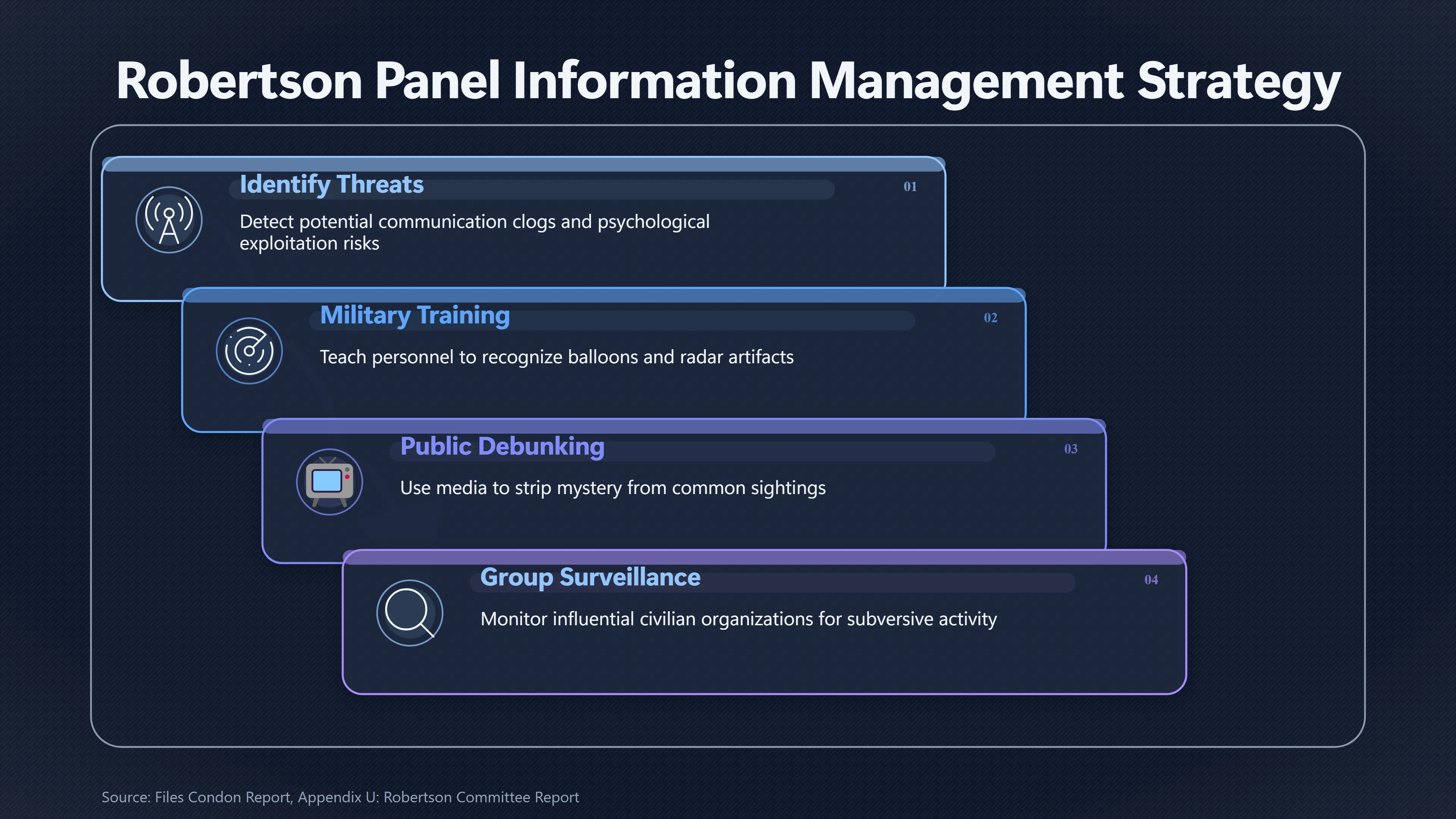
Convened under Central Intelligence Agency auspices in January 1953, the scientific panel recommended an organised programme of training, public education and “debunking”. Its concern was that large volumes of UFO reports could clog defence communications, encourage false alarms and create a psychological environment that an adversary might exploit. Its proposed remedies included mass-media education and scrutiny of influential civilian UFO organisations. The surviving documentation therefore supports a case for deliberate information management and discouragement of public interest. It does not document a policy of physically eliminating researchers.[NCAS Files]files.ncas.orgFiles Condon Report, Appendix U: Robertson Committee ReportNCAS FilesCondon Report, Appendix U: Robertson Committee Report…
Why officials wanted fewer UFO reports
The panel emerged from an unusually tense period. The wave of UFO reports in 1952, including widely publicised sightings around Washington, had raised a problem that intelligence officials regarded as potentially significant even without accepting extraordinary explanations for the objects themselves. CIA historian Gerald K. Haines records that officials feared a hostile power might exploit the phenomenon to disrupt American air defences.[CIA]cia.govthe cias role in the study of ufosThe CIA's Role in the Study of UFOs, 1947-90 - CSI…
This distinction between a physical UFO threat and an information-system threat runs directly through the panel’s signed conclusions. After reviewing material supplied principally by the Air Technical Intelligence Center, the panel stated that the evidence showed “no indication” of a direct physical threat to national security. It nevertheless concluded that continued emphasis on UFO reporting threatened the orderly operation of national defences.[NCAS Files]files.ncas.orgFiles Condon Report, Appendix U: Robertson Committee ReportNCAS FilesCondon Report, Appendix U: Robertson Committee Report…
Three mechanisms particularly worried the panel:
- irrelevant reports could clog communications channels;
- repeated false alarms could make personnel less responsive to genuine indications of hostile action;
- widespread public excitement could create conditions favourable to hostile propaganda and distrust of government authority.[NCAS Files]files.ncas.orgFiles Condon Report, Appendix U: Robertson Committee ReportNCAS FilesCondon Report, Appendix U: Robertson Committee Report…
This is important because “debunking” can sound, outside its documentary setting, like a generic instruction to suppress inconvenient discoveries. The report gives it a much more specific Cold War rationale. Officials wanted observers and defence personnel to distinguish balloons, astronomical phenomena, radar artefacts and other false indications from genuinely hostile aircraft or missiles. The target of the intervention was therefore the reporting environment and public reaction, not a named population of scientists who were to be physically neutralised.[NCAS Files]files.ncas.orgFiles Condon Report, Appendix U: Robertson Committee ReportNCAS FilesCondon Report, Appendix U: Robertson Committee Report…
The Department of Defense’s All-domain Anomaly Resolution Office (AARO) reached essentially the same historical reading in its 2024 review. It acknowledged that the CIA-sponsored panel advocated an active training and debunking effort intended to steer the public away from UFO reporting, while explaining the policy in terms of government overload, fears of mass hysteria and possible Soviet exploitation.[U.S. Department of War]media.defense.govU.S. Department of War AARO Historical Record Report Volume 1U.S. Department of War AARO Historical Record Report Volume 1(https://media.defense.gov/2024/Mar/08/2003409233/-1/-1/0/AARO_Historical_Record_Report_Vol_1_2024.pdf)
What “debunking” actually meant
The detailed record preserved as the Durant Report is unusually explicit. The proposed educational programme had two major aims: training and “debunking”. Training meant teaching military and other personnel to recognise things commonly mistaken for UFOs, including balloons, aircraft reflections, meteors, fireballs, mirages and unusual clouds, as well as improving radar recognition. The anticipated result was fewer erroneous reports and less confusion.[NCAS Files]files.ncas.orgFiles Condon Report, Appendix U: Robertson Committee ReportNCAS FilesCondon Report, Appendix U: Robertson Committee Report…
“Debunking” addressed the public rather than merely specialist observers. The panel wanted to reduce interest in flying saucers and believed that showing how initially mysterious cases acquired ordinary explanations would diminish their psychological appeal. Television, films and popular articles were proposed as channels. Psychologists familiar with mass psychology and specialists in mass communication or advertising were also discussed.[NCAS Files]files.ncas.orgFiles Condon Report, Appendix U: Robertson Committee ReportNCAS FilesCondon Report, Appendix U: Robertson Committee Report…
The surviving minutes make the communications strategy remarkably concrete. Potential channels or collaborators discussed included broadcaster Arthur Godfrey, organisations experienced in wartime training films, Walt Disney, amateur astronomers, business clubs, schools, colleges and television stations. One proposed presentation technique was to show a real case first as a mystery and then reveal its explanation.[NCAS Files]files.ncas.orgFiles Condon Report, Appendix U: Robertson Committee ReportNCAS FilesCondon Report, Appendix U: Robertson Committee Report…
That is plainly more interventionist than simply publishing neutral scientific findings. The panel was discussing how government could deliberately influence public interpretation of a controversial subject. The language about reducing “gullibility”, stripping UFOs of their “aura of mystery” and reassuring the public demonstrates that managing attitudes was part of the programme, not an accidental by-product.[NCAS Files]files.ncas.orgFiles Condon Report, Appendix U: Robertson Committee ReportNCAS FilesCondon Report, Appendix U: Robertson Committee Report…
At the same time, the records complicate the idea that the panel wanted all investigation stopped. Robertson envisaged retaining a small Air Technical Intelligence Center capability after the public-education campaign had reduced erroneous reports. That unit would follow up cases potentially indicating unconventional enemy technology. The panel also considered controlled experiments for significant cases and endorsed technical measures for resolving confusing radar returns.[NCAS Files]files.ncas.orgFiles Condon Report, Appendix U: Robertson Committee ReportNCAS FilesCondon Report, Appendix U: Robertson Committee Report…
The policy was therefore selective rather than simply anti-investigation: reduce public excitement and routine reporting noise, train observers to discard obvious misidentifications, but preserve a smaller intelligence mechanism for anomalies that might reveal foreign technology.
Monitoring UFO groups crossed another line
The most intrusive recommendation concerned civilian organisations. The panel specifically discussed the Civilian Flying Saucer Investigators in Los Angeles and the Aerial Phenomena Research Organization in Wisconsin. It said such organisations should be “watched” because they could exert considerable influence on public thinking during another wave of sightings, while officials should bear in mind their possible use for subversive purposes.[NCAS Files]files.ncas.orgFiles Condon Report, Appendix U: Robertson Committee ReportNCAS FilesCondon Report, Appendix U: Robertson Committee Report…
This recommendation belongs squarely within the security politics of the early Cold War. Haines notes that the panel was reporting during the McCarthy era and describes its proposal as monitoring private UFO groups for possible subversive activities.[CIA]cia.govDOC 0005517742A Die-Hard IssueCIA’s Role in the Study of UFOs, 1947-90Gerald K. HainesAn extraordinary 95 percent of all…
For the broader question of institutional hostility towards UFO researchers, this is meaningful evidence. A government advisory body was not merely sceptical of UFO claims; it contemplated surveillance of private organisations because of their potential influence over public opinion. That can reasonably be described as institutional suspicion and an attempt at information control.
But the evidential boundary remains important. Monitoring is not assassination. Neither the signed recommendations nor Durant’s detailed supplementary account instructs agencies to assault, abduct, kill or otherwise physically suppress researchers. The measures actually specified concern surveillance, public education, communications strategy, military training, case investigation and reduction of public interest.[NCAS Files]files.ncas.orgFiles Condon Report, Appendix U: Robertson Committee ReportNCAS FilesCondon Report, Appendix U: Robertson Committee Report…
Secrecy made the policy look more sinister
The later handling of the Robertson material added another genuine source of suspicion. According to Haines’s official CIA history, Agency officials wanted CIA involvement in UFO matters tightly restricted. When civilian UFO organisations pressed for the panel report, the Agency resisted full disclosure and produced a sanitised version that removed references to CIA involvement and the psychological-warfare implications of the UFO controversy. CIA officials again resisted complete disclosure when the Air Force sought declassification in the 1960s.[CIA]cia.govDOC 0005517742A Die-Hard IssueCIA’s Role in the Study of UFOs, 1947-90Gerald K. HainesAn extraordinary 95 percent of all…
That history deserves acknowledgement rather than minimisation. It demonstrates that the government both advocated deliberate management of public attitudes and subsequently concealed significant information about its own role. As journalist and author Sarah Scoles has observed, such secrecy helped generate precisely the distrust that the policy was supposed to reduce.[WIRED]wired.comHow UFO Sightings Became an American ObsessionThe period following his sighting saw a surge in UFO sightings across the U.S. This surge, or "flap," is linked to societal fears of inva…
Yet secrecy about an information-management programme cannot automatically serve as evidence for a more serious, undocumented programme. The inference “officials concealed their debunking activities, therefore they might also have concealed killings” is possible as speculation but does not establish the second proposition. Evidence of one concealed activity cannot substitute for evidence of another.
This is especially important in suspicious-death narratives, where documented secrecy can become a bridge connecting otherwise unrelated events. The Robertson documents show that officials had reasons to discourage UFO excitement. They do not show that the government regarded individual UFO scientists as physical threats requiring removal.
Why information management is not evidence of violence
For claims involving allegedly suspicious deaths or disappearances, the Robertson Panel is best treated as evidence at one level of an evidential ladder, rather than evidence for every stronger form of suppression.
The historical record directly supports several propositions. CIA officials were sufficiently concerned about UFO reporting to convene a classified scientific panel. The panel explicitly recommended training and debunking. It wanted public interest reduced through organised communications efforts. It recommended watching potentially influential civilian UFO organisations. The CIA also restricted disclosure of its involvement. Those points are supported by the surviving government documentation and subsequent official histories.[NCAS Files]files.ncas.orgFiles Condon Report, Appendix U: Robertson Committee ReportNCAS FilesCondon Report, Appendix U: Robertson Committee Report…
What those documents do not establish is a Robertson Panel directive to threaten researchers physically, manufacture accidents, arrange suicides, cause disappearances or conduct assassinations. Searches of the panel’s recommendations and detailed meeting record reveal instead an administrative vocabulary of education, intelligence collection, training, communications management and monitoring. The signed report actually began from the judgement that the UFO phenomena themselves did not constitute a direct physical national-security threat.[NCAS Files]files.ncas.orgFiles Condon Report, Appendix U: Robertson Committee ReportNCAS FilesCondon Report, Appendix U: Robertson Committee Report…
That does not prove that no US official, programme or contractor ever mistreated a UFO researcher. It establishes the narrower point necessary for evaluating the Robertson Panel itself: the documented intervention was informational and institutional, not a documented programme of physical suppression.
The distinction also prevents two opposite historical errors. One is to dismiss all claims of institutional hostility because there is no evidence of assassinations; the Robertson documents plainly demonstrate that officials contemplated deliberate public debunking and monitoring. The other is to treat that genuine institutional hostility as proof that later deaths must have resulted from the same apparatus. The surviving record does not support that extrapolation.

The policy’s real significance
The Robertson Panel remains important precisely because there is no need to exaggerate what it says. It provides unusually direct evidence that, during the Cold War, influential US national-security advisers regarded public UFO fascination itself as a security problem and proposed organised measures to reduce it. Modern Pentagon historical reporting openly acknowledges this as a government proposal to use public-media tools to steer people away from UFO reporting.[U.S. Department of War]media.defense.govU.S. Department of War AARO Historical Record Report Volume 1U.S. Department of War AARO Historical Record Report Volume 1(https://media.defense.gov/2024/Mar/08/2003409233/-1/-1/0/AARO_Historical_Record_Report_Vol_1_2024.pdf)
That policy could have consequences for researchers without involving physical coercion. Reduced public legitimacy can make witnesses reluctant to report observations, discourage scientists from entering a field, shape media treatment and make funding or institutional sponsorship harder to obtain. Such effects are consistent with the broader history of stigma surrounding UFO research, even though establishing the precise downstream influence of the 1953 recommendations requires evidence beyond the panel document itself.
For investigations of alleged suspicious deaths, therefore, the Robertson Panel should function as a control case for evidential discipline. It proves that institutional discouragement and information management were possible and, in this instance, explicitly recommended. It also shows why the word “suppression” needs qualification. Suppression of public interest, surveillance of organisations and management of information are historically demonstrable here; physical suppression of researchers is not.
That boundary makes the Robertson record more useful, not less. It identifies what a documented government UFO-suppression policy actually looks like on paper—and provides a benchmark against which much more serious claims of violence should be tested.
Amazon book picks
Further Reading
Books and field guides related to What Did the Robertson Panel Mean by Debunking?. Use these as the next step if you want deeper reading beyond the article.
The Report on Unidentified Flying Objects
The Report on Unidentified Flying Objects, written by Captain Edward Ruppelt in 1956, was the first serious, unbiased account written abo...
The UFO Experience: A Scientific Inquiry
Cited by the New York Review of Books as "the best brief for visitation," this classic study presents an analysis of UFO reports and conc...
UFOs and Government: A Historical Inquiry
Governments around the world have had to deal with the UFO phenomenon for a good part of a century. How and why they did so is the subjec...
Mirage Men: A Journey into Disinformation, Paranoia and UFOs
Seeking the truth about UFOs in America, Mark Pilkington and John Lundberg uncover a 60 year-old story stranger than any conspiracy thril...
eBay marketplace picks
Marketplace Samples
Live-tested eBay searches with available results related to this page.
Selected fromUFO poster oneBay.co.uk.

Endnotes
1.
Source: files.ncas.org
Title: Files [Condon Report]({{ ‘condon-report/’ | relative_url }}), Appendix U: Robertson Committee Report
Link:https://files.ncas.org/condon/text/appndx-u.htm
Source snippet
NCAS FilesCondon Report, Appendix U: Robertson Committee Report...
2.
Source: media.defense.gov
Title: U.S. Department of War AARO Historical Record Report Volume 1
Link:https://media.defense.gov/2024/Mar/08/2003409233/-1/-1/0/AARO_Historical_Record_Report_Vol_1_2024.pdf
3.
Source: cia.gov
Title: the cias role in the study of ufos 1947 90
Link:https://www.cia.gov/resources/csi/studies-in-intelligence/archives/vol-40-no-5/the-cias-role-in-the-study-of-ufos-1947-90/
Source snippet
The CIA's Role in the Study of UFOs, 1947-90 - CSI...
4.
Source: cia.gov
Title: DOC 0005517742
Link:https://www.cia.gov/readingroom/docs/DOC_0005517742.pdf
Source snippet
A Die-Hard IssueCIA’s Role in the Study of UFOs, 1947-90Gerald K. HainesAn extraordinary 95 percent of all...
5.
Source: cia.gov
Title: How To Investigate a Flying Saucer
Link:https://www.cia.gov/stories/story/how-to-investigate-a-flying-saucer/
Source snippet
How To Investigate a Flying Saucer - CIA...
6.
Source: wired.com
Title: How UFO Sightings Became an American Obsession
Link:https://www.wired.com/story/how-ufo-sightings-became-an-american-obsession
Source snippet
The period following his sighting saw a surge in UFO sightings across the U.S. This surge, or "flap," is linked to societal fears of inva...
7.
Source: aaro.mil
Link:https://www.aaro.mil/Next-AARO-Home-redesign/Next-Parent/Next-UAP-Report-Documents/
8.
Source: aaro.mil
Link:https://www.aaro.mil/Next-AARO-Home-redesign/Next-Parent/Next-UAP-Report-Documents/poster/dividLink/
9.
Source: aaro.mil
Link:https://www.aaro.mil/Next-AARO-Home-redesign/Next-Parent/Next-UAP-Report-Documents/poster/
10.
Source: aaro.mil
Link:https://www.aaro.mil/Next-AARO-Home-redesign/Next-Parent/Presidential-UAP-Transparency-Initiative/videoid/988676/dvpcc/false/
11.
Source: history.com
Title: ufo sightings cia robertson condon
Link:https://www.history.com/articles/ufo-sightings-cia-robertson-condon
12.
Source: cia.gov
Title: cias role in the study of ufos 1947 1990
Link:https://www.cia.gov/resources/csi/studies-in-intelligence/studies-in-intelligence-1997/cias-role-in-the-study-of-ufos-1947-1990/
13.
Source: cia.gov
Title: The Pike Committee Investigations and the CIA
Link:https://www.cia.gov/resources/csi/studies-in-intelligence/archives/vol-42-no-5/the-pike-committee-investigations-and-the-cia/
14.
Source: cia.gov
Title: DOC 0000838058
Link:https://www.cia.gov/readingroom/docs/DOC_0000838058.pdf
15.
Source: cia.gov
Title: cia rdp81r00560r000100030027 0
Link:https://www.cia.gov/readingroom/document/cia-rdp81r00560r000100030027-0
16.
Source: cia.gov
Link:https://www.cia.gov/readingroom/document/07083374
17.
Source: cia.gov
Title: cia rdp79b00752a000300100010 4
Link:https://www.cia.gov/readingroom/document/cia-rdp79b00752a000300100010-4
18.
Source: aaro.mil
Title: Congressional Press Products
Link:https://www.aaro.mil/Congressional-Press-Products/
19.
Source: aaro.mil
Link:https://www.aaro.mil/Next-AARO-Home-redesign/Next-Parent/Next-AARO-Congressional-Press-Products/
20.
Source: aaro.mil
Title: Congressional Tab DT
Link:https://www.aaro.mil/Next-AARO-Home-redesign/Next-Parent/AARO-Congressional-Tab-DT/
21.
Source: aaro.mil
Link:https://www.aaro.mil/Next-AARO-Home-redesign/Next-Parent/Next-Submit-a-Report-dup/
22.
Source: aaro.mil
Link:https://www.aaro.mil/Next-AARO-Home-redesign/Inactive-Parent/Next-Congressional-Press-Products/
23.
Source: aaro.mil
Link:https://www.aaro.mil/UAP-Cases/Official-UAP-Imagery/4/
24.
Source: aaro.mil
Link:https://www.aaro.mil/UAP-Records/
25.
Source: aaro.mil
Link:https://www.aaro.mil/EFOIA-Reading-Room/
26.
Source: files.ncas.org
Link:https://files.ncas.org/condon/text/s5chap02.htm
27.
Source: theblackvault.com
Title: cias role in the study of ufos 1947 90
Link:https://www.theblackvault.com/casefiles/cias-role-in-the-study-of-ufos-1947-90/
Source snippet
The Black VaultCIA’s Role in the Study of UFOs, 1947-90 - The Black Vault Case Files...
28.
Source: wikidisc.org
Title: Robertson Panel | Wiki Disc
Link:https://www.wikidisc.org/wiki/Robertson_Panel
29.
Source: signalsfromtheperiphery.com
Title: robertson panel
Link:https://signalsfromtheperiphery.com/en/files/robertson-panel/
30.
Source: archives.gov
Link:https://www.archives.gov/research/topics/uaps/presidential-libraries
31.
Source: archives.gov
Link:https://www.archives.gov/research/topics/uaps/rg-collections
32.
Source: archives.gov
Link:https://www.archives.gov/declassification/iscap/pdf/2015-114
33.
Source: archives.gov
Link:https://www.archives.gov/research/topics/uaps/textual-and-microfilm
34.
Source: archives.gov
Link:https://www.archives.gov/research/catalog/catalog-bulk-downloads/uap-bulk-download
35.
Source: archives.gov
Link:https://www.archives.gov/research/topics/uaps/moving-images-and-sound
36.
Source: archives.gov
Title: JF K Assassination Records
Link:https://www.archives.gov/research/jfk/release-2017-2018?order=Num+Pages&page=273&search=&sort=asc
37.
Source: isoo-overview.blogs.archives.gov
Title: iscap appeal release on cablegram to national security council 1953
Link:https://isoo-overview.blogs.archives.gov/2025/02/19/iscap-appeal-release-on-cablegram-to-national-security-council-1953/
38.
Source: archives.gov
Title: Records of the Central Intelligence Agency [CIA]
Link:https://www.archives.gov/research/guide-fed-records/groups/263.html
39.
Source: archives.gov
Title: [Project BLUE BOOK]({{ ‘blue-book/’ | relative_url }})
Link:https://www.archives.gov/research/military/air-force/ufos
40.
Source: archives.gov
Title: Records of the Central Intelligence Agency (CIA) | National Archives
Link:https://www.archives.gov/research/intelligence/cia
41.
Source: majesticdocuments.com
Title: Robertson Panel | Majestic Documents
Link:https://majesticdocuments.com/investigations/official/robertson-panel/
42.
Source: violations.org.uk
Title: robertson panel
Link:https://violations.org.uk/robertson_panel.html
43.
Source: ufotransparency.com
Title: robertson panel
Link:https://ufotransparency.com/topics/robertson-panel
44.
Source: intelligence.fandom.com
Title: Robertson Panel
Link:https://intelligence.fandom.com/wiki/Robertson_Panel
45.
Source: military-history.fandom.com
Title: Robertson Panel
Link:https://military-history.fandom.com/wiki/Robertson_Panel
46.
Source: archives.gov
Link:https://www.archives.gov/research/guide-fed-records/groups/263.html/1000
47.
Source: kb42.info
Title: Robertson Panel
Link:https://kb42.info/index.php?title=Robertson_Panel
48.
Source: ufouapdisclosure.com
Link:https://www.ufouapdisclosure.com/about
49.
Source: ufxufo.org
Title: The Durant Report
Link:https://ufxufo.org/robertson/durantrept.htm
50.
Source: disclosdex.com
Title: Robertson Panel | Disclosdex
Link:https://disclosdex.com/programs/1953-robertson-panel
Additional References
51.
Source: nsarchive.gwu.edu
Link:https://nsarchive.gwu.edu/briefing-book/intelligence/2026-07-01/exploiting-bicentennial-church-committee-cia-and
Source snippet
gwu.edu“Exploiting the Bicentennial”: The Church Committee, the CIA, and the Politicization of the Revolutionary War | National Security...
52.
Source: theconspiratory.com
Title: Did the CIA push to debunk UFOs?
Link:https://theconspiratory.com/theory/robertson-panel
Source snippet
Robertson PanelJuly 8, 2026 — Case File No. 3456-I● Declassified · Confirmed Theories/UFOs & Aliens·1950s IN 1953 THE CIA CONVENED THE RO...
Published: July 8, 2026
53.
Source: en.wikisource.org
Title: Page:AARO Historical Record Report Volume 1 2024
Link:https://en.wikisource.org/wiki/Page%3AAARO_Historical_Record_Report_Volume_1_2024.pdf/27
Source snippet
Page:AARO Historical Record Report Volume 1 2024.pdf/27 - Wikisource, the free online library...
54.
Source: youtube.com
Title: Project Blue Book: HYNEK BETRAYED DURING ROBERTSON PANEL (Season 2) | History
Link:https://www.youtube.com/watch?v=G-4oolp_7qI
Source snippet
They Spent 70 Years Making You Laugh at UFOs, Here's Why | AlMaghrib Podcast...
55.
Source: youtube.com
Title: Dark Ambient on Korg Wavestate + Montana & Utah UFO films
Link:https://www.youtube.com/watch?v=0_ubEXNVhqU
Source snippet
Project Blue Book: HYNEK BETRAYED DURING ROBERTSON PANEL (Season 2) | History...
56.
Source: ojp.gov
Link:https://ojp.gov/ncjrs/virtual-library/abstracts/report-secretarys-blue-ribbon-panel-violence-prevention
57.
Source: newparadigminstitute.org
Link:https://newparadigminstitute.org/learn/library/aaro-report-on-the-historical-record-of-u-s-government-involvement-with-unidentified-anomalous-phenomena-uap-volume-i/
58.
Source: experiencersupport.org
Link:https://www.experiencersupport.org/declassified/aaro-report-on-the-historical-record-of-u-s-government-involvement-with-unidentified-anomalous-phenomena-uap
59.
Source: cambridge.org
Link:https://www.cambridge.org/core/journals/the-british-journal-of-psychiatry/article/abs/does-violence-have-cognitive-correlates/0096838BCD011559D92B086B51BBD375
60.
Source: cufon.org
Link:https://www.cufon.org/cufon/robert.htm