Within UFO Research Deaths
What Would Prove a Coordinated Campaign Against Researchers?
A coordinated-elimination theory would require links across cases, actors and motives that the currently described record does not establish.
On this page
- Evidence expected in a coordinated campaign
- Why isolated suspicious cases are insufficient
- What the four central cases actually share
Page outline Jump by section
Introduction
A claim that UFO or antigravity researchers were eliminated in a coordinated campaign requires much more than showing that several researchers died young, disappeared from public view, worked on controversial subjects or believed that sensitive technology was being suppressed. The central evidential question islinkage: is there reliable evidence connecting separate cases to the same actors, organisation, operational method or common plan?
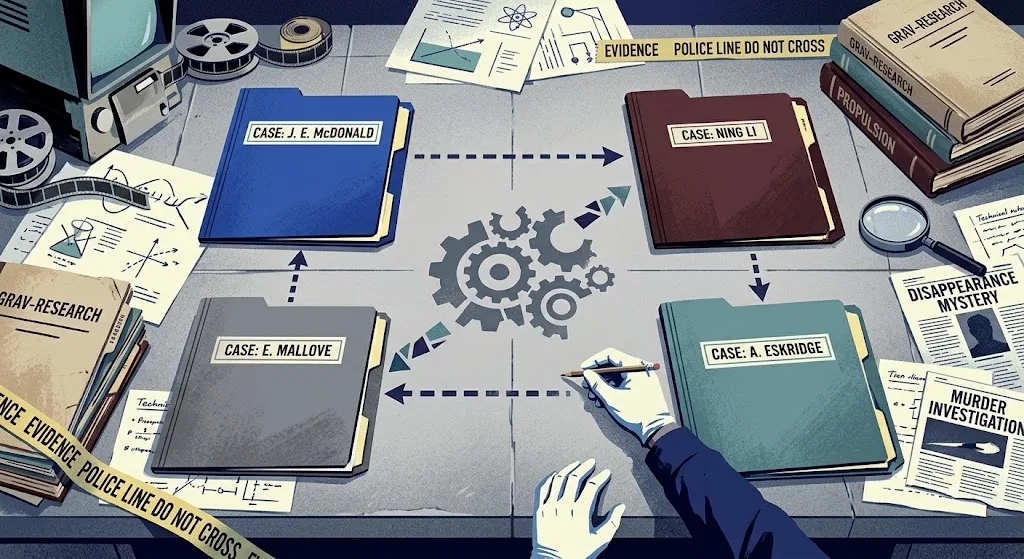
On the presently documented record, that threshold is not met. The four cases most often invoked in this discussion — James E. McDonald, Ning Li, Eugene Mallove and Amy Eskridge — have genuine points of interest, but their circumstances differ substantially. McDonald was a prominent UFO investigator; Li withdrew from public scientific life; Mallove was murdered; and Eskridge died young amid later speculation about her work. Yet similarity of subject matter is not evidence that the same people caused those outcomes. Criminal-investigation and intelligence-analysis frameworks both emphasise testing links across cases and considering competing explanations rather than accumulating individually suggestive facts.
What evidence should a coordinated campaign leave behind?
A coordinated-elimination hypothesis makes a stronger claim than “some of these deaths are suspicious”. It asserts that two or more actors shared a purpose and acted to remove researchers because of their work. In ordinary conspiracy law, the defining feature is an agreement or common unlawful plan; depending on the offence, evidence may also be required that participants knowingly joined it and committed acts in furtherance of it. That legal standard does not directly determine a historical investigation, but it illustrates the distinction between mere association and evidence of coordination.
For this subject, persuasive evidence would therefore need to connect the deaths or disappearancesacross cases, not simply make each case seem unusual in isolation. The strongest forms would include:
- A recurring actor or organisation:the same identifiable agency, company, unit, intermediary or individual demonstrably involved with multiple researchers before their deaths.
- Communications establishing intent:authenticated emails, memoranda, recordings, orders or testimony showing a plan to silence particular researchers because of their UFO, propulsion or gravity-related work.
- Operational linkage:shared perpetrators, weapons, financial transfers, surveillance teams, travel records, communications infrastructure or other forensic signatures connecting otherwise separate incidents.
- A specific common motive:evidence that the victims possessed the same sensitive information, threatened the same programme or were targeted after identifiable disclosure attempts — rather than merely working somewhere within the broad field of unconventional physics.
- Independent corroboration:records or witnesses originating separately from one another, rather than later accounts repeating an earlier rumour.
- Evidence inconsistent with ordinary explanations:facts that the suicide, accident, personal dispute or other case-specific explanation cannot adequately account for.
This is broadly how cross-case analysis works in less controversial criminal settings. The US National Institute of Justice describes forensic intelligence as using evidence across incidents to identify genuine links between crimes; statistical crime-linkage research similarly treats common-offender attribution as an evidential problem in which similarities must be assessed against the possibility of false matches.
That last point is particularly important here. A pattern becomes meaningful only when the relevant feature is sufficiently unusual. “Worked in advanced science”, “received government funding”, “stopped publishing” or “died” describes far too many people to identify a common perpetrator. A repeated obscure intermediary, identical threat language or matching forensic signature would be different because it would be considerably harder to explain as coincidence.
Why suspicious cases cannot simply be added together
The intuitive appeal of a researcher “death list” comes from accumulation. One unexplained incident may appear ambiguous; four can look like a pattern. But adding weakly connected events does not automatically produce strong evidence. The quality of the connection matters more than the number of entries.
Intelligence-analysis guidance explicitly warns against selecting a favoured explanation first and then collecting facts that appear to support it. The CIA’sPsychology of Intelligence Analysisrecommends comparing competing hypotheses and looking especially for evidence that distinguishes between them. US intelligence-community analytic standards likewise call for assessing source credibility, stating uncertainty and separating underlying information from analysts’ assumptions.
Applied here, at least three hypotheses need to remain distinct: researchers were deliberately targeted because of their work; some researchers encountered secrecy, professional pressure or classified recruitment without being physically harmed; or the deaths and withdrawals arose from unrelated personal, medical, criminal and institutional circumstances. Evidence that government-funded advanced research can become secret would support the second possibility, but by itself says little about the first.
The distinction can be seen in discussions surrounding Ning Li. Li genuinely conducted published work on possible gravitational effects involving superconductors and later largely disappeared from the public research record. That absence helped generate claims that she had been recruited, detained or otherwise made to vanish. In 2023, however, theHuntsville Business Journallocated her son, George Guangyu Men, and reported a much more ordinary later history: Li had continued living in Alabama, was struck by a vehicle in 2014, suffered severe and permanent neurological injury and died on 27 July 2021.
Li’s case demonstrates a crucial evidential hazard. A gap in public information is real evidence of a gap; it is not, without further documentation, evidence explainingwhythat gap exists. Once an ordinary explanation becomes documented, using the earlier disappearance claim as evidence for an elimination campaign becomes much harder.
What the four central cases actually share
The strongest genuine commonality among McDonald, Li, Mallove and Eskridge is thematic: all became associated, to different degrees, with UFO investigation, unconventional propulsion, gravity modification or alternative-energy research. Beyond that level, the evidential paths diverge.
James E. McDonaldwas unquestionably a serious scientist who became an unusually forceful advocate for scientific investigation of UFO reports. The University of Arizona’s archive describes his extensive work on the subject and his disputes with official and scientific treatments of UFO evidence. The American Meteorological Society obituary confirms that he died on 13 June 1971. These facts make McDonald highly relevant to the history of scientific UFO investigation, but neither source identifies evidence connecting his death to an organised effort against other researchers.
Ning Liprovides a different type of story. Her withdrawal from public publication was real enough to create a mystery, but later reporting based on direct contact with her son substantially changed what could responsibly be inferred from it. The reported 2014 road accident and subsequent illness supply a documented personal explanation for the final years of her life. No evidence presented in that reporting connects her death to McDonald, Mallove or Eskridge.
Eugene Malloveis the case in which homicide itself is not disputed. Connecticut authorities treated his 2004 death as murder and formed a dedicated task force. Later proceedings developed an evidential narrative centred on people connected with a Norwich rental property from which tenants had recently been evicted. A 2025 Connecticut Appellate Court decision recounts that background while ordering a new trial for Mozelle Brown because of a Brady due-process violation. The reversal is important: it means one should not present Brown’s 2014 conviction as an untouched final resolution. But the appellate decision does not substitute a cold-fusion or advanced-energy motive for the property-related evidence, nor does it connect Mallove’s killing to any of the other researcher deaths.
That distinction is easy to miss. A criminal case can contain mistakes, disputed testimony or even a wrongful conviction without the alternative explanation automatically becoming “research assassination”. Demonstrating flaws in one prosecution establishes those flaws; a technology-suppression motive still requires affirmative evidence of its own.
Amy Eskridgepresents the largest current information gap. Her published obituary confirms that she died on 11 June 2022 at the age of 34 and describes her role in the Institute for Exotic Science, but it gives no cause of death. Later online discussions have circulated allegations that she was threatened or targeted because of advanced-propulsion research. A widely shared account also reproduces a 2018 presentation in which an audience member raised the possibility of an inventor “disappearing”, with Ning Li cited during the exchange. But even the author of the original speculative account acknowledged lacking evidence for claims about Eskridge’s death. The material demonstrates that fears about secrecy and disappearance circulated within that community before her death; it does not demonstrate who caused her death, or that anyone did.
Put together, the cases therefore share anarrative category, not a demonstrated operational chain. There is no publicly established common perpetrator, common command structure, common killing method, shared financial trail or authenticated set of instructions tying them together.
Secrecy is not the same claim as assassination
Much of the confusion comes from combining several propositions that require different evidence. Governments and defence contractors conduct classified research; researchers can move from open publication into proprietary or classified work; institutions can restrict dissemination of intellectual property; unconventional research can encounter funding barriers or professional stigma. None of those propositions logically entails that researchers are being killed.
Eskridge’s surviving discussions are instructive because the themes sometimes appear beside one another. Material attributed to her describes concerns over research publication, government-linked intellectual property and the possibility that work might migrate from an open environment to highly classified programmes. Online commentators subsequently connected those concerns to her death. But a publication restriction establishes a dispute over information release, not a homicide mechanism.
The same analytical separation applies to McDonald. His University of Arizona archive documents his battles over the scientific and governmental treatment of UFO reports. Institutional hostility to a research programme may be historically significant, yet evidence of obstruction does not become evidence of murder unless a factual bridge connects the two.
This is why the “coordinated campaign” hypothesis should be formulated in falsifiable terms. If the supposed mechanism is flexible enough to treat suicide, homicide, accidental injury, quiet retirement, classified employment and absence from publishing as interchangeable evidence of the same programme, virtually any outcome confirms it. Such a theory becomes difficult to test because contradictory events can simply be absorbed into the narrative.
The missing bridge between motive and mechanism
The unresolved question is not whether powerful organisations might have an incentive to protect genuinely sensitive aerospace technology. That is plausible in the abstract and classification systems exist precisely because states protect information. The question is whether that general incentive explains these particular deaths.
A credible case would need to move through a chain something like this: identify the sensitive result each researcher possessed; show that a particular actor regarded its disclosure as threatening; establish that the actor communicated or acted against the researcher; and then connect that action to the death. To claim acampaign, the same chain would have to recur across multiple victims or be traced to a common directing organisation.
None of the four central cases currently supplies that full chain. Mallove provides a confirmed homicide but no demonstrated UFO or antigravity programme connection. Li supplies authentic gravity-related research and a once-puzzling disappearance from publication, but later reporting provides a non-homicidal account of her fate. McDonald supplies unquestioned UFO involvement but no established cross-case perpetrator. Eskridge supplies advanced-propulsion interests and genuine uncertainty in the readily available public record about the circumstances of her death, but uncertainty is the point at which further evidence is needed, not proof that an elimination operation occurred.
That asymmetry matters. Different cases each possess one component that a conspiracy hypothesis would predict — controversial research here, an unexplained interval there, an actual murder elsewhere — but those components occur in different people. Combining them into a single composite story risks treating evidence belonging to one case as though it fills the gaps in another.

What would change the assessment?
The coordinated-campaign hypothesis should not be treated as impossible simply because present public evidence is inadequate. It should be treated as a proposition capable of being strengthened by specific discoveries.
The assessment would change substantially if authenticated records showed that one organisation tracked several of these researchers because of their work; if a witness with direct knowledge supplied independently corroborated details of orders or operations; if financial, communications or forensic evidence connected perpetrators across cases; or if official investigative records demonstrated that the publicly stated explanations had been fabricated to conceal a common motive.
Conversely, merely finding additional researchers who stopped publishing, died unexpectedly or worked near defence establishments would add little unless those cases producedlinkage evidence. Crime-linkage research exists precisely because apparent similarity generates false positives: investigators need features that discriminate a real series from coincidental resemblance.
This also explains why the 2025 development in the Mallove litigation deserves careful rather than sensational treatment. A court ordering a new trial because exculpatory evidence was not properly disclosed is important evidence about the integrity of that prosecution. It increases legitimate uncertainty about one defendant’s conviction. But it does not identify an aerospace organisation, demonstrate a research-related motive or link Mallove’s death to the other cases. The evidential gap between “the original prosecution was flawed” and “a coordinated research-suppression campaign killed him” remains large.
The defensible conclusion
The public record supports investigating individual anomalies and keeping genuinely unresolved questions open. It also supports a history of secrecy, contested research, institutional resistance and occasional gaps in the careers of people working around unconventional propulsion and UFO subjects. Those are legitimate subjects of inquiry.
What it does not presently establish is the critical additional proposition that McDonald, Li, Mallove, Eskridge or comparable researchers were victims of one coordinated elimination programme. The four central cases differ in cause, setting, chronology and available investigative evidence, and no demonstrated actor or operational mechanism currently binds them together.
For a coordinated-killings claim, therefore, the appropriate evidence threshold is not “several strange stories point in the same direction”. It isindependent evidence that connects the stories to one another. Until such a bridge appears, the strongest evidence-based conclusion is narrower: some individual cases contain unanswered questions, but unanswered questions across separate cases are not themselves proof of coordination.
Amazon book picks
Further Reading
Books and field guides related to What Would Prove a Coordinated Campaign Against Researchers?. Use these as the next step if you want deeper reading beyond the article.
The Demon-Haunted World: Science as a Candle in the Dark
Rating: 4.5/5 from 43 Google Books ratings
NEW YORK TIMES BESTSELLER • From the renowned astronomer and author of Cosmos comes a “powerful [and] stirring defense of informed ration...
The UFO Experience: A Scientific Inquiry
Cited by the New York Review of Books as "the best brief for visitation," this classic study presents an analysis of UFO reports and conc...
The UFO Handbook: A Guide to Investigating, Evaluating, and R...
An explanation of the usual reasons for confusing IFOs (identified flying objects) with UFOs and a survey of the tools used to investigat...
UFOs: An Insider's View of the Official Quest for Evidence
A former field investigator for the Condon Project, the University of Colorado's scientific study of UFOs, relates details of individual...
eBay marketplace picks
Marketplace Samples
Live-tested eBay searches with available results related to this page.
Selected fromUFO poster oneBay.co.uk.


Endnotes
1.
Source: cia.gov
Title: Psychology of Intelligence Analysis
Link:https://www.cia.gov/resources/csi/static/Pyschology-of-Intelligence-Analysis.pdf
Source snippet
Psychology of Intelligence Analysis...
2.
Source: justice.gov
Title: criminal resource manual 2167 jury instruction conspiracy 18 usc 1956h
Link:https://www.justice.gov/archives/usam/criminal-resource-manual-2167-jury-instruction-conspiracy-18-usc-1956h
Source snippet
Department of JusticeU.S. Attorneys' Manual | 2167. Jury Instruction -- Conspiracy -- 18 U.S.C. § 1956(h) | United States Department of J...
3.
Source: justice.gov
Link:https://www.justice.gov/archives/jm/criminal-resource-manual-923-18-usc-371-conspiracy-defraud-us
4.
Source: lib.arizona.edu
Link:https://lib.arizona.edu/special-collections/collections/james-e-mcdonald-papers
5.
Source: archive.ph
Link:https://archive.ph/O3Pgg
6.
Source: cia.gov
Title: Insights with Impact: The Directorate of Analysis
Link:https://www.cia.gov/stories/story/insights-with-impact-the-directorate-of-analysis/
7.
Source: cia.gov
Title: Combating Surprise: Introducing the Kinetic Predictive Analytic Technique
Link:https://www.cia.gov/resources/csi/studies-in-intelligence/volume-66-no-4-december-2022/combating-surprise-introducing-the-kinetic-predictive-analytic-technique/
8.
Source: justice.gov
Link:https://www.justice.gov/archives/usam/antitrust-resource-manual-7-elements-offense
9.
Source: lib.arizona.edu
Title: world ufo day july 2
Link:https://lib.arizona.edu/about/news/world-ufo-day-july-2
10.
Source: justice.gov
Link:https://www.justice.gov/archives/jm/criminal-resource-manual-652-statute-limitations-conspiracy
11.
Source: justice.gov
Title: criminal resource manual 2483 conspiracy aid and abet
Link:https://www.justice.gov/archives/jm/criminal-resource-manual-2483-conspiracy-aid-and-abet
12.
Source: justice.gov
Link:https://www.justice.gov/atr/case-document/courts-instructions-jury-conclusion-trial-price-fixing-wholesale-groceries
13.
Source: justice.gov
Link:https://www.justice.gov/atr/case-document/united-states-pre-trial-memorandum-law
14.
Source: cia.gov
Title: TRAININ G IN INTELLIGENCE ANALYSIS | CIA FOIA (foia.cia.gov)
Link:https://www.cia.gov/readingroom/document/cia-rdp83m00914r003000050015-2
15.
Source: justice.gov
Link:https://www.justice.gov/archives/usam/criminal-resource-manual-965-conspiracy-violate-mail-fraud-or-wire-fraud-statutes
16.
Source: justice.gov
Title: criminal resource manual 2482 pinkerton vs aiding and abetting
Link:https://www.justice.gov/archives/usam/criminal-resource-manual-2482-pinkerton-vs-aiding-and-abetting
17.
Source: justice.gov
Link:https://www.justice.gov/archives/usam/criminal-resource-manual-14-conspiracy-within-us-murder-kidnap-or-maim-persons-or-damage
18.
Source: justice.gov
Title: Office of the Solicitor General | United States v. Recio
Link:https://www.justice.gov/osg/brief/united-states-v-recio-brief-merits
19.
Source: justice.gov
Link:https://www.justice.gov/archives/jm/civil-resource-manual-162-sample-odometer-fraud-jury-instructions
20.
Source: cia.gov
Title: A Tradecraft Primer
Link:https://www.cia.gov/resources/csi/books-monographs/a-tradecraft-primer/?source=post_page—–e66f9b8dddb4——————————–
21.
Source: cia.gov
Title: Analytic Culture in the U.S. Intelligence Community
Link:https://www.cia.gov/resources/csi/books-monographs/analytic-culture-in-the-u-s-intelligence-community-2/
22.
Source: cia.gov
Title: Psychology of Intelligence Analysis
Link:https://www.cia.gov/resources/csi/books-monographs/psychology-of-intelligence-analysis-2/
23.
Source: cia.gov
Title: Improving Intelligence Analysis: Combatting Mind-Set
Link:https://www.cia.gov/resources/csi/studies-in-intelligence/1992-2/combatting-mind-set/
24.
Source: cia.gov
Title: Thinking and Writing: Cognitive Science and Intelligence Analysis
Link:https://www.cia.gov/resources/csi/books-monographs/thinking-and-writing/
25.
Source: cia.gov
Title: The Caesar, Polo, and Esau Papers
Link:https://www.cia.gov/resources/publications/the-caesar-polo-and-esau-papers/
26.
Source: cia.gov
Title: Cuban Missile Crisis: Revisiting Sherman Kent’s Defense of SNIE 85-3-62
Link:https://www.cia.gov/resources/csi/studies-in-intelligence/volume-51-no-3/revisiting-sherman-kents-defense-of-snie-85-3-62/
27.
Source: cia.gov
Title: Curing Analytic Pathologies
Link:https://www.cia.gov/resources/csi/books-monographs/curing-analytic-pathologies/
28.
Source: cia.gov
Title: Directorate of Analysis
Link:https://www.cia.gov/about/organization/directorate-of-analysis/
29.
Source: lib.arizona.edu
Title: great soul trial collection
Link:https://lib.arizona.edu/special-collections/collections/great-soul-trial-collection
30.
Source: archive.org
Title: Full text of “Crusader
Link:https://archive.org/stream/Crusader-Vol_13_Nos_1-24_Sept_1971-May_1972/Crusader-Vol_13_Nos_1-24_Sept_1971-May_1972_djvu.txt
31.
Source: tilln.com
Title: Ning Li | This Scientist Got $450k From The Do D, Then She Disappeared
Link:https://tilln.com/season-4/ning-li-this-scientist-got-450k-from-the-dod-then-she-disappeared/
32.
Source: nij.ojp.gov
Title: forensic intelligence
Link:https://nij.ojp.gov/topics/forensics/forensic-intelligence
33.
Source: ufouap.com
Title: amy eskridge
Link:https://www.ufouap.com/case-files/amy-eskridge/
34.
Source: uapmurders.com
Link:https://uapmurders.com/uaps/Details/Eugene_Mallove/
35.
Source: uapmurders.com
Link:https://uapmurders.com/uaps/Details/Ning_Li/
36.
Source: everything.explained.today
Title: Eugene Mallove
Link:https://everything.explained.today/Eugene_Mallove/
37.
Source: obits.al.com
Link:https://obits.al.com/us/[obituaries
38.
Source: academickids.com
Title: Eugene Mallove
Link:https://academickids.com/encyclopedia/index.php/Eugene_Mallove
39.
Source: files.ncas.org
Link:https://files.ncas.org/ufosymposium/mcdonald.html
Additional References
40.
Source: nij.ojp.gov
Link:https://nij.ojp.gov/topics/articles/understanding-forensic-intelligence-nij-framework
Source snippet
National Institute of JusticeUnderstanding Forensic Intelligence: The NIJ Framework | National Institute of JusticeOctober 25, 2023...
Published: October 25, 2023
41.
Source: nij.ojp.gov
Link:https://nij.ojp.gov/library/publications/statistical-approach-crime-linkage
Source snippet
National Institute of JusticeA Statistical Approach to Crime Linkage | National Institute of JusticeJanuary 1, 2016...
Published: January 1, 2016
42.
Source: huntsvillebusinessjournal.com
Link:https://huntsvillebusinessjournal.com/news/2023/07/30/solving-the-mystery-of-huntsvilles-brilliant-scientist-disappearing/
Source snippet
Huntsville Business JournalUncovering The Mystery Of Huntsville’s Brilliant Anti-gravity Scientist - Huntsville Business JournalJuly 30...
43.
Source: youtube.com
Title: Father of 11th dead or [missing scientist]({{ ‘missing-scientist/’ | relative_url }}) rejects suspicions about her death
Link:https://www.youtube.com/watch?v=1d–WxTUkXE
Source snippet
The disappearance of America's leading anti-gravity researcher...
44.
Source: arxiv.org
Link:https://arxiv.org/html/2502.06794v2
45.
Source: youtube.com
Title: The disappearance of America’s leading anti-gravity researcher
Link:https://www.youtube.com/watch?v=Qsbz8_G9WcU
Source snippet
12 U.S. Scientists Have Gone Missing or Died. What's Going On?...
46.
Source: dni.gov
Link:https://www.dni.gov/index.php/ncsc-how-we-work/123-about
47.
Source: dni.gov
Link:https://www.dni.gov/index.php/features/223-about/organization/chief-information-officer
48.
Source: dni.gov
Link:https://www.dni.gov/index.php/who-we-are/organizations/ic-cio/ic-technical-specifications/intelligence-community-specification-framework?highlight=WyJhdCIsImF0cyJd
49.
Source: dni.gov
Link:https://www.dni.gov/index.php/what-we-do/ic-related-menus/ic-related-links/intelligence-community-directives