Within Hostility
When Failed Antigravity Tests Look Like Suppression
Experiments associated with Ning Li produced limits rather than a large gravity-shielding effect, showing how negative results can later be recast as
On this page
- What the superconducting gravity experiments proposed
- What later measurements actually constrained
- Why failed replication can be mistaken for institutional hostility
Page outline Jump by section
Introduction
The late-1990s superconducting-gravity episode is useful precisely because the documented record is less dramatic than the suppression story later built around it. Experiments associated with physicist Ning Li and NASA’s Marshall Space Flight Center did not demonstrate a large antigravity or “gravity-shielding” effect. Instead, a 1997 test placed a stringent upper limit on any static effect, while subsequent experiments with rotating fields and superconducting discs likewise failed to reproduce the much larger weight reductions claimed by Eugene Podkletnov.[sciencedirect.com]sciencedirect.comStatic test for a gravitational force coupled to type II YBCO superconductors - ScienceDirectAugust 1, 1997…
That history does not mean every experimental question was perfectly settled. Replicating Podkletnov’s apparatus was technically difficult, and researchers disagreed over whether later tests reproduced all the supposedly necessary conditions. But the surviving scientific literature shows something important for claims of researcher suppression: unconventional gravity research was not simply forbidden. It was published, funded, tested and criticised. The strongest documented outcome was increasingly restrictive experimental limits, not confirmation followed by physical suppression.
What the superconducting gravity experiments proposed
The story combined two related but distinct lines of work. Ning Li and Douglas Torr at the University of Alabama in Huntsville investigated theoretical connections between superconductivity and weak gravitational or “gravitomagnetic” effects. Their work appeared in mainstream physics journals: a 1992 Physical Review B paper, for example, examined gravitational effects within a theoretical model of superconductors rather than reporting the discovery of an antigravity machine.[APS Journals]journals.aps.orgAPS JournalsGravitational effects on the magnetic attenuation of superconductors | Phys. Rev. BSeptember 1, 1992…
The more spectacular experimental claim came from Eugene Podkletnov and colleagues. Podkletnov reported that objects positioned above a high-temperature YBCO — yttrium barium copper oxide — superconducting disc appeared to lose a small fraction of their weight. A later account claimed losses initially around 0.3–0.5 per cent and, under particular rotational conditions, as much as roughly 1.9–2.1 per cent. Such an effect, if genuine and controllable, would have been enormous by gravitational-physics standards and potentially revolutionary for propulsion.[arXiv]arxiv.orgWeak gravitation shielding properties of composite bulk YBa_2Cu_3O_{7-x} superconductor below 70 K under e.m. fieldJanuary 10, 1997…
The claim therefore attracted attention rather than disappearing into obscurity. NASA records show researchers at Marshall investigating possible gravitational effects associated with high-temperature superconductors. NASA’s own technical archive describes the Podkletnov result explicitly and preserves papers examining both experimental tests and possible mechanisms.[NASA Technical Reports Server]ntrs.nasa.govNASA Technical Reports ServerOn the Mechanism for a Gravity Effect Using Type 2 Superconductors - NASA Technical Reports Server (NTRS)Jan…
This distinction matters. The documented history is not one in which government scientists refused to touch a forbidden subject. NASA researchers were willing to ask whether an extraordinary reported effect could survive controlled measurement.
What later measurements actually constrained
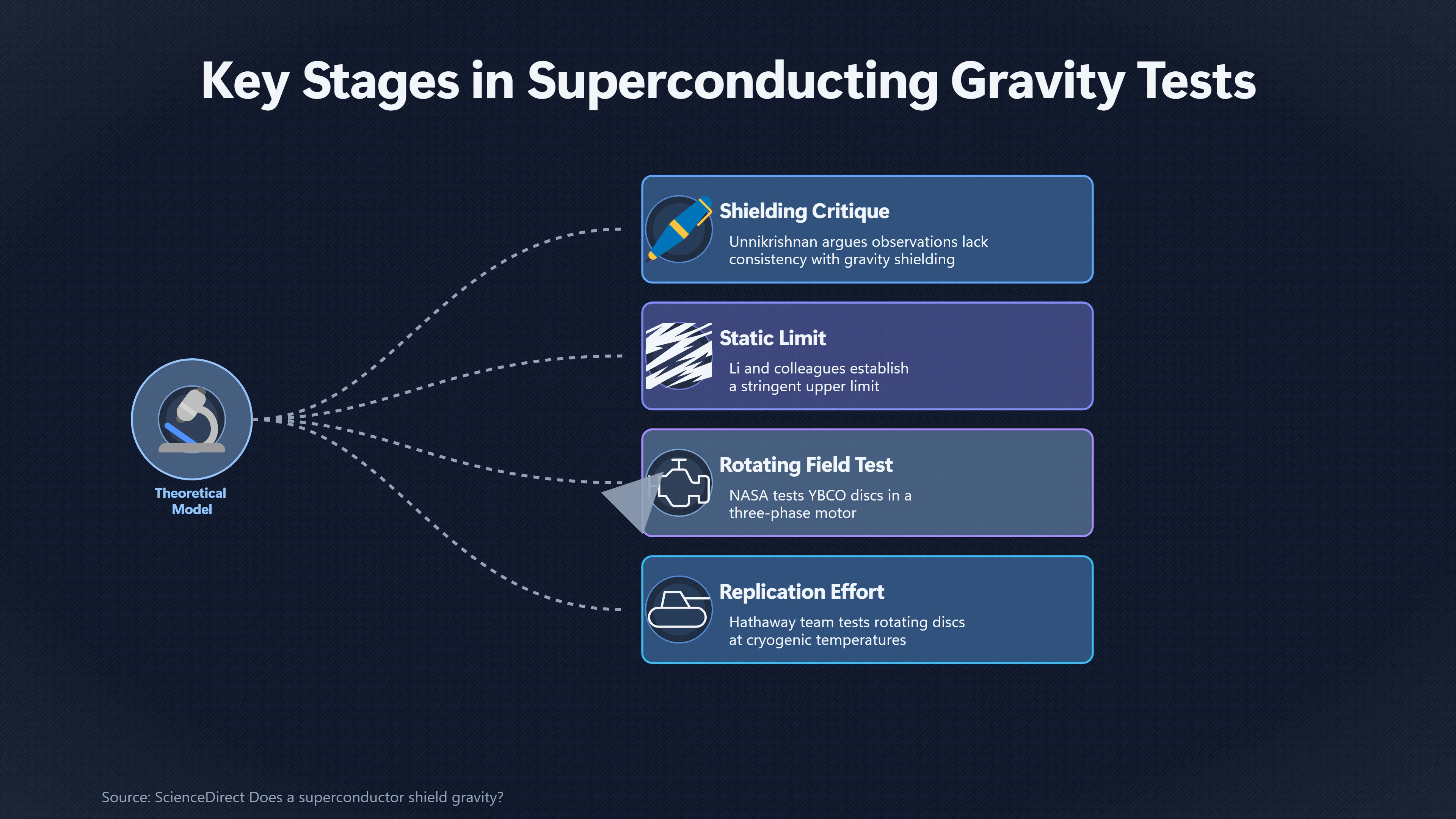
The most important Ning Li-associated experiment for evaluating the suppression narrative is the 1997 Physica C paper “Static test for a gravitational force coupled to type II YBCO superconductors”, written by Li, David Noever, Tony Robertson, Ron Koczor and Whitt Brantley. The authors levitated bulk YBCO superconductors in a direct-current magnetic field and used a sensitive gravimeter to look for changes in gravitational acceleration.[ScienceDirect]sciencedirect.comStatic test for a gravitational force coupled to type II YBCO superconductors - ScienceDirectAugust 1, 1997…
They did not reproduce anything remotely comparable to the reported percentage-scale weight reductions. The measured change was less than two parts in 100 million of normal gravitational acceleration, or 2×10⁻⁸g. The authors presented that result as a new limit on the strength and range of any proposed coupling between a static superconductor and gravity.[ScienceDirect]sciencedirect.comStatic test for a gravitational force coupled to type II YBCO superconductors - ScienceDirectAugust 1, 1997…
That number is particularly revealing. A claimed 0.05 per cent effect corresponds to roughly five parts in ten thousand; Podkletnov’s largest reported effects approached two per cent. Li and her colleagues were therefore not publishing confirmation of those large effects. They were reporting that, in their static experimental configuration, nothing comparable appeared down to a vastly smaller measurement threshold.[ScienceDirect]sciencedirect.comStatic test for a gravitational force coupled to type II YBCO superconductors - ScienceDirectAugust 1, 1997…
There was a legitimate qualification: Podkletnov maintained that rotation and alternating electromagnetic fields were important. A static null experiment could therefore constrain the static version of the hypothesis without necessarily reproducing every feature of the rotating apparatus. NASA researchers consequently pursued configurations involving large YBCO discs and rotating magnetic fields.[NASA Technical Reports Server]ntrs.nasa.govNASA Technical Reports ServerSuperconductor-Mediated Modification of Gravity? AC Motor Experiments with Bulk YBCO Disks in Rotating Magne…
A 1998 NASA-associated experiment placed 15-centimetre YBCO discs inside a three-phase motor stator capable of producing a rotating magnetic field corresponding to as much as 12,000 revolutions per minute. Measurements found no effect attributable to the rotating magnetic field, thermal environment or rotation of the superconducting disc within the precision of the observations.[NASA Technical Reports Server]ntrs.nasa.govNASA Technical Reports ServerSuperconductor-Mediated Modification of Gravity? AC Motor Experiments with Bulk YBCO Disks in Rotating Magne…
Independent criticism was already emerging as well. In 1996, C. S. Unnikrishnan examined the claimed shielding interpretation in Physica C, argued that the published observations contained difficulties inconsistent with simple shielding of Earth’s gravity, and reported that preliminary static experiments showed no evidence for the claimed effect.[ScienceDirect]sciencedirect.comScienceDirect Does a superconductor shield gravity?Does a superconductor shield gravity? - ScienceDirectJuly 20, 1996…
Later attempts pushed closer to the more elaborate rotating-disc claim. In a 2003 Physica C paper, George Hathaway, Blair Cleveland and Y. Bao described a replication effort based not only on Podkletnov’s publications but also on personal communications with him. They fabricated bilayer YBCO discs, operated high-frequency electromagnetic systems and mechanically rotated the apparatus at cryogenic temperatures. A dummy disc was also tested to identify artefacts such as air currents or electromagnetic interference.[ScienceDirect]sciencedirect.comGravity modification experiment using a rotating superconducting disk and radio frequency fields - ScienceDirectApril 1, 2003…
The result was again negative: the researchers reported no weight modification or gravity-like force down to approximately 0.001 per cent. They nevertheless acknowledged an important experimental caveat: their discs reached only about 550 rpm, below the roughly 1,000–2,000 rpm range they thought should eventually be tested. Their conclusion was therefore not that every imaginable superconducting-gravity configuration had been disproved, but that their substantial attempt had detected no claimed effect within its operating conditions and sensitivity.[ScienceDirect]sciencedirect.comGravity modification experiment using a rotating superconducting disk and radio frequency fields - ScienceDirectApril 1, 2003…
Other experiments likewise produced limits. A 2004 study by Martin Tajmar and colleagues tested high-temperature superconductors through their phase transitions, examined a rotating YBCO superconductor and investigated other claimed electromagnetic conditions. It reported no anomalous weight behaviour within experimental accuracy and described the measurements as placing new boundaries on proposed inertial effects associated with superconductivity.[arXiv]arxiv.orgOpen source on arxiv.org.
The cumulative picture is therefore more precise than either “antigravity was disproved immediately” or “successful experiments were suppressed”. Different experiments tested somewhat different configurations, so not every null result was an exact reproduction of every claimed condition. Nevertheless, increasingly careful measurements repeatedly failed to reproduce the conspicuous weight changes that had made the original claim interesting.
Replication was imperfect, but that cuts both ways
Supporters of the superconducting-gravity hypothesis have a genuine methodological point: an unsuccessful experiment is not a decisive replication if it substantially changes conditions that the original claimant regards as essential.
This became especially important because Podkletnov’s proposed requirements grew unusually specific. Later accounts emphasised disc diameter and composition, a partly non-superconducting or bilayer structure, self-levitation, numerous inter-grain junctions, particular alternating-field frequencies and rotation at thousands of revolutions per minute. The Woods group reported no test-mass weight change with smaller superconducting discs but itself noted that its apparatus did not satisfy all of the claimed requirements. A later historical review likewise argued that NASA’s efforts did not constitute a complete verification or disproof of the original experiment because the intended full replication was not completed.[ResearchGate]researchgate.netResearch Gate Gravity modification by high-temperature superconductorsResearch Gate Gravity modification by high-temperature superconductors
That prevents an overly simple verdict. It would be inaccurate to say that NASA constructed a perfect copy of every Podkletnov apparatus, operated it through every claimed regime and definitively falsified the phenomenon.
But the same qualification cannot be turned into positive evidence for gravity shielding. When an effect appears only under an increasingly narrow combination of difficult-to-reproduce conditions, the evidential burden remains with the claimed phenomenon. The Hathaway experiment is particularly informative because it incorporated information obtained directly from Podkletnov and still produced no effect at the 0.001 per cent level, despite not reaching the highest desired rotational speeds.[ScienceDirect]sciencedirect.comGravity modification experiment using a rotating superconducting disk and radio frequency fields - ScienceDirectApril 1, 2003…
NASA’s public-facing assessment eventually reflected this distinction. A Goddard Space Flight Center physics explanation noted that other scientists had not reproduced Podkletnov’s claimed result and consequently described it as highly suspect. That is conventional scientific reasoning about reproducibility, not evidence that the experiment was prohibited from investigation.[Cosmicopia]cosmicopia.gsfc.nasa.govCosmicopia NASA's Cosmicopia – Ask UsCosmicopia NASA's Cosmicopia – Ask Us
Why failed replication can look like institutional hostility
The suppression interpretation becomes understandable when several separate events are compressed into one narrative. There was an extraordinary claim; mainstream physicists were sceptical; replication attempts returned negative results; funding and attention eventually moved elsewhere; and some researchers later became much less visible publicly. Viewed without the experimental details, that sequence can resemble an institution closing ranks around an inconvenient discovery.
The actual chronology is less supportive of that conclusion. The subject generated peer-reviewed papers, NASA technical reports and government-supported experimental work. NASA’s archive still publicly hosts records discussing purported superconducting gravity modification and proposed mechanisms. The 1997 Li experiment itself was published in Physica C, as was the detailed 2003 Hathaway replication attempt.[NASA Technical Reports Server]ntrs.nasa.govNASA Technical Reports ServerStatic Test for a Gravitational Force Coupled to Type 2 YBCO Superconductors - NASA Technical Reports Server…
Nor did scepticism precede testing in every case. Researchers invested considerable effort in manufacturing unusual superconducting discs, operating cryogenic systems, applying magnetic and radio-frequency fields and developing sensitive measurement arrangements. The Hathaway team even thanked Podkletnov for assistance. That history fits a pattern of extraordinary claims receiving limited exploratory investigation and losing credibility when the expected signal fails to appear much better than it fits a straightforward suppression model.[ScienceDirect]sciencedirect.comGravity modification experiment using a rotating superconducting disk and radio frequency fields - ScienceDirectApril 1, 2003…
There was undoubtedly scientific resistance. A claim that superconductors can reduce apparent weight by percentages conflicts sharply with established gravitational physics, so researchers demanded unusually strong evidence. But demanding replication is not equivalent to institutional hostility, and institutional hostility is itself not evidence of physical suppression.
This distinction is especially important in the wider literature about allegedly missing or targeted antigravity researchers. A failed replication can easily be retrospectively described as an attempt to “debunk” a scientist, while the subsequent disappearance of a researcher from academic publishing can be interpreted as evidence that successful work was classified or suppressed. Neither inference follows automatically from the experimental record.

Ning Li’s later silence is not evidence that the null result was false
Ning Li’s subsequent career is one reason the episode acquired a second life in UFO and antigravity narratives. She left the University of Alabama in Huntsville and established AC Gravity LLC. Later public-record enquiries have focused on a reported Department of Defense award of $448,970 to the company and on the absence of publicly available experimental results from that later work.[MuckRock]muckrock.comOpen source on muckrock.com.
The resulting information gap encouraged a powerful story: Li supposedly demonstrated antigravity, received military attention and then “disappeared”. But that version conflates her theoretical ambitions and later unpublished work with what the earlier experimental literature actually established. Her own 1997 peer-reviewed paper did not announce a working gravity shield; it reported a stringent experimental limit in a static configuration.[ScienceDirect]sciencedirect.comStatic test for a gravitational force coupled to type II YBCO superconductors - ScienceDirectAugust 1, 1997…
More importantly for allegations of physical suppression, Li did not literally disappear. A 2023 investigation by the Huntsville Business Journal located and interviewed her son, George Men. The article reported that Li had remained in Huntsville and that later family and health circumstances explained much of her withdrawal from public visibility. An obituary records that she died in Huntsville on 27 July 2021.[Huntsville Business Journal]huntsvillebusinessjournal.comOpen source on huntsvillebusinessjournal.com.
Her son’s account, as reported by the Huntsville Business Journal, also adds a complication rather than a neat resolution: he said his mother continued sensitive defence-related work and stopped discussing aspects of it publicly. Such an account can reasonably raise questions about what later research was conducted and whether some information was classified. But classification, if involved, would establish secrecy around particular research, not demonstrate that the earlier gravity-shielding claims had been experimentally confirmed, nor that Li was physically removed because of them.[Huntsville Business Journal]huntsvillebusinessjournal.comOpen source on huntsvillebusinessjournal.com.
The unanswered question is therefore narrower than conspiracy versions often imply. There is a legitimate historical gap concerning the detailed outcome of some of Li’s later AC Gravity work. There is not a corresponding gap in the crucial 1997 experiment: its published result is available and was a limit, not a large anomalous gravitational signal.
The suppression claim reverses the strongest evidence
Superconducting gravity research provides an unusually clear test of the difference between scientific marginalisation and physical suppression. The hypothesis was unconventional enough to attract scepticism, but important enough that researchers nevertheless spent money, laboratory time and specialist engineering effort trying to measure it. The published record then moved predominantly towards null results and tighter limits.[sciencedirect.com]sciencedirect.comStatic test for a gravitational force coupled to type II YBCO superconductors - ScienceDirectAugust 1, 1997…
There remains room for careful qualification. Not every replication reproduced every claimed material property, rotational speed or electromagnetic condition. Consequently, the historical literature does not justify the sweeping statement that every possible interaction between superconductors and gravity has been experimentally excluded. Even modern research continues to investigate how quantum systems and gravity interact at much subtler scales.[Frontiers]frontiersin.orgOpen source on frontiersin.org.
What the record does justify is much more specific. The large gravity-shielding effect that drove the late-1990s excitement did not become a reproducible laboratory phenomenon. Li and colleagues measured less than 2×10⁻⁸g in their static test; NASA-associated rotating-field experiments found no corresponding effect; Hathaway and colleagues found none at the 0.001 per cent level in a more elaborate replication effort.[sciencedirect.com]sciencedirect.comStatic test for a gravitational force coupled to type II YBCO superconductors - ScienceDirectAugust 1, 1997…
That chronology matters when assessing later allegations involving suspicious deaths, disappearances or suppression of antigravity researchers. The absence of a confirmed effect cannot logically prove that no later classified research ever succeeded. But neither can classification, career obscurity or missing publications be used to erase the negative measurements that are actually documented.
The most evidence-consistent interpretation is therefore not that successful superconducting antigravity was demonstrated and then physically suppressed. It is that an extraordinary claim passed through a recognisable scientific sequence: theoretical interest, provocative experimental reports, institutional investigation, increasingly demanding replication and failure to establish a robust effect. The unresolved portions of Ning Li’s later research history are legitimate subjects for historical inquiry, but they do not convert those experimental limits into evidence of suppression.
Amazon book picks
Further Reading
Books and field guides related to When Failed Antigravity Tests Look Like Suppression. Use these as the next step if you want deeper reading beyond the article.
The Antigravity Enigma: Fiction, Fringe Science, and Modern P...
From magic carpets to hoverboards and space drives, the human imagination has always seen antigravity as the ultimate aspirational symbol...
Gravity: How the Weakest Force in the Universe Shaped Our Lives
A history of gravity, and a study of its importance and relevance to our lives, as well as its influence on other areas of science. Physi...
Superconductivity: A Very Short Introduction
Superconductivity is one of the most exciting areas of research in physics today. Outlining the history of its discovery, and the race to...
Bad Science
Rating: 5.0/5 from 5 Google Books ratings
Have you ever wondered how one day the media can assert that alcohol is bad for us and the next unashamedly run a story touting the benef...
eBay marketplace picks
Marketplace Samples
Live-tested eBay searches with available results related to this page.
Selected fromantigravity poster oneBay.co.uk.



Endnotes
1.
Source: sciencedirect.com
Link:https://www.sciencedirect.com/science/article/pii/S0921453497014627
Source snippet
Static test for a gravitational force coupled to type II YBCO superconductors - ScienceDirectAugust 1, 1997...
Published: August 1, 1997
2.
Source: ntrs.nasa.gov
Link:https://ntrs.nasa.gov/search.jsp?R=19990039542
Source snippet
NASA Technical Reports ServerStatic Test for a Gravitational Force Coupled to Type 2 YBCO Superconductors - NASA Technical Reports Server...
3.
Source: ntrs.nasa.gov
Link:https://ntrs.nasa.gov/search.jsp?R=19990019627&hterms=superconducting+gravity
Source snippet
NASA Technical Reports ServerSuperconductor-Mediated Modification of Gravity? AC Motor Experiments with Bulk YBCO Disks in Rotating Magne...
4.
Source: journals.aps.org
Link:https://journals.aps.org/prb/abstract/10.1103/PhysRevB.46.5489
Source snippet
APS JournalsGravitational effects on the magnetic attenuation of superconductors | Phys. Rev. BSeptember 1, 1992...
Published: September 1, 1992
5.
Source: arxiv.org
Link:https://arxiv.org/abs/cond-mat/9701074
Source snippet
Weak gravitation shielding properties of composite bulk YBa_2Cu_3O_{7-x} superconductor below 70 K under e.m. fieldJanuary 10, 1997...
Published: January 10, 1997
6.
Source: ntrs.nasa.gov
Link:https://ntrs.nasa.gov/archive/nasa/casi.ntrs.nasa.gov/19990046249.pdf
Source snippet
NASA Technical Reports ServerOn the Mechanism for a Gravity Effect Using Type 2 Superconductors - NASA Technical Reports Server (NTRS)Jan...
7.
Source: ntrs.nasa.gov
Link:https://ntrs.nasa.gov/citations/20020068834
Source snippet
NASA Technical Reports ServerConsequences of Coupled Electromagnetic-Gravitational Fields - NASA Technical Reports Server (NTRS)...
8.
Source: sciencedirect.com
Title: ScienceDirect Does a superconductor shield gravity?
Link:https://www.sciencedirect.com/science/article/pii/0921453496003401
Source snippet
Does a superconductor shield gravity? - ScienceDirectJuly 20, 1996...
Published: July 20, 1996
9.
Source: sciencedirect.com
Link:https://www.sciencedirect.com/science/article/pii/S0921453402022840
Source snippet
Gravity modification experiment using a rotating superconducting disk and radio frequency fields - ScienceDirectApril 1, 2003...
Published: April 1, 2003
10.
Source: arxiv.org
Link:https://arxiv.org/abs/gr-qc/0404005
11.
Source: researchgate.net
Title: Research Gate Gravity modification by high-temperature superconductors
Link:https://www.researchgate.net/publication/269216231_Gravity_modification_by_high-temperature_superconductors
12.
Source: researchgate.net
Title: Research Gate(PDF) Gravity-Superconductors Interactions: Historical Background
Link:https://www.researchgate.net/publication/281439915_Gravity-Superconductors_Interactions_Historical_Background
13.
Source: cosmicopia.gsfc.nasa.gov
Title: Cosmicopia NASA’s Cosmicopia – Ask Us
Link:https://cosmicopia.gsfc.nasa.gov/qa_gp_gr.html
14.
Source: muckrock.com
Link:https://www.muckrock.com/foi/united-states-of-america-10/department-of-defense-grant-for-ac-gravity-llc-2001-department-of-defense-office-of-the-secretary-of-defense-135083/
15.
Source: muckrock.com
Link:https://www.muckrock.com/foi/united-states-of-america-10/department-of-defense-grant-for-ac-gravity-llc-2001-department-of-defense-under-secretary-of-defense-for-intelligence-and-security-135082/
16.
Source: researchgate.net
Link:https://www.researchgate.net/publication/405054195_Small-Scale_Gravitational_Anomaly_Induced_by_Peculiar_Massive_Photon_Dynamics
17.
Source: unpublished.ca
Title: Disappearance of Physicists
Link:https://unpublished.ca/opinion/disappearance-of-physicists
18.
Source: archive.ph
Link:https://archive.ph/O3Pgg
19.
Source: muckrock.com
Link:https://www.muckrock.com/foi/united-states-of-america-10/department-of-defense-grant-for-ac-gravity-llc-2001-department-of-defense-freedom-of-information-policy-office-135081/
20.
Source: muckrock.com
Link:https://www.muckrock.com/foi/united-states-of-america-10/department-of-defense-grant-for-ac-gravity-llc-2001-department-of-defense-defense-security-cooperation-agency-135084/
21.
Source: researchgate.net
Link:https://www.researchgate.net/publication/354521867_A_simple_investigation_of_Static_test_for_a_gravitational_force_coupled_to_type_II_YBCO_superconductors_by_Li_and_coworkers
22.
Source: researchgate.net
Title: 298460654 Gravity Superconductors interactions Theory and experiment
Link:https://www.researchgate.net/publication/298460654_Gravity-Superconductors_interactions_Theory_and_experiment
23.
Source: researchgate.net
Title: (PDF) Experimental considerations in superconductor gravity experiments
Link:https://www.researchgate.net/publication/288399413_Experimental_considerations_in_superconductor_gravity_experiments
24.
Source: researchgate.net
Link:https://www.researchgate.net/publication/1967822_Weight_Measurements_of_High-Temperature_Superconductors_during_Phase_Transition_in_Stationary_Non-Stationary_Condition_and_under_ELF_Radiation
25.
Source: researchgate.net
Link:https://www.researchgate.net/publication/222897740_Gravity_modification_experiment_using_a_rotating_superconducting_disk_and_radio_frequency_fields
26.
Source: sciencedirect.com
Title: Static test for a gravitational force coupled to type II YBCO superconductors
Link:https://www.sciencedirect.com/science/article/abs/pii/S0921453497014627
27.
Source: sciencedirect.com
Link:https://www.sciencedirect.com/journal/physica-c-superconductivity-and-its-applications/vol/281/issue/2
28.
Source: sciencedirect.com
Link:https://www.sciencedirect.com/science/article/pii/092145349290055H
29.
Source: sciencedirect.com
Link:https://www.sciencedirect.com/science/article/abs/pii/092145349290055H
30.
Source: sciencedirect.com
Link:https://www.sciencedirect.com/science/article/pii/092145349290055H/pdf?md5=bfc751b87889117434dec5c029c2d522&pid=1-s2.0-092145349290055H-main.pdf
31.
Source: journals.aps.org
Title: Phys Rev D.43.457
Link:https://journals.aps.org/prd/abstract/10.1103/PhysRevD.43.457
32.
Source: journals.aps.org
Link:https://journals.aps.org/prd/abstract/10.1103/PhysRevD.42.2144
33.
Source: techport.nasa.gov
Link:https://techport.nasa.gov/projects/10880
34.
Source: sciencedirect.com
Title: Reverse Engineering Podkletnov’s Experiments
Link:https://www.sciencedirect.com/science/article/pii/S1875389211005803
35.
Source: researchgate.net
Link:https://www.researchgate.net/publication/277311313_Gravitoelectromagnetic_Theories_and_Their_Applications_to_Advanced_Science_and_Technology
36.
Source: researchgate.net
Link:https://www.researchgate.net/publication/386695026_Superconductor_in_a_weak_static_gravitational_field
37.
Source: researchgate.net
Link:https://www.researchgate.net/publication/234969235_Review_of_Claims_of_Interaction_Between_Gravitation_and_High-Temperature_Superconductors
38.
Source: researchgate.net
Link:https://www.researchgate.net/publication/2167450_Comments_on_A_gravitational_shielding_based_upon_ZnSAg_phosphor_and_The_gravitational_mass_at_the_superconducting_state
39.
Source: everything.explained.today
Link:https://everything.explained.today/Eugene_Podkletnov/
40.
Source: everything.explained.today
Link:https://everything.explained.today/Ning_Li_%28physicist%29/
41.
Source: huntsvillebusinessjournal.com
Link:https://huntsvillebusinessjournal.com/news/2023/07/30/solving-the-mystery-of-huntsvilles-brilliant-scientist-disappearing/
42.
Source: frontiersin.org
Link:https://www.frontiersin.org/journals/physics/articles/10.3389/fphy.2022.941858/full
43.
Source: t.co
Title: Who Killed The Scientists?
Link:https://t.co/wBG4dAdCGX
44.
Source: en.ikwipedia.org
Title: Eugene Podkletnov
Link:https://en.ikwipedia.org/wiki/Eugene_Podkletnov
45.
Source: wikidata.org
Title: Ning Li
Link:https://www.wikidata.org/wiki/Q11170087
46.
Source: tilln.com
Title: Ning Li | This Scientist Got $450k From The Do D, Then She Disappeared
Link:https://tilln.com/season-4/ning-li-this-scientist-got-450k-from-the-dod-then-she-disappeared/
47.
Source: justapedia.org
Title: Eugene Podkletnov
Link:https://justapedia.org/wiki/Eugene_Podkletnov
48.
Source: wired.com
Link:https://www.wired.com/1998/03/antigravity/
49.
Source: science.gov
Link:https://www.science.gov/topicpages/r/rotating%2Bdisk%2Bflow.html
50.
Source: science.gov
Link:https://www.science.gov/topicpages/m/magnetic%2Bfield%2Bdistortion
51.
Source: science.gov
Link:https://www.science.gov/topicpages/a/ac%2Bapplied%2Bmagnetic
52.
Source: science.gov
Link:https://www.science.gov/topicpages/m/mm%2Bwide%2Bybco.html
53.
Source: science.gov
Link:https://www.science.gov/topicpages/a/ac%2Bmagnetic%2Bfield
54.
Source: science.gov
Link:https://www.science.gov/topicpages/b/bulk%2Bhigh-temperature%2Bsuperconductor
55.
Source: science.gov
Link:https://www.science.gov/topicpages/s/superconducting%2Blinear%2Bmotor.html
56.
Source: science.gov
Link:https://www.science.gov/topicpages/m/magnetically-enhanced%2Beffective%2Bgravity
57.
Source: ouci.dntb.gov.ua
Link:https://ouci.dntb.gov.ua/en/works/7nJwBNL7/
58.
Source: a.osmarks.net
Title: Eugene Podkletnov
Link:https://a.osmarks.net/content/wikipedia_en_all_maxi_2020-08/A/Eugene_Podkletnov
59.
Source: uapmurders.com
Link:https://uapmurders.com/uaps/Details/Ning_Li/
Additional References
60.
Source: youtube.com
Title: The disappearance of America’s leading anti-gravity researcher
Link:https://www.youtube.com/watch?v=Qsbz8_G9WcU
Source snippet
Eugene Podkletnov: Antigravity, Superconductors & Gravitational Impulse Force Beams...
61.
Source: youtube.com
Title: Eugene Podkletnov on Gravitational Shielding in Rotating Superconductors
Link:https://www.youtube.com/watch?v=blXEtLPVE9g
Source snippet
The Mysterious Demise Of Dr. Ning Li | Jim Landrith...
62.
Source: pmc.ncbi.nlm.nih.gov
Link:https://pmc.ncbi.nlm.nih.gov/articles/PMC11370934/
63.
Source: youtube.com
Title: The Ning Li Disappearance | Noah Logan
Link:https://www.youtube.com/watch?v=SUeQWs1vWDw
Source snippet
Eugene Podkletnov on Gravitational Shielding in Rotating Superconductors...
64.
Source: shinysideout.com.au
Link:https://www.shinysideout.com.au/13-ning-li.html
65.
Source: independent.co.uk
Link:https://www.independent.co.uk/news/science/boeing-investigates-possibility-that-planes-can-be-set-free-from-the-pull-of-gravity-186448.html
66.
Source: metallicbackup.pages.dev
Link:https://metallicbackup.pages.dev/backup/mm-experience/ftl-travel/e502-the-techniques
67.
Source: bibliotecapleyades.net
Link:https://www.bibliotecapleyades.net/ciencia/secret_projects/project124.htm
68.
Source: scribd.com
Link:https://www.scribd.com/document/859744597/80585
69.
Source: documentsdelivered.com
Link:https://documentsdelivered.com/source/051/770/051770205.php