Within Peer Review
Why Kowitt Challenged Li and Torr's Prediction
Mark Kowitt argued that Li and Torr greatly overstated the effect by misreading magnetic permeability in superconductors.
On this page
- The permeability assumption at the center of the dispute
- Why the predicted gravitomagnetic effect shrank
- What the criticism shows about peer reviewed correction
Page outline Jump by section
Introduction
Mark Kowitt’s 1994 Physical Review B paper is important because it challenged the numerical foundation of one of Ning Li and Douglas Torr’s most striking superconducting-gravity predictions without disputing the legitimacy of studying gravitomagnetism itself. Kowitt argued that Li and Torr had taken the near-zero macroscopic magnetic permeability associated with the Meissner effect and used it as though it were a microscopic material parameter in equations coupling magnetic and gravitomagnetic fields. In his analysis, that interpretation made the gravitational contribution enormously larger than it should have been.[Physical Review Journals]journals.aps.orgPhysical Review Journals Physical Review BPhysical Review JournalsPhysical Review B - Recent Articles…
The dispute is therefore a useful example of what peer review does — and does not — establish in controversial gravity research. Li and Torr’s calculations were published in established physics journals, but publication did not make their assumptions immune from later criticism. Kowitt’s critique, itself published in the same peer-reviewed literature, argued that correcting one crucial assumption drove the proposed gravitomagnetic enhancement back towards an effectively undetectable scale.[PubMed]pubmed.ncbi.nlm.nih.govPub Med Gravitomagnetism and magnetic permeability in superconductorsGravitomagnetism and magnetic permeability in superconductors - PubMedJanuary 1, 1994…
The permeability assumption at the centre of the dispute
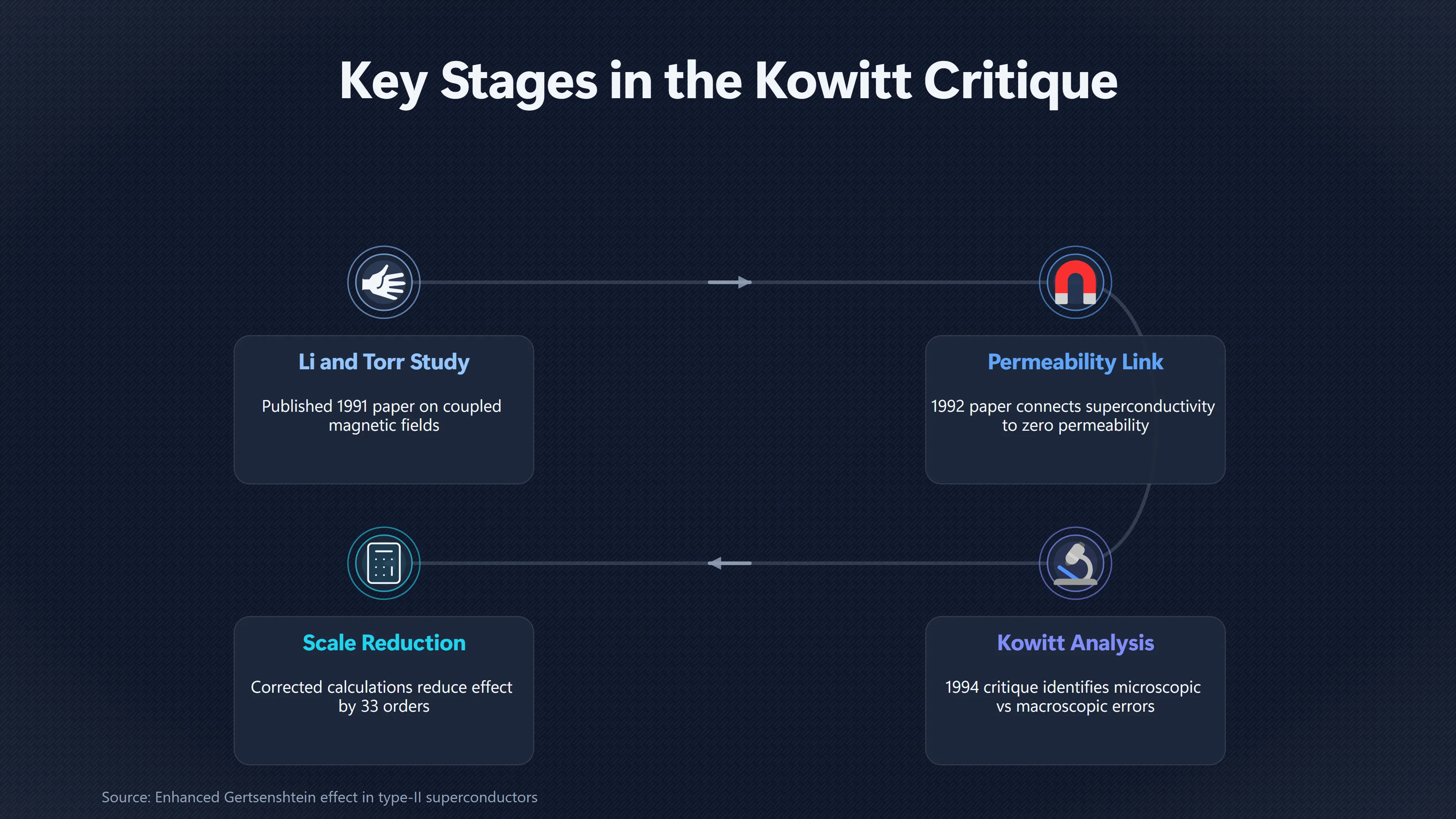
Li and Torr’s starting point was not simply the familiar observation that superconductors expel magnetic flux. Their 1991 Physical Review D paper formulated coupled magnetic and gravitomagnetic fields inside a pure superconductor. In their equations, the induced gravitomagnetic contribution depended on the ratio of the gravitomagnetic permeability to the ordinary magnetic permeability of the material. That denominator was crucial: if the ordinary magnetic permeability became extraordinarily small, the gravitationally related term could become correspondingly large.[Physical Review Journals]journals.aps.orgPhys Rev D.43.457Physical Review JournalsEffects of a gravitomagnetic field on pure superconductors | Phys. Rev. DJanuary 15, 1991…
Their 1992 Physical Review B paper made the superconductivity connection explicit. Li and Torr described the two traditional properties of an ideal superconductor as perfect conductivity and perfect diamagnetism, the latter characterised in their formulation by zero permeability. They proposed a theoretical relationship between conductivity and permeability once gravitational terms were incorporated.[Physical Review Journals]journals.aps.orgOpen source on aps.org.
The difficulty identified by Kowitt was the meaning of that zero. A bulk superconductor in the Meissner state excludes magnetic flux because screening currents arise in such a way as to oppose the applied field. Experimentalists can consequently describe the bulk response with quantities such as magnetisation, susceptibility and an effective permeability. Kowitt argued that Li and Torr had treated this macroscopic description as if it meant that the local microscopic magnetic permeability appearing in their gravitational calculation was itself approaching zero.[Physical Review Journals]journals.aps.orgPhysical Review Journals Physical Review BPhysical Review JournalsPhysical Review B - Recent Articles…
That distinction is the core of his paper. Kowitt explicitly blamed part of the problem on ambiguity in the way magnetisation M, susceptibility χ and permeability μ are used when moving between microscopic and macroscopic descriptions of superconductors. He therefore constructed what the paper’s abstract calls a “simple heuristic model” to clarify those concepts. His criticism was not merely that Li and Torr had selected a slightly inaccurate material constant; it was that the physical meaning assigned to that constant was wrong for the calculation being performed.[Physical Review Journals]journals.aps.orgPhysical Review Journals Physical Review BPhysical Review JournalsPhysical Review B - Recent Articles…
This matters because “zero permeability” can sound, in ordinary language, as though the material itself possesses an intrinsically vanishing local permeability. Kowitt’s argument was that the Meissner effect does not justify making that substitution at microscopic scales. The near-zero effective bulk response instead arises from the organised electromagnetic response of the superconducting system. Treating the bulk parameter as a microscopic denominator can therefore create an artificial amplification.
Why the predicted gravitomagnetic effect shrank
The mathematical stakes were unusually large because Li and Torr’s magnetic–gravitomagnetic coupling depended sensitively on permeability. Their 1991 equations contained terms in which an applied magnetic field could induce an internal gravitomagnetic perturbation, with the magnetic permeability entering the relevant ratio. Thus, once an extremely small value of μ was inserted, a normally negligible gravitational coupling could appear dramatically enhanced.[Physical Review Journals]journals.aps.orgPhys Rev D.43.457Physical Review JournalsEffects of a gravitomagnetic field on pure superconductors | Phys. Rev. DJanuary 15, 1991…
Kowitt concluded that this enhancement was not physically justified. The published abstract describes Li and Torr’s magnitude as “grossly overestimated” and says that they had misinterpreted magnetic permeability as used in descriptions of the Meissner effect. It also criticises the microscopic models introduced to support that interpretation.[Physical Review Journals]journals.aps.orgPhysical Review Journals Physical Review BPhysical Review JournalsPhysical Review B - Recent Articles…
The scale of the disagreement is especially important for interpreting later antigravity narratives. Accounts of Kowitt’s full calculation report that correcting the permeability treatment reduced the relevant ratio between gravitomagnetic and applied magnetic fields by roughly 33 orders of magnitude. That figure should be understood as Kowitt’s theoretical conclusion, not an experimentally measured suppression factor. The underlying peer-reviewed paper’s central documented conclusion is nevertheless unambiguous: Kowitt considered the predicted enhancement so excessive that the resulting gravitomagnetic effect remained effectively beyond detection.[Physical Review Journals]journals.aps.orgPhysical Review Journals Physical Review BPhysical Review JournalsPhysical Review B - Recent Articles…
In other words, this was not a dispute between “large antigravity” and “somewhat smaller antigravity”. It concerned whether the mechanism that had apparently lifted an extraordinarily weak general-relativistic effect into a potentially interesting laboratory regime survived a consistent interpretation of superconducting electrodynamics. Under Kowitt’s treatment, it did not.
That distinction also helps prevent a common category error in accounts of Li’s work. A superconductor’s striking electromagnetic behaviour does not automatically imply an equally striking gravitational response. The Meissner effect is real and readily measurable; gravitomagnetism is also a legitimate consequence of weak-field general relativity. The controversial step was the proposed bridge between those two facts — specifically, whether superconductivity could amplify their coupling enough to produce an observable gravitational phenomenon. Kowitt attacked that bridge rather than either established phenomenon individually.[Physical Review Journals]journals.aps.orgPhys Rev D.43.457Physical Review JournalsEffects of a gravitomagnetic field on pure superconductors | Phys. Rev. DJanuary 15, 1991…
Kowitt’s criticism was itself contested
Kowitt’s paper should not be portrayed as having ended the theoretical argument instantly. Later authors sympathetic to continued investigation of gravity–superconductor interactions questioned whether his macroscopic-versus-microscopic objection fully captured the unusual electromagnetic response of a superconductor.
A later technical discussion, for example, argued that superconducting screening differs from ordinary magnetic polarisation because the currents responsible for the Meissner response are spatially extended supercurrents rather than merely localised atomic magnetic moments. On that interpretation, Kowitt’s objection might not automatically rule out assigning an effective permeability meaningful to the superconducting state. A 2006 Physica C paper discussing possible gravitational-wave manipulation likewise described Kowitt’s objection but judged the issue unresolved rather than treating his argument as definitive.[ScienceDirect]sciencedirect.comManipulation of gravitational waves for communications applications using superconductors - ScienceDirectDecember 1, 2005…
That counterargument is worth preserving because it shows the actual state of the literature more accurately than a simple claim that Kowitt “disproved” Li and Torr. His paper identified a potentially devastating conceptual and numerical problem. Subsequent authors disputed whether his treatment of superconducting permeability was itself appropriate.
There was also a separate later criticism. Edward G. Harris challenged Li and Torr’s gravitoelectric calculation on different grounds, involving extremely small assumed distances used in estimating the field. Later reviews distinguish Harris’s objection from Kowitt’s permeability argument rather than treating them as interchangeable. One subsequent survey characterised Harris’s correction as reducing a predicted external gravitoelectric effect by about 20 orders of magnitude.[UFO Transparency]ufotransparency.comOpen source on ufotransparency.com.
That later dispute should not be folded into Kowitt’s result. Kowitt’s specific contribution was narrower: the use and interpretation of magnetic permeability in deriving an enhanced gravitomagnetic response.
What the criticism shows about peer-reviewed correction
The chronology makes this episode unusually useful when assessing claims that unconventional gravity research was either scientifically validated or simply excluded from mainstream physics. Neither description fits particularly well.
Li and Torr’s original work appeared in mainstream American Physical Society journals. Their 1991 paper was published in Physical Review D, and the 1992 permeability calculation appeared in Physical Review B. Kowitt’s criticism then appeared in Physical Review B in January 1994, occupying pages 704–708.[Physical Review Journals]journals.aps.orgPhys Rev D.43.457Physical Review JournalsEffects of a gravitomagnetic field on pure superconductors | Phys. Rev. DJanuary 15, 1991…
That sequence demonstrates a more ordinary scientific process. An unconventional calculation entered the literature; another physicist examined the assumptions responsible for its unusually large prediction; he argued that one of them confused macroscopic and microscopic quantities; and the resulting disagreement remained available for subsequent researchers to examine and challenge.
Peer review therefore has to be interpreted carefully in this branch of gravity research. The publication of Li and Torr’s papers is meaningful evidence that their calculations were treated as legitimate subjects for scientific discussion. It is not evidence that superconductors were experimentally established to amplify gravity. Conversely, Kowitt’s publication is strong evidence that a technically specific objection existed within the peer-reviewed literature, but it does not by itself turn a contested theoretical calculation into a universally settled theorem. Later researchers continued to debate his treatment.[Physical Review Journals]journals.aps.orgPhysical Review Journals Physical Review BPhysical Review JournalsPhysical Review B - Recent Articles…
For the wider history in which Li’s research is sometimes connected to UFO technology, classified programmes or allegations surrounding researchers, this distinction is particularly important. Kowitt’s paper supplies no evidence about disappearances, suppression or covert exploitation of a working antigravity effect. Its evidential value is narrower and more concrete: it shows that one of the extraordinary-looking amplification mechanisms associated with Li and Torr was challenged on conventional condensed-matter physics grounds almost immediately within the scientific literature.
The key takeaway from Kowitt’s challenge
Kowitt’s critique turns on a deceptively simple question: what does it actually mean to say that a superconductor has nearly zero magnetic permeability? Li and Torr used that property in a theoretical framework where a tiny permeability could magnify the calculated relationship between magnetic and gravitomagnetic fields. Kowitt argued that the relevant zero was a macroscopic description of the Meissner response, not the microscopic permeability that their calculation required.[Physical Review Journals]journals.aps.orgOpen source on aps.org.
If Kowitt’s interpretation is adopted, the apparent enhancement largely disappears and the gravitomagnetic effect returns to an extraordinarily small scale. If his interpretation is rejected, further justification is required for carrying the superconducting bulk response into the microscopic gravitational calculation. Later literature shows that this particular point was disputed rather than simply forgotten.[ScienceDirect]sciencedirect.comManipulation of gravitational waves for communications applications using superconductors - ScienceDirectDecember 1, 2005…
That is the most useful conclusion for evaluating the controversial history of superconducting gravity research. The scientifically interesting fact is not merely that Li and Torr published an unusual prediction. It is that peer-reviewed physics also contained a direct attempt to locate exactly where its enormous magnitude came from — and Kowitt traced much of it to the interpretation of a single, physically loaded quantity: magnetic permeability.
Amazon book picks
Further Reading
Books and field guides related to Why Kowitt Challenged Li and Torr's Prediction. Use these as the next step if you want deeper reading beyond the article.
Gravitation
First published in 1973, Gravitation is a landmark graduate-level textbook that presents Einstein’s general theory of relativity and offe...
Superconductivity of Metals and Cuprates
Superconductivity of Metals and Cuprates covers the basic physics of superconductivity, both the theoretical and experimental aspects. Th...
eBay marketplace picks
Marketplace Samples
Live-tested eBay searches with available results related to this page.
Selected fromgravity physics poster oneBay.co.uk.

Endnotes
1.
Source: sciencedirect.com
Link:https://www.sciencedirect.com/science/article/abs/pii/S0921453405007458
Source snippet
Manipulation of gravitational waves for communications applications using superconductors - ScienceDirectDecember 1, 2005...
Published: December 1, 2005
2.
Source: sciencedirect.com
Link:https://www.sciencedirect.com/science/article/abs/pii/S0921453406008574
3.
Source: sciencedirect.com
Title: Enhanced Gertsenshtein effect in type-II superconductors
Link:https://www.sciencedirect.com/science/article/abs/pii/S0921453406003297
4.
Source: sciencedirect.com
Link:https://www.sciencedirect.com/science/article/abs/pii/S0921453497018571
5.
Source: journals.aps.org
Title: Physical Review Journals Physical Review B
Link:https://journals.aps.org/prb/recent?ei=ntuwkjqa&page=8577
Source snippet
Physical Review JournalsPhysical Review B - Recent Articles...
6.
Source: journals.aps.org
Link:https://journals.aps.org/prb/abstract/10.1103/PhysRevB.46.5489
7.
Source: pubmed.ncbi.nlm.nih.gov
Title: Pub Med Gravitomagnetism and magnetic permeability in superconductors
Link:https://pubmed.ncbi.nlm.nih.gov/10009347
Source snippet
Gravitomagnetism and magnetic permeability in superconductors - PubMedJanuary 1, 1994...
Published: January 1, 1994
8.
Source: journals.aps.org
Title: Physical Review Journals Physical Review B
Link:https://journals.aps.org/prb/issues/49/1
Source snippet
Physical Review JournalsPhysical Review B - Volume 49 Issue 1...
9.
Source: journals.aps.org
Title: Phys Rev D.43.457
Link:https://journals.aps.org/prd/abstract/10.1103/PhysRevD.43.457
Source snippet
Physical Review JournalsEffects of a gravitomagnetic field on pure superconductors | Phys. Rev. DJanuary 15, 1991...
Published: January 15, 1991
10.
Source: pubmed.ncbi.nlm.nih.gov
Title: Pub Med Gravitational effects on the magnetic attenuation of superconductors
Link:https://pubmed.ncbi.nlm.nih.gov/10004334/
Source snippet
Gravitational effects on the magnetic attenuation of superconductors - PubMed...
11.
Source: ufotransparency.com
Link:https://ufotransparency.com/files/decade-2020s-aatip-dird-documents-2018-2019-dird-14-dird-the-role-of-superconductors-in-gravity-rese
12.
Source: pubmed.ncbi.nlm.nih.gov
Link:https://pubmed.ncbi.nlm.nih.gov/10055910/
13.
Source: pubmed.ncbi.nlm.nih.gov
Link:https://pubmed.ncbi.nlm.nih.gov/10056682/
14.
Source: journals.aps.org
Link:https://journals.aps.org/prb/issues/46/9
15.
Source: journals.aps.org
Link:https://journals.aps.org/prd/issues/43/2
16.
Source: pubmed.ncbi.nlm.nih.gov
Link:https://pubmed.ncbi.nlm.nih.gov/10013404/
17.
Source: researchgate.net
Link:https://www.researchgate.net/profile/Mark-Kowitt
18.
Source: uapmurders.com
Link:https://uapmurders.com/uaps/Details/Ning_Li/
19.
Source: science.gov
Title: gravitational+aharonov bohm+effect
Link:https://www.science.gov/topicpages/g/gravitational%2Baharonov-bohm%2Beffect
20.
Source: science.gov
Link:https://www.science.gov/topicpages/a/absolute%2Bgravity%2Bmeasurements
Additional References
21.
Source: osti.gov
Link:https://www.osti.gov/biblio/5986002
Source snippet
Effects of a gravitomagnetic field on pure superconductors (Journal Article) | OSTI.GOV...
22.
Source: youtube.com
Title: The disappearance of America’s leading anti-gravity researcher
Link:https://www.youtube.com/watch?v=Qsbz8_G9WcU
Source snippet
This detailed presentation on The Ning Li Disappearance addresses the theoretical physics calculations by Ning Li and Douglas Torr regard...
23.
Source: youtube.com
Link:https://www.youtube.com/watch?v=7Xhxml67glM
Source snippet
The disappearance of America's leading anti-gravity researcher...
24.
Source: youtube.com
Title: The Truth About Antigravity: Myths, Legends, and Real Science
Link:https://www.youtube.com/watch?v=-P6san8AGO0
Source snippet
Eugene [Podkletnov]({{ 'podkletnov/' | relative_url }}): Antigravity, Superconductors & Gravitational Impulse Force Beams...
25.
Source: youtube.com
Title: Superconductors & Gravity Control | Gary Stephenson
Link:https://www.youtube.com/watch?v=msrhrssRmCE
Source snippet
The Truth About Antigravity: Myths, Legends, and Real Science...
26.
Source: researchgate.net
Link:https://www.researchgate.net/publication/228616053_Gravitational_Wave_Generation_and_Detection_Using_Acoustic_Resonators_and_Coupled_Resonance_Chambers
27.
Source: researchgate.net
Link:https://www.researchgate.net/publication/1971465_Gravitomagnetic_Fields_in_Rotating_Superconductors_to_Solve_Tate%27s_Cooper_Pair_Mass_Anomaly
28.
Source: researchgate.net
Link:https://www.researchgate.net/publication/234929198_High-Frequency_Gravitational_Wave_HFGW_Generation_by_Means_of_X-ray_Lasers_and_Detection_by_Coupling_Linearized_GW_to_EM_Fields
29.
Source: studylib.net
Link:https://studylib.net/doc/27876853/arthur-thompson-margaret-peteraf-john-gamble-a.-stricklan
30.
Source: scribd.com
Link:https://www.scribd.com/document/964115557/Ebook-Gravity-superconductors-Interactions-by-Giovanni-Modanese-Glen-A-Robertson-ISBN-9781608053995-1608053997-available-all-format