Within Motive Test
Does the Brutality of Mallove's Killing Reveal Motive?
The severity of Mallove's injuries shows an exceptionally violent attack, but brutality cannot by itself distinguish rage from a targeted professional killing.
On this page
- What is known about the violence
- Why extreme force can arise from different motives
- How motive claims should be tested beyond injury severity
Page outline Jump by section
Introduction
Eugene Mallove’s killing was extraordinarily violent. The official post-mortem record describes 32 lacerations to his face caused by a blunt instrument, numerous cuts and abrasions to his limbs, a knife wound to his right forearm and crushing of the tracheal area, which the medical examiner identified as the actual cause of death. His blood-covered clothing and the wider scene were consistent with a severe physical assault.[The Black Vault]theblackvault.comOpen source on theblackvault.com.

Those facts establish something important but limited: Mallove did not merely die during an ambiguous incident; he was the victim of sustained, lethal violence. They do not, however, reveal by themselves why that violence occurred. In discussions linking Mallove’s death to his controversial cold-fusion and unconventional-energy work, brutality is sometimes treated as evidence that the killing must have been a professional assassination or suppression operation. That inference goes further than the injuries allow. Extreme violence can accompany a planned killing, but it can also arise from anger, escalation, multiple attackers, attempts to prevent identification or an uncontrolled confrontation. In Mallove’s case, the distinction between what was done to him and why it was done is therefore crucial.
What the injuries actually establish
The strongest description comes from the medical evidence contained in investigative records. Mallove was found dead at 119 Salem Turnpike in Norwich, Connecticut, on 14 May 2004. The post-mortem examination the following morning recorded extensive trauma to his face, head and neck. Investigators summarised the medical examiner’s findings as 32 facial lacerations caused by a blunt instrument, numerous cuts and abrasions to the extremities, a knife wound to the right forearm and a crushed tracheal area. The latter injury was determined to be the cause of death, and the death was classified as homicide.[The Black Vault]theblackvault.comOpen source on theblackvault.com.
That is considerably more specific than saying Mallove was simply “beaten to death”. It indicates several forms of trauma and a prolonged or repeated application of force. Later court records also preserve testimony describing kicking and blows to Mallove’s head with a pipe. Candace Foster testified that, when she arrived at the property, Mallove was already lying face-down but could still call for help. According to her account, Chad Schaffer and Mozzelle Brown then kicked him and struck his head with a pipe; Schaffer subsequently placed a bag over Mallove’s face, and Foster said she too was made to strike and kick him.[Justia Law]law.justia.comOpen source on justia.com.
The physical severity is therefore not an embellishment added by later conspiracy literature. It is part of the documented case. Contemporary reporting immediately described multiple head and neck injuries, while Norwich police publicly called the crime a “brutal murder” when seeking information about property taken from Mallove.[Lewiston Sun Journal]sunjournal.compolice investigate slayingpolice investigate slaying
The crucial evidential question is what follows from that brutality. The answer is less than might initially seem.
Does extreme violence mean the killing was personal?
A common intuitive reaction to an exceptionally violent homicide is that the attacker must have possessed an exceptionally strong motive. In Mallove’s case, that intuition can easily become: someone wanted him dead very badly; therefore his controversial work may explain the violence.
But the inference contains a hidden step. Injury severity can tell investigators something about how an assault unfolded without uniquely identifying why it began.
Mallove’s injuries are compatible with several broad mechanisms. An attacker acting out of anger might repeatedly strike a victim after the force necessary to incapacitate them had already been exceeded. Several participants can increase the amount and variety of trauma. An initially spontaneous confrontation can become homicidal once an assailant fears identification or prosecution. Conversely, an organised killer could deliberately employ extreme force. The injuries alone cannot select among those possibilities.
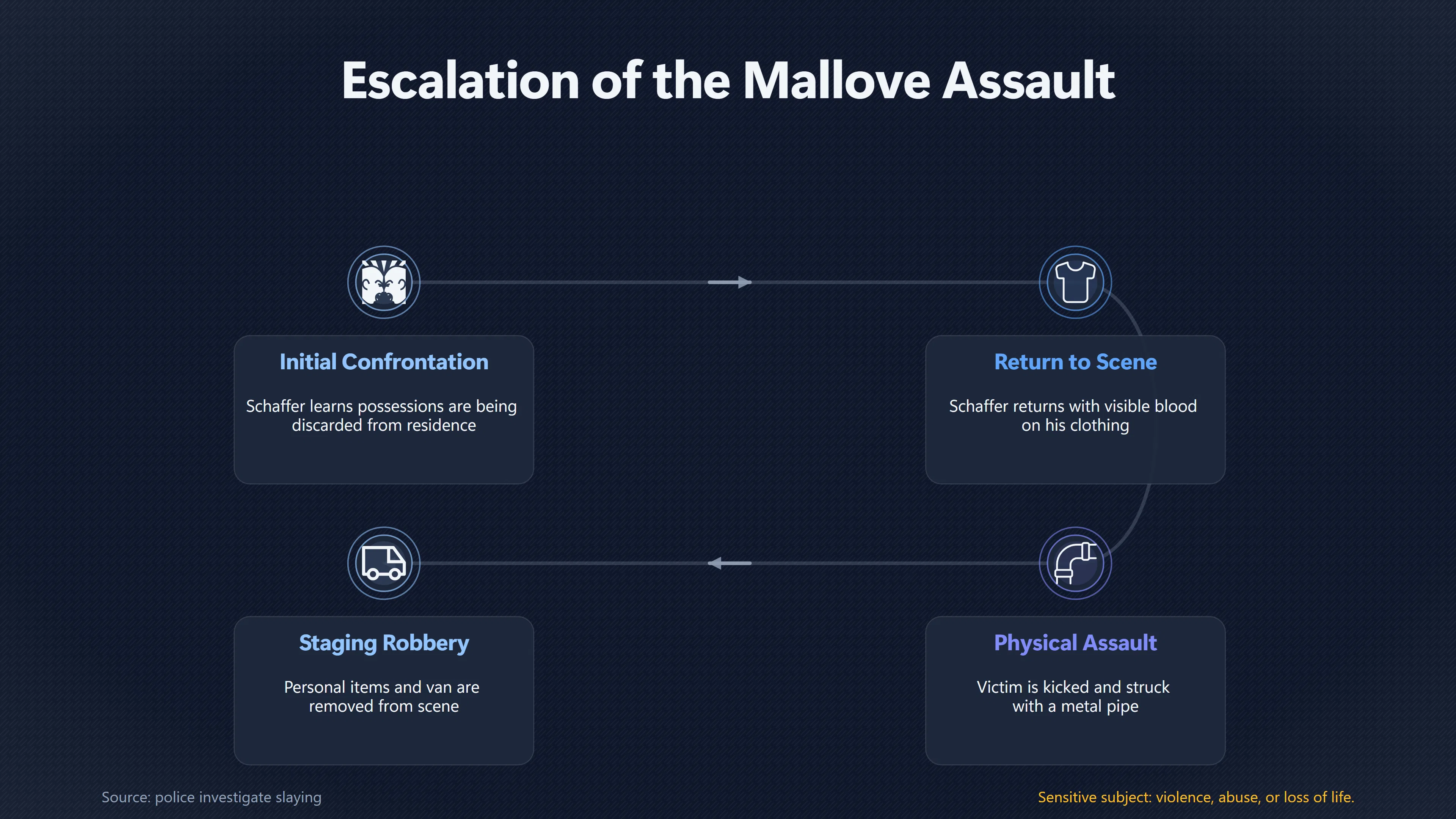
The later prosecution evidence is particularly important because it supplied a potential mechanism for severe violence that did not depend upon Mallove’s scientific career. Connecticut’s 2025 appellate decision records testimony that Schaffer became angry after learning that possessions from the family’s former residence were being thrown into a skip. Schaffer had previously lived at the property; Mallove had recently evicted the tenants and had travelled from New Hampshire to clear the house. Foster testified that Schaffer left after learning what was happening and returned with visible blood on his clothing.[Justia Law]law.justia.comOpen source on justia.com.
That evidence matters precisely because anger arising from an immediate property dispute can account for intense violence without requiring a distant professional motive. It does not mean every detail of the prosecution narrative should automatically be accepted. It means that the brutality is not uniquely predicted by the research-suppression hypothesis.
The attack may have escalated in stages
One particularly revealing feature of the prosecution narrative is that the killing was described not as a single clean act but as an escalating sequence.
According to Foster’s testimony summarised by the Connecticut Appellate Court, Schaffer left their flat after hearing that possessions were being discarded. When he returned, his clothing was bloodstained. Later, Foster, Schaffer and Brown travelled back towards 119 Salem. Foster said that Schaffer stated that they needed to make the incident look like a robbery. At the property, Mallove was still alive. The court records her testimony that Schaffer and Brown kicked him and struck his head with a pipe before Schaffer placed a bag over his face; Mallove’s shirt, shoes and wallet were removed, and his van was subsequently driven away.[Justia Law]law.justia.comOpen source on justia.com.
If substantially accurate, that account demonstrates why brutality should not automatically be read as the signature of an assassination. A confrontation can produce an initial severe beating and then acquire additional motives: avoiding identification, eliminating a witness, implicating accomplices or disguising the original circumstances.
The distinction is especially relevant because early police information pointed towards robbery. Several personal items were missing, Mallove’s van was taken and later abandoned in a Foxwoods employee parking area, and Norwich police publicly sought his wedding ring, digital camera, mobile phone and wallet.[eugenemallove.com]eugenemallove.comOpen source on eugenemallove.com. Later evidence complicated that interpretation by suggesting that theft may partly have been an attempt to make the killing resemble a robbery. The Connecticut appellate record says a witness reported that Schaffer had spoken of taking Mallove’s possessions to stage the attack that way, while Foster testified that Schaffer said they had to make it look like a robbery.[Justia Law]law.justia.comOpen source on justia.com.
That evolution is instructive. Even “robbery” versus “not robbery” cannot be reliably settled from the condition of the body. Motive emerges from the relationship between forensic findings, behaviour, statements, prior disputes and post-crime actions.
Why the brutality became evidence for suppression claims
The suspicion surrounding Mallove’s death is understandable in context. He was a conspicuous advocate of cold fusion and unconventional energy, and communities already receptive to claims that disruptive technologies were being suppressed quickly noticed the killing. A 2004 update from the Paradigm Research Group, for example, acknowledged that initial police information pointed towards a robbery while simultaneously emphasising Mallove’s alternative-energy interests and their potential challenge to powerful governmental or corporate interests.[Paradigm Research Group]paradigmresearchgroup.orgOpen source on paradigmresearchgroup.org.
Later material sympathetic to a suppression interpretation has continued to foreground the physical details — particularly the 32 facial lacerations and crushed trachea — alongside Mallove’s scientific activities.[Murdering UAP Experts]uapmurders.comOpen source on uapmurders.com. This juxtaposition is rhetorically powerful because each fact is independently striking: a controversial energy advocate and an exceptionally violent homicide.
But juxtaposition is not causation.
The reasoning becomes circular if brutality is first interpreted as evidence of a professional killing and the professional killing is then used to explain the brutality. To move beyond suspicion, there would need to be evidence connecting the attack to Mallove’s research independently of his injuries: communications referring to his work, threats tied to particular publications or demonstrations, payments or instructions from an interested party, surveillance connected with his professional activities, credible admissions describing such a motive, or comparable evidence linking perpetrators to organisations with a reason to suppress him.
The publicly documented injury pattern does not provide that link.
The 2025 court ruling adds an important caution
There is also a reason not to turn the later prosecution narrative into an equally simplistic certainty.
In January 2025, the Connecticut Appellate Court ordered that Mozzelle Brown’s murder and conspiracy convictions be vacated and that he receive a new trial. The ruling concerned a Brady violation — the prosecution’s failure to disclose favourable evidence to the defence — involving statements suggesting an informal understanding that cooperating witness Candace Foster could receive consideration for her testimony. The court concluded that the undisclosed information was material enough to undermine confidence in the verdict.[Connecticut Judicial Branch]ct.govOpen source on ct.gov.
This is particularly relevant to the brutality question because Foster supplied the only eyewitness testimony at Brown’s trial describing the specific events and the extent of Brown’s alleged violent conduct. The appellate court explicitly observed that no other witness could corroborate what she personally saw, that Schaffer did not testify at Brown’s trial and that prosecutors presented no forensic evidence tying Brown to the crime scene. It consequently regarded Foster’s testimony as crucial to the case against Brown.[Justia Law]law.justia.comOpen source on justia.com.
That does not undo the medical evidence establishing Mallove’s violent homicide. Nor does the appellate ruling provide evidence for a research-related assassination. It changes something narrower but important: some claims about precisely who inflicted which injuries and how the final assault unfolded depend heavily on testimony whose treatment at trial was later found constitutionally problematic.
The most defensible account therefore separates different levels of certainty. Mallove’s severe injuries and homicide classification are firmly documented. The existence of a confrontation connected with the former tenants and discarded possessions is supported by substantial investigative and court material. Particular allocations of violent acts among the alleged participants require more caution, especially after the 2025 ruling.
How a research-related motive should actually be tested
Mallove’s injuries should be treated as forensic evidence of an exceptionally violent killing, not as a shortcut to motive. A research-suppression hypothesis becomes stronger only when it explains evidence that the property-dispute hypothesis cannot readily explain.
Three questions are especially useful.
Is there evidence connecting the perpetrators to Mallove’s professional activities? The important connection would not simply be that Mallove worked on controversial energy subjects. Investigators would need a bridge between those subjects and the people involved in his death.
Did Mallove receive specific threats concerning his research? A documented warning tied to a publication, experiment, funding initiative or planned disclosure would carry much more evidential weight than the severity of the subsequent injuries.
Does the behaviour surrounding the crime fit a professional operation better than an escalating local dispute? The documented case contains a recently vacated property, anger over discarded possessions, stolen personal effects, witnesses connected with former occupants and later statements about staging a robbery. Those details have to be explained rather than bypassed.[Justia Law]law.justia.comOpen source on justia.com.
This is the central limit of motive inference from brutality: the more violent a crime appears, the more tempting it is to assume that the motive must have been correspondingly extraordinary. That assumption is not a forensic rule.
What the brutality can — and cannot — tell us
The violence inflicted on Eugene Mallove deserves to be described without euphemism. Thirty-two blunt-force facial lacerations, additional injuries, a knife wound and fatal crushing of the tracheal area establish an unusually severe homicidal assault.[The Black Vault]theblackvault.comOpen source on theblackvault.com. The surviving court record further depicts a chaotic and prolonged episode rather than an unexplained single fatal blow.[Justia Law]law.justia.comOpen source on justia.com.
Yet the same evidence illustrates the danger of reading motive directly from wounds. Extreme force is consistent with an assassination, but it is not diagnostic of one. In Mallove’s case there is documented evidence of an immediate conflict surrounding a recently vacated property and discarded possessions, together with later testimony about attempts to disguise what happened as a robbery. That provides a plausible pathway from a mundane dispute to extraordinary violence without invoking his energy research.[Justia Law]law.justia.comOpen source on justia.com.
At the same time, the 2025 reversal of Brown’s convictions cautions against presenting every detail of the prosecution’s reconstruction as permanently settled.[Justia Law]law.justia.comOpen source on justia.com. The appropriate conclusion is therefore deliberately narrower: Mallove’s brutality is strong evidence about the severity of his murder, but weak evidence by itself about its underlying motive. A claim that he was killed because of cold fusion, unconventional energy or related research requires an independent evidential bridge between that work and the people or interests responsible for his death. The injuries, however shocking, do not supply that bridge.
Amazon book picks
Further Reading
Books and field guides related to Does the Brutality of Mallove's Killing Reveal Motive?. Use these as the next step if you want deeper reading beyond the article.
The Anatomy of Motive
An FBI criminal profiling expert discusses his theories of motive.
Forensic Pathology
The first two editions of Forensic Pathology have been highly touted as the definitive, go-to text reference on forensic pathology and th...
Practical Homicide Investigation: Tactics, Procedures, and Fo...
Renowned for being THE definitive source of homicide investigation, Practical Homicide Investigation: Tactics, Procedures, and Forensic T...
Mindhunter: Inside the FBI's Elite Serial Crime Unit
During his twenty-five year career with the Investigative Support Unit, Special Agent John Douglas became a legendary figure in law enfor...
eBay marketplace picks
Marketplace Samples
Live-tested eBay searches with available results related to this page.
Selected fromUFO poster oneBay.co.uk.




Endnotes
1.
Source: documents.theblackvault.com
Link:https://documents.theblackvault.com/documents/fbifiles/scientists/eugenemallove-fbi1.pdf
2.
Source: sunjournal.com
Title: police investigate slaying
Link:https://www.sunjournal.com/2004/05/17/police-investigate-slaying/
3.
Source: law.justia.com
Link:https://law.justia.com/cases/connecticut/court-of-appeals/2025/ac46658.html
4.
Source: youtube.com
Title: Court for man charged with scientist’s murder
Link:https://www.youtube.com/watch?v=V2q8nvRL2kc
Source snippet
Cold Fusion...
5.
Source: youtube.com
Title: Cold Fusion
Link:https://www.youtube.com/watch?v=S9hxBmSPN7s
Source snippet
The "Conspiracy" to Kill Cold Fusion...
Additional References
6.
Source: youtube.com
Title: Eugene Mallove’s Missing Shoes Are Clue In His Murder
Link:https://www.youtube.com/watch?v=w2OxNZEyKGs
Source snippet
Arrest made in 2004 Norwich murder of scientist...
7.
Source: youtube.com
Link:https://www.youtube.com/watch?v=oPIKzgXRDRg
Source snippet
Court for man charged with scientist's murder...
8.
Source: youtube.com
Title: The “Conspiracy” to Kill Cold Fusion
Link:https://www.youtube.com/watch?v=KWlBZT7L1qM
Source snippet
An Unexpected Killer Eugene [Mallove Cold Fusion]({{ 'cold-fusion-timing/' | relative_url }})...
9.
Source: youtube.com
Title: Exodus From Earth
Link:https://www.youtube.com/watch?v=GCFSS5NjGPs
Source snippet
Nashville TV producer Veronica Bozza’s murder explored in true crime doc: ‘The whole thing was sense Breaking News...
10.
Source: projectcamelot.org
Link:https://projectcamelot.org/mallove.html
11.
Source: asa3.org
Link:https://www.asa3.org/archive/asa/200403/0244.html