Within UFO Research Deaths
What Would Actually Prove a Research Related Motive?
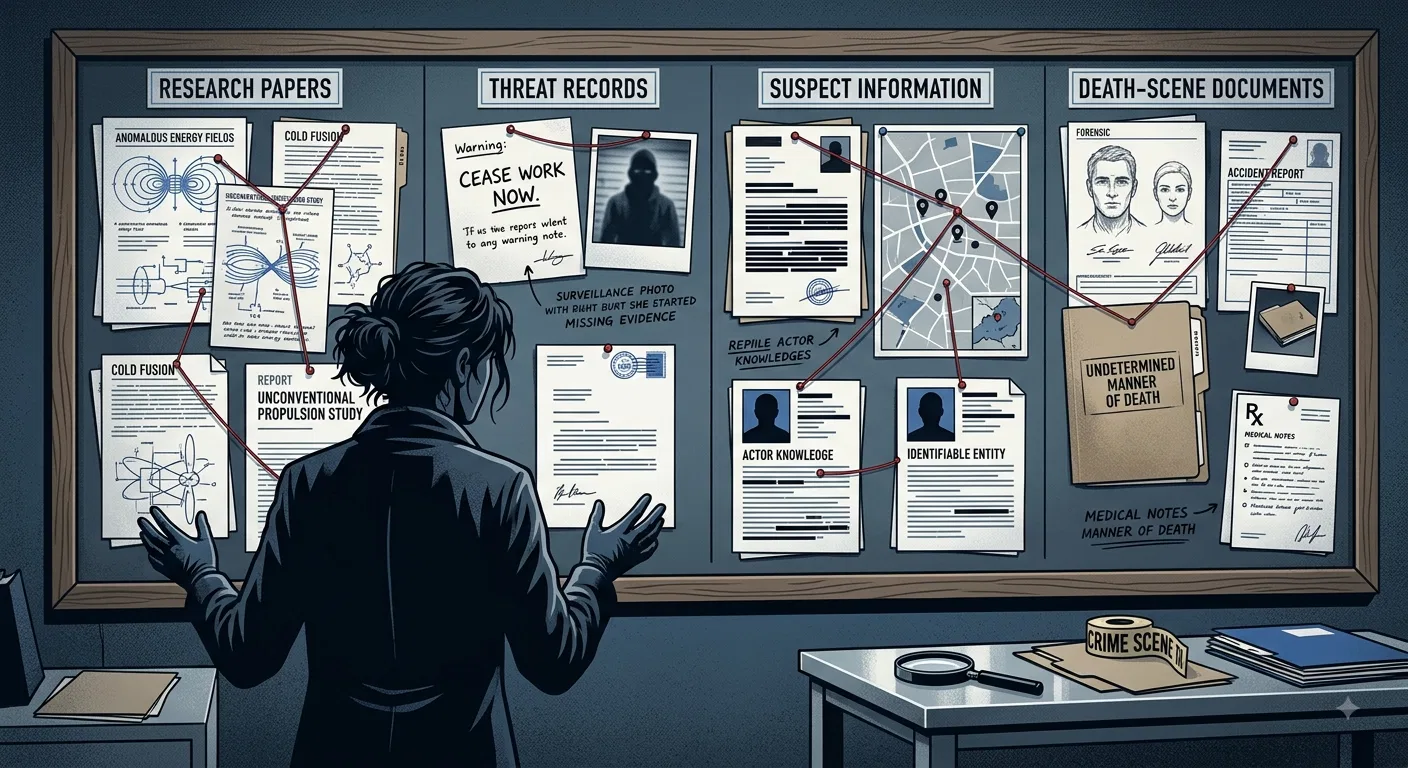
A credible motive claim needs evidence connecting a person's work to identifiable actors, threats, opportunities and the circumstances of death.
On this page
- From controversial work to identifiable motive
- Threats, opportunities and corroborating records
- Why coincidence is not a causal chain
Page outline Jump by section
Introduction
A credible claim that a UFO, unconventional-propulsion or antigravity researcher was killed because of their work needs more than an unusual death, secretive research or an apparently powerful technology. It needs an evidential chain: a death that is itself established as suspicious or homicidal; an identifiable person, organisation or interest with a reason to intervene; evidence that the actor knew about the researcher and cared enough to act; practical opportunity or access; and records, witnesses, communications, forensic findings or other material that link the supposed motive to the death.
That distinction matters because motive is only one part of an explanation. Even in criminal law, motive can strengthen an inference without proving who committed a crime. California’s current criminal jury instruction, for example, explicitly says prosecutors need not prove motive, while jurors may consider its presence or absence.[Justia]justia.comCALCRIM No. 370. Motive:: California Criminal Jury Instructions (CALCRIM) (2026):: JustiaApril 25, 2018… In disputed historical deaths, the problem runs in the opposite direction: a plausible motive is often treated as though it proves the killing. It does not.
From controversial work to an identifiable motive
The first question is not whether a research project could have threatened somebody. Almost any disruptive technology can be described that way. The useful question is: who, specifically, had something concrete to gain or lose, and what evidence shows that they perceived the researcher as a problem?
This is where many research-related death theories become too abstract. Claims may invoke “the government”, “the defence industry”, “oil interests”, “intelligence agencies” or some unnamed programme. Those labels describe possible categories of interest, not actors with demonstrated intent. A viable motive theory should narrow from a general constituency to identifiable people, offices, companies or networks and then show what they actually knew and did.
A practical test is to separate four propositions that are often collapsed into one:
- The research was genuinely consequential. Was there a working result, valuable intellectual property, sensitive data, a credible pending publication or contract, rather than an ambitious claim or speculative programme?
- A particular actor knew about it. Is there documentary evidence of briefings, correspondence, meetings, funding relationships, litigation, surveillance, contract negotiations or disputes?
- That actor regarded the researcher as a threat or obstacle. Did anyone try to suppress publication, acquire the work, enforce secrecy, remove funding, issue warnings, make threats or otherwise demonstrate adverse intent?
- The conflict connects to the death. Did the relevant actor have contact, access, surveillance, payments, communications or other behaviour temporally linked to what happened?
Without those intermediate links, “the work was important, therefore someone had a motive to kill” is not a causal argument. It is a possibility statement.
The Ning Li story illustrates the danger of filling gaps with motive. Li’s unusual superconducting-gravity research, later defence work and long disappearance from public scientific publishing created an obvious narrative: she had worked on strategically sensitive technology and then vanished. Yet reporting based on an interview with her son established that she had not disappeared in the ordinary sense at all. She remained in Huntsville, continued classified work, was struck by a vehicle in 2014 in an accident witnessed by her husband, suffered severe lasting injury, and died in 2021 after years of family care.[Huntsville Business Journal]huntsvillebusinessjournal.comHuntsville Business JournalUncovering The Mystery Of Huntsville’s Brilliant Anti-gravity Scientist - Huntsville Business Journal… Her classified work is evidence of secrecy around her employment; it is not evidence that secrecy caused her later injuries or death.
That is the broader lesson. Strategic importance can supply a hypothetical motive, but case-specific evidence must show that somebody converted that interest into action.
Threats, opportunities and corroborating records
A serious research-related motive claim should become stronger as it becomes more specific. Vague statements that a scientist “felt watched” or “was afraid” may justify further investigation, but they are much weaker than dated, attributable threats or a documented pattern of interference.
Threat evidence itself needs testing. The US Department of Justice notes, in its guidance on proving threats, that meaning depends on the words used and the circumstances in which they were communicated.[Department of Justice]justice.govcriminal resource manual 1072 special considerations proving threatDepartment of JusticeU.S. Attorneys' Manual | 1072. Special Considerations in Proving a Threat | United States Department of Justice… For historical suspicious-death research, that means asking who made the alleged threat, when, through what medium, whether the record predates the death, and whether an independent recipient, message, diary entry, police report or other document corroborates it. A recollection first recorded decades later is not worthless, but it should not be weighted like a contemporaneous email or report.
Threat assessment research offers another useful principle: targeted attacks are generally examined as behaviour directed towards a goal, connecting motive, target selection and attack-related activity. The National Institute of Justice’s guide, based on US Secret Service research, emphasises investigative corroboration rather than relying on a personality profile or a single ominous statement.[National Institute of Justice]nij.ojp.govNational Institute of JusticeProtective Intelligence and Threat Assessment Investigations: A Guide for State and Local Law Enforcement Of… Applied to a scientist’s death, that means looking for movement from hostility to preparation: surveillance, repeated approaches, acquisition of information about routines, travel to the location, intermediaries, payments, suspicious digital activity or efforts to gain physical access.
Opportunity matters just as much. An organisation may have a powerful theoretical interest in silencing a researcher but no demonstrated connection to the place, time or mechanism of death. Conversely, a mundane adversary may have immediate access, a recent dispute and direct forensic or witness links. A sound inquiry must compare those hypotheses rather than privileging the more dramatic one.
Eugene Mallove’s killing is particularly instructive. Mallove was a prominent advocate for cold fusion and unconventional energy, so a technology-suppression motive may initially seem conceivable. But the homicide record developed much more specific evidence around his rental property in Norwich, Connecticut. A 2025 Connecticut appellate decision recounts that Mallove had recently evicted tenants and travelled to the property to clean it; later witnesses described bloody clothing, admissions about the assault, movement of Mallove’s van and efforts to make the killing appear to be a robbery.[Justia Law]law.justia.comJustia LawBrown v. Commissioner of Correction:: 2025:: Connecticut Appellate Court Decisions:: Connecticut Case Law:: Connecticut Law…
The procedural history is complicated — importantly, the 2025 appellate decision ordered a new trial for Mozzelle Brown because of a due-process violation concerning a cooperating witness.[Justia Law]law.justia.comJustia LawBrown v. Commissioner of Correction:: 2025:: Connecticut Appellate Court Decisions:: Connecticut Case Law:: Connecticut Law… That development cautions against treating every conviction or witness statement as permanently settled. But it does not produce affirmative evidence of an energy-research assassination. The evidential dispute still revolves around identifiable people, the property, witness credibility, physical circumstances and alleged participation in the killing, rather than a documented campaign to suppress Mallove’s scientific advocacy.
That comparison shows what a stronger competing explanation looks like. It has a particular conflict, people who can be identified, a location they can be connected to, witnesses whose accounts can be checked, and conduct allegedly tied to the crime itself. A research-suppression hypothesis would have to produce evidence of comparable specificity to overtake it.
The death itself has to be established first
Motive analysis should not get ahead of medicolegal evidence. Before asking why someone killed the researcher, investigators first have to establish whether someone killed the researcher at all.
Modern death investigation separates cause of death from manner of death. The US National Center for Health Statistics distinguishes natural, accidental, suicidal, homicidal, pending and undetermined manners of death, while forensic pathologists combine examination of the body with scene findings.[CDC]cdc.govICD-10-Mortality Manual 2bICD-10-Mortality Manual 2b - 2025… A homicide theory therefore cannot be inferred simply from the fact that a death was premature, violent-looking or unexpected.
National Institute of Justice guidance stresses methodical scene documentation, preservation of physical evidence and the combination of scene findings with case information and witness statements.[National Institute of Justice]nij.ojp.govOpen source on ojp.gov. Current US forensic standards likewise treat sudden, unexplained and suspicious deaths as medicolegal investigations requiring structured procedures rather than narrative inference.[Office of Justice Programs]ojp.govOpen source on ojp.gov.
For a claimed assassination of a researcher, the core questions therefore include: What did the autopsy establish? Was toxicology performed? Was the scene consistent with suicide, accident, natural disease or assault? Were injuries or substances inconsistent with the official account? Was evidence preserved properly? Did investigators document entry and exit routes, digital devices, communications and relevant witnesses? Has the official manner of death ever been revised?
An “undetermined” finding also needs careful treatment. It does not mean “probably homicide”. CDC coding guidance uses undetermined intent when the competent authority cannot determine whether an injury was accidental, suicidal or homicidal.[CDC]cdc.gov2a 20252a 2025 Uncertainty is evidence of an unresolved classification, not evidence for whichever theory a later writer prefers.
Why coincidence is not a causal chain
The most common error in suspicious-death lists is to start with a category — UFO investigators, antigravity researchers, cold-fusion advocates — find people in that category who died unusually, and then treat the grouping itself as evidence of a common cause.
That approach reverses the proper order of inquiry. A category assembled after the deaths can be made to look remarkable without showing that the supposed perpetrator ever recognised the same category. A physicist researching superconductors, a UFO advocate, an inventor pursuing unconventional propulsion and an energy researcher may appear related to a modern compiler while having worked in different institutions, decades and technical fields. A common label imposed retrospectively is not proof of a common adversary.
The problem becomes more serious when normal selection effects disappear from view. Lists tend to preserve unusual deaths and omit researchers who pursued similarly controversial work and lived ordinary lives. They may also combine homicide, suicide, accident, illness and mere loss of public contact as though these were equivalent outcomes. Once those different events are pooled, the resulting “pattern” may reflect how the list was constructed rather than how the deaths occurred.
The disappearance narrative around Ning Li demonstrates this mechanism unusually clearly. Public silence after sensitive defence work was interpreted online as disappearance, and disappearance was then treated as suggestive of coercion. Direct reporting to her family later supplied a very different chronology.[Huntsville Business Journal]huntsvillebusinessjournal.comHuntsville Business JournalUncovering The Mystery Of Huntsville’s Brilliant Anti-gravity Scientist - Huntsville Business Journal… The original coincidence — controversial research followed by public absence — was real. The supposed causal chain was not.
A useful analogy comes from criminal investigations in which it is uncertain whether a suspicious cluster represents deliberate killing or ordinary variation. Researchers examining alleged healthcare serial killings have emphasised that investigators must distinguish two questions: whether homicide occurred at all, and, only if it did, whether the suspected person caused it.[arXiv]arxiv.orgOpen source on arxiv.org. The same discipline applies here. Researchers should not jump directly from “several unusual deaths exist” to “they share a suppressive motive”.
Corroboration should be claim-specific
Conspiracy allegations are especially vulnerable to accumulation by repetition. Ten sources repeating the same unnamed anecdote are not ten independent confirmations. The underlying question is how many independent evidential paths reach the same conclusion.
The US Department of Justice’s later review of conspiracy claims surrounding Martin Luther King Jr.’s assassination provides a useful model for testing extraordinary historical allegations, even though the case itself is unrelated to UFO research. Investigators compared successive witness accounts for internal consistency, sought physical and documentary corroboration, interviewed available witnesses, examined prior investigative records and actively looked for evidence that contradicted the claims.[Department of Justice]justice.govOpen source on justice.gov. The review rejected several dramatic allegations not simply because they were extraordinary, but because they relied on contradictory, second- or third-hand accounts that could not be connected to corroborating physical evidence.[Department of Justice]justice.govOpen source on justice.gov.
That method translates directly to alleged research-related killings. Each assertion should be broken into a proposition that could, at least in principle, be verified:
- If a researcher said they were threatened, identify the earliest surviving record of that statement.
- If a government or company supposedly wanted the work suppressed, look for documented contact, disputes, classification actions, legal demands, acquisition attempts or internal correspondence.
- If someone allegedly followed or watched the researcher, seek contemporaneous witnesses, photographs, vehicle records, building logs or police reports.
- If research disappeared after the death, establish who actually possessed the laboratory notebooks, computers, prototypes and intellectual-property rights, and whether their disposition was abnormal.
- If the death scene was allegedly manipulated, specify which forensic finding contradicts the official reconstruction and whether a qualified independent examiner has assessed it.
- If several deaths are said to form one programme, identify evidence connecting the same actor, method, intermediary, operational pattern or decision-making structure across cases.
The standard does not require a “smoking gun”. Circumstantial evidence can be powerful when several independent facts converge. But the facts must genuinely narrow the possibilities. A person’s occupation, an unexplained gap in records and a general claim that powerful interests disliked disruptive technology may all be true while doing little to identify who caused a death.

Competing motives must be tested, not merely mentioned
A convincing analysis should compare the proposed research-related motive with ordinary alternatives on equal terms. That means examining financial conflict, intimate relationships, property disputes, workplace grievances, mental-health history where legitimately documented, accidental hazards, medical conditions and opportunistic crime rather than treating them as distractions from the central theory.
The Mallove case again shows why this matters. His unconventional-energy work makes a suppression theory narratively attractive, but investigators also had a recent property dispute and evidence concerning people with direct access to that property.[Justia Law]law.justia.comJustia LawBrown v. Commissioner of Correction:: 2025:: Connecticut Appellate Court Decisions:: Connecticut Case Law:: Connecticut Law… A credible alternative-motive analysis asks which hypothesis better predicts the evidence actually found. It does not ask which motive would be more historically consequential if true.
The same principle applies when evidence favours self-harm or accident. A researcher may genuinely have faced professional hostility and still have died for unrelated reasons. Evidence of institutional conflict should not be discarded, but neither should it be converted automatically into evidence of homicide. These are distinct claims requiring distinct proof.
This distinction is particularly important with James E. McDonald. His UFO advocacy unquestionably placed him in contentious scientific and institutional debates, and later accounts have sometimes interpreted that hostility as part of a darker explanation for his 1971 death. His documented career in UFO investigation is real.[UFOR]ufor.asn.auUFORDr James E Mc Donald’s ArchivesUFORDr James E Mc Donald’s Archives But professional opposition, reputational conflict and lethal action occupy very different evidential categories. Showing that officials or colleagues resisted a research agenda does not identify an assassin, establish homicidal manner of death or connect any opponent to the scene.
What would actually change the assessment?
A research-related motive claim should become substantially more credible if new evidence fills links that are presently missing. Particularly important discoveries would include contemporaneous threats naming a research issue; authenticated communications discussing the researcher as a problem; surveillance or travel records tying a suspected actor to the victim; unexplained payments to intermediaries; verified removal or targeting of research materials; forensic findings inconsistent with the recorded manner of death; or independent witnesses whose accounts converge on the same operational story.
Evidence can also weaken a theory. A documented prior suicide attempt, a witnessed accident, medical findings consistent with natural disease, a mundane adversary with direct access, DNA or digital evidence supporting another perpetrator, or records showing that supposedly “missing” research remained with colleagues all reduce the need for a covert-suppression explanation.
The key is that both confirming and disconfirming evidence must be allowed to count. That is also why witness credibility matters. The Justice Department’s King review treated changed stories, internal contradictions and lack of physical corroboration as reasons to reduce confidence rather than trying to harmonise every inconsistency into a larger conspiracy.[Department of Justice]justice.govOpen source on justice.gov. Suspicious-death research should use the same discipline.
For UFO and antigravity cases, the strongest conclusion will often be narrower than either believers or sceptics would prefer. A person may genuinely have conducted unusual research. Their work may genuinely have attracted military, commercial or governmental interest. Their death may even contain unresolved features. None of those facts should be suppressed or trivialised. But a research-related motive is demonstrated only when evidence bridges the distance between controversial work, an identifiable hostile actor and the actual circumstances of the death. Until that bridge exists, the appropriate description is not “proved assassination” but an allegation with specified evidential gaps.
Amazon book picks
Further Reading
Books and field guides related to What Would Actually Prove a Research Related Motive?. Use these as the next step if you want deeper reading beyond the article.
The Book of Why: The New Science of Cause and Effect
The hugely influential book on how the understanding of causality revolutionized science and the world, by the pioneer of artificial inte...
The Demon-Haunted World: Science as a Candle in the Dark
Rating: 4.5/5 from 43 Google Books ratings
NEW YORK TIMES BESTSELLER • From the renowned astronomer and author of Cosmos comes a “powerful [and] stirring defense of informed ration...
Calling Bullshit: The Art of Skepticism in a Data-Driven World
Bullshit isn’t what it used to be. Now, two science professors give us the tools to dismantle misinformation and think clearly in a world...
Forensic Science Fundamentals/ Investigations Se V2
With popular television programs, movies, and books about criminal justice and crime scene investigation, students often have a passion f...
eBay marketplace picks
Marketplace Samples
Live-tested eBay searches with available results related to this page.
Selected fromUFO poster oneBay.co.uk.



Endnotes
1.
Source: justia.com
Link:https://www.justia.com/criminal/docs/calcrim/300/370/
Source snippet
CALCRIM No. 370. Motive:: California Criminal Jury Instructions (CALCRIM) (2026):: JustiaApril 25, 2018...
Published: April 25, 2018
2.
Source: justice.gov
Title: criminal resource manual 1072 special considerations proving threat
Link:https://www.justice.gov/archives/usam/criminal-resource-manual-1072-special-considerations-proving-threat
Source snippet
Department of JusticeU.S. Attorneys' Manual | 1072. Special Considerations in Proving a Threat | United States Department of Justice...
3.
Source: law.justia.com
Link:https://law.justia.com/cases/connecticut/court-of-appeals/2025/ac46658.html
Source snippet
Justia LawBrown v. Commissioner of Correction:: 2025:: Connecticut Appellate Court Decisions:: Connecticut Case Law:: Connecticut Law...
4.
Source: cdc.gov
Title: ICD-10-Mortality Manual 2b
Link:https://www.cdc.gov/nchs/nvss/manuals/2026/2b-2026.html
Source snippet
ICD-10-Mortality Manual 2b - 2025...
5.
Source: cdc.gov
Title: 2a 2025
Link:https://www.cdc.gov/nchs/nvss/manuals/2025/2a-2025.html
6.
Source: cdc.gov
Title: Instructions for Classification of Underlying and Multiple Causes of Death
Link:https://www.cdc.gov/nchs/nvss/manuals/2023/2a-sectioniv-2023.htm
7.
Source: arxiv.org
Link:https://arxiv.org/abs/2210.00962
8.
Source: justice.gov
Link:https://www.justice.gov/crt/overview-investigation-allegations-regarding-assassination-dr-martin-luther-king-jr
9.
Source: justice.gov
Title: Department of Justice Civil Rights Division | Jowers’ Allegations
Link:https://www.justice.gov/crt/jowers-allegations
10.
Source: justice.gov
Link:https://www.justice.gov/crt/vii-king-v-jowers-conspiracy-allegations
11.
Source: ufor.asn.au
Title: UFORDr James E Mc Donald’s Archives
Link:https://www.ufor.asn.au/archives/articles/james-e-mcdonald-ufo-researcher-archives/
12.
Source: justice.gov
Link:https://www.justice.gov/ovw/framework-prosecutors-strengthen-our-national-response-sexual-assault-and-domestic-violence
13.
Source: justice.gov
Title: Manual | 9-10.000
Link:https://www.justice.gov/jm/jm-9-10000-capital-crimes
14.
Source: docs.justia.com
Link:https://docs.justia.com/cases/federal/district-courts/new-jersey/njdce/2%3A2010cv05821/249314/80
15.
Source: justice.gov
Title: april 2023 murder southeast apartment complex results guilty plea
Link:https://www.justice.gov/usao-dc/pr/april-2023-murder-southeast-apartment-complex-results-guilty-plea
Published: april 2023
16.
Source: justice.gov
Title: labor day weekend triple murder 2021 yields guilty verdict six people
Link:https://www.justice.gov/usao-dc/pr/labor-day-weekend-triple-murder-2021-yields-guilty-verdict-six-people
17.
Source: justice.gov
Link:https://www.justice.gov/opa/pr/tennessee-man-sentenced-life-prison-conspiring-murder-law-enforcement-and-attack-fbi-office
18.
Source: justice.gov
Link:https://www.justice.gov/usao-dc/pr/jury-finds-district-man-guilty-murdering-best-friend-and-conspiring-influence-witness
19.
Source: cdc.gov
Link:https://www.cdc.gov/sudden-infant-death/php/training/index.html
20.
Source: cdc.gov
Link:https://www.cdc.gov/phlp/php/coroner/
21.
Source: cdc.gov
Link:https://www.cdc.gov/phlp/php/coroner/colorado.html
22.
Source: cdc.gov
Link:https://www.cdc.gov/phlp/php/coroner/washington.html
23.
Source: cdc.gov
Link:https://www.cdc.gov/phlp/php/coroner/pennsylvania.html
24.
Source: justice.gov
Title: Civil Rights Division | V. Wilson’s Allegations
Link:https://www.justice.gov/crt/v-wilsons-allegations
25.
Source: justice.gov
Title: Civil Rights Division | Larry Payne
Link:https://www.justice.gov/crt/case-document/larry-payne-notice-close-file-0
26.
Source: justice.gov
Link:https://www.justice.gov/oip/assassination-archives-rsch-ctr-v-cia-no-21-1237-2023-wl-2184550-ddc-feb-22-2023-cooper-j
27.
Source: law.justia.com
Link:https://law.justia.com/cases/north-carolina/court-of-appeals/2022/22-486.html
28.
Source: justice.gov
Link:https://www.justice.gov/usao-dc/pr/department-justice-closes-investigation-death-ashli-babbitt?os=vbkn42_
29.
Source: justice.gov
Link:https://www.justice.gov/archives/opa/pr/justice-department-announces-closing-investigation-2014-officer-involved-shooting-cleveland
30.
Source: justice.gov
Link:https://www.justice.gov/crt/case-document/united-states-v-porter-court-appeals-decision
31.
Source: justice.gov
Link:https://www.justice.gov/archives/usam/criminal-resource-manual-1532-threats-against-former-presidents-and-certain-other-secret
32.
Source: justice.gov
Link:https://www.justice.gov/archives/opa/pr/federal-officials-decline-prosecution-death-freddie-gray
33.
Source: justice.gov
Link:https://www.justice.gov/usao-dc/pr/us-attorneys-office-concludes-investigation-death-bobby-gross
34.
Source: justice.gov
Link:https://www.justice.gov/usao-sdfl/pr/former-north-miami-mayor-convicted-her-involvement-multi-million-dollar-mortgage-fraud
35.
Source: law.justia.com
Link:https://law.justia.com/cases/connecticut/supreme-court/2014/sc18914.html
36.
Source: law.justia.com
Link:https://law.justia.com/cases/connecticut/court-of-appeals/2014/ac35508.html
37.
Source: law.justia.com
Title: ac35508 0
Link:https://law.justia.com/cases/connecticut/court-of-appeals/2014/ac35508-0.html
38.
Source: justice.gov
Link:https://www.justice.gov/usao-edca/pr/jury-finds-dixon-man-guilty-mortgage-fraud-after-trial
39.
Source: law.justia.com
Link:https://law.justia.com/cases/connecticut/supreme-court/2014/sc18913.html
40.
Source: law.justia.com
Link:https://law.justia.com/cases/connecticut/court-of-appeals/2014/ac35782.html
41.
Source: law.justia.com
Link:https://law.justia.com/cases/connecticut/court-of-appeals/2014/ac34763.html
42.
Source: law.justia.com
Title: ac36298 1
Link:https://law.justia.com/cases/connecticut/court-of-appeals/2014/ac36298-1.html
43.
Source: law.justia.com
Link:https://law.justia.com/cases/connecticut/court-of-appeals/2014/ac35826.html
44.
Source: law.justia.com
Link:https://law.justia.com/cases/connecticut/court-of-appeals/2014/ac35068.html
45.
Source: law.justia.com
Link:https://law.justia.com/cases/connecticut/court-of-appeals/2014/ac35465.html
46.
Source: justice.gov
Link:https://www.justice.gov/usao-wdmi/pr/2013_1107_GSinger.html
47.
Source: law.justia.com
Link:https://law.justia.com/cases/north-carolina/court-of-appeals/2012/11-1382.html
48.
Source: stacks.cdc.gov
Link:https://stacks.cdc.gov/view/cdc/25331
49.
Source: justice.gov
Title: Thomas & Countess Convicted
Link:https://www.justice.gov/archive/usao/md/news/2006/Thomas%20%26%20Countess%20Convicted.html
50.
Source: justice.gov
Link:https://www.justice.gov/crt/united-states-department-justice-investigation-allegations-regarding-assassination-dr-martin
51.
Source: law.justia.com
Link:https://law.justia.com/cases/federal/appellate-courts/F2/880/1012/241662/
52.
Source: law.justia.com
Link:https://law.justia.com/cases/federal/appellate-courts/F2/873/1265/432303/
53.
Source: justice.gov
Link:https://www.justice.gov/archives/ag/attorney-generals-guidelines-general-crimes-racketeering-enterprise-and-domestic
54.
Source: supreme.justia.com
Link:https://supreme.justia.com/cases/federal/us/471/307/
55.
Source: law.justia.com
Link:https://law.justia.com/cases/connecticut/supreme-court/1977/172-conn-531-1.html
56.
Source: justice.gov
Link:https://www.justice.gov/archives/usam/civil-resource-manual-162-sample-odometer-fraud-jury-instructions
57.
Source: justice.gov
Link:https://www.justice.gov/archives/jm/civil-resource-manual-162-sample-odometer-fraud-jury-instructions
58.
Source: cdc.gov
Title: Instructions for Classification of Underlying and Multiple Causes of Death
Link:https://www.cdc.gov/nchs/nvss/manuals/2024/2a-sectioni-2024.htm
59.
Source: cdc.gov
Title: Instructions for Classification of Underlying and Multiple Causes of Death
Link:https://www.cdc.gov/nchs/nvss/manuals/2022/2a-sectioni-2022.htm
60.
Source: cdc.gov
Title: 2b sectioni 2023
Link:https://www.cdc.gov/nchs/nvss/manuals/2023/2b-sectioni-2023.htm
61.
Source: cdc.gov
Title: 2b sectioni 2022
Link:https://www.cdc.gov/nchs/nvss/manuals/2022/2b-sectioni-2022.htm
62.
Source: cdc.gov
Link:https://www.cdc.gov/nchs/nvss/writing-cause-of-death-statements.htm
63.
Source: justice.gov
Title: Civil Rights Division | Michael Schwerner
Link:https://www.justice.gov/crt/case-document/micheal-schwerner-james-chaney-andrew-goodman
64.
Source: supreme.justia.com
Link:https://supreme.justia.com/cases/federal/us/157/320/
65.
Source: supreme.justia.com
Link:https://supreme.justia.com/us/151/396/
66.
Source: supreme.justia.com
Link:https://supreme.justia.com/cases/federal/us/151/396/
67.
Source: huntsvillebusinessjournal.com
Link:https://huntsvillebusinessjournal.com/news/2023/07/30/solving-the-mystery-of-huntsvilles-brilliant-scientist-disappearing/
Source snippet
Huntsville Business JournalUncovering The Mystery Of Huntsville’s Brilliant Anti-gravity Scientist - Huntsville Business Journal...
68.
Source: nij.ojp.gov
Link:https://nij.ojp.gov/library/publications/protective-intelligence-and-threat-assessment-investigations-guide-state-and-0
Source snippet
National Institute of JusticeProtective Intelligence and Threat Assessment Investigations: A Guide for State and Local Law Enforcement Of...
69.
Source: nij.ojp.gov
Link:https://nij.ojp.gov/library/publications/protective-intelligence-threat-assessment-investigation-guide-state-and-local
Source snippet
National Institute of JusticeProtective Intelligence Threat Assessment Investigation: A Guide for State and Local Law Enforcement Officia...
70.
Source: nij.ojp.gov
Title: National Institute of Justice Forensic Pathology | National Institute of Justice
Link:https://nij.ojp.gov/topics/forensics/human-pathology
71.
Source: nij.ojp.gov
Link:https://nij.ojp.gov/topics/articles/crime-scene-investigation-guides-law-enforcement
72.
Source: nij.ojp.gov
Link:https://nij.ojp.gov/library/publications/death-investigation-guide-scene-investigator-technical-update-ARCHIVED-2011
73.
Source: ojp.gov
Link:https://www.ojp.gov/resources/ojp-hhs-mdi-wg
74.
Source: cps.gov.uk
Link:https://www.cps.gov.uk/prosecution-guidance/homicide-murder-manslaughter-infanticide-and-causing-or-allowing-death-or
75.
Source: nij.ojp.gov
Title: just advancements death investigation practices
Link:https://nij.ojp.gov/media/audiofile/just-advancements-death-investigation-practices
76.
Source: nij.ojp.gov
Title: just science podcast just advancements death investigation practices
Link:https://nij.ojp.gov/library/publications/just-science-podcast-just-advancements-death-investigation-practices
77.
Source: nij.ojp.gov
Title: mdi myth next kin arent hard find
Link:https://nij.ojp.gov/events/mdi-myth-next-kin-arent-hard-find
78.
Source: nij.ojp.gov
Title: medicolegal death investigation
Link:https://nij.ojp.gov/topics/forensics/medicolegal-death-investigation
79.
Source: nij.ojp.gov
Title: graphic description medicolegal death investigation case specific frequently
Link:https://nij.ojp.gov/library/publications/graphic-description-medicolegal-death-investigation-case-specific-frequently
80.
Source: nij.ojp.gov
Title: graphic description medicolegal death investigation frequently used data
Link:https://nij.ojp.gov/library/publications/graphic-description-medicolegal-death-investigation-frequently-used-data
81.
Source: fbi.gov
Link:https://www.fbi.gov/video-repository/inside-the-fbi-the-osage-murders-video-101923.mp4/view
82.
Source: awm.gov.au
Title: Photographs | Australian War Memorial
Link:https://www.awm.gov.au/indigenous/photo
83.
Source: huntsvillebusinessjournal.com
Link:https://huntsvillebusinessjournal.com/lead/2023/02/17/family-honors-aerospace-engineering-pioneer-with-ronald-lee-lancaster-memorial-scholarship/
84.
Source: nist.gov
Link:https://www.nist.gov/standard/866
85.
Source: elibrary.judiciary.gov.ph
Title: judiciary.gov.ph- Supreme Court E-Library
Link:https://elibrary.judiciary.gov.ph/thebookshelf/showdocs/17/63683
86.
Source: scribd.com
Link:https://www.scribd.com/document/933725503/4880516
87.
Source: nij.ojp.gov
Title: death investigation guide scene investigator ARCHIVED 1999
Link:https://nij.ojp.gov/library/publications/death-investigation-guide-scene-investigator-ARCHIVED-1999
88.
Source: ojp.gov
Link:https://www.ojp.gov/ncjrs/virtual-library/abstracts/empirical-criteria-determination-suicide-manner-death
89.
Source: ojp.gov
Link:https://ojp.gov/ncjrs/virtual-library/abstracts/medicolegal-investigation-death-guidelines-application-pathology-2
90.
Source: ojp.gov
Link:https://www.ojp.gov/ncjrs/virtual-library/abstracts/medicolegal-investigation-death-guidelines-application-pathology-1
91.
Source: ojp.gov
Link:https://www.ojp.gov/ncjrs/virtual-library/abstracts/national-standards-medico-legal-investigation-death-final-report
92.
Source: ojp.gov
Link:https://www.ojp.gov/ncjrs/virtual-library/abstracts/microscopic-forensic-pathology-medicolegal-investigation-death
93.
Source: ojp.gov
Link:https://www.ojp.gov/ncjrs/virtual-library/abstracts/crime-scene-part-3-trace-evidence-medicolegal-investigation-death
94.
Source: nij.ojp.gov
Link:https://nij.ojp.gov/library/publications/list?page=2&subtopic=324326
95.
Source: nij.ojp.gov
Title: medicolegal death investigations
Link:https://nij.ojp.gov/taxonomy/term/medicolegal-death-investigations?page=7&type=node%3Apublication
96.
Source: nij.ojp.gov
Title: medicolegal death investigations
Link:https://nij.ojp.gov/taxonomy/term/medicolegal-death-investigations?page=9&type=node%3Aall
97.
Source: nij.ojp.gov
Title: death investigations
Link:https://nij.ojp.gov/taxonomy/term/death-investigations?page=0&type=node%3Aall
98.
Source: nist.gov
Link:https://www.nist.gov/standard/3126
99.
Source: uapmurders.com
Link:https://uapmurders.com/uaps/Details/Ning_Li/
100.
Source: files.ncas.org
Link:https://files.ncas.org/ufosymposium/mcdonald.html
Additional References
101.
Source: youtube.com
Link:https://www.youtube.com/watch?v=NP_y9HJdmoM
Source snippet
Mysterious case of missing and dead scientists tied to UFO programs sounds alarms...
102.
Source: youtube.com
Link:https://www.youtube.com/watch?v=9tqs6Z3OQSk
Source snippet
Ufo scientist mysterious death 11 UFO Scientists are Missing... and More are Coming...
103.
Source: youtube.com
Title: 10TH [MISSING SCIENTIST]({{ ‘missing-scientist/’ | relative_url }}) As UFO Mystery Deepens
Link:https://www.youtube.com/watch?v=FU19SrR4qG4
Source snippet
Mysterious Deaths of UFO Researchers Date Back to 1940s, Fresh Claim Emerges | GRAVITAS...
104.
Source: nist.gov
Link:https://www.nist.gov/osac/standards-library/ansiasb-best-practice-recommendation
105.
Source: nist.gov
Link:https://www.nist.gov/osac/standards-library/ansiasb-best-practice-recommendation
106.
Source: fbi.gov
Link:https://www.fbi.gov/how-we-investigate/behavioral-analysis
107.
Source: fbi.gov
Link:https://www.fbi.gov/news/speeches-and-testimony/fbi-pittsburgh-special-agent-in-charge-s-remarks-to-media-on-updates-to-the-butler-pennsyvlania-assassination-attempt-investigation
108.
Source: fbi.gov
Link:https://www.fbi.gov/video-repository/inside-the-fbi-investigating-assassination-attempts-080224.mp4/view
109.
Source: fbi.gov
Link:https://www.fbi.gov/history/cases-and-criminals/osage-murders-case
110.
Source: fbi.gov
Link:https://www.fbi.gov/history/cases-and-criminals/thomas-capano-and-the-murder-of-anne-marie-fahey