Within Antigravity
Does Antimatter Fall Up or Down?
CERN's antihydrogen experiment found antimatter falling toward Earth, undercutting the simple idea that antimatter naturally produces antigravity.
On this page
- Why antimatter was a legitimate test of gravitational theory
- What the antihydrogen experiment observed
- What the result rules out for antigravity claims
Page outline Jump by section
Introduction
Antimatter does not provide the straightforward route to antigravity sometimes imagined in speculative propulsion or UFO discussions. The decisive experimental change came in 2023, when CERN’s ALPHA collaboration directly observed the motion of neutral antihydrogen in Earth’s gravitational field. The anti-atoms moved preferentially downwards. ALPHA measured a best-fit gravitational acceleration of about 0.75 times the ordinary value of g, with uncertainties that make the result consistent with the expected 1g downward acceleration. A simple model in which antihydrogen instead experiences approximately 1g upwards was ruled out.[Nature]nature.comObservation of the effect of gravity on the motion of antimatter | NatureObservation of the effect of gravity on the motion of antimatter | NatureSeptember 27, 2023…
That result is narrower, and more useful, than saying that experiments have proved every aspect of antimatter gravity. Researchers still want much more precise measurements of whether antihydrogen falls at exactly the same rate as hydrogen. But the familiar idea that reversing electric charge somehow reverses gravity has lost its central experimental premise: antihydrogen is antimatter, yet Earth attracts it rather than gravitationally repelling it.[Nature]nature.comAntimatter falls down, not up: CERN experiment confirms theoryAntimatter falls down, not up: CERN experiment confirms theorySeptember 27, 2023…
Why antimatter was a legitimate gravity test
The question of how antimatter falls was scientifically legitimate because theoretical expectation and direct measurement are not the same thing. General relativity’s weak equivalence principle implies universal free fall: bodies subjected only to gravity should respond in the same way irrespective of their composition. Experiments with ordinary matter have tested that principle to extraordinary precision, but for decades there was no comparably direct ballistic experiment using neutral antimatter.[Nature]nature.comObservation of the effect of gravity on the motion of antimatter | NatureObservation of the effect of gravity on the motion of antimatter | NatureSeptember 27, 2023…
The obstacle was experimental rather than a shortage of speculation. Antiprotons and positrons carry electric charge, making them extremely sensitive to electromagnetic fields. ALPHA notes that the gravitational force on a proton at Earth’s surface is equivalent to the force produced by an electric field of only about 10−7 volts per metre. A tiny uncontrolled electric field can therefore overwhelm the gravitational effect that an experiment is trying to measure.[Nature]nature.comObservation of the effect of gravity on the motion of antimatter | NatureObservation of the effect of gravity on the motion of antimatter | NatureSeptember 27, 2023…
Antihydrogen offers a cleaner test. It consists of an antiproton bound to a positron and is electrically neutral overall. That greatly reduces the electrical-force problem, although antihydrogen still has a magnetic moment and must be produced, confined and manipulated using sophisticated magnetic traps. CERN’s ability to trap antihydrogen for useful periods, study its atomic transitions and eventually laser-cool it provided the technical foundation for a meaningful gravity experiment.[Nature]nature.comProspects for comparisons of matter and antimatter gravitation…
This history also explains why physicists did not simply dismiss “falling upwards” without testing it. Standard gravitational physics strongly favoured attraction, and indirect arguments already constrained large matter–antimatter gravitational differences. Yet a direct experiment remained valuable precisely because antimatter is a qualitatively unusual test system. A disagreement with the equivalence principle would have been evidence for new fundamental physics rather than merely an exotic laboratory curiosity.[arXiv]arxiv.orgarXiv Testing Fundamental Physics in Antihydrogen ExperimentsTesting Fundamental Physics in Antihydrogen ExperimentsFebruary 21, 2020…
The first limits were not yet a measurement of g
ALPHA made an important preliminary attempt in 2013 by analysing 434 antihydrogen atoms released from its original trap. Researchers compared their annihilation positions with simulations to constrain the ratio between antihydrogen’s gravitational and inertial mass. The result excluded only extremely large values: after allowing for worst-case systematic effects, the analysis ruled out ratios above about and below about −65 at the stated significance level.[Nature]nature.comDescription and first application of a new technique to measure the gravitational mass of antihydrogen | Nature Communications…
Those enormous bounds illustrate how difficult the measurement was. The 2013 study was a direct experimental constraint and a proof that trapped antihydrogen could be used for gravity research, but it could not distinguish ordinary +1g gravity from anything remotely close to it. A purpose-built apparatus was needed.
What ALPHA-g actually observed
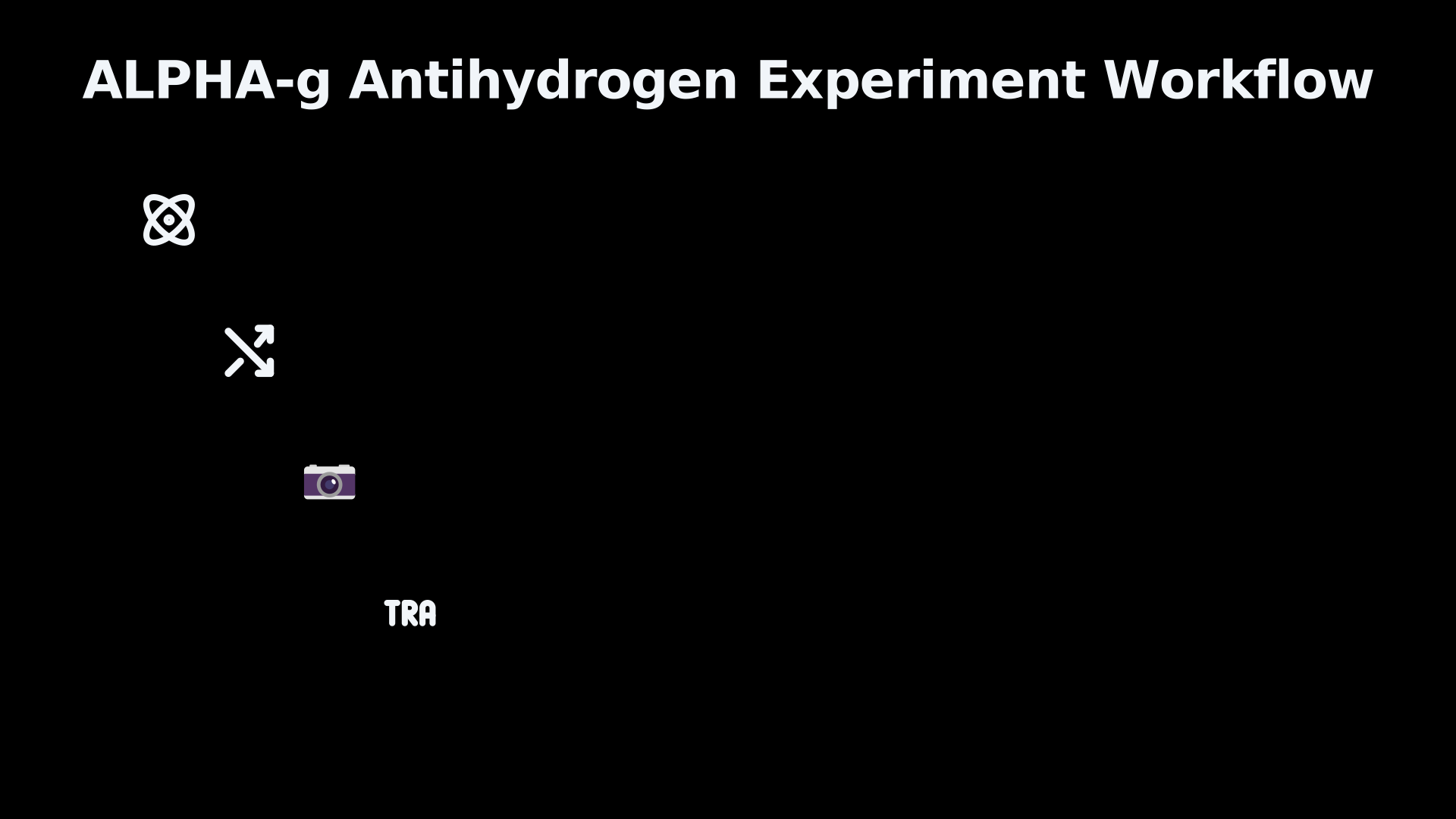
ALPHA-g turned the earlier idea into a vertically oriented experiment designed specifically to determine the direction and approximate strength of antihydrogen’s gravitational acceleration. Antihydrogen atoms were accumulated in a magnetic “bottle”. The magnetic barriers at the top and bottom were then gradually reduced, allowing anti-atoms to escape. When an antihydrogen atom encountered ordinary material in the apparatus, it annihilated, producing particles whose tracks allowed researchers to reconstruct where the event occurred.[Alpha Web Cern]alpha.web.cern.chOpen source on cern.ch.
Gravity should break the otherwise approximate top–bottom symmetry. With Earth attracting the antihydrogen, more anti-atoms should escape towards the bottom. The experiment therefore did not resemble the textbook picture of releasing a stationary ball and timing its fall. The trapped anti-atoms were already moving inside a three-dimensional magnetic potential, so ALPHA had to compare the distribution of observed annihilations with detailed simulations of antihydrogen trajectories.[Nature]nature.comObservation of the effect of gravity on the motion of antimatter | NatureObservation of the effect of gravity on the motion of antimatter | NatureSeptember 27, 2023…
Magnetism was the critical systematic issue. Because antihydrogen has a magnetic moment, a vertical magnetic-field gradient can push an anti-atom in a way that resembles gravity. ALPHA calculated that Earth’s 9.81ms−2 acceleration corresponds, for ground-state hydrogen, to a magnetic-field gradient of only about 1.77×10⁻³ tesla per metre. Across the relevant separation of the experiment’s mirror coils, a field difference of roughly 4.53×10⁻⁴ tesla could imitate a gravity-sized effect.[Nature]nature.comObservation of the effect of gravity on the motion of antimatter | NatureObservation of the effect of gravity on the motion of antimatter | NatureSeptember 27, 2023…
That potential confound became part of the measurement rather than something simply assumed away. ALPHA deliberately varied the magnetic bias so that the magnetic force could assist or oppose gravity and examined how the top-versus-bottom escape pattern changed. Near the magnetic bias expected to cancel ordinary downward gravity, the escape distribution became approximately balanced; changing the bias shifted the asymmetry in the expected direction.[Nature Media]media.nature.comOpen source on nature.com.
The resulting fit gave
aHˉ=0.75±0.13(statistical[systematic)±0.16(simulation]nature.comSource details in endnotes. g,
directed towards Earth. The central value of 0.75 should therefore not be read as evidence that antimatter has already been shown to fall 25% more slowly than matter. Once the quoted uncertainties are included, the measurement is compatible with the conventional 1g prediction.[CERN Courier]cern-courier.web.cern.chCourier ALPHA-g clocks the freefall of antihydrogen – CERN CourierCourier ALPHA-g clocks the freefall of antihydrogen – CERN Courier
The directional conclusion is much stronger. ALPHA reported that the probability of its observations being compatible with a repulsive gravitational acceleration of 1g was below 10−15. In other words, the experiment was not yet a high-precision comparison of hydrogen and antihydrogen gravity, but it was an extremely effective test of the dramatic “antimatter falls upwards at 1g” hypothesis.[Nature]nature.comObservation of the effect of gravity on the motion of antimatter | NatureObservation of the effect of gravity on the motion of antimatter | NatureSeptember 27, 2023…
Why antimatter is not negative mass
The popular antigravity misconception often begins with a correct statement and then makes an unjustified leap. An antiparticle has quantum properties opposite to those of its corresponding particle: the positron, for example, carries the opposite electric charge to the electron. But “opposite charge” does not mean “opposite everything”, and antimatter is not synonymous with hypothetical negative mass.
Antihydrogen consequently should not be pictured as hydrogen with every physical sign reversed. Its antiproton has the proton’s mass, its positron has the electron’s mass, and the anti-atom responds to inertia and electromagnetic fields in experimentally well-characterised ways. The open gravitational question concerned whether its gravitational response might depart from ordinary free fall, not whether physicists had discovered a substance with an automatically negative version of mass. CERN accordingly describes antihydrogen gravity measurements as tests of the weak equivalence principle and matter–antimatter symmetry.[CERN]home.cernr symmetry and the weak equivalence principle…
There is another reason simple analogies with positive and negative electric charge are misleading. Electromagnetism has two signs of charge, giving familiar attraction and repulsion. General relativity does not assign an opposite gravitational “charge” to an antiparticle merely because its electric charge and certain quantum numbers are reversed. Treatments of particle and antiparticle fields in curved spacetime ordinarily couple both to the same spacetime geometry.[arXiv]arxiv.orgarXiv Antimatter Gravity: Second Quantization and Lagrangian FormalismarXiv Antimatter Gravity: Second Quantization and Lagrangian Formalism
That distinction matters when “antimatter propulsion” and “antigravity” are discussed together. Antimatter can release enormous energy per unit mass when it annihilates with matter, which makes it conceptually interesting as an energy source for propulsion. That is a completely different proposition from antimatter gravitationally repelling ordinary matter. ALPHA-g tested the latter idea and found attraction.
What the experiment rules out for antigravity claims
For claims that antimatter itself supplies a gravity-reversal mechanism, ALPHA-g changes the evidential position substantially. Before a direct measurement existed, “perhaps antimatter falls upwards” could at least identify a genuine experimental unknown. After ALPHA-g, the simplest version of that proposal conflicts directly with observed antihydrogen behaviour.[Nature]nature.comObservation of the effect of gravity on the motion of antimatter | NatureObservation of the effect of gravity on the motion of antimatter | NatureSeptember 27, 2023…
Three distinctions are particularly important when applying the result to broader antigravity claims.
It rules out a simple sign reversal, not every conceivable departure from general relativity. ALPHA’s measurement is still much less precise than equivalence-principle experiments using ordinary matter. The scientifically interesting programme now is to reduce the uncertainty and determine whether antihydrogen’s acceleration is exactly g or differs from it by a small amount. ALPHA has already demonstrated laser cooling of antihydrogen, a technique intended to produce colder anti-atoms whose motion can be measured more precisely.[Nature]nature.comProspects for comparisons of matter and antimatter gravitation…
A small future anomaly would not automatically constitute usable antigravity. If a precision experiment eventually measured, for example, a slight difference between hydrogen and antihydrogen free fall, that would be major evidence against exact universality of free fall and could indicate an additional interaction. It would not by itself demonstrate gravity shielding, levitation or a propulsion system. Those much stronger claims would require a controllable effect of sufficient magnitude together with independent replication and exclusion of electromagnetic and instrumental forces.
The result concerns antihydrogen in Earth’s field. It should not be inflated into a claim that every speculative theory involving negative energy, modified gravity or exotic matter has been experimentally disproved. ALPHA itself states the conclusion carefully: repulsive antigravity is ruled out in this case, while precision measurements are needed to test the weak equivalence principle more tightly.[Nature]nature.comObservation of the effect of gravity on the motion of antimatter | NatureObservation of the effect of gravity on the motion of antimatter | NatureSeptember 27, 2023…
There are niche theoretical proposals attempting to preserve some form of matter–antimatter gravitational asymmetry by distinguishing contributions inside composite particles such as the antiproton. Such proposals illustrate why a finite-precision experiment cannot logically eliminate every specially constructed alternative model. They do not, however, restore the ordinary popular claim that an anti-atom should simply accelerate upwards at −g; that prediction is precisely what the ALPHA-g observations strongly reject.[arXiv]arxiv.orgarXiv What Exactly is Antimatter (Gravitationally Speaking)?arXiv What Exactly is Antimatter (Gravitationally Speaking)?

The next question is precision, not levitation
ALPHA-g converted antimatter gravity from a largely indirect question into an experimentally observed phenomenon. Other CERN programmes provide complementary approaches. AEgIS is developing a horizontal antihydrogen beam whose tiny vertical gravitational deflection can be reconstructed using a moiré-type measurement and high-resolution annihilation detection. GBAR takes a different route: it aims to produce antihydrogen ions, cool them using quantum-optical techniques and then neutralise them so that extremely slow antihydrogen can undergo measurable free fall.[CERN]home.cerngbar joins anticlubgbar joins anticlub
These experiments remain valuable even though ALPHA has established the direction of the force. Independent techniques can reduce different systematic uncertainties and turn a qualitative question — “up or down?” — into a quantitative test of whether antimatter obeys the weak equivalence principle to increasingly high precision. CERN therefore continues to describe ALPHA, AEgIS and GBAR as complementary efforts to measure the gravitational acceleration of atomic antimatter.[CERN]home.cernalpha experiment at cern observes the influence of gravity on antimatterCERNALPHA experiment at CERN observes the influence of…27 Sept 2023 — AEgIS and GBAR, share with ALPHA the goal of measuring with high…
For evaluating antigravity claims, that progression supplies a useful evidential benchmark. Antimatter was an unusually favourable candidate for a radical result because it represented a genuinely unexplored experimental regime, and physicists built specialised equipment capable of distinguishing gravitational motion from electromagnetic contamination. When the measurement became possible, the dramatic prediction did not appear: antihydrogen went down.
That does not make unconventional gravity research illegitimate. It demonstrates the standard that separates an interesting possibility from an established antigravity mechanism. The effect must be defined quantitatively, competing forces must be controlled, predictions must survive measurement, and the result must say more than that the system involves unusual physics. In the particular case of antimatter, the best direct evidence now supports gravitational attraction towards Earth while leaving increasingly precise tests of the equivalence principle as the meaningful open question.[Nature]nature.comObservation of the effect of gravity on the motion of antimatter | NatureObservation of the effect of gravity on the motion of antimatter | NatureSeptember 27, 2023…
Amazon book picks
Further Reading
Books and field guides related to Does Antimatter Fall Up or Down?. Use these as the next step if you want deeper reading beyond the article.
Antimatter
Antimatter explores a strange mirror world, where particles have identical yet opposite properties to those that make up the familiar mat...
Gravity: How the Weakest Force in the Universe Shaped Our Lives
A history of gravity, and a study of its importance and relevance to our lives, as well as its influence on other areas of science. Physi...
The Antigravity Enigma: Fiction, Fringe Science, and Modern P...
From magic carpets to hoverboards and space drives, the human imagination has always seen antigravity as the ultimate aspirational symbol...
The Particle at the End of the Universe
"The Higgs boson ... is the key to understanding why mass exists and how atoms are possible. After billions of dollars and decades of eff...
eBay marketplace picks
Marketplace Samples
Live-tested eBay searches with available results related to this page.
Selected fromantimatter poster oneBay.co.uk.



Endnotes
1.
Source: nature.com
Title: Observation of the effect of gravity on the motion of antimatter | Nature
Link:https://www.nature.com/articles/s41586-023-06527-1
Source snippet
Observation of the effect of gravity on the motion of antimatter | NatureSeptember 27, 2023...
Published: September 27, 2023
2.
Source: nature.com
Title: Antimatter falls down, not up: CERN experiment confirms theory
Link:https://www.nature.com/articles/d41586-023-03043-0
Source snippet
Antimatter falls down, not up: CERN experiment confirms theorySeptember 27, 2023...
Published: September 27, 2023
3.
Source: nature.com
Link:https://www.nature.com/articles/ncomms2787
Source snippet
Description and first application of a new technique to measure the gravitational mass of antihydrogen | Nature Communications...
4.
Source: nature.com
Link:https://www.nature.com/articles/s41586-021-03289-6
Source snippet
Prospects for comparisons of matter and antimatter gravitation...
5.
Source: home.cern
Link:https://home.cern/science/physics/antimatter/
Source snippet
r symmetry and the weak equivalence principle...
6.
Source: arxiv.org
Title: arXiv Testing Fundamental Physics in Antihydrogen Experiments
Link:https://arxiv.org/abs/2002.09348
Source snippet
Testing Fundamental Physics in Antihydrogen ExperimentsFebruary 21, 2020...
Published: February 21, 2020
7.
Source: alpha.web.cern.ch
Link:https://alpha.web.cern.ch/publications/detecting-antihydrogen-annihilations-alpha-g-measurement-gravitational-free-fall
8.
Source: media.nature.com
Link:https://media.nature.com/original/magazine-assets/d41586-023-02930-w/d41586-023-02930-w.pdf
9.
Source: cern-courier.web.cern.ch
Title: Courier ALPHA-g clocks the freefall of antihydrogen – CERN Courier
Link:https://cern-courier.web.cern.ch/a/alpha-g-clocks-the-freefall-of-antihydrogen/
10.
Source: arxiv.org
Link:https://arxiv.org/abs/2504.03496
11.
Source: arxiv.org
Title: arXiv Antimatter Gravity: Second Quantization and Lagrangian Formalism
Link:https://arxiv.org/abs/2003.08733
12.
Source: arxiv.org
Title: arXiv What Exactly is Antimatter (Gravitationally Speaking)?
Link:https://arxiv.org/abs/2401.10954
13.
Source: wiki.cern.ch
Title: ch GBA R experiment
Link:https://wiki.cern.ch/index.php/GBAR_experiment
14.
Source: cds.cern.ch
Link:https://cds.cern.ch/record/2954358
15.
Source: ilcdoc.cern.ch
Link:https://ilcdoc.cern.ch/record/2954358/export/hm?ln=fr
16.
Source: cds.cern.ch
Link:https://cds.cern.ch/record/2954126?ln=en
17.
Source: aegis.web.cern.ch
Link:https://aegis.web.cern.ch/news.php
18.
Source: cds.cern.ch
Title: ch Real-time antiproton annihilation vertexing with submicrometer resolution
Link:https://cds.cern.ch/record/2931545
19.
Source: cds.cern.ch
Link:https://cds.cern.ch/record/002923210
20.
Source: cds.cern.ch
Link:https://cds.cern.ch/record/2923210/export/hm?ln=pt
21.
Source: cds-lb.cern.ch
Link:https://cds-lb.cern.ch/record/2923210?ln=zh_TW
22.
Source: cern-courier.web.cern.ch
Title: ch The promise of laser-cooled positronium – CERN Courier
Link:https://cern-courier.web.cern.ch/a/the-promise-of-laser-cooled-positronium/
23.
Source: cds.cern.ch
Link:https://cds.cern.ch/record/002888058
24.
Source: ep-news.web.cern.ch
Link:https://ep-news.web.cern.ch/content/alpha-experiment-cern-observes-influence-gravity-antimatter
25.
Source: nature.com
Title: Gravity is attractive | Nature Physics
Link:https://www.nature.com/articles/s41567-023-02292-0
26.
Source: alpha.web.cern.ch
Title: ch First results from ALPHA-g: Antihydrogen doesn’t fall up! | ALPHA Experiment
Link:https://alpha.web.cern.ch/news/first-results-alpha-g-antihydrogen-doesnt-fall
27.
Source: nature.com
Title: Free-falling antihydrogen reveals the effect of gravity on antimatter
Link:https://www.nature.com/articles/d41586-023-02930-w
28.
Source: videos.cern.ch
Link:https://videos.cern.ch/record/2298635
29.
Source: videos.cern.ch
Link:https://videos.cern.ch/record/2298631
30.
Source: videos.cern.ch
Link:https://videos.cern.ch/record/2298313
31.
Source: cds.cern.ch
Link:https://cds.cern.ch/record/2806790
32.
Source: cern-courier.web.cern.ch
Title: ch Exploring how antimatter falls – CERN Courier
Link:https://cern-courier.web.cern.ch/a/exploring-how-antimatter-falls/
33.
Source: home.web.cern.ch
Title: raising gbar antimatter exploration
Link:https://home.web.cern.ch/news/news/physics/raising-gbar-antimatter-exploration
34.
Source: cern-courier.web.cern.ch
Title: ch Does antimatter fall up? – CERN Courier
Link:https://cern-courier.web.cern.ch/a/does-antimatter-fall-up/
35.
Source: nature.com
Title: Gravitational mass of positron from LEP synchrotron losses | Scientific Reports
Link:https://www.nature.com/articles/srep30461
36.
Source: nature.com
Title: An experimental limit on the charge of antihydrogen | Nature Communications
Link:https://www.nature.com/articles/ncomms4955
37.
Source: cern-courier.web.cern.ch
Title: antigravity matters at wag 2013
Link:https://cern-courier.web.cern.ch/a/antigravity-matters-at-wag-2013/
38.
Source: cds.cern.ch
Title: ch Antihydrogen Experiment Gravity Interferometry Spectroscopy
Link:https://cds.cern.ch/record/1156877
39.
Source: cds.cern.ch
Title: ch Black Holes and Gravitational Properties of Antimatter
Link:https://cds.cern.ch/record/1005569?ln=en
40.
Source: alpha.web.cern.ch
Link:https://alpha.web.cern.ch/publications/description-and-first-application-new-technique-measure-gravitational-mass
41.
Source: alpha.web.cern.ch
Link:https://alpha.web.cern.ch/publications/observation-effect-gravity-motion-antimatter
42.
Source: cds.cern.ch
Link:https://cds.cern.ch/record/1544916
43.
Source: cds.cern.ch
Title: ch Theoretical aspects of antimatter and gravity
Link:https://cds.cern.ch/record/2659391
44.
Source: home.web.cern.ch
Link:https://home.web.cern.ch/science/physics/antimatter/
45.
Source: home.web.cern.ch
Link:https://home.web.cern.ch/science/experiments/aegis/
46.
Source: cds.cern.ch
Title: ch The GBAR experiment: Gravitational behaviour of antihydrogen at rest
Link:https://cds.cern.ch/record/1505302?ln=en
47.
Source: cds.cern.ch
Title: ch The AEg IS Experiment: Progress and Future Outlook
Link:https://cds.cern.ch/record/2941648?ln=en
48.
Source: home.web.cern.ch
Link:https://home.web.cern.ch/tags/aegis
49.
Source: cds.cern.ch
Link:https://cds.cern.ch/record/2951146
50.
Source: alpha.web.cern.ch
Link:https://alpha.web.cern.ch/publications/magnetic-field-characterisation-gravitational-free-fall-measurements-antihydrogen
51.
Source: alpha.web.cern.ch
Link:https://alpha.web.cern.ch/publications/alpha-g-antihydrogen-gravity-magnet-system
52.
Source: nature.com
Link:https://www.nature.com/nature-index/topics/l4/quantum-gravity-and-antimatter-phenomena
53.
Source: nature.com
Link:https://www.nature.com/articles/s41586-026-10124-3
54.
Source: nature.com
Link:https://www.nature.com/subjects/particle-physics/nature?page=3&searchType=journalSearch&sort=PubDate
55.
Source: nature.com
Link:https://www.nature.com/nature/volumes/621/issues/7980
56.
Source: nature.com
Link:https://www.nature.com/articles/s41567-024-02712-9
57.
Source: nature.com
Link:https://www.nature.com/articles/s41586-026-10556-x
58.
Source: nature.com
Link:https://www.nature.com/nature/articles?page=5&searchType=journalSearch&sort=PubDate&type=review%2Cnews-and-views%2Cperspective%2Chypothesis%2Canalysis&year=2023
59.
Source: energy.gov
Title: antihydrogen falls downward
Link:https://www.energy.gov/science/fes/articles/antihydrogen-falls-downward
60.
Source: arxiv.org
Link:https://arxiv.org/pdf/2106.06464
61.
Source: arxiv.org
Link:https://arxiv.org/html/2401.10954v1
62.
Source: home.cern
Title: alpha experiment at cern observes the influence of gravity on antimatter
Link:https://home.cern/alpha-experiment-at-cern-observes-the-influence-of-gravity-on-antimatter/
Source snippet
CERNALPHA experiment at CERN observes the influence of...27 Sept 2023 — AEgIS and GBAR, share with ALPHA the goal of measuring with high...
63.
Source: cerncourier.com
Title: does antimatter fall up
Link:https://cerncourier.com/a/does-antimatter-fall-up/
Source snippet
CERN CourierDoes antimatter fall up?13 Jan 2017 — antimatter experiences an opposite gravitational force to matter and therefore “falls”...
64.
Source: home.cern
Title: gbar joins anticlub
Link:https://home.cern/gbar-joins-anticlub/
65.
Source: home.cern
Title: aegis transforms smartphone sensors antimatter camera unprecedented
Link:https://home.cern/aegis-transforms-smartphone-sensors-antimatter-camera-unprecedented/
66.
Source: home.cern
Link:https://home.cern/science/physics/antimatter/?from=NCCE
67.
Source: home.cern
Link:https://home.cern/tag/gravity/feed/
68.
Source: Wikipedia
Title: Negative mass
Link:https://en.wikipedia.org/wiki/Negative_mass
Additional References
69.
Source: youtube.com
Link:https://www.youtube.com/watch?v=0bgyi4skk9s
Source snippet
CERN ALPHA experiment antihydrogen gravity Nature video ALPHA experiment: an improved limit on the charge of antihydrogen...
70.
Source: youtube.com
Title: Strong Evidence That Antigravity Probably Doesn’t Exist (CERN Experiment)
Link:https://www.youtube.com/watch?v=rd-ezFsWr3s
Source snippet
Introducing ALPHA-g, a new experiment to measure the effect of gravity on antimatter...
71.
Source: youtube.com
Link:https://www.youtube.com/watch?v=td7dVbvKNAE
Source snippet
How ALPHA-g creates and drops antihydrogen atoms...
72.
Source: osti.gov
Link:https://www.osti.gov/biblio/2281639
73.
Source: youtube.com
Title: How ALPHA-g creates and drops antihydrogen atoms
Link:https://www.youtube.com/watch?v=prhmw9CavR0
Source snippet
Strong Evidence That Antigravity Probably Doesn't Exist (CERN Experiment)...
74.
Source: nsf.gov
Link:https://www.nsf.gov/science-matters/down-goes-antimatter-gravitys-effect-matters-elusive-twin
75.
Source: youtube.com
Title: Does Antimatter Create Anti-Gravity?
Link:https://www.youtube.com/watch?v=ALmS9E87LCg
Source snippet
Inside the antimatter factory: ALPHA-g measures effects of gravity on antihydrogen...
76.
Source: rug.nl
Link:https://www.rug.nl/research/vsi/news/2023/20231002sjonesnature?lang=en
77.
Source: researchgate.net
Link:https://www.researchgate.net/publication/237011652_Description_and_first_application_of_a_new_technique_to_measure_the_gravitational_mass_of_antihydrogen
78.
Source: researchgate.net
Link:https://www.researchgate.net/publication/395837432Book_7-Mirror_Sectors_Negative_Extension_and_Orientation_in_Physics_A_Morphometric_Information-Geometric_Treatment