Within Hostility
NASA Found UAP Stigma Without Endorsing UFO Claims
NASA's 2023 UAP study documented ridicule and career concerns while still finding no conclusive peer-reviewed evidence for an extraterrestrial explanation.
On this page
- What study team members reported
- How stigma can reduce scientific participation
- Why destigmatisation can coexist with scepticism
Page outline Jump by section
Introduction
NASA’s 2023 independent study of unidentified anomalous phenomena (UAP) documented something narrower, but more defensible, than claims of organised suppression: professional stigma can discourage people from reporting or researching unusual observations, and some scientists have encountered explicit concerns about credibility and career advancement. The study team recorded hate mail from scientific colleagues, social-media ridicule and firsthand knowledge of researchers being warned that work on extraterrestrial technosignatures could damage their scientific credibility and promotion prospects. NASA treated those pressures as obstacles to obtaining better evidence.[NASA]nasa.govuap independent study team final report 0uap independent study team final report 0
That finding is important in the wider debate over institutional hostility towards UFO-related research, but it does not validate extraordinary UFO claims or allegations of physical suppression of researchers. The same NASA report said there was no conclusive evidence in the peer-reviewed scientific literature that UAP have an extraterrestrial origin and repeatedly stressed that inadequate, poorly calibrated and irreproducible data prevent firm conclusions.[NASA]nasa.govuap independent study team final report 0uap independent study team final report 0
What NASA’s study team actually reported
NASA commissioned its independent UAP study in 2022, selecting 16 people with expertise spanning science, aviation, data analysis and related fields. Its task was not to reopen famous UFO cases or determine whether extraterrestrial spacecraft had visited Earth. Instead, the team was asked how NASA’s scientific capabilities, datasets and methods could improve future investigation of observations that could not initially be identified. The work concentrated on unclassified information.[NASA]nasa.govAnnounces Unidentified Aerial Phenomena Study Team MembersNASA Announces Unidentified Aerial Phenomena Study Team Members - NASAOctober 21, 2022…
Stigma emerged because it directly affected that data problem. The final report said many scientists and aviators regarded UAP study as “fringe” and that the panel had heard a firsthand account of stigma associated with reporting an observation. It judged that this problem almost certainly causes reporting attrition: potentially useful observations disappear from the scientific record because witnesses choose not to report them.[NASA]nasa.govuap independent study team final report 0uap independent study team final report 0
NASA then recorded more specific evidence involving its own study. After the membership of the UAP team became public, at least one scientist reported receiving hostile mail from colleagues because of participation in the panel. Other team members encountered ridicule and criticism on social media. Most significantly for claims about career risk, members said they personally knew colleagues who had been warned away from research into areas such as extraterrestrial technosignatures because involvement could harm their scientific credibility and promotion potential.[NASA]nasa.govuap independent study team final report 0uap independent study team final report 0
Those are different levels of evidence and should not be collapsed together. The hostile correspondence and online criticism were experiences reported by members of the NASA panel itself. The promotion warning was a second-hand career experience in the sense that team members reported what had happened to colleagues they knew. NASA’s report did not provide the names of those colleagues, their institutions, the identities of whoever issued the warnings, or documented examples of promotions actually being denied because of such research. The evidence therefore supports the existence of perceived and communicated career risk, but it does not quantify how often that risk results in a concrete adverse employment decision.[NASA]nasa.govuap independent study team final report 0uap independent study team final report 0
The pressure was serious enough to have operational consequences for NASA. When the agency announced a new UAP research director in September 2023, it initially withheld the person’s identity because of the threats and harassment experienced by panel members; later that day NASA identified him as Mark McInerney. Associated Press reporting at the time described the decision as an attempt to shield the official from the treatment already experienced by participants in the study.[AP News]apnews.comOpen source on apnews.com.
At the panel’s May 2023 public meeting, NASA officials were similarly explicit about harassment. Reporting on the meeting recorded Daniel Evans saying several team members had suffered online harassment and that NASA security personnel were addressing it. At the same meeting, however, Evans stressed that there was “absolutely no convincing evidence” connecting UAP with extraterrestrial life. The two positions were presented together: scientists should not be harassed for investigating UAP, and extraordinary explanations had not been established.[Scientific American]scientificamerican.comOpen source on scientificamerican.com.
How stigma can reduce scientific participation
NASA’s concern was primarily methodological. Scientific knowledge depends partly on what observations enter the evidence pool. If pilots, scientists or other technically capable witnesses anticipate ridicule, reputational damage or career consequences, some will remain silent. That creates a selection effect: investigators cannot evaluate observations that were never reported.
The report pointed to changes in military reporting as an illustration. After the US Department of Defense encouraged aviators to disclose anomalous encounters, 247 new UAP reports were received between 5 March 2021 and 30 August 2022. NASA contrasted that with 263 reports accumulated over the previous 17 years. The report did not interpret the increase as evidence that anomalous objects had suddenly become more common. It noted assessments that the rise was partly associated with greater awareness of possible flight-safety or adversary-surveillance issues and with reduced stigma around reporting.[NASA]nasa.govuap independent study team final report 0uap independent study team final report 0
This distinction is crucial. An increase in UAP reports can mean an increase in the willingness or ability to report, rather than an increase in whatever phenomenon is ultimately responsible for the observations. Conversely, a period with few reports cannot automatically be taken to mean that few unusual observations occurred if witnesses had incentives to keep quiet.
NASA therefore connected stigma directly to data quality and completeness. Its report asked practical questions a potential witness might face: where should an observation be reported, will the witness be believed or shamed, and will anyone actually investigate it? NASA argued that its institutional reputation could help make reporting more routine and scientifically useful.[NASA]nasa.govuap independent study team final report 0uap independent study team final report 0
The logic extends from witnesses to researchers. A scientist who believes UAP-related work might damage promotion prospects has an incentive to select a safer research problem. Even without an explicit ban, this can produce a chilling effect: fewer specialists participate, fewer proposals are written, fewer datasets are examined and fewer technically sophisticated criticisms or replications appear.
Independent academic survey evidence gives some support to that interpretation, while also putting useful limits on it. A 2023 study of 1,460 tenured and tenure-track academics at 144 major US research universities found substantial curiosity about UAP and significant interest in further academic evaluation. More than half said funding would make them more inclined to conduct UAP-related research, and 43.4 per cent said they would be more inclined if a reputable scholar in their discipline became involved. The response rate was only 3.9 per cent, however, so the figures should not simply be treated as representative of every US academic.[Nature]nature.comFaculty perceptions of unidentified aerial phenomena | Humanities and Social Sciences CommunicationsMay 23, 2023…
A follow-up analysis of the same survey dataset examined career concerns more directly. It found that 52.67 per cent reported some degree of concern that UAP research could affect tenure or promotion, whereas only 7.4 per cent said they would themselves vote negatively on a colleague’s tenure or promotion because of UAP-related research; another 27.95 per cent answered that they might. The researchers concluded that perceived professional danger may be greater than the number of academics actually willing to impose a sanction.[Nature]nature.comAcademic freedom and the unknown: credibility, criticism, and inquiry among the professoriate | Humanities and Social Sciences Comm…
That gap matters. Stigma does not require a large number of formal punishments to alter behaviour. Researchers may avoid a subject because they expect colleagues to judge it negatively. Yet the same gap also warns against exaggeration: widespread fear of career damage is not equivalent to evidence that widespread career destruction is actually occurring.
The disciplinary results reinforce that tension. Nearly three-quarters of surveyed physics academics expressed some concern about ridicule even though 95.82 per cent of physics respondents regarded their discipline as at least somewhat capable of evaluating UAP evidence. Engineering respondents likewise combined high assessments of disciplinary capability with relatively strong concerns about tenure and promotion consequences.[Nature]nature.comAcademic freedom and the unknown: credibility, criticism, and inquiry among the professoriate | Humanities and Social Sciences Comm…
NASA wanted better reports, not more believers
NASA’s proposed remedy was not to lower evidential standards. In several places the report effectively argued for the opposite: remove the social penalty for asking the question while raising the technical standard required to answer it.
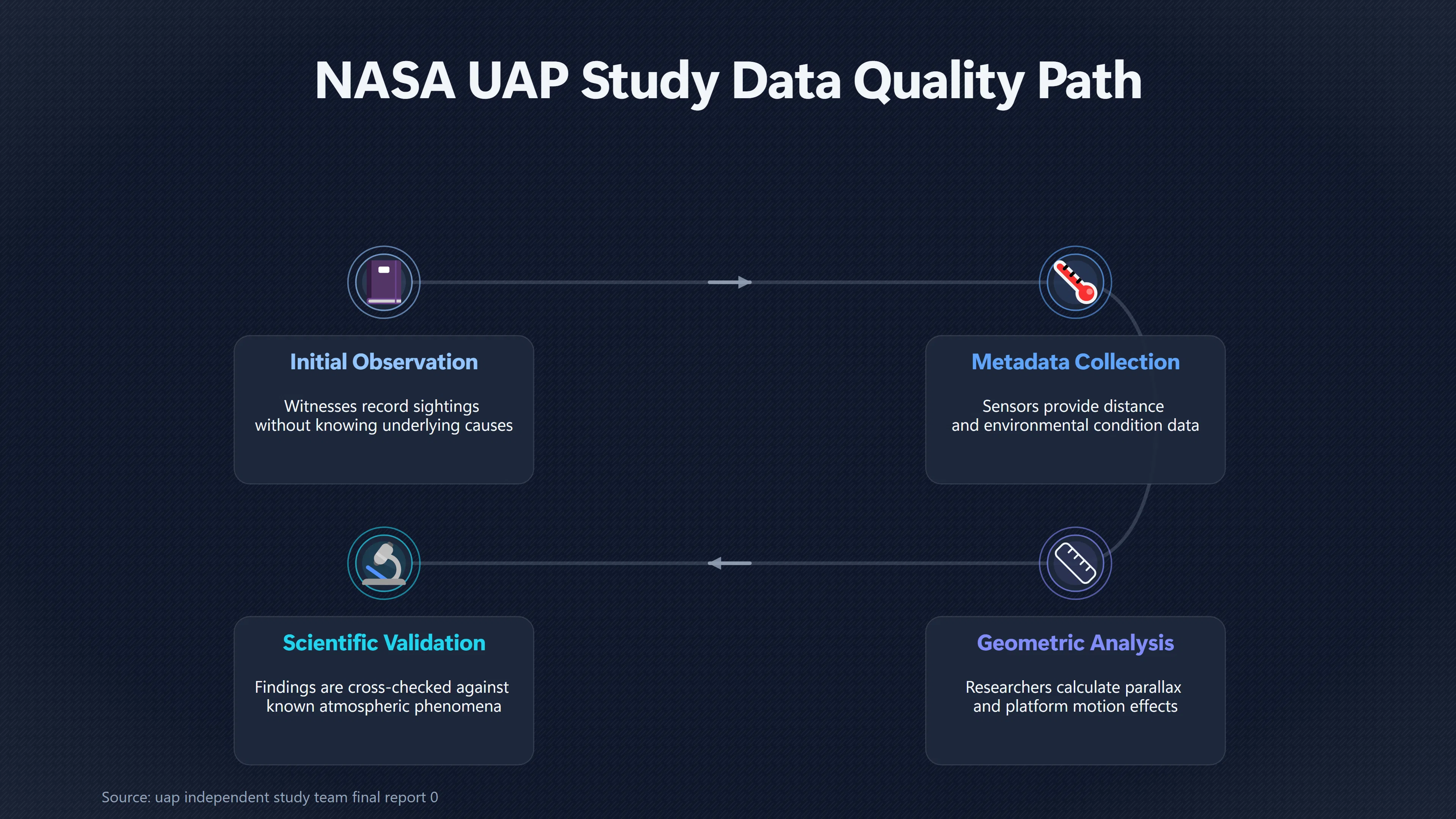
Existing UAP observations were often unsuitable for systematic scientific analysis. Sensors might not have been designed or calibrated for the phenomenon being observed; important metadata could be absent; eyewitness accounts were not reproducible; and military information was sometimes classified because disclosure could reveal sensor capabilities. NASA said that even apparently impressive imagery can become less anomalous when sufficient contextual data are available.[NASA]nasa.govuap independent study team final report 0uap independent study team final report 0
The report’s treatment of the well-known “GoFast” military video illustrates the point. The footage can give the impression of an object travelling extraordinarily quickly over the ocean, but the panel’s geometrical analysis showed that sensor-platform motion and parallax could account for much of that impression. Its estimate was consistent with an object moving at roughly wind speed rather than at an extraordinary velocity. NASA used the example to demonstrate why measurements of distance, sensor geometry and environmental conditions matter.[NASA]nasa.govuap independent study team final report 0uap independent study team final report 0
Accordingly, NASA recommended calibrated observations, standardised metadata, better-curated repositories, multisensor measurements and potentially crowdsourced smartphone observations capable of being cross-checked. The panel considered the quality of available data a more immediate limitation than the sophistication of analytical techniques.[NASA]nasa.govuap independent study team final report 0uap independent study team final report 0
This explains why destigmatisation was scientifically useful even if most UAP eventually received ordinary explanations. A reporting system is most valuable when witnesses are comfortable submitting observations before they know what caused them. Investigation can then identify aircraft, balloons, astronomical objects, sensor artefacts or unusual atmospheric effects without requiring the observer to have made an extraordinary claim in the first place.
NASA summarised that institutional role by arguing that its participation itself could reduce stigma and encourage public engagement. Its September 2023 response to the independent report specifically proposed working with the public and commercial pilots to build a broader and more reliable dataset while destigmatising UAP study.[NASA]nasa.govuap independent study team final report 0uap independent study team final report 0
Why destigmatisation can coexist with scepticism
The strongest safeguard against misreading NASA’s stigma findings is elsewhere in the same document. The study team stated that there was no conclusive evidence in peer-reviewed scientific literature for an extraterrestrial origin of UAP. It also argued that extraterrestrial life should be treated as a hypothesis of last resort after other possibilities have been excluded.[NASA]nasa.govuap independent study team final report 0uap independent study team final report 0
NASA’s current public guidance remains similarly explicit: it says it has found no credible evidence of extraterrestrial life, that there is no evidence UAP are extraterrestrial, and that available UAP data do not support the proposition that the observations represent alien technologies.[NASA Science]science.nasa.govScience UAP FAQsNASA ScienceUAP FAQs - NASA ScienceMay 8, 2026…
That position is not contradictory. There are three separate propositions:
- Some observations are initially unexplained.
- People who report or study those observations can experience ridicule, harassment or concern about professional consequences.
- The observations therefore represent extraterrestrial technology.
NASA found evidence relevant to the first two propositions but not the third. The mistake is to treat social resistance to a claim as evidence that the claim itself must be true. A researcher can be unfairly ridiculed while also being scientifically mistaken; equally, a sceptic can be correct about a particular explanation while behaving in a way that discourages legitimate investigation.
The NASA report explicitly rejected both credulity and dismissiveness. Its proposed framework called for critical thinking and scepticism and warned against uncritical acceptance of unlikely explanations, while also opposing criticism that prevents researchers from objectively examining unexplained phenomena.[NASA]nasa.govuap independent study team final report 0uap independent study team final report 0
That distinction makes the NASA material particularly useful when assessing broader claims about institutional hostility towards UFO or unconventional aerospace research. It supplies credible contemporary evidence that reputational pressure and perceived career risk exist. It does not establish a coordinated programme to ruin researchers’ careers, still less physical suppression, disappearances or killings. The evidential categories should remain separate.
What the career-risk evidence can and cannot establish
Within the narrower question of professional suppression, the NASA record supports several conclusions with different levels of confidence.
Directly documented by the study: members of NASA’s independent panel experienced hostile correspondence, online ridicule and harassment associated with their UAP work. NASA officials publicly acknowledged the problem, and concerns about harassment temporarily affected how the agency handled the identity of its new UAP research director.[NASA]nasa.govuap independent study team final report 0uap independent study team final report 0
Reported through study-team members: scientists known to panel members had been warned that research involving extraterrestrial technosignatures could harm their credibility and promotion potential. That is meaningful evidence of professional discouragement, but the report does not document particular lost promotions or establish how widespread such warnings were.[NASA]nasa.govuap independent study team final report 0uap independent study team final report 0
Supported by independent survey research: US academics reported substantial concern about ridicule and possible tenure or promotion consequences, although considerably fewer said they would definitely impose such a penalty themselves. That evidence is compatible with a chilling effect in which anticipated reputational costs discourage participation even when formal sanctions are uncommon.[Nature]nature.comAcademic freedom and the unknown: credibility, criticism, and inquiry among the professoriate | Humanities and Social Sciences Comm…
Not established by these sources: that NASA or the wider scientific establishment systematically fires, blacklists or otherwise destroys the careers of scientists for producing valid UAP findings; that harassment demonstrates the extraterrestrial hypothesis is correct; or that professional stigma supplies evidence for violent suppression of researchers.
NASA’s 2023 study therefore provides a useful evidential boundary for the wider UFO-research controversy. It shows that institutional and peer pressure need not be imaginary: scientists themselves can encounter ridicule, harassment and warnings about credibility or advancement. But NASA’s response was to demand more participation and better evidence at the same time. The resulting picture is one of a research subject burdened by genuine reputational stigma and serious data deficiencies—not evidence that extraordinary findings have been established and then physically suppressed.
Amazon book picks
Further Reading
Books and field guides related to NASA Found UAP Stigma Without Endorsing UFO Claims. Use these as the next step if you want deeper reading beyond the article.
The UFO Experience: A Scientific Inquiry
Cited by the New York Review of Books as "the best brief for visitation," this classic study presents an analysis of UFO reports and conc...
UFOs: Generals, Pilots, and Government Officials Go on the Re...
NEW YORK TIMES BESTSELLER • Impeccably researched, this riveting journalistic investigation separates fact from fiction, and documents th...
UFOs and Government: A Historical Inquiry
Governments around the world have had to deal with the UFO phenomenon for a good part of a century. How and why they did so is the subjec...
The Demon-Haunted World: Science as a Candle in the Dark
Are we on the brink of a new Dark Age of irrationality and superstition? In this book, the writer shows how scientific thinking is necess...
eBay marketplace picks
Marketplace Samples
Live-tested eBay searches with available results related to this page.
Selected fromUFO poster oneBay.co.uk.
Endnotes
1.
Source: nasa.gov
Title: uap independent study team final report 0
Link:https://www.nasa.gov/wp-content/uploads/2023/09/uap-independent-study-team-final-report-0.pdf?emrc=6896566543423
2.
Source: nasa.gov
Title: Announces Unidentified Aerial Phenomena Study Team Members
Link:https://www.nasa.gov/general/nasa-announces-unidentified-aerial-phenomena-study-team-members/
Source snippet
NASA Announces Unidentified Aerial Phenomena Study Team Members - NASAOctober 21, 2022...
Published: October 21, 2022
3.
Source: nasa.gov
Title: to Release, Discuss Unidentified Anomalous Phenomena Report
Link:https://www.nasa.gov/news-release/nasa-to-release-discuss-unidentified-anomalous-phenomena-report/
Source snippet
NASA to Release, Discuss Unidentified Anomalous Phenomena Report - NASA...
4.
Source: nature.com
Link:https://www.nature.com/articles/s41599-023-01746-3
Source snippet
Faculty perceptions of unidentified aerial phenomena | Humanities and Social Sciences CommunicationsMay 23, 2023...
Published: May 23, 2023
5.
Source: nature.com
Link:https://www.nature.com/articles/s41599-024-03351-4
Source snippet
Academic freedom and the unknown: credibility, criticism, and inquiry among the professoriate | Humanities and Social Sciences Comm...
6.
Source: nasa.gov
Title: UPDATE: NASA Shares UAP Independent Study Report; Names Director
Link:https://www.nasa.gov/news-release/update-nasa-shares-uap-independent-study-report-names-director/
Source snippet
UPDATE: NASA Shares UAP Independent Study Report; Names Director - NASA...
7.
Source: science.nasa.gov
Title: Science UAP FAQs
Link:https://science.nasa.gov/uap/faqs/
Source snippet
NASA ScienceUAP FAQs - NASA ScienceMay 8, 2026...
Published: May 8, 2026
8.
Source: science.nasa.gov
Link:https://science.nasa.gov/researchers/nac/science-advisory-committees/apac/
9.
Source: science.nasa.gov
Title: lynx2030 sag
Link:https://science.nasa.gov/astrophysics/programs/physics-of-the-cosmos/community/lynx2030-sag/
10.
Source: science.nasa.gov
Title: dual anonymous peer review
Link:https://science.nasa.gov/researchers/dual-anonymous-peer-review/
11.
Source: science.nasa.gov
Title: decadal pbl
Link:https://science.nasa.gov/earth-science/decadal-surveys/decadal-pbl/
12.
Source: science.nasa.gov
Link:https://science.nasa.gov/uap/
13.
Source: science.nasa.gov
Title: announcements 2024
Link:https://science.nasa.gov/astrophysics/programs/exep/exopag/announcements/announcements-2024/
14.
Source: science.nasa.gov
Title: decadal stv
Link:https://science.nasa.gov/earth-science/decadal-surveys/decadal-stv/
15.
Source: nasa.gov
Title: Past Reports and Transcripts
Link:https://www.nasa.gov/past-reports-and-transcripts/
16.
Source: science.nasa.gov
Title: decadal sdc
Link:https://science.nasa.gov/earth-science/decadal-surveys/decadal-sdc/
17.
Source: science.nasa.gov
Title: science workforce initiatives
Link:https://science.nasa.gov/about-us/science-workforce-initiatives/
18.
Source: science.nasa.gov
Title: scientists on why we might not spot solar panel technosignatures
Link:https://science.nasa.gov/science-research/planetary-science/astrobiology/nasa-scientists-on-why-we-might-not-spot-solar-panel-technosignatures/
19.
Source: nature.com
Link:https://www.nature.com/articles/s41598-023-49527-x
20.
Source: nature.com
Title: UF O sightings: how NASA can bring science to the debate
Link:https://www.nature.com/articles/d41586-023-02893-y
21.
Source: science.nasa.gov
Title: science workforce study
Link:https://science.nasa.gov/researchers/nasa-science-workforce-study/
22.
Source: science.nasa.gov
Title: searching for signs of intelligent life technosignatures
Link:https://science.nasa.gov/universe/search-for-life/searching-for-signs-of-intelligent-life-technosignatures/
23.
Source: nature.com
Link:https://www.nature.com/articles/s41599-023-01829-1
24.
Source: nasa.gov
Title: NAS A Provides Coverage of Unidentified Anomalous Phenomena Meeting
Link:https://www.nasa.gov/news-release/nasa-provides-coverage-of-unidentified-anomalous-phenomena-meeting/
25.
Source: nasa.gov
Title: NAS A Administrator Selects New Head of Science
Link:https://www.nasa.gov/news-release/nasa-administrator-selects-new-head-of-science/
26.
Source: ntrs.nasa.gov
Link:https://ntrs.nasa.gov/citations/19301717082420
27.
Source: science.nasa.gov
Title: independent review board makes recommendations for gdc
Link:https://science.nasa.gov/blogs/gdc/2022/10/12/independent-review-board-makes-recommendations-for-gdc/
28.
Source: nasa.gov
Title: Season 4, Episode 12: The Search for Technosignatures
Link:https://www.nasa.gov/podcasts/gravity-assist/gravity-assist-if-they-call-will-we-listen-the-search-for-technosignatures/
29.
Source: science.nasa.gov
Link:https://science.nasa.gov/universe/exoplanets/nasa-selects-medium-scale-space-mission-concepts-to-study-for-2020-astrophysics-decadal-survey/
30.
Source: issues.org
Link:https://issues.org/forum-winter-2008/
31.
Source: ntrs.nasa.gov
Link:https://ntrs.nasa.gov/citations/19710013692
32.
Source: ntrs.nasa.gov
Link:https://ntrs.nasa.gov/citations/19700019404
33.
Source: science.nasa.gov
Title: announcements 2023
Link:https://science.nasa.gov/astrophysics/programs/exep/exopag/announcements/announcements-2023/
35.
Source: time.com
Link:https://time.com/5326177/maxine-waters-death-threat-cancels-event/
36.
Source: ntrs.nasa.gov
Link:https://ntrs.nasa.gov/citations/19700006276
37.
Source: ntrs.nasa.gov
Link:https://ntrs.nasa.gov/citations/19690018516
38.
Source: ntrs.nasa.gov
Link:https://ntrs.nasa.gov/citations/19700017869
39.
Source: ntrs.nasa.gov
Link:https://ntrs.nasa.gov/citations/19690016943
40.
Source: ntrs.nasa.gov
Link:https://ntrs.nasa.gov/citations/19660014426
41.
Source: apnews.com
Link:https://apnews.com/article/8b477a5ed6a42f99bb13a4518368ce9a
42.
Source: scientificamerican.com
Link:https://www.scientificamerican.com/article/bad-data-not-aliens-may-be-behind-ufo-surge-nasa-team-says/
43.
Source: scientificamerican.com
Link:https://www.scientificamerican.com/article/trumps-order-to-release-evidence-for-aliens-obscures-the-scientific-search/
44.
Source: scientificamerican.com
Title: It’s Time to Hear from Social Scientists about UFOs | Scientific American
Link:https://www.scientificamerican.com/article/its-time-to-hear-from-social-scientists-about-ufos/
45.
Source: ufos-scientificresearch.blogspot.com
Title: Unidentified Anomalous Phenomena
Link:https://ufos-scientificresearch.blogspot.com/2023/09/nasas-uap-independent-study-team.html
46.
Source: scientificamerican.com
Title: NAS A Wants to Make UFO Studies a Real Science | Scientific American
Link:https://www.scientificamerican.com/article/nasa-wants-to-make-ufo-studies-a-real-science/
47.
Source: scientificamerican.com
Link:https://www.scientificamerican.com/article/scientists-try-to-get-serious-about-studying-ufos-good-luck-with-that/
48.
Source: scientificamerican.com
Title: With New Study, NASA Seeks the Science behind UFOs | Scientific American
Link:https://www.scientificamerican.com/article/with-new-study-nasa-seeks-the-science-behind-ufos/
49.
Source: ouci.dntb.gov.ua
Link:https://ouci.dntb.gov.ua/en/works/40yyRG3l/
Additional References
50.
Source: youtube.com
Title: Public Meeting on Unidentified Anomalous Phenomena (Official NASA Broadcast)
Link:https://www.youtube.com/watch?v=bQo08JRY0iM
Source snippet
Replay! NASA's Release of the Unidentified Anomalous Phenomena Report...
51.
Source: youtube.com
Title: Replay! NASA’s Release of the Unidentified Anomalous Phenomena Report
Link:https://www.youtube.com/watch?v=nuBMnluJfs0
Source snippet
Inside NASA's UFO coverup culture | Reality Check...
52.
Source: youtube.com
Title: NASA talks UFOs with public ahead of final report
Link:https://www.youtube.com/watch?v=zAf-dZIRvC8
Source snippet
UAP Independent Study Event Post-Meeting Media Teleconference (May 31, 2023)...
Published: May 31, 2023
53.
Source: researchgate.net
Link:https://www.researchgate.net/publication/382796556_Academic_freedom_and_the_unknown_credibility_criticism_and_inquiry_among_the_professoriate
54.
Source: researchgate.net
Link:https://www.researchgate.net/publication/6264853_Crewmember_and_mission_control_personnel_interactions_during_International_Space_Station_missions
55.
Source: researchgate.net
Link:https://www.researchgate.net/publication/336675505_Searches_for_Technosignatures_The_State_of_the_Profession
56.
Source: researchgate.net
Link:https://www.researchgate.net/publication/334558467The_Social_Sciences_Interdisciplinarity_for_Astronomy_and_Astrophysics–_Lessons_from_the_History_of_NASA_and_Related_Fields
57.
Source: researchgate.net
Link:https://www.researchgate.net/publication/394860246_The_nature_of_science_is_inclusive_A_qualitative_study_of_LGBTQ_undergraduate_STEM_students%27_experiences_in_pursuing_planetary_sciences
58.
Source: researchgate.net
Link:https://www.researchgate.net/publication/400348279_Science_in_a_Stigmatized_Field_Challenges_and_Opportunities_in_the_Emerging_Research_Domain_of_UAP
59.
Source: decur.org
Link:https://decur.org/research/papers/lomas-2024-jse-uap-history