Within Warnings
Fear Is Evidence, But Evidence of What?
A warning can reliably show that someone felt afraid while remaining weak evidence that the feared threat objectively existed.
On this page
- How contemporaneous fear can be established
- Why belief does not automatically prove an external event
- Applying the distinction to UFO researcher warnings
Page outline Jump by section
Introduction
A pre-death warning can be strong evidence that a researcher was frightened without being strong evidence that the danger they described objectively existed. That distinction is especially important in claims about suspicious deaths connected with UFO or antigravity research, where a vivid warning can easily be treated as though it were a posthumous identification of an attacker.
Evidence law provides a useful discipline. Both the US Federal Rules of Evidence and Alabama’s rules recognise statements of a person’s then-existing mental or emotional condition, while expressly restricting the use of remembered beliefs to prove that the believed event actually occurred.[Cornell Law School]law.cornell.eduCornell Law SchoolRule 803. Exceptions to the Rule Against Hearsay | Federal Rules of Evidence | US Law | LII / Legal Information Institute… In practical terms, “she feared she was being targeted” and “she was being targeted” are different propositions. The first may be established by an authenticated contemporaneous message. The second requires independent corroboration.
How contemporaneous fear can be established
Fear is itself a fact about a person’s state of mind. It may matter because it helps reconstruct what that person was thinking, why they took precautions, whom they contacted or what they intended to do. The law therefore does not regard statements about present feelings as inherently worthless simply because they were made outside court.
Federal Rule of Evidence 803(3), for example, covers a declarant’s then-existing “state of mind” and emotional or physical condition, including mental feeling, motive, intent and plan. The rule simultaneously excludes a statement of memory or belief when it is offered to prove the fact remembered or believed, subject to a narrow exception concerning wills. Alabama Rule 803(3) follows substantially the same structure.[cornell.edu]law.cornell.eduCornell Law SchoolRule 803. Exceptions to the Rule Against Hearsay | Federal Rules of Evidence | US Law | LII / Legal Information Institute…
The underlying logic predates the modern rules. In Mutual Life Insurance Co v Hillmon (1892), the US Supreme Court explained that a person’s intentions and feelings ordinarily become observable to other people through conduct, speech or writing. A letter stating what its author intended to do could therefore have evidential value concerning the author’s intention and, in appropriate circumstances, subsequent conduct.[Justia Law]supreme.justia.comJustia LawMutual Life Ins. Co. v. Hillmon | 145 U.S. 285 (1892) | Justia U.S. Supreme Court CenterMay 16, 1892…
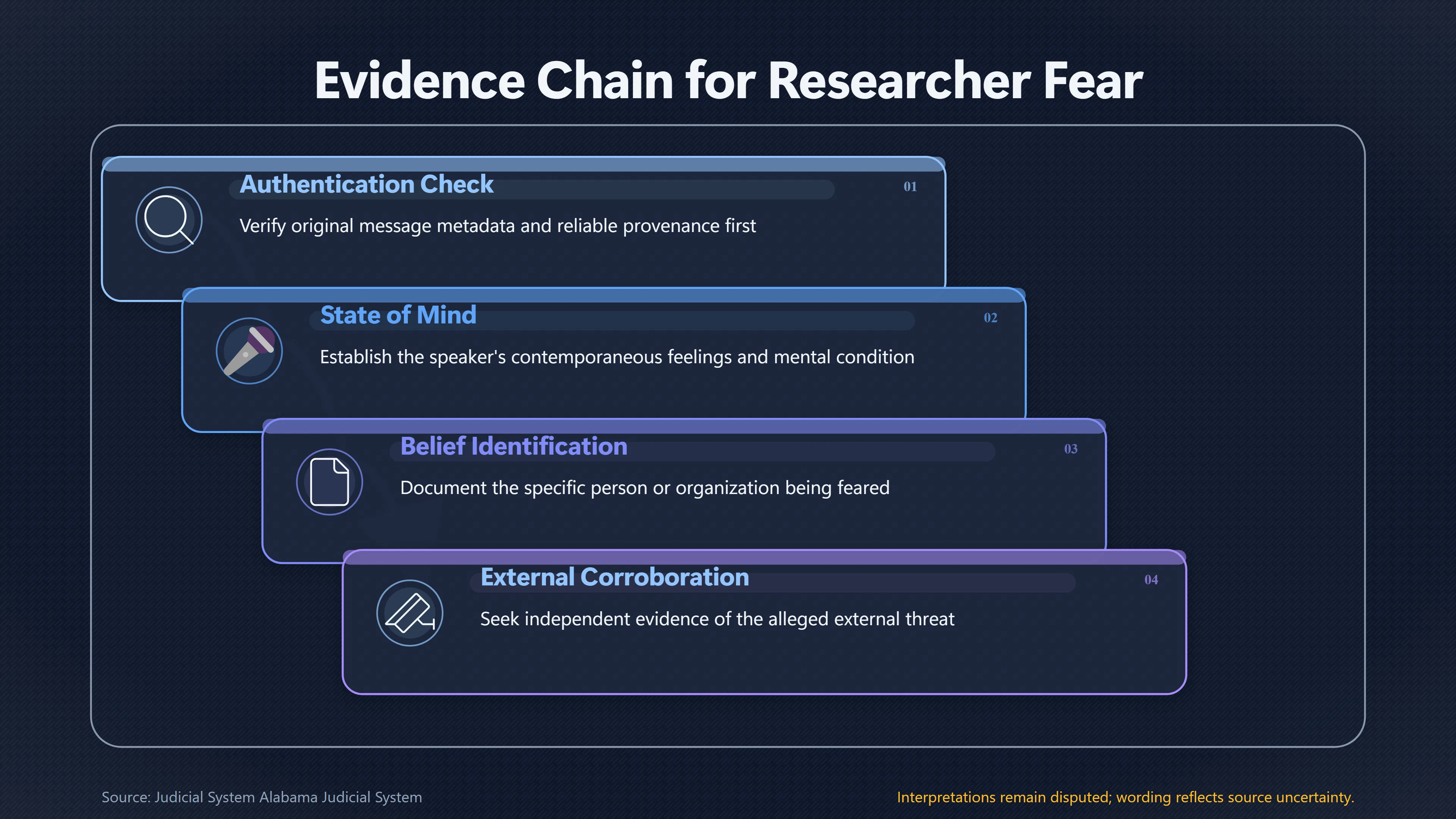
For a reported warning from a UFO or advanced-propulsion researcher, this means that authentication matters first. An original message with reliable metadata, a recording whose provenance can be established, or consistent testimony from several contemporaneous recipients is materially stronger evidence of the speaker’s state of mind than a quotation first published years later. Timing also matters. A series of warnings documented before a death is more useful for reconstructing the person’s contemporaneous outlook than a recollection reconstructed after the case has become controversial.
None of that requires deciding whether the feared danger was genuine. Someone can sincerely experience fear because of a real threat, a misunderstood event, incomplete information or a mistaken inference. Establishing sincerity and establishing external causation are separate evidential tasks.
Why belief does not prove an external threat
The critical limitation was stated unusually clearly in Shepard v United States (1933). The case involved a deceased woman’s accusation implicating her husband in her poisoning. The Supreme Court accepted that statements revealing her feelings could, in a suitable context, bear on her state of mind. But it rejected using an accusation about what another person had supposedly done as though the state-of-mind doctrine made the underlying allegation true.[Cornell Law School]law.cornell.eduCornell Law SchoolSHEPARD v. UNITED STATES. | Supreme Court | US Law | LII / Legal Information InstituteNovember 6, 1933…
That is almost exactly the evidential problem raised by some pre-death-warning narratives. Consider three increasingly strong claims:
- “The researcher said she was afraid.” An authenticated recording or message can directly support this.
- “The researcher believed a particular person or organisation was threatening her.” Her contemporaneous statements can establish that this was her expressed belief.
- “That person or organisation really was threatening her.” Her belief alone cannot establish this. Independent evidence is needed.
The distinction is not merely technical. In United States v Brown, the US Court of Appeals for the District of Columbia Circuit warned of the danger that jurors might take a victim’s fear as evidence about the accused person’s intentions or culpability rather than evidence about the victim’s mind. The court stressed that declarations of fear require careful attention to relevance and prejudice.[Justia Law]law.justia.comJustia LawUnited States of America v. Roland W. Brown, Appellant, 490 F.2d 758 (D.C. Cir. 1974):: JustiaJanuary 10, 1974… A later Virginia appellate decision summarised the broader principle similarly: a deceased person’s fear can sometimes help establish the deceased person’s conduct, but it does not thereby prove the conduct of the accused.[Justia Law]law.justia.comJustia LawRobert Lewis Clay v Commonwealth of Virginia:: 2000:: Virginia Court of Appeals - Published Opinions Decisions:: Virginia Ca…
This produces an important asymmetry. A warning may become more persuasive evidence of fear when it is detailed, repeated and contemporaneous. Yet repetition alone does not necessarily make the alleged external cause of that fear more probable. Ten messages describing the same suspected surveillance may establish persistent apprehension extremely well while still supplying no independent observation of whoever supposedly conducted the surveillance.
Corroboration has to come from outside the belief itself. Depending on the allegation, that could mean independently preserved threatening communications, identifiable witnesses, access records, CCTV, forensic evidence, contemporaneous police reports, medical findings tied to a demonstrable cause, verified intrusion into devices or premises, or documentation connecting a named actor with the alleged conduct. The precise evidence required depends on the claim. What matters is that the reasoning does not simply run in a circle: “she believed she was threatened; therefore a threat existed; therefore her fear proves the threat”.
Applying the distinction to Amy Eskridge’s warnings
Amy Catherine Eskridge is a particularly useful case because there is solid public evidence for some basic facts alongside much less secure evidence for the most dramatic interpretation. Her published obituary records that she died on 11 June 2022 aged 34 and identifies her as chairwoman and president of the Huntsville-based Institute for Exotic Science, which she had co-founded.[Legacy]legacy.comamy eskridge obituaryLegacyAmy Eskridge Obituary (1987 - 2022) - Huntsville, AL - AL.com (Huntsville)June 21, 2022
Reports that resurfaced prominently in 2026 describe messages attributed to Eskridge and supplied by Franc Milburn, a former British military officer who says he corresponded with her. One reported message dated 13 May 2022 said, in substance, that reports claiming she had killed herself or overdosed should not be believed. Milburn has also said that Eskridge described harassment and believed she had been subjected to a directed-energy attack.[Hindustan Times]hindustantimes.comHindustan TimesAmy Eskridge update: UFO scientist's old texts cast doubt on cause of death; ‘would never kill myself’ | Hindustan TimesAp…
Taken cautiously, such material has genuine evidential significance. If the messages are authenticated as Eskridge’s, they establish something that a retrospective claim alone could not: before her death, she was expressing an expectation that her death might subsequently be presented as suicide or overdose. That makes the warning contemporaneous rather than a theory created wholly after the event.
But the next inferential step is much larger. The messages do not, simply by containing allegations of harassment or directed-energy attacks, independently demonstrate that such attacks occurred. Nor does the fact that military directed-energy technologies exist establish that a particular device was used against Eskridge. Existence, capability, access, deployment and attribution are separate propositions.
The wider debate over so-called anomalous health incidents illustrates why that distinction matters. US government personnel have reported severe and sometimes disabling symptoms, and those experiences have been taken seriously. Yet a 2024 National Institutes of Health study of more than 80 affected personnel and family members found no significant MRI-detectable brain injury or differences in most measured clinical and biological variables compared with matched controls. The researchers explicitly cautioned that this did not prove that no adverse event had occurred.[National Institutes of Health]nih.govOpen source on nih.gov. The lesson is methodological rather than diagnostic: real symptoms and sincere reports can be established without automatically establishing one proposed external mechanism.
Likewise, the US intelligence community’s 2023 assessment said most agencies considered foreign-adversary responsibility for reported anomalous health incidents “very unlikely”, while acknowledging information gaps and continuing investigation. It simultaneously stressed that this judgment did not call the affected personnel’s experiences into question.[DNI]odni.govOpen source on odni.gov. That distinction — taking the reported experience seriously while separately testing attribution — is directly applicable to claims involving Eskridge.
What would move a warning from fear towards corroboration?
For governance and investigative purposes, the useful response to a credible pre-death warning is neither “the warning proves murder” nor “fear proves nothing”. It is to separate propositions and investigate each at the appropriate evidential level.
A warning gains external corroborative weight when evidence independent of the speaker converges on its specific predictions. If someone reports that an identifiable vehicle repeatedly follows them, independent footage showing the same vehicle at relevant locations would matter. If they report threatening messages, preserved originals that can be technically attributed to a sender would matter. If they allege an intrusion, contemporaneous forensic evidence of that intrusion would matter. If they identify a particular organisation, evidence establishing access, motive and operational connection would matter far more than the mere fact that the organisation possesses technology capable of causing harm.
Specificity is important too. “Something bad will happen to me” is difficult to test because many later events can be made to fit it. A dated warning identifying a particular person, method, place or expected sequence of events is more falsifiable. If subsequent independently documented events closely match those details, the evidential position changes — not because fear has somehow become proof, but because new evidence now exists outside the original statement.
Conversely, coincidence must be guarded against. Once a death occurs, readers know the outcome and naturally reread earlier statements through it. An ambiguous remark that seemed unremarkable beforehand can acquire an ominous appearance afterwards. That is precisely why original timestamps, complete conversations rather than selected screenshots, contemporaneous recipients and records created before the death are so valuable.
The same discipline applies to statements denying suicidal intent. Such a statement is relevant evidence about expressed intention at the time it was made. Hillmon demonstrates why statements of intention can matter when later conduct is disputed.[Justia Law]supreme.justia.comJustia LawMutual Life Ins. Co. v. Hillmon | 145 U.S. 285 (1892) | Justia U.S. Supreme Court CenterMay 16, 1892… But intention is not immutable. A prior declaration that someone did not intend to die by suicide is therefore evidence to be weighed against the complete circumstances; it is not logically sufficient, standing alone, to establish homicide.
Fear Is Evidence, But Evidence of What?
For disputed deaths in UFO and antigravity research, the most defensible approach is to preserve the evidential value of warnings without enlarging it. A well-authenticated warning may establish that a researcher feared for their safety, believed they were being targeted, intended to avoid self-harm, took precautions or expected a particular account of their death to emerge. Those are potentially important facts and can justify closer scrutiny of subsequent events.
What the warning cannot do by itself is authenticate its own explanation. The Federal Rules’ distinction between present mental state and remembered or asserted external facts exists precisely because otherwise almost any accusation could become proof merely by being framed as fear.[Cornell Law School]law.cornell.eduCornell Law SchoolRule 803. Exceptions to the Rule Against Hearsay | Federal Rules of Evidence | US Law | LII / Legal Information Institute… Shepard and Brown show the corresponding danger in homicide cases: evidence illuminating a deceased person’s mind can be improperly transformed into apparent evidence of somebody else’s guilt.[Cornell Law School]law.cornell.eduCornell Law SchoolSHEPARD v. UNITED STATES. | Supreme Court | US Law | LII / Legal Information InstituteNovember 6, 1933…
Applied to Amy Eskridge, the careful conclusion is therefore narrower, but more robust, than either dismissal or conspiracy certainty. The reported pre-death communications are relevant to determining what she was saying and apparently believed before 11 June 2022. They make her apprehension a legitimate subject for investigation. They do not, without independent corroboration, establish who or what caused that apprehension, demonstrate that a directed-energy attack occurred, or prove that another person caused her death. Preserving those distinctions is not a reason to ignore a warning. It is what allows a warning to be investigated without first assuming the conclusion it is supposed to help test.
Amazon book picks
Further Reading
Books and field guides related to Fear Is Evidence, But Evidence of What?. Use these as the next step if you want deeper reading beyond the article.
Thinking, Fast and Slow
Why is there more chance we'll believe something if it's in a bold type face? Why are judges more likely to deny parole before lunch? Why...
The Psychology of Judgment and Decision Making
THE PSYCHOLOGY OF JUDGMENT AND DECISION MAKING offers a comprehensive introduction to the field with a strong focus on the social aspects...
The Demon-haunted World
Rating: 4.5/5 from 43 Google Books ratings
Are we on the brink of a new Dark Age of irrationality and superstition? In this book, the writer shows how scientific thinking is necess...
The Believing Brain
Synthesizing thirty years of research, psychologist and science historian, Michael Shermer upends the traditional thinking about how huma...
eBay marketplace picks
Marketplace Samples
Live-tested eBay searches with available results related to this page.
Selected fromUFO poster oneBay.co.uk.




Endnotes
1.
Source: law.cornell.edu
Link:https://www.law.cornell.edu/rules/fre/rule_803
Source snippet
Cornell Law SchoolRule 803. Exceptions to the Rule Against Hearsay | Federal Rules of Evidence | US Law | LII / Legal Information Institute...
2.
Source: judicial.alabama.gov
Title: Judicial System Alabama Judicial System
Link:https://judicial.alabama.gov/library/rulesev
Source snippet
Alabama Judicial SystemAlabama Judicial System...
3.
Source: state-rules.com
Link:https://state-rules.com/alabama/evidence/803/
4.
Source: supreme.justia.com
Link:https://supreme.justia.com/cases/federal/us/145/285/
Source snippet
Justia LawMutual Life Ins. Co. v. Hillmon | 145 U.S. 285 (1892) | Justia U.S. Supreme Court CenterMay 16, 1892...
Published: May 16, 1892
5.
Source: law.cornell.edu
Link:https://www.law.cornell.edu/supremecourt/text/290/96
Source snippet
Cornell Law SchoolSHEPARD v. UNITED STATES. | Supreme Court | US Law | LII / Legal Information InstituteNovember 6, 1933...
Published: November 6, 1933
6.
Source: law.justia.com
Link:https://law.justia.com/cases/federal/appellate-courts/F2/490/758/122135/
Source snippet
Justia LawUnited States of America v. Roland W. Brown, Appellant, 490 F.2d 758 (D.C. Cir. 1974):: JustiaJanuary 10, 1974...
Published: January 10, 1974
7.
Source: law.justia.com
Link:https://law.justia.com/cases/virginia/court-of-appeals-published/2000/1893972.html
Source snippet
Justia LawRobert Lewis Clay v Commonwealth of Virginia:: 2000:: Virginia Court of Appeals - Published Opinions Decisions:: Virginia Ca...
8.
Source: legacy.com
Title: amy eskridge obituary
Link:https://www.legacy.com/us/[obituaries
Source snippet
Amy Eskridge Obituary (1987 - 2022) - Huntsville, AL - AL.com (Huntsville)June 21, 2022...
Published: June 21, 2022
9.
Source: odni.gov
Link:https://www.odni.gov/index.php/newsroom/reports-publications/reports-publications-2023/3673-dni-statement-on-the-intelligence-community-assessment-on-ahis?highlight=WyJkbmkiLCJkbmkncyIsImRuaXMiXQ%3D%3D
10.
Source: law.justia.com
Link:https://law.justia.com/cases/virginia/court-of-appeals-published/2025/1723-23-3.html
11.
Source: law.cornell.edu
Link:https://www.law.cornell.edu/rules/fre
12.
Source: legacy.com
Title: amy eskridge memorial
Link:https://www.legacy.com/us/obituaries/legacyremembers/amy-eskridge-memorial?id=35311909
13.
Source: law.justia.com
Link:https://law.justia.com/cases/new-jersey/supreme-court/2016/a-46-14.html
14.
Source: law.justia.com
Link:https://law.justia.com/cases/federal/appellate-courts/ca6/14-1120/14-1120-2015-08-14.html
15.
Source: docs.justia.com
Link:https://docs.justia.com/cases/federal/appellate-courts/ca6/94-3117/920061019
16.
Source: law.justia.com
Link:https://law.justia.com/cases/alabama/supreme-court/2004/1000999-4.html
17.
Source: law.justia.com
Title: 09170301 bed
Link:https://law.justia.com/cases/indiana/supreme-court/2003/09170301-bed.html
18.
Source: law.justia.com
Link:https://law.justia.com/cases/federal/district-courts/FSupp2/282/399/2480306/
19.
Source: law.justia.com
Title: 5750s98 1
Link:https://law.justia.com/cases/maryland/court-of-special-appeals/2001/5750s98-1.html
20.
Source: law.justia.com
Link:https://law.justia.com/cases/alabama/court-of-appeals-civil/1996/2950837-0.html
21.
Source: law.justia.com
Link:https://law.justia.com/cases/tennessee/court-of-criminal-appeals/1995/920-s-w-2d-227.html
22.
Source: law.justia.com
Title: 261 september term 1987 0
Link:https://law.justia.com/cases/maryland/court-of-special-appeals/1988/261-september-term-1987-0.html
23.
Source: law.justia.com
Link:https://law.justia.com/cases/federal/appellate-courts/F2/841/1014/420871/
24.
Source: judicial.alabama.gov
Link:https://judicial.alabama.gov/rules/
25.
Source: judicial.alabama.gov
Link:https://judicial.alabama.gov/rules/index
26.
Source: judicial.alabama.gov
Link:https://judicial.alabama.gov/library/criminalprocedure
27.
Source: judicial.alabama.gov
Title: Rules Bar Conduct
Link:https://judicial.alabama.gov/library/RulesBarConduct
28.
Source: judicial.alabama.gov
Title: Expedited Civil Action
Link:https://judicial.alabama.gov/library/ExpeditedCivilAction
29.
Source: judicial.alabama.gov
Title: Appellate Procedure
Link:https://judicial.alabama.gov/library/AppellateProcedure
30.
Source: judicial.alabama.gov
Title: Rules Bar Dis Proc
Link:https://judicial.alabama.gov/library/RulesBarDisProc
31.
Source: judicial.alabama.gov
Title: Civil Procedure
Link:https://judicial.alabama.gov/library/CivilProcedure
32.
Source: judicial.alabama.gov
Link:https://judicial.alabama.gov/library/civilprocedureappendix
33.
Source: judicial.alabama.gov
Link:https://judicial.alabama.gov/library/smallclaimsrules
34.
Source: law.cornell.edu
Title: edu29 CFR § 18.803
Link:https://www.law.cornell.edu/cfr/text/29/18.803
35.
Source: law.cornell.edu
Link:https://www.law.cornell.edu/wex/res_gestae_witness
36.
Source: law.cornell.edu
Title: rule 602
Link:https://www.law.cornell.edu/rules/fre/rule_602
37.
Source: dni.gov
Title: 335 assessments and reports
Link:https://www.dni.gov/index.php/ncsc-how-we-work/ncsc-know-the-risk-raise-your-shield/ncsc-awareness-materials/cyber-training-series/335-assessments-and-reports
38.
Source: legacy.com
Link:https://www.legacy.com/obituaries/name/eskridge/amy
39.
Source: supreme.justia.com
Link:https://supreme.justia.com/cases/federal/us/290/96/
40.
Source: law.cornell.edu
Link:https://www.law.cornell.edu/supremecourt/text/178/347
41.
Source: supreme.justia.com
Link:https://supreme.justia.com/cases/federal/us/164/221/
42.
Source: law.cornell.edu
Link:https://www.law.cornell.edu/supremecourt/text/145/285
43.
Source: hindustantimes.com
Link:https://www.hindustantimes.com/world-news/us-news/amy-eskridge-update-ufo-scientists-old-texts-cast-doubt-on-cause-of-death-would-never-kill-myself-101776897906208.html
Source snippet
Hindustan TimesAmy Eskridge update: UFO scientist's old texts cast doubt on cause of death; ‘would never kill myself’ | Hindustan TimesAp...
44.
Source: nih.gov
Link:https://www.nih.gov/news-events/news-releases/nih-studies-find-severe-symptoms-havana-syndrome-no-evidence-mri-detectable-brain-injury-or-biological-abnormalities
45.
Source: pmc.ncbi.nlm.nih.gov
Link:https://pmc.ncbi.nlm.nih.gov/articles/PMC10949155/
46.
Source: odni.gov
Link:https://www.odni.gov/index.php/newsroom/press-releases/press-releases-2023/3674-dni-statement-on-the-intelligence-community-assessment-on-ahis-1692377389
47.
Source: hindustantimes.com
Link:https://www.hindustantimes.com/world-news/us-news/amy-eskridge-update-ufo-scientists-old-texts-cast-doubt-on-cause-of-death-would-never-kill-myself-101776897906208-amp.html
48.
Source: disclosuremonitor.com
Title: Amy Eskridge | Disclosure Monitor
Link:https://disclosuremonitor.com/people/amy-eskridge-antigravity-researcher
49.
Source: irp.nih.gov
Title: in the news
Link:https://irp.nih.gov/news-and-events/in-the-news?page=8
50.
Source: GOV.UK
Link:https://www.gov.uk/government/publications/the-code-of-practice-for-victims-of-crime/code-of-practice-for-victims-of-crime-in-england-and-wales-victims-code?form=MG0AV3
51.
Source: pubmed.ncbi.nlm.nih.gov
Link:https://pubmed.ncbi.nlm.nih.gov/38497822/
52.
Source: pubmed.ncbi.nlm.nih.gov
Link:https://pubmed.ncbi.nlm.nih.gov/38497797/
53.
Source: irp.nih.gov
Title: irp studies find severe symptoms of havana syndrome but no evidence of mri
Link:https://irp.nih.gov/news-and-events/in-the-news/irp-studies-find-severe-symptoms-of-havana-syndrome-but-no-evidence-of-mri
54.
Source: pmc.ncbi.nlm.nih.gov
Link:https://pmc.ncbi.nlm.nih.gov/articles/PMC10949151/
55.
Source: odni.gov
Link:https://www.odni.gov/index.php/newsroom/press-releases/press-releases-2023/3677-odni-releases-2023-annual-threat-assessment-of-the-u-s-intelligence-community
56.
Source: ufouap.com
Title: amy eskridge
Link:https://www.ufouap.com/case-files/amy-eskridge/
57.
Source: ufouap.com
Title: amy eskridge
Link:https://www.ufouap.com/es/case-files/amy-eskridge/
58.
Source: odni.gov
Link:https://www.odni.gov/index.php/newsroom/reports-publications/reports-publications-2022/3591-complementary-efforts-on-anomalous-health-incidents
59.
Source: cps.gov.uk
Title: Hearsay | The Crown Prosecution Service
Link:https://www.cps.gov.uk/prosecution-guidance/hearsay
60.
Source: ncbi.nlm.nih.gov
Link:https://www.ncbi.nlm.nih.gov/books/NBK566407/
61.
Source: ncbi.nlm.nih.gov
Link:https://www.ncbi.nlm.nih.gov/books/NBK566399/
62.
Source: cps.gov.uk
Title: Mental Health: Victims and Witnesses | The Crown Prosecution Service
Link:https://www.cps.gov.uk/prosecution-guidance/mental-health-victims-and-witnesses
63.
Source: odni.gov
Title: reports publications 2023
Link:https://www.odni.gov/index.php/newsroom/reports-publications/reports-publications-2023?start=10
64.
Source: conspira.fi
Title: institute for exotic science
Link:https://conspira.fi/entity/institute-for-exotic-science
65.
Source: govinfo.gov
Link:https://www.govinfo.gov/app/details/USREPORTS-290/USREPORTS-290-96/context
Additional References
66.
Source: youtube.com
Link:https://www.youtube.com/watch?v=SSs-GI75nF8
Source snippet
State of mind hearsay exception vs. circumstantial evidence of state of mind definitional argument...
67.
Source: youtube.com
Title: Father of 11th dead or [missing scientist]({{ ‘missing-scientist/’ | relative_url }}) rejects suspicions about her death
Link:https://www.youtube.com/watch?v=1d–WxTUkXE
Source snippet
FBI called on to investigate scientists' 'suspicious' deaths, disappearances...
68.
Source: youtube.com
Link:https://www.youtube.com/watch?v=a5BGevIlMN8
Source snippet
United States v. Houlihan Case Brief Summary...
69.
Source: justice.gov
Link:https://www.justice.gov/atr/case-document/united-states-pre-trial-memorandum-law
70.
Source: justice.gov
Link:https://www.justice.gov/crt/case-document/united-states-v-cooper-court-appeals-decision
71.
Source: justice.gov
Link:https://www.justice.gov/crt/case-document/united-states-v-cowden-court-appeals-decision
72.
Source: justice.gov
Link:https://www.justice.gov/crt/case-document/united-states-v-damon-jackson-et-al-brief-appellee
73.
Source: illinoiscourts.gov
Link:https://www.illinoiscourts.gov/courts/supreme-court/courts-supreme-court-illinois-rules-of-evidence/
74.
Source: justice.gov
Link:https://www.justice.gov/archives/usam/criminal-resource-manual-639-insanity-scope-expert-testimony
75.
Source: uscode.house.gov
Link:https://uscode.house.gov/view.xhtml?edition=2023&num=0&req=granuleid%3AUSC-2023-title28a-node230-article8-rule803