Within Cold Fusion
What the 2004 Cold Fusion Review Actually Found
The Department of Energy revisited cold fusion in 2004 and found unresolved questions but no conclusive case for a nuclear reaction.
On this page
- Why the Department of Energy reopened the question
- Where reviewers agreed and disagreed
- Why reassessment complicates a total suppression narrative
Page outline Jump by section
Introduction
The US Department of Energy’s 2004 reassessment of cold fusion did something more nuanced than either “vindicating” or “burying” the field. Fifteen years after its first review, the Department of Energy (DOE) formally examined newer claims of anomalous heat and possible nuclear effects in deuterium-loaded metals. Its 18 reviewers were roughly evenly divided over whether the evidence for excess heat was convincing, but most did not accept that a low-energy nuclear reaction had been demonstrated. At the same time, reviewers were nearly unanimous that carefully designed individual experiments could legitimately be considered through normal peer-review and funding channels.[Wikisource]wikisource.orgReport of the Review of Low Energy Nuclear ReactionsWikisourceReport of the Review of Low Energy Nuclear Reactions - Wikisource, the free online library
That mixed outcome matters to cold fusion’s place in narratives about suppressed unconventional science. The reassessment provides real evidence that cold fusion remained marginal and scientifically disputed. But it also shows a major federal science agency reopening the question, soliciting evidence and identifying experiments that might resolve it. The episode therefore fits poorly with a simple claim that authorities had permanently forbidden investigation of the subject.
Why the DOE reopened the question
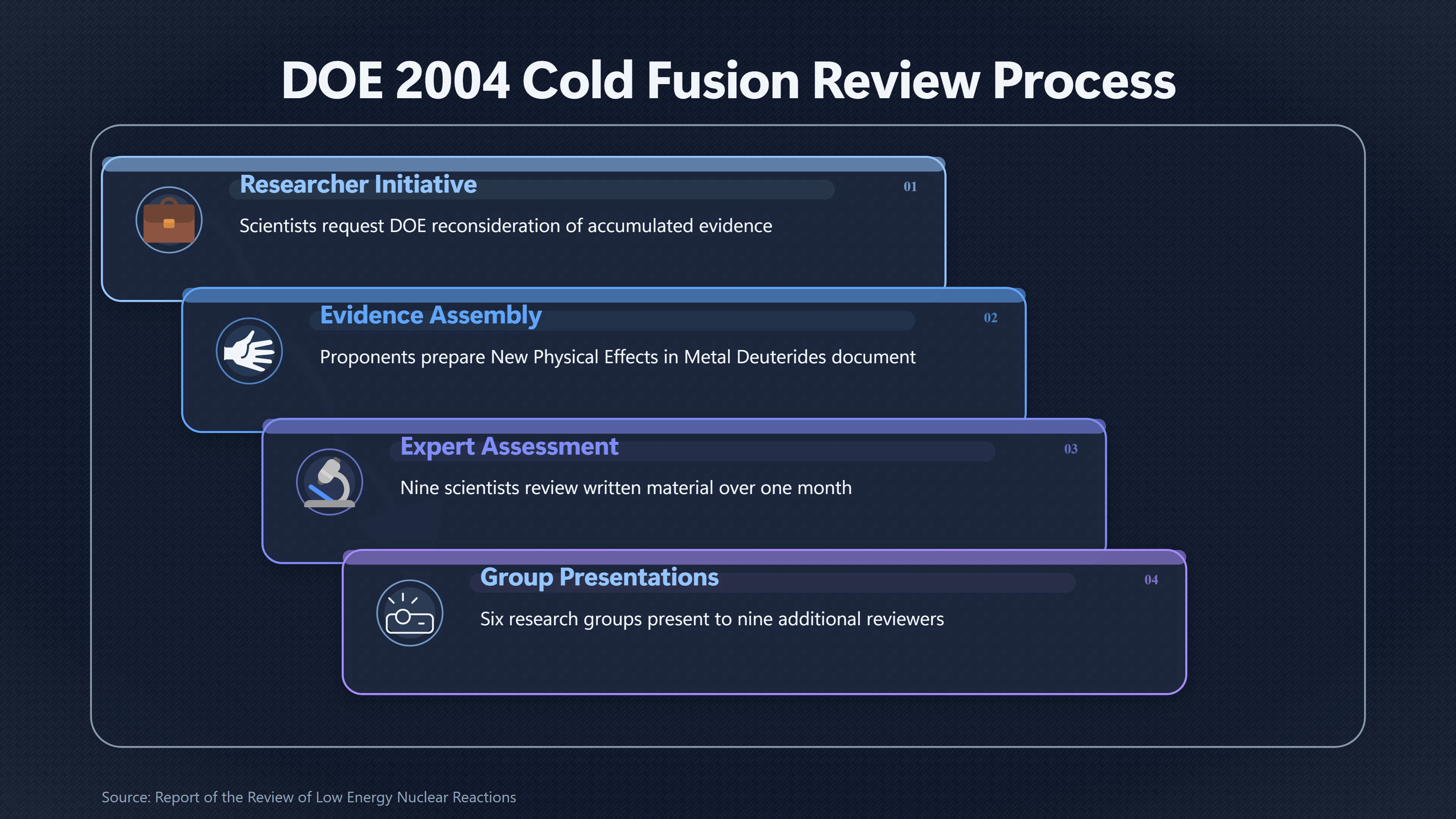
The initiative came from cold-fusion researchers themselves. In late 2003, scientists approached the DOE’s Office of Science and asked it to reconsider evidence accumulated since the department’s 1989 Energy Research Advisory Board review. James Decker, then a senior official in the Office of Science, agreed that the amount of intervening work justified another hearing. Contemporary reporting shows that the decision was controversial: supporters saw an opportunity to regain scientific legitimacy, while many physicists remained deeply sceptical that 15 years of additional experimentation had changed the underlying case.[DOI]doi.orgDOE Warms to Cold FusionDOE Warms to Cold Fusion - Physics TodayApril 1, 2004…
DOE did not simply convene a discussion about whether cold fusion deserved respectability. It asked proponents to assemble the strongest scientific case they could make. Peter Hagelstein of MIT, Michael McKubre of SRI International, David Nagel of George Washington University, Talbot Chubb of Research Systems and Randall Hekman of Hekman Industries prepared a document called New Physical Effects in Metal Deuterides. It concentrated on two questions: reported excess heat in deuterated metals and reported nuclear emissions or reaction products.[Wikisource]wikisource.orgReport of the Review of Low Energy Nuclear ReactionsWikisourceReport of the Review of Low Energy Nuclear Reactions - Wikisource, the free online library
The review was conducted through the DOE Office of Science’s Basic Energy Sciences and Nuclear Physics offices. Nine scientists with backgrounds spanning nuclear physics, materials science and electrochemistry received the written material and roughly a month to assess it. A further nine reviewers participated in a one-day review on 23 August 2004, during which six research groups made presentations. DOE ultimately received comments from 18 reviewers.[Wikisource]wikisource.orgReport of the Review of Low Energy Nuclear ReactionsWikisourceReport of the Review of Low Energy Nuclear Reactions - Wikisource, the free online library
That process is important when assessing claims of institutional suppression. The department did not accept proponents’ interpretation of their evidence, but neither did it refuse to look at it because the subject was cold fusion. It created a formal mechanism in which proponents could select and present what they regarded as their strongest evidence to scientists with relevant expertise.
Where the reviewers agreed and disagreed
The most striking result concerned excess heat. Proponents argued that palladium-deuterium experiments could produce more heat than known chemical or solid-state processes could explain. On that narrower question, DOE reported that reviewers ranged from finding the evidence compelling to finding no convincing evidence of excess power at all. The panel was “split approximately evenly”.[Wikisource]wikisource.orgReport of the Review of Low Energy Nuclear ReactionsWikisourceReport of the Review of Low Energy Nuclear Reactions - Wikisource, the free online library
That sentence became particularly important to cold-fusion advocates. David Nagel told Nature that the division was significant because most scientists outside the field regarded cold fusion as laughable; in his interpretation, an even split showed that serious examination produced a much less dismissive result. Contemporary sceptics drew almost the opposite conclusion. Physicist Robert Park argued that the inability to establish cold fusion after another 15 years of research was itself damaging to the case.[Nature]nature.comUS review rekindles cold fusion debate: Nature NewsUS review rekindles cold fusion debate: Nature News…
The apparent disagreement becomes easier to understand once three different questions are separated.
Was anomalous heat being measured? Reviewers were divided. Those accepting the evidence believed excess power appeared often enough, under sufficiently understood conditions, to merit attention. Sceptical reviewers pointed out that temporary excess power did not necessarily mean net excess energy over an entire experiment. They also questioned whether all possible chemical and solid-state explanations had been excluded and whether small differences between applied and measured power might arise from calibration or systematic errors.[Wikisource]wikisource.orgReport of the Review of Low Energy Nuclear ReactionsWikisourceReport of the Review of Low Energy Nuclear Reactions - Wikisource, the free online library
Was the effect reliably reproducible? Here the assessment was considerably less favourable. DOE reported that most reviewers — including some who accepted the evidence for excess power — considered the effects insufficiently repeatable, noted that their magnitude had not substantially increased after more than a decade of research and criticised inadequate documentation in many experiments.[Wikisource]wikisource.orgReport of the Review of Low Energy Nuclear ReactionsWikisourceReport of the Review of Low Energy Nuclear Reactions - Wikisource, the free online library
Had a nuclear reaction actually been demonstrated? Here the balance shifted clearly towards scepticism. Two-thirds of reviewers commenting on the relevant part of the charge did not regard the evidence as conclusive for low-energy nuclear reactions. One reviewer found it convincing; the remainder were somewhat convinced. When DOE posed the still stronger question of whether the evidence conclusively demonstrated such reactions, the preponderance of reviewers again answered negatively.[Wikisource]wikisource.orgReport of the Review of Low Energy Nuclear ReactionsWikisourceReport of the Review of Low Energy Nuclear Reactions - Wikisource, the free online library
This distinction is crucial. An unexplained calorimetric anomaly, even if genuine, is not automatically evidence of fusion. The 2004 reassessment left more room for debate about the former than the latter.
Helium and nuclear signatures remained the weak link
The central scientific difficulty was connecting reported heat to a nuclear mechanism. Conventional deuterium-deuterium fusion produces characteristic reaction products in known proportions. Cold-fusion proponents were proposing something radically different: in the metal lattice, they argued, a pathway favouring helium-4 could operate while the approximately 24 MeV released by the reaction appeared principally as heat rather than as the expected high-energy radiation. DOE’s nuclear-physics reviewers raised serious objections to the assumptions required by the proposed theoretical explanation.[Wikisource]wikisource.orgReport of the Review of Low Energy Nuclear ReactionsWikisourceReport of the Review of Low Energy Nuclear Reactions - Wikisource, the free online library
The helium evidence illustrates why the reviewers remained divided. Material submitted to DOE reported helium-4 in five of 16 cases in which electrochemical cells supposedly generated excess heat. But the detected helium was generally only slightly above background. Some reviewers found this convincing or at least suggestive; others regarded the inconsistency and the possibility of atmospheric helium contamination as serious weaknesses.[Wikisource]wikisource.orgReport of the Review of Low Energy Nuclear ReactionsWikisourceReport of the Review of Low Energy Nuclear Reactions - Wikisource, the free online library
Other experiments searched more directly for particles expected from fusion. Researchers reported low-level proton-triton coincidences from deuterium-loaded foils. Interestingly, even sceptical reviewers thought this line of investigation could potentially be driven towards a clear answer. Their objection was that the experiments presented to them were not yet adequate: DOE recorded criticisms of the detection techniques, experimental methods and interpretation, noting that state-of-the-art methods for low-count particle measurements were substantially better than those employed in the submitted work.[Wikisource]wikisource.orgReport of the Review of Low Energy Nuclear ReactionsWikisourceReport of the Review of Low Energy Nuclear Reactions - Wikisource, the free online library
That is one of the reassessment’s most informative details. The response was not simply “this phenomenon is impossible”. In several places it was closer to: this evidence is inadequate, but here is a better experiment capable of testing the claim. That is a materially different scientific and institutional position.
The DOE left a narrow door open
The third question put to reviewers was explicitly about whether further work had a scientific case. Their answer produced perhaps the most misunderstood part of the 2004 report.
The reviewers were nearly unanimous that funding organisations should be willing to consider individual, well-designed experimental proposals addressing specific questions about anomalous energy production in palladium-deuterium systems or possible deuterium-deuterium reactions at extremely low energies. Such proposals, however, were to meet ordinary scientific standards and survive ordinary peer review. No reviewer recommended creating a dedicated federal programme for low-energy nuclear reactions.[Wikisource]wikisource.orgReport of the Review of Low Energy Nuclear ReactionsWikisourceReport of the Review of Low Energy Nuclear Reactions - Wikisource, the free online library
Reviewers highlighted two especially useful directions. One was modern materials research into deuterium-loaded metals, including the effects of alloy composition, defects and dislocations. The other was the use of modern particle-detection equipment to search for fusion products from thin deuterated foils. Several reviewers simultaneously warned that simply repeating the kinds of experiments performed during the preceding 15 years was unlikely to resolve the controversy.[Wikisource]wikisource.orgReport of the Review of Low Energy Nuclear ReactionsWikisourceReport of the Review of Low Energy Nuclear Reactions - Wikisource, the free online library
This was therefore not a recommendation to fund “cold fusion” as an established phenomenon. It was closer to an endorsement of narrowly framed experiments capable of distinguishing an unusual physical effect from experimental artefact or conventional physics.
Nor did DOE officials present this as a major policy reversal. Decker said that the department had always been receptive to scientifically sound proposals and made funding decisions according to peer review and programme relevance. When Scientific American asked whether that meant little had changed since 1989, he acknowledged that this was a fair interpretation.[Scientific American]scientificamerican.comScientific American Back to Square One | Scientific AmericanScientific American Back to Square One | Scientific American
Why reassessment complicates a total-suppression narrative
For advocates who had spent years describing cold fusion as institutionally excluded, the mere fact of the review carried symbolic weight. McKubre told Physics Today that an important outcome was being treated like ordinary scientists during the review rather than as scientific outcasts. Hagelstein similarly described a door as having been opened, while questioning whether researchers would actually be able to pass through it.[PHYSICS TODAY]physicstoday.aip.orgPHYSICS TODAYCold Fusion Gets Chilly EncorePhysics Today…
Their caution was understandable. A statement that agencies should entertain proposals does not guarantee money, publication or institutional acceptance. Without a dedicated programme, unconventional proposals still had to compete within existing funding structures, whose reviewers might consider them low priority or outside a programme’s remit. Hagelstein explicitly raised this problem after the reassessment.[Scientific American]scientificamerican.comScientific American Back to Square One | Scientific AmericanScientific American Back to Square One | Scientific American
Cold-fusion advocates subsequently argued that the practical environment remained hostile. Specialist repositories preserving the episode, such as LENR-CANR, interpret later funding decisions as evidence that the apparent opening did not translate into fair access to resources. Those claims are useful evidence for understanding the suppression narrative, but they should be distinguished from the DOE report itself: the official 2004 finding explicitly endorsed peer-reviewed consideration of suitable individual proposals rather than recommending their categorical rejection.[LENR-CANR.org]lenr-canr.org2004 DoE Review…
Later DOE policy history makes the idea of an absolute institutional prohibition harder to sustain. In a 2022 funding opportunity, the department’s Advanced Research Projects Agency–Energy (ARPA-E) revisited low-energy nuclear reactions and summarised the earlier reviews as finding insufficient evidence for deuterium-deuterium fusion while supporting evaluation of proposals concerning deuterated heavy metals through standard peer review. ARPA-E also noted that few such proposals had been submitted after the earlier reviews and that none had been funded by DOE during that period.[ARPA-E eXCHANGE]arpa-e-foa.energy.govFile Content.aspxARPA-E eXCHANGEFINANCIAL ASSISTANCESeptember 7, 2023…
The 2004 episode therefore supports a narrower and more defensible account of marginalisation. Cold fusion had an exceptionally poor scientific reputation; its researchers faced career and funding disadvantages; and a second federal review still concluded that their nuclear interpretation was unproven. Those conditions can produce powerful forms of institutional exclusion without requiring a centrally directed suppression programme.
For the broader narrative connecting unconventional-energy researchers with alleged suspicious deaths or disappearances, that distinction is essential. The DOE reassessment documents scientific controversy, scepticism, funding constraints and institutional gatekeeping. It does not document threats, disappearances or the physical elimination of researchers. Indeed, the formal reopening of the question in 2004 demonstrates that even after cold fusion had become deeply stigmatised, researchers could persuade the US government’s principal energy-science department to examine their evidence again.
What the 2004 review actually established
The fairest reading sits between the strongest claims made by either side. DOE did not conclude that cold fusion had been demonstrated. Most reviewers considered the evidence for a nuclear reaction inconclusive, and they identified substantial problems involving reproducibility, controls, documentation, nuclear signatures and theory. DOE’s final conclusion explicitly said that, despite improved calorimetry, the overall conclusions remained similar to those of 1989.[Wikisource]wikisource.orgReport of the Review of Low Energy Nuclear ReactionsWikisourceReport of the Review of Low Energy Nuclear Reactions - Wikisource, the free online library
But “nothing to see here” also understates the reassessment. Reviewers genuinely divided over whether excess heat had been observed. Some potentially decisive particle-detection experiments were judged worth pursuing. Nearly all reviewers supported allowing properly designed proposals into ordinary peer review, and DOE identified specific experimental approaches that could help settle outstanding questions. Contemporary coverage accordingly described the findings as intriguing but unconvincing rather than as a demonstration that further investigation was illegitimate.[Nature]nature.comUS review rekindles cold fusion debate: Nature NewsUS review rekindles cold fusion debate: Nature News…
That combination is what makes the 2004 reassessment especially useful when evaluating the suppressed-scientist narrative. It shows how an unconventional field can be both heavily marginalised and still periodically reconsidered by mainstream institutions. The documentary record supports a story of scientific stigma and unresolved disagreement far better than one of complete governmental suppression.
Amazon book picks
Further Reading
Books and field guides related to What the 2004 Cold Fusion Review Actually Found. Use these as the next step if you want deeper reading beyond the article.

Too hot to handle : the race for cold fusion
First published 1990. Subjects: Cold fusion, Research, Utah, Fusion reactors, Nuclear fusion.
Cold Fusion: The Scientific Fiasco of the Century
Professor Huizenga, Co-Chairman of the U.S. Department of Energy Cold Fusion Panel that investigated the claims of Pons and Fleischmann--...
Fire from Ice: Searching for the Truth Behind the Cold Fusion...
Discusses the furor over the announcement that scientists had succeeded in producing controlled nuclear fusion at ordinary temperatures,...
eBay marketplace picks
Marketplace Samples
Live-tested eBay searches with available results related to this page.
Selected fromUFO poster oneBay.co.uk.



Endnotes
1.
Source: en.wikisource.org
Title: Report of the Review of Low Energy Nuclear Reactions
Link:https://en.wikisource.org/wiki/Report_of_the_Review_of_Low_Energy_Nuclear_Reactions
Source snippet
Report of the Review of Low Energy Nuclear Reactions - Wikisource, the free online library...
2.
Source: physicstoday.aip.org
Title: PHYSICS TODAYCold Fusion Gets Chilly Encore
Link:https://physicstoday.aip.org/news/cold-fusion-gets-chilly-encore
Source snippet
Physics Today...
3.
Source: doi.org
Title: DOE Warms to Cold Fusion
Link:https://doi.org/10.1063/1.1752414
Source snippet
DOE Warms to Cold Fusion - Physics TodayApril 1, 2004...
Published: April 1, 2004
4.
Source: nature.com
Title: US review rekindles cold fusion debate: Nature News
Link:https://www.nature.com/news/2004/041202/full/news041129-11.html
Source snippet
US review rekindles cold fusion debate: Nature News...
5.
Source: lenr-canr.org
Link:https://lenr-canr.org/wordpress/?page_id=455
Source snippet
2004 DoE Review...
6.
Source: arpa-e-foa.energy.gov
Title: File Content.aspx
Link:https://arpa-e-foa.energy.gov/FileContent.aspx?FileID=11123e98-b2b2-4695-b889-6709cbce6f74
Source snippet
ARPA-E eXCHANGEFINANCIAL ASSISTANCESeptember 7, 2023...
Published: September 7, 2023
7.
Source: nature.com
Title: Revisiting the cold case of cold fusion | Nature
Link:https://www.nature.com/articles/s41586
8.
Source: en.wikisource.org
Title: Cold fusion and the issue of “majority” for the Do E
Link:https://en.wikisource.org/wiki/User%3AAbd/Cold_fusion_and_the_issue_of_%22majority%22_for_the_DoE
9.
Source: nature.com
Title: Observation of nuclear fusion driven by a pyroelectric crystal | Nature
Link:https://www.nature.com/articles/nature03575
10.
Source: lenr-canr.org
Link:https://lenr-canr.org/wordpress/?m=200503
11.
Source: nature.com
Title: News in brief | Nature
Link:https://www.nature.com/articles/432664a
12.
Source: nature.com
Title: U S review rekindles cold fusion debate | Nature
Link:https://www.nature.com/articles/news041129-11
13.
Source: en.wikisource.org
Title: Page:DOE Report of the Review of Low Energy Nuclear Reactions.djvu
Link:https://en.wikisource.org/wiki/Page%3ADOE_Report_of_the_Review_of_Low_Energy_Nuclear_Reactions.djvu/4
14.
Source: en.wikisource.org
Title: Page:DOE Report of the Review of Low Energy Nuclear Reactions.djvu
Link:https://en.wikisource.org/wiki/Page%3ADOE_Report_of_the_Review_of_Low_Energy_Nuclear_Reactions.djvu/1
15.
Source: en.wikisource.org
Title: Page:DOE Report of the Review of Low Energy Nuclear Reactions.djvu
Link:https://en.wikisource.org/wiki/Page%3ADOE_Report_of_the_Review_of_Low_Energy_Nuclear_Reactions.djvu/5
16.
Source: en.wikisource.org
Title: Page:DOE Report of the Review of Low Energy Nuclear Reactions.djvu
Link:https://en.wikisource.org/wiki/Page%3ADOE_Report_of_the_Review_of_Low_Energy_Nuclear_Reactions.djvu/3
17.
Source: en.wikisource.org
Title: File:DOE Report of the Review of Low Energy Nuclear Reactions.djvu
Link:https://en.wikisource.org/wiki/File%3ADOE_Report_of_the_Review_of_Low_Energy_Nuclear_Reactions.djvu
18.
Source: en.wikisource.org
Title: Page:DOE Report of the Review of Low Energy Nuclear Reactions.djvu
Link:https://en.wikisource.org/wiki/Page%3ADOE_Report_of_the_Review_of_Low_Energy_Nuclear_Reactions.djvu/2
19.
Source: en.wikisource.org
Title: Index:DOE Report of the Review of Low Energy Nuclear Reactions.djvu
Link:https://en.wikisource.org/wiki/Index%3ADOE_Report_of_the_Review_of_Low_Energy_Nuclear_Reactions.djvu
20.
Source: lenr-canr.org
Link:https://lenr-canr.org/wordpress/?page_id=323
21.
Source: lenr-canr.org
Link:https://lenr-canr.org/
22.
Source: lenr-canr.org
Link:https://lenr-canr.org/wordpress/
23.
Source: scientificamerican.com
Title: Scientific American Back to Square One | Scientific American
Link:https://www.scientificamerican.com/article/back-to-square-one/
24.
Source: sec.gov
Link:https://www.sec.gov/Archives/edgar/data/7286/000076462219000019/pnw2018123110-k.htm
25.
Source: nige.wordpress.com
Link:https://nige.wordpress.com/2007/05/25/
26.
Source: wanttoknow.info
Title: Cold Fusion
Link:https://www.wanttoknow.info/coldfusion
27.
Source: physicstoday.aip.org
Title: seeking answers from cold fusion review
Link:https://physicstoday.aip.org/letters/seeking-answers-from-cold-fusion-review
28.
Source: asa3.org
Link:https://www.asa3.org/archive/asa/200403/0244.html
29.
Source: wikizero.net
Title: Cold fusion
Link:https://www.wikizero.net/wiki/en/Cold_fusion
30.
Source: wikis.tw
Link:https://wikis.tw/%E5%86%B7%E6%A0%B8%E8%81%9A%E5%8F%98
31.
Source: academickids.com
Title: Cold fusion
Link:https://academickids.com/encyclopedia/index.php/Fleischmann-Pons_experiment
32.
Source: academickids.com
Title: Cold fusion
Link:https://academickids.com/encyclopedia/index.php/Cold_fusion
33.
Source: fusion.ucla.edu
Link:https://www.fusion.ucla.edu/presentations/
Additional References
34.
Source: ebay.com
Title: What constitutes scientific misco
Link:https://www.ebay.com/itm/147149707513?mkevt=1&mkcid=1&mkrid=710-53481-19255-0&campid=5339151051&customid=endnote-source&toolid=10001
Source snippet
Ethics in Science: Ethical Misconduct - Paperback, by D'Angelo John - Very Good 9781138035423| eBayApril 18, 2026 — Illustrated Yes Dewey...
Published: April 18, 2026
35.
Source: youtube.com
Title: Cafe Sci Silicon Valley: What Happened to Cold Fusion? (Pt 1 of 8)
Link:https://www.youtube.com/watch?v=EtweR_qGHEc
Source snippet
Dr. Michael McKubre: Experimental Cold Fusion, Pseudo-Skepticism, & Progressing LENR...
36.
Source: handwiki.org
Title: Physics:Cold fusion
Link:https://handwiki.org/wiki/Physics%3ACold_fusion
Source snippet
"Whatever happened to cold fusion?". American Scholar 63 (4): 527–...
5
4
- ISSN 0003-0937. http://www.its.caltech.edu/~dg/fusion_art.html. Re
37.
Source: youtube.com
Title: The “Conspiracy” to Kill Cold Fusion
Link:https://www.youtube.com/watch?v=KWlBZT7L1qM
Source snippet
DOE cold fusion 2004 review low energy nuclear reactions Cold Fusion: The Forgotten Breakthrough That Promised Unlimited Clean Energy...
38.
Source: youtube.com
Link:https://www.youtube.com/watch?v=TZXekFvKZoc
Source snippet
Cold Fusion 101 Dr. Peter Hagelstein at MIT...
39.
Source: medium.com
Title: The meas
Link:https://medium.com/%40krigerbruce/a-code-of-practice-for-introducing-entities-in-cosmology-1d398a802478
Source snippet
July 17, 2026 — The rays were being seen when their production had been rendered impossible, and this demonstrated beyond argument...
Published: July 17, 2026
40.
Source: researchgate.net
Link:https://www.researchgate.net/publication/309634360From_the_History_of_CF_Research-A_Review_of_the_Typical_Papers_on_the_Cold_Fusion_Phenomenon-
41.
Source: researchgate.net
Link:https://www.researchgate.net/publication/265085076_Social_Aspects_of_Cold_Fusion_23_Years_Later
42.
Source: wanttoknow.info
Link:https://www.wanttoknow.info/newenergyinventionsnewsarticles-0-100000
43.
Source: jlab.org
Link:https://www.jlab.org/news/releases/doe-announces-first-awards-scientific-discovery-through-advanced-computing-program