What Peer Review Did and Did Not Validate
Publication showed that Li's work was scientifically discussable, but it did not certify her predicted effects as experimentally true.
On this page
- Why publication gave the work scientific legitimacy
- Why peer review is not experimental confirmation
- How later criticism and testing changed the evidence
Page outline Jump by section
Introduction
Peer review gave Ning Li’s gravity-and-superconductor research something important, but much narrower than the status later retellings sometimes imply. Her papers with Douglas G. Torr were accepted into established physics journals, including Physical Review D and Physical Review B. That meant specialist editors and referees judged the arguments sufficiently serious, technically developed and relevant to enter the scientific literature. It did not mean that reviewers independently reproduced the calculations, performed Li’s proposed experiments, or certified that superconductors really generate useful anomalous gravitational fields.[Physical Review Journals]journals.aps.orgPhys Rev D.43.457Physical Review JournalsEffects of a gravitomagnetic field on pure superconductors | Phys. Rev. DJanuary 15, 1991…
Li’s publication history is especially instructive because science subsequently did exactly what peer review is supposed to permit: other researchers challenged the published reasoning and experiments tested related effects. A 1994 Physical Review B paper argued that Li and Torr had grossly overestimated a gravitomagnetic effect; a 1999 critique concluded that another prediction was many orders of magnitude too large; and Li’s own 1997 experiment found no sizeable static gravitational anomaly.[aps.org]link.aps.orgJournals Gravitomagnetism and magnetic permeability in superconductorsRev. B 46, 5489 (1992)] have developed theoretical models to estimate the magni- tude of gravitomagnetic effects in superconductors…
The correct lesson, therefore, is neither “peer review proved Li right” nor “later criticism makes publication meaningless”. Peer review admitted a controversial hypothesis into organised scientific scrutiny. What happened after publication determined how much confidence its specific predictions deserved.
Why publication gave the work scientific legitimacy
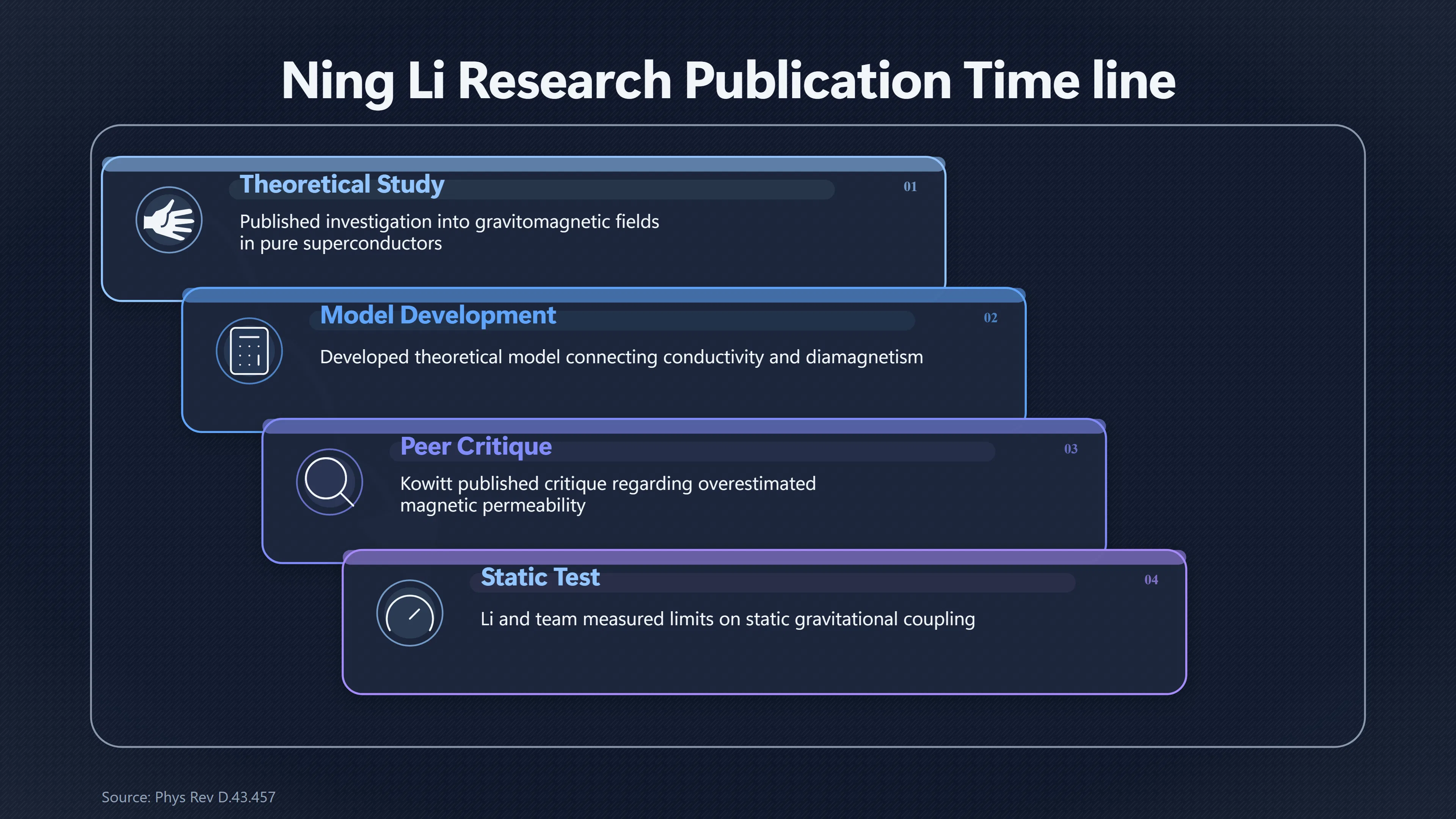
Li and Torr’s early work was not merely an informal antigravity proposal circulating outside physics. Their 1991 paper, “Effects of a gravitomagnetic field on pure superconductors”, appeared in the American Physical Society’s Physical Review D. It mathematically investigated how external magnetic and gravitomagnetic fields might behave inside a pure superconductor. The published abstract describes coupled internal fields, residual magnetic effects and exponential attenuation over a characteristic distance.[Physical Review Journals]journals.aps.orgPhys Rev D.43.457Physical Review JournalsEffects of a gravitomagnetic field on pure superconductors | Phys. Rev. DJanuary 15, 1991…
Their 1992 paper, “Gravitational effects on the magnetic attenuation of superconductors”, appeared in Physical Review B. Here Li and Torr developed a theoretical model connecting perfect electrical conductivity and perfect diamagnetism when gravitational effects were included. Significantly, the abstract itself used restrained language: the result “suggests a possible importance” of gravitational effects for understanding superconductivity. It was a theoretical proposition, not a report that antigravity had been experimentally demonstrated.[Physical Review Journals]journals.aps.orgOpen source on aps.org.
This publication record matters when assessing claims that Li’s work was simply pseudoscience from the outset. It was sufficiently connected to recognisable problems in gravitation and superconductivity to be considered, criticised and cited within the professional literature. Peer review is, fundamentally, expert assessment of a manuscript’s quality and suitability for publication; it provides a filter before research enters that literature.[Taylor & Francis Author Services]authorservices.taylorandfrancis.comTaylor & Francis Author Services Understanding peer reviewThe purpose of peer review is to evaluate the paper's quality and…Read more…
But “scientifically legitimate to investigate” and “experimentally established” are different propositions. Indeed, the Royal Society’s description of objective peer review illustrates the distinction particularly clearly: a scientifically sound and useful paper can be publishable without an editor making a judgement that its results are exceptionally important. Modern scientific publishing also treats replication as a distinct activity worthy of dedicated studies and procedures.[Royal Society]royalsociety.orgRoyal SocietyOpen scienceRoyal Society Open Science publishes research across the entire range of science on the basis of objective peer…
For Li’s work, that distinction is decisive. Publication established a legitimate scientific conversation. It did not establish a working gravity-control technology.
What peer review did not validate
A journal referee normally assesses what is contained in the submitted manuscript: whether its methods and reasoning are intelligible, whether relevant literature has been addressed, whether conclusions are adequately supported for publication, and whether defects require revision or rejection. Peer review is not ordinarily an independent laboratory replication performed before publication. A UK parliamentary examination of scientific peer review explicitly noted that replication does not usually occur during the peer-review process.[UK Parliament]publications.parliament.ukUK Parliament Peer review in scientific publicationsUK Parliament Peer review in scientific publications
That limitation becomes especially important with extraordinary physical predictions. If a manuscript derives a surprising consequence from a mathematical model, publication establishes that the derivation survived the journal’s review process in the form accepted. It does not establish that nature follows all the model’s assumptions. Nor does it prevent another physicist from subsequently identifying a mistaken approximation, interpretation or numerical estimate.
Li’s papers provide a concrete demonstration. The 1991 and 1992 articles made theoretical arguments about gravitomagnetic behaviour in superconductors. Their acceptance therefore cannot reasonably be converted into the stronger statement that Physical Review had experimentally verified a gravitational field produced by a superconductor. The 1991 paper itself reports a theoretical “investigation” and equations for internal fields; it does not present the sort of independent experimental replication that would justify such a claim.[Physical Review Journals]journals.aps.orgPhys Rev D.43.457Physical Review JournalsEffects of a gravitomagnetic field on pure superconductors | Phys. Rev. DJanuary 15, 1991…
This is why the phrase “peer-reviewed antigravity research” can mislead even when technically true. It can collapse three very different levels of scientific standing into one:
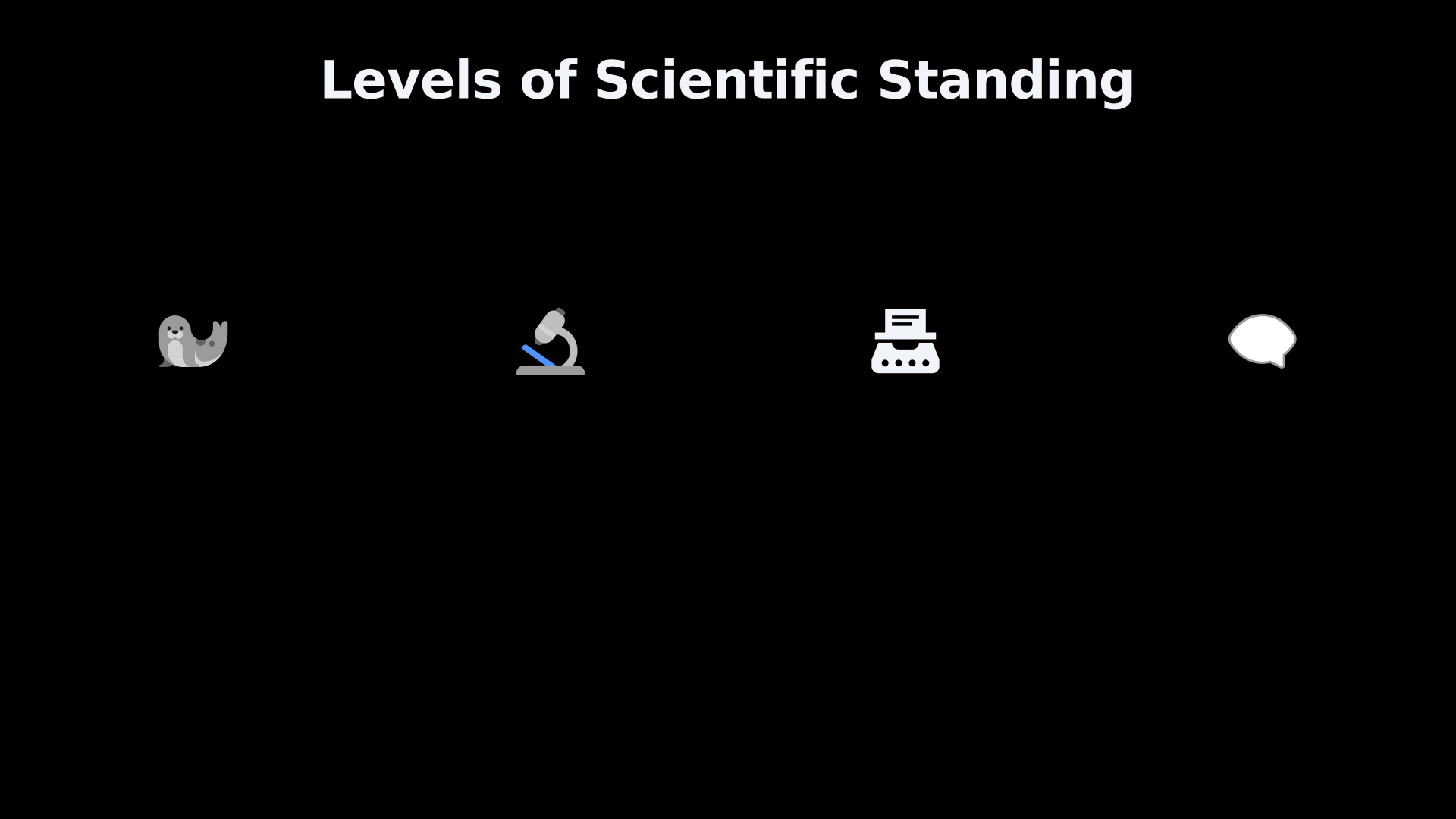
- Publishable hypothesis: specialists judge an argument sufficiently coherent and relevant to become part of the research literature.
- Supported experimental result: measurements provide evidence for a predicted phenomenon while plausible artefacts and alternative explanations are controlled.
- Independently confirmed phenomenon: separate investigators obtain compatible results, substantially increasing confidence that the effect is real rather than particular to one model, apparatus or analysis.
Li unquestionably reached the first level with several papers. The available record does not show that her most consequential claims about large, usable gravitational effects progressed through the latter stages into an independently established phenomenon. The National Academies likewise distinguishes reproducibility from replication, with replication requiring new data from an independent study aimed at the same scientific question.[National Academies]nationalacademies.orgOpen source on nationalacademies.org.
Published criticism became part of the evidence
The strongest demonstration of what peer review meant in Li’s case is that the scientific literature did not freeze when her papers were accepted. Other researchers were free to attack their assumptions and calculations.
In 1994, M. Kowitt published “Gravitomagnetism and magnetic permeability in superconductors” in Physical Review B — the same journal family in which Li and Torr had published. Kowitt directly addressed their 1992 model and argued that its predicted magnitude was “grossly overestimated” because Li and Torr had misinterpreted the magnetic permeability used experimentally to describe the Meissner effect in bulk superconductors.[APS Journals]link.aps.orgPhys Rev B.49.704Phys Rev B.49.704
That episode is particularly revealing. Both the original proposal and a serious objection to it could pass into the peer-reviewed literature. Peer review was not acting as a one-time declaration of which side possessed the final truth. It was functioning as a governance mechanism for scientific argument: claims became explicit enough for specialists to inspect, cite and challenge.
Edward G. Harris later subjected another Li–Torr claim to a more direct quantitative attack. His 1999 paper, “Comments on ‘Gravitoelectric-Electric Coupling via Superconductivity’ by Douglas G. Torr and Ning Li”, appeared in Foundations of Physics Letters. Harris summarised Li and Torr’s position as predicting experimentally detectable gravitomagnetic and gravitoelectric fields, then argued that unrealistic assumptions had made the calculated fields too large by many orders of magnitude.[Springer]link.springer.comfields that they calculate are too large by many orders of magnitude.Read more…
A later Defense Intelligence Agency review of superconductors and gravity research summarised this history and reported that Harris’s treatment reduced one induced gravitoelectric estimate by roughly 20 orders of magnitude relative to the problematic calculation. That document is a retrospective assessment rather than the original scientific criticism, but it illustrates why simply counting Li’s peer-reviewed publications gives a distorted picture: the subsequent literature is part of the evidential record too.[Defense Intelligence Agency]dia.milDefense Intelligence Agency The Role of Superconductors in Gravity ResearchDefense Intelligence Agency The Role of Superconductors in Gravity Research
The intellectually important fact is therefore not merely that “Li was peer reviewed”. Kowitt and Harris were engaging with the published theory through the same broad machinery of scholarly criticism. A fair assessment has to count those papers as well.
The 1997 experiment changed the question
The clearest evidence that publication did not amount to automatic confirmation came from experimental work involving Li herself. In 1997, Ning Li, David Noever, Tony Robertson, Ron Koczor and Whitt Brantley published “Static test for a gravitational force coupled to type II YBCO superconductors” in Physica C: Superconductivity. The work is also preserved in NASA’s Technical Reports Server.[ScienceDirect]sciencedirect.comStatic test for a gravitational force coupled to type II YBCO superconductors - ScienceDirect…
The experiment addressed reports of anomalous weight changes associated with superconductors. The team used a sensitive gravimeter while bulk yttrium barium copper oxide (YBCO) superconductors were levitated in a direct-current magnetic field. Instead of finding the comparatively large static anomaly suggested by earlier reports, they measured changes in acceleration below two parts in 100 million of normal gravitational acceleration. The authors said this placed new limits on the strength and range of a proposed coupling between static superconductors and gravity.[ScienceDirect]sciencedirect.comStatic test for a gravitational force coupled to type II YBCO superconductors - ScienceDirect…
That result needs careful interpretation. It did not test every possible configuration associated with Li’s broader theoretical programme, and a stationary or magnetically levitated YBCO experiment cannot automatically settle claims involving every conceivable rotating, driven or time-varying superconductor. But it did establish something much more informative than the bare fact of peer-reviewed publication: under the conditions actually tested, a sizeable static gravitational anomaly was not observed.
This is one reason null results matter so much in controversial research. They can narrow a hypothesis without requiring scientists to declare an entire subject impossible. NASA’s later documentation continued to describe the result as setting limits on the proposed coupling rather than as a demonstration of gravity control.[NASA Technical Reports Server]ntrs.nasa.govOpen source on nasa.gov.
Li’s own experimental paper therefore undercuts the simplistic story in which peer review had already “confirmed” her theory. If confirmation had already occurred merely because the theoretical papers were published, there would have been little scientific purpose in performing increasingly sensitive experimental tests.
Publication, criticism and replication form different filters
Li’s case makes more sense if peer review is treated as one stage in a longer system of scientific quality control rather than a certification stamp.
At the publication stage, referees ask whether a manuscript is sufficiently rigorous and relevant to warrant dissemination. After publication, a much larger community can inspect the reasoning, attempt alternative calculations, construct new apparatus and compare predictions against fresh observations. Independent replication goes further than editorial review because researchers obtain new data rather than merely examining the author’s report. The National Academies identifies rigorous peer review and replication-related practices as complementary parts of improving scientific reliability, not interchangeable procedures.[National Academies]nationalacademies.orgOpen source on nationalacademies.org.
Li’s research passed through these filters unevenly. The original theoretical programme cleared the publication threshold. Published critics then disputed crucial estimates. Experimental investigation failed to reveal a large static effect under the conditions Li and colleagues tested. Later researchers continued to discuss unusual gravitomagnetic effects in superconductors, showing that the general question remained scientifically interesting, but that continuing interest did not retroactively validate Li and Torr’s disputed quantitative predictions.[springer.com]link.springer.comfields that they calculate are too large by many orders of magnitude.Read more…
That sequence is not evidence that peer review “failed”. On the contrary, it shows why publication is provisional. Scientific journals provide a structured place where potentially important ideas can be exposed to criticism without requiring editors to certify them permanently as facts.

Why this distinction matters in the Ning Li story
The difference becomes particularly important because Li’s research later became entangled with much broader stories about antigravity technology, classified research and UFO-related claims. Within that larger narrative, the phrase “published in peer-reviewed journals” can sound like evidence that mainstream physics verified a technological breakthrough and that something unexplained must therefore account for its subsequent absence from public science.
The publication record does not support that inference.
What it establishes is narrower and more interesting. Li and Torr pursued unconventional ideas about gravity and superconductivity seriously enough to publish them in recognised physics venues. Their ideas were not excluded from scientific discussion simply because their potential implications were radical. NASA-associated researchers later participated in experimental work, and NASA’s technical archive preserves that work.[Physical Review Journals]journals.aps.orgPhys Rev D.43.457Physical Review JournalsEffects of a gravitomagnetic field on pure superconductors | Phys. Rev. DJanuary 15, 1991…
But the same open record also contains the ingredients expected when science is self-correcting: quantitative criticism, competing calculations and an experiment producing a stringent upper limit rather than the hoped-for large anomaly. Kowitt challenged Li and Torr’s interpretation of superconducting magnetic permeability; Harris argued that another calculation exaggerated the predicted fields by many orders of magnitude; Li and collaborators themselves reported no substantial static gravitational effect in their 1997 test.[aps.org]link.aps.orgJournals Gravitomagnetism and magnetic permeability in superconductorsRev. B 46, 5489 (1992)] have developed theoretical models to estimate the magni- tude of gravitomagnetic effects in superconductors…
None of those facts can establish what may or may not have occurred in later classified work. They do, however, establish what the public peer-reviewed record warrants saying. There is a documented history of serious investigation into unconventional gravity–superconductor coupling. There is not, in that record, independent experimental confirmation that Li achieved practical antigravity or a reproducible gravity-control effect.
The most accurate reading of Li’s peer-reviewed record
The phrase “Ning Li’s research was peer reviewed” is therefore true but incomplete. Its real significance lies in what followed publication.
Peer review validated the work’s eligibility for scientific consideration, not the physical reality of every predicted effect. It allowed Li and Torr’s models to become identifiable scientific claims with equations, assumptions and predicted consequences that other researchers could examine. That gave the work considerably more evidential weight than an unsupported anecdote or popular account.[Physical Review Journals]journals.aps.orgPhys Rev D.43.457Physical Review JournalsEffects of a gravitomagnetic field on pure superconductors | Phys. Rev. DJanuary 15, 1991…
Yet scientific confidence must be updated using the whole record rather than the prestige of the original journal. In Li’s case, that record includes major published objections to the predicted magnitude of the effects and an experimental result from Li and colleagues that constrained rather than confirmed a sizeable static gravity anomaly.[aps.org]link.aps.orgJournals Gravitomagnetism and magnetic permeability in superconductorsRev. B 46, 5489 (1992)] have developed theoretical models to estimate the magni- tude of gravitomagnetic effects in superconductors…
For evaluating controversial gravity research — particularly when it becomes connected to claims of suppressed technology or suspicious events involving researchers — this is the crucial evidential boundary. Peer review shows that Ning Li’s ideas were genuinely part of scientific discourse. It does not show that antigravity was experimentally achieved. The stronger claim would require robust measurements and credible independent confirmation, and the accessible scientific literature does not provide that confirmation.
Amazon book picks
Further Reading
Books and field guides related to What Peer Review Did and Did Not Validate. Use these as the next step if you want deeper reading beyond the article.
The Demon-Haunted World: Science as a Candle in the Dark
Rating: 4.5/5 from 43 Google Books ratings
NEW YORK TIMES BESTSELLER • From the renowned astronomer and author of Cosmos comes a “powerful [and] stirring defense of informed ration...
The Knowledge Machine: How Irrationality Created Modern Science
• Why is science so powerful? • Why did it take so long—two thousand years after the invention of philosophy and mathematics—for the huma...

Science Fictions: How Fraud, Bias, Negligence, and Hype Under...
First published 2020. Subjects: Science, Fraud in science, Scientific Errors.
The Structure of Scientific Revolutions
A good book may have the power to change the way we see the world, but a great book actually becomes part of our daily consciousness, per...
eBay marketplace picks
Marketplace Samples
Live-tested eBay searches with available results related to this page.
Selected fromantigravity collectible oneBay.co.uk.


Endnotes
1.
Source: journals.aps.org
Title: Phys Rev D.43.457
Link:https://journals.aps.org/prd/abstract/10.1103/PhysRevD.43.457
Source snippet
Physical Review JournalsEffects of a gravitomagnetic field on pure superconductors | Phys. Rev. DJanuary 15, 1991...
Published: January 15, 1991
2.
Source: journals.aps.org
Link:https://journals.aps.org/prb/abstract/10.1103/PhysRevB.46.5489
3.
Source: link.aps.org
Title: Journals Gravitomagnetism and magnetic permeability in superconductors
Link:https://link.aps.org/pdf/10.1103/PhysRevB.49.704
Source snippet
Rev. B 46, 5489 (1992)] have developed theoretical models to estimate the magni- tude of gravitomagnetic effects in superconductors...
4.
Source: link.springer.com
Link:https://link.springer.com/article/10.1023/A%3A1021621425670
Source snippet
fields that they calculate are too large by many orders of magnitude.Read more...
5.
Source: sciencedirect.com
Link:https://www.sciencedirect.com/science/article/pii/S0921453497014627
Source snippet
Static test for a gravitational force coupled to type II YBCO superconductors - ScienceDirect...
6.
Source: publications.parliament.uk
Title: UK Parliament Peer review in scientific publications
Link:https://publications.parliament.uk/pa/cm201012/cmselect/cmsctech/856/856.pdf
7.
Source: link.aps.org
Title: Phys Rev B.49.704
Link:https://link.aps.org/doi/10.1103/PhysRevB.49.704
8.
Source: link.springer.com
Link:https://link.springer.com/content/pdf/10.1023/A%3A1021621425670.pdf
9.
Source: ntrs.nasa.gov
Link:https://ntrs.nasa.gov/citations/19990039542
10.
Source: ntrs.nasa.gov
Link:https://ntrs.nasa.gov/citations/19990104365
11.
Source: ntrs.nasa.gov
Link:https://ntrs.nasa.gov/api/citations/19990023209/downloads/19990023209.pdf
12.
Source: link.springer.com
Link:https://link.springer.com/article/10.1140/epjc/s10052-024-12506-1
13.
Source: link.springer.com
Link:https://link.springer.com/article/10.1140/epjc/s10052-017-5116-y
14.
Source: sciencedirect.com
Link:https://www.sciencedirect.com/science/article/abs/pii/S0921453405007458
15.
Source: sciencedirect.com
Title: Gravitomagnetic field of a rotating superconductor and of a rotating superfluid
Link:https://www.sciencedirect.com/science/article/abs/pii/S0921453402023055
16.
Source: sciencedirect.com
Title: Static test for a gravitational force coupled to type II YBCO superconductors
Link:https://www.sciencedirect.com/science/article/abs/pii/S0921453497014627
17.
Source: sciencedirect.com
Link:https://www.sciencedirect.com/journal/physica-c-superconductivity-and-its-applications/vol/281/issue/2
18.
Source: ntrs.nasa.gov
Link:https://ntrs.nasa.gov/search.jsp?R=19990039542
19.
Source: journals.aps.org
Link:https://journals.aps.org/prb/issues/46/9
20.
Source: journals.aps.org
Link:https://journals.aps.org/prd/issues/43/2
21.
Source: ntrs.nasa.gov
Link:https://ntrs.nasa.gov/api/citations/19980003825/downloads/19980003825.pdf
22.
Source: ntrs.nasa.gov
Link:https://ntrs.nasa.gov/api/citations/19940031395/downloads/19940031395.pdf
23.
Source: ntrs.nasa.gov
Link:https://ntrs.nasa.gov/api/citations/19910013916/downloads/19910013916.pdf
24.
Source: ntrs.nasa.gov
Link:https://ntrs.nasa.gov/api/citations/19980201240/downloads/19980201240.pdf
25.
Source: ntrs.nasa.gov
Link:https://ntrs.nasa.gov/api/citations/19840019727/downloads/19840019727.pdf
26.
Source: ntrs.nasa.gov
Link:https://ntrs.nasa.gov/api/citations/19960000230/downloads/19960000230.pdf?attachment=true
27.
Source: ntrs.nasa.gov
Link:https://ntrs.nasa.gov/api/citations/19900004835/downloads/19900004835.pdf
28.
Source: ntrs.nasa.gov
Link:https://ntrs.nasa.gov/api/citations/20060000022/downloads/20060000022.pdf
29.
Source: ntrs.nasa.gov
Link:https://ntrs.nasa.gov/api/citations/19710016533/downloads/19710016533.pdf?attachment=true
30.
Source: ntrs.nasa.gov
Link:https://ntrs.nasa.gov/api/citations/19960050126/downloads/19960050126.pdf
31.
Source: ntrs.nasa.gov
Link:https://ntrs.nasa.gov/api/citations/19750020049/downloads/19750020049.pdf
32.
Source: ntrs.nasa.gov
Link:https://ntrs.nasa.gov/api/citations/19960052904/downloads/19960052904.pdf?attachment=true
33.
Source: ntrs.nasa.gov
Link:https://ntrs.nasa.gov/api/citations/19870009622/downloads/19870009622.pdf?attachment=true
34.
Source: ntrs.nasa.gov
Link:https://ntrs.nasa.gov/api/citations/19920018478/downloads/19920018478.pdf
35.
Source: ntrs.nasa.gov
Link:https://ntrs.nasa.gov/api/citations/19790020021/downloads/19790020021.pdf
36.
Source: ntrs.nasa.gov
Link:https://ntrs.nasa.gov/api/citations/19940031329/downloads/19940031329.pdf?attachment=true
37.
Source: sciencedirect.com
Title: NAS A breakthrough propulsion physics program
Link:https://www.sciencedirect.com/science/article/pii/S0094576599000454/pdf?md5=319c44c42d46bdc84bf89b7db0baa40c&pid=1-s2.0-S0094576599000454-main.pdf
38.
Source: sciencedirect.com
Title: Gravitational-magnetic-electric field interaction
Link:https://www.sciencedirect.com/science/article/pii/S2211379718314128
39.
Source: sciencedirect.com
Title: Peer Review
Link:https://www.sciencedirect.com/topics/social-sciences/peer-review
40.
Source: nature.com
Link:https://www.nature.com/nature-portfolio/editorial-policies/peer-review
41.
Source: nature.com
Link:https://www.nature.com/articles/d41586-024-00796-0
42.
Source: nature.com
Link:https://www.nature.com/articles/d41586-026-02175-3
43.
Source: nature.com
Link:https://www.nature.com/sdata/policies/for-referees
44.
Source: nature.com
Link:https://www.nature.com/sdata/policies/editorial-and-publishing-policies
45.
Source: nature.com
Link:https://www.nature.com/articles/d41586-024-03287-4
46.
Source: nature.com
Link:https://www.nature.com/articles/d41586-026-01973-z
47.
Source: link.springer.com
Link:https://link.springer.com/article/10.1007/s11948
48.
Source: journals.aps.org
Link:https://journals.aps.org/prb/recent?ei=ntuwkjqa&page=8577
49.
Source: authorservices.taylorandfrancis.com
Title: Taylor & Francis Author Services Understanding peer review
Link:https://authorservices.taylorandfrancis.com/publishing-your-research/peer-review/
Source snippet
The purpose of peer review is to evaluate the paper's quality and...Read more...
50.
Source: royalsociety.org
Link:https://royalsociety.org/journals/open-access/open-science/
Source snippet
Royal SocietyOpen scienceRoyal Society Open Science publishes research across the entire range of science on the basis of objective peer...
51.
Source: royalsocietypublishing.org
Link:https://royalsocietypublishing.org/rsos/pages/replication-studies
52.
Source: nationalacademies.org
Link:https://www.nationalacademies.org/read/25303/chapter/3
53.
Source: dia.mil
Title: Defense Intelligence Agency The Role of Superconductors in Gravity Research
Link:https://www.dia.mil/FOIA/FOIA-Electronic-Reading-Room/FileId/237631/
54.
Source: nationalacademies.org
Link:https://www.nationalacademies.org/news/new-report-examines-reproducibility-and-replicability-in-science-recommends-ways-to-improve-transparency-and-rigor-in-research
55.
Source: mdpi.com
Title: Superconductors and Gravity
Link:https://www.mdpi.com/2073-8994/14/3/554
56.
Source: Wikipedia
Title: Peer review
Link:https://en.wikipedia.org/wiki/Peer_review
57.
Source: wikidata.org
Title: Gravitoelectric-electric coupling via superconductivity
Link:https://www.wikidata.org/wiki/Q55922207
58.
Source: royalsocietypublishing.org
Link:https://royalsocietypublishing.org/rsos/pages/for-authors
59.
Source: ouci.dntb.gov.ua
Link:https://ouci.dntb.gov.ua/en/works/7nJwBNL7/
60.
Source: ouci.dntb.gov.ua
Link:https://ouci.dntb.gov.ua/en/works/9ZkjEPO7/
61.
Source: arxiv.org
Link:https://arxiv.org/pdf/physics/0108005
62.
Source: unpublished.ca
Link:https://unpublished.ca/sites/default/files/letter/263060/NL%203-3.pdf
63.
Source: royalsociety.org
Title: reproducibility meets accountability
Link:https://royalsociety.org/blog/2018/10/reproducibility-meets-accountability/
64.
Source: royalsociety.org
Title: peer review week science behind story
Link:https://royalsociety.org/blog/2020/09/peer-review-week-science-behind-story/
65.
Source: scribd.com
Link:https://www.scribd.com/document/39624103/Gravitomagnetic-Field-of-a-rotating-superconductor-ESA
66.
Source: facebook.com
Link:https://www.facebook.com/RoyalSocietyPublishing/videos/what-is-open-science/676061234766305/
67.
Source: inspirehep.net
Link:https://inspirehep.net/literature/1359113
68.
Source: wired.com
Link:https://www.wired.com/1998/03/antigravity/
69.
Source: nationalacademies.org
Link:https://www.nationalacademies.org/read/25303/chapter/10
70.
Source: springernature.com
Title: How to Peer Review | Publish your research
Link:https://www.springernature.com/gp/authors/campaigns/how-to-peer-review-2
71.
Source: scienceforums.net
Link:https://www.scienceforums.net/topic/30580-antigravity-is-it-possible/
72.
Source: libguides.du.edu
Title: peer reviewed
Link:https://libguides.du.edu/math/peer-reviewed
73.
Source: uapmurders.com
Link:https://uapmurders.com/uaps/Details/Ning_Li/
74.
Source: daviddarling.info
Link:https://www.daviddarling.info/encyclopedia/A/antigravity.html
Additional References
75.
Source: youtube.com
Title: The Scientist That “Discovered Antigravity” Then Disappeared Completely
Link:https://www.youtube.com/watch?v=eS_rEzKdzBA
Source snippet
Ning Li anti gravity peer review physics Top Physicist Says We've Already Discovered Anti-Gravity | Matthew Szydagis...
76.
Source: youtube.com
Title: Ning Li, [Podkletnov]({{ ‘podkletnov/’ | relative_url }}), Superconductors & Antigravity | Glen “Tony” Robertson
Link:https://www.youtube.com/watch?v=zdewIFNQGaQ
Source snippet
The disappearance of America's leading anti-gravity researcher...
77.
Source: youtube.com
Title: Superconductors & Gravity Control | Gary Stephenson
Link:https://www.youtube.com/watch?v=msrhrssRmCE
Source snippet
The Scientist That "Discovered Antigravity" Then Disappeared Completely - An Unsolved Mystery...
78.
Source: pmc.ncbi.nlm.nih.gov
Link:https://pmc.ncbi.nlm.nih.gov/articles/PMC4975196/
Source snippet
PubMed Central (PMC)Peer Review in Scientific Publications: Benefits, Critiques, & A...by J Kelly · 2014 · Cited by 918 — Despite the po...
79.
Source: osti.gov
Link:https://www.osti.gov/biblio/5986002
80.
Source: youtube.com
Title: The disappearance of America’s leading anti-gravity researcher
Link:https://www.youtube.com/watch?v=Qsbz8_G9WcU
Source snippet
NASA Anti-Gravity Files Revealed: The Ning Li Story...
81.
Source: youtube.com
Title: NASA Anti-Gravity Files Revealed: The Ning Li Story
Link:https://www.youtube.com/watch?v=ADUHLhrmEys
Source snippet
Superconductors & Gravity Control | Gary Stephenson...
82.
Source: researchgate.net
Link:https://www.researchgate.net/publication/354521867_A_simple_investigation_of_Static_test_for_a_gravitational_force_coupled_to_type_II_YBCO_superconductors_by_Li_and_coworkers
83.
Source: researchgate.net
Link:https://www.researchgate.net/publication/354532528_Gravitational-magnetic-electric_interaction_in_controlling_relative_permittivity_and_permeability
84.
Source: researchgate.net
Link:https://www.researchgate.net/publication/1971465_Gravitomagnetic_Fields_in_Rotating_Superconductors_to_Solve_Tate%27s_Cooper_Pair_Mass_Anomaly