Within Info Vacuums
When Does Scientific Silence Become a Disappearance?
A scientist vanishing from journals or interviews is not the same as relatives, employers, or authorities being unable to locate them.
On this page
- What the public record can actually establish
- Clues that indicate professional withdrawal rather than disappearance
- Why UFO and antigravity cases blur the distinction
Page outline Jump by section
Introduction
In UFO and antigravity lore, a scientist can be described as having “disappeared” when the underlying evidence establishes something much narrower: papers stopped appearing, interviews ceased, a laboratory closed, or outsiders could no longer obtain a reply. That is publication silence, not by itself a missing-person case. A genuine missing-person claim concerns a person’s whereabouts: relatives, colleagues or authorities cannot establish where they are. Police guidance makes this distinction unusually clear. The College of Policing defines a missing person as someone “whose whereabouts cannot be established” until the person is located and their wellbeing confirmed.[College of Policing]college.police.ukCollege of Policing Missing persons | College of PolicingCollege of PolicingMissing persons | College of PolicingNovember 22, 2016…
This distinction matters especially in antigravity stories because secrecy is already part of the narrative. Defence funding plus an abruptly thinning publication record can look suggestive without demonstrating that anyone physically vanished. Physicist Ning Li is the clearest example: her scientific visibility largely disappeared, but later evidence shows that Li herself did not.
What the public record can actually establish
A publication record can establish that somebody was scientifically active at a particular time. It can show affiliations, co-authors, research topics and sometimes funding. It can also establish that the visible trail subsequently became sparse. What it cannot establish, simply by ending, is what happened to the author.
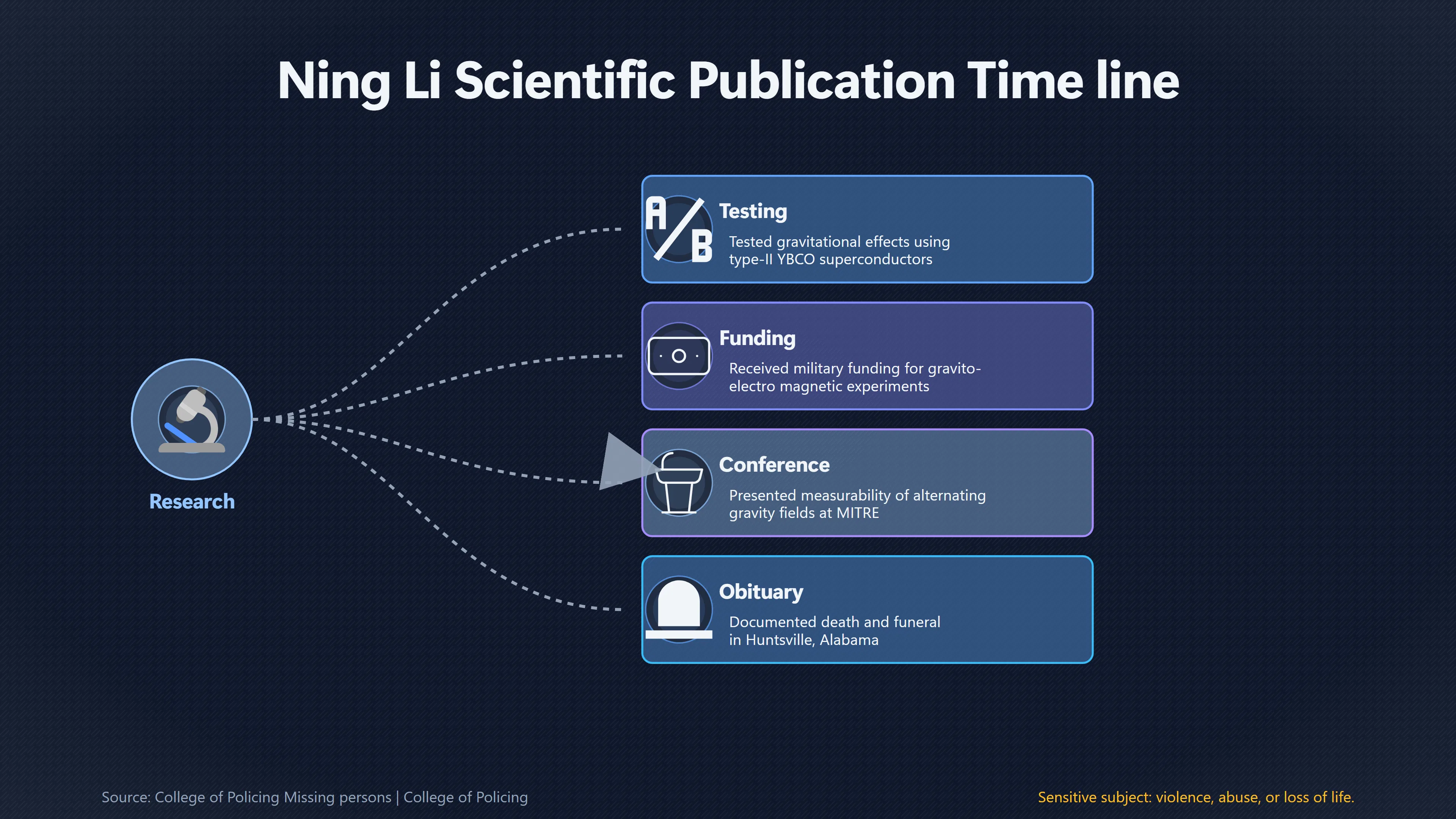
Li’s early record is unusually concrete. In 1991 she and Douglas Torr published Effects of a Gravitomagnetic Field on Pure Superconductors in Physical Review D, with both authors associated with the University of Alabama in Huntsville. A further Li–Torr paper appeared in Physical Review B in 1992. These are ordinary bibliographic facts preserved by the American Physical Society, PubMed and the US Department of Energy’s Office of Scientific and Technical Information.[nih.gov]pubmed.ncbi.nlm.nih.govPub Med Effects of a gravitomagnetic field on pure superconductorsEffects of a gravitomagnetic field on pure superconductors - PubMedJanuary 15, 1991…
Her later experimental record is also more restrained than the mythology surrounding it. In 1997, Li and collaborators published a test of a proposed gravitational effect involving type-II YBCO superconductors. NASA’s technical archive records that their gravimeter measurements found changes in acceleration smaller than two parts in 100 million of normal gravitational acceleration, placing new limits on the proposed static effect rather than announcing a spectacular antigravity breakthrough.[NASA Technical Reports Server]ntrs.nasa.govNASA Technical Reports ServerStatic Test for a Gravitational Force Coupled to Type 2 YBCO Superconductors - NASA Technical Reports Server…
After Li moved away from conventional university research and established AC Gravity, however, the trail became much harder for an outsider to follow. A US Army Aviation and Missile Command agreement associated with the company has repeatedly been documented as a $448,970 project entitled “Gravito-Electro Magnetic Superconductivity Experiment”, running from April 2001 to September 2002. Later Freedom of Information Act requests specifically sought documentation concerning that project because its results had not entered the normal public literature.[MuckRock]muckrock.comDepartment of Defense Grant for AC Gravity LLC (2001) (Department of Defense, Under Secretary Of Defense For Intelligence And Sec…
This produces three propositions of very different evidential strength:
- Strongly established: Li was a real physicist who published research concerning superconductors and gravity.[Physical Review Journals]journals.aps.orgOpen source on aps.org.
- Established but incomplete: her company received military research funding, after which little of the resulting work became publicly available.[MuckRock]muckrock.comDepartment of Defense Grant for AC Gravity LLC (2001) (Department of Defense, Under Secretary Of Defense For Intelligence And Sec…
- Not established by those facts: Li herself became an unlocatable missing person.[police.uk]police.ukUKReport a missing person | Police.ukUKReport a missing person | Police.uk
That final step requires a different category of evidence.
What turns silence into a missing-person case?
A useful way to test claims of a “missing scientist” is to ask what exactly is alleged to be missing: the person’s publications, their public accessibility, or the person themselves?
Official missing-person systems are built around the third question. British policing guidance defines somebody as missing when their whereabouts cannot be established, while Police.uk tells families they do not have to wait 24 hours to make such a report. In the United States, the National Missing and Unidentified Persons System, or NamUs, is an official Department of Justice programme through which law enforcement, investigators and families work to resolve missing-person cases.[police.uk]police.ukUKReport a missing person | Police.ukUKReport a missing person | Police.uk
There need not always be a publicly searchable database entry: reporting systems vary, some entries are voluntary, privacy matters, and not every case receives extensive media coverage. NamUs itself notes that entry requirements vary between jurisdictions.[National Institute of Justice]nij.ojp.govOpen source on ojp.gov. Therefore, absence from a database cannot prove that somebody was never missing.
But the evidential direction still matters. A defensible claim that a scientist genuinely disappeared would normally benefit from evidence such as a police missing-person report, a family appeal, an employer reporting that the person’s whereabouts were unknown, contemporary news coverage of a search, an official case file, or other direct testimony establishing that people who ordinarily knew where the person was could no longer locate them.
By contrast, searches for publications ending in a certain year, unanswered emails from journalists, disappearance from conference programmes, or a lack of public information about a defence-funded project demonstrate loss of public visibility. Without additional evidence, they cannot carry the stronger claim.
Ning Li shows why the distinction matters
Li’s story is particularly useful because the apparent disappearance can be watched forming inside the documentary gap.
The conventional publication trail does become thin in the early 2000s, but it does not end at a single mysterious point. A 2003 paper attributed to Ning Li and James C. Bradas, Measurability of AC Gravity Fields, survives in material from a MITRE-hosted conference. It discusses generating and measuring alternating gravitational fields. Whatever one thinks of the underlying theory, its existence means that the simple narrative “military funding in 2001, then she instantly vanished” is chronologically wrong.[Google Groups]groups.google.comOpen source on google.com.
The later silence was nevertheless real. The Huntsville Business Journal, investigating the disappearance story in 2023, found that Li ceased producing the sort of publications by which people following her academic career had previously tracked her. AC Gravity remained on the corporate record, while publicly visible scientific results became scarce. That combination created precisely the sort of information vacuum in which “I cannot find anything recent about this scientist” could mutate into “nobody can find this scientist”.[Huntsville Business Journal]huntsvillebusinessjournal.comOpen source on huntsvillebusinessjournal.com.
Yet Li’s eventual obituary gives a very different kind of record. Berryhill Funeral Home recorded that Dr Ning Li of Huntsville died on 27 July 2021, listed her son and grandchildren, and announced a visitation, funeral service and burial at Faith Memorial Park. This is not evidence about the success or failure of her research, but it is highly relevant to the disappearance claim: she had a documented family and local life in Huntsville at the end of it.[Berryhill Funeral Home]berryhillfh.comBerryhill Funeral Home Ning Li ObituaryBerryhill Funeral Home Ning Li Obituary
The 2023 Huntsville Business Journal investigation went further by interviewing Li’s son, George Men. Its reconstruction reported that Li’s later years included a serious 2014 road accident that left her badly impaired. The article therefore replaced a long-running internet mystery with a much more ordinary — and sadder — explanation for at least part of her later invisibility.[Huntsville Business Journal]huntsvillebusinessjournal.comOpen source on huntsvillebusinessjournal.com.
None of this determines what happened inside every non-public research programme with which Li may have been associated. It does, however, undermine the specific claim that the thinning scientific record itself demonstrates that Li physically disappeared.

Clues that point to professional withdrawal instead
Scientific careers leave several different trails, and they do not necessarily stop together. Journal articles are only one of them. A researcher may disappear from bibliographic databases while remaining visible through patents, conference proceedings, company registrations, professional directories, local records or family notices.
In a UFO or antigravity case, four patterns should therefore lower confidence in a literal-disappearance interpretation.
The public trail fades gradually rather than terminating at a documented incident. Li’s 2003 conference material is important precisely because it complicates an apparently sharp boundary between “public scientist” and “missing scientist”.[Google Groups]groups.google.comOpen source on google.com.
The researcher has moved from academia into private or government-sponsored work. Academic science rewards publication; proprietary research often does not. Military involvement does not prove classification, but neither should a lack of subsequent journal papers be surprising enough to count as evidence of physical disappearance.
Independent traces of ordinary life continue. An address, business filing, family account, obituary or local event does not tell readers what somebody was researching, but it can directly contradict the idea that the person’s whereabouts were wholly unknown. Li’s funeral record is particularly difficult to reconcile with sweeping versions of the claim that she simply vanished without trace.[Berryhill Funeral Home]berryhillfh.comBerryhill Funeral Home Ning Li ObituaryBerryhill Funeral Home Ning Li Obituary
The disappearance claim comes from people trying to contact the researcher rather than people responsible for their welfare. A journalist, UFO researcher or interested physicist receiving no reply is evidence that the person was inaccessible to that correspondent. It is not equivalent to a relative telling police that the person cannot be located.
These distinctions do not require assuming that every information gap is innocent. They simply keep the strength of the conclusion proportional to the strength of the evidence.
Why UFO and antigravity stories blur the categories
Antigravity research is unusually fertile ground for this confusion because publication silence already fits the expectations of the surrounding story. Once military funding, advanced propulsion and unconventional physics appear together, an absence of information can easily be interpreted as information about secrecy.
Li’s case contains an especially potent sequence: peer-reviewed gravity-related papers, experiments involving NASA-associated researchers, an Army-funded project and then a sharp reduction in publicly accessible work. Every component except the final inference is independently documentable.[aps.org]journals.aps.orgOpen source on aps.org.
The inference is nevertheless the decisive part. “The government funded her and then her publications stopped” can be verified without establishing “the government made her disappear”. The first statement describes a sequence in the documentary record. The second proposes a cause and a physical event for which additional evidence is required.
Older internet discussions illustrate how readily that distinction collapsed. Archived material concerning antigravity researchers explicitly labelled Li a “missing scientist” while simultaneously using the defence-funding record as an important part of the explanation for where she had supposedly gone. In other words, evidence that she had entered a less publicly visible research environment was being treated as evidence that she herself was missing.[projectavalon.net]projectavalon.netAnti Gravity Research And The Missing Dr. Ning LiAnti Gravity Research And The Missing Dr. Ning Li
There is also a self-reinforcing effect. Once an article calls somebody “missing”, later writers may search for evidence of why the person disappeared rather than first verifying whether a disappearance occurred. Defence grants, inaccessible records and unanswered correspondence then become supporting clues because the central premise has already been accepted. Repetition can make that premise appear independently corroborated even when many versions ultimately descend from the same thin public record.
A better evidence threshold for “disappeared”
For claims about scientists associated with UFOs, exotic propulsion or antigravity, the word “disappeared” is most useful when its meaning is made explicit.
A researcher who has stopped publishing has a publication gap. Someone who has stopped speaking publicly has withdrawn from public view. Someone whose subsequent career cannot readily be reconstructed has an uncertain public record. A person becomes a credible missing-person case when there is evidence that their actual whereabouts could not be established by people or institutions positioned to know.
The distinction also prevents two opposite errors. It avoids turning mundane professional withdrawal into a conspiracy, but it does not require dismissing genuine missing-person evidence merely because a scientist worked in a controversial field. If a family appeal, police investigation or documented search exists, that evidence should be evaluated on its own merits. Official systems themselves recognise that missing-person cases vary greatly in risk and circumstances.[College of Policing]college.police.ukCollege of Policing Missing persons | College of PolicingCollege of PolicingMissing persons | College of PolicingNovember 22, 2016…
Ning Li demonstrates why the threshold matters so much. The open record supports a genuine scientific mystery in the limited sense that outsiders still lack a complete account of her later research and of what resulted from the military-funded work. It does not follow that her physical fate is similarly mysterious. Her documented 2003 activity, later family account and 2021 Huntsville funeral record show how dramatically different those two questions can become.[google.com]groups.google.comOpen source on google.com.
The information vacuum is real; the disappearance may not be
The most defensible conclusion in cases of this kind is sometimes less dramatic but more informative: the missing object is the record, not necessarily the researcher.
That distinction leaves legitimate questions intact. Why did publication cease? What happened to an experimental programme? Were results negative, commercially sensitive, abandoned or unavailable for some other reason? Which claims were ever independently replicated? Those are worthwhile questions about science and documentation.
But they are different from asking whether somebody’s family, employer or the authorities were unable to find them. Treating the two questions as interchangeable turns an information vacuum into evidence for the very event the vacuum is supposed to prove.
For UFO and antigravity research, where secrecy itself is often part of the proposed explanation, maintaining that separation is especially important. A sparse publication history can establish silence. A missing-person case requires evidence that a person was actually missing. Ning Li’s history shows why confusing those standards can transform an incomplete bibliography into a disappearance story that persists long after ordinary records point elsewhere.[berryhillfh.com]berryhillfh.comBerryhill Funeral Home Ning Li ObituaryBerryhill Funeral Home Ning Li Obituary
Amazon book picks
Further Reading
Books and field guides related to When Does Scientific Silence Become a Disappearance?. Use these as the next step if you want deeper reading beyond the article.
The Skeptics' Guide to the Universe
An all-encompassing guide to skeptical thinking from podcast host and academic neurologist at Yale University School of Medicine Steven N...
The Demon-haunted World
Rating: 4.5/5 from 43 Google Books ratings
Are we on the brink of a new Dark Age of irrationality and superstition? In this book, the writer shows how scientific thinking is necess...
Calling Bullshit: The Art of Skepticism in a Data-Driven World
Bullshit isn’t what it used to be. Now, two science professors give us the tools to dismantle misinformation and think clearly in a world...

The Craft of Research
Rating: 4.3/5 from 6 Google Books ratings
Since 1995, students, researchers, and professionals have turned to The Craft of Research for clear and helpful guidance on how to conduc...
eBay marketplace picks
Marketplace Samples
Live-tested eBay searches with available results related to this page.
Selected fromUFO poster oneBay.co.uk.




Endnotes
1.
Source: college.police.uk
Title: College of Policing Missing persons | College of Policing
Link:https://www.college.police.uk/app/major-investigation-and-public-protection/missing-persons/missing-persons
Source snippet
College of PolicingMissing persons | College of PolicingNovember 22, 2016...
Published: November 22, 2016
2.
Source: college.police.uk
Title: College of Policing Missing persons | College of Policing
Link:https://www.college.police.uk/app/missing-persons
3.
Source: osti.gov
Link:https://www.osti.gov/biblio/5986002
Source snippet
Effects of a gravitomagnetic field on pure superconductors (Journal Article) | OSTI.GOV...
4.
Source: ntrs.nasa.gov
Link:https://ntrs.nasa.gov/search.jsp?R=19990039542
Source snippet
NASA Technical Reports ServerStatic Test for a Gravitational Force Coupled to Type 2 YBCO Superconductors - NASA Technical Reports Server...
5.
Source: muckrock.com
Link:https://www.muckrock.com/foi/united-states-of-america-10/department-of-defense-grant-for-ac-gravity-llc-2001-department-of-defense-under-secretary-of-defense-for-intelligence-and-security-135082/
Source snippet
Department of Defense Grant for AC Gravity LLC (2001) (Department of Defense, Under Secretary Of Defense For Intelligence And Sec...
6.
Source: police.uk
Title: UKReport a missing person | Police.uk
Link:https://www.police.uk/report-missing
7.
Source: groups.google.com
Link:https://groups.google.com/g/sci.space/c/RKfc3i7Xc1g
8.
Source: projectavalon.net
Title: Anti Gravity Research And The Missing Dr. Ning Li
Link:https://www.projectavalon.net/forum/showthread.php?t=1785
9.
Source: papers.cool
Title: Machines acquire scientific taste from institutional traces | Cool Papers
Link:https://papers.cool/arxiv/2603.16659
10.
Source: westmidlands.police.uk
Title: How do we investigate reports of missing people? | West Midlands Police
Link:https://www.westmidlands.police.uk/news/west-midlands/news/news/2025/may/how-do-we-investigate-reports-of-missing-people/
11.
Source: justice.gov
Link:https://www.justice.gov/ovw/national-institute-justice-framing-paper-improving-national-missing-and-unidentified-persons
12.
Source: archive.ph
Link:https://archive.ph/O3Pgg
13.
Source: muckrock.com
Link:https://www.muckrock.com/foi/united-states-of-america-10/department-of-defense-grant-for-ac-gravity-llc-2001-department-of-defense-defense-security-cooperation-agency-135084/
14.
Source: muckrock.com
Link:https://www.muckrock.com/foi/united-states-of-america-10/department-of-defense-grant-for-ac-gravity-llc-2001-department-of-defense-freedom-of-information-policy-office-135081/
15.
Source: muckrock.com
Link:https://www.muckrock.com/foi/united-states-of-america-10/department-of-defense-grant-for-ac-gravity-llc-2001-department-of-defense-office-of-the-secretary-of-defense-135083/
16.
Source: production.copweb.aws.college.police.uk
Title: college.police.uk Missing persons | College of Policing
Link:https://production.copweb.aws.college.police.uk/app/major-investigation-and-public-protection/missing-persons/missing-persons
17.
Source: college.police.uk
Title: Missing persons risk assessment | College of Policing
Link:https://www.college.police.uk/app/major-investigation-and-public-protection/missing-persons/missing-persons-risk-assessment
18.
Source: police.uk
Link:https://www.police.uk/advice/advice-and-information/missing-person/missing-persons/what-happens-after-you-report-a-missing-person/
19.
Source: police.uk
Link:https://www.police.uk/advice/advice-and-information/missing-person/missing-persons/what-to-do-when-someone-goes-missing/
20.
Source: police.uk
Link:https://www.police.uk/ro/report/mp/v3.1/report-a-missing-person2/
21.
Source: police.uk
Link:https://www.police.uk/pu/contact-us/a-missing-person/get-information-and-advice-about-missing-person/?cid=&lid=&rid=&stepid=1&tid=913507
22.
Source: sites.google.com
Title: ac gravity llc
Link:https://sites.google.com/view/the-asp-foundation/groups-of-interest/technology-creators-researchers/ac-gravity-llc
23.
Source: pubmed.ncbi.nlm.nih.gov
Title: Pub Med Effects of a gravitomagnetic field on pure superconductors
Link:https://pubmed.ncbi.nlm.nih.gov/10013404/
Source snippet
Effects of a gravitomagnetic field on pure superconductors - PubMedJanuary 15, 1991...
Published: January 15, 1991
24.
Source: journals.aps.org
Link:https://journals.aps.org/prd/abstract/10.1103/PhysRevD.43.457
25.
Source: journals.aps.org
Link:https://journals.aps.org/prb/abstract/10.1103/PhysRevB.46.5489
26.
Source: nij.ojp.gov
Link:https://nij.ojp.gov/namus
27.
Source: namus.nij.ojp.gov
Title: Nam Us Frequently Asked Questions | Nam Us
Link:https://namus.nij.ojp.gov/frequently-asked-questions
28.
Source: huntsvillebusinessjournal.com
Link:https://huntsvillebusinessjournal.com/news/2023/07/30/solving-the-mystery-of-huntsvilles-brilliant-scientist-disappearing/
29.
Source: berryhillfh.com
Title: Berryhill Funeral Home Ning Li Obituary
Link:https://www.berryhillfh.com/obituary/ning-li?lud=4CF765EE88E7526FCBA619C30101F7E6
30.
Source: berryhillfh.com
Title: Berryhill Funeral Home Ning Li Obituary
Link:https://www.berryhillfh.com/obituary/ning-li/print
31.
Source: journals.aps.org
Title: cvjn 7kvp
Link:https://journals.aps.org/prl/abstract/10.1103/cvjn-7kvp
32.
Source: pubmed.ncbi.nlm.nih.gov
Link:https://pubmed.ncbi.nlm.nih.gov/42117296/
33.
Source: GOV.UK
Title: www.gov.uk Identifying people at risk (accessible)
Link:https://www.gov.uk/government/publications/powers-and-operational-procedure-caseworker-guidance/identifying-people-at-risk-accessible
34.
Source: namus.nij.ojp.gov
Title: what namus
Link:https://namus.nij.ojp.gov/what-namus
35.
Source: inspirehep.net
Title: Superconductors and Gravity
Link:https://inspirehep.net/literature/2054233
36.
Source: pubmed.ncbi.nlm.nih.gov
Link:https://pubmed.ncbi.nlm.nih.gov/35235122/
37.
Source: berryhillfh.com
Title: Ning Li Obituary
Link:https://www.berryhillfh.com/guestbook/ning-li
38.
Source: ojp.gov
Title: Solving Missing Persons Cases | Office of Justice Programs
Link:https://www.ojp.gov/library/publications/solving-missing-persons-cases
39.
Source: journals.aps.org
Link:https://journals.aps.org/prd/issues/43/2
40.
Source: deepdyve.com
Link:https://www.deepdyve.com/lp/american-physical-society-aps/effects-of-a-gravitomagnetic-field-on-pure-superconductors-6alMKHnwD6
41.
Source: namus.nij.ojp.gov
Link:https://namus.nij.ojp.gov/?os=os
42.
Source: ojp.gov
Link:https://www.ojp.gov/ncjrs/virtual-library/abstracts/solving-missing-persons-cases
43.
Source: ouci.dntb.gov.ua
Link:https://ouci.dntb.gov.ua/en/works/4OrJ6Gq7/
44.
Source: ouci.dntb.gov.ua
Link:https://ouci.dntb.gov.ua/en/works/7PoVBnY9/
45.
Source: uapmurders.com
Link:https://uapmurders.com/uaps/Details/Ning_Li/
46.
Source: nationalcrimeagency.gov.uk
Title: Report someone missing
Link:https://www.nationalcrimeagency.gov.uk/find-support/report-someone-missing?highlight=WyJtaXNzaW5nIiwicGVyc29uIiwiYW5kIl0%3D
Additional References
47.
Source: sciencedirect.com
Link:https://www.sciencedirect.com/science/article/pii/S0921453497014627
Source snippet
Static test for a gravitational force coupled to type II YBCO superconductors - ScienceDirect...
48.
Source: youtube.com
Title: The Truth About Antigravity: Myths, Legends, and Real Science
Link:https://www.youtube.com/watch?v=-P6san8AGO0
Source snippet
This video details the case of physicist Ning Li, explaining how her transition to classified defense work and subsequent personal illnes...
49.
Source: youtube.com
Title: Father of 11th Dead or Missing Scientist Rejects Suspicions About Her Death
Link:https://www.youtube.com/watch?v=1d–WxTUkXE
Source snippet
The Truth About Antigravity: Myths, Legends, and Real Science...
50.
Source: nature.com
Link:https://www.nature.com/articles/s41598-025-27837-6
51.
Source: youtube.com
Title: Superconductors & Gravity Control | Gary Stephenson
Link:https://www.youtube.com/watch?v=msrhrssRmCE
Source snippet
Father of 11th Dead or Missing Scientist Rejects Suspicions About Her Death...
52.
Source: bia.gov
Link:https://www.bia.gov/service/mmu/national-missing-and-unidentified-persons-system-namus
53.
Source: loc.gov
Link:https://www.loc.gov/item/lcwaN0015448
55.
Source: scispace.com
Link:https://scispace.com/papers/responsiveness-informed-multiple-imputation-and-inverse-2wdddxanq5
56.
Source: researchgate.net
Link:https://www.researchgate.net/publication/354521867_A_simple_investigation_of_Static_test_for_a_gravitational_force_coupled_to_type_II_YBCO_superconductors_by_Li_and_coworkers