Within Pattern Illusion
When a Researcher Death List Creates Its Own Pattern
A striking list can emerge when researchers and time periods are defined only after the tragedies attracting attention are already known.
On this page
- How post hoc selection changes the apparent pattern
- Why flexible boundaries increase false positives
- What a predefined comparison group would look like
Page outline Jump by section
Introduction
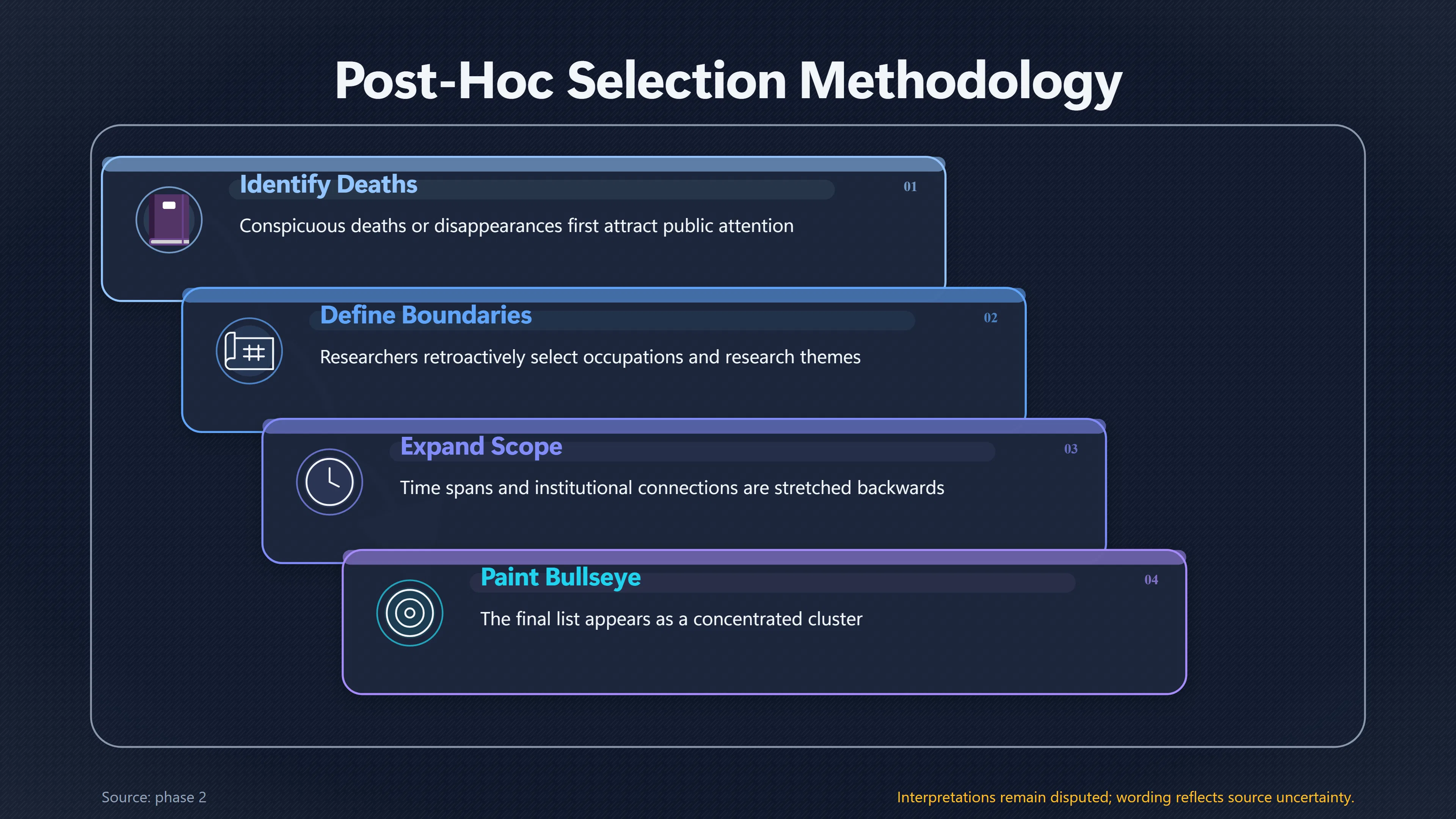
A researcher-death list can look statistically meaningful even when the list itself is what created the pattern. The crucial problem is post-hoc selection: the people, occupations, research themes and time span are defined after conspicuous deaths or disappearances have already attracted attention. That is the statistical equivalent of drawing a target around bullet holes after the shots have landed.
This matters especially in claims involving UFOs, antigravity, advanced propulsion and classified science because the category of a “related researcher” can expand dramatically. A list may begin with a physicist studying gravity, then absorb aerospace engineers, defence contractors, nuclear researchers, intelligence-connected personnel and even non-scientific staff at relevant institutions. A recent US example grew backwards from events in 2026 to include cases dating to 2022, while one supposedly scientific member was actually an administrative assistant.[AP News]apnews.comscientists gained traction, escalating from niche online forums to being addressed by the White House and U.S. Congress. Theories propose…
The resulting list may contain genuine tragedies. What it does not automatically contain is evidence that those tragedies form a genuine cluster.
How post-hoc selection changes the apparent pattern
A proper cluster question needs both a numerator and a denominator. Counting ten deaths is a numerator. To decide whether ten is unusual, however, one needs to know how many comparable people were at risk, over what period, and how many comparable deaths would ordinarily be expected. Without that denominator, “ten researchers died” cannot by itself establish an elevated rate.
Public-health cluster investigations illustrate the principle particularly clearly. The US Centers for Disease Control and Prevention (CDC) defines a cancer cluster by reference not merely to several cases, but to a greater-than-expected number among a defined population, in a defined area and over a defined period. Its guidance explicitly warns that changing the geographic area can create or obscure a cluster and that changing the time period alters both observed and expected case counts.[CDC]cdc.govCancer Characteristics, Definitions, and Recent Investigations | Unusual Cancer Patterns | CDCApril 12, 2024…
A hand-built list of unusual researchers has analogous choices, except that its boundaries are occupational and conceptual rather than geographical. Before assessing a supposed cluster, one would have to decide questions such as:
- Does “antigravity researcher” mean someone directly conducting gravity-modification experiments, or anybody working on theoretical gravity?
- Does UFO relevance require actual UAP research, or can aerospace, astronomy, nuclear science or a security clearance qualify?
- Are university researchers counted alongside military officers, engineers, contractors and laboratory administrators?
- Does the outcome mean homicide, unexplained disappearance or suspicious death, or does it also include suicide, accident, overdose and natural death?
- Is the relevant period two years, five years, a decade or the researcher’s entire career?
If those decisions are made after the cases are known, each decision becomes another opportunity to make the collection look more concentrated.
The 2026 American scientist narrative provides an unusually clear real-world example. Associated Press reported that speculation initially centred on recent cases but eventually incorporated deaths and disappearances reaching back to June 2022. The people grouped together did have some overlaps — including connections with national laboratories, aerospace institutions or sensitive work — but the individual cases were heterogeneous. Physicist Nuno Loureiro’s killing was tied by investigators to a known gunman who had also carried out a mass shooting; astrophysicist Carl Grillmair’s death resulted in a murder and carjacking charge against a suspect; and Melissa Casias, often presented online as another Los Alamos scientist, was an administrative assistant there. No definitive evidence had established coordinated foul play linking the set.[AP News]apnews.comscientists gained traction, escalating from niche online forums to being addressed by the White House and U.S. Congress. Theories propose…
The point is not that any individual case must therefore be uninteresting. It is that the definition of the collection was sufficiently flexible to survive cases with very different occupations and circumstances.
Why flexible boundaries increase false positives
The statistical problem is closely related to the “look-elsewhere effect”. When researchers search many possible places for an anomaly, the probability of finding at least one impressive-looking anomaly by chance becomes greater than the probability attached to any single, pre-specified test. The problem is familiar in particle physics, where searching across many possible signal locations requires accounting for the number of opportunities to find an apparently significant peak.[arXiv]arxiv.orgOn methods for correcting for the look-elsewhere effect in searches for new physicsFebruary 11, 2016…
A researcher-death list can perform the same search informally. Instead of testing different positions on an energy spectrum, its compiler can search different combinations of:
People. Include only physicists, then engineers, then defence scientists, then anyone attached to a national laboratory.
Research themes. Try antigravity, UFOs, advanced propulsion, nuclear research, directed energy, electronic warfare or broadly “classified technology”.
Institutions. Move from one company or laboratory to subsidiaries, contractors, universities, partner organisations and former employees.
Outcomes. Begin with murder, then count disappearance, suicide, accident, unexplained death or any death described as premature.
Dates. Start with a striking two-year run; extend backwards to capture an earlier suggestive case; extend forwards when another relevant person dies.
No single adjustment need look unreasonable. The statistical danger comes from their combination. If enough plausible definitions are available and only the definition producing the most striking list is displayed, the reader never sees all the alternative lists that were implicitly tried.
This is why methodological discussions of cluster detection emphasise the sensitivity of results to case definitions and analytic boundaries. Reviews of spatial epidemiology note that inaccurate or non-standardised case definitions can generate false-positive clusters and that seemingly arbitrary choices such as the size and shape of the search window can materially change results.[PubMed Central (PMC)]pmc.ncbi.nlm.nih.govPubMed Central (PMC)Spatial parasite ecology and epidemiology: a review of methods and applications - PMCJuly 19, 2012… CDC guidance similarly recommends pre-defining the area being evaluated and examining comparison populations rather than treating the noticed concentration as self-validating.[CDC]cdc.govphase 2Phased Approach to Respond to Community Inquiries: Phase 2 | Unusual Cancer Patterns | CDCApril 12, 2024…
The underlying idea is sometimes called the Texas sharpshooter fallacy: fire at a wall first, then paint the bullseye around the tightest group of holes. A cluster discovered after looking at the data can legitimately generate a hypothesis, but it cannot be evaluated as though that precise target had been specified beforehand.[Fallacy Files]fallacyfiles.orgFallacy Files The Texas Sharpshooter FallacyFallacy FilesThe Texas Sharpshooter FallacyOctober 7, 2022…
The Marconi list shows why the denominator matters
The long-running story of the deaths of British defence scientists and engineers associated with GEC-Marconi and related organisations demonstrates the same difficulty historically.
The boundaries of the alleged cluster have never been especially stable. Tony Collins and Steven Arkell’s 1990 book Open Verdict presented an account of 25 deaths in the British defence industry, with the connection described broadly in terms of electronic warfare rather than membership of one tightly defined research team. Bibliographic records describe the subjects as mostly computer programmers and defence-industry personnel working across different projects.[Open Library]openlibrary.orgOpen source on openlibrary.org.
Later retellings vary in both number and time span. Some concentrate on the conspicuous sequence in roughly 1986–88; others use a longer period extending from the early 1980s into the 1990s. They also differ over how direct a Marconi connection is required and which accidents, suicides and other deaths belong in the series. Even a sympathetic modern discussion of the mystery notes that reported totals range from a small core to more than twenty and that not all those included had the same direct relationship to Marconi.[Reddit]reddit.comthe gecmarconi deaths several researchers fromthe gecmarconi deaths several researchers from
That variation is not a trivial bookkeeping issue. It determines what claim is being tested.
Suppose, for example, that six deaths among employees of a specific division during a pre-specified 18-month interval were alleged to be excessive. One could obtain workforce numbers, establish age and occupational structure, define the qualifying causes of death and compare the observed total with an expected rate. But if the group instead means “people in British defence research whose work can be connected to electronic warfare”, the denominator becomes much larger and harder to define. Expanding the observation period changes it again.
The striking number at the top of a list therefore cannot substitute for the missing question: out of how many comparable people? Twenty-five cases among 500 eligible people would imply something very different from twenty-five cases among tens of thousands of employees, contractors, academics and associated defence specialists observed over most of a decade.
Without a defensible population at risk, the list can document twenty-five individual tragedies but cannot by itself establish an anomalous death rate.
A list can also hide the non-cases
Post-hoc lists attract attention to the people who fit while making the much larger population who do not fit nearly invisible.
Imagine that an aerospace sector contains thousands of scientists and engineers working over several decades. Some will die young, some will die by suicide, some will be killed, some will disappear and some deaths will initially have uncertain circumstances. If a compiler searches retrospectively through that population for unusual cases, the resulting page can consist entirely of striking biographies. The thousands of people who retired normally or died from unremarkable causes do not appear on it.
That produces a powerful visual asymmetry: every row seems to confirm the hypothesis because inclusion in the table already required possessing the characteristics that make the hypothesis interesting.
Statistical cluster analysis is designed partly to escape this problem by modelling the underlying population at risk. Epidemiological reviews stress that knowing that underlying population — or having suitable controls — is essential because raw concentrations of cases can simply reflect where more people at risk were located.[PubMed Central (PMC)]pmc.ncbi.nlm.nih.govPubMed Central (PMC)Spatial parasite ecology and epidemiology: a review of methods and applications - PMCJuly 19, 2012… Modern work on cluster detection likewise shows that selection bias can materially inflate false-positive identification of artificial clusters.[PubMed Central (PMC)]pmc.ncbi.nlm.nih.govOpen source on nih.gov.
For UFO- or antigravity-related claims, the equivalent control population is rarely visible. Readers are shown the deceased gravity researcher, not every living gravity researcher; the murdered aerospace scientist, not the thousands of aerospace scientists who were not murdered; the missing laboratory employee, not the full workforce from which that person came.
That absence makes an ordinary statistical question feel like a succession of extraordinary coincidences.
What a predefined comparison group would look like
A stronger test would reverse the order in which the evidence is assembled. Instead of beginning with suspicious deaths and asking who can be linked to unusual research, it would begin with a population of researchers and then measure what happened to them.
For example, investigators could define in advance:
- The exposed group: everyone employed in specified roles on named gravity-control, unconventional-propulsion or UAP-related programmes during a fixed period.
- The comparison group: researchers of similar age, sex, occupation, employer type and security environment working on conventional aerospace or physics projects during the same years.
- The outcomes: predefined categories such as all-cause mortality, suicide, homicide, accidental death and unresolved disappearance.
- The observation window: fixed beginning and end dates that are not moved to capture interesting cases.
- The inclusion rules: objective criteria applied identically whether an individual’s fate supports or weakens the suspected pattern.
The question could then become quantitative: did the unusual-research cohort experience more homicides, suicides, disappearances or premature deaths than the comparison cohort?
This does not require assuming that deaths are random or that conspiracies cannot occur. On the contrary, a real targeted campaign should leave evidence that survives stricter definitions. A genuine excess ought not to depend entirely on moving the starting year, adding loosely related occupations or excluding the many researchers who experienced no comparable event.
CDC cluster methodology makes the same distinction between simply noticing an unusual pattern and establishing that cases exceed what is expected in an appropriately defined population. Modern spatial methods likewise distinguish exploratory searches for possible clusters from focused tests of a previously specified source or hypothesis.[CDC]cdc.govCancer Characteristics, Definitions, and Recent Investigations | Unusual Cancer Patterns | CDCApril 12, 2024…
The cluster illusion does not make individual mysteries disappear
Recognising post-hoc selection is not an argument that every death on a researcher list has been satisfactorily explained. An individual homicide can remain unsolved; an inquest can return an open verdict; a disappearance can remain genuinely puzzling. Nor does statistical caution demonstrate that covert targeting has never occurred.
It changes the level at which the evidence should be judged.
An unexplained death is evidence that one death is unexplained. Several unexplained deaths become evidence for a common cause only when there is an independently defensible reason to group the people together and evidence that their outcomes occur more often than expected. Similarity discovered after searching hundreds or thousands of possible people, projects, dates and circumstances carries less evidential weight than similarity predicted before the cases occurred.
That distinction is particularly important for UFO and antigravity narratives because “related research” has unusually permeable boundaries. The 2026 US narrative illustrates how quickly a category can stretch from specialised scientists to people merely associated with relevant institutions, while the older Marconi story shows how different choices of company connection, occupation and time span can produce different versions of an apparently singular cluster.[AP News]apnews.comscientists gained traction, escalating from niche online forums to being addressed by the White House and U.S. Congress. Theories propose…
The useful test is therefore not whether a compiled list looks uncanny. A sufficiently flexible retrospective search can make many lists look uncanny. The stronger question is whether the same pattern remains after the target has been drawn in advance: a fixed population, fixed inclusion rules, fixed dates, a complete denominator and an appropriate comparison group. Only then can a striking researcher-death list begin to distinguish an unusual rate from an unusually persuasive selection of cases.
Amazon book picks
Further Reading
Books and field guides related to When a Researcher Death List Creates Its Own Pattern. Use these as the next step if you want deeper reading beyond the article.
Calling Bullshit: The Art of Skepticism in a Data-Driven World
Bullshit isn’t what it used to be. Now, two science professors give us the tools to dismantle misinformation and think clearly in a world...
How to Lie with Statistics
'A great introduction to a crucial topic' Bill Gates 'Perhaps the most popular book on statistics ever published ... It's a marvel ... ga...
The Art of Statistics: Learning from Data
'A statistical national treasure' Jeremy Vine, BBC Radio 2 'Required reading for all politicians, journalists, medics and anyone who trie...
eBay marketplace picks
Marketplace Samples
Live-tested eBay searches with available results related to this page.
Selected fromUFO poster oneBay.co.uk.
Current eBay listing
VINTAGE UFO FLYING SAUCERS COMIC ADVERTISING A2 POSTER PRINT



Current eBay listing
FS02 VINTAGE UFO FLYING SAUCERS COMIC ADVERTISING A4 POSTER PRINT
Endnotes
1.
Source: cdc.gov
Link:https://www.cdc.gov/cancer-environment/php/guidelines/characteristics.html
Source snippet
Cancer Characteristics, Definitions, and Recent Investigations | Unusual Cancer Patterns | CDCApril 12, 2024...
Published: April 12, 2024
2.
Source: cdc.gov
Link:https://www.cdc.gov/mmwr/preview/mmwrhtml/rr6208a1.htm
Source snippet
Investigating Suspected Cancer Clusters and Responding to Community Concerns: Guidelines from CDC and the Council of State and Territo...
3.
Source: arxiv.org
Link:https://arxiv.org/abs/1602.03765
Source snippet
On methods for correcting for the look-elsewhere effect in searches for new physicsFebruary 11, 2016...
Published: February 11, 2016
4.
Source: arxiv.org
Link:https://arxiv.org/abs/2007.13821
5.
Source: cdc.gov
Title: phase 2
Link:https://www.cdc.gov/cancer-environment/php/guidelines/phase-2.html
Source snippet
Phased Approach to Respond to Community Inquiries: Phase 2 | Unusual Cancer Patterns | CDCApril 12, 2024...
Published: April 12, 2024
6.
Source: reddit.com
Title: the gecmarconi deaths several researchers from
Link:https://www.reddit.com/r/UnresolvedMysteries/comments/ulrpc7/the_gecmarconi_deaths_several_researchers_from/
7.
Source: cdc.gov
Title: Appendix B: Mapping and Spatiotemporal Methods | Unusual Cancer Patterns | CDC
Link:https://www.cdc.gov/cancer-environment/php/guidelines/mapping-spatiotemporal-methods.html
8.
Source: atsdr.cdc.gov
Title: cancer cluster spatial cluster training
Link:https://www.atsdr.cdc.gov/place-health/php/training/cancer-cluster-spatial-cluster-training.html
9.
Source: dshs.texas.gov
Title: cancer reporting guides
Link:https://www.dshs.texas.gov/texas-cancer-registry/cancer-reporting/cancer-reporting-guides
10.
Source: cdc.gov
Title: outbreak case definitions
Link:https://www.cdc.gov/urdo/php/surveillance/outbreak-case-definitions.html
11.
Source: cdc.gov
Link:https://www.cdc.gov/cancer-environment/about/index.html
12.
Source: cdc.gov
Link:https://www.cdc.gov/cancer-environment/php/guidelines/index.html
13.
Source: cdc.gov
Title: proactive evaluation
Link:https://www.cdc.gov/cancer-environment/php/guidelines/proactive-evaluation.html
14.
Source: cdc.gov
Link:https://www.cdc.gov/cancer-environment/php/guidelines/methods.html
15.
Source: cdc.gov
Link:https://www.cdc.gov/cancer-environment/php/guidelines/summary.html
16.
Source: cdc.gov
Title: statistical considerations
Link:https://www.cdc.gov/cancer-environment/php/guidelines/statistical-considerations.html
17.
Source: cdc.gov
Title: phase 1
Link:https://www.cdc.gov/cancer-environment/php/guidelines/phase-1.html
18.
Source: stacks.cdc.gov
Link:https://stacks.cdc.gov/view/cdc/117884
19.
Source: cdc.gov
Link:https://www.cdc.gov/mmwr/preview/mmwrhtml/rr6208a1.htm/00001797.htm
20.
Source: cdc.gov
Title: APPENDI X C: Statistical and Epidemiologic Approaches
Link:https://www.cdc.gov/mmwr/preview/mmwrhtml/rr6208a4.htm
21.
Source: stacks.cdc.gov
Link:https://stacks.cdc.gov/view/cdc/117881
22.
Source: archive.cdc.gov
Title: Fact Sheet
Link:https://archive.cdc.gov/www_cdc_gov/nceh/clusters/FactSheet.htm
23.
Source: journals.senate.texas.gov
Link:https://journals.senate.texas.gov/sjrnl/77r/html/5-17.htm
24.
Source: cdc.gov
Title: Guidelines for Investigating Clusters of Health Events
Link:https://www.cdc.gov/Mmwr/preview/mmwrhtml/00001797.htm
25.
Source: archive.cdc.gov
Link:https://archive.cdc.gov/www_atsdr_cdc_gov/tox-tool/cancer/cn_2c.html
26.
Source: stacks.cdc.gov
Link:https://stacks.cdc.gov/view/cdc/25847
27.
Source: archive.cdc.gov
Title: cancer cluster
Link:https://archive.cdc.gov/www_atsdr_cdc_gov/tox-tool/cancer/cancer_cluster.html
28.
Source: reddit.com
Title: the mysterious death of the marconi scientists
Link:https://www.reddit.com/r/UnresolvedMysteries/comments/47ksai/the_mysterious_death_of_the_marconi_scientists/
29.
Source: reddit.com
Link:https://www.reddit.com/r/UFOs/comments/1g5x30a/spate_of_unusual_deaths_of_scientists_circa/
30.
Source: dshs.texas.gov
Title: environmental epidemiology
Link:https://www.dshs.texas.gov/environmental-surveillance-toxicology/environmental-epidemiology
31.
Source: statutes.capitol.texas.gov
Link:https://statutes.capitol.texas.gov/?artSec=&chapter=HS.81&code=HS&tab=1
32.
Source: youtube.com
Title: Texas sharpshooter fallacy
Link:https://www.youtube.com/watch?v=PniicEqWhYQ
Source snippet
Clustering Illusion...
33.
Source: apnews.com
Link:https://apnews.com/article/c046ce6d0a004e6a3e1971ff769244b5
Source snippet
scientists gained traction, escalating from niche online forums to being addressed by the White House and U.S. Congress. Theories propose...
34.
Source: pmc.ncbi.nlm.nih.gov
Link:https://pmc.ncbi.nlm.nih.gov/articles/PMC3526959/
Source snippet
PubMed Central (PMC)Spatial parasite ecology and epidemiology: a review of methods and applications - PMCJuly 19, 2012...
Published: July 19, 2012
35.
Source: fallacyfiles.org
Title: Fallacy Files The Texas Sharpshooter Fallacy
Link:https://www.fallacyfiles.org/texsharp.html
Source snippet
Fallacy FilesThe Texas Sharpshooter FallacyOctober 7, 2022...
Published: October 7, 2022
36.
Source: pmc.ncbi.nlm.nih.gov
Link:https://pmc.ncbi.nlm.nih.gov/articles/PMC12574381/
37.
Source: openlibrary.org
Link:https://openlibrary.org/works/OL12837278W/Open_verdict
38.
Source: openlibrary.org
Link:https://openlibrary.org/books/OL19643427M/Open_verdict
39.
Source: pmc.ncbi.nlm.nih.gov
Link:https://pmc.ncbi.nlm.nih.gov/articles/PMC11180222/
40.
Source: pubmed.ncbi.nlm.nih.gov
Link:https://pubmed.ncbi.nlm.nih.gov/42018135/
41.
Source: artificialnoodles.com
Title: The Cluster | Blog | Artificial Noodles
Link:https://www.artificialnoodles.com/blog/the-cluster/
42.
Source: everydayconcepts.io
Title: Texas Sharpshooter Fallacy | Everyday Concepts
Link:https://everydayconcepts.io/texas-sharpshooter-fallacy
43.
Source: pmc.ncbi.nlm.nih.gov
Link:https://pmc.ncbi.nlm.nih.gov/articles/PMC12122011/
44.
Source: pmc.ncbi.nlm.nih.gov
Link:https://pmc.ncbi.nlm.nih.gov/articles/PMC6814431/
45.
Source: pmc.ncbi.nlm.nih.gov
Link:https://pmc.ncbi.nlm.nih.gov/articles/PMC5816564/
46.
Source: pmc.ncbi.nlm.nih.gov
Link:https://pmc.ncbi.nlm.nih.gov/articles/PMC4214144/
47.
Source: pmc.ncbi.nlm.nih.gov
Link:https://pmc.ncbi.nlm.nih.gov/articles/PMC3945549/
48.
Source: pmc.ncbi.nlm.nih.gov
Link:https://pmc.ncbi.nlm.nih.gov/articles/PMC3878948/
49.
Source: pubmed.ncbi.nlm.nih.gov
Link:https://pubmed.ncbi.nlm.nih.gov/24067663/
50.
Source: pmc.ncbi.nlm.nih.gov
Link:https://pmc.ncbi.nlm.nih.gov/articles/PMC3408895/
51.
Source: pubmed.ncbi.nlm.nih.gov
Link:https://pubmed.ncbi.nlm.nih.gov/22006061/
52.
Source: pmc.ncbi.nlm.nih.gov
Link:https://pmc.ncbi.nlm.nih.gov/articles/PMC2871332/
53.
Source: pmc.ncbi.nlm.nih.gov
Link:https://pmc.ncbi.nlm.nih.gov/articles/PMC2998766/
54.
Source: pubmed.ncbi.nlm.nih.gov
Link:https://pubmed.ncbi.nlm.nih.gov/21218153/
55.
Source: pmc.ncbi.nlm.nih.gov
Link:https://pmc.ncbi.nlm.nih.gov/articles/PMC2838429/
56.
Source: pmc.ncbi.nlm.nih.gov
Link:https://pmc.ncbi.nlm.nih.gov/articles/PMC2694210/
57.
Source: pmc.ncbi.nlm.nih.gov
Link:https://pmc.ncbi.nlm.nih.gov/articles/PMC2516558/
58.
Source: pmc.ncbi.nlm.nih.gov
Link:https://pmc.ncbi.nlm.nih.gov/articles/PMC1939838/
59.
Source: pmc.ncbi.nlm.nih.gov
Link:https://pmc.ncbi.nlm.nih.gov/articles/PMC1247193/
60.
Source: pmc.ncbi.nlm.nih.gov
Link:https://pmc.ncbi.nlm.nih.gov/articles/PMC2359075/?page=0
61.
Source: pubmed.ncbi.nlm.nih.gov
Link:https://pubmed.ncbi.nlm.nih.gov/8870578/
62.
Source: openlibrary.org
Title: Open Verdict by Collins, Tony Editor of Computer weekly | Open Library
Link:https://openlibrary.org/books/OL9682962M/Open_Verdict
63.
Source: api.parliament.uk
Link:https://api.parliament.uk/historic-hansard/written-answers/1989/jul/05/marconi
64.
Source: api.parliament.uk
Link:https://api.parliament.uk/historic-hansard/written-answers/1987/oct/28/marconi
65.
Source: api.parliament.uk
Link:https://api.parliament.uk/historic-hansard/commons/1987/oct/27/defence
66.
Source: anecdotal.app
Link:https://anecdotal.app/fallacy/texas-sharpshooter/
67.
Source: pubmed.ncbi.nlm.nih.gov
Link:https://pubmed.ncbi.nlm.nih.gov/6691637/
68.
Source: pubmed.ncbi.nlm.nih.gov
Link:https://pubmed.ncbi.nlm.nih.gov/18932143/
69.
Source: pubmed.ncbi.nlm.nih.gov
Link:https://pubmed.ncbi.nlm.nih.gov/23733283/
70.
Source: pubmed.ncbi.nlm.nih.gov
Link:https://pubmed.ncbi.nlm.nih.gov/4085443/
71.
Source: pubmed.ncbi.nlm.nih.gov
Link:https://pubmed.ncbi.nlm.nih.gov/15371285/
72.
Source: pubmed.ncbi.nlm.nih.gov
Link:https://pubmed.ncbi.nlm.nih.gov/11067773/
73.
Source: pubmed.ncbi.nlm.nih.gov
Link:https://pubmed.ncbi.nlm.nih.gov/3687925/
74.
Source: books.google.com
Title: Open Verdict
Link:https://books.google.com/books/about/Open_Verdict.html?id=cmmAAAAACAAJ
75.
Source: fallacyfiles.org
Link:https://www.fallacyfiles.org/multcomp.html
76.
Source: trove.nla.gov.au
Link:https://trove.nla.gov.au/newspaper/article/110617336
77.
Source: researchportal.ukhsa.gov.uk
Title: ukhsa.gov.uk The case-cohort design in outbreak investigations
Link:https://researchportal.ukhsa.gov.uk/en/publications/the-case-cohort-design-in-outbreak-investigations/
78.
Source: projectcamelot.org
Link:https://projectcamelot.org/marconi.html
79.
Source: apnews.com
Title: scientists missing dead conspiracy theories c046ce6d0a004e6a3e1971ff769244b5
Link:https://apnews.com/article/scientists-missing-dead-conspiracy-theories-c046ce6d0a004e6a3e1971ff769244b5
80.
Source: emuseum.aberdeencity.gov.uk
Link:https://emuseum.aberdeencity.gov.uk/objects/21724/boxed-beam-tetrode
81.
Source: emuseum.aberdeencity.gov.uk
Link:https://emuseum.aberdeencity.gov.uk/objects/21726/boxed-beam-tetrode
82.
Source: emuseum.aberdeencity.gov.uk
Link:https://emuseum.aberdeencity.gov.uk/objects/78989/miniature-voltage-indicator-boxed
83.
Source: emuseum.aberdeencity.gov.uk
Link:https://emuseum.aberdeencity.gov.uk/objects/24915/heptode-boxed
84.
Source: emuseum.aberdeencity.gov.uk
Link:https://emuseum.aberdeencity.gov.uk/objects/79032/half-wave-rectifier
85.
Source: emuseum.aberdeencity.gov.uk
Link:https://emuseum.aberdeencity.gov.uk/objects/78991/miniature-voltage-indicator-boxed
86.
Source: emuseum.aberdeencity.gov.uk
Link:https://emuseum.aberdeencity.gov.uk/objects/21609/13-boxed-receiving-valves
87.
Source: emuseum.aberdeencity.gov.uk
Link:https://emuseum.aberdeencity.gov.uk/objects/21648/28-mixed-boxed-miniatures
88.
Source: emuseum.aberdeencity.gov.uk
Link:https://emuseum.aberdeencity.gov.uk/objects/21738/octaltriodeheptode
89.
Source: emuseum.aberdeencity.gov.uk
Title: aberdeencity.gov.uk A ready reference
Link:https://emuseum.aberdeencity.gov.uk/objects/24945/a-ready-reference-summary-of-marconi-valves
90.
Source: emuseum.aberdeencity.gov.uk
Link:https://emuseum.aberdeencity.gov.uk/objects/21659/current-regulator
91.
Source: libraries.middlesbrough.gov.uk
Link:https://libraries.middlesbrough.gov.uk/GroupedWork/97443350-f95d-eae1-1de0-c86a171fbba4-eng/Home
Additional References
92.
Source: cambridge.org
Link:https://www.cambridge.org/core/journals/parasitology/article/spatial-parasite-ecology-and-epidemiology-a-review-of-methods-and-applications/CEBF9CEF2781FCB25E15E6EAA5E86128
Source snippet
Cambridge University PressSpatial parasite ecology and epidemiology: a review of methods and applications | Parasitology | Cambridge Core...
93.
Source: youtube.com
Title: Clustering Illusion: See the Bigger Picture
Link:https://www.youtube.com/watch?v=cyNBRwmYy-g
Source snippet
Texas Sharpshooter Fallacy: When Randomness Masquerades as Skill...
94.
Source: researchgate.net
Link:https://www.researchgate.net/publication/286363969_False-positive_psychology_Undisclosed_flexibility_in_data_collection_and_analysis_allows_presenting_anything_as_significant
95.
Source: researchgate.net
Link:https://www.researchgate.net/publication/353351150_Guidance_for_investigating_non-infectious_disease_clusters_from_potential_environmental_causes
96.
Source: independent.co.uk
Link:https://www.independent.co.uk/news/business/news/angry-marconi-investors-call-for-scalps-as-shares-nosedive-9178361.html
97.
Source: whokilledthescientists.com
Link:https://whokilledthescientists.com/antigravity.html
98.
Source: facebook.com
Link:https://www.facebook.com/groups/deathinicevalley/posts/986920751677807/
99.
Source: doi.org
Link:https://doi.org/10.1186/1471
100.
Source: sciencedirect.com
Link:https://www.sciencedirect.com/science/article/pii/S0002916523136963
101.
Source: researchgate.net
Link:https://www.researchgate.net/publication/381890694_False-positive_psychology_Undisclosed_flexibility_in_data_collection_and_analysis_allows_presenting_anything_as_significant