Within UFO Research Deaths
Why Eugene Mallove's Murder Points Away From Suppression
Mallove was murdered, but the investigated motive pointed to a property dispute rather than retaliation for unconventional energy advocacy.
On this page
- Mallove's role in unconventional energy advocacy
- What investigators established about the homicide
- Why the case entered suppressed scientist lore
Page outline Jump by section
Introduction
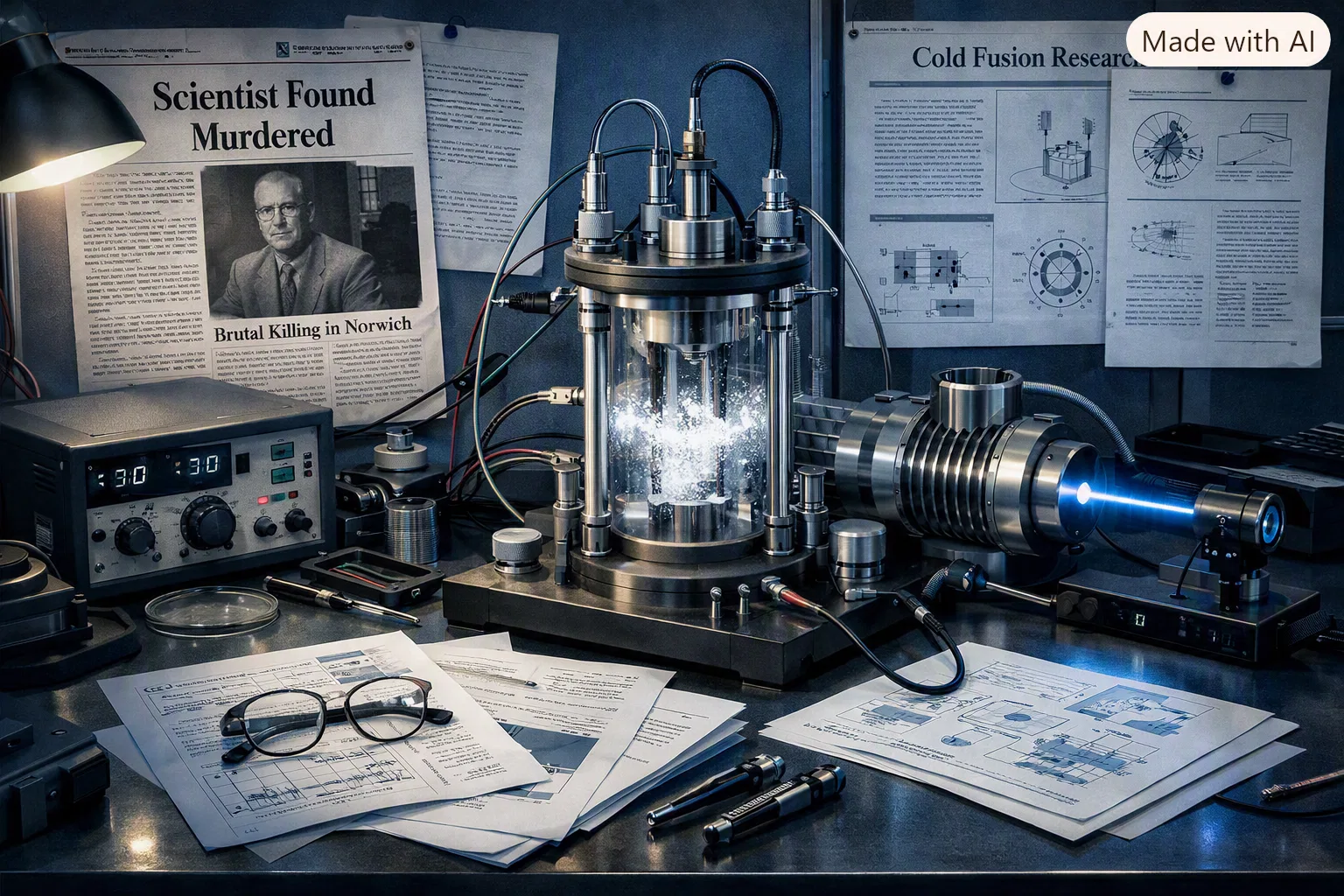
Eugene Mallove’s death is one of the strongest-looking cases in lists of allegedly suppressed unconventional-energy researchers because one fact is beyond dispute: he was murdered. Mallove, a prominent advocate of cold fusion and other “new energy” research, was beaten to death in Norwich, Connecticut, on 14 May 2004. But the criminal record points in a markedly different direction from retaliation over his scientific advocacy. Investigators linked the killing to people connected with tenants whom Mallove had recently evicted from the property where he was attacked, and evidence developed that his possessions and van were taken to make the killing resemble a robbery. Chad Schaffer, the son of one of the evicted tenants, ultimately pleaded guilty to manslaughter and robbery.[Justia Law]law.justia.comJustia LawBrown v. Commissioner of Correction:: 2025:: Connecticut Appellate Court Decisions:: Connecticut Case Law:: Connecticut Law…
That does not make every aspect of the prosecution history simple: another defendant’s murder conviction was ordered vacated in 2025 because of a serious disclosure violation involving a cooperating witness. But neither that ruling nor the documented investigative record supplies evidence that Mallove was killed because of cold fusion, antigravity research or an organised effort to suppress unconventional science.[Justia Law]law.justia.comJustia LawBrown v. Commissioner of Correction:: 2025:: Connecticut Appellate Court Decisions:: Connecticut Case Law:: Connecticut Law…
Mallove really was a prominent unconventional-energy advocate
Mallove’s inclusion in suppressed-scientist narratives is understandable in a way that some looser cases are not. He had substantial technical credentials and made unconventional energy a central part of his public life. His professional biography records undergraduate and master’s degrees in aeronautical and astronautical engineering from the Massachusetts Institute of Technology and a doctorate in environmental health sciences from Harvard. He later founded and edited Infinite Energy, a magazine devoted principally to cold fusion and other proposed new-energy technologies, and established organisations intended to support research in those areas.[infinite-energy.com]infinite-energy.comBiographical Note for Dr. Eugene F. MalloveMarch 1, 2026…
He was especially identified with the controversy surrounding the 1989 announcement by Martin Fleischmann and Stanley Pons of anomalous heat production in electrochemical experiments — the phenomenon popularly called cold fusion and later often discussed under the label low-energy nuclear reactions. Mallove became one of its most outspoken defenders and argued that mainstream scientific institutions had dismissed anomalous evidence too aggressively. That history meant that, when he died violently at 56, a suppression interpretation had an immediately recognisable narrative structure: a scientist who had publicly accused established science of mishandling an energy breakthrough had himself been killed.
The possibility was discussed almost immediately. Material preserved by Mallove supporters records speculation that his death might somehow have resulted from his cold-fusion work. Yet contemporary reporting on the investigation also made clear that police were pursuing an ordinary criminal explanation rather than a scientific or political assassination. Even a pro-new-energy account published directly after the killing stated that there was then no evidence of a political connection, while noting robbery or a landlord–tenant dispute among the possibilities.[eugenemallove.com]eugenemallove.comPress Releases on Mallove InvestigationJanuary 24, 2005…
That distinction matters. Mallove unquestionably believed unconventional energy was being unfairly resisted. Evidence that he had professional adversaries or believed research was being suppressed, however, is not evidence that those disputes caused his homicide.

The crime scene centred on a recently evicted rental property
The location and immediate circumstances of Mallove’s death are crucial because they provide the first concrete connection to the later criminal case.
On 14 May 2004, Mallove had travelled from his home in New Hampshire to 119 Salem Turnpike in Norwich, a property associated with his family. According to the factual history later recited by the Connecticut Appellate Court, Mallove had evicted tenants Roy and Patricia Anderson the previous month and was at the property cleaning it out. Patricia Anderson’s son, Chad Schaffer, and Schaffer’s girlfriend, Candace Foster, had also lived there. Mallove’s body was discovered in the driveway that evening.[Justia Law]law.justia.comJustia LawBrown v. Commissioner of Correction:: 2025:: Connecticut Appellate Court Decisions:: Connecticut Case Law:: Connecticut Law…
His green minivan subsequently turned up in an employee car park at Foxwoods casino. Early investigators considered robbery because property had disappeared, and the apparently abandoned vehicle seemed consistent with an offender attempting to distance himself from the scene. In 2009, while the case remained unresolved, Connecticut authorities publicly offered a $50,000 reward for information leading to an arrest and conviction.[CT.gov]portal.ct.gov50000 Reward Being Offered from Homicide Investigation Norwich 2004CT.gov50000 Reward Being Offered from Homicide Investigation Norwich 2004February 11, 2009…
The investigation was not clean or linear. Two other men, Gary McAvoy and Joseph Reilly, were arrested in 2005 after evidence initially appeared to point towards them. Later forensic work excluded them as contributors to relevant DNA profiles, and prosecutors dropped the homicide charges. That episode is important because it shows why the Mallove case should not be simplified into a tidy police success story: authorities did pursue a wrong path before developing the case against Schaffer and others.[Justia Law]law.justia.comJustia LawBrown v. Commissioner of Correction:: 2025:: Connecticut Appellate Court Decisions:: Connecticut Case Law:: Connecticut Law…
But the collapse of those first prosecutions is not evidence for an energy-suppression theory either. The more consequential break came when witnesses began directing investigators back towards people linked to the evicted tenants.
The later evidence tied the killing to the eviction dispute
The breakthrough described in the Connecticut court record came in 2009. Jill Sebastian told police that the former occupants of the property might have been involved. She reported having seen Schaffer’s blood-covered clothing and said Foster had admitted lying about Schaffer being at home during the killing and disposing of bloody trousers. Another witness, Keishon Dullivan, told investigators that Schaffer had said he assaulted Mallove and then took Mallove’s property in order to stage the attack as a robbery.[Justia Law]law.justia.comJustia LawBrown v. Commissioner of Correction:: 2025:: Connecticut Appellate Court Decisions:: Connecticut Case Law:: Connecticut Law…
Foster subsequently gave investigators several accounts before admitting involvement herself. According to the judicial record, she ultimately said she had kicked Mallove and struck him with a pipe, had driven Mallove’s van to Foxwoods and that Schaffer had removed property belonging to Mallove. Foster and Schaffer were arrested in April 2010.[Justia Law]law.justia.comJustia LawBrown v. Commissioner of Correction:: 2025:: Connecticut Appellate Court Decisions:: Connecticut Case Law:: Connecticut Law…
Reporting based on the resulting criminal proceedings supplied about the confrontation. Prosecutors described Schaffer and his cousin Mozzelle Brown as attacking Mallove while he was preparing the house for another rental after Schaffer’s family had been evicted. Associated accounts of Foster’s evidence said Schaffer had learned that belongings left behind at the property were being thrown away, after which the men went there and confronted Mallove.[Norwalk Hour]thehour.comNorwalk Hour Trial wraps up in killing of physicistNorwalk Hour Trial wraps up in killing of physicist
This is the central evidential point when assessing the claimed motive. The people identified in the criminal investigation were not documented competitors in cold fusion, intelligence operatives, energy-industry figures or scientific opponents of Mallove. The prosecution evidence connected them to the property itself and the recently displaced tenants.
That does not require accepting every detail of every witness’s later account. The criminal case contained inconsistent testimony, plea negotiations and, eventually, a major constitutional problem involving disclosure to the defence. But the evidence necessary to posit a property-related confrontation does not rest solely on a theory invented after Mallove’s death. The eviction pre-dated the homicide; Schaffer was the former tenant’s son; Schaffer himself ultimately entered guilty pleas; and the record contains evidence that property was deliberately taken to disguise what had happened.[Justia Law]law.justia.comJustia LawBrown v. Commissioner of Correction:: 2025:: Connecticut Appellate Court Decisions:: Connecticut Case Law:: Connecticut Law…
Schaffer’s guilty plea is stronger evidence than the original “robbery” theory
One potentially misleading shorthand is that Mallove simply died in a “robbery gone wrong”. Early police suspicion did lean towards robbery, but the later case was more specific. Evidence presented by investigators suggested that theft was at least partly staging after the assault, rather than necessarily the original reason the attackers approached Mallove.
That distinction strengthens the relevance of the landlord–tenant dispute. Dullivan told investigators that Schaffer had said possessions were taken to make the attack appear to be a robbery. Foster likewise placed Schaffer at the scene and said Mallove’s van and property were removed.[Justia Law]law.justia.comJustia LawBrown v. Commissioner of Correction:: 2025:: Connecticut Appellate Court Decisions:: Connecticut Case Law:: Connecticut Law…
Schaffer then made the most legally significant admission in the case. During his 2012 trial, he accepted a plea agreement and pleaded guilty to first-degree manslaughter and third-degree robbery. He received a 16-year prison sentence. Contemporary Associated Press reporting identified him as a member of the family that had been evicted from Mallove’s property before the killing.[Justia Law]law.justia.comJustia LawBrown v. Commissioner of Correction:: 2025:: Connecticut Appellate Court Decisions:: Connecticut Case Law:: Connecticut Law…
A guilty plea to manslaughter does not, by itself, prove every proposed detail concerning why the confrontation began. It does, however, seriously weaken the claim that the known criminal proceedings never connected Mallove’s death to ordinary local actors. One participant tied directly to the evicted household admitted criminal responsibility for Mallove’s death in court.
For a suppression hypothesis to replace that explanation, it would need positive evidence showing that the property dispute was a cover story — for example, communications with an outside organiser, payment for the killing, surveillance related to Mallove’s research, testimony describing a contract, or evidence that the attackers had some connection to entities threatened by Mallove’s work. No such evidence appears in the published court record or official investigative material examined here.
The 2025 reversal changes Brown’s legal status, not the documented context
The case requires an important update because older summaries commonly state that both Schaffer and Mozzelle Brown were successfully convicted.
Brown was convicted by a jury in October 2014 of murder and conspiracy to commit murder and was sentenced in January 2015 to 58 years in prison. The jury, however, acquitted him of felony murder and first-degree robbery. Foster, who became a key prosecution witness, later pleaded guilty to hindering prosecution and tampering with physical evidence.[Justia Law]law.justia.comJustia LawBrown v. Commissioner of Correction:: 2025:: Connecticut Appellate Court Decisions:: Connecticut Case Law:: Connecticut Law…
In January 2025, the Connecticut Appellate Court ordered Brown’s murder and conspiracy convictions vacated and directed that he receive a new trial. The reason was not newly discovered evidence connecting Mallove’s death to his scientific work. It was a due-process violation concerning the prosecution’s treatment of Foster as a cooperating witness. The court concluded that the state had failed to disclose an informal understanding indicating that Foster could receive consideration for her cooperation, information that Brown’s defence could have used to challenge her credibility. The court found the suppressed information sufficiently material that there was a reasonable probability of a different trial result had it been disclosed.[Justia Law]law.justia.comJustia LawBrown v. Commissioner of Correction:: 2025:: Connecticut Appellate Court Decisions:: Connecticut Case Law:: Connecticut Law…
Connecticut’s Supreme Court then denied the state’s petition seeking review on 1 April 2025, leaving the order for a new trial in place.[Connecticut Judicial Branch]jud.ct.govConnecticut Judicial Branch Page 29CONNECTICUT LAW JOURNAL ORD…
This development should prevent an overstatement sometimes made in summaries of the Mallove case: Brown’s 2014 conviction can no longer simply be cited as a final, intact murder conviction. The appellate decision exposed a genuine defect in the prosecution.
Yet the reversal does not establish that Brown was innocent, does not invalidate Schaffer’s separate guilty plea, and does not identify any scientific or political motive. It concerns whether Brown received a constitutionally fair trial given undisclosed information affecting Foster’s credibility. Treating that ruling as evidence of a cold-fusion assassination would therefore assign it a meaning the court itself did not give it.

Why the murder became part of suppressed-scientist lore
Mallove’s case persists because its surface features are unusually powerful. He was not merely a researcher who died unexpectedly; he was a vocal critic of scientific institutions who was deliberately killed. His advocacy centred on technologies whose supporters often believe economically transformative discoveries are resisted by entrenched interests. And because the homicide took years to resolve — including the mistaken prosecution of two other men — there was a long period during which speculation could flourish without a settled criminal narrative.
Those circumstances make suspicion psychologically understandable. They do not make the suppression hypothesis evidentially equivalent to the property-dispute explanation.
There is also an important difference between motive for approaching Mallove and actions after the assault. The later case indicates a confrontation rooted in the recently vacated property, followed by theft and movement of Mallove’s vehicle that witnesses described as efforts to create the appearance of robbery. This is more specific than simply saying “police thought it was robbery”.[Justia Law]law.justia.comJustia LawBrown v. Commissioner of Correction:: 2025:: Connecticut Appellate Court Decisions:: Connecticut Case Law:: Connecticut Law…
By contrast, the research-suppression theory largely proceeds backwards from Mallove’s biography: he promoted controversial energy research; he was murdered; therefore his research may have caused the murder. That sequence identifies a conceivable hypothesis, but it does not supply the missing causal evidence between the two facts.
Even within the unconventional-energy community, early commentary acknowledged that limitation. A sympathetic account published immediately after Mallove’s death explicitly observed that there was no evidence at that stage of a political connection.[greatdreams.com]greatdreams.comDr. Eugene MalloveCold Fusion Expert…
Why the documented motive points away from suppression
The Mallove homicide deserves more careful wording than either “mysterious unsolved assassination” or “simple robbery”. The published criminal record supports a more precise conclusion.
Mallove was killed at a rental property from which tenants had recently been evicted. The son of one of those tenants, Chad Schaffer, emerged as a central suspect after witnesses described bloody clothing, a false alibi and admissions about the assault. Evidence indicated that Mallove’s possessions and vehicle were taken in an attempt to stage the death as a robbery. Schaffer ultimately pleaded guilty to manslaughter and robbery.[Justia Law]law.justia.comJustia LawBrown v. Commissioner of Correction:: 2025:: Connecticut Appellate Court Decisions:: Connecticut Case Law:: Connecticut Law…
The case against Mozzelle Brown became legally compromised because prosecutors failed to disclose information affecting the credibility of cooperating witness Candace Foster; Brown’s convictions were therefore ordered vacated in 2025. That is a substantial qualification and should be included in any current account. It does not, however, introduce evidence of an alternative-energy assassination.[Justia Law]law.justia.comJustia LawBrown v. Commissioner of Correction:: 2025:: Connecticut Appellate Court Decisions:: Connecticut Case Law:: Connecticut Law…
Within the wider subject of allegedly suspicious deaths among UFO, antigravity and unconventional-energy researchers, Mallove is therefore an instructive case precisely because the homicide itself is real but the claimed research-related motive remains unsupported. The documented trail leads towards a confrontation arising from an eviction and the handling of property left behind, involving locally connected individuals, rather than towards retaliation for Mallove’s cold-fusion advocacy. His murder is evidence that an unconventional-energy advocate was killed; the available record does not establish that he was killed for being an unconventional-energy advocate.
Amazon book picks
Further Reading
Books and field guides related to Why Eugene Mallove's Murder Points Away From Suppression. Use these as the next step if you want deeper reading beyond the article.
Fire from Ice: Searching for the Truth Behind the Cold Fusion...
Discusses the furor over the announcement that scientists had succeeded in producing controlled nuclear fusion at ordinary temperatures,...
Bad Science: The Short Life and Weird Times of Cold Fusion
Documents the bizarre 1989 episode of 2 scientists who announced they had created a sustained nuclear-fusion reaction at room temperature...

Too hot to handle : the race for cold fusion
First published 1990. Subjects: Cold fusion, Research, Utah, Fusion reactors, Nuclear fusion.
The Anatomy of Motive
An FBI criminal profiling expert discusses his theories of motive.
eBay marketplace picks
Marketplace Samples
Live-tested eBay searches with available results related to this page.
Selected fromUFO poster oneBay.co.uk.




Endnotes
1.
Source: law.justia.com
Link:https://law.justia.com/cases/connecticut/court-of-appeals/2025/ac46658.html
Source snippet
Justia LawBrown v. Commissioner of Correction:: 2025:: Connecticut Appellate Court Decisions:: Connecticut Case Law:: Connecticut Law...
2.
Source: infinite-energy.com
Title: Biographical Note for Dr. Eugene F. Mallove
Link:https://www.infinite-energy.com/images/pdfs/GeneMalloveBio.pdf
Source snippet
March 1, 2026...
Published: March 1, 2026
3.
Source: infinite-energy.com
Title: Infinite Energy Magazine
Link:https://www.infinite-energy.com/whoarewe/gene.html
4.
Source: eugenemallove.com
Title: Press Releases on Mallove Investigation
Link:https://www.eugenemallove.com/em_investigation.html
Source snippet
January 24, 2005...
Published: January 24, 2005
5.
Source: greatdreams.com
Title: Dr. Eugene Mallove
Link:https://www.greatdreams.com/mallove.htm
Source snippet
Cold Fusion Expert...
6.
Source: eugenemallove.org
Link:https://www.eugenemallove.org/
7.
Source: docs.justia.com
Link:https://docs.justia.com/cases/federal/appellate-courts/ca2/09-4991/920110105
8.
Source: infinite-energy.com
Title: Back Issues
Link:https://www.infinite-energy.com/iemagazine/issue56/index.html
9.
Source: law.justia.com
Title: s99a0230 1
Link:https://law.justia.com/cases/georgia/supreme-court/1999/s99a0230-1.html
10.
Source: law.justia.com
Title: s94a0969 1
Link:https://law.justia.com/cases/georgia/supreme-court/1994/s94a0969-1.html
11.
Source: infinite-energy.com
Link:https://www.infinite-energy.com/resources/unusual-suspects.html
12.
Source: infinite-energy.com
Title: Infinite Energy Magazine
Link:https://www.infinite-energy.com/whoarewe/whoarewe.html
13.
Source: infinite-energy.com
Link:https://infinite-energy.com/genemallovecollection/biography.html
14.
Source: infinite-energy.com
Link:https://www.infinite-energy.com/whoarewe/gene_old2013.html
15.
Source: eugenemallove.com
Link:https://www.eugenemallove.com/death_of_IE.html
16.
Source: eugenemallove.com
Link:https://www.eugenemallove.com/why_write_no_more.html
17.
Source: eugenemallove.com
Title: Mallove in His Words
Link:https://eugenemallove.com/
18.
Source: eugenemallove.com
Link:https://www.eugenemallove.com/emwords_quest2.5.html
19.
Source: eugenemallove.com
Link:https://www.eugenemallove.com/emwords_CV.html
20.
Source: eugenemallove.com
Link:https://www.eugenemallove.com/emwords_quest1.html
21.
Source: thehour.com
Title: Norwalk Hour Man gets 16 years in prison for killing scientist
Link:https://www.thehour.com/news/article/Man-gets-16-years-in-prison-for-killing-scientist-8163651.php
22.
Source: jud.ct.gov
Title: Connecticut Judicial Branch Page 29
Link:https://www.jud.ct.gov/lawjournal/Docs/CTReports/2025/16/ord351_8642.pdf
Source snippet
CONNECTICUT LAW JOURNAL ORD...
23.
Source: portal.ct.gov
Title: 50000 Reward Being Offered from Homicide Investigation Norwich 2004
Link:https://portal.ct.gov/DESPP/Press-Releases/2009/50000-Reward-Being-Offered-from-Homicide-Investigation-Norwich-2004
Source snippet
CT.gov50000 Reward Being Offered from Homicide Investigation Norwich 2004February 11, 2009...
Published: February 11, 2009
24.
Source: thehour.com
Title: Norwalk Hour Trial wraps up in killing of physicist
Link:https://www.thehour.com/news/article/Trial-wraps-up-in-killing-of-physicist-8080746.php
25.
Source: jud.ct.gov
Link:https://jud.ct.gov/lawlib/lawlibnews/Default.aspx?ArchMY=202501
26.
Source: jud.ct.gov
Link:https://jud.ct.gov/lawlib/lawlibnews/Posts/Post.aspx?Id=6178
27.
Source: thehour.com
Title: Man convicted of killing physicist gets 58 years in prison
Link:https://www.thehour.com/news/article/Man-convicted-of-killing-physicist-gets-58-years-7977379.php
28.
Source: uapmurders.com
Link:https://uapmurders.com/uaps/Details/Eugene_Mallove/
29.
Source: jud.ct.gov
Title: archive AROap12
Link:https://www.jud.ct.gov/external/supapp/archiveAROap12.htm
30.
Source: everything.explained.today
Title: Eugene Mallove
Link:https://everything.explained.today/Eugene_Mallove/
31.
Source: academickids.com
Title: Eugene Mallove
Link:https://academickids.com/encyclopedia/index.php/Eugene_Mallove
Additional References
32.
Source: vecteezy.com
Link:https://www.vecteezy.com/editorial/news/chad-schaffer-trial-155843/chad-schaffer-listens-65263214
33.
Source: conspira.fi
Link:https://conspira.fi/topic/cold-fusion
34.
Source: thecinemaholic.com
Link:https://thecinemaholic.com/dr-eugene-mallove-murder-where-are-candace-foster-chad-schaffer-and-mozzelle-brown-now/
35.
Source: truecrimene.com
Link:https://www.truecrimene.com/episodes/p6zagfbyw95khxlki00s3o5zfagrz4
36.
Source: vettingroom.org
Link:https://vettingroom.org/2019/11/19/judge-barbara-jongbloed/
37.
Source: okcca.net
Link:https://www.okcca.net/cases/2005/OK-CR-4/
38.
Source: okcca.net
Link:https://okcca.net/cases/1995/OK-CR-33/
39.
Source: okcca.net
Link:https://okcca.net/cases/1981/OK-CR-123/
40.
Source: projectcamelot.org
Link:https://projectcamelot.org/mallove.html
41.
Source: conspiracytheory.net
Link:https://conspiracytheory.net/theory/cold-fusion-suppression/