Within Antigravity
How Much Room Is Left for Exotic Gravity?
Precision free-fall tests show different materials responding to gravity almost identically, sharply constraining many exotic gravity models.
On this page
- What the equivalence principle means for antigravity ideas
- What the MICROSCOPE satellite measured
- Why tiny allowed deviations are not practical gravity control
Page outline Jump by section
Introduction
For claims about antigravity or unconventional propulsion, one of the most important experimental questions is surprisingly simple: does gravity accelerate different kinds of matter differently? If a material could substantially weaken, screen or reverse its coupling to ordinary gravity because of its composition, a sufficiently sensitive comparison with another material should reveal a difference in free fall.

The strongest direct test of this idea is the MICROSCOPE satellite experiment. It compared titanium- and platinum-alloy test masses while they orbited Earth and found no violation of the weak equivalence principle. Its final result constrained the relative difference in their gravitational accelerations to the level of a few parts in 1015.[APS Journals]journals.aps.orgAPS JournalsMission: Final Results of the Test of the Equivalence Principle | Phys. Rev. Lett.September 14, 2022…
That does not prove that every imaginable modification of gravity is impossible. Some theories can evade this particular test through very short interaction ranges, screening mechanisms or effects that do not depend on material composition. But it leaves extraordinarily little room for a broad and important class of exotic-gravity models in which ordinary materials possess significantly different gravitational responses. In the context of UFO and antigravity claims, this distinction is crucial: speculative gravitational physics remains an active field, but precision free-fall experiments provide no evidence for the large, controllable departures from ordinary gravity that practical gravity cancellation would require.
What the equivalence principle means for antigravity ideas
The weak equivalence principle, also called the universality of free fall, says that objects subjected only to gravity should undergo the same acceleration regardless of their composition or internal structure. It is one of the empirical foundations underlying general relativity. Before MICROSCOPE, rotating torsion-balance experiments had already compared different substances to roughly the part-in-1013 level.[arXiv]arxiv.orgarXiv Torsion-balance tests of the weak equivalence principleTorsion-balance tests of the weak equivalence principleJuly 10, 2012…
The useful quantity is the Eötvös parameter, usually written η. In simplified form it compares the accelerations a1 and a2 of two test bodies:
η≈a1+a22(a1−a2).
If the two materials fall identically, η=0. A reproducible non-zero value would be profound. Depending on its characteristics, it could indicate that gravitational and inertial mass are not universally equivalent or that an additional force is acting differently on different forms of matter. The MICROSCOPE researchers explicitly described a non-zero differential acceleration as a possible signature of an equivalence-principle violation or a new long-range force.[PubMed]pubmed.ncbi.nlm.nih.govMICROSCOPE Mission: First Results of a Space Test of the Equivalence Principle - PubMedDecember 8, 2017…
This is why such experiments are relevant to exotic-gravity proposals even though they are not experiments in propulsion. Many proposed extensions of established physics introduce additional scalar or vector fields. If the new field couples differently to different combinations of protons, neutrons, electrons or nuclear binding energy, two chemically different objects acquire slightly different effective gravitational responses. A composition-sensitive free-fall experiment can therefore detect — or constrain — the proposed interaction without having to know how to build a device exploiting it.[APS Journals]journals.aps.orgAPS JournalsMICROSCOPE Mission: First Constraints on the Violation of the Weak Equivalence Principle by a Light Scalar Dilaton | Phys. Re…
That relationship needs an important qualification. An equivalence-principle test is not a universal detector for every conceivable form of antigravity. A hypothetical effect that couples identically to every form of matter would not necessarily produce differential acceleration between titanium and platinum. Nor does MICROSCOPE by itself rule out forces confined to very short distances or models in which additional fields become strongly screened under the experimental conditions. Modern experimental limits therefore exclude regions of theoretical parameter space rather than proving a blanket theorem that no unconventional gravitational phenomenon can exist. Research on screened scalar fields, for example, continues precisely because such models can suppress observable fifth forces in some environments.[arXiv]arxiv.orgarXiv Fifth force induced by a chameleon field on nested cylindersFifth force induced by a chameleon field on nested cylindersApril 17, 2020…
What MICROSCOPE does rule against, with exceptional sensitivity, is the simpler and highly relevant possibility that ordinary materials possess appreciably different passive responses to Earth’s gravity.
What MICROSCOPE actually measured
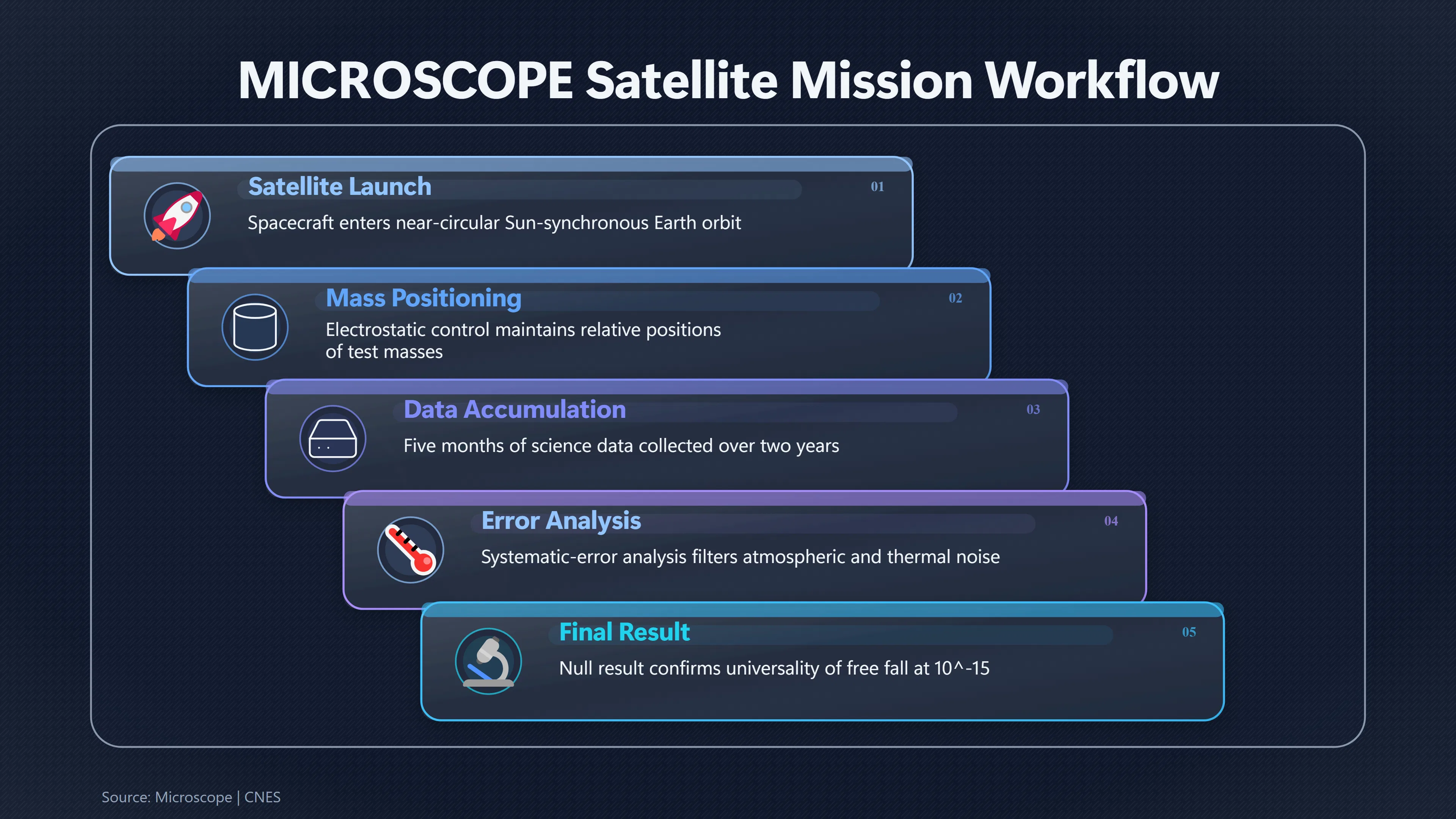
MICROSCOPE was a French space mission led by CNES, with an instrument developed by ONERA and contributions from other European institutions. Launched in April 2016, the roughly 300-kilogram satellite placed its equivalence-principle experiment in a near-circular, Sun-synchronous Earth orbit. The reason for going to space was not theatrical: an orbiting experiment can maintain test bodies in effectively continuous free fall while escaping seismic disturbances and several other limitations of terrestrial laboratories.[CNES]cnes.frMicroscope | CNESMicroscope | CNES…
Inside the satellite were extremely sensitive differential electrostatic accelerometers. The critical comparison involved two concentric cylindrical masses made from different materials: titanium alloy and platinum-rhodium alloy. A second sensor used masses of the same composition and served as a reference. The instrument did not simply drop two objects and watch which reached the floor first. Electrostatic control kept the masses positioned relative to the spacecraft, and researchers measured the forces necessary to do so. If titanium and platinum experienced measurably different gravitational accelerations, a characteristic differential signal should appear.[APS Journals]journals.aps.orgAPS JournalsMission: Final Results of the Test of the Equivalence Principle | Phys. Rev. Lett.September 14, 2022…
The spacecraft itself was designed to minimise disturbances. Microthrusters compensated for nongravitational accelerations acting on the satellite, while the experiment monitored the relative behaviour of the test masses inside it. The mission accumulated about five months of usable science free-fall data during approximately two and a half years of operation; roughly two-thirds involved the different-composition titanium/platinum pair and the remainder the same-composition reference pair.[APS Journals]journals.aps.orgAPS JournalsMission: Final Results of the Test of the Equivalence Principle | Phys. Rev. Lett.September 14, 2022…
This matters because a measurement at the 10−15 level is fundamentally an exercise in distinguishing physics from apparatus. Residual atmospheric drag, Earth’s gravity gradient, magnetic disturbances, thermal variations and effects originating inside the accelerometer all had to be characterised. The MICROSCOPE team’s systematic-error analysis explicitly divided possible disturbances into external, spacecraft-related and internal instrumental sources.[arXiv]arxiv.orgarXiv MICROSCOPE: systematic errorsarXiv MICROSCOPE: systematic errors
The final analysis also dealt with thermal instability and short-lived instrumental events capable of imitating part of the expected signal. That makes the published number more meaningful than simply saying that the satellite was capable of detecting extremely small accelerations: the reported uncertainty incorporates a detailed assessment of effects that could masquerade as an equivalence-principle violation.[DOI]doi.orgMICROSCOPE Mission: Final Results of the Test of the Equivalence PrincipleMICROSCOPE Mission: Final Results of the Test of the Equivalence Principle
The final result was
η(Ti,Pt)=[−1.5±2.3(stat)±1.5(syst)]×10−15.
In other words, the measured value remained statistically compatible with zero. CNES summarises the final test as confirming universality of free fall at a precision of about 2.7×10⁻¹⁵, roughly 100 times beyond the precision available from earlier terrestrial tests.[APS Journals]journals.aps.orgAPS JournalsMission: Final Results of the Test of the Equivalence Principle | Phys. Rev. Lett.September 14, 2022…
A useful way to grasp the scale is that the experiment was looking for a fractional difference measured in quadrillionths. It did not find evidence that titanium was gravitationally special relative to platinum at that extraordinary sensitivity.
The null result squeezes many exotic-gravity models
MICROSCOPE was never merely a contest to add more decimal places to an old observation. Equivalence-principle violations occur naturally in numerous attempts to extend established gravitational physics.
One common example is a hypothetical fifth force mediated by a very light particle or scalar field. Ordinary gravity effectively couples universally to mass-energy, whereas a new field might couple to quantities such as baryon number or combinations of baryon and lepton number. Because different elements contain different proportions of protons and neutrons and have different nuclear binding energies, their acceleration in the combined gravitational and fifth-force field need not be exactly equal.[APS Journals]journals.aps.orgAPS JournalsMICROSCOPE Mission: First Constraints on the Violation of the Weak Equivalence Principle by a Light Scalar Dilaton | Phys. Re…
Even MICROSCOPE’s early results substantially tightened some such models. Researchers analysing light scalar or “dilaton” fields reported approximately an order-of-magnitude improvement over previous equivalence-principle constraints for parts of the relevant parameter space. For a sufficiently light mediator — below about 10−12 electronvolts in the model considered — the first MICROSCOPE result placed particularly stringent limits on hypothetical interactions coupled to baryon number or to the difference between baryon and lepton numbers.[APS Journals]journals.aps.orgAPS JournalsMICROSCOPE Mission: First Constraints on the Violation of the Weak Equivalence Principle by a Light Scalar Dilaton | Phys. Re…
Later theoretical analyses have translated the more precise final MICROSCOPE result into still tighter bounds on particular light-scalar couplings. The exact numerical constraint depends heavily on the assumed field, its mass, its interaction range and what “charge” it couples to, so there is no single model-independent number describing all fifth forces.[arXiv]arxiv.orgarXiv Constraining Light Scalar Field with Torsion-Balance Gravity ExperimentsarXiv Constraining Light Scalar Field with Torsion-Balance Gravity Experiments
That model dependence is essential when interpreting statements that MICROSCOPE “rules out exotic gravity”. It does not. Instead, its null result says that any proposed theory predicting a sufficiently large titanium-versus-platinum differential acceleration under the conditions of the experiment is incompatible with observation. A theory can survive only if its predicted violation lies beneath the experimental limit, falls outside the experiment’s relevant length scale or is suppressed by some mechanism.
The latter possibility motivates screening theories such as chameleon-type models. In these theories, an additional scalar interaction may become difficult to observe in dense environments. Researchers have therefore studied explicitly how a chameleon field would behave inside MICROSCOPE’s nested cylindrical apparatus. Such work illustrates why a precision null result narrows rather than terminates the search for new gravitational physics: increasingly elaborate models must be tested using the conditions under which they actually predict an observable signal.[arXiv]arxiv.orgarXiv Fifth force induced by a chameleon field on nested cylindersFifth force induced by a chameleon field on nested cylindersApril 17, 2020…
The important point for antigravity discussions is the direction in which the evidence has moved. The increasingly sensitive experiment did not uncover a growing anomaly. The permitted composition-dependent effect became smaller.
Why a tiny allowed deviation is not practical gravity control
The difference between an experimental upper limit and a usable effect is easy to lose in discussions of unconventional propulsion.
Suppose, purely for illustration, that an unknown interaction existed immediately below MICROSCOPE’s sensitivity and changed the gravitational acceleration of one material relative to another by roughly one part in 1015. At Earth’s surface, where gravitational acceleration is about 9.8ms−2, that fractional scale corresponds to only about 10−14ms−2 in differential acceleration.
That is not remotely comparable with cancelling Earth’s gravity. Levitation by gravitational cancellation would require an upward or gravity-reducing effect comparable with g itself — an order-unity alteration rather than a quadrillionth-level composition-dependent difference.
There is an even deeper problem. An equivalence-principle violation would demonstrate that two kinds of matter respond slightly differently; it would not demonstrate that anyone could switch the difference on and off. Practical gravity control would require several additional properties that an equivalence-principle anomaly alone would not provide:
- a sufficiently large force;
- a way of controlling its magnitude and direction;
- a physical source for the interaction;
- acceptable energy and engineering requirements;
- reproducibility across independent apparatus;
- and a mechanism capable of producing useful thrust or lift rather than merely a minute difference between test materials.
Consequently, even the discovery of a statistically convincing 10−15-scale violation would be revolutionary fundamental physics without automatically being propulsion technology.
The gap becomes especially important when evaluating historical antigravity narratives. A laboratory report of a weight anomaly, unusual force or theoretical departure from general relativity cannot be promoted directly into evidence for operational gravity control. The intermediate experimental questions — composition dependence, magnitude, environmental dependence, systematic errors, repeatability and controllability — are precisely the questions that high-precision gravity experiments are designed to separate.
What remains open — and what does not
MICROSCOPE therefore supports a more precise conclusion than either “antigravity is impossible” or “physics still has mysteries, so antigravity remains equally plausible”.
There is genuine theoretical room for physics beyond general relativity. Some attempts to connect gravity with quantum physics predict additional fields, equivalence-principle violations or other departures from Einsteinian gravity. That is why experiments continue to improve. The absence of a MICROSCOPE signal is scientifically valuable precisely because plausible new-physics models predicted that a signal might occur.[ihes.fr]ihes.frPublication of the last results of the MICROSCOPE missionPublication of the last results of the MICROSCOPE mission
There are also experimental regimes that MICROSCOPE did not exhaust. Ground-based torsion balances can probe different interaction ranges and material combinations. A 2024 short-range equivalence-principle experiment, for example, compared copper and lead test bodies using a rotating three-tonne uranium attractor and found a differential acceleration consistent with zero, establishing new constraints on equivalence-principle-violating interactions at shorter ranges.[arXiv]arxiv.orgarXiv Short-range tests of the equivalence principlearXiv Short-range tests of the equivalence principle
Different experiments are therefore complementary rather than interchangeable. A new force can depend on range, composition, environment and its hypothetical mediator. No single titanium-versus-platinum measurement maps every possible modification of gravity.
But the freedom left by that caveat should not be mistaken for positive evidence of gravity manipulation. For the specific class of exotic-gravity ideas in which ordinary substances couple appreciably differently to Earth’s gravitational field, MICROSCOPE is an exceptionally severe constraint. The experiment deliberately placed chemically different masses in prolonged orbital free fall, controlled disturbances capable of creating false signals and searched at approximately the 10−15 level. It found no significant differential acceleration.[APS Journals]journals.aps.orgAPS JournalsMission: Final Results of the Test of the Equivalence Principle | Phys. Rev. Lett.September 14, 2022…
That result provides an important baseline for the wider subject of UFO and alleged antigravity research. The existence of speculative gravitational theories is real; so is legitimate experimental research seeking deviations from general relativity. Neither fact establishes that a laboratory, inventor or classified programme acquired a method of cancelling gravity. Where a proposed mechanism predicts that matter should fall substantially differently because of its composition, precision experiments have pushed the permissible discrepancy not towards engineering usefulness, but down towards parts in a quadrillion.
Amazon book picks
Further Reading
Books and field guides related to How Much Room Is Left for Exotic Gravity?. Use these as the next step if you want deeper reading beyond the article.
Gravity: An Introduction to Einstein's General Relativity
Einstein's theory of general relativity is a cornerstone of modern physics. It also touches upon a wealth of topics that students find fa...
Spacetime and Geometry: An Introduction to General Relativity
An accessible introductory textbook on general relativity, covering the theory's foundations, mathematical formalism and major applications.
A First Course in General Relativity
Second edition of a widely-used textbook providing the first step into general relativity for undergraduate students with minimal mathema...
Gravitation
First published in 1973, Gravitation is a landmark graduate-level textbook that presents Einstein’s general theory of relativity and offe...
eBay marketplace picks
Marketplace Samples
Live-tested eBay searches with available results related to this page.
Selected fromspacecraft model oneBay.co.uk.
Endnotes
1.
Source: journals.aps.org
Link:https://journals.aps.org/prl/abstract/10.1103/PhysRevLett.129.121102
Source snippet
APS JournalsMission: Final Results of the Test of the Equivalence Principle | Phys. Rev. Lett.September 14, 2022...
Published: September 14, 2022
2.
Source: cnes.fr
Title: Microscope | CNES
Link:https://cnes.fr/en/projects/microscope
Source snippet
Microscope | CNES...
3.
Source: arxiv.org
Title: arXiv Torsion-balance tests of the weak equivalence principle
Link:https://arxiv.org/abs/1207.2442
Source snippet
Torsion-balance tests of the weak equivalence principleJuly 10, 2012...
Published: July 10, 2012
4.
Source: journals.aps.org
Link:https://journals.aps.org/prl/abstract/10.1103/PhysRevLett.120.141101
Source snippet
APS JournalsMICROSCOPE Mission: First Constraints on the Violation of the Weak Equivalence Principle by a Light Scalar Dilaton | Phys. Re...
5.
Source: arxiv.org
Title: arXiv Fifth force induced by a chameleon field on nested cylinders
Link:https://arxiv.org/abs/2004.08403
Source snippet
Fifth force induced by a chameleon field on nested cylindersApril 17, 2020...
Published: April 17, 2020
6.
Source: journals.aps.org
Link:https://journals.aps.org/prd/abstract/10.1103/3486-4m4t
Source snippet
APS JournalsSearching for screened scalar forces with long-baseline atom interferometers | Phys. Rev. D...
7.
Source: onera.fr
Title: Einstein was right! | ONERA
Link:https://onera.fr/en/news/einstein-was-right
Source snippet
Einstein was right! | ONERA...
8.
Source: arxiv.org
Title: arXiv MICROSCOPE Mission scenario, ground segment and data processing
Link:https://arxiv.org/abs/2201.10841
9.
Source: arxiv.org
Title: arXiv MICROSCOPE: systematic errors
Link:https://arxiv.org/abs/2112.10559
10.
Source: doi.org
Title: MICROSCOPE Mission: Final Results of the Test of the Equivalence Principle
Link:https://doi.org/10.26092/elib/3988
11.
Source: arxiv.org
Link:https://arxiv.org/abs/1712.00483
12.
Source: arxiv.org
Title: arXiv Constraining Light Scalar Field with Torsion-Balance Gravity Experiments
Link:https://arxiv.org/abs/2212.06032
13.
Source: physics.aps.org
Link:https://physics.aps.org/articles/v15/94
14.
Source: ihes.fr
Title: Publication of the last results of the MICROSCOPE mission
Link:https://www.ihes.fr/en/lest-results-microscope/
15.
Source: arxiv.org
Title: arXiv Short-range tests of the equivalence principle
Link:https://arxiv.org/abs/2405.10982
16.
Source: opera.cnes.fr
Title: fr User Manual — Opera
Link:https://opera.cnes.fr/index.php/User_Manual
17.
Source: psimu.cnes.fr
Title: fr Basic Principle — Psimu
Link:https://psimu.cnes.fr/index.php/Basic_Principle
18.
Source: doi.org
Link:https://doi.org/10.1007/JHEP06%282026%29039
19.
Source: journals.aps.org
Title: 15g1 gklx
Link:https://journals.aps.org/prd/abstract/10.1103/15g1-gklx
20.
Source: journals.aps.org
Title: gw1d hbxj
Link:https://journals.aps.org/prd/abstract/10.1103/gw1d-hbxj
21.
Source: journals.aps.org
Title: tlqz 713s
Link:https://journals.aps.org/prl/abstract/10.1103/tlqz-713s
22.
Source: journals.aps.org
Title: 17wc xxjm
Link:https://journals.aps.org/prd/abstract/10.1103/17wc-xxjm
23.
Source: cnes.fr
Link:https://cnes.fr/en/projects/caspex
24.
Source: journals.aps.org
Title: 8mc9 6cmr
Link:https://journals.aps.org/prd/abstract/10.1103/8mc9-6cmr
25.
Source: cosparhq.cnes.fr
Link:https://cosparhq.cnes.fr/scientific-structure/scientific-commissions/scientific-commission-h-fundamental-physics-in-space/
26.
Source: journals.aps.org
Link:https://journals.aps.org/prl/abstract/10.1103/PhysRevLett.134.191003
27.
Source: journals.aps.org
Link:https://journals.aps.org/prd/abstract/10.1103/PhysRevD.110.055022
28.
Source: doi.org
Link:https://doi.org/10.1103/PhysRevD.110.055022
29.
Source: journals.aps.org
Link:https://journals.aps.org/prd/abstract/10.1103/PhysRevD.109.124013
30.
Source: doi.org
Link:https://doi.org/10.1140/epjc/s10052-024-12723-8
31.
Source: journals.aps.org
Link:https://journals.aps.org/prd/abstract/10.1103/PhysRevD.109.064010
32.
Source: journals.aps.org
Link:https://journals.aps.org/prd/abstract/10.1103/PhysRevD.108.095054
33.
Source: doi.org
Link:https://doi.org/10.1103/physrevd.108.095054
34.
Source: physics.aps.org
Link:https://physics.aps.org/articles/v16/s97
35.
Source: journals.aps.org
Link:https://journals.aps.org/prd/abstract/10.1103/PhysRevD.107.024013
36.
Source: physics.aps.org
Link:https://physics.aps.org/articles/v15/197
37.
Source: physics.aps.org
Link:https://physics.aps.org/articles/v15/192
38.
Source: physics.aps.org
Link:https://physics.aps.org/articles/v15/189
39.
Source: physics.aps.org
Link:https://physics.aps.org/articles/v15/s141
40.
Source: doi.org
Link:https://doi.org/10.1140/epjc/s10052-022-10905-w
41.
Source: physics.aps.org
Link:https://physics.aps.org/articles/v15/156
42.
Source: journals.aps.org
Link:https://journals.aps.org/prl/issues/129/12
43.
Source: aps.org
Link:https://www.aps.org/about/news/2022/09/general-relativitys-weak-equivalence-principle
44.
Source: aps.org
Title: New Results for MICROSCOPE Mission | American Physical Society
Link:https://www.aps.org/apsnews/2022/09/microscope-mission-general-relativity
45.
Source: physics.aps.org
Title: philippe brax
Link:https://physics.aps.org/authors/philippe_brax
46.
Source: physics.aps.org
Link:https://physics.aps.org/articles/v15/95
47.
Source: onera.fr
Title: final results of microscope mission achieve record levels of precision
Link:https://onera.fr/en/presse/communiques-presse/final-results-of-microscope-mission-achieve-record-levels-of-precision
48.
Source: doi.org
Link:https://doi.org/10.1103/PhysRevLett.129.101102
49.
Source: journals.aps.org
Link:https://journals.aps.org/prl/issues/129/2
50.
Source: physics.aps.org
Link:https://physics.aps.org/articles/v15/8
51.
Source: doi.org
Title: Pulsed production of antihydrogen | Communications Physics
Link:https://doi.org/10.1038%2Fs42005-020-00494-z
52.
Source: journals.aps.org
Link:https://journals.aps.org/prl/abstract/10.1103/PhysRevLett.123.231102
53.
Source: journals.aps.org
Link:https://journals.aps.org/prd/abstract/10.1103/PhysRevD.100.084006
54.
Source: doi.org
Link:https://doi.org/10.1103%2FPhysRevD.99.055043
55.
Source: doi.org
Link:https://doi.org/10.1103%2FPhysRevD.98.042002
56.
Source: meetings-archive.aps.org
Link:https://meetings-archive.aps.org/apr/2018/h04/2/
57.
Source: journals.aps.org
Link:https://journals.aps.org/prd/abstract/10.1103/PhysRevD.97.055039
58.
Source: videotheque.cnes.fr
Link:https://videotheque.cnes.fr/index.php?id_cat=2911&id_doc=36188&rang=1&urlaction=doc
59.
Source: physics.aps.org
Link:https://physics.aps.org/articles/v10/s133
60.
Source: onera.fr
Link:https://onera.fr/fr/presse/l-onera-livre-au-cnes-l-instrument-d-accelerometrie-ultra-sensible-de-la-mission-microscope
61.
Source: onera.fr
Title: a first for a cold atom accelerometer
Link:https://onera.fr/en/news/a-first-for-a-cold-atom-accelerometer
62.
Source: journals.aps.org
Link:https://journals.aps.org/prl/abstract/10.1103/PhysRevLett.106.151102
63.
Source: journals.aps.org
Link:https://journals.aps.org/prl/recent?page=493
64.
Source: link.aps.org
Title: tlqz 713s
Link:https://link.aps.org/doi/10.1103/tlqz-713s
65.
Source: journals.aps.org
Title: 1my7 zklj
Link:https://journals.aps.org/prd/abstract/10.1103/1my7-zklj
66.
Source: physics.aps.org
Link:https://physics.aps.org/authors/anonymous
67.
Source: cmsm-ds.onera.fr
Link:https://cmsm-ds.onera.fr/html/microscope/Publications.html
68.
Source: onera.fr
Link:https://onera.fr/fr/recherche-onera
69.
Source: onera.fr
Title: Physics Domain
Link:https://onera.fr/en/phy-dphy
70.
Source: onera.fr
Title: Domaine Physique
Link:https://onera.fr/fr/phy-dphy
71.
Source: onera.fr
Link:https://onera.fr/en/dphy-research-units
72.
Source: onera.fr
Link:https://onera.fr/fr/staff/judicael-bedouet
73.
Source: onera.fr
Title: onera 70 years 1963 1983 expansion
Link:https://onera.fr/en/history/onera-70-years-1963-1983-expansion
74.
Source: onera.fr
Link:https://onera.fr/fr/staff/elise-colin
75.
Source: onera.fr
Link:https://onera.fr/en/identity
76.
Source: onera.fr
Link:https://onera.fr/en/research/looking-to-the-future
77.
Source: onera.fr
Link:https://onera.fr/en/phy-dota/onda-platform
78.
Source: cnes.fr
Link:https://cnes.fr/projets/microscope/en-details
79.
Source: cnes.fr
Link:https://cnes.fr/projets/microscope
80.
Source: cnes.fr
Link:https://cnes.fr/node?page=12
81.
Source: recrutement.cnes.fr
Title: fr Emploi CNES
Link:https://recrutement.cnes.fr/fr/annonce/4195923-26-253-dark-matter-detection-with-the-microscope-and-lisa-space-missions-75014-paris
82.
Source: cnes.fr
Link:https://cnes.fr/en/projects/carioqa
83.
Source: videotheque.cnes.fr
Link:https://videotheque.cnes.fr/index.php?id_cat=400&id_doc=32850&rang=1&urlaction=doc
84.
Source: cnes.fr
Link:https://cnes.fr/projets/microscope/segment-sol
85.
Source: cnes.fr
Link:https://cnes.fr/projets/carioqa
86.
Source: cnes.fr
Title: electric satellites
Link:https://cnes.fr/en/projects/electric-satellites
87.
Source: cnes.fr
Link:https://cnes.fr/en/projects/t2l2
88.
Source: cnes.fr
Link:https://cnes.fr/en/projects/parasol
89.
Source: cnes.fr
Link:https://cnes.fr/projets/microscope/satellite
90.
Source: cnes.fr
Link:https://cnes.fr/en/news
91.
Source: cnes.fr
Title: Press releases
Link:https://cnes.fr/en/press-releases
92.
Source: cnes.fr
Link:https://cnes.fr/en/projects/goce
93.
Source: arxiv.org
Link:https://arxiv.org/abs/2102.00022
94.
Source: arxiv.org
Link:https://arxiv.org/html/2204.08484v4
95.
Source: arxiv.org
Link:https://arxiv.org/pdf/2512.16804
96.
Source: arxiv.org
Link:https://arxiv.org/abs/2209.15487
97.
Source: space.com
Title: 32812 einstein equivalence principle put to test
Link:https://www.space.com/32812-einstein-equivalence-principle-put-to-test.html
98.
Source: pubmed.ncbi.nlm.nih.gov
Link:https://pubmed.ncbi.nlm.nih.gov/29286705/
Source snippet
MICROSCOPE Mission: First Results of a Space Test of the Equivalence Principle - PubMedDecember 8, 2017...
Published: December 8, 2017
99.
Source: pmc.ncbi.nlm.nih.gov
Link:https://pmc.ncbi.nlm.nih.gov/articles/PMC10533407/
100.
Source: pubmed.ncbi.nlm.nih.gov
Link:https://pubmed.ncbi.nlm.nih.gov/37137301/
101.
Source: pubmed.ncbi.nlm.nih.gov
Link:https://pubmed.ncbi.nlm.nih.gov/36598504/
102.
Source: pubmed.ncbi.nlm.nih.gov
Link:https://pubmed.ncbi.nlm.nih.gov/36179190/
103.
Source: ui.adsabs.harvard.edu
Link:https://ui.adsabs.harvard.edu/abs/2022PhRvL.129l1102T/abstract
104.
Source: pubmed.ncbi.nlm.nih.gov
Link:https://pubmed.ncbi.nlm.nih.gov/31868496/
105.
Source: pubmed.ncbi.nlm.nih.gov
Link:https://pubmed.ncbi.nlm.nih.gov/29694146/
106.
Source: pubmed.ncbi.nlm.nih.gov
Link:https://pubmed.ncbi.nlm.nih.gov/24702346/
107.
Source: npl.washington.edu
Title: torsion balances
Link:https://www.npl.washington.edu/eotwash/torsion-balances
108.
Source: npl.washington.edu
Title: equivalence principle
Link:https://www.npl.washington.edu/eotwash/equivalence-principle
109.
Source: periodicos.capes.gov.br
Link:https://www.periodicos.capes.gov.br/index.php/acervo/buscador.html?id=W2049737160&task=detalhes
110.
Source: ouci.dntb.gov.ua
Link:https://ouci.dntb.gov.ua/en/works/leqW0XDl/
111.
Source: cosmosage.online
Link:https://cosmosage.online/arxiv/?pid=2205.14134&rank=pid
112.
Source: Wikipedia
Title: Fifth force
Link:https://en.wikipedia.org/wiki/Fifth_force
Additional References
113.
Source: youtube.com
Link:http://www.youtube.com/watch?v=9SLr5SW7EQo
Source snippet
MICROSCOPE satellite weak equivalence principle test MICROSCOPE Mission Presents Most Precise Test of General Relativity’s Weak Equivalen...
114.
Source: youtube.com
Link:http://www.youtube.com/watch?v=om1GmMjqXVI
Source snippet
From the Lab: French mission confirms one of Einstein's General Relativity principles...
115.
Source: youtube.com
Link:http://www.youtube.com/watch?v=JF04GJqJa3Y
Source snippet
Manuel Rodrigues - A Space Test of the Equivalence Principle with MICROSCOPE...
116.
Source: youtube.com
Title: Neil de Grasse Tyson Explains The Equivalence Principle
Link:http://www.youtube.com/watch?v=AB1S5cSWNmI
Source snippet
Einstein’s theory still passes the test: weak and strong gravity objects fall the same way...
117.
Source: youtube.com
Title: Manuel Rodrigues
Link:http://www.youtube.com/watch?v=V9oUsinoUEE
Source snippet
Neil deGrasse Tyson Explains The Equivalence Principle...
118.
Source: nature.com
Link:https://www.nature.com/articles/s41550-022-01833-6
119.
Source: nature.com
Link:https://www.nature.com/articles/s41567-022-01706-9
120.
Source: nature.com
Link:https://www.nature.com/articles/s41598-022-09473-6
121.
Source: nature.com
Link:https://www.nature.com/articles/s42003-022-03601-8
122.
Source: nature.com
Link:https://www.nature.com/articles/s41526-023-00306-y