Within Credentials
What Peer Review Did to Ning Li's Theory
A published critique of Ning Li and Douglas Torr shows that mainstream publication opened their ideas to scientific challenge rather than certifying them as
On this page
- The gravity model Li and Torr put forward
- How Mark Kowitt challenged their assumptions
- Why peer review is credibility without scientific endorsement
Page outline Jump by section
Introduction
Ning Li and Douglas Torr’s gravity-superconductor research is a particularly useful test of what scientific credibility actually means. Their ideas were not confined to fringe publications: papers appeared in Physical Review D in 1991 and Physical Review B in 1992, followed by further work in Foundations of Physics Letters. But mainstream publication did not certify the proposed large gravitational effects. It exposed the calculations to criticism.[APS Journals]journals.aps.orgPhys Rev D.43.457APS JournalsEffects of a gravitomagnetic field on pure superconductors | Phys. Rev. DJanuary 15, 1991…
The sharpest early challenge came from physicist Mark Kowitt. In a 1994 Physical Review B paper, Kowitt argued that Li and Torr had seriously misinterpreted magnetic permeability in a superconductor and therefore grossly overestimated the resulting gravitomagnetic effect. Edward G. Harris later attacked another part of the theory, arguing that unrealistic assumptions made the predicted gravitoelectric and gravitomagnetic fields many orders of magnitude too large.[PubMed]pubmed.ncbi.nlm.nih.govPub Med Gravitomagnetism and magnetic permeability in superconductorsGravitomagnetism and magnetic permeability in superconductors - PubMedJanuary 1, 1994…
This history is important to the wider question of scientific credibility versus alleged suppression. Li’s unconventional work demonstrably entered legitimate scientific channels. What happened there was not endorsement, but something more informative: publication, technical challenge, attempted experimental testing and continuing disagreement.
The gravity model Li and Torr actually proposed
Li and Torr were working with gravitomagnetism, an approximation arising in weak-field general relativity in which certain gravitational effects associated with moving mass can be written in a form bearing similarities to electromagnetism. The analogy is useful, but it does not mean that gravity literally behaves like ordinary magnetism inside materials. That distinction becomes crucial in understanding the criticism of their theory. Later technical literature continues to distinguish carefully between gravitoelectromagnetic analogies and electromagnetic material properties.[arXiv]arxiv.orgarXiv Gravito-electromagnetismGravito-electromagnetismApril 22, 1997…
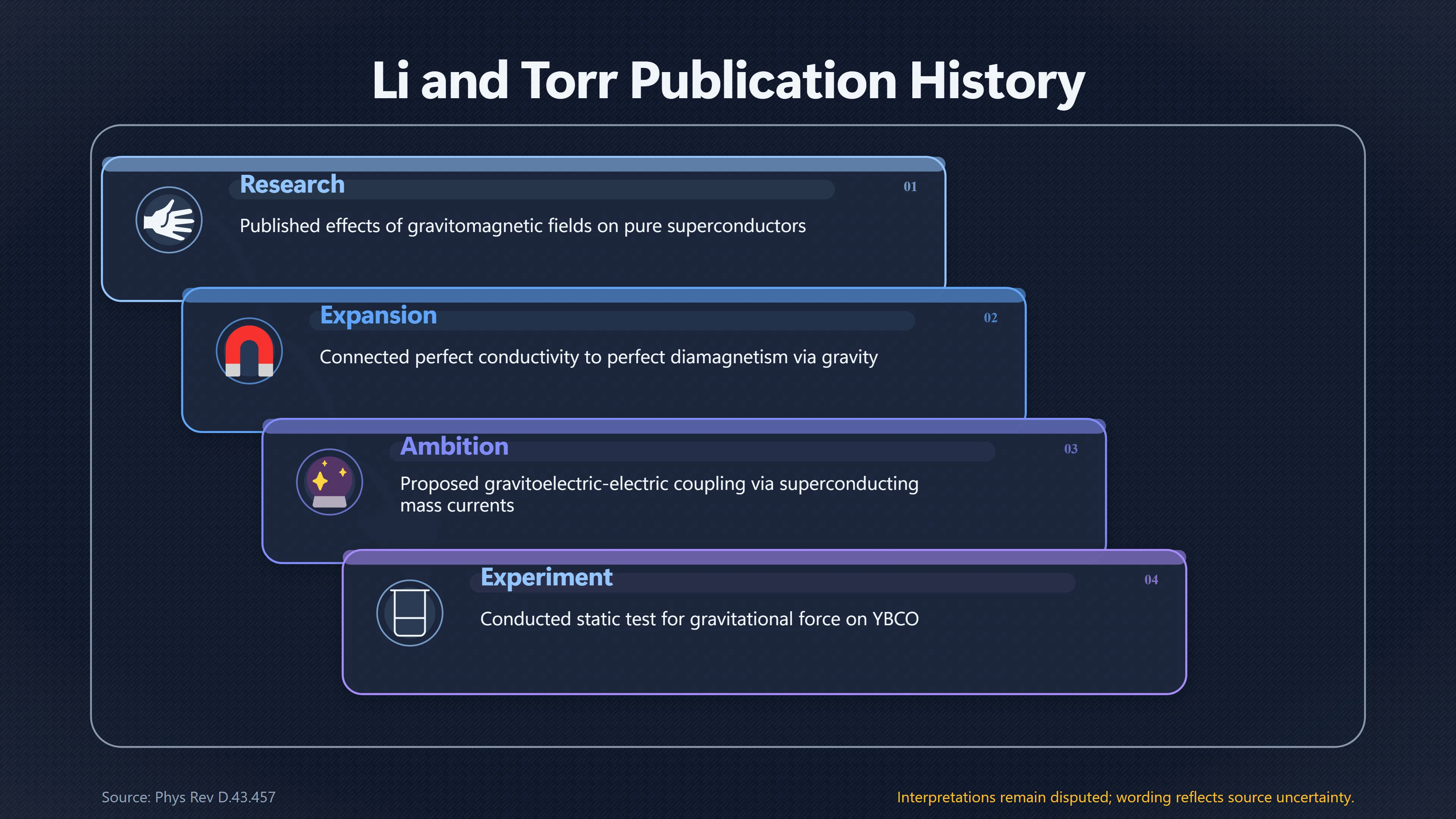
Their 1991 Physical Review D paper, “Effects of a gravitomagnetic field on pure superconductors”, considered how external magnetic and gravitomagnetic fields would behave in a pure superconductor. Li and Torr derived expressions involving the magnetic permeability of the superconductor and a proposed gravitomagnetic permeability. Their calculation predicted small internally induced perturbation fields and exponential attenuation over a characteristic distance. The paper was received in February 1990 and published on 15 January 1991.[APS Journals]journals.aps.orgPhys Rev D.43.457APS JournalsEffects of a gravitomagnetic field on pure superconductors | Phys. Rev. DJanuary 15, 1991…
In 1992 they developed the argument further in “Gravitational effects on the magnetic attenuation of superconductors”, published in Physical Review B. The paper attempted to connect two characteristic properties of an ideal superconductor — perfect conductivity and perfect diamagnetism — through a theoretical model incorporating gravitational effects. Li and Torr concluded that the result suggested gravity might have an unexpectedly important role in understanding superconductivity.[APS Journals]journals.aps.orgAPS JournalsGravitational effects on the magnetic attenuation of superconductors | Phys. Rev. B…
The idea became still more ambitious in Torr and Li’s 1993 Foundations of Physics Letters paper, “Gravitoelectric-electric coupling via superconductivity”. Their model argued that electromagnetic currents associated with electrons and ions could substantially cancel magnetically while the corresponding mass currents would not cancel gravitationally in the same fashion. From this they developed predictions involving coherent lattice-ion behaviour and potentially detectable gravitomagnetic and gravitoelectric fields.[OUCI]ouci.dntb.gov.uaOUCIGravitoelectric-electric coupling via superconductivityOUCIGravitoelectric-electric coupling via superconductivity
That last word — detectable — was the crucial scientific stake. General relativity normally predicts laboratory gravitomagnetic effects of extraordinary smallness. The scientific significance of Li and Torr’s proposal therefore depended not merely on whether some coupling existed mathematically, but on whether superconductivity could amplify or organise it enough to produce measurable effects. A later specialist review of gravity-superconductor research summarised the basic problem succinctly: conventional general relativity and lowest-order quantum-gravity estimates imply very small effects, so technologically interesting phenomena would require some strong additional quantum effect.[benthambooks.com]benthambooks.comGravity-Superconductors Interactions: Theory and ExperimentGravity-Superconductors Interactions: Theory and Experiment
Kowitt attacked the proposed amplification mechanism
Mark Kowitt’s 1994 Physical Review B paper, “Gravitomagnetism and magnetic permeability in superconductors”, directly challenged Li and Torr’s 1992 work. This was not a general complaint that “antigravity is impossible”. It was a technical criticism aimed at a quantity central to their calculation: the magnetic permeability, μ, assigned to a superconductor.[PubMed]pubmed.ncbi.nlm.nih.govPub Med Gravitomagnetism and magnetic permeability in superconductorsGravitomagnetism and magnetic permeability in superconductors - PubMedJanuary 1, 1994…
A superconductor exhibits the Meissner effect: magnetic flux is expelled from its bulk when it enters the superconducting state, subject to qualifications associated with geometry, penetration depth and, for type-II superconductors, flux penetration above the lower critical field. At the macroscopic level, ideal superconducting behaviour is consequently associated with perfect diamagnetism.
Kowitt argued that Li and Torr had taken the near-zero permeability used as a macroscopic description of this magnetic response and assigned it a microscopic physical significance it did not possess. According to his published criticism, this made their inferred gravitomagnetic effect far too large. His abstract did not treat the problem as a small correction: it described the predicted magnitude as “grossly overestimated” and also criticised the microscopic models Li and Torr had invoked to support their treatment.[ResearchGate]researchgate.net298460654 Gravity Superconductors interactions Theory and experiment298460654 Gravity Superconductors interactions Theory and experiment
The issue matters because a very small denominator or material parameter can create an enormous apparent enhancement in a theoretical expression. If that small number is being used outside the circumstances in which it meaningfully describes the material, the resulting amplification may be mathematical rather than physical.
Later physicist R. C. Woods summarised Kowitt’s objection in essentially these terms: Li and Torr had treated the permeability inside a superconductor as zero, or equivalently its susceptibility as −1, even though the central question was whether the familiar macroscopic experimental description could legitimately be carried into the microscopic calculation they were performing.[ScienceDirect]sciencedirect.comOpen source on sciencedirect.com.
That is a much more revealing criticism than simply saying that another physicist “disagreed”. Kowitt was challenging the bridge that took Li and Torr from an established superconducting phenomenon — strong diamagnetic response — to an extraordinary gravitational consequence.
Kowitt’s criticism was not itself the end of the debate
There is an important qualification. The historical literature does not support presenting Kowitt’s 1994 paper as an uncontested, once-and-for-all demolition of every Li–Torr argument.
Later reviews sympathetic to continued investigation questioned whether Kowitt’s permeability objection was decisive. Woods, for example, subsequently treated the validity of Li and Torr’s predicted superconducting gravitational-wave effects as unresolved rather than simply refuted. His later review described the underlying prediction as disputed and not conclusively confirmed or disproved.[Rex Research]rexresearch.comRex Research Gravity-Superconductors InteractionsRex Research Gravity-Superconductors Interactions
A later defence-oriented review of superconductor gravity research similarly stated that Li and Torr had countered Kowitt’s objection and that Woods had also questioned it. That document should not be treated as establishing that Li and Torr were therefore correct; it is valuable here because it records that the technical literature itself did not reduce the dispute to “Kowitt published, therefore the theory vanished”.[UFO Transparency]ufotransparency.comOpen source on ufotransparency.com.
Indeed, Woods’s 2010 paper framed the controversy explicitly as a testable conjecture. He noted that Li and Torr’s work implied a very large change in the propagation properties of gravitational waves in superconducting material and considered possible experimental consequences. At the same time, his abstract explicitly acknowledged that both Kowitt and Harris had argued that Li and Torr’s result was not credible.[ResearchGate]researchgate.netResearch Gate Testing the Li-Torr-Chiao conjecture: A novel HFGW detector?Research Gate Testing the Li-Torr-Chiao conjecture: A novel HFGW detector?
This is an important feature of genuine scientific controversy. A peer-reviewed criticism is itself an argument subject to scrutiny. Scientific credibility is not awarded permanently to whichever side publishes first — or whichever side publishes the first rebuttal. What matters is whether assumptions survive further theoretical examination and whether distinctive predictions survive measurement.
Harris identified a second and potentially deeper problem
Edward G. Harris’s 1999 paper, “Comments on ‘Gravitoelectric-Electric Coupling via Superconductivity’ by Douglas G. Torr and Ning Li”, shifted the focus away from Kowitt’s permeability objection. Published in Foundations of Physics Letters, volume 12, pages 201–208, it directly revisited Torr and Li’s 1993 calculations.[INSPIRE]inspirehep.netINSPIREGravitational Casimir effectINSPIREGravitational Casimir effect
Harris’s central conclusion was that the experimentally detectable fields predicted by Torr and Li depended on unrealistic assumptions that produced values many orders of magnitude too large. This matters because it provided an independent route to scepticism: even if one disputed Kowitt’s particular argument about magnetic permeability, that did not rescue all of the quantitative claims in the Li–Torr framework.
A later technical review of the controversy characterises Harris’s objection more specifically. According to that review, Torr and Li’s calculation employed extremely small distances between lattice ions and the observation point, thereby producing an unrealistically large gravitoelectric field. On the corrected treatment described there, Harris’s estimate for the externally induced field was about 20 orders of magnitude smaller.[UFO Transparency]ufotransparency.comOpen source on ufotransparency.com.
That figure should be reported carefully. It is a result attributed to Harris’s critique and repeated in later reviews; it is not a direct experimental measurement showing a twenty-order discrepancy. Nevertheless, the scale illustrates why the argument mattered. A theory proposing an experimentally accessible gravitational effect can cease to be experimentally interesting if correcting its assumptions reduces the signal by tens of orders of magnitude.
Harris therefore sharpened the scientific problem facing the theory. The issue was no longer just whether one should describe a superconductor using μ approaching zero in a particular calculation. It was whether several modelling choices had systematically converted intrinsically tiny gravitational effects into apparently laboratory-sized ones.
Li’s own experiment produced a stringent null constraint
Theory was not the only source of scrutiny. In 1997, Li joined David Noever, Tony Robertson, Ron Koczor and Whitt Brantley in an experiment published in Physica C under the title “Static test for a gravitational force coupled to type II YBCO superconductors”. YBCO is yttrium-barium-copper oxide, a high-temperature type-II superconductor.[ScienceDirect]sciencedirect.comOpen source on sciencedirect.com.
The experiment is especially important because it complicates caricatures of Li as someone simply promoting positive “antigravity” results. The team used a sensitive gravimeter while bulk YBCO superconductors were levitated in a direct-current magnetic field. They were investigating reports of anomalous weight changes associated with superconducting material, including earlier claims involving rotating YBCO.[ScienceDirect]sciencedirect.comOpen source on sciencedirect.com.
They did not report a detectable gravitational anomaly. Changes in acceleration were below two parts in 108 of normal gravitational acceleration. The authors explicitly described the result as placing new limits on the strength and range of the proposed coupling between static superconductors and gravity. NASA’s Technical Reports Server independently preserves the same result.[ScienceDirect]sciencedirect.comOpen source on sciencedirect.com.
This was not a comprehensive experimental refutation of everything Li had proposed. The configuration involved static superconductors, whereas some proposed effects depended on rotation, time-dependent fields or other conditions. It would therefore be misleading to say that this one experiment “disproved Li’s antigravity theory”.
But the null result is highly relevant to the peer-review story. It shows Li participating in the ordinary process by which an unusual hypothesis becomes experimentally constrained. A claimed or hypothesised effect was translated into a measurable configuration; the experiment established an upper bound rather than detecting the expected anomaly; and that bound became part of the published literature.
Later literature kept the controversy visible without establishing the effect
The gravity-superconductor subject did not disappear after Kowitt and Harris. Later researchers continued to explore theoretical couplings, gravitational-wave interactions and experimental configurations involving superconductors. A 2012 specialist volume on gravity-superconductor interactions explicitly surveyed both predictions and challenges, while describing conventional theoretical expectations as extremely small unless an additional strong quantum effect existed.[EurekaSelect]eurekaselect.comEureka Select BookEureka Select Book
That persistence is significant, but it should not be mistaken for retrospective validation of Li’s numerical predictions. Later literature includes models that differ substantially from Li and Torr’s assumptions, as well as papers explicitly attempting new approaches to gravitational interactions with superconducting quantum systems. A 2017 European Physical Journal C paper, for example, cites the Li–Torr sequence as part of the historical theoretical literature while developing its own treatment of superconductors in weak gravitational fields.[Springer Link]link.springer.comOpen source on springer.com.
More recent reviews likewise place Li and Torr among a much wider body of proposed gravity-superconductor interactions rather than treating their particular mechanism as established physics. A 2022 review in Symmetry surveys numerous approaches to superconductors and gravity, while a Frontiers in Physics treatment cites the Li–Torr papers as earlier work in an area where different gravitoelectromagnetic formulations remain technically important.[MDPI]mdpi.comSuperconductors and GravitySuperconductors and Gravity
The distinction is therefore between continued research interest and confirmation. A disputed theoretical idea can remain scientifically interesting because it raises testable questions or because later theories revisit related phenomena through different mechanisms. That does not mean the original calculation survived its objections.
What peer review did — and did not — establish
The Li–Torr episode shows why the phrase “peer-reviewed antigravity research” can mislead when used without explanation.
Peer review established that identifiable physicists at the University of Alabama in Huntsville formulated calculations that editors and referees judged suitable for publication and scientific scrutiny. Their 1991 and 1992 papers are genuine Physical Review publications with traceable publication records and DOIs. Their 1993 work likewise entered the scholarly literature.[APS Journals]journals.aps.orgPhys Rev D.43.457APS JournalsEffects of a gravitomagnetic field on pure superconductors | Phys. Rev. DJanuary 15, 1991…
It did not establish that superconductors had been demonstrated to generate technologically useful gravitational fields. The subsequent record contains exactly the sort of evidence that must be considered before making that stronger claim: Kowitt attacked the interpretation of permeability; Harris identified unrealistic assumptions producing enormous numerical enhancement; and Li’s own experimental collaboration reported a stringent null constraint in a static configuration.[nih.gov]pubmed.ncbi.nlm.nih.govPub Med Gravitomagnetism and magnetic permeability in superconductorsGravitomagnetism and magnetic permeability in superconductors - PubMedJanuary 1, 1994…
The fairest assessment is therefore neither “Li was a crank whose ideas never entered real physics” nor “peer review proved Li had discovered antigravity”. Both formulations erase the most informative part of the history.
Li’s unconventional gravity research did enter legitimate scientific debate. Once there, however, legitimacy meant exposure to criticism rather than immunity from it. Kowitt’s paper is especially revealing because Physical Review B — the journal that published Li and Torr’s 1992 model — also published a direct challenge to that model in 1994.[APS Journals]journals.aps.orgAPS JournalsGravitational effects on the magnetic attenuation of superconductors | Phys. Rev. B…
That is precisely how publication should function in a contested field: it makes assumptions inspectable.

Why this matters to claims of scientific suppression
Within accounts connecting UFO research, unconventional propulsion and alleged suppression of scientists, Li’s publication history creates an important evidential boundary.
There is strong documentary evidence for the narrow proposition that Ning Li was a genuine researcher pursuing highly unconventional gravitational ideas. The APS records, the Foundations of Physics Letters publications and the later Physica C experiment establish that without relying on anecdotes or retrospective UFO narratives.[aps.org]journals.aps.orgPhys Rev D.43.457APS JournalsEffects of a gravitomagnetic field on pure superconductors | Phys. Rev. DJanuary 15, 1991…
There is also strong evidence that important parts of those ideas encountered substantive scientific resistance. Kowitt and Harris did not merely invoke orthodoxy or refuse to discuss the subject. They published technical arguments about why the predicted magnitude of the effects was wrong. Later specialist literature continued to describe the Li–Torr results as disputed rather than experimentally established.[nih.gov]pubmed.ncbi.nlm.nih.govPub Med Gravitomagnetism and magnetic permeability in superconductorsGravitomagnetism and magnetic permeability in superconductors - PubMedJanuary 1, 1994…
That documented scientific criticism cannot by itself answer separate historical questions about Li’s later career, defence-related work or periods of low public visibility. But neither can those later circumstances retroactively establish that Kowitt or Harris was wrong, or that the scientific community had secretly accepted Li’s theory.
The peer-review record instead provides a useful benchmark for assessing suppression narratives. During the period for which the documentary scientific record is clearest, Li’s unconventional work was not simply prevented from reaching mainstream physics. It was published by mainstream journals, publicly criticised by other physicists, tested under at least some experimental conditions and subsequently discussed in specialist literature.
That distinction is central to evaluating scientific credibility. Publication means an unconventional claim has gained entry into the scientific conversation. It does not mean that peer reviewers have certified the claim as true. In Ning Li’s case, what happened after publication is at least as important as publication itself: the proposed large gravitational effects encountered quantitative objections precisely because other scientists were able to read the theory, identify its high-leverage assumptions and challenge them in the same scholarly system that had given the original ideas a hearing.
Amazon book picks
Further Reading
Books and field guides related to What Peer Review Did to Ning Li's Theory. Use these as the next step if you want deeper reading beyond the article.
The Demon-Haunted World: Science as a Candle in the Dark
Rating: 4.5/5 from 43 Google Books ratings
NEW YORK TIMES BESTSELLER • From the renowned astronomer and author of Cosmos comes a “powerful [and] stirring defense of informed ration...
The Trouble with Physics: The Rise of String Theory, the Fall...
The Trouble with Physics is a groundbreaking account of the state of modern physics: of how we got from Einstein and Relativity through q...
The Structure of Scientific Revolutions
A good book may have the power to change the way we see the world, but a great book actually becomes part of our daily consciousness, per...
Bad Science
Rating: 5.0/5 from 5 Google Books ratings
Have you ever wondered how one day the media can assert that alcohol is bad for us and the next unashamedly run a story touting the benef...
eBay marketplace picks
Marketplace Samples
Live-tested eBay searches with available results related to this page.
Selected fromgravity poster oneBay.co.uk.
Endnotes
1.
Source: journals.aps.org
Title: Phys Rev D.43.457
Link:https://journals.aps.org/prd/abstract/10.1103/PhysRevD.43.457
Source snippet
APS JournalsEffects of a gravitomagnetic field on pure superconductors | Phys. Rev. DJanuary 15, 1991...
Published: January 15, 1991
2.
Source: journals.aps.org
Link:https://journals.aps.org/prb/abstract/10.1103/PhysRevB.46.5489
Source snippet
APS JournalsGravitational effects on the magnetic attenuation of superconductors | Phys. Rev. B...
3.
Source: ouci.dntb.gov.ua
Title: OUCIGravitoelectric-electric coupling via superconductivity
Link:https://ouci.dntb.gov.ua/en/works/7nJwBNL7/
4.
Source: inspirehep.net
Title: INSPIREGravitational Casimir effect
Link:https://inspirehep.net/literature/1346504
5.
Source: arxiv.org
Title: arXiv Gravito-electromagnetism
Link:https://arxiv.org/abs/gr-qc/9704059
Source snippet
Gravito-electromagnetismApril 22, 1997...
Published: April 22, 1997
6.
Source: link.springer.com
Link:https://link.springer.com/article/10.1140/epjc/s10052
Source snippet
Springer LinkComments on gravitoelectromagnetism of Ummarino and Gallerati in “Superconductor in a weak static gravitational field” vs ot...
7.
Source: researchgate.net
Link:https://www.researchgate.net/publication/287041399_On_the_possibility_of_strong_coupling_between_electricity_and_gravitation
8.
Source: benthambooks.com
Title: Gravity-Superconductors Interactions: Theory and Experiment
Link:https://benthambooks.com/book/9781608053995/
9.
Source: journals.aps.org
Title: Journals Physical Review B
Link:https://journals.aps.org/prb/recent?ei=ntuwkjqa&page=8577
10.
Source: researchgate.net
Title: 298460654 Gravity Superconductors interactions Theory and experiment
Link:https://www.researchgate.net/publication/298460654_Gravity-Superconductors_interactions_Theory_and_experiment
11.
Source: researchgate.net
Link:https://www.researchgate.net/profile/Mark-Kowitt
12.
Source: sciencedirect.com
Link:https://www.sciencedirect.com/science/article/abs/pii/S0921453405007458
13.
Source: researchgate.net
Title: Research Gate Testing the Li-Torr-Chiao conjecture: A novel HFGW detector?
Link:https://www.researchgate.net/publication/234969415_Testing_the_Li-Torr-Chiao_conjecture_A_novel_HFGW_detector
14.
Source: sciencedirect.com
Link:https://www.sciencedirect.com/science/article/pii/S0921453497014627
15.
Source: ntrs.nasa.gov
Link:https://ntrs.nasa.gov/search.jsp?R=19990039542
16.
Source: eurekaselect.com
Title: Eureka Select Book
Link:https://www.eurekaselect.com/ebook_volume/1072
17.
Source: link.springer.com
Link:https://link.springer.com/article/10.1140/epjc/s10052-017-5116-y
18.
Source: mdpi.com
Title: Superconductors and Gravity
Link:https://www.mdpi.com/2073-8994/14/3/554
19.
Source: link.springer.com
Link:https://link.springer.com/article/10.1140/epjc/s10052-024-12506-1
20.
Source: researchgate.net
Title: (PDF) Interaction Between Macroscopic Quantum Systems and Gravity
Link:https://www.researchgate.net/publication/361488107_Interaction_Between_Macroscopic_Quantum_Systems_and_Gravity
21.
Source: researchgate.net
Link:https://www.researchgate.net/publication/354521867_A_simple_investigation_of_Static_test_for_a_gravitational_force_coupled_to_type_II_YBCO_superconductors_by_Li_and_coworkers
22.
Source: researchgate.net
Link:https://www.researchgate.net/publication/346408561_Fisher_information_and_the_weak_equivalence_principle_of_a_quantum_particle_in_a_gravitational_wave
23.
Source: researchgate.net
Title: (PDF) Comparative Study of the Meissner and Skin Effects in Superconductors
Link:https://www.researchgate.net/publication/325847085_Comparative_Study_of_the_Meissner_and_Skin_Effects_in_Superconductors
24.
Source: researchgate.net
Link:https://www.researchgate.net/publication/324558262_Applications_of_Ultra-Cold_Atomic_Trapping_Methods_Towards_Cooling_of_Stored_Electrons
25.
Source: researchgate.net
Link:https://www.researchgate.net/publication/319701206_Comments_on_Gravitoelectromagnetism_of_Ummarino_and_Gallerati_in_Superconductor_in_a_weak_static_gravitational_field_vs_Other_Versions
26.
Source: researchgate.net
Title: (PDF) On the physical significance of London’s equation
Link:https://www.researchgate.net/publication/280062435_On_the_physical_significance_of_London%27s_equation
27.
Source: researchgate.net
Link:https://www.researchgate.net/publication/276068572_Using_Tender_X-ray_Ambient_Pressure_X-Ray_Photoelectron_Spectroscopy_as_A_Direct_Probe_of_Solid-Liquid_Interface
28.
Source: researchgate.net
Title: (PDF) Distribution of Vascular Plants in the Ulleung Forest Trail Area, Korea
Link:https://www.researchgate.net/publication/272812004_Distribution_of_Vascular_Plants_in_the_Ulleung_Forest_Trail_Area_Korea
29.
Source: sciencedirect.com
Title: Spin rotation by Earthʼs gravitational field in a “frozen-spin” ring
Link:https://www.sciencedirect.com/science/article/abs/pii/S0375960112008973
30.
Source: researchgate.net
Title: (PDF) Gravity-Superconductors Interactions: Historical Background
Link:https://www.researchgate.net/publication/281439915_Gravity-Superconductors_Interactions_Historical_Background
31.
Source: sciencedirect.com
Link:https://www.sciencedirect.com/science/article/abs/pii/S0921453406008744
32.
Source: sciencedirect.com
Link:https://www.sciencedirect.com/science/article/abs/pii/S0921453406008574
33.
Source: researchgate.net
Link:https://www.researchgate.net/publication/1971465_Gravitomagnetic_Fields_in_Rotating_Superconductors_to_Solve_Tate%27s_Cooper_Pair_Mass_Anomaly
34.
Source: researchgate.net
Title: 259308236 A novel variable focus lens for HFGW
Link:https://www.researchgate.net/publication/259308236_A_novel_variable-focus_lens_for_HFGW
35.
Source: researchgate.net
Link:https://www.researchgate.net/publication/257331914_Manipulation_of_gravitational_waves_for_communications_applications_using_superconductors
36.
Source: researchgate.net
Link:https://www.researchgate.net/publication/228616053_Gravitational_Wave_Generation_and_Detection_Using_Acoustic_Resonators_and_Coupled_Resonance_Chambers
37.
Source: researchgate.net
Title: (PDF) Gravito-Electromagnetic Properties of Superconductors
Link:https://www.researchgate.net/publication/1944840Gravito-Electromagnetic_Properties_of_Superconductors-A_Brief_Review-
38.
Source: sciencedirect.com
Link:https://www.sciencedirect.com/science/article/abs/pii/S0378437103009038
39.
Source: sciencedirect.com
Title: Gravitomagnetic field of a rotating superconductor and of a rotating superfluid
Link:https://www.sciencedirect.com/science/article/pii/S0921453402023055
40.
Source: sciencedirect.com
Title: Magnetic flux quantization in superconductors and the Aharonov–Bohm effect
Link:https://www.sciencedirect.com/science/article/abs/pii/S0375960199002509
41.
Source: sciencedirect.com
Title: Magnetic flux quantization in superconductors and the Aharonov–Bohm effect
Link:https://www.sciencedirect.com/science/article/pii/S0375960199002509
42.
Source: sciencedirect.com
Title: Static test for a gravitational force coupled to type II YBCO superconductors
Link:https://www.sciencedirect.com/science/article/abs/pii/S0921453497014627
43.
Source: sciencedirect.com
Link:https://www.sciencedirect.com/journal/physica-c-superconductivity-and-its-applications/vol/281/issue/2
44.
Source: journals.aps.org
Link:https://journals.aps.org/prb/issues/46/9
45.
Source: journals.aps.org
Link:https://journals.aps.org/prd/issues/43/2
46.
Source: researchgate.net
Link:https://www.researchgate.net/publication/386695026_Superconductor_in_a_weak_static_gravitational_field
47.
Source: researchgate.net
Link:https://www.researchgate.net/publication/234929198_High-Frequency_Gravitational_Wave_HFGW_Generation_by_Means_of_X-ray_Lasers_and_Detection_by_Coupling_Linearized_GW_to_EM_Fields
48.
Source: researchgate.net
Link:https://www.researchgate.net/publication/228659858_Gravitational_Wave_GW_Radiation_Pattern_at_the_Focus_of_a_High-Frequency_GW_HFGW_Generator_and_Aerospace_Applications
49.
Source: sciencedirect.com
Title: Reverse Engineering [Podkletnov]({{ ‘podkletnov/’ | relative_url }})’s Experiments
Link:https://www.sciencedirect.com/science/article/pii/S1875389211005803
50.
Source: eurekaselect.com
Link:https://www.eurekaselect.com/chapter/3856
51.
Source: benthambooks.com
Link:https://benthambooks.com/book/9781608053995/contributors/
52.
Source: benthambooks.com
Link:https://benthambooks.com/book/9781608053995/preface/
53.
Source: benthambooks.com
Link:https://benthambooks.com/book/9781608053995/foreword/
54.
Source: benthambooks.com
Link:https://benthambooks.com/book/9781608053995/chapter/100224/
55.
Source: journals.aps.org
Title: Phys Rev.70.281
Link:https://journals.aps.org/pr/abstract/10.1103/PhysRev.70.281
56.
Source: pubmed.ncbi.nlm.nih.gov
Title: Pub Med Gravitomagnetism and magnetic permeability in superconductors
Link:https://pubmed.ncbi.nlm.nih.gov/10009347
Source snippet
Gravitomagnetism and magnetic permeability in superconductors - PubMedJanuary 1, 1994...
Published: January 1, 1994
57.
Source: pubmed.ncbi.nlm.nih.gov
Title: Pub Med Effects of a gravitomagnetic field on pure superconductors
Link:https://pubmed.ncbi.nlm.nih.gov/10013404/
Source snippet
Effects of a gravitomagnetic field on pure superconductors - PubMed...
58.
Source: rexresearch.com
Title: Rex Research Gravity-Superconductors Interactions
Link:https://www.rexresearch.com/ModaneseImpulseGenerator/GravitysuperconductorsInteractionsModanese.pdf
59.
Source: ufotransparency.com
Link:https://ufotransparency.com/files/decade-2020s-aatip-dird-documents-2018-2019-dird-14-dird-the-role-of-superconductors-in-gravity-rese
60.
Source: pmc.ncbi.nlm.nih.gov
Link:https://pmc.ncbi.nlm.nih.gov/articles/PMC7915057/
61.
Source: pmc.ncbi.nlm.nih.gov
Link:https://pmc.ncbi.nlm.nih.gov/articles/PMC4591620/
62.
Source: sweetstudy.com
Title: 2 pages | English homework help
Link:https://www.sweetstudy.com/sites/default/files/q4/02/06/strategicbrandmanagement4thedition.pdf
63.
Source: abr.business.gov.au
Title: business.gov.au Historical details for ABN 20 461 146 474 | ABN Lookup
Link:https://abr.business.gov.au/AbnHistory/View?id=20461146474
64.
Source: inspirehep.net
Link:https://inspirehep.net/literature/722115
65.
Source: pmc.ncbi.nlm.nih.gov
Link:https://pmc.ncbi.nlm.nih.gov/articles/PMC31091/
66.
Source: zamandayolculuk.com
Link:https://zamandayolculuk.com/html-3/electrostatic_propulsion.htm
68.
Source: pubmed.ncbi.nlm.nih.gov
Link:https://pubmed.ncbi.nlm.nih.gov/10004334/
69.
Source: deepdyve.com
Link:https://www.deepdyve.com/lp/american-physical-society-aps/effects-of-a-gravitomagnetic-field-on-pure-superconductors-6alMKHnwD6
70.
Source: wikidata.org
Title: Gravitoelectric-electric coupling via superconductivity
Link:https://www.wikidata.org/wiki/Q55922207
71.
Source: benthamscience.com
Link:https://www.benthamscience.com/ebook_volume/1072
72.
Source: uapmurders.com
Link:https://uapmurders.com/uaps/Details/Ning_Li/
73.
Source: ouci.dntb.gov.ua
Link:https://ouci.dntb.gov.ua/en/works/4OrJ6Gq7/
74.
Source: inspirehep.net
Link:https://inspirehep.net/literature/2022658
Additional References
75.
Source: youtube.com
Title: Anti-gravity and magnetic effects of mass | Maxwell’s eqn for gravity 2
Link:https://www.youtube.com/watch?v=OXceYD0OCBk
Source snippet
Superconductors & Gravity Control | Gary Stephenson This presentation directly traces the publication history of Ning Li's 1991 paper on...
76.
Source: youtube.com
Title: Eugene Podkletnov on Gravitational Shielding in Rotating Superconductors
Link:https://www.youtube.com/watch?v=blXEtLPVE9g
Source snippet
Anti-gravity and magnetic effects of mass | Maxwell's eqn for gravity 2...
77.
Source: youtube.com
Title: The disappearance of America’s leading anti-gravity researcher
Link:https://www.youtube.com/watch?v=Qsbz8_G9WcU
Source snippet
Eugene Podkletnov on Gravitational Shielding in Rotating Superconductors...
78.
Source: nature.com
Link:https://www.nature.com/articles/s41467-021-23365-9
79.
Source: nature.com
Link:https://www.nature.com/articles/ncomms1946
80.
Source: nature.com
Link:https://www.nature.com/articles/s41467-022-30918-z
81.
Source: osti.gov
Link:https://www.osti.gov/biblio/5986002
82.
Source: nature.com
Title: Single nuclear spin detection and control in a van der Waals material | Nature
Link:https://www.nature.com/articles/s41586-025-09258-7
83.
Source: montgomerycounty.online
Link:https://www.montgomerycounty.online/businesses
84.
Source: scribd.com
Link:https://www.scribd.com/document/133020262/Advances-in-Atomic-and-Molecular-Physics-Volume-15