Within Warnings
Does a Pre Death Suicide Denial Prove Foul Play?
Saying 'I would never kill myself' can raise a serious investigative question without conclusively establishing how a later death occurred.
On this page
- What a prior denial says about intent at that time
- Why later circumstances can still differ
- When the warning should trigger deeper scrutiny
Page outline Jump by section
Introduction
A statement such as “if you hear that I killed myself, I did not” is unusually striking when the speaker later dies in circumstances officially classified as suicide. In the UFO and antigravity-research debate, Amy Eskridge’s reported May 2022 message has become the clearest example. Reporting says she explicitly rejected suicide and overdose explanations less than a month before her death in Huntsville, Alabama; her death was subsequently reported as suicide by self-inflicted gunshot.[CRBC News]crbcnews.comCRBC News Researcher Texted 'I Definitely Did Not' Intend To Kill Herself Before Death; Friend Says She Feared Directed-Energy AttacksCRBC NewsResearcher Texted 'I Definitely Did Not' Intend To Kill Herself Before Death; Friend Says She Feared Directed-Energy Attacks - C…
That contradiction deserves scrutiny, but it does not settle the manner of death. A pre-death denial is strongest as evidence of the speaker’s expressed intention and expectations when the statement was made. It becomes evidence for homicide only when independent facts connect the warning to the later death. There is another important complication: research on suicide shows that some people who later die by suicide previously deny suicidal thoughts.[ScienceDirect]sciencedirect.comHow Common is Recent Denial of Suicidal Ideation among Ideators, Attempters, and Suicide Decedents? A Literature Review - Sc…
The useful question, therefore, is not whether such a statement “proves” foul play. It is what the statement establishes, what it cannot establish, and what additional evidence investigators should seek when the eventual death appears to match the very scenario the deceased had rejected.
What a prior denial actually says about intent
The most defensible interpretation begins with timing. A credible, authenticated message rejecting suicide provides direct evidence about what the person was saying about their intentions at that point in time. It can be particularly informative when it is spontaneous, specific, securely dated and sent privately rather than created after controversy has begun.
That distinction has a useful legal analogue. Federal Rule of Evidence 803(3) recognises statements describing a person’s then-existing state of mind, including motive, intent or plan. But it specifically limits the use of remembered beliefs as proof that the underlying events actually happened. In other words, “I intend to do X” can illuminate the speaker’s intention; “someone is doing X to me” does not automatically establish that another person really is doing it.[Legal Information Institute]law.cornell.eduLegal Information InstituteRule 803. Exceptions to the Rule Against Hearsay | Federal Rules of Evidence | US Law | LII / Legal Informatio…
Applied to a future-suicide denial, several propositions need to be kept separate. A sufficiently authenticated statement can support the conclusion that the speaker said they did not intend to kill themselves. If it contains predictions about how their death might be represented, it can also show that the speaker was already contemplating the possibility that others might interpret a future death as suicide. Neither proposition demonstrates why the speaker held that belief.
That last limitation matters greatly in cases involving allegations of surveillance, secret technology or targeted attacks. A person’s fear can be entirely genuine without their explanation for that fear necessarily being correct. Conversely, an unusual allegation should not be dismissed merely because it is unusual. The warning and the claimed cause of the danger are separate evidential questions.
Eskridge’s May 2022 message creates a real contradiction
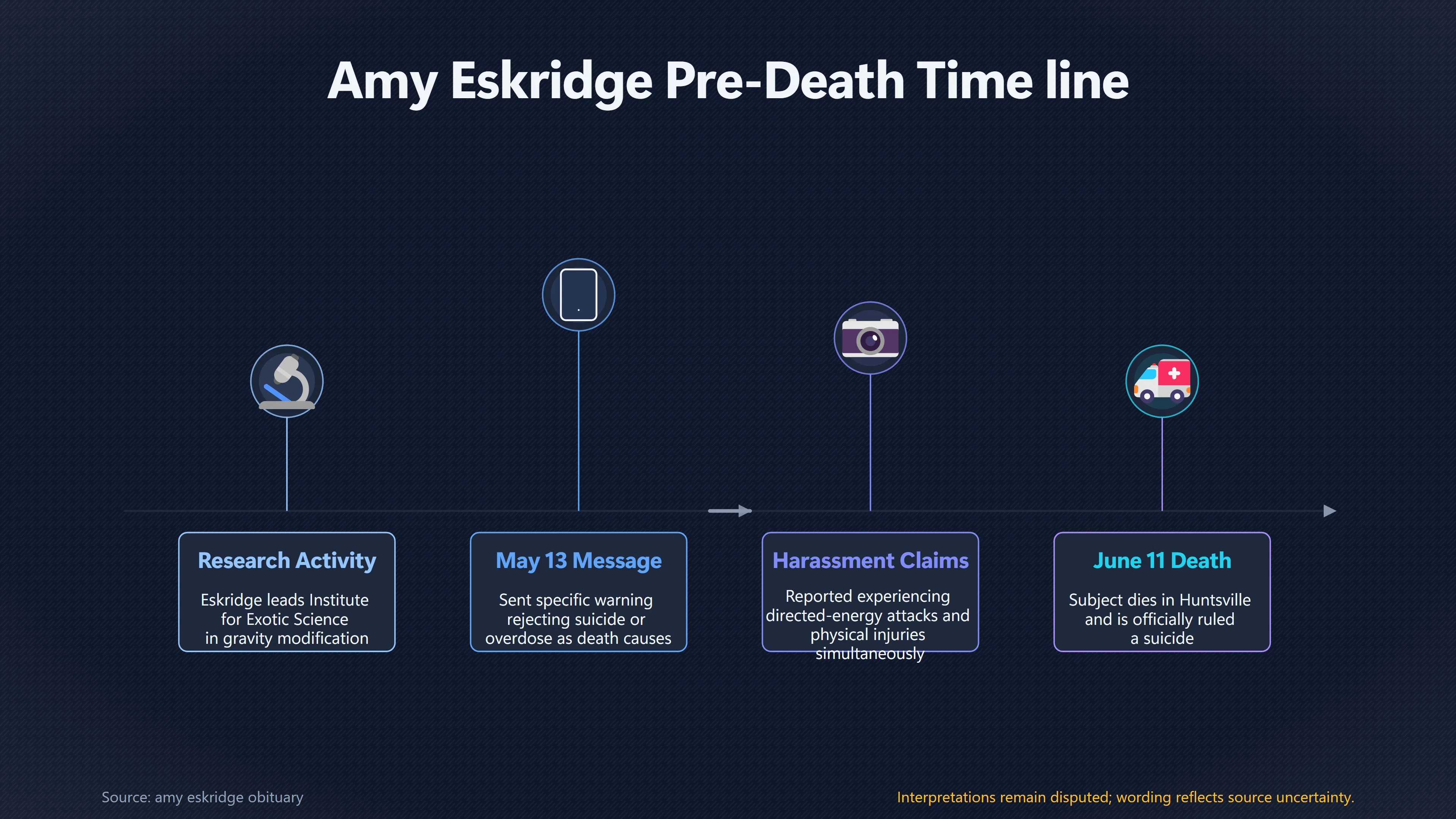
Amy Eskridge’s case makes the distinction unusually concrete. Her obituary confirms that she died on 11 June 2022 at 34 and identifies her as chairwoman and president of the Institute for Exotic Science in Huntsville, an organisation she had co-founded.[Legacy]legacy.comamy eskridge obituaryLegacyAmy Eskridge Obituary (1987 - 2022) - Huntsville, AL - AL.com (Huntsville)June 21, 2022
According to messages subsequently made public by Franc Milburn, a retired British military and intelligence figure who says he corresponded with her, Eskridge sent a message dated 13 May 2022 saying that if reports appeared claiming she had killed herself, overdosed or killed somebody else, those accounts should not be believed. Recent reporting reproduces the substance of the message and says her death was subsequently ruled a suicide by self-inflicted gunshot.[CRBC News]crbcnews.comCRBC News Researcher Texted 'I Definitely Did Not' Intend To Kill Herself Before Death; Friend Says She Feared Directed-Energy AttacksCRBC NewsResearcher Texted 'I Definitely Did Not' Intend To Kill Herself Before Death; Friend Says She Feared Directed-Energy Attacks - C…
The chronological sequence is therefore the important feature:
- Eskridge was publicly involved with unconventional propulsion and gravity-modification research.
- Weeks before her death, she reportedly sent a specific message rejecting suicide and overdose as explanations for any future death.
- Milburn says she was simultaneously describing harassment and attacks that she believed were directed against her.
- She died on 11 June 2022.
- Subsequent reporting describes the official determination as suicide by self-inflicted gunshot. CRBC News
That sequence is genuinely noteworthy. It is stronger than an acquaintance saying years later, “she would never have done that”, because the reported message is attributed to Eskridge herself and predates the death. It is also more specific than a general statement about wanting to live.
Yet its significance depends heavily on authentication. Investigators would ideally want the original device or account data, full conversation rather than selected screenshots, reliable timestamps, metadata where recoverable, corroborating recipients and evidence excluding alteration or impersonation. Public reporting has largely relied on messages supplied by people who knew or corresponded with Eskridge rather than publication of a complete forensic authentication of the communications. That leaves a meaningful difference between a widely reported message attributed to Eskridge and a communication independently forensically established as hers in an investigative record. CRBC News
Why “I would never kill myself” cannot prove homicide
The apparent paradox is powerful: if someone says they will not die by suicide and then authorities classify their death as suicide, one of those pieces of information may appear to have to be wrong. Human behaviour makes the inference less straightforward.
A 2021 review in General Hospital Psychiatry examined 22 studies concerning disclosure or denial of suicidal ideation. It found that roughly half of suicide decedents in the relevant studies had denied suicidal ideation during the preceding week or month. The author concluded that denial of suicidal ideation, by itself, is an inadequate indicator of suicide risk. ScienceDirect
That finding does not mean Eskridge was suicidal, nor does it explain her death. It establishes a narrower but crucial point: a genuine earlier denial and a later suicide are not mutually exclusive as a matter of behavioural evidence. People may conceal suicidal thoughts, experience rapidly changing circumstances, develop suicidal intent after making an earlier statement, or give answers that do not capture their actual risk.
Modern clinical guidance reflects the same problem. Suicide risk is understood as dynamic and multifactorial rather than something that can reliably be inferred from a single answer about present suicidal thoughts. Current clinical summaries emphasise combining present and historical information, records and collateral evidence rather than treating denial of suicidal ideation as dispositive. NCBI
There is an additional distinction in Eskridge’s case. Her reported statement was not simply the clinical proposition “I am not suicidal today”. It was framed prospectively: if a particular explanation appeared after her death, it should be rejected. That makes it more relevant to a later investigation because it shows she had contemplated precisely that possible account of her death. But it still cannot tell investigators whether her expectation reflected a genuine external threat, mistaken attribution of frightening experiences, rhetorical emphasis, or circumstances that subsequently changed.
The warning becomes stronger only when other evidence converges
A pre-death suicide denial should therefore be treated as an investigative lead whose weight can increase or decrease through corroboration. The most important question is whether evidence independent of the warning converges on what the deceased predicted.
In a case such as Eskridge’s, several forms of evidence would materially change the assessment. Authentication of the complete message history would establish exactly what she said and when. Statements from multiple independent recipients could show whether the warning was repeated consistently rather than appearing in one isolated exchange. Medical and mental-health records, where lawfully available to investigators, could help reconstruct changes in condition without assuming that either apparent stability or distress determines the answer. Firearms evidence, scene reconstruction, toxicology, autopsy findings and digital activity immediately before death would bear directly on the physical circumstances.
The alleged threats require a separate evidential track. Milburn says Eskridge reported harassment and injuries that she attributed to a directed-energy weapon and supplied photographs of apparent physical effects. Those claims have been reported publicly, but the available reporting does not establish an independent forensic finding that the injuries were caused by such a weapon. CRBC News The existence of directed-energy technology in general would likewise not demonstrate its use against a particular individual.
Evidence linking an identifiable person or organisation to surveillance, threats, access to Eskridge, or the death scene would be far more consequential than the warning itself. So would independently documented attempts to encourage suicide, falsify records, interfere with her work or obtain her research. Without such bridges, a warning establishes apprehension and stated intent but leaves the proposed perpetrator and mechanism unproven.
The counter-evidence matters just as much. Public accounts report that Eskridge’s father, Richard Eskridge, has rejected the idea that her death was mysterious; one account quotes him saying that scientists “die also, just like other people”. strangerthanfiction.org Family opinion does not determine a forensic finding, but neither can it fairly be omitted from an assessment that relies heavily on the recollections of other people close to her.
When a denial should trigger deeper scrutiny
The appropriate response to a credible pre-death denial lies between two unhelpful extremes. One is to declare it proof of murder. The other is to dismiss it because people who die by suicide sometimes previously deny suicidal intent.
The case for deeper scrutiny becomes substantially stronger when several features occur together: the statement is demonstrably authentic and close in time to death; it explicitly anticipates the eventual reported manner of death; the speaker repeatedly made the same warning to independent people; specific threats can be verified; physical or digital evidence supports surveillance or coercion; the death-scene evidence contains anomalies; or important parts of the official explanation conflict with independently established facts.
Eskridge’s reported message meets at least one particularly interesting criterion: its content, as reported, specifically anticipates a suicide explanation before a death subsequently reported as suicide. CRBC News That coincidence makes the message relevant and worth preserving, authenticating and comparing with the complete investigative record.
What the publicly accessible record does not currently supply is the evidential bridge from “Eskridge said a future suicide report would be false” to “another person killed Eskridge because of her antigravity research”. Those are fundamentally different propositions. The first is supported by reported pre-death communications; the second requires forensic and investigative evidence establishing external action, motive and connection to her research.
The right evidential weight
A pre-death suicide denial occupies an awkward but important position. It is more probative than hindsight from friends who simply cannot imagine that someone took their own life, because a contemporaneous statement records what the deceased themselves said before the outcome was known. Yet it is much less probative than physical evidence establishing another person’s involvement.
For the wider controversy over suspicious deaths among UFO, advanced-propulsion and antigravity researchers, that distinction is essential. Pre-death warnings should not be stripped of significance merely because they are associated with extraordinary claims. Equally, their dramatic correspondence with a later death should not substitute for proving the mechanism behind that death.
In Eskridge’s case, the reported denial makes a legitimate investigative question unusually sharp: why did she specifically tell others not to believe a future suicide explanation, and how does that statement fit the physical and documentary evidence surrounding her death? Clinical research prevents the denial alone from answering the question. The timing and specificity prevent it from being responsibly ignored. ScienceDirect
Amazon book picks
Further Reading
Books and field guides related to Does a Pre Death Suicide Denial Prove Foul Play?. Use these as the next step if you want deeper reading beyond the article.
Thinking, Fast and Slow
Why is there more chance we'll believe something if it's in a bold type face? Why are judges more likely to deny parole before lunch? Why...
The Psychology of Judgment and Decision Making
THE PSYCHOLOGY OF JUDGMENT AND DECISION MAKING offers a comprehensive introduction to the field with a strong focus on the social aspects...
The Demon-haunted World
Rating: 4.5/5 from 43 Google Books ratings
Are we on the brink of a new Dark Age of irrationality and superstition? In this book, the writer shows how scientific thinking is necess...
Unnatural Causes
Dr Richard Shepherd is the UK's foremost forensic pathologist. At medical school, while performing his first autopsy, he held the heart o...
eBay marketplace picks
Marketplace Samples
Live-tested eBay searches with available results related to this page.
Selected fromUFO poster oneBay.co.uk.




Endnotes
1.
Source: sciencedirect.com
Link:https://www.sciencedirect.com/science/article/abs/pii/S0163834321001080
Source snippet
How Common is Recent Denial of Suicidal Ideation among Ideators, Attempters, and Suicide Decedents? A Literature Review - Sc...
2.
Source: sciencedirect.com
Link:https://www.sciencedirect.com/science/article/pii/S0163834321001080
Source snippet
How Common is Recent Denial of Suicidal Ideation among Ideators, Attempters, and Suicide Decedents? A Literature Review - Sc...
3.
Source: legacy.com
Title: amy eskridge obituary
Link:https://www.legacy.com/us/[obituaries
Source snippet
Amy Eskridge Obituary (1987 - 2022) - Huntsville, AL - AL.com (Huntsville)June 21, 2022...
Published: June 21, 2022
4.
Source: ncbi.nlm.nih.gov
Title: NCBISuicide: Assessment and Management
Link:https://www.ncbi.nlm.nih.gov/books/NBK617057/
Source snippet
StatPearls - NCBI BookshelfJune 17, 2026...
Published: June 17, 2026
5.
Source: ncbi.nlm.nih.gov
Title: NCBISuicide: Assessment and Management
Link:https://www.ncbi.nlm.nih.gov/sites/books/NBK617057/
Source snippet
StatPearls - NCBI Bookshelf...
6.
Source: strangerthanfiction.org
Title: Amy Eskridge: The Scientist Who Predicted Her Own Death
Link:https://www.strangerthanfiction.org/2026/04/amy-eskridge-scientist-predicted-own-death/
7.
Source: sciencedirect.com
Link:https://www.sciencedirect.com/science/article/pii/S0749208126001774
8.
Source: sciencedirect.com
Link:https://www.sciencedirect.com/science/article/abs/pii/S0005791623000034
9.
Source: legacy.com
Title: amy eskridge obituary
Link:https://www.legacy.com/us/obituaries/name/amy-eskridge-obituary?pid=202539896
10.
Source: legacy.com
Title: amy eskridge obituary
Link:https://www.legacy.com/us/obituaries/name/amy-eskridge-obituary?id=36170956
11.
Source: legacy.com
Title: amy eskridge memorial
Link:https://www.legacy.com/us/obituaries/legacyremembers/amy-eskridge-memorial?id=35311909
12.
Source: sciencedirect.com
Link:https://www.sciencedirect.com/science/article/abs/pii/S0025619617308868
13.
Source: legacy.com
Link:https://www.legacy.com/obituaries/name/eskridge/amy
14.
Source: sciencedirect.com
Title: Suicidal ideation disclosure: Patterns, correlates and outcome
Link:https://www.sciencedirect.com/science/article/abs/pii/S0165178119305359
15.
Source: sciencedirect.com
Link:https://www.sciencedirect.com/science/article/abs/pii/S0163834326001349
17.
Source: law.cornell.edu
Link:https://www.law.cornell.edu/rules/fre/rule_803
Source snippet
Legal Information InstituteRule 803. Exceptions to the Rule Against Hearsay | Federal Rules of Evidence | US Law | LII / Legal Informatio...
18.
Source: pmc.ncbi.nlm.nih.gov
Link:https://pmc.ncbi.nlm.nih.gov/articles/PMC13267865/
19.
Source: ncbi.nlm.nih.gov
Link:https://ncbi.nlm.nih.gov/books/NBK617057/?report=reader
20.
Source: imdb.com
Title: Amy Eskridge
Link:https://www.imdb.com/name/nm13210059/news/
21.
Source: pmc.ncbi.nlm.nih.gov
Link:https://pmc.ncbi.nlm.nih.gov/articles/PMC13270292/
22.
Source: disclosuremonitor.com
Title: Amy Eskridge | Disclosure Monitor
Link:https://disclosuremonitor.com/people/amy-eskridge-antigravity-researcher
23.
Source: pubmed.ncbi.nlm.nih.gov
Link:https://pubmed.ncbi.nlm.nih.gov/41331149/
24.
Source: pmc.ncbi.nlm.nih.gov
Link:https://pmc.ncbi.nlm.nih.gov/articles/PMC13337130/
25.
Source: pmc.ncbi.nlm.nih.gov
Link:https://pmc.ncbi.nlm.nih.gov/articles/PMC12263158/
26.
Source: pmc.ncbi.nlm.nih.gov
Link:https://pmc.ncbi.nlm.nih.gov/articles/PMC12438984/
27.
Source: pmc.ncbi.nlm.nih.gov
Link:https://pmc.ncbi.nlm.nih.gov/articles/PMC12246001/
28.
Source: ncbi.nlm.nih.gov
Link:https://www.ncbi.nlm.nih.gov/books/NBK613190/?report=reader
29.
Source: pmc.ncbi.nlm.nih.gov
Link:https://pmc.ncbi.nlm.nih.gov/articles/PMC11164635/
30.
Source: ncbi.nlm.nih.gov
Link:https://www.ncbi.nlm.nih.gov/sites/books/NBK592804/
31.
Source: ncbi.nlm.nih.gov
Link:https://www.ncbi.nlm.nih.gov/books/NBK592804/?report=printable
32.
Source: pmc.ncbi.nlm.nih.gov
Link:https://pmc.ncbi.nlm.nih.gov/articles/PMC10234328/
33.
Source: pmc.ncbi.nlm.nih.gov
Link:https://pmc.ncbi.nlm.nih.gov/articles/PMC10045566/
34.
Source: pmc.ncbi.nlm.nih.gov
Link:https://pmc.ncbi.nlm.nih.gov/articles/PMC9712587/
35.
Source: pubmed.ncbi.nlm.nih.gov
Link:https://pubmed.ncbi.nlm.nih.gov/36263445/
36.
Source: pmc.ncbi.nlm.nih.gov
Link:https://pmc.ncbi.nlm.nih.gov/articles/PMC9280826/
37.
Source: ufouap.com
Title: amy eskridge
Link:https://www.ufouap.com/case-files/amy-eskridge/
38.
Source: pmc.ncbi.nlm.nih.gov
Link:https://pmc.ncbi.nlm.nih.gov/articles/PMC10281367/
39.
Source: em-consulte.com
Title: General Hospital Psychiatry
Link:https://www.em-consulte.com/revue/GHP/72/C/table-des-matieres/
40.
Source: pmc.ncbi.nlm.nih.gov
Link:https://pmc.ncbi.nlm.nih.gov/articles/PMC8111990/
41.
Source: pubmed.ncbi.nlm.nih.gov
Link:https://pubmed.ncbi.nlm.nih.gov/33189221/
42.
Source: pmc.ncbi.nlm.nih.gov
Link:https://pmc.ncbi.nlm.nih.gov/articles/PMC6120798/
43.
Source: pmc.ncbi.nlm.nih.gov
Link:https://pmc.ncbi.nlm.nih.gov/articles/PMC5517300/
44.
Source: pubmed.ncbi.nlm.nih.gov
Link:https://pubmed.ncbi.nlm.nih.gov/28685838/
45.
Source: pmc.ncbi.nlm.nih.gov
Link:https://pmc.ncbi.nlm.nih.gov/articles/PMC5690847/
46.
Source: pmc.ncbi.nlm.nih.gov
Link:https://pmc.ncbi.nlm.nih.gov/articles/PMC5451650/
47.
Source: pmc.ncbi.nlm.nih.gov
Link:https://pmc.ncbi.nlm.nih.gov/articles/PMC5674992/
48.
Source: pmc.ncbi.nlm.nih.gov
Link:https://pmc.ncbi.nlm.nih.gov/articles/PMC4055158/
49.
Source: law.cornell.edu
Title: edu225 Pa. Code r. 803(3)
Link:https://www.law.cornell.edu/regulations/pennsylvania/225-Pa-Code-r-803%283%29
50.
Source: ncbi.nlm.nih.gov
Link:https://www.ncbi.nlm.nih.gov/books/NBK217848/?report=printable
51.
Source: pubmed.ncbi.nlm.nih.gov
Link:https://pubmed.ncbi.nlm.nih.gov/23561227/
52.
Source: pubmed.ncbi.nlm.nih.gov
Link:https://pubmed.ncbi.nlm.nih.gov/31198796/
53.
Source: pmc.ncbi.nlm.nih.gov
Link:https://pmc.ncbi.nlm.nih.gov/articles/PMC6555204/
54.
Source: pubmed.ncbi.nlm.nih.gov
Link:https://pubmed.ncbi.nlm.nih.gov/41216768/
55.
Source: crbcnews.com
Title: The ‘[Missing Scientists]({{ ‘missing-scientist/’ | relative_url }})’ Myth: What the Evidence Actually Shows
Link:https://www.crbcnews.com/articles/6a0423fdbd8d368dc7ba8a48
56.
Source: imdb.com
Title: Franc Milburn
Link:https://www.imdb.com/name/nm18471285/
Additional References
57.
Source: youtube.com
Title: Father of 11th dead or missing scientist rejects suspicions about her death
Link:https://www.youtube.com/watch?v=1d–WxTUkXE
Source snippet
What Happened to Amy Eskridge? | Anti-Gravity, Exotic Science, and Conspiracy Theories...
58.
Source: youtube.com
Link:https://www.youtube.com/watch?v=SSs-GI75nF8
Source snippet
US adversaries may have taken out missing scientists: Eric Burlison...
59.
Source: youtube.com
Title: Missing scientists case less ‘Men in Black,’ more espionage: Luis Elizondo
Link:https://www.youtube.com/watch?v=4Ei3yCXF098
Source snippet
Probe deepens into deaths & disappearances of 12 US scientists with nuke, UFO info...
60.
Source: yahoo.com
Title: researcher felt endangered her 2022 070000699
Link:https://www.yahoo.com/news/videos/researcher-felt-endangered-her-2022-070000699.html
Source snippet
Researcher felt endangered before her 2022 death: Acquaintance | Elizabeth Vargas Reports...
61.
Source: youtube.com
Title: US adversaries may have taken out missing scientists: Eric Burlison
Link:https://www.youtube.com/watch?v=9GgbmGi2aR8
Source snippet
Missing scientists case less 'Men in Black,' more espionage: Luis Elizondo...
62.
Source: illinoiscourts.gov
Link:https://www.illinoiscourts.gov/courts-supreme-court-illinois-rules-of-evidence/
63.
Source: osha.gov
Link:https://www.osha.gov/laws-regs/federalregister/1994
64.
Source: pacodeandbulletin.gov
Title: 225 Pa. Code Rule 803(3). Then-Existing Mental, Emotional, or Physical Condition
Link:https://www.pacodeandbulletin.gov/secure/pacode/data/225/chapter8/s803-3.html
65.
Source: shinysideout.com.au
Link:https://www.shinysideout.com.au/00-amy-eskridge.html
66.
Source: bollywoodshaadis.com
Link:https://www.bollywoodshaadis.com/articles/amy-eskridge-death-mystery-final-texts-revealed-death-threats-suicide-plot-78120