Within Cold Fusion
What Happened When Google Retested Cold Fusion
A Google-backed team deliberately revisited cold fusion, found no evidence for it and still argued that rigorous re-examination was scientifically worthwhile.
On this page
- Why researchers chose to revisit a taboo subject
- What the multi institution experiments found
- What the project says about stigma versus suppression
Page outline Jump by section
Introduction
In 2019, a Google-backed research team published the results of an unusually deliberate experiment in scientific second chances: it had spent several years revisiting cold-fusion claims with modern instrumentation, multiple laboratories and stringent internal review. The result was not a vindication. The researchers reported no compelling evidence for cold fusion. Yet they also argued that undertaking the work had been scientifically worthwhile because some experimental conditions invoked by cold-fusion proponents were harder to create and measure than the earlier controversy had made clear, while the investigation produced useful advances in materials science and experimental methods.[Nature]nature.comRevisiting the cold case of cold fusion | NatureRevisiting the cold case of cold fusion | NatureMay 27, 2019…
That combination makes the project particularly relevant to claims that unconventional energy research is “suppressed”. Google’s programme shows that a stigmatised subject can indeed become difficult to investigate within mainstream science. But it also demonstrates something different from organised suppression: substantial private funding, respected laboratories, publication in Nature and an explicit attempt to give controversial claims another rigorous test. The experiment therefore provides an unusually useful case for separating scientific stigma from claims that evidence or researchers were deliberately silenced.[EurekaAlert!]eurekalert.orgEureka Alert!Scientists revisit the cold case of cold fusion | Eurek Alert!EurekaAlert!Scientists revisit the cold case of cold fusion | EurekAlert!May 28, 2019…
Why Google reopened a scientific taboo
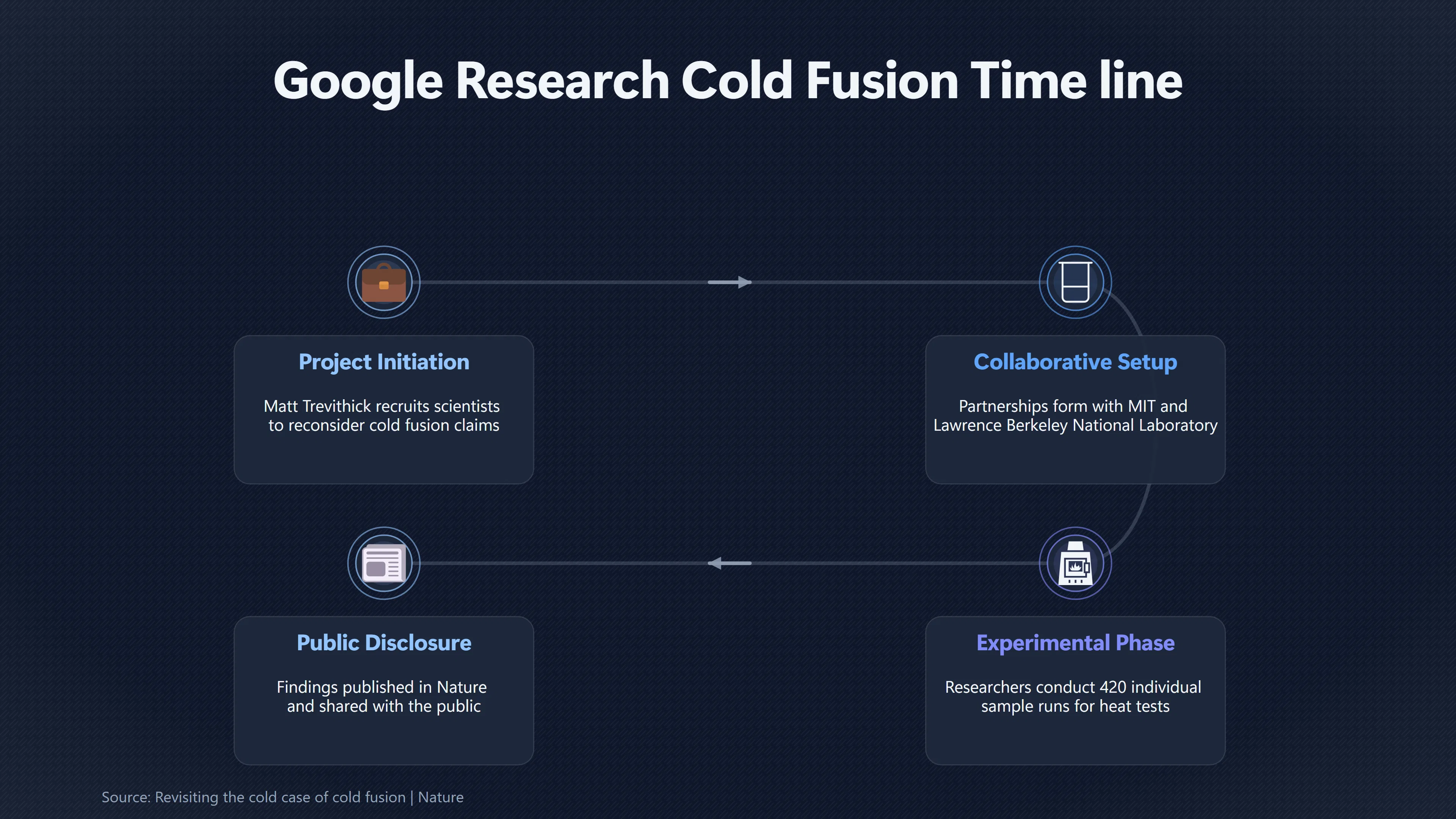
The project originated with Matt Trevithick, then a senior programme manager at Google Research. By spring 2015 he was recruiting scientists to reconsider cold fusion. Rather than instructing them to prove or disprove a predetermined proposition, Google asked prospective collaborators what experiments they considered scientifically interesting. Yet-Ming Chiang of the Massachusetts Institute of Technology later recalled that proposals were internally reviewed and that the attraction for his group lay partly in the possibility of using electrochemistry to create unusual, heavily hydrogen-loaded states of matter.[MIT News]news.mit.eduMIT News3Q: Yet-Ming Chiang on reopening the case of cold fusion | MIT News | Massachusetts Institute of Technology…
The collaboration eventually involved roughly 30 graduate students, postdoctoral researchers and staff scientists, with investigators associated with Google, MIT, the University of British Columbia, the University of Maryland and Lawrence Berkeley National Laboratory. The programme operated as a scientific “peer group”, with transparent access among participating researchers to apparatus and data and a stringent internal-review process. Its stated aim was to generate reliable experimental evidence rather than simply rehabilitate old claims.[Nature]nature.comRevisiting the cold case of cold fusion | NatureRevisiting the cold case of cold fusion | NatureMay 27, 2019…
The researchers also kept the programme deliberately quiet during its early stages. Chiang said that his MIT group initially concealed the underlying purpose even from some laboratory members because the researchers did not want Google’s involvement in cold fusion to become a distraction. That choice is revealing about the subject’s reputation: the team clearly regarded the label as capable of distorting attention around otherwise ordinary materials-science experiments. But secrecy during the research phase was paired with a stated intention to publish the findings after internal scrutiny, including negative results.[MIT News]news.mit.eduMIT News3Q: Yet-Ming Chiang on reopening the case of cold fusion | MIT News | Massachusetts Institute of Technology…
According to contemporary reporting, Google had spent about US$10 million on the programme by 2019. The project’s significance was therefore not that somebody casually repeated a thirty-year-old electrolysis demonstration. It was a well-resourced attempt to identify specific claims that could be converted into measurable experimental questions.[National Geographic]nationalgeographic.comOpen source on nationalgeographic.com.
The experiments targeted conditions proponents said mattered
One difficulty in evaluating cold fusion is that unsuccessful replications can generate an escape route: perhaps the experiment failed because some critical material state was never achieved. Google’s collaboration tried to address that problem by examining particular conditions that advocates had associated with anomalous heat or nuclear effects rather than treating “cold fusion” as one undifferentiated claim.
One major target was extreme loading of hydrogen isotopes into palladium. Earlier cold-fusion work had suggested that anomalous effects might occur only after the metal contained exceptionally high concentrations of deuterium. The Google-backed researchers therefore investigated how to create and accurately measure highly loaded palladium rather than simply assuming that an electrochemical cell had reached the required state.[National Geographic]nationalgeographic.comOpen source on nationalgeographic.com.
That exercise uncovered an important measurement problem. Electrical resistance had previously been used as an indirect measure of deuterium loading, but the team found limitations in that approach. Researchers instead developed methods involving X-ray diffraction, using changes in the palladium crystal lattice to determine its hydrogen content more directly. Chiang’s MIT group reported reaching a hydrogen-to-palladium ratio of about 0.96 ± 0.02, close to the theoretical ratio of one hydrogen atom per palladium atom.[National Geographic]nationalgeographic.comOpen source on nationalgeographic.com.
This did not produce compelling evidence of cold fusion. More importantly, however, the researchers found that maintaining and characterising the extreme loading conditions claimed to be important was itself technically difficult. That prevented the project from turning its negative findings into an unlimited statement that every conceivable cold-fusion configuration had been disproved. The conclusion was narrower: under the conditions the researchers actually produced and measured, they had not observed the claimed phenomenon.[MIT News]news.mit.eduMIT News3Q: Yet-Ming Chiang on reopening the case of cold fusion | MIT News | Massachusetts Institute of Technology…
Four hundred and twenty heat tests found no excess energy
Another part of the programme addressed claims of anomalous heat from metal-hydrogen systems at elevated temperatures and pressures. This was particularly important because “excess heat” is central to many cold-fusion and later low-energy nuclear reaction claims: if a device genuinely releases substantially more heat than conventional chemistry and measurement error can explain, something unusual requires investigation.
The team found that calorimetry — accurately accounting for heat entering and leaving the apparatus — became difficult under the relevant conditions. Researchers therefore constructed unusually precise calorimeters and developed methods for modelling time-dependent heat flows and stored energy before judging whether a sample had generated anomalous power.[National Geographic]nationalgeographic.comOpen source on nationalgeographic.com.
They then examined 420 individual sample runs, varying parameters including temperature, pressure, composition, particle size and surface treatment. The result was strikingly consistent: none provided evidence of excess heat. The reported coefficient of performance — energy measured out relative to energy supplied — remained consistent with unity, with a stated three-standard-deviation uncertainty of ±0.0825. In practical terms, the apparatus did not reveal the substantial unexplained energy production being sought.[Squarespace]static1.squarespace.comBerlinguette Nature 2019Source details in endnotes.
This is one of the strongest parts of the 2019 programme for assessing suppression narratives because it replaced a sociological argument with a measurement problem. Whether cold fusion had previously been treated unfairly did not determine the outcome. A large experimental series specifically designed to detect anomalous heat failed to find it.
The team nevertheless avoided claiming that the 420 runs covered every possible combination of conditions proposed by advocates. Instead, it made its calorimeter design and analytical methods available so that others could explore the remaining parameter space. That is an important distinction: failure to detect an effect was reported as failure to detect an effect, rather than inflated into proof that no conceivable version of the phenomenon could exist.[Squarespace]static1.squarespace.comBerlinguette Nature 2019Source details in endnotes.
Low-energy nuclear tests produced real fusion, but not the claimed anomaly
A third line of investigation examined nuclear reactions more directly. At Lawrence Berkeley National Laboratory, researchers used a pulsed deuterium plasma directed at palladium. Unlike the famous electrochemical claims, this apparatus could produce recognisable deuterium-deuterium fusion at low but non-zero ion energies, allowing researchers to measure nuclear products rather than infer nuclear processes merely from unexplained heat.[BioFusion Lab]biochemistry.khu.ac.krOpen source on khu.ac.kr.
The researchers confirmed that they could generate and detect neutrons from deuterium-deuterium fusion at ion energies corresponding to about 1.2 kiloelectronvolts in the centre-of-mass frame. They were interested in whether the metallic environment might alter reaction rates and whether earlier claims of unusual tritium production could be reproduced.[BioFusion Lab]biochemistry.khu.ac.krOpen source on khu.ac.kr.
They did not find the claimed excess tritium after prolonged irradiation of palladium targets. Contemporary reporting did, however, describe an interesting discrepancy between measured fusion rates and theoretical expectations in some low-energy experiments, encouraging further investigation of ordinary low-energy nuclear physics rather than establishing cold fusion as an energy-producing phenomenon.[National Geographic]nationalgeographic.comOpen source on nationalgeographic.com.
This distinction is easy to lose in retellings. Detecting some nuclear fusion in an experiment involving deuterium and palladium does not validate the Fleischmann-Pons proposition of anomalous, energy-producing fusion under electrochemical conditions. The Berkeley experiments involved energetic deuterium ions and detectable conventional fusion products. Their value was partly that they offered a controlled system in which possible material effects on low-energy fusion rates could be studied quantitatively.
The negative result still produced useful science
When the collaboration disclosed itself in May 2019, its Nature Perspective stated plainly that its investigations had “yet to yield any evidence” of cold fusion. By then the wider collaboration had also generated nine peer-reviewed publications and three preprints, according to participating institutions.[Google Research]research.googleGoogle Research Revisiting the cold case of cold fusionGoogle Research Revisiting the cold case of cold fusion
The spin-offs were not trivial. Work on the project improved methods for producing and characterising highly hydrogen-loaded metals, exposed limitations in some indirect measurements of palladium loading, advanced calorimetry under difficult temperature and pressure conditions, and opened experimentally tractable questions about low-energy nuclear reactions in metallic environments.[nationalgeographic.com]nationalgeographic.comOpen source on nationalgeographic.com.
This was central to the researchers’ defence of the programme. Their argument was not that a negative cold-fusion result should somehow count as evidence for cold fusion. It was that high-risk research can return useful knowledge even when its headline hypothesis fails. A Nature editorial broadly endorsed that logic while remaining sceptical about cold fusion itself, describing the programme as rigorous and saying that it provided no support for groups insisting that cold fusion already existed.[Nature]nature.comA Google programme failed to detect cold fusion — but is still a success | Nature…
The project consequently produced a more informative outcome than either of the two extreme positions surrounding the subject. It did not show that the scientific establishment had wrongly buried a working revolutionary technology. Nor did it show that every experiment associated with the subject was scientifically worthless. It found no cold fusion while identifying legitimate materials and nuclear-physics questions hidden inside a heavily stigmatised research area.
Stigma is not the same thing as suppression
For the broader suppressed-scientist narrative, Google’s experiment is valuable precisely because it confirms one part of the story while weakening another.
The stigma was real. Researchers involved in the project openly described cold fusion as an area that many scientists would not consider, and the collaboration initially kept a low profile partly to prevent the subject’s reputation from interfering with the work. Nature described cold fusion as having been relegated to the fringes of mainstream scientific discussion after repeated replication failures.[MIT News]news.mit.eduMIT News3Q: Yet-Ming Chiang on reopening the case of cold fusion | MIT News | Massachusetts Institute of Technology…
But the 2019 episode also shows the limitations of treating that stigma as evidence of organised suppression. A major technology company financed the work; established researchers at leading universities and a US national laboratory participated; the collaboration used government- and university-supported facilities; its findings appeared in peer-reviewed literature; and Nature devoted a Perspective, news coverage and an editorial to the project.[Nature]nature.comRevisiting the cold case of cold fusion | NatureRevisiting the cold case of cold fusion | NatureMay 27, 2019…
Most importantly, when unusually favourable resources were finally applied to the disputed claims, the result was negative rather than revelatory. The palladium-loading work did not uncover anomalous heat. The 420 calorimetric trials did not show excess energy. The plasma experiments did not reproduce the claimed excess tritium. The programme therefore supplies no evidence that a functioning cold-fusion energy technology had been hidden from science by suppressing the people studying it.[Squarespace]static1.squarespace.comBerlinguette Nature 2019Source details in endnotes.
At the same time, the experiment cautions against the opposite mistake: assuming that scientific consensus makes re-examination illegitimate. Google’s researchers explicitly asked whether the rapid collapse of cold fusion’s reputation after 1989 might have discouraged technically useful work along with unsupported claims. Their answer was effectively twofold. They still found no cold fusion, but they found enough difficult and underexplored materials science to regard carefully bounded investigation as worthwhile.[Nature]nature.comRevisiting the cold case of cold fusion | NatureRevisiting the cold case of cold fusion | NatureMay 27, 2019…
What the Google retest changes in the suppression narrative
The strongest reading of the 2019 programme is therefore neither “Google proved cold fusion” nor “Google proved that cold fusion research was always foolish”. It performed a more useful function: it separated three questions that are often merged in stories about marginalised science.
First, was cold fusion professionally stigmatised? Yes. Contemporary researchers explicitly recognised the subject as scientifically taboo and took precautions against that reputation disrupting their work.[MIT News]news.mit.eduMIT News3Q: Yet-Ming Chiang on reopening the case of cold fusion | MIT News | Massachusetts Institute of Technology…
Second, did rigorous re-examination reveal the extraordinary effect that advocates said mainstream science had overlooked? No. The programme’s published assessment was that it had found no evidence for cold fusion, including no excess heat in hundreds of calorimetric trials and no reproduction of the sought anomalous nuclear signature in its plasma work.[Squarespace]static1.squarespace.comBerlinguette Nature 2019Source details in endnotes.
Third, can a discredited field still contain worthwhile research questions? The Google team argued yes. Highly hydrogen-loaded metals, demanding calorimetry and fusion reactions at relatively low ion energies remained legitimate scientific subjects regardless of whether “cold fusion” itself survived testing.[Google Research]research.googleGoogle Research Revisiting the cold case of cold fusionGoogle Research Revisiting the cold case of cold fusion
That is the main lesson for interpreting cold fusion’s place in narratives about allegedly suppressed unconventional researchers. Scientific communities can become hostile to a topic, sometimes strongly enough that researchers hesitate to associate themselves with it. Such stigma deserves to be distinguished and documented rather than denied. But Google’s unusually well-funded retest demonstrates why stigma alone cannot establish that suppressed claims were correct — still less that a wider campaign existed to silence or eliminate the people making them. In this case, reopening the door produced better experiments, useful ancillary science and a clearer evidential record, but not evidence of the extraordinary energy phenomenon that the supposed suppression would have been concealing.[Nature]nature.comA Google programme failed to detect cold fusion — but is still a success | Nature…
Amazon book picks
Further Reading
Books and field guides related to What Happened When Google Retested Cold Fusion. Use these as the next step if you want deeper reading beyond the article.

Too hot to handle : the race for cold fusion
First published 1990. Subjects: Cold fusion, Research, Utah, Fusion reactors, Nuclear fusion.
Fire from Ice: Searching for the Truth Behind the Cold Fusion...
Discusses the furor over the announcement that scientists had succeeded in producing controlled nuclear fusion at ordinary temperatures,...
Cold Fusion: The Scientific Fiasco of the Century
Professor Huizenga, Co-Chairman of the U.S. Department of Energy Cold Fusion Panel that investigated the claims of Pons and Fleischmann--...
eBay marketplace picks
Marketplace Samples
Live-tested eBay searches with available results related to this page.
Selected fromUFO poster oneBay.co.uk.




Endnotes
1.
Source: nature.com
Title: Revisiting the cold case of cold fusion | Nature
Link:https://www.nature.com/articles/s41586
Source snippet
Revisiting the cold case of cold fusion | NatureMay 27, 2019...
Published: May 27, 2019
2.
Source: nature.com
Link:https://www.nature.com/articles/d41586-019-01675-9
Source snippet
A Google programme failed to detect cold fusion — but is still a success | Nature...
3.
Source: news.mit.edu
Link:https://news.mit.edu/2019/3q-yet-ming-chiang-reopening-the-case-of-cold-fusion-0527
Source snippet
MIT News3Q: Yet-Ming Chiang on reopening the case of cold fusion | MIT News | Massachusetts Institute of Technology...
4.
Source: static1.squarespace.com
Title: Berlinguette Nature 2019
Link:https://static1.squarespace.com/static/5d832a10791b8a06dddc7b1f/t/5d8406b976c0e303addff0e9/1568933565808/Berlinguette_Nature_2019.pdf
Source snippet
"Squarespace[https://doi.org/10.1038/s41586-019-1256-6..."](https://doi.org/10.1038/s41586-019-1256-6...")...
5.
Source: nature.com
Link:https://www.nature.com/articles/s41586-025-09042-7
6.
Source: nature.com
Title: Enhancing soot oxidation using microtextured surfaces | Scientific Reports
Link:https://www.nature.com/articles/s41598-024-54320-5
7.
Source: patents.google.com
Link:https://patents.google.com/patent/AU2021251287A1/en
8.
Source: patents.google.com
Link:https://patents.google.com/patent/US11408797
9.
Source: nature.com
Link:https://www.nature.com/articles/s41467-022-28411-8
10.
Source: patents.google.com
Link:https://patents.google.com/patent/US11002649B1/en
11.
Source: nuc.berkeley.edu
Title: thomas schenkel
Link:https://nuc.berkeley.edu/people/thomas-schenkel/
12.
Source: books.google.com
Title: Cold Fusion
Link:https://books.google.com/books/about/Cold_Fusion.html?id=fyzJDwAAQBAJ
13.
Source: books.google.com
Link:https://books.google.com/books?id=gSzJDwAAQBAJ
14.
Source: patents.google.com
Link:https://patents.google.com/patent/WO2019236455A1/en
15.
Source: nature.com
Title: Coming in from the cold | Nature Materials
Link:https://www.nature.com/articles/s41563
16.
Source: nature.com
Link:https://www.nature.com/articles/s42005
17.
Source: nature.com
Link:https://www.nature.com/articles/s41439
18.
Source: nature.com
Link:https://www.nature.com/articles/d41586-019-01716-3
19.
Source: nature.com
Title: Daily briefing: Trump moves to limit climate-change predictions
Link:https://www.nature.com/articles/d41586-019-01699-1
20.
Source: nature.com
Title: Google revives controversial cold-fusion experiments | Nature
Link:https://www.nature.com/articles/d41586-019-01683-9
21.
Source: nature.com
Link:https://www.nature.com/articles/d41586-019-01673-x
22.
Source: patents.google.com
Link:https://patents.google.com/patent/US10287011B2/en
23.
Source: books.google.com
Link:https://books.google.com/books/about/Introduction_to_Plasma_Physics_and_Contr.html?id=wZE5jgEACAAJ
24.
Source: news.mit.edu
Title: progress practical fusion energy 0124
Link:https://news.mit.edu/2019/progress-practical-fusion-energy-0124
25.
Source: nature.com
Link:https://www.nature.com/articles/srep37740
26.
Source: nature.com
Title: Magnetic-confinement fusion | Nature Physics
Link:https://www.nature.com/articles/nphys3745
27.
Source: patents.google.com
Link:https://patents.google.com/patent/US20150187444A1/en
28.
Source: patents.google.com
Link:https://patents.google.com/patent/US8129656B2/pt
29.
Source: patents.google.com
Link:https://patents.google.com/patent/US20090122940A1/en
30.
Source: patents.google.com
Link:https://patents.google.com/patent/US20090022256A1
31.
Source: patents.google.com
Link:https://patents.google.com/patent/US20070206715A1/en
32.
Source: patents.google.com
Link:https://patents.google.com/patent/EP1345238A3
33.
Source: groups.google.com
Title: Nnvc IWG6XPw
Link:https://groups.google.com/g/alt.skeptic.magazine/c/NnvcIWG6XPw
34.
Source: patents.google.com
Link:https://patents.google.com/patent/WO1991008573A1
35.
Source: nature.com
Title: Searches for low-temperature nuclear fusion of deuterium in palladium | Nature
Link:https://www.nature.com/articles/340525a0.pdf
36.
Source: nature.com
Title: Searches for low-temperature nuclear fusion of deuterium in palladium | Nature
Link:https://www.nature.com/articles/340525a0
37.
Source: nature.com
Link:https://www.nature.com/nature/articles?page=116&searchType=journalSearch&sort=PubDate&type=&year=2019
38.
Source: books.google.com
Title: Fusion Neutron Production Using Deuteriu
Link:https://books.google.com/books/about/Fusion_Neutron_Production_Using_Deuteriu.html?hl=en&id=Rq960AEACAAJ&output=html_text
39.
Source: sites.google.com
Title: ct ncc
Link:https://sites.google.com/ctss.edu.sg/ct-ncc/home
40.
Source: sites.google.com
Link:https://sites.google.com/view/karthik-s/home/research
41.
Source: sites.google.com
Link:https://sites.google.com/view/scinbre/about/cores
42.
Source: cold-fusion.org
Title: Cold Fusion & LENR: What We Know | Comprehensive Research Analysis CONTENTS *
Link:https://www.cold-fusion.org/
43.
Source: eurekalert.org
Title: Eureka Alert!Scientists revisit the cold case of cold fusion | Eurek Alert!
Link:https://www.eurekalert.org/news-releases/693503
Source snippet
EurekaAlert!Scientists revisit the cold case of cold fusion | EurekAlert!May 28, 2019...
Published: May 28, 2019
44.
Source: biochemistry.khu.ac.kr
Link:https://biochemistry.khu.ac.kr/lab/?p=3579
45.
Source: nationalgeographic.com
Link:https://www.nationalgeographic.com/science/article/cold-fusion-remains-elusive-these-scientists-may-revive-quest
46.
Source: research.google
Title: Google Research Revisiting the cold case of cold fusion
Link:https://research.google/pubs/revisiting-the-cold-case-of-cold-fusion/
47.
Source: sciencesources.eurekalert.org
Title: news releases
Link:https://sciencesources.eurekalert.org/news-releases/1095250
48.
Source: eurekalert.org
Link:https://www.eurekalert.org/news-releases/1095250
49.
Source: nationalgeographic.com
Link:https://www.nationalgeographic.com/science/article/cold-fusion-remains-elusive-these-scientists-may-revive-quest?sf213482354=1
50.
Source: e-catworld.com
Title: Nature: Google-funded Team Fails to Generate ‘Cold Fusion’ in 400 Experiments
Link:https://e-catworld.com/2019/05/28/nature-google-funded-team-fails-to-generate-cold-fusion-in-400-experiments/
51.
Source: research.google
Title: So there I was, firing a megawatt plasma collider at work
Link:https://research.google/blog/so-there-i-was-firing-a-megawatt-plasma-collider-at-work/
52.
Source: research.google
Title: a perspective from the google group
Link:https://research.google/pubs/a-perspective-from-the-google-group/
53.
Source: research.google
Link:https://research.google/pubs/fusion-plasma-reconstruction/
54.
Source: sciencedirect.com
Title: Cold Fusion Research
Link:https://www.sciencedirect.com/topics/engineering/cold-fusion-research
Additional References
55.
Source: esovitae.com
Title: Cold Fusion: Fact or Fantasy?
Link:https://esovitae.com/cold-fusion-fact-or-fantasy/
Source snippet
The Evidence in 2026May 7, 2026 — THE GOOGLE REPLICATION: 2015 TO 2019 The most rigorous modern attempt to settle the question came from...
Published: May 7, 2026
56.
Source: memento.epfl.ch
Title: ch ER C Synergy Grants
Link:https://memento.epfl.ch/event/erc-synergy-grants/
Source snippet
Synergy Grants - EPFLNovember 5, 2026 — ERC SYNERGY GRANTS Image: Thumbnail EVENT DETAILS Date | 05.11.2026 Category | Call for proposal...
Published: November 5, 2026
57.
Source: youtube.com
Title: LENR or COLD FUSION: The miracle of infinite and free energy! Or is it?
Link:http://www.youtube.com/watch?v=8wUqo3xKEdc
Source snippet
Cold Fusion and LENR: The 1,000-Experiment Anomaly Mainstream Physics Can't Explain...
58.
Source: youtube.com
Link:http://www.youtube.com/watch?v=i-fgEN3OO-g
Source snippet
Google cold fusion nature 2019 The Truth About Solar...
59.
Source: osti.gov
Link:https://www.osti.gov/pages/biblio/1582630
60.
Source: researchgate.net
Link:https://www.researchgate.net/publication/337800550_Lattice_Dilation_of_Plasma_Sprayed_Nickel_Film_Quantified_by_High_Resolution_Terahertz_Imaging
61.
Source: aetherenergy.com
Link:https://www.aetherenergy.com/Technologies/aether_technologies.php
62.
Source: geaerospace.com
Link:https://www.geaerospace.com/news/tags/cfm-international
63.
Source: sciencedirect.com
Link:https://www.sciencedirect.com/science/article/pii/B9780128159446000051
64.
Source: elevify.com
Link:https://www.elevify.com/en-lr/courses/natural-sciences-and-research/physics/curso-de-fusao-a-frio-48435