Within UFO Research Deaths
Why Do Unrelated Researcher Deaths Look Like a Pattern?
Once several researchers share an unconventional subject, unrelated accidents, suicides and crimes can appear more coordinated than the evidence supports.
On this page
- How shared research themes create perceived links
- The danger of mixing unlike causes of death
- What a genuine pattern would need to show
Page outline Jump by section
Introduction
When researchers share an unusual subject — UFOs, “antigravity”, unconventional propulsion or other work surrounded by secrecy and controversy — later tragedies can look connected even when the underlying events are very different. The shared research theme provides a ready-made story: first the people are grouped together because of what they studied, then their deaths, accidents or disappearances are interpreted through that grouping.
That is a powerful way to create the appearance of a pattern without first establishing that a pattern exists. Psychological research shows that people can perceive meaningful connections in random or ambiguous events, while statistical research on reported “clusters” warns that groups assembled after the fact are especially prone to false-positive associations.[PubMed Central (PMC)]pmc.ncbi.nlm.nih.govPubMed Central (PMC)Connecting the dots: Illusory pattern perception predicts belief in conspiracies and the supernatural - PMCSeptember…
In the UFO and antigravity cases, the central question is therefore not whether several unusual researchers experienced tragedies. They did. It is whether those tragedies become unusually frequent, unusually similar or demonstrably linked once the correct comparison group, time period and individual circumstances are taken into account.
How a shared research theme creates a perceived link
The first step in constructing an apparent death pattern is often selection by theme rather than selection by event. A researcher enters the set because they worked on something interpreted as UFO-related, gravitational, aerospace, nuclear, classified or otherwise unusual. Once the group has been created, almost any adverse event affecting one of its members can become another data point.
This reverses the order needed for a strong causal investigation. Normally, investigators would define in advance what outcome they were looking for, what population was at risk and what exposure might explain an excess. A retrospective “mysterious deaths” list instead begins with conspicuous cases and then asks what they have in common.
Epidemiologists encounter a similar difficulty with apparent disease clusters. Researchers have long warned that a cluster noticed after cases have occurred can suffer from what one methodological review calls “boundary shrinkage”: the population and boundaries effectively get chosen around the events that attracted attention. The more possible groups, locations and time periods one can inspect, the more likely some striking concentration will appear by chance.[PubMed Central (PMC)]pmc.ncbi.nlm.nih.govPubMed Central (PMC)Cluster analysis and disease mapping–why, when, and how? A step by step guide - PMC…
The UFO-research version can be even more flexible because “related research” has no fixed boundary. Depending on the list-maker, it might encompass direct UFO investigation, aerospace engineering, plasma physics, nuclear science, gravitational theory, advanced materials, military employment, security clearances or association with somebody else in those fields. A sufficiently elastic category can connect people who would never appear in the same dataset under a predefined scientific classification.
That does not mean the connection is necessarily false. It means that membership in the supposed cluster is itself something that must be justified rather than assumed.
A recent example illustrates the problem. In 2026, a viral narrative grouped a series of dead or missing Americans under a loose “scientist” or sensitive-research umbrella. Associated Press reporting found that the set included people with markedly different jobs and circumstances, and reported that no definitive evidence had established a coordinated connection among the cases. One frequently discussed missing person, Melissa Casias, was an administrative assistant at Los Alamos National Laboratory rather than a scientist, showing how institutional proximity could become substituted for occupational similarity as the narrative expanded.[AP News]apnews.comscientists gained traction, escalating from niche online forums to being addressed by the White House and U.S. Congress. Theories propose…
Why coincidences become more persuasive once a story exists
Humans are not irrational for detecting patterns. Pattern recognition is indispensable: genuine conspiracies, frauds, epidemics and criminal series are discovered by noticing relationships among events. The difficulty is that the same mental machinery can also assign meaning to coincidences.
Experimental research provides unusually direct evidence for this mechanism. In a series of studies published in the European Journal of Social Psychology, participants who perceived more structure in randomly generated coin-toss sequences were also more likely to endorse conspiracy beliefs. The association appeared specifically with illusory pattern perception — seeing structure in chaotic material — rather than simply being good at recognising real structure.[PubMed Central (PMC)]pmc.ncbi.nlm.nih.govPubMed Central (PMC)Connecting the dots: Illusory pattern perception predicts belief in conspiracies and the supernatural - PMCSeptember…
Later work using signal-detection methods and visual-noise experiments similarly found associations between conspiracy endorsement and a greater tendency to report meaningful signals where none had been inserted. These studies do not imply that every suspicion of conspiracy is a cognitive error. They establish the narrower and more useful point that people vary in how readily they infer meaningful connections from ambiguous information.[PubMed Central (PMC)]pmc.ncbi.nlm.nih.govPubMed Central (PMC)Illusory perception of visual patterns in pure noise is associated with COVID-19 conspiracy beliefs - PMCJanuary 18…
That tendency becomes particularly relevant when the underlying subject already contains unanswered questions. UFO and unconventional-propulsion research has long intersected with military secrecy, classified programmes, institutional scepticism and fragmentary public records. Those real information gaps can make a hidden common cause feel more plausible.
Psychologists Karen Douglas, Robbie Sutton and Aleksandra Cichocka describe conspiracy beliefs as serving, among other things, “epistemic” motives — the desire to understand events — and “existential” motives involving security and control. An explanation involving deliberate suppression can therefore transform a confusing collection of accidents, crimes, illnesses and disappearances into a single intelligible narrative.[PubMed Central (PMC)]pmc.ncbi.nlm.nih.govPub Med Central (PMC)The Psychology of Conspiracy TheoriesPubMed Central (PMC)The Psychology of Conspiracy Theories - PMCDecember 7, 2017…
The psychological usefulness of a coherent story is not evidence that the story is wrong. But it explains why uncertainty itself can strengthen perceived connections even before independent evidence connects the cases.

The danger of mixing unlike causes of death
The strongest warning sign in a purported researcher-death pattern is causal heterogeneity: cases are grouped together despite having fundamentally different mechanisms.
Consider three cases often encountered in discussions of unconventional research.
James E. McDonald was a University of Arizona atmospheric physicist and one of the most scientifically prominent UFO advocates of the 1960s. Contemporary historical material identifies his 1971 death as suicide.[Kirk McD]kirkmcd.princeton.edujem tape achives basterfieldjem tape achives basterfield
Eugene Mallove, a prominent advocate of cold-fusion research, was murdered in Connecticut in 2004. That makes his case superficially more suspicious than a natural death or accident. Yet Connecticut court records describe a highly specific local context: Mallove’s body was found at a rental property shortly after tenants had been evicted, and the subsequent prosecution centred on people connected with that property dispute.[Justia Law]law.justia.comOpen source on justia.com.
Ning Li, whose theoretical work on superconductors and gravity made her famous in antigravity circles, generated a different kind of mystery. Her withdrawal from public scientific publication was repeatedly described online as a “disappearance”. Reporting by the Huntsville Business Journal, based in part on an interview with her son, established that she had remained in the Huntsville area and later suffered devastating injuries after being struck by a vehicle on the University of Alabama in Huntsville campus in 2014. She died in 2021. Her classified work still leaves unanswered questions about her research, but the supposed physical disappearance was substantially a product of missing public information rather than evidence that she had vanished.[Huntsville Business Journal]huntsvillebusinessjournal.comOpen source on huntsvillebusinessjournal.com.
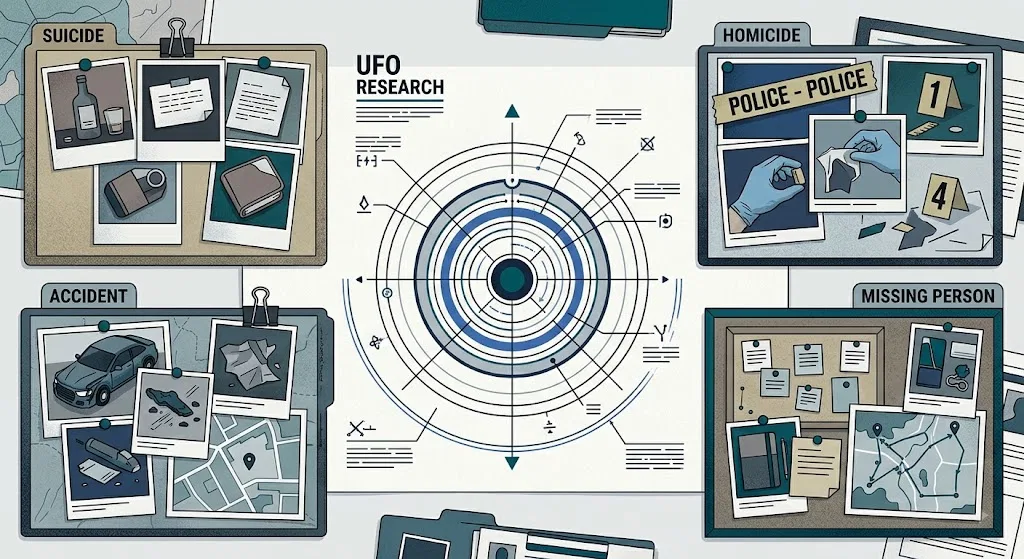
Placed in separate files, these are different stories: a suicide, a homicide arising in a documented local criminal context, and a scientist whose retreat from publication evolved into disappearance folklore before later reporting filled in much of her biography.
Placed instead under a heading such as “unconventional researchers who died or vanished”, the differences recede and the common label becomes visually dominant.
That is a crucial analytical error. If a hypothetical organisation were eliminating researchers to protect a secret, investigators would expect some recurring operational signature: similar threats, linked perpetrators, comparable staging, common intermediaries, repeated timing or evidence that the victims possessed the same protected information. A collection containing unrelated suicides, ordinary illnesses, vehicular accidents, locally motivated homicides and people merely absent from public life does not become stronger evidence simply because the categories are added together.
In statistical terms, adding unlike outcomes may increase the number of cases while decreasing the coherence of the proposed cause.
The denominator problem: a list of tragedies is not a death rate
A second major problem is that dramatic lists usually provide a numerator but no denominator.
Suppose ten people connected in some way with aerospace or unconventional physics die over twenty years. Ten deaths may sound extraordinary when presented sequentially. But extraordinary compared with what?
A meaningful comparison requires knowing at least approximately:
- how many researchers, engineers, contractors and associated staff could have qualified for inclusion;
- how old they were and how long the observation period lasted;
- how broadly “UFO” or “antigravity related” is being defined;
- what death rates would normally be expected in people of similar age and circumstances; and
- whether researchers in a comparable field experienced fewer deaths, disappearances or violent incidents.
Without that denominator, a death list cannot distinguish an unusual incidence rate from an ordinary number of tragedies drawn from a large population.
This is closely related to the “multiple inference” problem described in statistical studies of apparent clusters. If one is free to examine many occupations, institutions, decades, research subjects and definitions of suspicious death, chance alone creates opportunities for apparently striking concentrations.[PubMed]pubmed.ncbi.nlm.nih.govThe problem of multiple inference in identifying point-source environmental hazards - PubMed…
The selection process can also be asymmetric. Researchers who work on unusual subjects and live uneventfully to old age rarely become entries in viral compilations. Neither do scientists who abandon controversial research, move industries, retire or simply stop publishing. Adverse outcomes are memorable and searchable; non-events are not.
That produces a deceptively dense record in which every surviving data point is interesting.
A case can contain genuine secrecy without proving a lethal connection
One reason this topic resists simple dismissal is that some ingredients that encourage suspicion are real.
Ning Li provides a useful example. The Huntsville Business Journal reported her son’s account that after leaving university work she obtained a top-secret clearance and became much less able to discuss her research. The reporter also described Freedom of Information Act requests concerning her Department of Defense-funded work being denied.[Huntsville Business Journal]huntsvillebusinessjournal.comOpen source on huntsvillebusinessjournal.com.
Those facts can reasonably support questions about what happened to the research.
They do not, by themselves, support the additional proposition that her later road accident was engineered because of that research.
This distinction matters throughout UFO history. Evidence can support secrecy, classification, institutional surveillance, professional hostility or missing records without supporting murder. Treating those propositions as interchangeable allows genuine anomalies in one area to provide emotional credibility for an unsupported claim in another.
Mallove’s case produces the reverse problem. He really was murdered, so the disputed element is not the death classification but its motive. Court records connecting the killing to circumstances around an evicted rental property substantially change the evidential question. To establish research-related assassination, a competing theory would need evidence strong enough to displace that specific documented criminal context.[Justia Law]law.justia.comOpen source on justia.com.
A suspicious-looking fact should therefore be broken into separate propositions: Was the research unusual? Was it secret? Was the death unusual? Is the official explanation credible? And, most importantly, is there evidence connecting the unusual research to the adverse event?
The final link cannot simply be inherited from the first four.
Why hindsight makes the connections look tighter
Once someone has died or disappeared, earlier biographical details acquire new significance.
A security clearance may look ominous. A complaint about professional opposition may become a warning. A discontinued paper trail may be interpreted as suppression. A colleague’s recollection that the person was worried may be treated as foreknowledge.
Some of those clues can be important. The danger lies in selecting them after the outcome is known.
If hundreds of researchers have, over decades, expressed frustration, dealt with classified programmes, changed jobs, quarrelled with colleagues or worried about professional consequences, then discovering those facts retrospectively in a person who later died does not show that they predicted the death. The evidential question is how common the same features were among comparable people who did not experience the alleged outcome.
This is why pre-existing documentation carries much more weight than retrospective narrative reconstruction. A dated police report describing a specific threat, for example, would be more significant than an ambiguous remark recalled years later. Several independently documented threats from the same actor against multiple researchers would be stronger still.
Retrospective pattern construction can also alter the timeline. Events separated by many years feel simultaneous when displayed as adjacent entries in a list. A death in 1971, a homicide in 2004 and a death in 2021 can be absorbed into a single enduring suppression narrative even though any common perpetrator or organisation would have to operate coherently across generations, jurisdictions and radically different research environments.
The longer and looser the timeline becomes, the easier it is to add cases — but the harder it becomes to identify a testable mechanism linking them.
What a genuine pattern would need to show
None of these problems proves that researchers could never be targeted because of sensitive work. Scientists have been victims of espionage, political repression and targeted violence in documented historical contexts. The correct standard is therefore not “conspiracies never happen”. It is whether this particular proposed pattern generates evidence that is difficult to explain without a common cause.
A convincing pattern among UFO or antigravity researchers would become substantially stronger if investigators found several independent features such as an abnormal rate, a narrow exposure, repeated methods, documented links and predictive value.
An abnormal rate would mean demonstrating that qualifying researchers experienced the relevant outcome more often than a properly chosen comparison population. A narrow exposure would mean the victims shared something more specific than broad participation in aerospace, physics or government work — for example, access to the same project, information or compartment.
Repeated methods would matter because coordinated action should leave some consistency: the same intermediaries, unusual toxicology, similar staged accidents, recurring threats or comparable investigative anomalies. Documented links could include communications, financial trails, surveillance records, common suspects or credible contemporaneous witnesses connecting more than one case.
Most importantly, a genuine theory should make predictions. If a proposed mechanism only explains people after they have already been added to the list, while every contradictory case can simply be excluded or reinterpreted, it is very difficult to distinguish from retrospective storytelling.
This principle mirrors the wider statistical problem of post-hoc clusters: a grouping discovered first and explained afterwards is inherently harder to assess than a hypothesis stated before subsequent observations occur.[PubMed Central (PMC)]pmc.ncbi.nlm.nih.govPubMed Central (PMC)Cluster analysis and disease mapping–why, when, and how? A step by step guide - PMC…
Why the pattern can persist after individual cases are explained
One of the most revealing features of a loosely defined cluster is that explaining individual cases may not dissolve the larger belief.
If a supposed disappearance turns out to have been withdrawal from public life, the remaining absence of publications can still be attributed to secrecy. If a murder acquires a conventional criminal motive, another unresolved death may take its place as the most suspicious case. If someone originally described as a scientist turns out to have held a different role, the definition may expand from scientists to anybody associated with a sensitive laboratory.
Psychological research helps explain why. Conspiracy beliefs are not ordinarily based on a single factual claim; they can function as broader explanatory frameworks through which new information is interpreted. Reviews of the field emphasise that such beliefs are associated with efforts to explain significant events, manage uncertainty and understand the actions of powerful groups.[PubMed Central (PMC)]pmc.ncbi.nlm.nih.govOpen source on nih.gov.
In 2026, reporting on the viral US “missing scientists” narrative provided a live example of this process. Associated Press found that several highly disparate deaths and disappearances had become aggregated into a common story despite the absence, at that point, of definitive evidence connecting them. Some cases had identifiable suspects or conventional explanations, yet the existence of unresolved cases allowed the larger narrative to continue.[AP News]apnews.comscientists gained traction, escalating from niche online forums to being addressed by the White House and U.S. Congress. Theories propose…
This is why case-by-case verification matters more than arguing about the entire list at once. A claim involving twenty names may feel stronger than one involving two, but twenty weakly connected cases are not necessarily stronger evidence than two closely linked ones.
The most useful test is whether the connection survives disaggregation
The apparent pattern becomes easiest to evaluate when the list is taken apart.
For each individual, three questions should be separated: What did this person actually work on? What actually happened to them? What independent evidence links those two facts?
That exercise often produces a less dramatic but more informative picture. One researcher may genuinely have performed unusual classified work yet died from an apparently unrelated cause. Another may have been murdered but with evidence pointing towards a personal or property dispute. Another may genuinely have disappeared for a period, but have only a weak connection to unconventional propulsion. A fourth may remain unresolved and therefore deserve continued attention.
Disaggregation does not dismiss the unresolved cases. It prevents the resolved ones from lending borrowed mystery to them.
That is the central reason unusual research can make ordinary tragedies appear connected. The research theme is distinctive and memorable; the events themselves are emotionally powerful; incomplete records create uncertainty; and retrospective selection compresses very different lives into one narrative category. Human pattern recognition then does what it normally does: it searches for an explanation that ties the pieces together.
Sometimes such a search can uncover a real relationship. But before a “researcher death pattern” becomes evidence of coordinated suppression, it must survive the tests that ordinary patterns survive: a stable definition, an appropriate denominator, comparable outcomes, independently documented links and a common mechanism that explains the cases better than their individual circumstances do.
Amazon book picks
Further Reading
Books and field guides related to Why Do Unrelated Researcher Deaths Look Like a Pattern?. Use these as the next step if you want deeper reading beyond the article.
Thinking, Fast and Slow
Why is there more chance we'll believe something if it's in a bold type face? Why are judges more likely to deny parole before lunch? Why...
The Drunkard's Walk: How Randomness Rules Our Lives
Leonard Mlodinow reveals the psychological illusions that prevent us understanding everything from stock-picking to wine-tasting, winning...
How We Know What Isn't So: The Fallibility of Human Reason in...
Thomas Gilovich offers a wise and readable guide to the fallacy of the obvious in everyday life. When can we trust what we believe—that "...
eBay marketplace picks
Marketplace Samples
Live-tested eBay searches with available results related to this page.
Selected fromUFO poster oneBay.co.uk.


Endnotes
1.
Source: law.justia.com
Link:https://law.justia.com/cases/connecticut/court-of-appeals/2025/ac46658.html
2.
Source: ufos.wiki
Title: James E. Mc Donald
Link:https://ufos.wiki/figure/james-e-mcdonald/
3.
Source: everything.explained.today
Title: Eugene Mallove
Link:https://everything.explained.today/Eugene_Mallove/
4.
Source: pmc.ncbi.nlm.nih.gov
Link:https://pmc.ncbi.nlm.nih.gov/articles/PMC5900972/
Source snippet
PubMed Central (PMC)Connecting the dots: Illusory pattern perception predicts belief in conspiracies and the supernatural - PMCSeptember...
5.
Source: pmc.ncbi.nlm.nih.gov
Link:https://pmc.ncbi.nlm.nih.gov/articles/PMC2359075/?page=0
Source snippet
PubMed Central (PMC)Cluster analysis and disease mapping--why, when, and how? A step by step guide - PMC...
6.
Source: pmc.ncbi.nlm.nih.gov
Link:https://pmc.ncbi.nlm.nih.gov/articles/PMC1568719/?page=0
Source snippet
PubMed Central (PMC)The problem of multiple inference in identifying point-source environmental hazards - PMC...
7.
Source: pubmed.ncbi.nlm.nih.gov
Link:https://pubmed.ncbi.nlm.nih.gov/4085443/
Source snippet
The problem of multiple inference in identifying point-source environmental hazards - PubMed...
8.
Source: apnews.com
Link:https://apnews.com/article/c046ce6d0a004e6a3e1971ff769244b5
Source snippet
scientists gained traction, escalating from niche online forums to being addressed by the White House and U.S. Congress. Theories propose...
9.
Source: pmc.ncbi.nlm.nih.gov
Link:https://pmc.ncbi.nlm.nih.gov/articles/PMC9893368/
Source snippet
PubMed Central (PMC)Illusory perception of visual patterns in pure noise is associated with COVID-19 conspiracy beliefs - PMCJanuary 18...
10.
Source: pmc.ncbi.nlm.nih.gov
Link:https://pmc.ncbi.nlm.nih.gov/articles/PMC10275861/
Source snippet
PubMed Central (PMC)Linking paranormal and conspiracy beliefs to illusory pattern perception through signal detection theory - PMC...
11.
Source: pmc.ncbi.nlm.nih.gov
Title: Pub Med Central (PMC)The Psychology of Conspiracy Theories
Link:https://pmc.ncbi.nlm.nih.gov/articles/PMC5724570/
Source snippet
PubMed Central (PMC)The Psychology of Conspiracy Theories - PMCDecember 7, 2017...
Published: December 7, 2017
12.
Source: kirkmcd.princeton.edu
Title: jem tape achives basterfield
Link:https://kirkmcd.princeton.edu/JEMcDonald/jem_tape_achives_basterfield.pdf
13.
Source: huntsvillebusinessjournal.com
Link:https://huntsvillebusinessjournal.com/news/2023/07/30/solving-the-mystery-of-huntsvilles-brilliant-scientist-disappearing/
14.
Source: pmc.ncbi.nlm.nih.gov
Link:https://pmc.ncbi.nlm.nih.gov/articles/PMC6282974/
15.
Source: huntsvillebusinessjournal.com
Link:https://huntsvillebusinessjournal.com/
16.
Source: ons.gov.uk
Link:https://www.ons.gov.uk/aboutus/transparencyandgovernance/freedomofinformationfoi/deathscausedbyassaultsuicidedrugpoisoningandalcohol2020to2026
17.
Source: GOV.UK
Link:https://www.gov.uk/government/statistics/near-to-real-time-suspected-suicide-surveillance-nrtsss-for-england-data-to-january-2026/near-to-real-time-suspected-suicide-surveillance-nrtsss-for-england-data-to-january-2026
Published: january 2026
18.
Source: GOV.UK
Link:https://www.gov.uk/government/publications/suicide-prevention-identifying-and-responding-to-suicide-clusters/responding-to-suicide-clusters-guidance-for-stakeholders-and-members-of-cluster-response-groups
19.
Source: pmc.ncbi.nlm.nih.gov
Link:https://pmc.ncbi.nlm.nih.gov/articles/PMC12783889/
20.
Source: pmc.ncbi.nlm.nih.gov
Link:https://pmc.ncbi.nlm.nih.gov/articles/PMC12779699/
21.
Source: ons.gov.uk
Title: User guide to mortality statistics
Link:https://www.ons.gov.uk/peoplepopulationandcommunity/birthsdeathsandmarriages/deaths/methodologies/userguidetomortalitystatisticsjuly2017
22.
Source: ons.gov.uk
Link:https://www.ons.gov.uk/aboutus/transparencyandgovernance/freedomofinformationfoi/suicideratesandreason2004to2024
23.
Source: ons.gov.uk
Title: Suicide rates in the UK QMI
Link:https://www.ons.gov.uk/peoplepopulationandcommunity/birthsdeathsandmarriages/deaths/methodologies/suicideratesintheukqmi
24.
Source: ons.gov.uk
Title: Suicides in England and Wales
Link:https://www.ons.gov.uk/peoplepopulationandcommunity/birthsdeathsandmarriages/deaths/bulletins/suicidesintheunitedkingdom/2024registrations
25.
Source: GOV.UK
Title: coroners statistics 2024 england and wales
Link:https://www.gov.uk/government/statistics/coroners-statistics-2024/coroners-statistics-2024-england-and-wales
26.
Source: ons.gov.uk
Title: Drug-related deaths and suicide in offenders in the community, England and Wales
Link:https://www.ons.gov.uk/peoplepopulationandcommunity/birthsdeathsandmarriages/deaths/bulletins/drugrelateddeathsandsuicideinoffendersinthecommunityenglandandwales/2011to2021
27.
Source: pmc.ncbi.nlm.nih.gov
Link:https://pmc.ncbi.nlm.nih.gov/articles/PMC10212733/
28.
Source: pmc.ncbi.nlm.nih.gov
Link:https://pmc.ncbi.nlm.nih.gov/articles/PMC10075392/
29.
Source: pmc.ncbi.nlm.nih.gov
Link:https://pmc.ncbi.nlm.nih.gov/articles/PMC10101207/
30.
Source: pubmed.ncbi.nlm.nih.gov
Link:https://pubmed.ncbi.nlm.nih.gov/36170672/
31.
Source: ons.gov.uk
Link:https://www.ons.gov.uk/aboutus/transparencyandgovernance/freedomofinformationfoi/mortalitystatisticsbycause2018to2021by10yearagebracket
32.
Source: pubmed.ncbi.nlm.nih.gov
Link:https://pubmed.ncbi.nlm.nih.gov/35660344/
33.
Source: pmc.ncbi.nlm.nih.gov
Link:https://pmc.ncbi.nlm.nih.gov/articles/PMC8477633/
34.
Source: pmc.ncbi.nlm.nih.gov
Link:https://pmc.ncbi.nlm.nih.gov/articles/PMC8212084/
35.
Source: huntsvillebusinessjournal.com
Title: End Of An Era: Huntsville’s Spencer Oil Sold To Mississippi-based Company
Link:https://huntsvillebusinessjournal.com/news/2021/02/01/end-of-an-era-huntsvilles-spencer-oil-sold-to-mississippi-based-company/
36.
Source: ons.gov.uk
Title: Leading causes of death, UK
Link:https://www.ons.gov.uk/peoplepopulationandcommunity/healthandsocialcare/causesofdeath/articles/leadingcausesofdeathuk/2001to2018
37.
Source: ons.gov.uk
Link:https://www.ons.gov.uk/aboutus/transparencyandgovernance/freedomofinformationfoi/deathsintheukbyagegroupgenderandmostcommoncauses
38.
Source: pmc.ncbi.nlm.nih.gov
Link:https://pmc.ncbi.nlm.nih.gov/articles/PMC6238178/
39.
Source: pmc.ncbi.nlm.nih.gov
Link:https://pmc.ncbi.nlm.nih.gov/articles/PMC6282862/
40.
Source: pmc.ncbi.nlm.nih.gov
Link:https://pmc.ncbi.nlm.nih.gov/articles/PMC5776328/
41.
Source: pubmed.ncbi.nlm.nih.gov
Link:https://pubmed.ncbi.nlm.nih.gov/29276345/
42.
Source: pubmed.ncbi.nlm.nih.gov
Link:https://pubmed.ncbi.nlm.nih.gov/26136717/
43.
Source: pmc.ncbi.nlm.nih.gov
Link:https://pmc.ncbi.nlm.nih.gov/articles/PMC4470066/
44.
Source: ons.gov.uk
Title: Suicides in the UK
Link:https://www.ons.gov.uk/peoplepopulationandcommunity/birthsdeathsandmarriages/deaths/bulletins/suicidesintheunitedkingdom/2015
45.
Source: pubmed.ncbi.nlm.nih.gov
Link:https://pubmed.ncbi.nlm.nih.gov/24219086/
46.
Source: pmc.ncbi.nlm.nih.gov
Link:https://pmc.ncbi.nlm.nih.gov/articles/PMC3703523/
47.
Source: pmc.ncbi.nlm.nih.gov
Link:https://pmc.ncbi.nlm.nih.gov/articles/PMC3619951/
48.
Source: pmc.ncbi.nlm.nih.gov
Link:https://pmc.ncbi.nlm.nih.gov/articles/PMC2694210/
49.
Source: pubmed.ncbi.nlm.nih.gov
Link:https://pubmed.ncbi.nlm.nih.gov/1480954/
50.
Source: pmc.ncbi.nlm.nih.gov
Link:https://pmc.ncbi.nlm.nih.gov/articles/PMC1568719/?page=4
51.
Source: uapmurders.com
Link:https://uapmurders.com/uaps/Details/Ning_Li/
52.
Source: uapmurders.com
Link:https://uapmurders.com/uaps/Details/Eugene_Mallove/
53.
Source: pmc.ncbi.nlm.nih.gov
Link:https://pmc.ncbi.nlm.nih.gov/articles/PMC5891410/
54.
Source: pmc.ncbi.nlm.nih.gov
Link:https://pmc.ncbi.nlm.nih.gov/articles/PMC1568719/?page=3
55.
Source: pubmed.ncbi.nlm.nih.gov
Link:https://pubmed.ncbi.nlm.nih.gov/15371285/
56.
Source: pubmed.ncbi.nlm.nih.gov
Link:https://pubmed.ncbi.nlm.nih.gov/8272659/
57.
Source: ncbi.nlm.nih.gov
Link:https://www.ncbi.nlm.nih.gov/books/n/nap6034/appa/
58.
Source: pubmed.ncbi.nlm.nih.gov
Link:https://pubmed.ncbi.nlm.nih.gov/18932143/
59.
Source: pubmed.ncbi.nlm.nih.gov
Link:https://pubmed.ncbi.nlm.nih.gov/7656552/
60.
Source: huntsvillebusinessjournal.com
Title: may 2021
Link:https://huntsvillebusinessjournal.com/issues/2021/05/02/may-2021/
Published: may 2021
61.
Source: linkedin.com
Link:https://www.linkedin.com/company/huntsville-business-journal
Additional References
62.
Source: youtube.com
Title: Apophenia Explained | Pareidolia, Confirmation Bias, & Other Pattern Errors
Link:https://www.youtube.com/watch?v=yb_kFPSjHUY
Source snippet
Missing scientists conspiracy UFO 11 UFO Scientists are Missing... and More are Coming...
63.
Source: youtube.com
Title: Father of 11th dead or missing scientist rejects suspicions about her death
Link:https://www.youtube.com/watch?v=1d–WxTUkXE
Source snippet
UFOs and missing scientists: Are conspiracy theories mainstream?...
64.
Source: nature.com
Link:https://www.nature.com/articles/s44159-022-00133-0
65.
Source: cdc.gov
Link:https://www.cdc.gov/mmwr/preview/mmwrhtml/rr6208a1.htm/00001797.htm
66.
Source: youtube.com
Title: 10TH MISSING SCIENTIST As UFO Mystery Deepens
Link:https://www.youtube.com/watch?v=FU19SrR4qG4
Source snippet
Apophenia Explained | Pareidolia, Confirmation Bias, & Other Pattern Errors...
67.
Source: youtube.com
Title: UFO insider reveals pattern behind missing scientists
Link:https://www.youtube.com/watch?v=YcHt-OBkabU
Source snippet
10TH MISSING SCIENTIST As UFO Mystery Deepens...
68.
Source: shinysideout.com.au
Link:https://www.shinysideout.com.au/13-ning-li.html
69.
Source: expandingfrontiersresearch.org
Link:https://www.expandingfrontiersresearch.org/items-1/ann-druffel-special-collection
70.
Source: taylorfrancis.com
Link:https://www.taylorfrancis.com/chapters/edit/10.4324/9781003154730-5/base-rate-neglect-gordon-pennycook-christie-newton-valerie-thompson
71.
Source: bizjournals.com
Link:https://www.bizjournals.com/birmingham/news/feature/huntsville