Within Coordination
When Does a Suspicious Pattern Stop Being Evidence?
Testing assassination, secrecy without violence and unrelated personal causes side by side helps prevent suggestive facts from becoming a false pattern.
On this page
- Three competing explanations for the same researcher stories
- Evidence that distinguishes targeting from secrecy or coincidence
- How documented ordinary explanations should update a claim
Page outline Jump by section
Introduction
Claims that UFO, gravity-control or unconventional-propulsion researchers have been systematically eliminated are easiest to overstate when every unusual event is tested only against the assassination hypothesis. A stronger method asks three explanations to compete: deliberate targeting because of the research; secrecy or withdrawal without violence; and unrelated personal, medical, criminal or accidental causes. The important question is not whether any one story contains something strange, but which explanation best accounts for the most reliable evidence with the fewest contradictions.
Applied to well-documented cases, this comparison substantially weakens the appearance of a single elimination pattern. Ning Li’s supposed “disappearance”, for example, has a documented non-violent explanation, while Eugene Mallove’s very real murder developed evidence pointing towards a local property dispute rather than his controversial energy research. Other cases retain genuine uncertainties, but uncertainty is not positive evidence of assassination. The decisive evidence would be facts that discriminate between the rival explanations rather than merely fitting all of them.
Three explanations for the same researcher stories
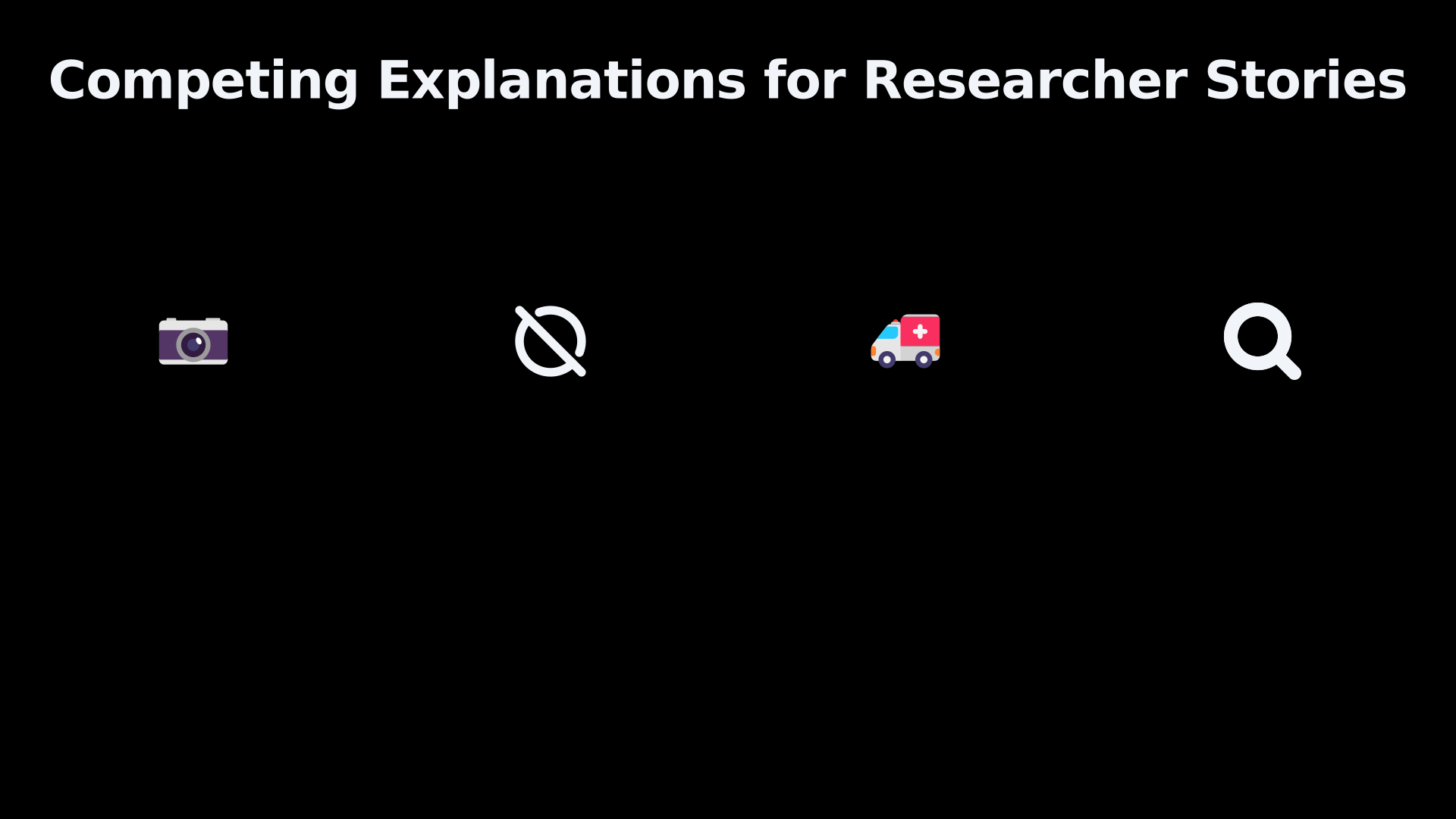
A useful comparison starts by recognising that the three hypotheses make different predictions. This is the central advantage of analysing competing explanations: instead of asking, “What facts support assassination?”, the investigator asks which facts would be difficult to explain unless assassination occurred. The Analysis of Competing Hypotheses approach developed for intelligence work formalises this principle by requiring reasonable alternatives to be considered simultaneously, with particular attention to evidence inconsistent with each explanation.[CIA]cia.govPsychology of Intelligence AnalysisPsychology of Intelligence Analysis…
That method is not infallible. Experimental research involving intelligence analysts has found mixed results for formal Analysis of Competing Hypotheses, and a 2024 review concluded that the complete technique has shown little overall benefit to judgement quality in experimental testing. Its most valuable lesson here is therefore modest rather than mechanical: do not allow the preferred explanation to determine which evidence counts.[wiley.com]onlinelibrary.wiley.comOnline Library The “analysis of competing hypotheses” in intelligence analysisWiley Online LibraryThe “analysis of competing hypotheses” in intelligence analysis - Dhami - 2019 - Applied Cognitive Psychology - Wiley…
The three principal explanations make recognisably different predictions:
- Targeted elimination. Researchers are deliberately killed, incapacitated or made to disappear because their work threatens a government programme, commercial interest, foreign intelligence service or other actor. This predicts some evidence connecting the research to the adverse event: threats referring to the work, surveillance tied to an identifiable organisation, common intermediaries, operational similarities, attempts to obtain particular material, or perpetrators demonstrably interested in what the victim knew.
- Secrecy without elimination. Researchers appear to “vanish” because classified contracts, security clearances, commercial confidentiality, retirement or a decision to stop publishing removes them from the open literature. This predicts continued private life or employment despite public silence, evidence of restricted work, and no corresponding evidence of violent coercion.
- Unrelated causes. Death, disappearance from public view or career interruption arises from circumstances that would also occur among researchers with no UFO or antigravity connection: illness, suicide, accident, ordinary homicide, family circumstances, retirement or other personal events. This predicts strong case-specific evidence for those causes and little or no operational connection between separate researchers.
These hypotheses can overlap. A scientist can conduct classified work and later die from an unrelated illness. A researcher can sincerely believe that they are being threatened without that belief establishing who, if anyone, caused a subsequent death. And a murder victim can have controversial scientific interests while being killed for a completely different reason. Treating “secrecy”, “suspicious death” and “murder connected to research” as interchangeable categories is therefore one of the quickest ways to manufacture a pattern.
Ning Li shows why silence is not disappearance
Physicist Ning Li is particularly useful for distinguishing secrecy from elimination because the apparent mystery arose largely from the disappearance of information rather than the disappearance of the person.
Li published unconventional work concerning superconductors and gravitational effects at the University of Alabama in Huntsville and later established AC Gravity. A US Department of Defense award supported further work. Her subsequent absence from ordinary scientific publishing helped generate stories that she had disappeared, defected to China or been absorbed into a secret programme. Yet detailed reporting in 2023 located and interviewed her son, George Guangyu Men, who said she had never disappeared or returned permanently to China. He described her move from open university research into classified work as the reason she became unable to discuss what she was doing.[Huntsville Business Journal]huntsvillebusinessjournal.comHuntsville Business JournalUncovering The Mystery Of Huntsville’s Brilliant Anti-gravity Scientist - Huntsville Business Journal…
The later chronology is even more important. According to Men, Li was struck by a vehicle while crossing a street on the University of Alabama in Huntsville campus in 2014. The accident caused permanent brain damage; he cared for her for the following six years, and she died in July 2021. A Huntsville funeral home independently records her death on 27 July 2021.[Huntsville Business Journal]huntsvillebusinessjournal.comHuntsville Business JournalUncovering The Mystery Of Huntsville’s Brilliant Anti-gravity Scientist - Huntsville Business Journal…
This does not answer every question about Li’s research. The 2023 investigation reported that requests for records concerning her Department of Defense work had been denied, leaving part of her scientific career outside public view. But that evidential gap supports a much narrower conclusion: some of Li’s work was not publicly available. It does not establish that she was forcibly disappeared, much less killed to suppress antigravity technology.[Huntsville Business Journal]huntsvillebusinessjournal.comHuntsville Business JournalUncovering The Mystery Of Huntsville’s Brilliant Anti-gravity Scientist - Huntsville Business Journal…
Li’s case therefore demonstrates a crucial diagnostic distinction. Under an elimination hypothesis, “a researcher stops publishing” may initially look suggestive. Under a classified-work hypothesis, exactly the same observation is expected. Once evidence emerges that the researcher remained alive, stayed in the United States and later suffered a documented life-changing accident, the disappearance claim should be substantially downgraded. The public silence has ceased to discriminate between the hypotheses.
Eugene Mallove shows why a real murder is not automatically a research murder
Eugene Mallove presents the opposite problem. There is no dispute that Mallove, a prominent advocate of cold fusion and unconventional energy research, was murdered. Connecticut authorities recorded his 14 May 2004 death as a homicide, eventually offering a $50,000 reward while the investigation remained unresolved.[CT.gov]portal.ct.gov50000 Reward Being Offered from Homicide Investigation Norwich 2004CT.gov50000 Reward Being Offered from Homicide Investigation Norwich 2004…
A genuine homicide naturally makes an elimination theory seem more plausible than it would in a case involving nothing more than professional withdrawal. But the relevant question is not whether Mallove was murdered. It is why he was murdered.
Later criminal proceedings supplied an alternative with unusually concrete supporting evidence. A 2025 Connecticut Appellate Court decision recounts that Mallove was killed at a Norwich rental property after tenants had recently been evicted and while he was there clearing the premises. The litigation arose from the prosecution of Mozzelle Brown, who had been convicted of murder and conspiracy to commit murder in 2014. Contemporary reporting records Brown receiving a 58-year sentence.[Justia Law]law.justia.comJustia LawBrown v. Commissioner of Correction:: 2025:: Connecticut Appellate Court Decisions:: Connecticut Case Law:: Connecticut Law…
The appellate history does not make every detail of the prosecution immune from challenge: indeed, the 2025 appellate decision granted Brown relief on a legal issue and ordered a new trial. That qualification matters. But it does not transform the case into evidence of scientific suppression. The documented investigative and judicial record concerns people connected to the rental-property circumstances, not an identified organisation seeking Mallove’s cold-fusion research.[Justia Law]law.justia.comJustia LawBrown v. Commissioner of Correction:: 2025:: Connecticut Appellate Court Decisions:: Connecticut Case Law:: Connecticut Law…
Mallove therefore illustrates an important asymmetry in evaluating suspicious-death lists. “Researcher was murdered” is powerful evidence for homicide, but only weak evidence for research-motivated homicide until a motive, perpetrator or operational fact connects the killing to the research. A mundane motive does not have to be proved with philosophical certainty before it becomes relevant; credible evidence for it directly lowers the need to invoke a more elaborate scientific-suppression explanation.

What evidence actually separates targeting from coincidence?
The most useful evidence is diagnostic evidence: information expected under one hypothesis but relatively unexpected under its rivals. Evidence that fits every explanation may be interesting, but it does little to tell them apart. Intelligence-analysis literature explicitly emphasises this distinction, and statistical crime-linkage research likewise treats similarities between incidents as something whose evidential strength must be assessed rather than assumed.[cia.gov]cia.govPsychology of Intelligence AnalysisPsychology of Intelligence Analysis…
Consider several frequently cited features of alleged researcher-elimination stories. Working in aerospace is compatible with targeting, but also with ordinary employment. Holding a security clearance is compatible with suppression, but is even more directly compatible with legitimate secrecy. Dying relatively young can occur under assassination, suicide, illness or accident. A lack of published research can result from confiscation, but also classified contracts or career change. These observations therefore have low discriminatory value by themselves.
By contrast, several kinds of evidence would materially shift the balance towards targeting:
- A research-specific threat with independent authentication. A warning that explicitly identifies a project, disclosure or document is more probative than a general statement that a researcher felt unsafe.
- The same actor appearing in independent cases. Repeated contact by the same organisation, intermediary, surveillance team or financial network would provide the cross-case linkage that a mere occupational resemblance lacks.
- Forensic or operational repetition. Matching methods, communications, travel records, payments or other signatures can transform resemblance into a testable common-offender hypothesis.
- Evidence of information acquisition or suppression. Missing laboratory records, unauthorised access immediately surrounding a death, demands for particular data, or documented efforts to recover a specific technology would connect motive to action.
- Evidence contradicting the ordinary explanation. A claimed accident becomes more suspicious if reliable forensic findings cannot be reconciled with an accident. A claimed suicide becomes more suspicious if physical or documentary evidence makes self-infliction implausible. The contradiction must concern the mechanics of the event, not merely the victim’s unusual occupation.
Crime-linkage research provides a useful warning against treating similarity as certainty. A National Institute of Justice-supported statistical approach used Bayes factors to estimate whether crimes shared an offender; even a model performing well on known cases still produced false-positive linkages. The general lesson is directly relevant: when many incidents are available for comparison, some will resemble one another even without a common perpetrator.[National Institute of Justice]nij.ojp.govNational Institute of Justice Home | National Institute of JusticeNational Institute of Justice Home | National Institute of Justice
Base rates matter for the same reason. Psychological research has repeatedly documented people’s tendency, under some conditions, to underweight background probabilities in favour of vivid case-specific information. In a researcher-death narrative, a striking fact such as “worked on antigravity” can consequently receive more intuitive weight than the less dramatic question of how often scientists retire, become ill, die by suicide, suffer accidents, work under confidentiality restrictions or become victims of ordinary crime.[sciencedirect.com]sciencedirect.comScienceDirect The base-rate fallacy in probability judgmentsScienceDirect The base-rate fallacy in probability judgments
Amy Eskridge shows how contradictory evidence should be handled
Amy Eskridge’s case demonstrates a harder situation: one in which publicly reported information pulls in different directions and the underlying primary documentation is less accessible.
Eskridge, who co-founded the Institute for Exotic Science in Huntsville and pursued unconventional propulsion and gravity-related ideas, died aged 34 on 11 June 2022. Her published obituary confirms her age, scientific interests and role at the institute but gives no detailed cause or manner of death.[Alabama Obituaries]al.comamy eskridge obituaryamy eskridge obituary
The case gained renewed attention in 2026 after reporting described her death as a suicide by self-inflicted gunshot and publicised statements from an acquaintance who said Eskridge had previously expressed fears for her safety and denied that she intended to kill herself. Those claims are legitimately relevant to reassessing the case because a contemporaneous, authenticated warning could be more diagnostic than generic posthumous speculation. But the inference still has several steps: evidence that Eskridge feared being harmed is not, by itself, evidence establishing that someone harmed her; nor does it identify a perpetrator or connect her death to other researchers.[CRBC News]crbcnews.comOpen source on crbcnews.com.
There is also directly conflicting testimony within the public discussion. Reporting in April 2026 said Eskridge’s father rejected the idea that her death was suspicious. Meanwhile, broader reporting on the alleged cluster noted that relatives in some cases disputed attempts to incorporate their family members into a conspiracy narrative.[ProveIt]proveit.nowOpen source on proveit.now.
The appropriate assessment is therefore neither “nothing to see here” nor “the warning proves assassination”. It is that Eskridge’s reported prior statements create a specific evidential question worth testing against primary records. Police files, medical-examiner documentation, authenticated communications with complete provenance, forensic findings and independently corroborated evidence of any alleged harassment would carry far more weight than repetitions of the story across social media. Until those evidential layers are available and reconciled, the case remains more uncertain than Ning Li’s but does not supply a demonstrated link to a coordinated researcher-elimination campaign.
How ordinary explanations should update the larger claim
The greatest analytical mistake is to treat an ordinary explanation as irrelevant simply because it does not solve every mystery surrounding a researcher. Evidence works comparatively. If one hypothesis predicts an observation better than its rivals, belief should move towards that hypothesis even when absolute certainty is unavailable.
Ning Li provides a clear example. Before her son’s account was published, years without conventional publications could be interpreted as evidence of disappearance, classified work, retirement or several other possibilities. Once her son supplied a coherent chronology in which she remained in Huntsville, worked under secrecy restrictions and later became incapacitated after a traffic accident, the literal-disappearance theory lost much of its evidential basis. The remaining secrecy surrounding her research cannot simply be used to restore the original claim.[Huntsville Business Journal]huntsvillebusinessjournal.comHuntsville Business JournalUncovering The Mystery Of Huntsville’s Brilliant Anti-gravity Scientist - Huntsville Business Journal…
Mallove requires a similar update in a different direction. His murder unquestionably establishes that one unconventional-energy advocate suffered deliberate violence. But evidence tying suspects to the circumstances surrounding his family’s rental property gives an ordinary criminal explanation positive evidential support. Unless evidence connects those people or the killing itself to Mallove’s energy work, the murder cannot fairly be counted as though research suppression were the established motive.[Justia Law]law.justia.comJustia LawBrown v. Commissioner of Correction:: 2025:: Connecticut Appellate Court Decisions:: Connecticut Case Law:: Connecticut Law…
This is also why a growing list of names does not necessarily strengthen the elimination hypothesis. Adding a person whose apparent disappearance has been explained can actually weaken the proposed pattern if the list was originally presented as evidence of unexplained disappearances. Adding a murder with a documented local motive increases the number of deaths but not necessarily the evidence for a common campaign. Adding a genuinely unresolved case increases uncertainty, but uncertainty should remain uncertainty until cross-case evidence appears.
The principle is especially important because the alleged pattern received renewed public and governmental attention in 2026. Contemporary reporting described federal interest in a broader set of dead or missing researchers while also stressing that officials had not established that the cases were connected. A decision to investigate a possible pattern is evidence that the question is being taken seriously; it is not evidence that investigators have confirmed the proposed explanation.[The Wall Street Journal]wsj.comTheories escalated after the disappearance of William McCasland, a retired general with a history in classified programs. As the narrativ…
When does a suspicious pattern stop being evidence?
A suspicious pattern stops carrying much evidential weight when its defining similarities survive equally well under several incompatible explanations. “Scientists connected to sensitive subjects experienced unusual events” may justify examining individual cases. It does not, by itself, distinguish assassination from classified employment, ordinary homicide, accident, illness, suicide or simple withdrawal from public research.
The strongest safeguard is therefore not automatic scepticism but competitive explanation. Start with targeting as a genuine hypothesis rather than dismissing it. Then give secrecy without violence and unrelated personal causes the same opportunity to explain the record. Ask which observations each hypothesis predicted before the facts were selected, which evidence actually contradicts each explanation, and whether the supposedly linked cases share anything more specific than an interesting scientific subject.
On that test, the best-documented examples do not presently behave like components of one coherent elimination programme. Ning Li’s supposed disappearance is substantially explained by classified work followed by severe injury and later death; Mallove’s murder produced a criminal case centred on local property circumstances; and Amy Eskridge presents unresolved and conflicting evidence that warrants careful separation of documented fact from inference.[huntsvillebusinessjournal.com]huntsvillebusinessjournal.comHuntsville Business JournalUncovering The Mystery Of Huntsville’s Brilliant Anti-gravity Scientist - Huntsville Business Journal…
A coordinated-killing hypothesis would become substantially stronger if future evidence supplied what these cases presently lack: a recurring perpetrator, authenticated research-specific orders or threats, common operational signatures, demonstrable attempts to obtain or suppress the same information, or forensic evidence that independently documented ordinary explanations cannot accommodate. Until then, the existence of secrecy and the existence of tragedy are both real features of these stories, but combining them into a single assassination pattern goes further than the available evidence supports.
Amazon book picks
Further Reading
Books and field guides related to When Does a Suspicious Pattern Stop Being Evidence?. Use these as the next step if you want deeper reading beyond the article.
The Demon-Haunted World: Science as a Candle in the Dark
Rating: 4.5/5 from 43 Google Books ratings
NEW YORK TIMES BESTSELLER • From the renowned astronomer and author of Cosmos comes a “powerful [and] stirring defense of informed ration...
The Demon-Haunted World
Rating: 4.5/5 from 43 Google Books ratings
NEW YORK TIMES BESTSELLER • From the renowned astronomer and author of Cosmos comes a “powerful [and] stirring defense of informed ration...
Why People Believe Weird Things: Pseudoscience, Superstition,...
Why do so many people believe in mind reading, past-life regression therapy, abductions by extraterrestrials, and ghosts? What has led to...
Calling Bullshit: The Art of Skepticism in a Data-Driven World
Bullshit isn’t what it used to be. Now, two science professors give us the tools to dismantle misinformation and think clearly in a world...
eBay marketplace picks
Marketplace Samples
Live-tested eBay searches with available results related to this page.
Selected fromUFO poster oneBay.co.uk.




Endnotes
1.
Source: cia.gov
Title: Psychology of Intelligence Analysis
Link:https://www.cia.gov/resources/csi/static/Pyschology-of-Intelligence-Analysis.pdf
Source snippet
Psychology of Intelligence Analysis...
2.
Source: onlinelibrary.wiley.com
Title: Online Library The “analysis of competing hypotheses” in intelligence analysis
Link:https://onlinelibrary.wiley.com/doi/full/10.1002/acp.3550
Source snippet
Wiley Online LibraryThe “analysis of competing hypotheses” in intelligence analysis - Dhami - 2019 - Applied Cognitive Psychology - Wiley...
3.
Source: law.justia.com
Link:https://law.justia.com/cases/connecticut/court-of-appeals/2025/ac46658.html
Source snippet
Justia LawBrown v. Commissioner of Correction:: 2025:: Connecticut Appellate Court Decisions:: Connecticut Case Law:: Connecticut Law...
4.
Source: iarpa.org
Link:https://iarpa.org/international/reports/intelligence-analysis-uncertainty/
5.
Source: sciencedirect.com
Title: ScienceDirect The base-rate fallacy in probability judgments
Link:https://www.sciencedirect.com/science/article/pii/0001691880900463
6.
Source: proveit.now
Link:https://proveit.now/videos/10176
7.
Source: GOV.UK
Title: www.gov.uk Quality assessment in data linkage
Link:https://www.gov.uk/government/publications/joined-up-data-in-government-the-future-of-data-linking-methods/quality-assessment-in-data-linkage
8.
Source: onlinelibrary.wiley.com
Link:https://onlinelibrary.wiley.com/doi/abs/10.1002/acp.3550
9.
Source: onlinelibrary.wiley.com
Link:https://onlinelibrary.wiley.com/doi/abs/10.1002/%28SICI%291099-0771%28199912%2912%3A4%3C307%3A%3AAID-BDM324%3E3.0.CO%3B2-H
10.
Source: all.net
Link:https://all.net/journal/deception/ciabook2/www.cia.gov/csi/books/19104/art11.html
11.
Source: sciencedirect.com
Title: The base-rate fallacy in probability judgments
Link:https://www.sciencedirect.com/science/article/pii/0001691880900463/pdf?md5=f02e92ad04e412bfd6b34ca00a9882fb&pid=1-s2.0-0001691880900463-main.pdf
12.
Source: everything.explained.today
Title: Eugene Mallove
Link:https://everything.explained.today/Eugene_Mallove/
13.
Source: everything.explained.today
Link:https://everything.explained.today/Ning_Li_%28physicist%29/
14.
Source: ufo.se
Title: 1042 mcdonald james edward 1920 1971
Link:https://www.ufo.se/index.php/fakta/lexikon/1042-mcdonald-james-edward
15.
Source: tandfonline.com
Link:https://www.tandfonline.com/doi/full/10.1080/02684527.2024.2304934
Source snippet
Taylor & Francis OnlineCritical review of the Analysis of Competing Hypotheses technique: lessons for the intelligence community: Intelli...
16.
Source: pmc.ncbi.nlm.nih.gov
Link:https://pmc.ncbi.nlm.nih.gov/articles/PMC11169332/
Source snippet
PubMed Central (PMC)Effects of task structure and confirmation bias in alternative hypotheses evaluation - PMC...
17.
Source: huntsvillebusinessjournal.com
Link:https://huntsvillebusinessjournal.com/news/2023/07/30/solving-the-mystery-of-huntsvilles-brilliant-scientist-disappearing/
Source snippet
Huntsville Business JournalUncovering The Mystery Of Huntsville’s Brilliant Anti-gravity Scientist - Huntsville Business Journal...
18.
Source: portal.ct.gov
Title: 50000 Reward Being Offered from Homicide Investigation Norwich 2004
Link:https://portal.ct.gov/DESPP/Press-Releases/2009/50000-Reward-Being-Offered-from-Homicide-Investigation-Norwich-2004
Source snippet
CT.gov50000 Reward Being Offered from Homicide Investigation Norwich 2004...
19.
Source: nij.ojp.gov
Title: National Institute of Justice Home | National Institute of Justice
Link:https://nij.ojp.gov/library/publications/statistical-approach-crime-linkage-0
20.
Source: nij.ojp.gov
Link:https://nij.ojp.gov/library/publications/statistical-approach-crime-linkage-paper-and-project-files
21.
Source: pubmed.ncbi.nlm.nih.gov
Title: Pub Med Base rates: both neglected and intuitive
Link:https://pubmed.ncbi.nlm.nih.gov/24219086/
22.
Source: pubmed.ncbi.nlm.nih.gov
Title: Pub Med On the generality and cognitive basis of base-rate neglect
Link:https://pubmed.ncbi.nlm.nih.gov/35660344/
23.
Source: obits.al.com
Title: amy eskridge obituary
Link:https://obits.al.com/us/[obituaries
24.
Source: crbcnews.com
Link:https://www.crbcnews.com/articles/69e9d358941f2f577a2091b7
25.
Source: wsj.com
Link:https://www.wsj.com/politics/national-security/how-a-fringe-conspiracy-theory-about-missing-scientists-got-the-fbis-attention-d61de97c
Source snippet
Theories escalated after the disappearance of William McCasland, a retired general with a history in classified programs. As the narrativ...
26.
Source: portal.ct.gov
Link:https://portal.ct.gov/dcj/press-releases/division-of-criminal-justice/07062026esposito
27.
Source: wikidata.org
Title: Ning Li
Link:https://www.wikidata.org/wiki/Q11170087
28.
Source: disclosuremonitor.com
Title: Amy Eskridge | Disclosure Monitor
Link:https://disclosuremonitor.com/people/amy-eskridge-antigravity-researcher
29.
Source: tilln.com
Title: Ning Li | This Scientist Got $450k From The Do D, Then She Disappeared
Link:https://tilln.com/season-4/ning-li-this-scientist-got-450k-from-the-dod-then-she-disappeared/
30.
Source: nij.ojp.gov
Title: impact false or misleading forensic evidence wrongful convictions
Link:https://nij.ojp.gov/topics/articles/impact-false-or-misleading-forensic-evidence-wrongful-convictions
31.
Source: nij.ojp.gov
Title: forensic testimony archaeology analysis exoneration cases and its implications
Link:https://nij.ojp.gov/library/publications/forensic-testimony-archaeology-analysis-exoneration-cases-and-its-implications
32.
Source: ufouap.com
Title: amy eskridge
Link:https://www.ufouap.com/case-files/amy-eskridge/
33.
Source: nij.ojp.gov
Title: statistical infrastructure use error rate studies interpretation forensic
Link:https://nij.ojp.gov/library/publications/statistical-infrastructure-use-error-rate-studies-interpretation-forensic
34.
Source: nij.ojp.gov
Title: statistical approach crime linkage
Link:https://nij.ojp.gov/library/publications/statistical-approach-crime-linkage
35.
Source: ojp.gov
Title: A Statistical Approach to Crime Linkage | Office of Justice Programs
Link:https://www.ojp.gov/library/publications/statistical-approach-crime-linkage
36.
Source: ojp.gov
Title: Statistical Methods for Crime Series Linkage | Office of Justice Programs
Link:https://ojp.gov/library/publications/statistical-methods-crime-series-linkage
37.
Source: ojp.gov
Link:https://www.ojp.gov/library/publications/statistical-approach-crime-linkage-paper-and-project-files
38.
Source: ojp.gov
Title: Statistical Approach to Crime Linkage, Paper and Project Files
Link:https://ojp.gov/ncjrs/virtual-library/abstracts/statistical-approach-crime-linkage-paper-and-project-files
39.
Source: doi.org
Link:https://doi.org/10.1901/jeab.2008.90-23
40.
Source: ojp.gov
Link:https://ojp.gov/ncjrs/virtual-library/abstracts/statistical-approach-crime-linkage-jnl
41.
Source: doi.org
Title: An Experientially Derived Base-Rate Error in Humans
Link:https://doi.org/10.1111/J.1467-9280.1995.TB00314.X
42.
Source: jud.ct.gov
Link:https://jud.ct.gov/crim.htm
43.
Source: jud.ct.gov
Link:https://www.jud.ct.gov/jud2.htm?vm=r
44.
Source: jud.ct.gov
Link:https://www.jud.ct.gov/lookup.htm
45.
Source: uapmurders.com
Link:https://uapmurders.com/uaps/Details/Eugene_Mallove/
46.
Source: uapmurders.com
Link:https://uapmurders.com/uaps/Details/Ning_Li/
Additional References
47.
Source: theguardian.com
Link:https://www.theguardian.com/world/2026/apr/25/conspiracy-theory-ufo-scientists-white-house
Source snippet
Other scientists named in the theory include Monica Reza, who vanished during a hike; Michael Hicks, who died unexpectedly; and Amy Eskri...
48.
Source: nationalacademies.org
Link:https://www.nationalacademies.org/read/12854/chapter/3
Source snippet
National AcademiesRead "Field Evaluation in the Intelligence and Counterintelligence Context: Workshop Summary" at NAP.edu...
49.
Source: youtube.com
Link:https://www.youtube.com/watch?v=SSs-GI75nF8
Source snippet
Father of 11th dead or missing scientist rejects suspicions about her death...
50.
Source: youtube.com
Title: Father of 11th dead or missing scientist rejects suspicions about her death
Link:https://www.youtube.com/watch?v=1d–WxTUkXE
Source snippet
12 U.S. Scientists Have Gone Missing or Died. What's Going On?...
51.
Source: youtube.com
Title: Eugene Mallove’s Missing Shoes Are Clue In His Murder
Link:https://www.youtube.com/watch?v=w2OxNZEyKGs
Source snippet
What Happened to Amy Eskridge? | Anti-Gravity, Exotic Science, and Conspiracy Theories...
52.
Source: youtube.com
Title: The disappearance of America’s leading anti-gravity researcher
Link:https://www.youtube.com/watch?v=Qsbz8_G9WcU
Source snippet
Eugene Mallove's Missing Shoes Are Clue In His Murder...
53.
Source: berryhillfh.com
Title: Berryhill Funeral Home Ning Li Obituary
Link:https://www.berryhillfh.com/obituary/ning-li?lud=4CF765EE88E7526FCBA619C30101F7E6
Source snippet
Berryhill Funeral HomeNing Li Obituary July 27, 2021 - Berryhill Funeral Home & Crematory...
Published: July 27, 2021
54.
Source: shinysideout.com.au
Link:https://www.shinysideout.com.au/00-amy-eskridge.html
55.
Source: shinysideout.com.au
Link:https://www.shinysideout.com.au/13-ning-li.html
56.
Source: podscan.fm
Link:https://podscan.fm/podcasts/ufoexofiles/episodes/70-kids-drew-the-same-alien-amp-ufo-at-school-ariel-school-zimbabwe-1994-full-drawings-breakdown