Within Hostility
Did Reputation Fears Distort the Condon UFO Study?
Colorado's UFO project shows how fear of ridicule can shape an institution without proving that its scientific conclusions were secretly dictated.
On this page
- Why Colorado officials feared ridicule
- What the Low memorandum actually said
- Where evidence for bias stops short of suppression
Page outline Jump by section
Introduction
The University of Colorado’s Air Force-funded UFO study of 1966–68 is often cited as evidence that official science was instructed to suppress UFO research. The surviving record supports a more precise conclusion. Reputational fear and prior scepticism were plainly present at Colorado, and they created legitimate questions about the study’s institutional neutrality. But the evidence does not establish that the Air Force secretly dictated the scientific findings or that the university operated a covert suppression programme.
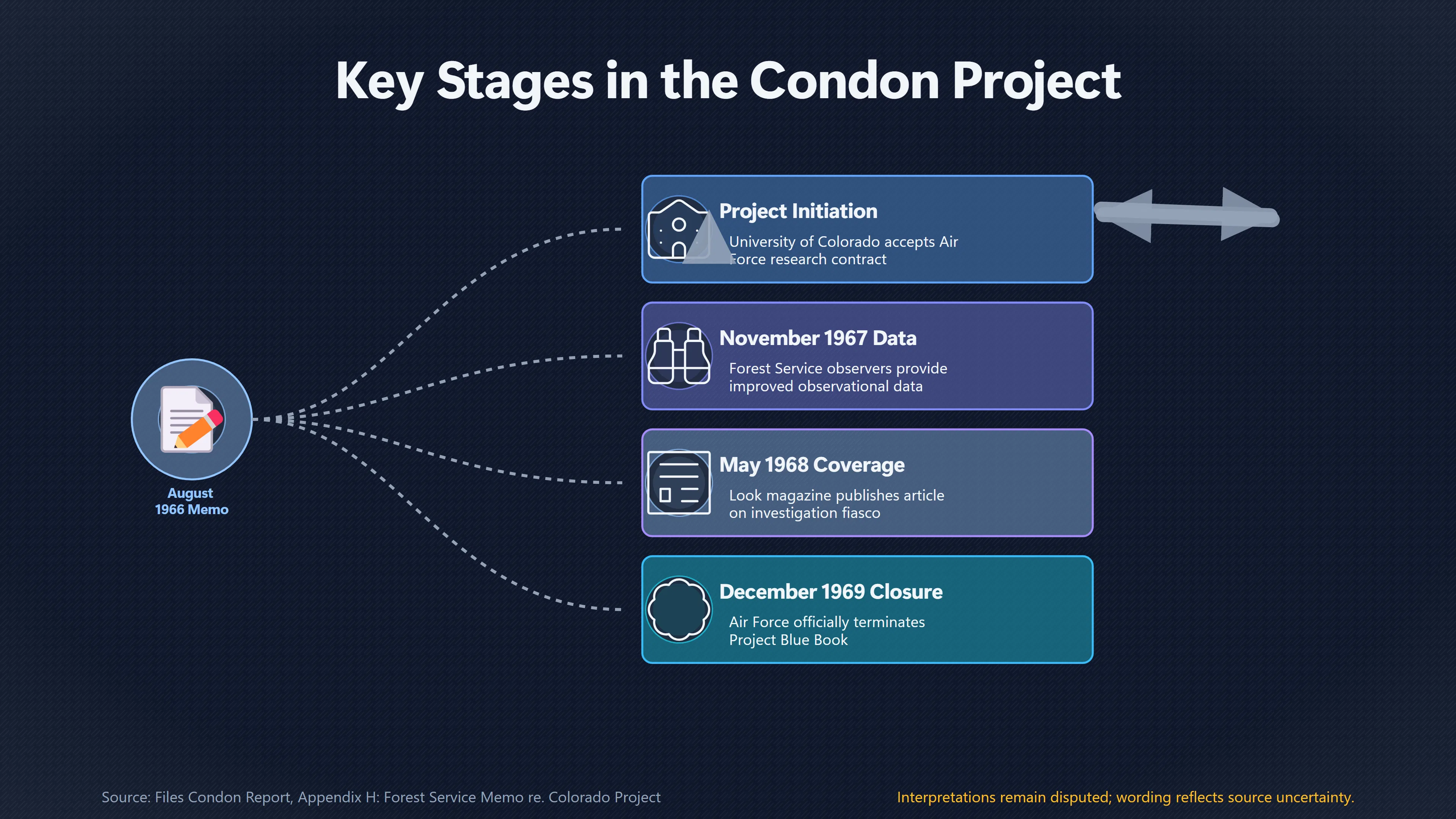
The key document is project co-ordinator Robert J. Low’s memorandum of 9 August 1966. Its notorious language about making a sceptical project appear objective is damaging precisely because it records an administrator thinking about how Colorado could investigate a ridiculed subject without damaging its scientific standing. Yet the memo was written before the project formally began, some of its proposed methodology was not adopted, and Edward Condon maintained that he did not know of it until much later. The Condon affair therefore demonstrates something subtler than proven research suppression: institutional stigma can influence how a scientific inquiry is framed before anyone needs to issue an explicit order about its conclusion.[NCAS Files]files.ncas.orgNCAS FilesCondon Report, Sec V, Chapter 2: UFOs: 1947 - 1968…
Why Colorado officials feared ridicule
When the Air Force approached the University of Colorado in 1966, UFO research already carried a substantial reputational burden. Condon’s own historical account says several Colorado faculty members had “grave misgivings” about taking the contract and predicted that the university might be derided for doing so. Earlier in the same report, he acknowledged a wider disciplinary problem: many astronomers avoided UFO involvement partly because of the danger of publicity as well as the poor quality of much of the available evidence.[NCAS Files]files.ncas.orgNCAS FilesCondon Report, Sec V, Chapter 2: UFOs: 1947 - 1968…
That distinction matters. Colorado was not simply deciding whether UFO reports deserved scientific examination. Its administrators were also considering what accepting such a contract would signal to other academics. Robert Low, then assistant dean of the graduate school, prepared his memorandum for graduate-school dean E. James Archer and vice-president for academic affairs Thurston Manning immediately before an August 1966 meeting with representatives of the Air Force Office of Scientific Research.[NCAS Files]files.ncas.orgNCAS FilesCondon Report, Sec V, Chapter 2: UFOs: 1947 - 1968…
The setting therefore makes the memo especially revealing about institutional incentives. Low was trying to solve a reputational problem: how could a respectable university accept money to investigate flying saucers without appearing to endorse flying saucers? That is different from asking, without preconceptions, what research design would best test the available claims.
The concern was not imaginary. UFO research could attach an unwelcome label to scientists and institutions, while the Air Force wanted an outside scientific assessment after years of controversy surrounding Project Blue Book. Colorado consequently entered the project in an environment where both the sponsor and the university had powerful reasons to want a credible, scientifically respectable resolution of the issue. The Air Force later explicitly relied on Colorado’s report, together with the National Academy of Sciences review, previous studies and its own experience, when terminating Project Blue Book.[Air Force]af.milOpen source on af.mil.
This is the strongest reason not to dismiss the reputation issue as incidental. Colorado’s administrators were discussing scientific credibility before the research contract was finalised. Even without any conspiracy, such pressures can influence which investigators appear suitable, which hypotheses look respectable and how an institution defines a successful study.
What the Low memorandum actually said
The controversy turns on wording that is considerably more troubling than a routine statement of scientific scepticism. Low suggested that the project could be presented publicly as objective while being staffed largely by sceptics who had very little expectation of finding evidence for a “saucer”. His most frequently cited passage called the problem a “trick”: the project would appear objective to the public while the scientific community would recognise sceptical investigators trying to be fair. The surviving transcription and reproduced memorandum date this discussion to 9 August 1966.[NICAP]nicap.orgRobert Low "trick" memoRobert Low "Trick Would Be" Memo and Transcription (below memo jpegs) page 2. Transcription. August 9, 1966…
Read in isolation, that language understandably looks like evidence of a predetermined outcome. Low also contemplated an approach concentrating heavily on the psychology and sociology of people reporting UFOs rather than primarily on the alleged physical phenomena. Critics could reasonably ask whether a study conceived in that fashion was starting with the assumption that the interesting scientific problem lay in witnesses rather than unidentified objects.[NCAS Files]files.ncas.orgNCAS FilesCondon Report, Sec V, Chapter 2: UFOs: 1947 - 1968…
But “predetermined outcome” is stronger than the surviving evidence warrants. The final project did not simply implement the research design sketched in Low’s memo. Condon’s account points out that the completed report devoted substantial attention to physical questions and case investigations rather than making witness psychology its central subject. The project’s field arrangements also sought potentially better observational evidence: a November 1967 US Forest Service memorandum, for example, described Colorado’s interest in obtaining reports from trained Forest Service observers, with the stated aim of getting “better data”.[NCAS Files]files.ncas.orgNCAS FilesCondon Report, Sec V, Chapter 2: UFOs: 1947 - 1968…
Low himself later said his concern had been Colorado’s standing in the university world, not engineering a particular answer to the UFO question. He characterised the memorandum as preliminary thinking rather than university policy. Condon likewise wrote that he had been unaware of the document until about 18 months after it was written and therefore could not have used it as his blueprint for directing the project. Those are interested parties defending their own conduct, so their statements cannot simply settle the dispute; nevertheless, they are relevant evidence against treating the memo as a documented Air Force-to-university instruction to produce a negative result.[NCAS Files]files.ncas.orgNCAS FilesCondon Report, Sec V, Chapter 2: UFOs: 1947 - 1968…
There is another important distinction. A group of investigators beginning with a low expectation that an extraordinary hypothesis will prove correct is not automatically conducting fraudulent science. Scientists routinely begin investigations with expectations. The methodological question is whether contrary evidence can change the conclusion. Low’s proposed concern with making scepticism acceptable to both public and scientific audiences is therefore evidence of preconception and reputation management, but not by itself proof that inconvenient observations would be falsified, destroyed or prohibited from appearing in the report.
The memo became a crisis inside the project
The significance of Low’s memorandum cannot be judged solely from its wording because its discovery helped trigger a genuine institutional conflict. James E. McDonald, the University of Arizona atmospheric physicist and prominent advocate of serious UFO research, learnt about the document and challenged the Colorado project over it. Project investigators David Saunders and Norman Levine became entangled in the dispute and were subsequently dismissed. Contemporary coverage in Science treated the Colorado project as an organisation suffering serious internal trouble rather than merely a technical disagreement over UFO cases.[JSTOR]jstor.orgUFO Project: Trouble on the Groundby PM Boffey · 1968 · Cited by 6 — Condon discussed the controversy briefly in pre- liminary telep…
The controversy then escaped the university. Journalist John G. Fuller’s 1968 Look article, “Flying Saucer Fiasco”, portrayed the memo and subsequent events as evidence that the supposedly objective investigation was compromised. Condon rejected that portrayal as containing falsehoods and misrepresentations. The National Investigations Committee on Aerial Phenomena (NICAP), which had supplied material and co-operated with Colorado, broke with the project amid the deteriorating relationship.[Wikipedia]WikipediaCondon CommitteeLow's memo. Press coverage included an article, "Flying Saucer Fiasco" by John G. Fuller in the May 1968 issue of Look, that presented in…
Those events make the suppression question more complicated than either side’s simplest version. Researchers were indeed dismissed during a bitter dispute involving a document that raised questions about the project’s objectivity. That is meaningful evidence of an institution becoming hostile towards internal dissent.
It is not, however, evidence that the researchers were physically silenced or made to disappear. Nor does the chronology alone prove that they were removed because they had discovered scientifically persuasive UFO evidence. The documented dispute concerned project management, loyalty, the Low memorandum and accusations surrounding its disclosure. In the wider history of alleged suspicious deaths of UFO or unconventional-physics researchers, this is therefore a particularly useful control case: real institutional conflict is visible in contemporary records without requiring an inference of covert physical suppression.[JSTOR]jstor.orgUFO Project: Trouble on the Groundby PM Boffey · 1968 · Cited by 6 — Condon discussed the controversy briefly in pre- liminary telep…

Did scepticism distort the scientific conclusions?
There are legitimate reasons to question how comfortably Condon’s broad conclusion fits the detailed material in the report. His headline judgement was that nothing from 21 years of UFO study had added to scientific knowledge and that further extensive investigation probably could not be justified in expectation of advancing science.[NCAS Files]files.ncas.orgFiles Condon Report, Section I: Conclusions & RecommendationsFiles Condon Report, Section I: Conclusions & Recommendations
Yet individual case analyses were not uniformly dismissive. Some remained unresolved, and at least one prominent radar-visual case was assessed within the report as having a low probability of conventional explanation and a fairly high probability that at least one genuine unidentified object was involved. “Unidentified” does not mean extraterrestrial, but the presence of such cases made it possible for critics to argue that Condon’s sweeping recommendation against further extensive research went beyond what the project’s case material itself demonstrated.[Wikipedia]WikipediaCondon CommitteeLow's memo. Press coverage included an article, "Flying Saucer Fiasco" by John G. Fuller in the May 1968 issue of Look, that presented in…
James McDonald made essentially that case in his post-report critique, arguing that the study’s conclusions should not close scientific consideration of the subject. J. Allen Hynek likewise became a prominent critic of the report. Their objections matter because the debate was not simply between credentialled scientists and outsiders: qualified scientists disagreed about what conclusions the evidence justified.[Kirk McD]kirkmcd.princeton.eduOpen source on princeton.edu.
At the same time, an independent National Academy of Sciences panel reviewed Colorado’s work and broadly supported its judgement that the accumulated evidence did not warrant giving UFO investigation a high scientific priority. The Air Force subsequently cited both Colorado’s report and the Academy’s assessment among the grounds for ending Project Blue Book in December 1969.[Wikipedia]WikipediaCondon CommitteeLow's memo. Press coverage included an article, "Flying Saucer Fiasco" by John G. Fuller in the May 1968 issue of Look, that presented in…
That sequence weakens a simple claim that Colorado’s conclusion survived only because dissent was suppressed. Scientists outside the project could inspect and criticise it; prominent critics did so publicly; and an external Academy panel nevertheless agreed with its broad direction. The existence of disagreement is evidence of a scientific controversy, not evidence that one side was secretly prevented from speaking.
Where evidence for bias stops short of suppression
The Condon case becomes clearer when three different claims are kept separate.
First, institutional stigma is strongly documented. Colorado faculty feared ridicule merely for accepting the assignment, and Low explicitly thought about how the university and project would look to the scientific community. That is direct evidence that reputation affected institutional decision-making around UFO research.[NCAS Files]files.ncas.orgNCAS FilesCondon Report, Sec V, Chapter 2: UFOs: 1947 - 1968…
Second, reasonable evidence exists for prior scepticism and potential bias. Low’s memorandum contemplated a study largely conducted by people expecting not to find a “saucer”. The project’s later internal crisis, dismissals and hostile relations with critics make concerns about neutrality more substantial than a retrospective conspiracy theory invented decades afterwards. Contemporary scientific journalism was already reporting the dispute in 1968.[nicap.org]nicap.orgRobert Low "trick" memoRobert Low "Trick Would Be" Memo and Transcription (below memo jpegs) page 2. Transcription. August 9, 1966…
Third, the stronger suppression claim remains unproven. The memo is not an Air Force order demanding a negative finding. Its proposed psychology-heavy design was not simply reproduced in the final project. Condon said he did not know about the memo when establishing and directing the investigation. The final report openly contained unresolved cases rather than erasing every anomalous result. And public critics, including McDonald and Hynek, were able to attack the project’s conclusions in scientific and political forums.[NCAS Files]files.ncas.orgNCAS FilesCondon Report, Sec V, Chapter 2: UFOs: 1947 - 1968…
That distinction is especially important within claims about suspicious deaths or disappearances of UFO and unconventional-physics researchers. The Condon affair supplies unusually good evidence that professional pressure can be powerful without becoming physical repression. Careers, institutional prestige, access to funding and perceptions of scientific respectability can all narrow a research field. None of those mechanisms requires murder, disappearance or a secret order to falsify results.
Reputation pressure is the stronger historical finding
The enduring importance of the Colorado UFO Project is therefore not that it proves a hidden operation to suppress a discovery. It shows how a controversial field can enter an institution already burdened by expectations about what respectable scientists are supposed to believe.
Low’s memorandum is difficult to dismiss because it captures that mechanism in unusually candid language. University officials were worried about ridicule; Low considered how a sceptically staffed project could retain an appearance of public objectivity while signalling scientific respectability; and the document later contributed to a serious breakdown in trust inside the investigation. Those facts justify scrutiny of the Condon project’s neutrality.[NICAP]nicap.orgRobert Low "trick" memoRobert Low "Trick Would Be" Memo and Transcription (below memo jpegs) page 2. Transcription. August 9, 1966…
But the same record supplies limits that a suppression narrative must acknowledge. Colorado conducted physical and field investigations that went beyond Low’s preliminary proposal. Its report preserved unexplained cases. Its critics publicly challenged it. The National Academy of Sciences independently reviewed its work. The Air Force then used the report as one component of its stated rationale for closing Project Blue Book.[ncas.org]files.ncas.orgFiles Condon Report, Appendix H: Forest Service Memo re. Colorado ProjectNCAS FilesCondon Report, Appendix H: Forest Service Memo re. Colorado Project…
The most defensible conclusion is consequently narrower, but historically more useful: the Condon project is strong evidence that fear of ridicule and institutional scepticism could shape the environment in which UFO research was conducted; it is much weaker evidence for a deliberate programme that secretly dictated scientific results. In assessing broader allegations of suppression surrounding UFO researchers, that boundary matters. Documented hostility should not be minimised, but neither should it be converted into evidence of more extreme forms of suppression without an additional evidential bridge.
Amazon book picks
Further Reading
Books and field guides related to Did Reputation Fears Distort the Condon UFO Study?. Use these as the next step if you want deeper reading beyond the article.
The UFO Experience: A Scientific Inquiry
Cited by the New York Review of Books as "the best brief for visitation," this classic study presents an analysis of UFO reports and conc...
The Close Encounters Man: How One Man Made the World Believe...
Meet the astronomer who invented the concept of "Close Encounters" with aliens, inspired a classic sci-fi film, and made a nation want to...
The Report on Unidentified Flying Objects
The Report on Unidentified Flying Objects, written by Captain Edward Ruppelt in 1956, was the first serious, unbiased account written abo...
UFOs and Government: A Historical Inquiry
Governments around the world have had to deal with the UFO phenomenon for a good part of a century. How and why they did so is the subjec...
eBay marketplace picks
Marketplace Samples
Live-tested eBay searches with available results related to this page.
Selected fromUFO poster oneBay.co.uk.


Endnotes
1.
Source: files.ncas.org
Link:https://files.ncas.org/condon/text/s5chap02.htm
Source snippet
NCAS FilesCondon Report, Sec V, Chapter 2: UFOs: 1947 - 1968...
2.
Source: nicap.org
Link:https://www.nicap.org/docs/660809lowmemo.htm
Source snippet
Robert Low "trick" memoRobert Low "Trick Would Be" Memo and Transcription (below memo jpegs) page 2. Transcription. August 9, 1966...
Published: August 9, 1966
3.
Source: files.ncas.org
Title: Files [Condon Report]({{ ‘condon-report/’ | relative_url }}), Appendix H: Forest Service Memo re. Colorado Project
Link:https://files.ncas.org/condon/text/appndx-h.htm
Source snippet
NCAS FilesCondon Report, Appendix H: Forest Service Memo re. Colorado Project...
4.
Source: jstor.org
Link:https://www.jstor.org/stable/1724207
Source snippet
UFO Project: Trouble on the Groundby PM Boffey · 1968 · Cited by 6 — Condon discussed the controversy briefly in pre- liminary telep...
5.
Source: Wikipedia
Title: Condon Committee
Link:https://en.wikipedia.org/wiki/Condon_Committee
Source snippet
Low's memo. Press coverage included an article, "Flying Saucer Fiasco" by John G. Fuller in the May 1968 issue of Look, that presented in...
Published: May 1968
6.
Source: nicap.org
Title: hall IUR1994
Link:https://www.nicap.org/papers/hall-IUR1994.htm
Source snippet
IUR1994-RHall...
7.
Source: files.ncas.org
Title: Files Condon Report, Section I: Conclusions & Recommendations
Link:https://files.ncas.org/condon/text/sec-i.htm
8.
Source: history.com
Title: uk ufos mainbrace nato
Link:https://www.history.com/articles/uk-ufos-mainbrace-nato
9.
Source: history.com
Title: ufo sightings cia robertson condon
Link:https://www.history.com/articles/ufo-sightings-cia-robertson-condon
10.
Source: history.com
Title: us navy ufo sighting guidelines
Link:https://www.history.com/articles/us-navy-ufo-sighting-guidelines
11.
Source: history.com
Title: j allen hynek ufos project blue book
Link:https://www.history.com/articles/j-allen-hynek-ufos-project-blue-book
12.
Source: history.com
Title: ufo chiles whitted soviet spycraft air force coverup
Link:https://www.history.com/articles/ufo-chiles-whitted-soviet-spycraft-air-force-coverup
13.
Source: history.com
Title: u s air force closes the book on ufos 45 years ago
Link:https://www.history.com/articles/u-s-air-force-closes-the-book-on-ufos-45-years-ago
14.
Source: history.com
Title: Project Blue Book
Link:https://www.history.com/articles/project-blue-book
15.
Source: history.com
Title: Kenneth Arnold
Link:https://www.history.com/articles/kenneth-arnold
16.
Source: history.com
Title: U.S. Air Force reports on Roswell
Link:https://www.history.com/this-day-in-history/june-24/u-s-air-force-reports-on-roswell
17.
Source: history.com
Title: Jimmy Carter files report on UFO sighting
Link:https://www.history.com/this-day-in-history/September-18/carter-files-report-on-ufo-sighting
18.
Source: history.com
Title: of UFOs
Link:https://www.history.com/articles/history-of-ufos
19.
Source: reason.com
Link:https://reason.com/1978/01/01/letters-156/
20.
Source: nicap.org
Link:https://www.nicap.org/bluebook/51-69.htm
21.
Source: nicap.org
Link:https://www.nicap.org/bios/NICAP-Bios/The_Supergroup.htm
22.
Source: nicap.org
Title: Nicap history 1976
Link:https://www.nicap.org/articles/Nicap_history_1976.htm
23.
Source: condon.ncas.org
Link:https://condon.ncas.org/text/intro.htm
24.
Source: files.ncas.org
Link:https://files.ncas.org/condon/text/intro.htm
25.
Source: files.ncas.org
Link:https://files.ncas.org/condon/text/ucnotice.htm
26.
Source: files.ncas.org
Title: sec ii
Link:https://files.ncas.org/condon/text/sec-ii.htm
27.
Source: files.ncas.org
Link:https://files.ncas.org/condon/text/case01.htm
28.
Source: files.ncas.org
Link:https://files.ncas.org/condon/text/contents.htm
29.
Source: Wikipedia
Title: Condon, Montana
Link:https://en.wikipedia.org/wiki/Condon%2C_Montana
30.
Source: jstor.org
Link:https://www.jstor.org/stable/1725090
31.
Source: nicap.org
Title: 1969TruthAbCondRep NICAP
Link:https://www.nicap.org/waves/1969TruthAbCondRep_NICAP.htm
32.
Source: files.ncas.org
Link:https://files.ncas.org/condon/text/covrletr.htm
33.
Source: files.ncas.org
Link:https://files.ncas.org/condon/text/preface.htm
34.
Source: files.ncas.org
Title: appndx b
Link:https://files.ncas.org/condon/text/appndx-b.htm
35.
Source: files.ncas.org
Title: appndx u
Link:https://files.ncas.org/condon/text/appndx-u.htm
36.
Source: af.mil
Link:https://www.af.mil/About-Us/Fact-Sheets/Display/Article/104590/unidentified-flying-objects-and-air-force-project-blue-book/
37.
Source: kirkmcd.princeton.edu
Link:https://kirkmcd.princeton.edu/JEMcDonald/mcdonald_021869.pdf
38.
Source: kirkmcd.princeton.edu
Title: mcdonald 030871
Link:https://kirkmcd.princeton.edu/JEMcDonald/mcdonald_030871.pdf
39.
Source: kirkmcd.princeton.edu
Title: gillin senior thesis jem 0613
Link:https://kirkmcd.princeton.edu/JEMcDonald/gillin_senior_thesis_jem_0613.pdf
40.
Source: spanishdict.com
Title: Condon | Spanish to English Translation
Link:https://www.spanishdict.com/translate/Condon
41.
Source: globalsecurity.org
Link:https://www.globalsecurity.org/intell/ops/condon.htm
42.
Source: cia.gov
Link:https://www.cia.gov/readingroom/document/0005516065
43.
Source: cia.gov
Title: AI R FORCE REQUEST TO DECLASSIFY CIA UFO REPORT | CIA FOIA (foia.cia.gov)
Link:https://www.cia.gov/readingroom/document/0000015430
Additional References
44.
Source: science.org
Link:https://www.science.org/doi/pdf/10.1126/science.161.3839.341
Source snippet
News in Briefentitled, "Flying Saucer Fiasco-The extraordinary story of the half-million- dollar 'trick' to make Americans believe...
45.
Source: ebsco.com
Link:https://www.ebsco.com/research-starters/history/unidentified-flying-objects-ufos-phenomenon-1960s
Source snippet
Unidentified Flying Objects (UFOs) phenomenon of the...” However, a 1966 memo from the project's coordinator, Robert Low, was...
46.
Source: youtube.com
Title: UFOs, the Air Force, and the Colorado Study (Ret. USAF Col. David Shea)
Link:https://www.youtube.com/watch?v=d2wfUiUodpM
Source snippet
Edward U. Condon: Quantum Pioneer & Champion of Scientific Integrity...
47.
Source: science.org
Link:https://www.science.org/doi/pdf/10.1126/science.161.3839.342?download=true
48.
Source: arxiv.org
Link:https://arxiv.org/html/2502.06794v1
49.
Source: cia.gov
Link:https://www.cia.gov/readingroom/document/cia-rdp96-00792r000700660006-3
50.
Source: cia.gov
Link:https://www.cia.gov/readingroom/document/cia-rdp90b01390r000300370024-1
51.
Source: cia.gov
Link:https://www.cia.gov/readingroom/document/0000015273
52.
Source: cia.gov
Link:https://www.cia.gov/readingroom/document/cia-rdp81r00560r000100010008-3
53.
Source: cia.gov
Link:https://www.cia.gov/readingroom/docs/CIA-RDP81R00560R000100010010-0.pdf