Within Motive Evidence
Was It a Homicide Before Motive Is Considered?
A homicide theory cannot rest on an unusual death alone; scene findings, forensic examination and manner-of-death evidence must establish what happened first.
On this page
- Cause of death versus manner of death
- What scene and forensic findings can establish
- Why an unexplained death is not automatically a killing
Page outline Jump by section
Introduction
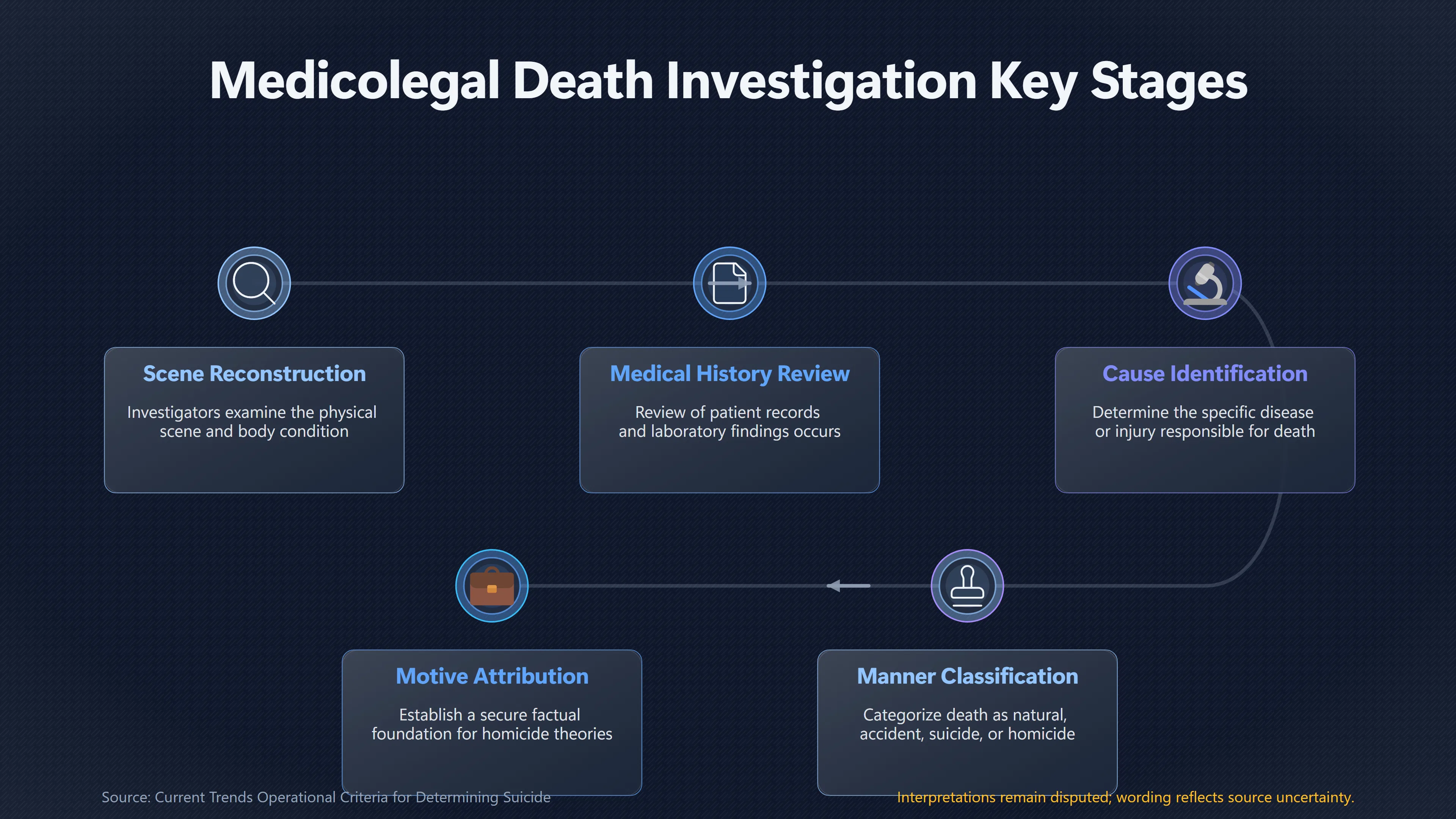
Before asking who might have wanted a UFO, antigravity or unconventional-propulsion researcher dead, investigators have to establish a more basic proposition: was the person killed at all? An unusual death, an unresolved death or a death surrounded by secrecy does not by itself establish homicide. Medicolegal death investigation works in the opposite order. Investigators reconstruct the circumstances, examine the scene and body, review medical history and laboratory findings, and determine the cause and, where possible, the manner of death. Only then does a homicide-specific motive theory have a secure factual foundation.[National Institute of Justice]nij.ojp.govdeath investigation guide scene investigator 2024This document provides a breakdown of the various tasks involved in conducting medicolegal death…Read more…

That ordering is especially important when researching alleged suspicious deaths of scientists. A compelling suppression motive can make ambiguous facts look sinister after the event. But motive cannot substitute for evidence that another person’s actions caused the death. The disciplined question is therefore not initially, “Who benefited?” It is: “What does the death evidence establish happened?”
Cause of death and manner of death answer different questions
“Cause of death” and “manner of death” are related but distinct findings. Cause identifies the disease or injury responsible for the fatal sequence: examples might include a gunshot wound, blunt-force injuries, poisoning or coronary disease. Manner places the death into a broader category reflecting its circumstances. In the standard US system these categories are natural, accident, suicide, homicide and undetermined; a case can also remain pending while necessary investigation or testing is completed.[cdc.gov]cdc.govCurrent Trends Operational Criteria for Determining SuicideCurrent Trends Operational Criteria for Determining SuicideDecember 23, 1988 — Editorial Note: For each death certificate filed in the…
That distinction matters because knowing the physical cause does not necessarily reveal how it came about. A forensic pathologist might establish that somebody died from blunt-force injuries while the available evidence remains insufficient to decide whether those injuries resulted from an accident, suicide or another person’s actions. A published forensic-pathology series of deaths classified as undetermined found precisely this problem: manner could remain unresolved despite an established cause of death, with accident appearing the most probable explanation in many cases while homicide could not be excluded in some.[PubMed]pubmed.ncbi.nlm.nih.govPub Med Undetermined Manner of Death: An Autopsy SeriesUndetermined Manner of Death: An Autopsy Series - PubMedJanuary 1, 2016…
Conversely, the word homicide in a medical examiner’s classification should not automatically be translated into “murder”. In medicolegal usage it can describe a death resulting from another person’s actions; questions of criminal culpability, justification and the precise offence belong to the legal investigation. The distinction is particularly visible when comparing jurisdictions. England and Wales uses the coroner’s conclusion of “unlawful killing”, for which the elements of murder, manslaughter or another applicable unlawful killing must actually be established to the required standard. The Chief Coroner’s guidance separately recognises “lawful killing”, demonstrating why the bare fact that human action caused death and the legal conclusion that a crime occurred are not interchangeable propositions.[Courts and Tribunals Judiciary]judiciary.ukChapter 15 Conclusions 140725Chapter 15 Conclusions 140725
For claims involving unconventional researchers, therefore, several questions should remain separate:
- What killed the person? The medical cause.[stacks.cdc.gov]stacks.cdc.govcdc 151721 DS1cdc 151721 DS1
- Under what circumstances did that fatal injury or condition arise? The manner or equivalent legal finding.
- Did another person’s conduct cause it? The threshold question for a homicide theory.
- Was that conduct criminal? A legal question requiring additional evidence.
- Who was responsible, and why? Attribution and motive questions that come later.
Collapsing those stages is one of the easiest ways for a suspicious-death narrative to outrun its evidence.
What the scene and forensic findings can establish
A post-mortem examination is only part of a death investigation. The US National Institute of Justice’s current Death Investigation: A Guide for the Scene Investigator treats medicolegal investigation as a structured process involving the scene, body, evidence, witnesses and relevant records. Earlier NIJ guidance makes the underlying principle explicit: physical evidence from all relevant locations may bear on the cause, manner and circumstances of death.[National Institute of Justice]nij.ojp.govdeath investigation guide scene investigator 2024This document provides a breakdown of the various tasks involved in conducting medicolegal death…Read more…
In England, Wales and Northern Ireland, the Royal College of Pathologists likewise describes forensic pathology in suspicious deaths as a process extending from the initial police contact through examination and ultimately, where necessary, evidence in court. Its professional code establishes standards for each stage rather than treating the post-mortem as an isolated medical exercise.[Royal College of Pathologists]rcpath.orgRoyal College of PathologistsCode-of-practice-and-performance-standards-for-forensic-…This code sets out what is expected of the patho…
That broader reconstruction matters because individual findings often admit more than one explanation. Investigators may need to consider the position and condition of the body; injury patterns; blood or other biological material; weapons or possible instruments; signs of disturbance; medications and toxicology; medical records; witness accounts; electronic or documentary evidence; and whether the physical evidence is consistent with the reported circumstances. A claimed homicide mechanism becomes materially stronger when independent findings converge on it rather than merely failing to rule it out.[Office of Justice Programs]ojp.govOpen source on ojp.gov.
For example, toxicology identifying a lethal substance can help establish what caused death without automatically establishing who administered it. A fatal fall can explain extensive blunt-force trauma without by itself determining whether the person jumped, slipped, was pushed or entered the fall by some other route. Conversely, injury distribution, defensive injuries, scene reconstruction or evidence inconsistent with an alleged accident may make third-party involvement substantially more plausible.
This is why isolated autopsy details can be misleading when circulated without the complete report and scene investigation. A particular fracture, concentration of a drug or unusual wound may be real while still being non-specific. Its significance depends on the complete pattern and competing explanations. Forensic pathologists themselves work with scene findings and medical history alongside the post-mortem examination when establishing cause and manner.[National Institute of Justice]nij.ojp.govNational Institute of JusticeDeath investigations | National Institute of JusticeAn autopsy of the remains is conducted to establish the…
Why “undetermined” does not mean “probably murdered”
One of the most consequential errors in suspicious-death research is treating uncertainty as positive evidence of homicide. Undetermined means that the available evidence does not support assigning another manner with sufficient confidence. It preserves uncertainty rather than resolving it in favour of the most dramatic possibility.
The distinction is empirically important. In the published autopsy series of undetermined deaths, homicide remained possible in a minority of cases, but accident was the most frequent probable manner. The authors nevertheless emphasised that homicide can sometimes be underestimated. Both observations matter: an undetermined classification should neither be converted into homicide nor treated as proof that homicide has been excluded.[PubMed]pubmed.ncbi.nlm.nih.govPub Med Undetermined Manner of Death: An Autopsy SeriesUndetermined Manner of Death: An Autopsy Series - PubMedJanuary 1, 2016…
The US standard death certificate similarly instructs certifiers to use “Could not be Determined” when manner cannot be determined. That is fundamentally different from selecting homicide.[CDC]cdc.govDEATH11 03FINAL ACCU.S. STANDARD CERTIFICATE OF DEATH – REV. 11/2003Indicate “Could not be Determined” ONLY when it is impossible to determine the manne…
The same evidential discipline applies when the cause itself is uncertain. Decomposition, incomplete remains, unavailable toxicology, ambiguous injuries or missing scene information can leave investigators unable to reconstruct exactly what happened. Those deficiencies may justify further investigation. They do not create affirmative evidence for an assassination theory.
A useful way to think about an unresolved case is that it contains competing hypotheses, not an evidential vacuum that belongs to homicide by default. If accident, suicide, natural disease, homicide and some combination of contributing factors remain reasonably possible, evidence has to discriminate between them. A theory gains weight by explaining observations better than its alternatives, not merely because its alternatives have unanswered questions.
This problem is recognised beyond conventional death investigation. A Royal Statistical Society-associated analysis of suspected killings in healthcare stressed that such investigations can contain two distinct uncertainties: whether homicide occurred at all and, conditional on homicide having occurred, whether the suspected person was responsible. Treating suspicion about a person as evidence that the underlying deaths were murders risks reversing those questions.[arXiv]arxiv.orgOpen source on arxiv.org.
The same logic applies directly to claims that unconventional researchers were eliminated because of their work.
Suspicious circumstances are a reason to investigate, not a manner of death
A case can quite reasonably attract investigation before homicide is established. Sudden, violent, unusual or unexplained deaths are precisely the cases medicolegal systems are designed to scrutinise. The National Institute of Justice describes medicolegal death investigation as determining identity, cause, manner and surrounding circumstances when deaths are unexpected or unnatural. The Royal College of Pathologists similarly places suspected murder and other complex suspicious deaths within forensic pathology’s remit.[National Institute of Justice]nij.ojp.govOpen source on ojp.gov.
The key distinction is between an investigative trigger and an investigative conclusion. A locked laboratory, missing research papers, intelligence contacts, an unexplained absence, contradictory witnesses or an unexpected death shortly before a claimed breakthrough could all justify asking more questions. None independently establishes that the death was inflicted by another person.
This distinction protects an investigation in both directions. It prevents premature homicide claims, but it also prevents authorities or researchers from dismissing genuinely troubling evidence merely because an initial explanation appears mundane. Scene evidence and forensic conclusions can be revised when significant new evidence emerges. The appropriate response to uncertainty is therefore preservation of evidence, documented reasoning and continued investigation where warranted—not an automatic assumption either of assassination or innocence.
The importance of independent, evidence-led manner determinations is not merely theoretical. Recent scrutiny of US deaths involving police restraint has shown that manner-of-death decisions can themselves become contested and consequential. An independent Maryland review concluded that numerous cases previously given other classifications should have been classified as homicides, illustrating both that forensic classifications can be revisited and that institutional context can affect disputed cases.[AP News]apnews.comOpen source on apnews.com. An Associated Press investigation likewise documented controversy over external pressure on medical examiners and cited professional concerns that cause-and-manner decisions should remain independent of police and prosecutors.[AP News]apnews.comOpen source on apnews.com.
The lesson is not that disputed rulings should therefore be presumed corrupt. It is that the underlying forensic record matters more than institutional prestige or institutional suspicion. A credible challenge identifies specific deficiencies—missed injuries, inconsistent reconstruction, overlooked toxicology, compromised evidence, incomplete records, unsupported assumptions or credible new evidence—and shows how correcting them changes the death analysis.
Motive can distort the reading of ambiguous evidence
The ordering problem becomes acute in stories about UFO and antigravity researchers because the alleged motive is often unusually compelling. A scientist may have worked for defence contractors, sought patents, claimed a revolutionary propulsion effect, communicated with military agencies or stopped publishing after entering classified work. Those facts can make later misfortune feel connected even before evidence of a killing exists.
But this creates a classic direction-of-reasoning problem. Once a researcher is imagined as possessing dangerous knowledge, almost any unusual subsequent event can be assimilated into the theory: a traffic collision becomes a possible targeted attack; suicide becomes a possible staged killing; missing records become evidence of suppression; an inconclusive post-mortem becomes evidence of sophisticated concealment. The theory becomes difficult to falsify because ambiguity itself is repeatedly counted in its favour.
Forensic reasoning imposes a useful brake. Start without assuming the motive theory is true and ask what conclusions the death evidence independently supports. If the injuries and scene strongly establish assault, then questions of perpetrator and motive become central. If the findings establish an ordinary accident, a suppression theory must produce strong contradictory evidence before displacing that explanation. If manner remains genuinely undetermined, homicide remains one hypothesis among the possibilities supported by the case—not the default winner.
That approach also prevents the reverse mistake. A seemingly persuasive motive should not cause investigators to force ambiguous pathology into a homicide classification. Manner-of-death classification has genuine areas of professional judgement and disagreement, which makes independence particularly important. Professional standards and government death-investigation guidance emphasise systematic investigation precisely because a conclusion should emerge from the totality of the evidence rather than from the preferred investigative narrative.[The Name]thename.orgOpen source on thename.org.
A homicide claim needs a bridge from death evidence to motive
For alleged suspicious deaths among unconventional researchers, the most reliable evaluation therefore proceeds in a deliberate evidential sequence. First establish identity, chronology and the reliability of the basic death record. Then establish the medical cause as far as the evidence permits. Reconstruct the circumstances and determine whether the manner is natural, accidental, suicidal, homicidal or genuinely unresolved. Only if the evidence supports another person’s causal involvement does a homicide-specific investigation move securely towards attribution, opportunity and motive.
That sequence does not mean motive evidence is irrelevant during an investigation. A documented death threat, surveillance record or attempt to interfere with a researcher’s work could legitimately prompt investigators to preserve evidence, revisit a scene or test a particular hypothesis. But such information should direct inquiry rather than predetermine the forensic conclusion.
This creates a useful standard for historical UFO and antigravity death claims. Before asking whether a government programme, corporation, intelligence service or commercial rival had reason to silence a researcher, ask what evidence establishes the foundational event that the proposed motive is supposed to explain. If another person’s lethal action has not been established, the accurate description is an unusual, disputed or unresolved death—not an assassination established by motive.
That distinction may sound cautious, but it is actually what makes a strong suspicious-death case stronger. Where scene reconstruction, pathology, toxicology, witness evidence and other records independently point to homicide, motive evidence can then help explain why it happened and narrow who might have been responsible. Where those foundations are absent, an impressive motive remains a hypothesis about a killing that has yet to be demonstrated.
Amazon book picks
Further Reading
Books and field guides related to Was It a Homicide Before Motive Is Considered?. Use these as the next step if you want deeper reading beyond the article.
Unnatural Causes
Dr Richard Shepherd is the UK's foremost forensic pathologist. At medical school, while performing his first autopsy, he held the heart o...
Working Stiff: Two Years, 262 Bodies, and the Making of a Med...
Fearless memoir of a forensic pathologist's "rookie season" as a NYC medical examiner, and the cases that shaped her as both a physician...
Forensics: What Bugs, Burns, Prints, Dna, and More Tell Us ab...
Crime writer Val McDermid takes readers behind the scenes of real forensic investigations: from bugs that reveal time of death to DNA tha...
The Demon-Haunted World
Rating: 4.5/5 from 43 Google Books ratings
NEW YORK TIMES BESTSELLER • From the renowned astronomer and author of Cosmos comes a “powerful [and] stirring defense of informed ration...
eBay marketplace picks
Marketplace Samples
Live-tested eBay searches with available results related to this page.
Selected fromUFO poster oneBay.co.uk.

Endnotes
1.
Source: cdc.gov
Title: Current Trends Operational Criteria for Determining Suicide
Link:https://www.cdc.gov/mmwr/preview/mmwrhtml/00001318.htm
Source snippet
Current Trends Operational Criteria for Determining SuicideDecember 23, 1988 — Editorial Note: For each death certificate filed in the...
Published: December 23, 1988
2.
Source: cdc.gov
Title: DEATH11 03FINAL ACC
Link:https://www.cdc.gov/NCHS/DATA/DVS/DEATH11-03FINAL-ACC.PDF
Source snippet
U.S. STANDARD CERTIFICATE OF DEATH -- REV. 11/2003Indicate “Could not be Determined” ONLY when it is impossible to determine the manne...
3.
Source: judiciary.uk
Title: Chapter 15 Conclusions 140725
Link:https://www.judiciary.uk/wp-content/uploads/2025/01/Chapter-15-Conclusions-140725.pdf
4.
Source: judiciary.uk
Title: Courts and Tribunals Judiciary CHIEF CORONER
Link:https://www.judiciary.uk/wp-content/uploads/2021/09/Law-Sheet-1-1-September-2021-Unlawful-Killing.pdf
5.
Source: arxiv.org
Link:https://arxiv.org/abs/2210.00962
6.
Source: college.police.uk
Link:https://www.college.police.uk/app/post-incident-procedures-following-death-or-serious-injury/changes
7.
Source: judiciary.uk
Title: Rebekah Arter: Prevention of future deaths report
Link:https://www.judiciary.uk/prevention-of-future-death-reports/rebekah-arter-prevention-of-future-deaths-report/
8.
Source: college.police.uk
Title: Arrests, charges and judicial outcomes | College of Policing
Link:https://www.college.police.uk/app/media-and-communications/arrests-charges-judicial-outcomes
9.
Source: college.police.uk
Title: Bridging borders in family liaison | College of Policing
Link:https://www.college.police.uk/article/bridging-borders-family-liaison
10.
Source: judiciary.uk
Title: Andrew Mc Cleary: Prevention of future death report
Link:https://www.judiciary.uk/prevention-of-future-death-reports/andrew-mccleary-prevention-of-future-death-report/
11.
Source: judiciary.uk
Title: Georgia Barter: Prevention of future deaths report
Link:https://www.judiciary.uk/prevention-of-future-death-reports/georgia-barter-prevention-of-future-deaths-report/
12.
Source: judiciary.uk
Title: Melissa Mathieson: Prevention of Future Deaths Report
Link:https://www.judiciary.uk/prevention-of-future-death-reports/melissa-mathieson-prevention-of-future-deaths-report/
13.
Source: judiciary.uk
Title: Chief Coroner’s Guidance for Coroners on the Bench
Link:https://www.judiciary.uk/guidance-and-resources/chief-coroners-guidance-for-coroners-on-the-bench/
14.
Source: judiciary.uk
Link:https://www.judiciary.uk/guidance-and-resources/conclusions/
15.
Source: judiciary.uk
Title: David Haw: Prevention of Future Deaths Report
Link:https://www.judiciary.uk/prevention-of-future-death-reports/david-haw-prevention-of-future-deaths-report/
16.
Source: judiciary.uk
Title: Bryan and Mary Andrews: Prevention of Future Deaths Report
Link:https://www.judiciary.uk/prevention-of-future-death-reports/bryan-and-mary-andrews-prevention-of-future-deaths-report/
17.
Source: judiciary.uk
Title: Kellie Sutton: Prevention of future deaths report
Link:https://www.judiciary.uk/prevention-of-future-death-reports/kellie-sutton-prevention-of-future-deaths-report/
18.
Source: cdc.gov
Link:https://www.cdc.gov/mmwr/volumes/72/ss/ss7205a1.htm
19.
Source: judiciary.uk
Title: Sharon Harman: Prevention of future deaths report
Link:https://www.judiciary.uk/prevention-of-future-death-reports/sharon-harman-prevention-of-future-deaths-report/
20.
Source: judiciary.uk
Title: Chief Coroner’s Guidance No.17 Conclusions: Short-Form and Narrative
Link:https://www.judiciary.uk/guidance-and-resources/chief-coroners-guidance-no-17-conclusions-short-form-and-narrative/
21.
Source: judiciary.uk
Title: Chief Coroner’s Law Sheet No.1
Link:https://www.judiciary.uk/guidance-and-resources/chief-coroners-law-sheet-no-1/
22.
Source: blogs.cdc.gov
Link:https://blogs.cdc.gov/nchs/2021/02/01/5409/
23.
Source: college.police.uk
Title: Post-incident procedures following death or serious injury | College of Policing
Link:https://www.college.police.uk/app/post-incident-procedures-following-death-or-serious-injury/post-incident-procedures-following-death-or-serious-injury
24.
Source: cdc.gov
Link:https://www.cdc.gov/mmwr/volumes/68/ss/ss6809a1.htm
25.
Source: judiciary.uk
Title: Chief Coroner’s Guidance No. 31 Death Referrals and Medical Examiners
Link:https://www.judiciary.uk/guidance-and-resources/chief-coroners-guidance-no-31-death-referrals-and-medical-examiners/
26.
Source: cdc.gov
Link:https://www.cdc.gov/mmwr/volumes/67/ss/ss6702a1.htm
27.
Source: college.police.uk
Title: Specific investigations | College of Policing
Link:https://www.college.police.uk/app/major-investigation-and-public-protection/missing-persons/specific-investigations
28.
Source: cdc.gov
Link:https://www.cdc.gov/mmwr/volumes/65/ss/ss6510a1.htm
29.
Source: college.police.uk
Title: Suicide and bereavement response | College of Policing
Link:https://www.college.police.uk/app/mental-health/suicide-and-bereavement-response
30.
Source: college.police.uk
Title: Homicide | College of Policing
Link:https://www.college.police.uk/app/major-investigation-and-public-protection/homicide
31.
Source: cdc.gov
Link:https://www.cdc.gov/mmwr/preview/mmwrhtml/ss6301a1.htm
32.
Source: college.police.uk
Title: DV I roles and responsibilities | College of Policing
Link:https://www.college.police.uk/app/civil-emergencies/disaster-victim-identification/dvi-roles-and-responsibilities?highlight=dvi
33.
Source: college.police.uk
Title: Recovering and identifying the deceased and human remains | College of Policing
Link:https://www.college.police.uk/app/civil-emergencies/disaster-victim-identification/recovering-and-identifying-deceased-and-human-remains?highlight=managing+conflict
34.
Source: college.police.uk
Title: Inquests and inquiries | College of Policing
Link:https://www.college.police.uk/app/civil-emergencies/disaster-victim-identification/inquests-and-inquiries
35.
Source: college.police.uk
Title: Physical evidence | College of Policing
Link:https://www.college.police.uk/app/investigation/investigative-strategies/physical-evidence
36.
Source: stacks.cdc.gov
Link:https://stacks.cdc.gov/view/cdc/22418
37.
Source: cdc.gov
Title: 2a 2025
Link:https://www.cdc.gov/nchs/nvss/manuals/2025/2a-2025.html
38.
Source: cdc.gov
Title: 2b sectionv 2022
Link:https://www.cdc.gov/nchs/nvss/manuals/2022/2b-sectionv-2022.htm
39.
Source: cdc.gov
Link:https://www.cdc.gov/nchs/training/improving-cause-of-death-reporting/glossary.htm
40.
Source: cdc.gov
Link:https://www.cdc.gov/nchs/nvss/writing-cause-of-death-statements.htm
41.
Source: cdc.gov
Title: 2b 2026
Link:https://www.cdc.gov/nchs/nvss/manuals/2026/2b-2026.html
42.
Source: wonder.cdc.gov
Title: Classification Terrorism
Link:https://wonder.cdc.gov/wonder/help/cmf/Classification-Terrorism.htm
43.
Source: wisqars.cdc.gov
Link:https://wisqars.cdc.gov/glossary/
44.
Source: cdc.gov
Link:https://www.cdc.gov/nchs/data/ice/ice95v1/c25.pdf
45.
Source: wwwnc.cdc.gov
Link:https://wwwnc.cdc.gov/eid/article/10/1/pdfs/02-0764.pdf
46.
Source: cdc.gov
Link:https://www.cdc.gov/phlp/php/coroner/florida.html
47.
Source: cdc.gov
Link:https://www.cdc.gov/mmwr/volumes/74/ss/ss7405a1.htm
48.
Source: stacks.cdc.gov
Title: cdc 151721 DS1
Link:https://stacks.cdc.gov/view/cdc/151721/cdc_151721_DS1.pdf
49.
Source: cdc.gov
Link:https://www.cdc.gov/mmwr/preview/mmwrhtml/rr5308a1.htm
50.
Source: cdc.gov
Title: death certificates the process that produces national mortality data in the u s
Link:https://www.cdc.gov/nchs/blog/posts/2021/02/death-certificates-the-process-that-produces-national-mortality-data-in-the-u-s.html
51.
Source: wwwnc.cdc.gov
Title: 02 0764 article
Link:https://wwwnc.cdc.gov/eid/article/10/1/02-0764_article
52.
Source: college.police.uk
Link:https://www.college.police.uk/research/projects/exploration-sensemaking-crime-scene-investigators-sudden-and-suspicious-deaths
53.
Source: nij.ojp.gov
Title: death investigation guide scene investigator 2024
Link:https://nij.ojp.gov/library/publications/death-investigation-guide-scene-investigator-2024
Source snippet
This document provides a breakdown of the various tasks involved in conducting medicolegal death...Read more...
54.
Source: nij.ojp.gov
Link:https://nij.ojp.gov/taxonomy/term/death-investigations
Source snippet
National Institute of JusticeDeath investigations | National Institute of JusticeAn autopsy of the remains is conducted to establish the...
55.
Source: rcpath.org
Link:https://www.rcpath.org/static/5617496b-cd1a-4ce3-9ec8eabfb0db8f3a/Code-of-practice-and-performance-standards-for-forensic-pathology-in-England-Wales-and-Northern-Ireland.pdf
Source snippet
Royal College of PathologistsCode-of-practice-and-performance-standards-for-forensic-...This code sets out what is expected of the patho...
56.
Source: snohomishcountywa.gov
Link:https://snohomishcountywa.gov/806/Cause-Manner-of-Death
Source snippet
Snohomish CountyCause & Manner of DeathCause of Death is a term used to indicate the medical cause of death. It... The manner of death i...
57.
Source: pubmed.ncbi.nlm.nih.gov
Title: Pub Med Undetermined Manner of Death: An Autopsy Series
Link:https://pubmed.ncbi.nlm.nih.gov/26234640/
Source snippet
Undetermined Manner of Death: An Autopsy Series - PubMedJanuary 1, 2016...
Published: January 1, 2016
58.
Source: ojp.gov
Link:https://www.ojp.gov/pdffiles1/nij/234457.pdf
59.
Source: rcpath.org
Link:https://www.rcpath.org/discover-pathology/careers-in-pathology/careers-in-medicine/become-a-forensic-pathologist.html
60.
Source: nij.ojp.gov
Link:https://nij.ojp.gov/taxonomy/term/medicolegal-death-investigations?page=5
61.
Source: rcpath.org
Link:https://www.rcpath.org/discover-pathology/what-is-pathology/information-about-post-mortems-for-friends-and-relatives-/what-happens-during-a-post-mortem.html
62.
Source: apnews.com
Link:https://apnews.com/article/71e52a4cd2cc4103eab9648a127f1835
63.
Source: apnews.com
Link:https://apnews.com/article/a401d382bd0ceb3b35d48cfaccab4275
64.
Source: thename.org
Link:https://www.thename.org/death-certification
65.
Source: thename.org
Link:https://www.thename.org/assets/docs/2016%20NAME%20Forensic%20Autopsy%20Standards%209-12-2016.pdf
66.
Source: lawcom.gov.uk
Title: Law Commission proposes major overhaul of homicide offences – Law Commission
Link:https://lawcom.gov.uk/news/law-commission-proposes-major-overhaul-of-homicide-offences/
67.
Source: lawcom.gov.uk
Title: Law of homicide – Law Commission
Link:https://lawcom.gov.uk/project/law-of-homicide/
68.
Source: richmond.gov.uk
Title: The role of the coroner
Link:https://www.richmond.gov.uk/the_role_of_the_coroner
69.
Source: GOV.UK
Title: www.gov.uk Phase 1 report: volume 1 (accessible)
Link:https://www.gov.uk/government/publications/the-southport-inquiry-phase-1-report/phase-1-report-volume-1-accessible
70.
Source: GOV.UK
Title: www.gov.uk Guide to coroners statistics
Link:https://www.gov.uk/government/statistics/coroners-statistics-2025/guide-to-coroners-statistics
71.
Source: GOV.UK
Title: coroners statistics 2025 england and wales
Link:https://www.gov.uk/government/statistics/coroners-statistics-2025/coroners-statistics-2025-england-and-wales
72.
Source: GOV.UK
Title: www.gov.uk Annex 4: Coroner (England and Wales)
Link:https://www.gov.uk/government/publications/murder-manslaughter-and-infanticide-of-british-nationals-abroad-memorandum-of-understanding/annex-3-coroner-england-and-wales-roles-and-responsibilities
73.
Source: ncbi.nlm.nih.gov
Link:https://www.ncbi.nlm.nih.gov/books/NBK620157/
74.
Source: ncbi.nlm.nih.gov
Link:https://www.ncbi.nlm.nih.gov/books/NBK620159/
75.
Source: ncbi.nlm.nih.gov
Link:https://www.ncbi.nlm.nih.gov/books/NBK620155/
76.
Source: ncbi.nlm.nih.gov
Link:https://www.ncbi.nlm.nih.gov/books/NBK620149/
77.
Source: ncbi.nlm.nih.gov
Link:https://www.ncbi.nlm.nih.gov/books/NBK620161/
78.
Source: lawcom.gov.uk
Title: Product liability: Terms of reference – Law Commission
Link:https://lawcom.gov.uk/publication/product-liability-terms-of-reference/
79.
Source: GOV.UK
Link:https://www.gov.uk/government/publications/sudden-unexpected-death-medical-investigation/practice-advice-the-medical-investigation-of-suspected-homicide-accessible–2
80.
Source: ojp.gov
Link:https://ojp.gov/resources/ojp-hhs-mdi-wg
82.
Source: GOV.UK
Title: coroners statistics 2024 england and wales
Link:https://www.gov.uk/government/statistics/coroners-statistics-2024/coroners-statistics-2024-england-and-wales
83.
Source: GOV.UK
Link:https://www.gov.uk/government/publications/medical-certificate-of-cause-of-death-mccd-guidance-for-medical-practitioners/guidance-for-medical-practitioners-completing-medical-certificates-of-cause-of-death-in-england-and-wales
84.
Source: nij.ojp.gov
Title: overview forensic pathology
Link:https://nij.ojp.gov/topics/forensics/overview-forensic-pathology
85.
Source: pmc.ncbi.nlm.nih.gov
Link:https://pmc.ncbi.nlm.nih.gov/articles/PMC11347210/
86.
Source: ojp.gov
Title: death investigation guide scene investigator 2024
Link:https://www.ojp.gov/library/publications/death-investigation-guide-scene-investigator-2024
88.
Source: GOV.UK
Title: www.gov.uk Guide to coroners statistics
Link:https://www.gov.uk/government/statistics/coroners-statistics-2023/guide-to-coroners-statistics
89.
Source: pubmed.ncbi.nlm.nih.gov
Link:https://pubmed.ncbi.nlm.nih.gov/38567211/
90.
Source: govinfo.gov
Title: Death Investigation: A Guide for the Scene Investigator
Link:https://www.govinfo.gov/app/details/GOVPUB-J28-PURL-gpo235137
91.
Source: ncbi.nlm.nih.gov
Link:https://www.ncbi.nlm.nih.gov/books/NBK539901/
92.
Source: pubmed.ncbi.nlm.nih.gov
Link:https://pubmed.ncbi.nlm.nih.gov/37249490/
93.
Source: GOV.UK
Title: www.gov.uk Guide to coroners statistics
Link:https://www.gov.uk/government/statistics/coroners-statistics-2022/guide-to-coroners-statistics
94.
Source: pmc.ncbi.nlm.nih.gov
Link:https://pmc.ncbi.nlm.nih.gov/articles/PMC9780396/
95.
Source: pmc.ncbi.nlm.nih.gov
Link:https://pmc.ncbi.nlm.nih.gov/articles/PMC9616451/
96.
Source: lawcom.gov.uk
Title: Corporate criminal liability – Law Commission
Link:https://lawcom.gov.uk/project/corporate-criminal-liability/
97.
Source: GOV.UK
Title: www.gov.uk Guide to coroners statistics
Link:https://www.gov.uk/government/statistics/coroners-statistics-2021/guide-to-coroners-statistics
98.
Source: pmc.ncbi.nlm.nih.gov
Link:https://pmc.ncbi.nlm.nih.gov/articles/PMC8727841/
99.
Source: pubmed.ncbi.nlm.nih.gov
Link:https://pubmed.ncbi.nlm.nih.gov/34836666/
100.
Source: GOV.UK
Title: www.gov.uk Guide to coroners statistics
Link:https://www.gov.uk/government/statistics/coroners-statistics-2020/guide-to-coroners-statistics
101.
Source: cps.gov.uk
Title: Coroners | The Crown Prosecution Service
Link:https://www.cps.gov.uk/prosecution-guidance/coroners
102.
Source: pubmed.ncbi.nlm.nih.gov
Link:https://pubmed.ncbi.nlm.nih.gov/33282045/
103.
Source: GOV.UK
Title: www.gov.uk Guide to coroners statistics
Link:https://www.gov.uk/government/statistics/coroners-statistics-2019/guide-to-coroners-statistics
104.
Source: legislation.gov.uk
Link:https://www.legislation.gov.uk/ukpga/2019/12/notes/division/4/index.htm
105.
Source: nij.ojp.gov
Title: death scene investigations roles responsibilities
Link:https://nij.ojp.gov/media/video/death-scene-investigations-roles-responsibilities
106.
Source: pmc.ncbi.nlm.nih.gov
Link:https://pmc.ncbi.nlm.nih.gov/articles/PMC6474445/
107.
Source: GOV.UK
Title: www.gov.uk Sudden unexpected death: medical investigation
Link:https://www.gov.uk/government/publications/sudden-unexpected-death-medical-investigation
108.
Source: nij.ojp.gov
Title: aquatic death and homicidal drowning investigation
Link:https://nij.ojp.gov/library/publications/aquatic-death-and-homicidal-drowning-investigation
109.
Source: pmc.ncbi.nlm.nih.gov
Link:https://pmc.ncbi.nlm.nih.gov/articles/PMC5508151/
110.
Source: lawcom.gov.uk
Title: Unfitness to plead – Law Commission
Link:https://lawcom.gov.uk/project/unfitness-to-plead/
111.
Source: nidirect.gov.uk
Title: Coroners, post-mortems and inquests | nidirect
Link:https://www.nidirect.gov.uk/articles/coroners-post-mortems-and-inquests
112.
Source: pmc.ncbi.nlm.nih.gov
Link:https://pmc.ncbi.nlm.nih.gov/articles/PMC4411039/
113.
Source: pmc.ncbi.nlm.nih.gov
Link:https://pmc.ncbi.nlm.nih.gov/articles/PMC3951636/
114.
Source: nij.ojp.gov
Title: death investigation guide scene investigator technical update ARCHIVED 2011
Link:https://nij.ojp.gov/library/publications/death-investigation-guide-scene-investigator-technical-update-ARCHIVED-2011
115.
Source: pubmed.ncbi.nlm.nih.gov
Link:https://pubmed.ncbi.nlm.nih.gov/20830284/
116.
Source: lawcom.gov.uk
Title: Murder – Law Commission
Link:https://lawcom.gov.uk/project/murder/
117.
Source: nij.ojp.gov
Title: death investigation guide scene investigator ARCHIVED 1999
Link:https://nij.ojp.gov/library/publications/death-investigation-guide-scene-investigator-ARCHIVED-1999
118.
Source: ojp.gov
Link:https://www.ojp.gov/library/publications/death-investigation-guide-scene-investigator-ARCHIVED-1999
119.
Source: rcpath.org
Title: new college report highlights workforce challenges in forensic pathology
Link:https://www.rcpath.org/discover-pathology/news/new-college-report-highlights-workforce-challenges-in-forensic-pathology.html
120.
Source: rcpath.org
Link:https://www.rcpath.org/asset/8CBAD99C-E268-4666-8D128633AD1FC74A/
121.
Source: rcpath.org
Link:https://www.rcpath.org/asset/CC440CDD-450E-445D-9AB5EB4F427F440E/
122.
Source: rcpath.org
Link:https://www.rcpath.org/asset/33B81F4A-89F3-42BD-BC33BDD67879F008/
123.
Source: rcpath.org
Title: Forensic Pathology Regulations and Guidelines
Link:https://www.rcpath.org/static/8cbad99c-e268-4666-8d128633ad1fc74a/a982df4c-22d7-4e31-8881c1101dd2005a/Forensic-Pathology-Regulations-and-Guidelines.pdf
124.
Source: rcpath.org
Link:https://www.rcpath.org/asset/641EB44E-C64F-44AA-A613F8D12902E362/
125.
Source: rcpath.org
Link:https://www.rcpath.org/static/15a26420-ce7b-4858-ad538b210328d973/950d5510-c733-4eba-888c84a1e57afbb4/G175-Guidelines-on-autopsy-practice-Deaths-in-patients-with-epilepsy-including-sudden-deaths.pdf
126.
Source: Wikipedia
Title: Manner of death
Link:https://en.wikipedia.org/wiki/Manner_of_death
127.
Source: GOV.UK
Title: www.gov.uk What to do after someone dies: When a death is reported to a coroner
Link:https://www.gov.uk/after-a-death/when-a-death-is-reported-to-a-coroner
128.
Source: pubmed.ncbi.nlm.nih.gov
Link:https://pubmed.ncbi.nlm.nih.gov/10183268/
129.
Source: pubmed.ncbi.nlm.nih.gov
Link:https://pubmed.ncbi.nlm.nih.gov/10739221/
130.
Source: ncbi.nlm.nih.gov
Link:https://www.ncbi.nlm.nih.gov/books/NBK577019/
131.
Source: pubmed.ncbi.nlm.nih.gov
Link:https://pubmed.ncbi.nlm.nih.gov/12899425/
132.
Source: pubmed.ncbi.nlm.nih.gov
Link:https://pubmed.ncbi.nlm.nih.gov/15274947/
133.
Source: pubmed.ncbi.nlm.nih.gov
Link:https://pubmed.ncbi.nlm.nih.gov/3176712/
134.
Source: pubmed.ncbi.nlm.nih.gov
Link:https://pubmed.ncbi.nlm.nih.gov/8454995/
135.
Source: pubmed.ncbi.nlm.nih.gov
Link:https://pubmed.ncbi.nlm.nih.gov/26561747/
136.
Source: pubmed.ncbi.nlm.nih.gov
Link:https://pubmed.ncbi.nlm.nih.gov/9290869/
137.
Source: pubmed.ncbi.nlm.nih.gov
Link:https://pubmed.ncbi.nlm.nih.gov/1855716/
138.
Source: nij.ojp.gov
Title: human pathology
Link:https://nij.ojp.gov/topics/forensics/human-pathology
139.
Source: ojp.gov
Title: death investigation guide scene investigator 2024
Link:https://www.ojp.gov/ncjrs/virtual-library/abstracts/death-investigation-guide-scene-investigator-2024
140.
Source: ojp.gov
Link:https://www.ojp.gov/ncjrs/virtual-library/abstracts/guidelines-death-scene-investigation-sudden-unexplained-infant
141.
Source: ojp.gov
Link:https://www.ojp.gov/library/publications/death-investigation-guide-scene-investigator-technical-update-ARCHIVED-2011
142.
Source: nij.ojp.gov
Title: medicolegal death investigations
Link:https://nij.ojp.gov/taxonomy/term/medicolegal-death-investigations?page=45&series_filter=National+Center+on+Forensics+Community-Focused+Webinar+Series
143.
Source: ojp.gov
Link:https://www.ojp.gov/ncjrs-virtual-library/search?combine_keywords=&delta=All&field_authors_value=&field_ncj_number_value=&journal_name=&page=86&program_office=All&pub_date_max=&pub_date_min=&sort_by=created&sort_order=DESC&title=
144.
Source: nij.ojp.gov
Title: just advancements death investigation practices
Link:https://nij.ojp.gov/media/audiofile/just-advancements-death-investigation-practices
145.
Source: uat.ojp.gov
Title: death investigation guide scene investigator technical update ARCHIVED 2011
Link:https://uat.ojp.gov/library/publications/death-investigation-guide-scene-investigator-technical-update-ARCHIVED-2011
146.
Source: ojp.gov
Link:https://www.ojp.gov/pdffiles1/nij/grants/213421.pdf
147.
Source: ojp.gov
Title: crime scene investigation
Link:https://www.ojp.gov/taxonomy/term/crime-scene-investigation?page=72&type=all
148.
Source: ojp.gov
Link:https://www.ojp.gov/pdffiles1/nij/199758.pdf
149.
Source: uat.ojp.gov
Link:https://uat.ojp.gov/taxonomy/term/development?page=4
150.
Source: ojp.gov
Link:https://www.ojp.gov/pdffiles1/ojjdp/209764.pdf
151.
Source: ojp.gov
Link:https://ojp.gov/taxonomy/term/medicolegal-death-investigations?page=57
152.
Source: ojp.gov
Link:https://www.ojp.gov/pdffiles1/nij/grants/305762.pdf
153.
Source: ojp.gov
Title: crime scene investigation
Link:https://ojp.gov/taxonomy/term/crime-scene-investigation?page=65
154.
Source: thename.org
Link:https://www.thename.org/
155.
Source: thename.org
Title: NAME 2018 SAMs Workbook
Link:https://www.thename.org/assets/docs/NAME%202018%20SAMs%20Workbook.pdf
156.
Source: thename.org
Title: NAME 2017 FULL PROGRAM
Link:https://www.thename.org/assets/docs/NAME%202017%20FULL%20PROGRAM.pdf
157.
Source: thename.org
Link:https://www.thename.org/index.php?id=67&option=com_content&task=view
158.
Source: sciencedirect.com
Title: Cause of Death
Link:https://www.sciencedirect.com/topics/medicine-and-dentistry/cause-of-death
159.
Source: hse.gov.uk
Title: Investigation after a work-related death
Link:https://www.hse.gov.uk/victims-and-bereaved-families/investigation-after-work-related-death.htm
160.
Source: coroners.leicester.gov.uk
Link:https://coroners.leicester.gov.uk/faqs/office-of-the-coroner/what-do-coroners-do/
161.
Source: lawcom.gov.uk
Link:https://lawcom.gov.uk/project/offences-against-dead-bodies/
162.
Source: lawcom.gov.uk
Link:https://lawcom.gov.uk/contact/
163.
Source: lawcom.gov.uk
Link:https://lawcom.gov.uk/area-of-law/criminal-law/
164.
Source: lawcom.gov.uk
Link:https://lawcom.gov.uk/completed-projects-table/
165.
Source: lawcom.gov.uk
Link:https://lawcom.gov.uk/project/burial-cremation-and-new-funerary-methods/
166.
Source: lawcom.gov.uk
Link:https://lawcom.gov.uk/law-reform-programme/14th-programme/
Additional References
167.
Source: youtube.com
Title: Ex-State Coroner Says Autopsy Got Cause of Death Wrong In Devyn Michaels Trial
Link:https://www.youtube.com/watch?v=hO7wi6215SQ
Source snippet
Medical Examiner Testifies Lyoya Was Shot in the Head | Homicide Ruling | Schurr Trial Day 1...
168.
Source: youtube.com
Title: Father of 11th dead or [missing scientist]({{ ‘missing-scientist/’ | relative_url }}) rejects suspicions about her death
Link:https://www.youtube.com/watch?v=1d–WxTUkXE
Source snippet
Ex-State Coroner Says Autopsy Got Cause of Death Wrong In Devyn Michaels Trial...
169.
Source: youtube.com
Link:https://www.youtube.com/watch?v=1Hp02QoYzN4
Source snippet
Father of 11th dead or missing scientist rejects suspicions about her death...
170.
Source: washoecounty.gov
Link:https://www.washoecounty.gov/coroner/faq/difference_cause_and_manner_of_death.php
171.
Source: govinfo.gov
Title: Death Investigation: A Guide for the Scene Investigator: Technical Update
Link:https://www.govinfo.gov/app/details/GOVPUB-J28-PURL-gpo10182
172.
Source: sciencedirect.com
Link:https://www.sciencedirect.com/science/article/pii/S1752928X26000740
173.
Source: alberta.ca
Link:https://www.alberta.ca/death-investigation-process
174.
Source: facebook.com
Link:https://www.facebook.com/Georgia.Bureau.of.Investigation/posts/do-you-know-the-difference-between-a-cause-and-manner-of-death-do-you-know-the-f/1825790130916276/
175.
Source: england.nhs.uk
Link:https://www.england.nhs.uk/patient-safety/medical-examiners/
176.
Source: nationalacademies.org
Link:https://www.nationalacademies.org/read/29232/chapter/7