Within Cold Fusion
Did MIT's Cold Fusion Test Hide Excess Heat?
Mallove accused MIT researchers of presenting calorimetry results in a way that understated possible excess heat, while MIT rejected his claims.
On this page
- What the MIT replication attempted to measure
- Mallove's allegations about the calorimetry results
- MIT's response and the limits of the dispute
Page outline Jump by section
Introduction
The MIT cold-fusion dispute was not a case in which a clear positive result was simply erased. It was a narrower, more technically interesting argument about how a small calorimetric signal was processed, plotted and interpreted. In 1989, a team spanning MIT’s Plasma Fusion Center and other departments attempted to reproduce aspects of the Fleischmann–Pons experiment. Its published conclusion was negative: within the experiment’s estimated accuracy, the researchers found no excess power or other fusion products.[WashU Research Profiles]profiles.wustl.eduWashU Research ProfilesMeasurement and analysis of neutron and gamma-ray emission rates, other fusion products, and power in electrochemi…
Eugene Mallove later argued that preliminary graphs told a less straightforward story. He said the heavy-water data initially sat slightly above the zero-power baseline and that subsequent processing shifted the curve down, making it resemble the ordinary-water control. MIT Plasma Fusion Center director Ronald Parker rejected the allegation of improper manipulation. Crucially, Parker argued that the effect Mallove was discussing — roughly 20 milliwatts — was smaller than the experiment’s roughly 40-milliwatt measurement uncertainty.[Deseret News]deseret.comNews SCIENTISTS AT MIT EMBROILED IN WRANGLING OVER FUSION – Deseret NewsDeseret NewsSCIENTISTS AT MIT EMBROILED IN WRANGLING OVER FUSION – Deseret News…
That distinction is central to assessing the episode. The surviving record supports a genuine dispute over data treatment, experimental sensitivity and presentation. It does not, by itself, establish that MIT detected cold fusion and deliberately concealed it.
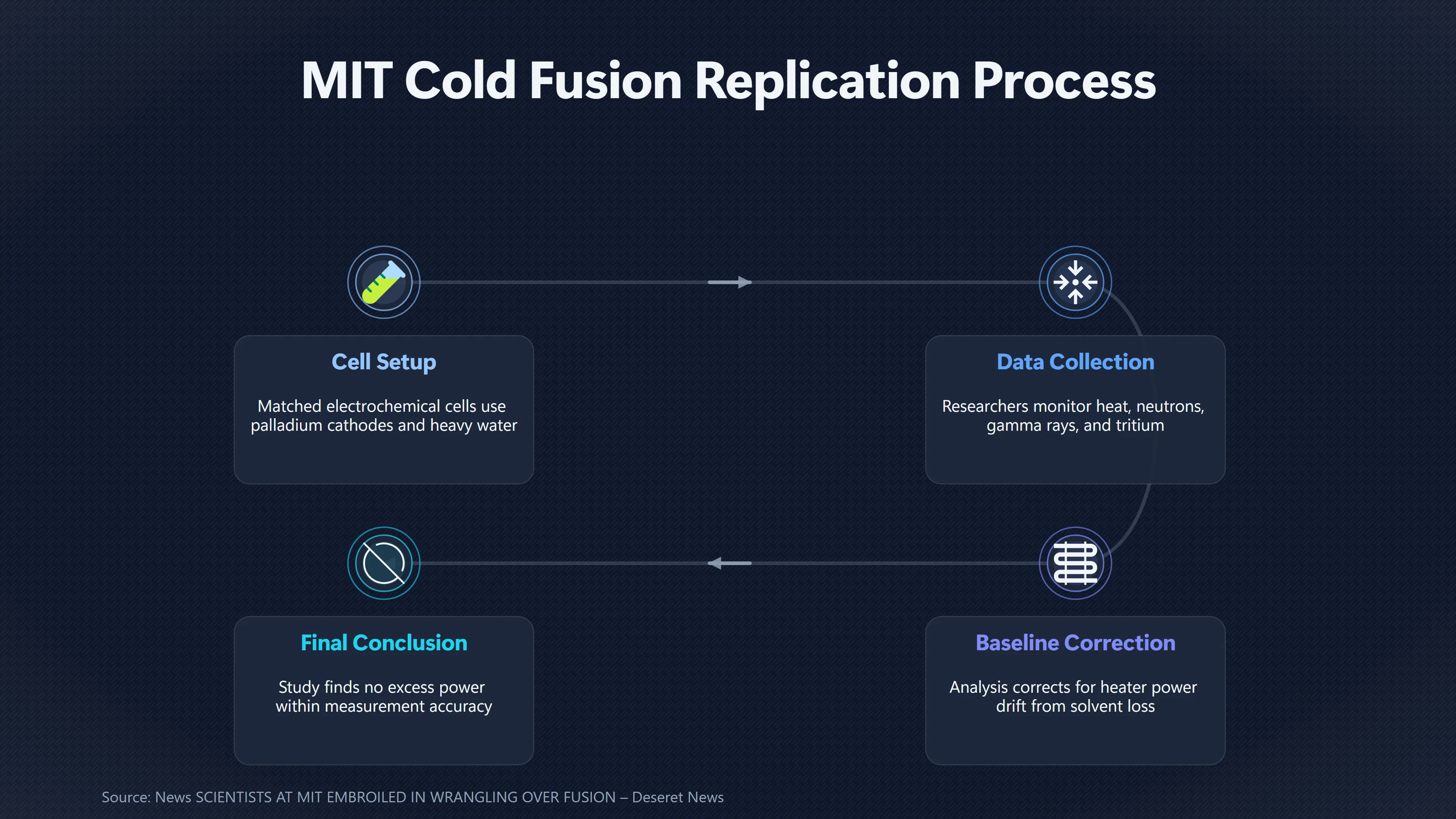
What the MIT replication actually measured
The MIT experiment followed the extraordinary March 1989 claim by Martin Fleischmann and Stanley Pons that electrolysis involving palladium and heavy water could produce anomalous heat associated with nuclear fusion. The MIT collaboration was unusually broad, involving researchers from the Plasma Fusion Center, chemistry and other departments. Its experiment used matched electrochemical cells with palladium cathodes and examined more than heat alone: the investigators also searched for neutrons, gamma rays, helium and tritium.[WashU Research Profiles]profiles.wustl.eduWashU Research ProfilesMeasurement and analysis of neutron and gamma-ray emission rates, other fusion products, and power in electrochemi…
For the calorimetry — measurement of heat entering and leaving the apparatus — the important comparison was between a cell containing heavy water, D₂O, and a control using ordinary water, H₂O. If the proposed deuterium-related phenomenon were real, the heavy-water cell was the one in which anomalous power might be expected.
The published 1990 paper, Measurement and analysis of neutron and gamma-ray emission rates, other fusion products, and power in electrochemical cells having Pd cathodes, reported that the matched cells had operated for ten days. Its conclusion was explicit: within the team’s estimated measurement accuracy, it found neither excess power nor evidence of the fusion products for which it searched.[WashU Research Profiles]profiles.wustl.eduWashU Research ProfilesMeasurement and analysis of neutron and gamma-ray emission rates, other fusion products, and power in electrochemi…
The calorimetry itself was not simply a matter of reading a thermometer. The investigators observed a long-term drift in measured heater power as electrolyte was lost during operation. Their analysis attributed that drift to changing solvent volume. They therefore corrected the sloping baseline and digitally smoothed faster fluctuations before assessing whether sustained anomalous power remained. The paper said neither the ordinary-water nor heavy-water cell showed sustained production at the level Fleischmann, Pons and Hawkins had reported; for the operating conditions involved, the comparison level cited was about 79 milliwatts.[SciSpace]scispace.comMeasurement and analysis of neutron and gamma-ray emission rates, other fusion products, and power in electrochemical cells havin…
That processing step became the centre of the controversy.
Why Mallove thought the graphs had been made to look negative
Mallove had an unusually close view of the episode. He was an MIT-trained engineer and worked in MIT’s News Office while the cold-fusion controversy unfolded. He later became convinced that cold fusion had been dismissed too quickly and resigned from MIT in 1991 amid increasingly bitter disagreements over its treatment. Contemporary reporting confirms that he sought a formal scientific-misconduct inquiry concerning the calorimetry.[Deseret News]deseret.comNews SCIENTISTS AT MIT EMBROILED IN WRANGLING OVER FUSION – Deseret NewsDeseret NewsSCIENTISTS AT MIT EMBROILED IN WRANGLING OVER FUSION – Deseret News…
His most concrete allegation concerned different versions of the MIT graphs. Mallove possessed draft material dated 10 July and 13 July 1989. He maintained that the earlier heavy-water curve appeared predominantly above zero while the ordinary-water curve fluctuated around zero. In his interpretation, that difference corresponded to approximately 20 milliwatts of possible excess heat. He then argued that processing of the later graph shifted the heavy-water curve downwards, visually suppressing the difference between the experimental and control cells.[Deseret News]deseret.comNews SCIENTISTS AT MIT EMBROILED IN WRANGLING OVER FUSION – Deseret NewsDeseret NewsSCIENTISTS AT MIT EMBROILED IN WRANGLING OVER FUSION – Deseret News…
This was more specific than a generic accusation that MIT was hostile to cold fusion. It raised a reproducible question about a dataset: why did the plotted baseline change, what mathematical correction produced the change, and was that correction justified by the behaviour of the calorimeter?
Mallove’s later retrospective reproduced the two drafts and characterised the difference in much stronger terms, alleging that the data had been improperly altered. That document is useful primary evidence for understanding what Mallove alleged, but it cannot independently establish that the allegation was correct: it was written by Mallove himself, years after the experiment, in a publication devoted to unconventional-energy research.[Cold Fusion Now]coldfusionnow.orgCold Fusion Now
Contemporary journalism nevertheless confirms that the graph dispute existed in 1991 rather than being invented retrospectively. Deseret News reported Mallove’s claim that the ordinary-water data oscillated around zero while the preliminary heavy-water curve lay mainly above it, before the latter was shifted down in the reported analysis.[Deseret News]deseret.comNews SCIENTISTS AT MIT EMBROILED IN WRANGLING OVER FUSION – Deseret NewsDeseret NewsSCIENTISTS AT MIT EMBROILED IN WRANGLING OVER FUSION – Deseret News… A later Wired account likewise described Mallove examining MIT’s experimental data and concluding that a baseline adjustment had concealed a small anomalous-heat indication.[WIRED]wired.comWhat If Cold Fusion Is Real? | WIREDNovember 1, 1998…
The important word is small. Even according to Mallove’s interpretation, this was not a hidden demonstration of large amounts of unexplained energy. The argument concerned a signal of only tens of milliwatts.
MIT’s answer: the apparent signal was inside the error bars
Ronald Parker’s response went directly to that point. He did not argue that every intermediate curve was identical. Instead, he maintained that MIT’s calorimetry was insufficiently accurate to assign physical significance to the offset Mallove identified.
Parker told reporters that the relevant uncertainty was about 40 milliwatts. A possible 20-milliwatt excess therefore fell inside the experiment’s uncertainty: in his account, the same underlying measurement limitations could permit an interpretation of roughly 20 milliwatts in the opposite direction. The team’s defensible conclusion, he said, was consequently that it had not detected excess heat.[Deseret News]deseret.comNews SCIENTISTS AT MIT EMBROILED IN WRANGLING OVER FUSION – Deseret NewsDeseret NewsSCIENTISTS AT MIT EMBROILED IN WRANGLING OVER FUSION – Deseret News…
This is the strongest limitation on the popular version of the “altered MIT graph” story. Moving or correcting a baseline is not automatically scientific misconduct. Calorimetric data commonly require corrections for instrumental drift and changing experimental conditions. The scientific question is whether the correction has an independently defensible basis and whether uncertainty is reported honestly.
The MIT researchers gave a physical reason for their correction. Their published analysis attributed the long-term change in heater power to loss of solvent. When solvent was restored to the heavy-water cell, heater power moved back towards its earlier value, supporting their conclusion that changing electrolyte volume was responsible for much of the drift. The investigators then fitted and subtracted a linear baseline drift.[SciSpace]scispace.comMeasurement and analysis of neutron and gamma-ray emission rates, other fusion products, and power in electrochemical cells havin…
MIT also eventually produced a dedicated technical treatment of the issue. Its Plasma Fusion Center catalogue records Stanley C. Luckhardt’s May 1992 report, Technical appendix to D. Albagli, et al. Journal of Fusion Energy (1990): calorimetry error analysis, report PFC/RR-92-7.[PSFC Library]library.psfc.mit.eduPSFC Library MIT Plasma Science & Fusion Center LibraryPSFC Library MIT Plasma Science & Fusion Center Library The existence of that appendix matters because the controversy cannot fairly be described as MIT simply refusing ever to address calorimetric uncertainty. At the same time, its appearance in 1992 — after Mallove’s accusations — helps explain why advocates regarded the original publication and subsequent clarification as an evolving account rather than a completely transparent resolution.
The 20 mW versus 40 mW problem changes the meaning of the dispute
The numbers make the evidential problem unusually clear. Mallove believed that approximately 20 milliwatts separating the heavy-water data from the control was potentially meaningful. Parker said the apparatus had an uncertainty of approximately 40 milliwatts.[Deseret News]deseret.comNews SCIENTISTS AT MIT EMBROILED IN WRANGLING OVER FUSION – Deseret NewsDeseret NewsSCIENTISTS AT MIT EMBROILED IN WRANGLING OVER FUSION – Deseret News…
If Parker’s uncertainty estimate is accepted, the alleged signal cannot support a confident detection. A measurement whose possible anomalous component is smaller than the uncertainty cannot establish that excess heat occurred merely because a preliminary curve happens to sit on one side of zero.
But that does not make every aspect of Mallove’s criticism meaningless. A graph intended to communicate a comparison should make processing choices and baseline corrections intelligible, particularly when the result is politically and scientifically contentious. Mallove’s strongest case was therefore about transparency and interpretation, not proof that MIT had replicated cold fusion.
There was another important limitation. The MIT paper’s own target was substantially larger than Mallove’s proposed residual effect. The investigators discussed an expected Fleischmann–Pons-level signal of about 79 milliwatts under their experimental conditions and reported that such sustained production was absent.[SciSpace]scispace.comMeasurement and analysis of neutron and gamma-ray emission rates, other fusion products, and power in electrochemical cells havin… A later debate about whether a much smaller residual might survive the analysis is not equivalent to overturning that experimental conclusion.
This is why two statements that sometimes appear contradictory can both be true: an early plot can contain a small positive-looking offset, while the experiment can still legitimately fail to establish statistically or experimentally significant excess heat.
The argument expanded from one graph into a misconduct complaint
Mallove did not accept the issue as an ordinary disagreement over error analysis. Contemporary reporting shows that by October 1991 he had formally requested a scientific-misconduct investigation at MIT, alleging that the curve had been altered so that an apparent cold-fusion effect disappeared.[Deseret News]deseret.comNews SCIENTISTS AT MIT EMBROILED IN WRANGLING OVER FUSION – Deseret NewsDeseret NewsSCIENTISTS AT MIT EMBROILED IN WRANGLING OVER FUSION – Deseret News…
Access to underlying information became another source of friction. Mallove complained that he had been denied data needed to examine the experiment fully. Parker responded that the Plasma Fusion Center had offered to have a staff member review the material with Mallove but was uncomfortable simply releasing all of its laboratory books.[Deseret News]deseret.comDeseret NewsEX-MIT WRITER ACCUSES RESEARCHERS OF ALTERING DATA TO DISCREDIT FUSION – Deseret News… The disagreement therefore involved not only the final graph but who could inspect the underlying records and under what conditions.
Mallove’s later collection of correspondence shows that he continued pressing MIT administrators and researchers through 1991 and 1992. His account records requests for additional calorimetry information and further complaints after explanations from the experimental team.[studylib.net]studylib.netMI T and Cold Fusion: A Special ReportMI T and Cold Fusion: A Special Report These documents demonstrate a prolonged institutional dispute. They do not provide an independent adjudication proving his misconduct allegation.
That distinction is particularly important in the suppressed-scientist narrative. “MIT was accused of misconduct” and “MIT committed scientific fraud” are not interchangeable statements. The first is firmly documented. The second remains Mallove’s interpretation of contested experimental decisions.
Why MIT’s negative result carried unusual weight
MIT’s result did not exist in isolation. In 1989 the US Department of Energy’s Cold Fusion Panel reviewed a rapidly expanding and contradictory experimental literature. It found that many groups reported neither excess heat nor fusion products, while some reported heat without nuclear products at levels capable of explaining it. The panel emphasised poor reproducibility and internal inconsistencies and concluded that the available evidence did not persuasively demonstrate a new nuclear process.[NCAS Files]files.ncas.orgFiles Cold Fusion Research: ExecutiveFiles Cold Fusion Research: Executive
Other laboratories also reported negative calorimetric results. Later scientific discussion explicitly grouped MIT with Caltech and Harwell among influential early experiments reporting no excess heat.[ACS Publications]pubs.acs.orgOpen source on acs.org. This broader context makes an important difference: even if every criticism Mallove made of MIT’s graph presentation were granted, overturning the MIT result alone would not overturn the wider 1989 replication problem.
At the same time, MIT’s prestige made its negative finding symbolically powerful. Mallove’s later suppression argument concentrated on the institution because this was not merely an anonymous failed replication. It was a highly visible result from one of the world’s best-known scientific institutions, and Mallove himself had been working inside MIT’s communications apparatus while the controversy unfolded.
That is why the calorimetry graphs became so important to his later narrative. They offered something more concrete than speculation about peer pressure or funding: two versions of experimental plots whose treatment could actually be argued over.
What the surviving evidence can and cannot establish
The strongest evidence supports a more qualified account than either side’s polemical version.
MIT really performed a relevant replication attempt. Its published experiment compared matched palladium electrochemical cells, used calorimetry and searched for several possible nuclear products. It reported no excess power or fusion products within its estimated accuracy.[WashU Research Profiles]profiles.wustl.eduWashU Research ProfilesMeasurement and analysis of neutron and gamma-ray emission rates, other fusion products, and power in electrochemi…
Mallove identified a genuine data-presentation question. Contemporary accounts document his comparison of preliminary and later curves and his objection to the downward adjustment of the heavy-water data. This was not merely a vague allegation constructed years afterwards.[Deseret News]deseret.comNews SCIENTISTS AT MIT EMBROILED IN WRANGLING OVER FUSION – Deseret NewsDeseret NewsSCIENTISTS AT MIT EMBROILED IN WRANGLING OVER FUSION – Deseret News…
MIT had an experimental explanation for processing the data. The published analysis attributed substantial baseline drift to solvent loss and described correcting that drift; the team also argued that the small residual invoked by Mallove was below the calorimeter’s useful resolution.[SciSpace]scispace.comMeasurement and analysis of neutron and gamma-ray emission rates, other fusion products, and power in electrochemical cells havin…
The disputed offset was not a robust cold-fusion detection. The roughly 20-milliwatt value associated with Mallove’s interpretation was smaller than the approximately 40-milliwatt uncertainty Parker cited. Even if the preliminary offset is treated as potentially interesting, it cannot simply be promoted into proof of anomalous heat.[Deseret News]deseret.comNews SCIENTISTS AT MIT EMBROILED IN WRANGLING OVER FUSION – Deseret NewsDeseret NewsSCIENTISTS AT MIT EMBROILED IN WRANGLING OVER FUSION – Deseret News…
The wider cold-fusion case did not depend on MIT alone. The Department of Energy’s 1989 assessment found extensive problems with reproducibility and, especially, the mismatch between claimed heat and expected nuclear products across the field.[NCAS Files]files.ncas.orgFiles Cold Fusion Research: ExecutiveFiles Cold Fusion Research: Executive
Why this case became evidence of “suppression”
For Mallove, the MIT episode supplied a mechanism for scientific suppression that required no secret programme: a prestigious institution could produce a negative result, make analytical choices that critics considered questionable, restrict access to some underlying material, reject accusations of wrongdoing and thereby help establish a scientific consensus that became increasingly difficult to challenge.
There is documentary evidence for several pieces of that sequence. There was an MIT negative experiment; Mallove challenged its calorimetric presentation; he sought more data and an institutional inquiry; Parker publicly rejected his accusations; and the controversy continued into 1992.[Deseret News]deseret.comNews SCIENTISTS AT MIT EMBROILED IN WRANGLING OVER FUSION – Deseret NewsDeseret NewsSCIENTISTS AT MIT EMBROILED IN WRANGLING OVER FUSION – Deseret News…
What the evidence does not demonstrate is the stronger proposition often attached to this history in later narratives: that MIT knowingly obtained decisive evidence of cold fusion and deliberately erased it. The small magnitude of the disputed effect, the stated measurement uncertainty, the documented problem of solvent-related drift and the broader failure to obtain corresponding nuclear products all prevent that conclusion.
That makes the MIT controversy more useful as a case study in how contested science becomes polarised than as proof of a conspiracy. Mallove saw the changed graphs as a concrete example of institutional bias turning an ambiguous result into a negative one. MIT’s researchers saw an insignificant fluctuation being transformed by an advocate into an accusation of misconduct. The documentary record establishes the dispute; the calorimetry does not resolve it in Mallove’s favour.
Within the wider narrative linking unconventional-energy researchers to allegedly suppressed scientists, that boundary matters. The MIT episode provides genuine evidence of acrimony, mistrust and disagreement over scientific data. It provides much weaker evidence for intentional suppression, and none by itself for the more expansive claims of organised physical targeting that later became attached to stories about Mallove and other unconventional researchers.
Amazon book picks
Further Reading
Books and field guides related to Did MIT's Cold Fusion Test Hide Excess Heat?. Use these as the next step if you want deeper reading beyond the article.
Fire from Ice: Searching for the Truth Behind the Cold Fusion...
Discusses the furor over the announcement that scientists had succeeded in producing controlled nuclear fusion at ordinary temperatures,...

Too hot to handle : the race for cold fusion
First published 1990. Subjects: Cold fusion, Research, Utah, Fusion reactors, Nuclear fusion.
Cold Fusion: The Scientific Fiasco of the Century
Professor Huizenga, Co-Chairman of the U.S. Department of Energy Cold Fusion Panel that investigated the claims of Pons and Fleischmann--...
eBay marketplace picks
Marketplace Samples
Live-tested eBay searches with available results related to this page.
Selected fromUFO poster oneBay.co.uk.



Endnotes
1.
Source: pubs.acs.org
Link:https://pubs.acs.org/doi/10.1021/j100349a002
Source snippet
ACS PublicationsElectronic structure of palladium clusters: implications for cold fusion | The Journal of Physical Chemistry...
2.
Source: deseret.com
Title: News SCIENTISTS AT MIT EMBROILED IN WRANGLING OVER FUSION – Deseret News
Link:https://www.deseret.com/1991/10/21/18947426/scientists-at-mit-embroiled-in-wrangling-over-fusion/
Source snippet
Deseret NewsSCIENTISTS AT MIT EMBROILED IN WRANGLING OVER FUSION – Deseret News...
3.
Source: studylib.net
Link:https://studylib.net/doc/10512779/of-redox-polymer-modified–electrodes-properties-and
4.
Source: scispace.com
Link:https://scispace.com/pdf/measurement-and-analysis-of-neutron-and-gamma-ray-emission-4j94z09bqu.pdf
Source snippet
Measurement and analysis of neutron and gamma-ray emission rates, other fusion products, and power in electrochemical cells havin...
5.
Source: deseret.com
Link:https://www.deseret.com/1991/8/10/18935394/ex-mit-writer-accuses-researchers-of-altering-data-to-discredit-fusion/
Source snippet
Deseret NewsEX-MIT WRITER ACCUSES RESEARCHERS OF ALTERING DATA TO DISCREDIT FUSION – Deseret News...
6.
Source: coldfusionnow.org
Title: Cold Fusion Now
Link:https://coldfusionnow.org/wp-content/uploads/2012/05/mitcfreport.pdf
7.
Source: wired.com
Link:https://www.wired.com/1998/11/coldfusion/
Source snippet
What If Cold Fusion Is Real? | WIREDNovember 1, 1998...
Published: November 1, 1998
8.
Source: library.psfc.mit.edu
Title: PSFC Library MIT Plasma Science & Fusion Center Library
Link:https://library.psfc.mit.edu/cgi-library/exec.pl?report=RR&rm=1&year=1992
9.
Source: studylib.net
Title: MI T and Cold Fusion: A Special Report
Link:https://studylib.net/doc/18663563/mit-and-cold-fusion–a-special-report
10.
Source: files.ncas.org
Title: Files Cold Fusion Research: Executive
Link:https://files.ncas.org/erab/execsumm.htm
11.
Source: pubs.acs.org
Link:https://pubs.acs.org/doi/10.1021/jp961751j
12.
Source: pubs.acs.org
Link:https://pubs.acs.org/doi/pdf/10.1021/acs.chemmater.6b05271?download=true
13.
Source: studylib.net
Title: Brief Biographies: Scientists & Alternative Medicine
Link:https://studylib.net/doc/7473131/brief-biography-of-names-i
14.
Source: caltech.edu
Title: ‘s David Goodstein Investigates Sham Science in “On Fact and Fraud”
Link:https://www.caltech.edu/about/news/caltechs-david-goodstein-investigates-sham-science-fact-and-fraud-1774
15.
Source: news.mit.edu
Link:https://news.mit.edu/2007/dod
16.
Source: pubs.acs.org
Link:https://pubs.acs.org/doi/10.1021/jp962038x
17.
Source: deseret.com
Title: MI T WRITER WILL RESIGN, CITING `UNFAIR’ CRITICISM OF FUSION – Deseret News
Link:https://www.deseret.com/1991/6/9/18924935/mit-writer-will-resign-citing-unfair-criticism-of-fusion/
18.
Source: deseret.com
Link:https://www.deseret.com/1990/12/20/18897131/paper-debunks-cold-fusion-phenomenon-says-the-heat-is-energy-freed-from-cracks-br/
19.
Source: scispace.com
Title: upper bounds on cold fusion in electrolytic cells 5cerm2mk9i
Link:https://scispace.com/papers/upper-bounds-on-cold-fusion-in-electrolytic-cells-5cerm2mk9i
20.
Source: pubs.acs.org
Link:https://pubs.acs.org/doi/10.1021/j100349a001
21.
Source: studylib.net
Title: doe pc 70512 14 pfc rr 88 10 mhd magnet cost analysis
Link:https://studylib.net/doc/10783829/doe-pc-70512-14-pfc-rr-88-10-mhd–magnet–cost–analysis
22.
Source: studylib.net
Title: doe id 01570 2 litfire user s guide d.s. pfc rr 87 11
Link:https://studylib.net/doc/10783810/doe-id-01570-2-litfire-user-s–guide-d.s.-pfc-rr
23.
Source: studylib.net
Title: A N EXPERIMENTAL STUDY OF James
Link:https://studylib.net/doc/11219548/an–experimental–study–of-james
24.
Source: files.ncas.org
Link:https://files.ncas.org/erab/apx2a.htm
25.
Source: files.ncas.org
Link:https://files.ncas.org/erab/intro.htm
26.
Source: cold-fusion.org
Link:https://www.cold-fusion.org/
27.
Source: studylib.net
Link:https://studylib.net/doc/27578891/iso20816-3-2022-compress
28.
Source: library.psfc.mit.edu
Link:https://library.psfc.mit.edu/catalog/media/videos.html
29.
Source: library.psfc.mit.edu
Link:https://library.psfc.mit.edu/cgi-library/exec.pl?days=30&rm=3
30.
Source: library.psfc.mit.edu
Link:https://library.psfc.mit.edu/catalog/theses/theses.html
31.
Source: library.psfc.mit.edu
Link:https://library.psfc.mit.edu/cgi-library/exec.pl?days=90&rm=3
32.
Source: calteches.library.caltech.edu
Link:https://calteches.library.caltech.edu/610/
33.
Source: profiles.wustl.edu
Link:https://profiles.wustl.edu/en/publications/measurement-and-analysis-of-neutron-and-gamma-ray-emission-rates-/
Source snippet
WashU Research ProfilesMeasurement and analysis of neutron and gamma-ray emission rates, other fusion products, and power in electrochemi...
34.
Source: doi.org
Title: An Operando calorimeter for high temperature electrochemical cells
Link:https://doi.org/10.1088/2515-7655%2Fabb4c4
35.
Source: doi.org
Link:https://doi.org/10.1029%2F2018JA025940
36.
Source: coldfusionnow.org
Link:https://coldfusionnow.org/remove-institutional-blocks-at-mit-and-caltech-fund-cold-fusion-programs-now/
37.
Source: astro.gla.ac.uk
Link:https://www.astro.gla.ac.uk/users/martin/teaching/fftf/ethics/coldfusion.htm
38.
Source: books.google.com
Title: Cold Fusion
Link:https://books.google.com/books/about/Cold_Fusion.html?id=jC5mQgAACAAJ
39.
Source: infinite-energy.com
Link:https://infinite-energy.com/iemagazine/issue47/mit.html
40.
Source: coldfusionnow.org
Link:https://coldfusionnow.org/tag/eugene-mallove/
41.
Source: coldfusionnow.org
Link:https://coldfusionnow.org/category/education/
42.
Source: profiles.wustl.edu
Title: measurements of neutron emission induced by muons stopped in meta
Link:https://profiles.wustl.edu/en/publications/measurements-of-neutron-emission-induced-by-muons-stopped-in-meta/
43.
Source: uapmurders.com
Title: Eugene Mallove
Link:https://uapmurders.com/uaps/Details/Eugene_Mallove/
Additional References
44.
Source: nature.com
Link:https://www.nature.com/articles/s41398-021-01496-3
45.
Source: nature.com
Link:https://www.nature.com/articles/d41586-024-00976-y
46.
Source: nature.com
Link:https://www.nature.com/articles/s41598-026-46153-1
47.
Source: science.gov
Link:https://www.science.gov/topicpages/c/cold%2Bfusion%2Bresearch.html
48.
Source: science.gov
Link:https://www.science.gov/topicpages/t/transmutation%2Bcurrent%2Bdevelopments
49.
Source: nature.com
Title: Problems with the γ-ray spectrum in the Fleischmann et al. experiments | Nature
Link:https://www.nature.com/articles/339183a0
50.
Source: youtube.com
Title: Eugene Mallove Interview
Link:https://www.youtube.com/watch?v=avpoIAKvYmU
Source snippet
Cold Fusion and Beyond - Dr. Eugene Mallove / Disclosure Project Witness Testimony Archive...
51.
Source: youtube.com
Title: Cold Fusion and Beyond
Link:https://www.youtube.com/watch?v=Q_A4XJhV1y4
Source snippet
The Dead Grad Student Problem...
52.
Source: vensteropdevecht.nl
Link:https://www.vensteropdevecht.nl/component/ajax/?hash=2d283a9f&p=cache%2F39%2F0_loenersloot_intro800x800-39c4eff0.png&src=images%2Fkastelen%2F0_loenersloot_intro800x800.png&thumbnail=800%2C800%2C
53.
Source: researchgate.net
Link:https://www.researchgate.net/publication/337318729_Electrochemical_Isoperibolic_Calorimetry_for_D2O_Electrolysis