Within UFO Research Deaths
How Scientific UFO Research Became Professionally Risky
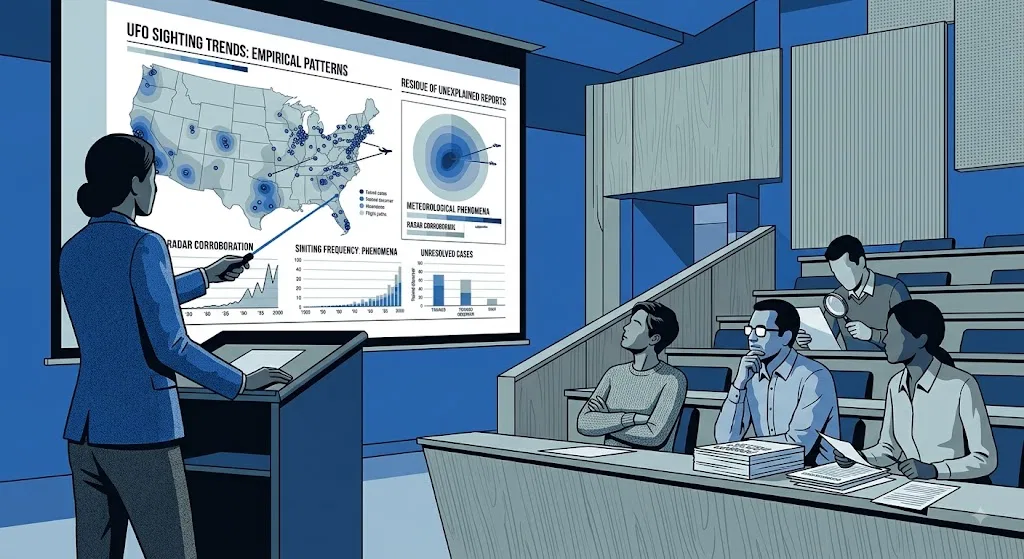
McDonald's career illustrates how serious UFO inquiry could encounter skepticism and institutional resistance without proving violent suppression.
On this page
- Mc Donald's scientific credibility
- Academic resistance to UFO investigation
- Why stigma should not be conflated with assassination
Page outline Jump by section
Introduction
For much of the post-war period, a scientist who treated UFO reports as a legitimate research problem risked something more ordinary, and more demonstrable, than secret physical retaliation: ridicule, reputational damage, difficulty attracting institutional support and association with a subject widely regarded as pseudoscientific. Atmospheric physicist James E. McDonald is the clearest historical example. He remained a serious scientist with recognised credentials while publicly arguing that some UFO reports deserved systematic investigation, yet he worked in an intellectual climate increasingly hostile to that proposition. The 1969 Condon Report helped reinforce the view that further UFO research was unlikely to advance science, while recent NASA and academic studies still identify stigma as an obstacle to reporting and research.[NCAS Files]files.ncas.orgFiles Mc Carthy Dissertation: James E. Mc Donald ObituaryNCAS FilesMcCarthy Dissertation: James E. McDonald Obituary…
That history matters when considering claims of suspicious deaths among UFO or unconventional-propulsion researchers. Professional marginalisation is well documented. It does not, by itself, constitute evidence of assassination.
McDonald was not an outsider to science
James Edward McDonald is useful precisely because he cannot easily be dismissed as someone whose scientific identity was created by UFO research. His career pre-dated his public campaign on the subject. He held a master’s degree from the Massachusetts Institute of Technology and a doctorate in physics from Iowa State University, served as a naval aerologist during the Second World War and joined the University of Arizona’s Institute of Atmospheric Physics in 1954. At his death in 1971 he was a professor of atmospheric sciences and a Fellow of the American Meteorological Society. The Society’s obituary described a substantial conventional career in teaching and atmospheric research.[NCAS Files]files.ncas.orgFiles Mc Carthy Dissertation: James E. Mc Donald ObituaryNCAS FilesMcCarthy Dissertation: James E. McDonald Obituary…
That background gave McDonald’s UFO advocacy unusual significance. He was not merely asking scientists to accept stories of extraordinary craft. His recurring argument was that there existed a residue of reports, sometimes involving trained observers, radar or multiple witnesses, that had not received investigation commensurate with their potential scientific importance. By the late 1960s he was giving technical presentations, examining historical case files and challenging the adequacy of official investigations. He addressed a congressional symposium in 1968 and, in December 1969, presented “Science in Default: Twenty-Two Years of Inadequate UFO Investigations” at an American Association for the Advancement of Science symposium.[Isaac Koi Archive]isaackoi.com19691226 aaas ufo symposiumIsaac Koi Archive1969.1226 AAAS UFO Symposium | Isaac Koi ArchiveDecember 26, 1969…
His argument was controversial but not intellectually trivial. The AAAS symposium itself demonstrates that the boundary between “legitimate science” and UFO inquiry was still being contested rather than simply fixed. Participants included McDonald, astronomer J. Allen Hynek and scientists who were considerably more sceptical. The proceedings were later edited by Carl Sagan and Thornton Page as UFO’s: A Scientific Debate.[Isaac Koi Archive]isaackoi.com19691226 aaas ufo symposiumIsaac Koi Archive1969.1226 AAAS UFO Symposium | Isaac Koi ArchiveDecember 26, 1969…
McDonald therefore illustrates a particularly important kind of professional risk. A credentialled researcher did not have to lose his qualifications or formal position to become identified, in the eyes of colleagues and the public, with a subject carrying a heavy reputational burden. Once that identification occurred, arguments about individual cases could easily become arguments about the researcher’s judgement.
How UFO inquiry acquired an institutional handicap
The stigma surrounding UFO research was not generated by one decision. It accumulated through the interaction of poor-quality reports, hoaxes, popular entertainment, sensational claims, official scepticism and a scientific incentive structure in which the subject offered substantial reputational risk with uncertain academic reward.
Government-sponsored assessments contributed to that environment. The most consequential was the University of Colorado study directed by physicist Edward Condon and published in 1969. Condon’s conclusion was emphatic: the previous 21 years of UFO study had produced nothing that added to scientific knowledge, and further extensive investigation probably could not be justified in the expectation of scientific advancement. He suggested that scientists who accepted the report’s conclusions would direct their talents elsewhere.[NCAS Files]files.ncas.orgFiles Condon Report, Section I: Conclusions & RecommendationsNCAS FilesCondon Report, Section I: Conclusions & Recommendations…
That was more than a finding about particular sightings. Coming from a university project funded by the US Air Force and then accepted by much of the mainstream scientific establishment, it supplied an authoritative reason for laboratories, departments and funders not to make UFOs a research priority.
McDonald disputed the report vigorously. His objection was not simply that Condon had failed to endorse an extraterrestrial explanation. He argued that the project had not adequately examined the strongest cases and that its broad recommendation against further research was not justified by the material presented. Contemporary scientific criticism was not limited to McDonald: a 1969 Physics Today article by Gerald Rothberg likewise addressed what its title called “Where the Condon Committee Went Wrong”.[DOI]doi.orgOpen source on doi.org.
None of this proves that the Condon project was designed to destroy careers. It does show how institutional judgements can alter the cost-benefit calculation facing researchers. Once a prestigious inquiry concludes that a field is scientifically unproductive, a younger scientist considering a grant application, dissertation or publication has to ask why scarce career time should be spent there rather than on a subject recognised by established journals and funding bodies.
There was also an earlier official desire to reduce unproductive public fixation on UFOs. The CIA-sponsored Robertson Panel of 1953 viewed the flood of reports partly as a Cold War problem: excessive or false reports could burden warning systems and potentially be exploited by an adversary. CIA’s historical account says the panel recommended educating military personnel, researchers and the public to identify common astronomical, meteorological and aviation phenomena that generated false reports.[CIA]cia.govHow To Investigate a Flying SaucerHow To Investigate a Flying Saucer
That policy context is sometimes presented as proof that every later instance of scientific scepticism was centrally engineered. The evidence supports a narrower conclusion. US security agencies genuinely worried about the social and military effects of UFO reporting and favoured reducing false alarms. That could reinforce a culture of dismissal, but it does not establish that sceptical scientists were acting under orders, much less that researchers who persisted faced covert physical elimination.
Stigma could operate without any formal ban
The most effective professional stigma rarely requires an explicit rule saying, “Do not research this.” It works through expectations.
A scientist deciding whether to enter a controversial subject must consider whether colleagues will take the work seriously, whether journals will review it fairly, whether funding is available and whether association with the topic will weaken confidence in unrelated work. These are especially powerful constraints in disciplines where appointments and promotions depend heavily on peer evaluation.
Historical UFO research presented an unusually difficult version of that problem. The empirical material was heterogeneous: eyewitness reports sat alongside photographs, radar records, misidentifications, deliberate hoaxes and extraordinary claims that were often impossible to reconstruct experimentally. A conscientious researcher could therefore spend considerable time establishing merely that a case was unresolved, without being able to show that the underlying cause was exotic. That made it easy for critics to ask what scientific return justified the effort.
The situation created a self-reinforcing loop. Because respected scientists hesitated to enter the field, much investigation remained in the hands of private UFO organisations and enthusiasts. Their dominance then made the topic appear still further removed from mainstream science. Poor evidence, sensational publicity and occasional credulity strengthened the association. Researchers who wanted better evidence consequently faced greater reputational risk for trying to obtain it.
Jacques Vallée’s recollections provide a revealing example of this climate. Although he established a substantial career in computing, he was cautious about publicly tying his institutional position to his early UFO work. Wired reported that he did not want his Northwestern University affiliation highlighted on a book jacket and recalled scientists privately showing greater interest than they were willing to express publicly.[WIRED]wired.comJacques Vallée Still Doesn't Know What UFOs AreJacques Vallée Still Doesn't Know What UFOs Are
Such cases are difficult to quantify retrospectively, but the mechanism is straightforward: no conspiracy is necessary when researchers themselves anticipate that public association with a subject may damage credibility.

Modern surveys show the reputational problem did not simply disappear
One reason the historical stigma deserves to be taken seriously is that it can now be measured, albeit imperfectly.
A 2023 study published in Humanities and Social Sciences Communications surveyed tenured and tenure-track academics across 14 disciplines at 144 high-research-activity US universities. Of 1,460 respondents included in the analysis, only 3.84 per cent reported having conducted UAP-related research, yet more than a third expressed at least some interest in doing so. Nearly two-thirds regarded academic evaluation of newly released UAP information as “Very Important” or “Absolutely Essential”, while 37.26 per cent gave those ratings to the need for more UAP research.[Nature]nature.comOpen source on nature.com.
The contrast is instructive. Interest in examination was substantially greater than existing participation. Funding and respected peers also mattered: 54.86 per cent said funding would make them more inclined to conduct UAP research to at least some degree, while 43.4 per cent said they would be more inclined if a reputable scholar in their own discipline did so.[Nature]nature.comOpen source on nature.com.
A follow-up analysis published in 2024 asked more directly about professional consequences. Some 69.04 per cent of faculty reported at least some concern that colleagues would ridicule them or give them a hard time for UAP research, while 52.67 per cent expressed some concern that such work could jeopardise tenure or promotion. Assistant professors, whose careers are generally most exposed to peer judgement, showed the highest concern about tenure or promotion, at 73.41 per cent.[Nature]nature.comOpen source on nature.com.
Yet the same survey also provides an important corrective to exaggerated accounts of academic persecution. When respondents were asked whether a colleague’s UAP research would negatively affect their own tenure or promotion vote, 61.92 per cent said no, 27.95 per cent said maybe and only 7.4 per cent said yes. The authors therefore concluded that researchers’ fear of career consequences might be greater than colleagues’ declared willingness to impose them.[Nature]nature.comOpen source on nature.com.
Those results are not a precise measurement of the academic climate of McDonald’s 1960s. The survey also had a low 3.9 per cent response rate, which the authors identify as its principal limitation. It nevertheless provides contemporary evidence for the central mechanism: researchers can perceive a subject as professionally hazardous even where there is no explicit institutional prohibition.[Nature]nature.comOpen source on nature.com.
NASA now treats stigma as a data-quality problem
The clearest institutional reversal came from NASA’s 2023 Independent Study Team on unidentified anomalous phenomena, the modern governmental term that includes what earlier decades generally called UFOs.
NASA did not endorse an extraterrestrial explanation. Its report instead stressed that available observations were too inconsistent and poorly curated to support definitive conclusions. But it explicitly identified stigma as part of the measurement problem. The panel found that the negative perception surrounding UAP reporting obstructed data collection and that NASA’s participation could help reduce a stigma that was probably causing reports and information to be lost before scientists could examine them.[NASA]nasa.govuap independent study team final report 0NASA should therefore explore the viability of developing or acquiring such a crowdsourcing system as part of its strategy. In turn, the…
That is an important distinction. Destigmatising investigation does not mean lowering evidential standards. In NASA’s formulation, the reason to reduce ridicule is almost the opposite: better reporting makes conventional explanations easier to establish and genuinely anomalous cases easier to isolate.
Modern projects such as the Galileo Project have adopted the same basic strategy by shifting attention away from anecdote towards calibrated, multimodal instruments. Its published methodology describes wide-field and narrow-field cameras, radar-related measurements, radio receivers, microphones and environmental sensors designed to identify ordinary artefacts and corroborate unusual detections across several independent channels.[arXiv]arxiv.orgOpen source on arxiv.org.
The lesson is less dramatic than either believers or dismissive sceptics sometimes suggest. A topic can carry substantial stigma and still contain many mistaken reports. Removing stigma is therefore not evidence that extraordinary UFO claims are true. It is a way of improving the process by which claims are tested.
McDonald’s case shows resistance, not proof of a lethal campaign
Within the wider subject of allegedly suspicious deaths or disappearances among UFO and unconventional-propulsion researchers, McDonald presents a crucial evidential boundary.
His career supports the proposition that serious UFO investigation could expose a scientist to an unusually hostile professional environment. He publicly challenged influential official conclusions, argued that mainstream science had neglected significant reports and became closely identified with a field many colleagues considered scientifically unrewarding. The broader historical record, followed by modern survey research and NASA’s own discussion of stigma, makes professional marginalisation entirely plausible.[cufon.org]cufon.orgComputer UFO Network New Page 1Computer UFO Network New Page 1
But that evidence cannot simply be carried over into a claim that McDonald was killed because of his UFO work. Professional ridicule, funding difficulty, institutional resistance, intelligence-agency interest and homicide are different propositions requiring different evidence.
This distinction matters because conspiracy narratives often join them into a single continuum: a scientist was mocked, therefore powerful institutions feared his research; institutions feared his research, therefore they may have monitored him; if they monitored him, an unexpected death becomes suspicious; and suspicion is then treated as evidence of murder. Each step requires independent support. Evidence for the first step cannot substitute for evidence for the last.
The historically defensible conclusion is consequently narrower but still significant. UFO investigation acquired a genuine reputational penalty within much of twentieth-century science. James McDonald encountered that environment while trying to move the subject into formal scientific debate, and the later Condon consensus helped make sustained academic engagement less attractive. Modern research indicates that fear of ridicule and career consequences remains measurable even after renewed government and scientific interest.[NCAS Files]files.ncas.orgFiles Condon Report, Section I: Conclusions & RecommendationsNCAS FilesCondon Report, Section I: Conclusions & Recommendations…
That makes stigma relevant background when evaluating the lives and careers of researchers later incorporated into “suppressed scientist” narratives. It can explain why research was abandoned, why witnesses remained quiet, why projects struggled for institutional legitimacy and why a controversial investigator might become professionally isolated. What it cannot do, without separate forensic or documentary evidence, is turn isolation into proof of assassination.
Amazon book picks
Further Reading
Books and field guides related to How Scientific UFO Research Became Professionally Risky. Use these as the next step if you want deeper reading beyond the article.
The UFO Experience: A Scientific Inquiry
Cited by the New York Review of Books as "the best brief for visitation," this classic study presents an analysis of UFO reports and conc...
UFOs and Government: A Historical Inquiry
Governments around the world have had to deal with the UFO phenomenon for a good part of a century. How and why they did so is the subjec...
The Demon-Haunted World: Science as a Candle in the Dark
Are we on the brink of a new Dark Age of irrationality and superstition? In this book, the writer shows how scientific thinking is necess...
eBay marketplace picks
Marketplace Samples
Live-tested eBay searches with available results related to this page.
Selected fromUFO poster oneBay.co.uk.

Endnotes
1.
Source: files.ncas.org
Title: Files Mc Carthy Dissertation: James E. Mc Donald Obituary
Link:https://files.ncas.org/mccarthy/obit.html
Source snippet
NCAS FilesMcCarthy Dissertation: James E. [McDonald Obituary]({{ 'mc-donald-f859b7/' | relative_url }})...
2.
Source: files.ncas.org
Title: Files Condon Report, Section I: Conclusions & Recommendations
Link:https://files.ncas.org/condon/text/sec-i.htm
Source snippet
NCAS FilesCondon Report, Section I: Conclusions & Recommendations...
3.
Source: nasa.gov
Title: uap independent study team final report 0
Link:https://www.nasa.gov/wp-content/uploads/2023/09/uap-independent-study-team-final-report-0.pdf?emrc=69d1cddfd9ee7
Source snippet
NASA should therefore explore the viability of developing or acquiring such a crowdsourcing system as part of its strategy. In turn, the...
4.
Source: doi.org
Link:https://doi.org/10.1063/1.3035312
5.
Source: cia.gov
Title: How To Investigate a Flying Saucer
Link:https://www.cia.gov/stories/story/how-to-investigate-a-flying-saucer/
6.
Source: wired.com
Title: Jacques Vallée Still Doesn’t Know What UFOs Are
Link:https://www.wired.com/story/jacques-[vallee
7.
Source: nature.com
Link:https://www.nature.com/articles/s41599-023-01746-3
8.
Source: nature.com
Link:https://www.nature.com/articles/s41599-024-03351-4
9.
Source: nasa.gov
Title: NASA unless otherwise indicated. Panelists EXECUTIVE
Link:https://www.nasa.gov/wp-content/uploads/2023/09/uap-independent-study-team-final-report-0.pdf?emrc=69d735b96d21b
10.
Source: arxiv.org
Link:https://arxiv.org/abs/2305.18566
11.
Source: science.nasa.gov
Link:https://science.nasa.gov/uap/faqs/
12.
Source: science.nasa.gov
Link:https://science.nasa.gov/uap/
13.
Source: nasa.gov
Title: UPDAT E: NASA Shares UAP Independent Study Report; Names Director
Link:https://www.nasa.gov/news-release/update-nasa-shares-uap-independent-study-report-names-director/
14.
Source: nasa.gov
Title: uap independent study team final report 0
Link:https://www.nasa.gov/wp-content/uploads/2023/09/uap-independent-study-team-final-report-0.pdf?emrc=69f94a6a06cfa
15.
Source: nasa.gov
Title: uap independent study team final report 0
Link:https://www.nasa.gov/wp-content/uploads/2023/09/uap-independent-study-team-final-report-0.pdf?emrc=68cb5cc518b91
16.
Source: nasa.gov
Title: uap independent study team final report 0
Link:https://www.nasa.gov/wp-content/uploads/2023/09/uap-independent-study-team-final-report-0.pdf?emrc=69d323f358b35
17.
Source: nasa.gov
Title: uap independent study team final report 0
Link:https://www.nasa.gov/wp-content/uploads/2023/09/uap-independent-study-team-final-report-0.pdf?emrc=6935064ba630d
18.
Source: nasa.gov
Title: uap independent study team final report 0
Link:https://www.nasa.gov/wp-content/uploads/2023/09/uap-independent-study-team-final-report-0.pdf?emrc=6a4fc54602e71
19.
Source: nasa.gov
Title: uap independent study team final report 0
Link:https://www.nasa.gov/wp-content/uploads/2023/09/uap-independent-study-team-final-report-0.pdf?emrc=69e569fef025b
20.
Source: nasa.gov
Title: uap independent study team final report 0
Link:https://www.nasa.gov/wp-content/uploads/2023/09/uap-independent-study-team-final-report-0.pdf?emrc=6a6fda40209a1
21.
Source: nasa.gov
Title: uap independent study team final report 0
Link:https://www.nasa.gov/wp-content/uploads/2023/09/uap-independent-study-team-final-report-0.pdf?emrc=69c9c4262e626
22.
Source: nasa.gov
Title: uap independent study team final report 0
Link:https://www.nasa.gov/wp-content/uploads/2023/09/uap-independent-study-team-final-report-0.pdf?emrc=69fb3c3d5dcea
23.
Source: nasa.gov
Title: uap independent study team final report 0
Link:https://www.nasa.gov/wp-content/uploads/2023/09/uap-independent-study-team-final-report-0.pdf?emrc=69d99187b8057
24.
Source: nasa.gov
Title: uap independent study team final report 0
Link:https://www.nasa.gov/wp-content/uploads/2023/09/uap-independent-study-team-final-report-0.pdf?emrc=69cde5075c1e9
25.
Source: nasa.gov
Title: uap independent study team final report 0
Link:https://www.nasa.gov/wp-content/uploads/2023/09/uap-independent-study-team-final-report-0.pdf?emrc=69f177782b980
26.
Source: nasa.gov
Title: uap independent study team final report 0
Link:https://www.nasa.gov/wp-content/uploads/2023/09/uap-independent-study-team-final-report-0.pdf?emrc=6a4597555b721
27.
Source: nasa.gov
Title: uap independent study team final report 0
Link:https://www.nasa.gov/wp-content/uploads/2023/09/uap-independent-study-team-final-report-0.pdf?emrc=6a74ea8fefd7c
28.
Source: nasa.gov
Title: uap independent study team final report 0
Link:https://www.nasa.gov/wp-content/uploads/2023/09/uap-independent-study-team-final-report-0.pdf?emrc=6a5840861e49e
29.
Source: nasa.gov
Title: uap independent study team final report 0
Link:https://www.nasa.gov/wp-content/uploads/2023/09/uap-independent-study-team-final-report-0.pdf?emrc=697561b2bd5b7
30.
Source: nasa.gov
Title: uap independent study team final report 0
Link:https://www.nasa.gov/wp-content/uploads/2023/09/uap-independent-study-team-final-report-0.pdf?emrc=697eadc3c4814
31.
Source: nasa.gov
Title: uap independent study team final report 0
Link:https://www.nasa.gov/wp-content/uploads/2023/09/uap-independent-study-team-final-report-0.pdf?emrc=69933f8fe6968
32.
Source: nasa.gov
Title: uap independent study team final report 0
Link:https://www.nasa.gov/wp-content/uploads/2023/09/uap-independent-study-team-final-report-0.pdf?emrc=691a85f73a3f1
33.
Source: nasa.gov
Title: uap independent study team final report 0
Link:https://www.nasa.gov/wp-content/uploads/2023/09/uap-independent-study-team-final-report-0.pdf?emrc=69daaf017d88b
34.
Source: nasa.gov
Title: NAS A to Release, Discuss Unidentified Anomalous Phenomena Report
Link:https://www.nasa.gov/news-release/nasa-to-release-discuss-unidentified-anomalous-phenomena-report/
35.
Source: nasa.gov
Title: 144 Search Results for “business analysis”
Link:https://www.nasa.gov/offices/oce/functions/lessons/index.html?Anwendungsfall=+Mindmap&escaped_fragment=%2Fccomment-comment%3D249u0026start%3D45&a=1&ab=1&anonId=undefined&bid=20&cq_cmp=11083603179&er=1&feed=rss2&highlight=WyJlbGlnaWJpbGl0eSJd&km_CPC_AdGroupID=71781869170&km_CPC_CampaignId=2074713332&km_CPC_Country=1031728&km_CPC_Creative=376637830304&km_CPC_Device=c&km_CPC_Keyword=mapa+mental+online&km_CPC_MatchType=e&km_CPC_Network=g&km_CPC_TargetID=kwd-331536443705&mkwid=sLjkJRm7N_pcrid_376637830304pkw_mapa+mental+online_pmt_e_pdv_c_slid__pgrid_71781869170_ptaid_kwd-331536443705&page=2&paged=1&s____=30&search=business+analysis&sessionDate=undefined&sessionId=undefined&u=admin&usecase=uml&wtime=seek_to_second_number
36.
Source: nasa.gov
Title: 144 Search Results for “business analysis”
Link:https://www.nasa.gov/nasa-lessons-learned?Anwendungsfall=+Mindmap&escaped_fragment=%2Fccomment-comment%3D249u0026start%3D45&a=1&ab=1&anonId=undefined&cq_cmp=11083603179&er=1&feed=rss2&km_CPC_AdGroupID=55807267381&km_CPC_AdPosition=1t1&km_CPC_CampaignId=1551525052&km_CPC_Country=1005381&km_CPC_Creative=294035694861&km_CPC_Device=c&km_CPC_Keyword=draw+er+diagram&km_CPC_MatchType=e&km_CPC_Network=g&km_CPC_TargetID=kwd-331064058175&mkwid=sqDwE6vIl%7Cpcrid%7C294035694861%7Cpkw%7Cdraw+er+diagram%7Cpm&page=2&paged=1&s____=30&search=business+analysis&sessionDate=undefined&sessionId=undefined&sortBy=Popularity&u=admin&usecase=orgchart&wtime=%7Bseek_to_second_number%7D
37.
Source: nasa.gov
Title: 143 Search Results for “business analysis”
Link:https://www.nasa.gov/nasa-lessons-learned/?Anwendungsfall=+Mindmap&escaped_fragment=%2Fccomment-comment%3D249%27A%3D0&sc_token=v2%3A8W-q2x6-nxZKup-gfTI72sGLYKAdPUmWcKPpISnupgSNch2wHynz1pMUsrdB2dpH2ij53nn1oq27fW69WMeHSchtQd5bD4YfRDAEKqBgjwPbsi_6zvNmgW5ZxuOSwbLDN46nhnoA80_61HFJMVZcWymnD1NWkZpuD4jKjm_i0bpyi3Q5pq6dR7bxzHLpZ5PY&ab=1&anonId=undefined&bid=20&catids=7&childforums=1&cq_cmp=11083603179&er=1&escaped_fragment=%2Fccomment-comment%3D249&highlight=WyJlbGlnaWJpbGl0eSJd&iOS=1oa97z&km_CPC_AdGroupID=71781869170&km_CPC_AdPosition=1t1&km_CPC_CampaignId=2074713332&km_CPC_Country=1031728&km_CPC_Creative=376637830304&km_CPC_Device=c&km_CPC_Keyword=mapa+mental+online&km_CPC_MatchType=e&km_CPC_Network=g&km_CPC_TargetID=kwd-331536443705&mkwid=sLjkJRm7N_pcrid_376637830304_pkw_mapa+mental+online_pmt_e_pdv_c_slid__pgrid_71781869170_ptaid_kwd-331536443705&query=Partner&s____=30&search=business+analysis&sessionDate=undefined&sessionId=undefined&sortBy=Popularity&subject=13&task=blogsection%27A%3D0&u=admin&usecase=uml&wtime=%7Bseek_to_second_number%7D
38.
Source: nature.com
Link:https://www.nature.com/articles/s41599-023-01829-1
39.
Source: nasa.gov
Title: NAS A Provides Coverage of Unidentified Anomalous Phenomena Meeting
Link:https://www.nasa.gov/news-release/nasa-provides-coverage-of-unidentified-anomalous-phenomena-meeting/
40.
Source: nasa.gov
Title: NAS A Announces Unidentified Aerial Phenomena Study Team Members
Link:https://www.nasa.gov/general/nasa-announces-unidentified-aerial-phenomena-study-team-members/
41.
Source: lib.arizona.edu
Title: world ufo day july 2
Link:https://lib.arizona.edu/about/news/world-ufo-day-july-2
42.
Source: nasa.gov
Title: “Airplanes” or “Langleys” and Other Tales of the NACA
Link:https://www.nasa.gov/aeronautics/airplanes-or-langleys-and-other-tales-of-the-naca/
43.
Source: nodis3.gsfc.nasa.gov
Title: display All.cfm
Link:https://nodis3.gsfc.nasa.gov/displayAll.cfm?Internal_ID=N_PR_71000001&page_name=all
44.
Source: condon.ncas.org
Link:https://condon.ncas.org/text/s5chap03.htm
45.
Source: condon.ncas.org
Link:https://condon.ncas.org/text/intro.htm
46.
Source: files.ncas.org
Link:https://files.ncas.org/mccarthy/chap06.html
47.
Source: files.ncas.org
Link:https://files.ncas.org/ufosymposium/friedman.html
48.
Source: nasa.gov
Title: News Release
Link:https://www.nasa.gov/news-release/page/91/
49.
Source: asrs.arc.nasa.gov
Title: dl10 gacom
Link:https://asrs.arc.nasa.gov/publications/directline/dl10_gacom.htm
50.
Source: nasa.gov
Title: uap independent study team final report 0
Link:https://www.nasa.gov/wp-content/uploads/2023/09/uap-independent-study-team-final-report-0.pdf?emrc=69d3f7030d7ca
51.
Source: ciesrds-review.colorado.edu
Title: resources and links
Link:https://ciesrds-review.colorado.edu/resources-and-links?catid=2&id=29%3Aciesrds-publications-2026-sept-2023&view=article
52.
Source: cia.gov
Link:https://www.cia.gov/readingroom/document/0005516065
53.
Source: cia.gov
Title: INDICATION S OF PSYCHOLOGICAL VULNERABILITIES | CIA FOIA (foia.cia.gov)
Link:https://www.cia.gov/readingroom/document/cia-rdp78-04864a000300060021-9
54.
Source: cia.gov
Title: INDICATION S OF PSYCHOLOGICAL VULNERABILITIES | CIA FOIA (foia.cia.gov)
Link:https://www.cia.gov/readingroom/document/cia-rdp78-04864a000300060020-0
55.
Source: cia.gov
Title: INDICATION S OF PSYCHOLOGICAL VULNERABILITIES | CIA FOIA (foia.cia.gov)
Link:https://www.cia.gov/readingroom/document/cia-rdp78-04864a000300060008-4
56.
Source: cia.gov
Title: NS C STATUS REPORT ON THE FOREIGN INTELLIGENCE PROGRAM | CIA FOIA (foia.cia.gov)
Link:https://www.cia.gov/readingroom/document/cia-rdp82-00400r000200100007-7
57.
Source: cia.gov
Title: INDICATION S OF PSYCHOLOGICAL VULNERABILITIES | CIA FOIA (foia.cia.gov)
Link:https://www.cia.gov/readingroom/document/cia-rdp78-04864a000300050038-2
58.
Source: cia.gov
Link:https://www.cia.gov/readingroom/document/cia-rdp80-01826r000600210026-9
59.
Source: cia.gov
Title: INDICATION S OF PSYCHOLOGICAL VULNERABILITIES | CIA FOIA (foia.cia.gov)
Link:https://www.cia.gov/readingroom/document/cia-rdp78-04864a000300050034-6
60.
Source: cia.gov
Link:https://www.cia.gov/readingroom/document/cia-rdp80-01065a000300010011-2
61.
Source: cia.gov
Title: INDICATION S OF PSYCHOLOGICAL VULNERABILITIES | CIA FOIA (foia.cia.gov)
Link:https://www.cia.gov/readingroom/document/cia-rdp78-04864a000300040027-5
62.
Source: cia.gov
Title: INDICATION S OF PSYCHOLOGICAL VULNERABILITIES | CIA FOIA (foia.cia.gov)
Link:https://www.cia.gov/readingroom/document/cia-rdp78-04864a000300040017-6
63.
Source: isaackoi.com
Title: 19691226 aaas ufo symposium
Link:https://isaackoi.com/ufo-history/ufo/19691226-aaas-ufo-symposium/
Source snippet
Isaac Koi Archive1969.1226 AAAS UFO Symposium | Isaac Koi ArchiveDecember 26, 1969...
Published: December 26, 1969
64.
Source: cufon.org
Title: Computer UFO Network New Page 1
Link:https://www.cufon.org/cufon/mcdon2.htm
65.
Source: wikidisc.org
Title: Condon Report | Wiki Disc
Link:https://www.wikidisc.org/wiki/Condon_Report
66.
Source: wikidisc.org
Title: Condon Committee | Wiki Disc
Link:https://www.wikidisc.org/wiki/Condon_Committee
67.
Source: ufos-scientificresearch.blogspot.com
Title: Unidentified Anomalous Phenomena
Link:https://ufos-scientificresearch.blogspot.com/2017/10/westall-and-james-e-mcdonalds-files.html
68.
Source: ufos-scientificresearch.blogspot.com
Title: Unidentified Anomalous Phenomena
Link:https://ufos-scientificresearch.blogspot.com/2017/02/
69.
Source: ufos-scientificresearch.blogspot.com
Title: Unidentified Anomalous Phenomena
Link:https://ufos-scientificresearch.blogspot.com/2017/01/dr-michael-j-duggin-passes.html
70.
Source: ufos-scientificresearch.blogspot.com
Title: Unidentified Anomalous Phenomena
Link:https://ufos-scientificresearch.blogspot.com/2016/03/james-e-mcdonald-digital-recordings.html
71.
Source: ufos-scientificresearch.blogspot.com
Title: Unidentified Anomalous Phenomena
Link:https://ufos-scientificresearch.blogspot.com/2014/08/american-association-for-advancement-of.html
72.
Source: ufos-scientificresearch.blogspot.com
Title: Unidentified Anomalous Phenomena
Link:https://ufos-scientificresearch.blogspot.com/2012/02/james-e-mcdonald-in-australia.html
73.
Source: cufon.org
Link:https://www.cufon.org/cufon/fbimcdon.htm
74.
Source: mail.isaackoi.com
Title: 19691226 aaas ufo symposium
Link:https://mail.isaackoi.com/ufo/19691226-aaas-ufo-symposium.html
75.
Source: isaackoi.com
Title: 19680729 congressman roush hearing
Link:https://isaackoi.com/ufo-history/ufo/19680729-congressman-roush-hearing/
Additional References
76.
Source: youtube.com
Title: Breaking the UAP Stigma: How the Galileo Project is Changing the Game
Link:https://www.youtube.com/watch?v=56So2gXKFcg
Source snippet
NASA report 'important step forward to venture into space' instead of engaging in conflict on earth...
77.
Source: youtube.com
Link:https://www.youtube.com/watch?v=OkTsiKL99nI
Source snippet
Breaking the UAP Stigma: How the Galileo Project is Changing the Game - Abby White | Merged EP0106...
78.
Source: youtube.com
Link:https://www.youtube.com/watch?v=j3UYRN_jJT8
Source snippet
Where Will We Find Intelligent Life? Near or Far with Dr. Ravi Kopparapu...
79.
Source: youtube.com
Title: NASA panel holds first public meeting on UFOs | FULL
Link:https://www.youtube.com/watch?v=L3pbTRxk89Y
Source snippet
New UFO research found unidentified object with significance: Professor | Elizabeth Vargas Reports...
80.
Source: archives.gov
Link:https://www.archives.gov/publications/prologue/2013/fall-winter/color-tv
81.
Source: archives.gov
Link:https://www.archives.gov/news/articles/[project-blue-book
82.
Source: archives.gov
Link:https://www.archives.gov/research/topics/uaps/publications
83.
Source: archives.gov
Link:https://www.archives.gov/research/topics/uaps/presidential-libraries
84.
Source: archives.gov
Link:https://www.archives.gov/research/topics/uaps/textual-and-microfilm
85.
Source: trumpwhitehouse.archives.gov
Link:https://trumpwhitehouse.archives.gov/presidential-actions/executive-order-ensuring-transparency-accountability-efficiency-taxpayer-funded-union-time-use/