Within Cold Fusion
What Mallove Meant by Cold Fusion Suppression
Mallove framed cold fusion as institutionally suppressed years before his murder became part of a broader suspicious-death narrative.
On this page
- Mallove's case for institutional suppression
- How his argument differed from assassination claims
- Why later narratives blurred the distinction
Page outline Jump by section
Introduction
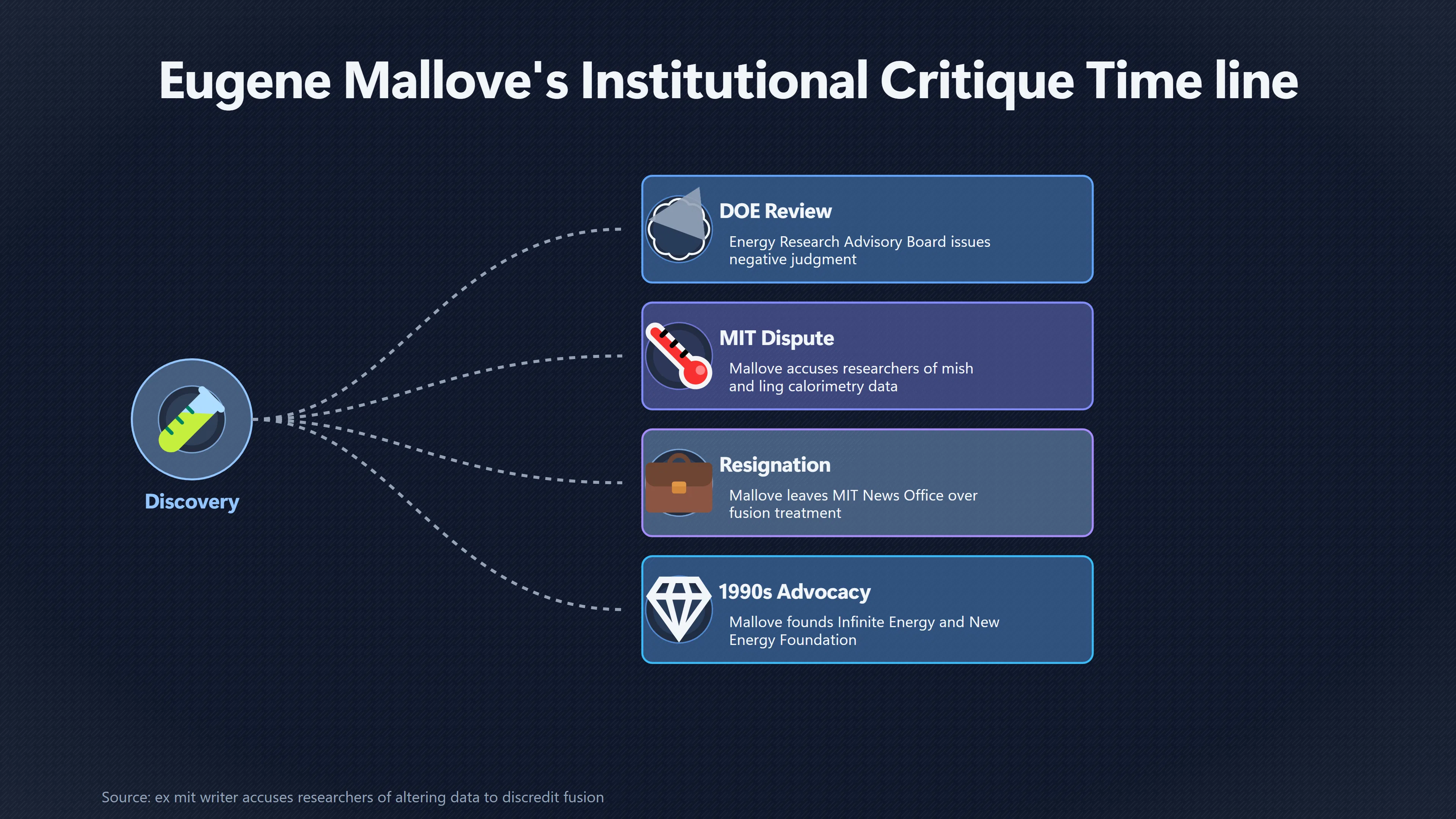
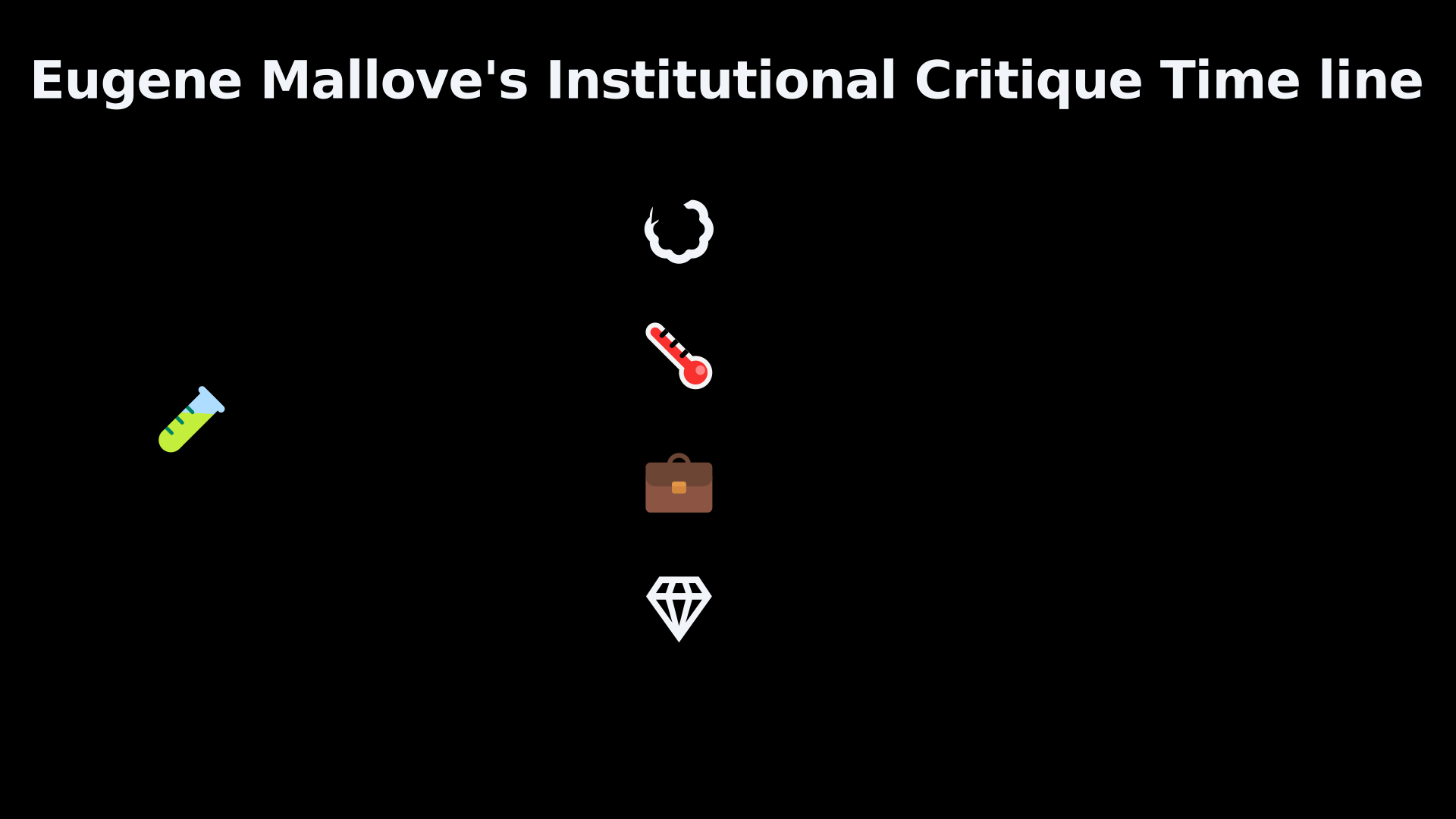
Eugene Mallove was arguing that cold fusion had been institutionally suppressed long before his murder in 2004 became attached to wider stories about suspicious scientist deaths. His claim was principally aboutscientific gatekeeping: he believed hostile researchers, major laboratories, journal editors and funding structures had prematurely converted an unresolved experimental controversy into a settled verdict that cold fusion was worthless. The most concrete part of his case concerned Massachusetts Institute of Technology (MIT) calorimetry experiments in 1989 and MIT’s subsequent public presentation of them. Contemporary reporting confirms that Mallove made serious allegations about MIT’s handling of those data, while the scientists he accused emphatically rejected his interpretation.
That chronology is crucial to Mallove’s later place in suppressed-scientist narratives. His documented pre-death argument concerned professional and institutional suppression, not a demonstrated campaign of assassination. The later joining of his scientific dispute to his murder therefore combines two historically separate propositions.
Mallove’s case for institutional suppression
Mallove occupied an unusual position when the cold-fusion controversy erupted in 1989. An MIT-trained engineer with a doctorate from Harvard, he was chief science writer in the MIT News Office rather than one of the electrochemists performing the disputed experiments. That gave him direct exposure to MIT’s public response while leaving him sufficiently outside the experimental groups to become an increasingly outspoken critic. He later made that dispute central to his 1991 bookFire from Ice: Searching for the Truth Behind the Cold Fusion Furor.
The wider scientific circumstances help explain both his suspicion and why most physicists rejected it. Martin Fleischmann and Stanley Pons had announced in March 1989 that electrochemical experiments involving palladium and heavy water appeared to produce anomalous heat attributable to nuclear processes. Attempts at replication soon generated sharply conflicting results. The US Department of Energy’s Energy Research Advisory Board concluded in November 1989 that the evidence did not convincingly establish the claimed phenomenon and recommended against creating specially funded cold-fusion programmes, although it allowed that carefully selected experiments could compete through normal funding channels.
Mallove believed that this negative judgement hardened too quickly. By April 1991, he was telling MIT president Charles Vest that he was more than 99 per cent confident that cold-fusion phenomena were real and urging MIT to reassess results being reported elsewhere. Contemporary material reproduced in the laterMIT and Cold Fusioncollection records his argument that simply ignoring accumulating experimental claims would be an abdication of scientific responsibility.
That was the broad version of Mallove’s suppression thesis: cold fusion had not merely lost a scientific argument; in his view, it had been placed beyond respectable consideration before the experimental record justified doing so. This distinction matters because some features of cold fusion’s subsequent history really did resemble marginalisation. Research participation declined markedly, mainstream publication became more difficult and supporters created their own conferences and publications. Those developments establish that the subject became heavily stigmatised, however; they do not by themselves establish Mallove’s stronger claim that interested institutions deliberately engineered that outcome.
The MIT dispute gave his claim a concrete target
Mallove’s argument became much more specific over MIT’s 1989 attempt to test the Fleischmann-Pons claims. He focused particularly on calorimetry — measurement of heat entering and leaving an experimental system — because excess heat was one of the central claimed signatures of cold fusion.
In 1991 Mallove publicly accused researchers associated with MIT’s Plasma Fusion Center of mishandling or altering the presentation of calorimetric data in a way that made the experiment appear more conclusively negative. Contemporary press coverage is important here because it shows that this was not an allegation reconstructed after his death. TheDeseret Newsreported it in August 1991, including Mallove’s contention that differences between the experimental and control measurements had been minimised. Plasma Fusion Center director Ronald Parker called the allegations “ludicrous”.
Naturealso reported the dispute at the time. Its account described Mallove’s allegations concerning the MIT experiment and a related controversy over MIT’s dealings with the press, demonstrating that his accusations had reached beyond cold-fusion advocacy circles while he was alive.
Mallove’s complaint was not simply that MIT scientists had reached the wrong conclusion. He alleged a combination of scientific and communications failures: questionable representation of experimental data, resistance to releasing underlying material for examination, and an institutional public-relations response that reinforced the emerging view that cold fusion had been discredited. He eventually sought a formal investigation into possible scientific misconduct. Documents later assembled by his supporters include correspondence showing MIT president Charles Vest referring Mallove’s complaint for an initial assessment because the provost was among the authors connected with the work under dispute.
That correspondence shows that Mallove made a genuine institutional complaint. It doesnotestablish that his scientific accusations were correct. His later publications presented the MIT affair from his own strongly committed perspective, and the people he accused disputed both his interpretation of the calorimetry and his suggestion of improper intent. Contemporary reporting noted an alternative possibility: that weaknesses in the original experiment or its presentation, even if established, would not necessarily demonstrate fraud or a deliberate programme to suppress cold fusion.
Suppression meant more than allegedly altered data
The MIT calorimetry controversy became Mallove’s most tangible example, but his conception of suppression was broader. He increasingly treated the cold-fusion dispute as a case study in how scientific institutions could close ranks around an accepted judgement.
One component wasreputational pressure. Cold fusion had moved with unusual speed from spectacular public announcement to an object of ridicule. Contemporary historical research into communication during the controversy shows how conferences, press coverage, informal scientific communication and rapidly circulating replication claims helped form scientific opinion during the intense months of 1989. Mallove interpreted this rapid reversal not merely as normal scientific correction but as evidence that scepticism had become socially self-reinforcing.
A second component waspublication gatekeeping. Mallove complained that an article he had prepared for MIT’sTechnology Reviewwas ultimately rejected. The magazine’s former managing editor Jonathan Schlefer gave a markedly different account, saying the article was rejected because it was one-sided and inadequate, not because MIT was censoring a forbidden conclusion. That clash captures a recurring difficulty in evaluating suppression claims: rejection of heterodox work can look like censorship to its advocates while looking like ordinary quality control to editors and reviewers.
A third component wascompetition for institutional resources. Mallove believed researchers committed to conventional high-temperature fusion had an interest in discrediting a technology which, if genuine, could undermine the rationale for enormous established programmes. During the 1991 dispute he explicitly characterised conventional fusion interests at MIT as trying to “squash” cold fusion. That supplied a motive within his theory of suppression, but motive and proof are different things. Conventional fusion researchers also had straightforward scientific reasons for scepticism: the reported heat appeared difficult to reconcile with the absence of nuclear products at levels conventional fusion physics would predict, and independent replication was unreliable. The 1989 DOE assessment made precisely these scientific objections.
Mallove therefore combined observations of genuine institutional behaviour — rejection, reputational damage, funding difficulty and scientific hostility — with a more contentious interpretation ofwhythose things occurred. That distinction is indispensable when assessing his claims.
Resigning from MIT turned criticism into advocacy
Mallove resigned from the MIT News Office in June 1991. Contemporary coverage described him as frustrated by MIT’s treatment of the cold-fusion question and increasingly uncomfortable acting as an institutional spokesman. Importantly, the account also records that his departure accompanied an extensive written denunciation of MIT’s handling of the controversy rather than an allegation that he had been physically threatened or forced out.
His career thereafter made the suppression thesis self-reinforcing in a practical sense. If mainstream channels were unwilling to give cold fusion adequate attention, Mallove concluded that alternative channels had to be created. He became a consultant on unconventional-energy research and, in the mid-1990s, foundedInfinite Energy, which provided a publication platform for cold fusion and a much wider collection of unconventional energy ideas. He later founded the New Energy Foundation and operated a laboratory that tested claimed new-energy technologies.
By the early 2000s his vocabulary had also moved beyond the narrow question of whether the original Fleischmann-Pons interpretation was correct. In March 2004, shortly before his death, Mallove welcomed the Department of Energy’s decision to revisit low-energy nuclear-reaction research but argued that the phenomena were broader than “fusion” and better understood as an unexplained new form of energy with nuclear aspects.
That DOE reconsideration is a useful test of the strongest versions of the suppression thesis. A group of scientists approached the Department in late 2003 and obtained a fresh review, showing that official reconsideration was possible even after years of stigma. The review, completed after Mallove’s death in December 2004, did not vindicate cold fusion: reviewers remained unconvinced that the evidence established the claimed effects, although some judged portions of the evidence suggestive enough to justify carefully designed research proposals.
The episode therefore fits neither an uncomplicated “cold fusion was disproved in 1989” story nor an uncomplicated “cold fusion was suppressed because it worked” story. The field remained scientifically contested and institutionally marginal, while advocates continued to obtain some hearings, publications and funding.
His argument was not an assassination claim
This is the most important boundary when Mallove is placed within narratives about suspicious deaths of unconventional researchers. His pre-2004 suppression argument should not be retroactively rewritten as a claim that scientists were being killed to prevent their discoveries.
Mallove’s documented complaints concerned data handling, scientific reputation, editorial decisions, access to institutional channels, research priorities and funding. Even when he used forceful language about conventional fusion interests trying to crush cold fusion, the mechanism he described was overwhelminglyprofessional and institutional. His resignation, book, magazine and foundation were responses to what he saw as intellectual exclusion.
This matters because “suppression” is an unusually elastic word. It can describe several very different propositions:
- a field becoming professionally unfashionable after negative results;
- journals becoming reluctant to publish work associated with a discredited claim;
- funding bodies deciding that a research programme has low priority;
- scientists deliberately manipulating evidence or abusing institutional power;
- organised coercion or threats against researchers;
- physical violence or assassination intended to stop research.
Mallove made strong allegations in the middle of that spectrum, particularly against MIT. Evidence that he believed those allegations, publicised them and sought an institutional investigation is substantial. Evidence that the scientific establishment organised his later killing in order to suppress cold fusion is a completely separate evidential question. Nothing about his 1991 dispute establishes that proposition.

Why the later narrative blurred the distinction
Mallove’s murder made the older suppression story unusually easy to reinterpret. A man who had spent more than a decade saying that powerful scientific interests resisted revolutionary energy research was then violently killed. Read backwards, the two events can appear to form a single narrative: he exposed suppression, continued promoting unconventional energy, and was eventually silenced.
That retrospective construction is understandable but historically misleading. Mallove’s suppression allegations were already fully developed by 1991, thirteen years before his death. They arose from identifiable scientific and institutional disputes, particularly the MIT calorimetry controversy. The evidential question in those disputes was whether experimental results had been fairly measured, represented and evaluated — not whether anyone intended physical harm to researchers.
His later expansion into other unconventional-energy subjects also made him more attractive to narratives linking cold fusion with antigravity, vacuum energy and other allegedly suppressed technologies. His own career did span alternative propulsion and increasingly speculative “new energy” interests, andInfinite Energydeliberately provided space for work outside the scientific mainstream. But that intellectual overlap does not convert the documented cold-fusion dispute into evidence of a common clandestine programme against UFO, antigravity or alternative-energy researchers.
The safest historical conclusion is narrower and more interesting. Mallove provides a genuine example of a scientifically trained writer who became convinced that normal mechanisms of scientific judgement had turned into institutional suppression. He publicly challenged MIT, resigned, built alternative publishing and funding structures, and maintained the argument until his death. Some of the conditions he complained about — severe stigma, reduced mainstream publication opportunities and difficulty attracting conventional support — were real. Whether those conditions resulted primarily from unjustified gatekeeping or from the field’s persistent experimental problems remained the central dispute.
The distinction that survives his death
Mallove’s strongest historical significance in the suppressed-scientist narrative therefore liesbeforethe circumstances of his death. By 1991 he had already supplied cold fusion with a durable explanatory framework: anomalous results existed, he believed; established science had rejected them too rapidly; institutional interests helped sustain that rejection; and researchers therefore needed alternative channels of communication and support.
There is enough contemporary evidence to treat those views as Mallove’s authentic, long-standing position rather than mythology invented after his murder. His allegations against MIT were reported contemporaneously byNatureand the press, his resignation was public, and his subsequent organisations were explicitly built around unconventional-energy research.
What the evidence does not permit is the next leap often made in broader suspicious-death narratives. Documented scientific marginalisation is not evidence of lethal suppression. A disputed calorimetry graph, a rejected magazine article, hostile professional opinion and scarce research funding may support an argument about scientific gatekeeping; they do not establish an assassination mechanism. Keeping those categories separate preserves what is genuinely unusual about Eugene Mallove’s story without making his earlier claims prove something they were never evidence for.
Amazon book picks
Further Reading
Books and field guides related to What Mallove Meant by Cold Fusion Suppression. Use these as the next step if you want deeper reading beyond the article.
Fire from Ice: Searching for the Truth Behind the Cold Fusion...
Discusses the furor over the announcement that scientists had succeeded in producing controlled nuclear fusion at ordinary temperatures,...
The Demon-Haunted World: Science as a Candle in the Dark
Rating: 4.5/5 from 43 Google Books ratings
NEW YORK TIMES BESTSELLER • From the renowned astronomer and author of Cosmos comes a “powerful [and] stirring defense of informed ration...
Voodoo Science: The Road from Foolishness to Fraud
This work examines the social, economic and political forces that elicit or support flawed or fake science and sustain it in the face of...
Bad Science
Ben Goldacre takes us on a journey through the bad science we are fed daily by hacks and quacks.
eBay marketplace picks
Marketplace Samples
Live-tested eBay searches with available results related to this page.
Selected fromcold fusion poster oneBay.co.uk.



Endnotes
1.
Source: nature.com
Link:https://www.nature.com/articles/353098b0.pdf
Source snippet
Cold fusion tempest at MITMallove also claims that Parker misled him into issuing a press release in May. 1989 accusing the Boston...
2.
Source: deseret.com
Title: ex mit writer accuses researchers of altering data to discredit fusion
Link:https://www.deseret.com/1991/8/10/18935394/ex-mit-writer-accuses-researchers-of-altering-data-to-discredit-fusion/
Source snippet
Deseret NewsEX-MIT WRITER ACCUSES RESEARCHERS OF...10 Aug 1991 — Ron Parker, director of MIT's Plasma Fusion Center, dismissed the char...
3.
Source: infinite-energy.com
Title: Infinite Energy MIT and Cold Fusion: A Special Report
Link:https://infinite-energy.com/images/pdfs/mitcfreport.pdf
4.
Source: infinite-energy.com
Title: Infinite Energy Gene Mallove, Biography
Link:https://www.infinite-energy.com/genemallovecollection/biography.html
5.
Source: deseret.com
Title: News DOE to review a new batch of claims in cold-fusion quest
Link:https://www.deseret.com/2004/3/31/19820492/doe-to-review-a-new-batch-of-claims-in-cold-fusion-quest/
6.
Source: infinite-energy.com
Title: The Implications of the “Big Bang” by Eugene F. Mallove
Link:https://www.infinite-energy.com/iemagazine/issue46/implications.html
7.
Source: infinite-energy.com
Title: Back Issues
Link:https://infinite-energy.com/iemagazine/issue31/index.html
8.
Source: infinite-energy.com
Title: Back Issues
Link:https://www.infinite-energy.com/iemagazine/issue11/index.html
9.
Source: deseret.com
Title: SCIENTIST S AT MIT EMBROILED IN WRANGLING OVER FUSION – Deseret News
Link:https://www.deseret.com/1991/10/21/18947426/scientists-at-mit-embroiled-in-wrangling-over-fusion/
10.
Source: deseret.com
Title: MI T WRITER WILL RESIGN, CITING `UNFAIR’ CRITICISM OF FUSION – Deseret News
Link:https://www.deseret.com/1991/6/9/18924935/mit-writer-will-resign-citing-unfair-criticism-of-fusion/
11.
Source: deseret.com
Link:https://www.deseret.com/
12.
Source: infinite-energy.com
Link:https://www.infinite-energy.com/iemagazine/issue17/index.html
13.
Source: infinite-energy.com
Link:https://www.infinite-energy.com/iemagazine/readarticles.html
14.
Source: infinite-energy.com
Link:https://www.infinite-energy.com/iemagazine/issue80/historicperspective.html
15.
Source: infinite-energy.com
Link:https://www.infinite-energy.com/resources/unusual-suspects.html
16.
Source: infinite-energy.com
Title: In the News
Link:https://www.infinite-energy.com/resources/inthenews.html
18.
Source: infinite-energy.com
Link:https://infinite-energy.com/iemagazine/issue25/press.html
19.
Source: infinite-energy.com
Link:https://www.infinite-energy.com/resources/keyexpdata.html
20.
Source: infinite-energy.com
Link:https://infinite-energy.com/iemagazine/issue47/mit.html
21.
Source: infinite-energy.com
Link:https://www.infinite-energy.com/iemagazine/issue62/mitcolloquium.html
22.
Source: infinite-energy.com
Title: Review of ICCF11
Link:https://infinite-energy.com/iemagazine/issue59/reviewoficcf11.html
23.
Source: library.psfc.mit.edu
Link:https://library.psfc.mit.edu/catalog/media/videos.html
24.
Source: Wikipedia
Title: Cold fusion
Link:https://en.wikipedia.org/wiki/Cold_fusion
25.
Source: scribd.com
Title: Cold Fusion
Link:https://www.scribd.com/document/654764697/Cold-Fusion-the-Scientific-Fiasco-of-the-Century
26.
Source: coasttocoastam.com
Link:https://www.coasttocoastam.com/guest/mallove-eugene-6005/
27.
Source: books.google.com
Title: Fire from Ice
Link:https://books.google.com/books/about/Fire_from_Ice.html?id=LkJwQgAACAAJ
28.
Source: Wikipedia
Title: Eugene Mallove
Link:https://en.wikipedia.org/wiki/Eugene_Mallove
29.
Source: everything.explained.today
Title: Eugene Mallove
Link:https://everything.explained.today/Eugene_Mallove/
30.
Source: academickids.com
Title: Eugene Mallove
Link:https://academickids.com/encyclopedia/index.php/Eugene_Mallove
31.
Source: newenergytimes.com
Title: Cold Fusion
Link:https://newenergytimes.com/v2/news/2005/ColdFusion-A2005Outlook.shtml
32.
Source: scribd.com
Title: Cold Fusion
Link:https://www.scribd.com/
33.
Source: catalog.hathitrust.org
Link:https://catalog.hathitrust.org/Record/002055969
34.
Source: linguee.it
Title: scientific misconduct
Link:https://www.linguee.it/inglese-italiano/traduzione/scientific%2Bmisconduct.html
35.
Source: uapmurders.com
Link:https://uapmurders.com/uaps/Details/Eugene_Mallove/
36.
Source: gotnuclear.org
Title: Fire from Ice
Link:https://gotnuclear.org/blog/book/fire-from-ice/
Additional References
37.
Source: newenergyinstitute.org
Title: New Energy Institute Untitled
Link:https://newenergyinstitute.org/v2/archives/1989DOE-CF-Panel/19891108-ERAB-Final.pdf
Source snippet
1 Science.gov Way. Oak Ridge, TN 37830. Page 3. DOE/S--0073. DE90 005611. JAN O 3 1990. Cold Fusion Research. Kew Energy Times. November...
38.
Source: en.wikisource.org
Title: Cold Fusion Research
Link:https://en.wikisource.org/wiki/Cold_Fusion_Research
Source snippet
Cold Fusion Research - Wikisource, the free online libraryCold Fusion Research. November 1989. A Report of the Energy Research...
Published: November 1989
39.
Source: washingtonpost.com
Link:https://www.washingtonpost.com/archive/entertainment/books/1993/07/25/lost-in-the-laboratory/4ad6a490-ab21-4f98-8ea5-193253c3c943/
Source snippet
The Washington PostLOST IN THE LABORATORY") That volume, like Eugene Mallove's pro- cold fusion Fire From Ice (1991) or Frank Close's neg...
40.
Source: coldfusionnow.org
Title: Cold Fusion Now MIT and Cold Fusion: A Special Report
Link:https://coldfusionnow.org/wp-content/uploads/2012/05/mitcfreport.pdf
Source snippet
Cold Fusion NowMIT and Cold Fusion: A Special ReportOctober 19, 2025...
Published: October 19, 2025
41.
Source: youtube.com
Title: The Eugene Mallove Story Cold Fusion
Link:https://www.youtube.com/watch?v=cevv7c3Nrlg
Source snippet
Cold Fusion and Beyond - Dr. Eugene Mallove / Disclosure Project Witness Testimony Archive...
42.
Source: youtube.com
Title: Cold Fusion and Beyond
Link:https://www.youtube.com/watch?v=Q_A4XJhV1y4
Source snippet
Eugene Mallove Interview - 1998...
43.
Source: researchgate.net
Link:https://www.researchgate.net/publication/240100129_Lost_in_the_Mall_with_Mesmer_and_Wundt_Demarcations_and_Demonstrations_in_the_Psychologies
44.
Source: researchgate.net
Link:https://www.researchgate.net/publication/253351521_How_can_cold_fusion_be_real_considering_it_was_disproved_by_several_well-respected_labs_in_1989
45.
Source: researchgate.net
Link:https://www.researchgate.net/publication/376389650_The_Cold_Fusion_Phenomenon_and_the_ARPA-E_Project_2022_of_DOE_A_Facet_of_the_Sociology_of_Modern_Science
46.
Source: dokumen.pub
Link:https://dokumen.pub/bad-science-the-short-life-and-weird-times-of-cold-fusion-1nbsped-0394584562-9780394584560.html