Within Mallove
What Does Schaffer's Guilty Plea Actually Establish?
Schaffer's manslaughter and robbery pleas provide the strongest direct criminal-record link between Mallove's death and the former tenants.
On this page
- Charges and admissions in Schaffer's plea
- How the plea connects him to the evicted tenants
- What the plea does and does not prove about motive
Page outline Jump by section
Introduction
Chad Schaffer’s 2012 plea is the clearest criminal-record link between Eugene Mallove’s killing and the people connected to the tenants recently evicted from the Norwich property where Mallove died. The Connecticut Appellate Court’s later account states that Schaffer — the son of former tenant Patricia Anderson and himself a former resident of the property — pleaded guilty during his murder trial to first-degree manslaughter and third-degree robbery. Crucially, however, the court records that these were Alford pleas: legally effective guilty pleas entered without the ordinary personal admission that the defendant committed the charged acts.[Justia Law]law.justia.comOpen source on justia.com.

That distinction sets the proper evidential boundary. Schaffer’s plea establishes criminal convictions for his role in the Mallove case and strongly anchors the homicide to the former-tenancy circle. It does not, by itself, amount to a sworn confession establishing every detail of the prosecution’s narrative or proving precisely why the confrontation began. The motive case — anger over belongings being removed after the eviction, followed by an attempt to disguise the violence as robbery — comes from the wider evidential record surrounding the plea.[Justia Law]law.justia.comOpen source on justia.com.
What Schaffer actually pleaded guilty to
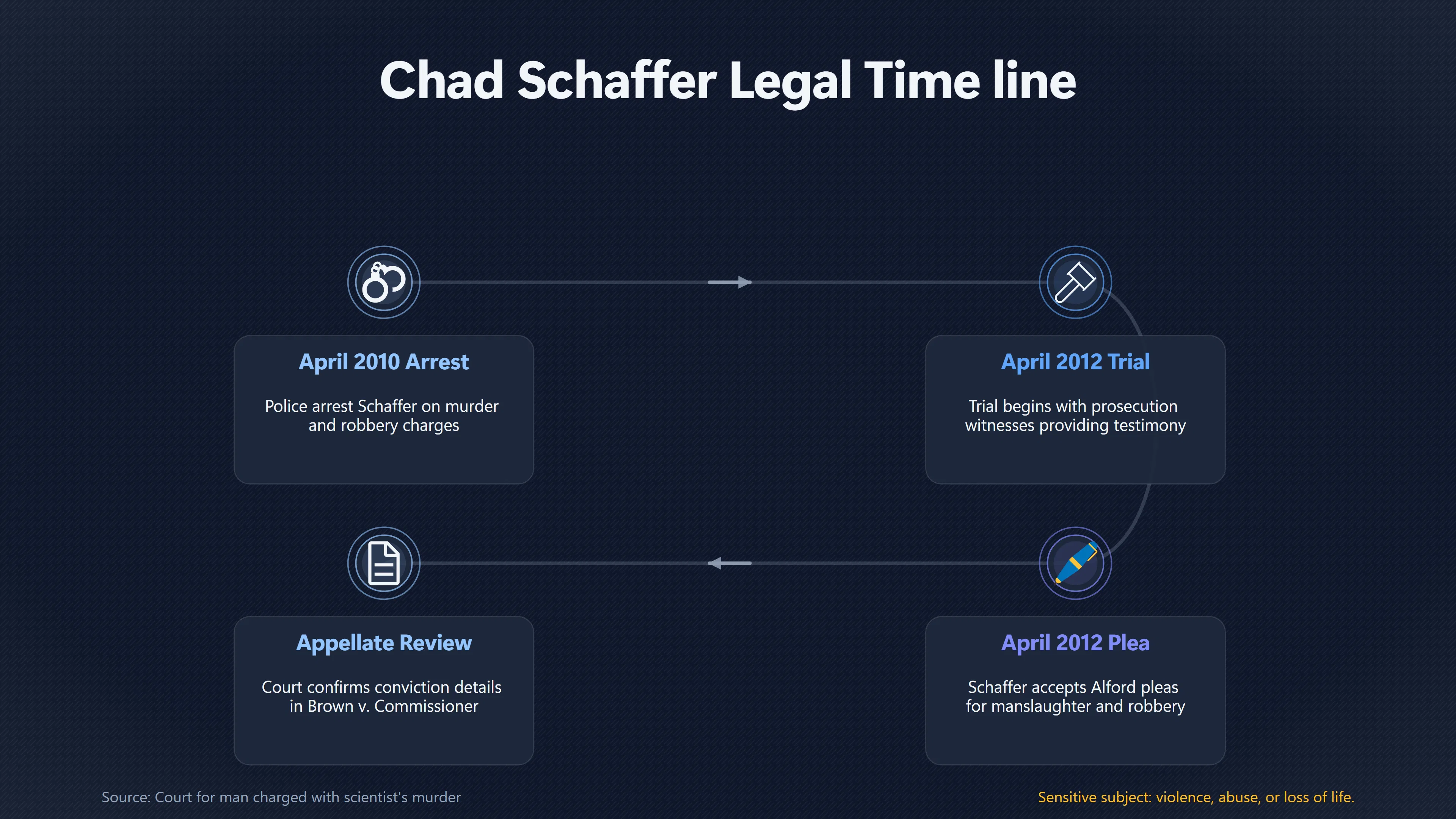
Schaffer had originally faced substantially more serious accusations. Contemporary material from Infinite Energy, the magazine Mallove founded, records that police arrested Schaffer in April 2010 on charges including murder, felony murder and first-degree robbery. His trial began in April 2012. After witnesses for the prosecution had begun testifying, the trial ended when Schaffer accepted a negotiated disposition rather than allowing the jury to decide the murder charges.[Infinite Energy]infinite-energy.comOpen source on infinite-energy.com.
The most authoritative later description comes from the Connecticut Appellate Court’s 2025 decision in Brown v. Commissioner of Correction. In recounting the procedural history of the Mallove homicide prosecutions, the court states that the prosecution extended Schaffer a plea offer during his trial and that, on 20 April 2012, he pleaded guilty to manslaughter in the first degree and robbery in the third degree. Elsewhere in the same decision, the court specifies that he entered those pleas under the Alford doctrine, after several prosecution witnesses had already testified.[Justia Law]law.justia.comOpen source on justia.com.
That detail is important because an Alford plea is not identical, in evidential meaning, to an ordinary confession. Under the doctrine derived from North Carolina v. Alford, a defendant may accept a guilty disposition while declining to make the conventional admission of factual guilt. Connecticut courts describe the procedure in precisely that setting: a defendant can maintain a denial while choosing to plead guilty because of the evidence and the risks of continuing to trial.[Connecticut Judicial Branch]ct.govOpen source on ct.gov.
Accordingly, descriptions of Schaffer simply as having “confessed by pleading guilty” go too far. The accurate formulation is narrower: he accepted convictions for first-degree manslaughter and third-degree robbery in the Mallove case through Alford guilty pleas. The legal consequences were convictions, but the pleas themselves should not be treated as Schaffer personally endorsing every allegation made by Foster, police or prosecutors.
There is some inconsistency in secondary reporting about the precise sentence structure. Contemporary Associated Press reporting described Schaffer as receiving a 16-year prison sentence. The 2025 appellate decision gives the court record as twenty years’ incarceration, suspended after fifteen years, followed by five years of probation. Material published by Infinite Energy at the time described a different plea structure involving a 25-year sentence with 16 years to serve. Those discrepancies make the appellate court’s later description the safest source for the formal sentence, while the central point is unaffected: Schaffer was convicted of manslaughter and robbery rather than murder after the negotiated plea.[thehour.com]thehour.comOpen source on thehour.com.
Why the plea ties the killing to the evicted tenants
The importance of Schaffer is not merely that he was a local defendant eventually convicted in the case. His relationship to 119 Salem Turnpike directly intersects with the circumstances that investigators identified around Mallove’s presence there.
The Connecticut Appellate Court records that Mallove had evicted Roy and Patricia Anderson from 119 Salem the month before the homicide and had travelled from New Hampshire to clean out the property. Schaffer was Patricia Anderson’s son, and both Schaffer and his then-girlfriend Candace Foster had themselves lived at the property.[Justia Law]law.justia.comOpen source on justia.com.
That makes the plea especially significant when evaluating claims that Mallove’s death was connected to his controversial scientific work. It places a convicted participant not in a speculative professional or scientific relationship with Mallove, but inside an immediate, local property dispute surrounding the precise place where the killing occurred.
The later court record adds a much more specific sequence. Foster testified that, on the afternoon of 14 May 2004, Schaffer learnt from his mother that somebody at 119 Salem was throwing items into a skip. Schaffer was angry because belongings — including items belonging to Foster — were supposed to have been collected from the former residence. He left their apartment and subsequently returned with visible blood on his clothing.[Justia Law]law.justia.comOpen source on justia.com.
Other evidence recorded by the appellate court connected Schaffer still more closely to the aftermath. Jill Sebastian told investigators that she had seen his bloody clothing and that Foster had admitted falsely providing him with an alibi. Keishon Dullivan said he had seen Schaffer’s blood-covered basketball jersey and that Schaffer told him he had assaulted Mallove with Mozelle Brown and taken Mallove’s possessions to stage the attack as a robbery.[Justia Law]law.justia.comOpen source on justia.com.
Those allegations are not transformed into indisputable historical facts merely because Schaffer later pleaded guilty. They are nevertheless important because they show the evidential setting in which his plea occurred. This was not a conviction disconnected from the former tenants followed by retrospective speculation about an eviction. The former residence, discarded belongings, Schaffer’s relationship to an evicted tenant and the alleged attempt to create the appearance of robbery were already integral parts of the prosecution case.
David Kushner’s 2016 account for Foreign Policy adds Schaffer’s own police version. According to that reporting, Schaffer told investigators that his mother had contacted him after learning that possessions were being removed from the property. He said he went there with Brown to retrieve belongings and eventually admitted punching Mallove once, while blaming Brown for the much more serious beating. He also described returning and taking Mallove’s vehicle in an effort to make the incident appear to be a robbery.[David Kushner]davidkushner.comOpen source on davidkushner.com.
The guilty pleas therefore sit within several mutually reinforcing links: Schaffer belonged to the recently displaced household; the confrontation was alleged to have arisen while Mallove was clearing that household’s possessions; Schaffer made incriminating statements to investigators according to the police account; witnesses placed bloody clothing and statements about the assault around him; and he ultimately accepted manslaughter and robbery convictions rather than complete his murder trial.[Justia Law]law.justia.comOpen source on justia.com.

What the plea establishes about motive — and what it does not
For assessing the claimed motive behind Mallove’s death, three different propositions need to be kept separate.
First, the plea establishes criminal responsibility at the level of the offences of conviction. Schaffer was not merely questioned, suspected or charged. His prosecution ended in accepted guilty pleas and convictions for first-degree manslaughter and third-degree robbery. That is much stronger evidence than an investigative theory or an untested accusation.[Justia Law]law.justia.comOpen source on justia.com.
Second, the plea strongly reinforces the connection to the former-tenancy dispute, but does not independently prove that dispute was the motive. The eviction connection comes from Schaffer’s identity and residence history; the discarded-belongings explanation comes from testimony, police statements and the wider prosecution record. The appellate court records Foster’s testimony that Schaffer became angry after learning that property was being thrown away. It also records her account that, when the group returned to 119 Salem, Schaffer said they needed to make the incident look like a robbery.[Justia Law]law.justia.comOpen source on justia.com.
This is an important distinction because Schaffer’s robbery conviction does not necessarily mean robbery was the original reason Mallove was attacked. Indeed, the prosecution evidence pointed towards a different sequence: a confrontation connected with the former occupants’ possessions, followed by removal of Mallove’s property as part of an effort to make the crime appear to have been a robbery. Foster testified that Schaffer removed Mallove’s shirt, shoes and wallet; the later court record also describes a box containing Mallove’s wallet, digital camera, mobile phone and Schaffer’s bloodstained jersey.[Justia Law]law.justia.comOpen source on justia.com.
Third, the plea supplies no affirmative evidence of a motive involving cold fusion, unconventional energy, UFO research or antigravity. Nothing in the offences to which Schaffer pleaded guilty identifies such a motive, and the documented connections surrounding Schaffer instead run through the property and the recently evicted household. Later reporting likewise summarised the police case as Schaffer and Brown attacking Mallove while he was preparing the Norwich house for rental after Schaffer’s relatives had been evicted.[WMUR]wmur.comOpen source on wmur.com.
That does not logically prove that no undisclosed motive could ever have existed. A manslaughter plea is not an exhaustive judicial finding about every possible influence on a homicide. But evidentially, theories linking Mallove’s death to suppression of unconventional science face a substantial problem here: the identified and convicted participant had an immediate personal connection to the crime scene and the displaced household, while the surviving criminal record provides no comparable link between Schaffer and any organisation supposedly threatened by Mallove’s research.
The Alford plea limits how far the record can be pushed
The strongest reason for caution is precisely the feature sometimes omitted from retellings of the case: Schaffer entered his pleas under Alford. The 2025 appellate decision explicitly records this fact.[Justia Law]law.justia.comOpen source on justia.com.
That matters retrospectively because Schaffer did not consistently acknowledge responsibility. At a 2023 parole hearing, he denied being present at the crime and said he had not been in the right frame of mind when he made incriminating statements to Norwich police. The parole board rejected his request for early release, with members questioning how his claimed remorse could be reconciled with his renewed denial. The report also noted that prosecutors had accepted the 2012 plea partly because they were concerned about the possibility of an acquittal at trial.[Yahoo]yahoo.comOpen source on yahoo.com.
His later denial does not erase the convictions. Nor does it convert the prosecution case into fact merely because he chose the plea bargain. Instead, it illustrates why the Alford qualification should be preserved whenever the plea is used as evidence.
The most defensible reading is therefore neither “Schaffer confessed to murdering Mallove over the eviction” nor “the plea tells us nothing because he maintained his innocence”. Both formulations lose important information. Schaffer accepted guilty convictions for manslaughter and robbery during a trial in which prosecutors were presenting evidence tying him to the killing; the plea has full significance as a criminal disposition. But determining the precise sequence, individual acts and motive still requires the testimony and investigative evidence surrounding it.[Justia Law]law.justia.comOpen source on justia.com.

The strongest conclusion the plea supports
Within the broader debate over Eugene Mallove’s inclusion among allegedly suspicious deaths of unconventional-energy researchers, Schaffer’s plea is valuable chiefly because it moves the case away from speculation and towards an identifiable criminal relationship.
The record establishes that Schaffer was the son of a recently evicted tenant, had lived at the Norwich property himself, was prosecuted for Mallove’s killing and ultimately accepted convictions for first-degree manslaughter and third-degree robbery. Independent evidence described in the later Connecticut appellate record connects his anger to belongings being removed from that former residence and describes efforts to take Mallove’s possessions and make the attack appear to be robbery.[Justia Law]law.justia.comOpen source on justia.com.
The plea alone cannot establish every disputed detail of the killing, particularly because it was entered under the Alford doctrine. It does not constitute Schaffer’s personal admission of the prosecution’s complete motive theory. Yet, considered alongside the relationship between Schaffer and the evicted household, it provides unusually concrete evidence for a local, personal chain of events surrounding Mallove’s death. Nothing in the plea or the court record examined here establishes that Mallove was targeted because of cold fusion, antigravity or other unconventional research.
That is the evidential significance of Schaffer’s guilty plea: it conclusively records his manslaughter and robbery convictions in Mallove’s death, strongly connects the homicide to people from the recently evicted household, and gives the property-dispute explanation a documented criminal foundation — while stopping short of proving every detail of motive or converting an Alford plea into a confession.[Justia Law]law.justia.comOpen source on justia.com.
Amazon book picks
Further Reading
Books and field guides related to What Does Schaffer's Guilty Plea Actually Establish?. Use these as the next step if you want deeper reading beyond the article.
Charged: The New Movement to Transform American Prosecution a...
NEW YORK TIMES BESTSELLER • A renowned journalist and legal commentator exposes the unchecked power of the prosecutor as a driving force...
Punishment Without Trial: Why Plea Bargaining Is a Bad Deal
From a prominent criminal law professor, a provocative and timely exploration of how plea bargaining prevents true criminal justice refor...
The Collapse of American Criminal Justice
The rule of law has vanished in America’s criminal justice system. Prosecutors now decide whom to punish and how severely. Almost no one...
Three Felonies a Day: How the Feds Target the Innocent
"The average professional in this country wakes up in the morning, goes to work, comes home, eats dinner and then goes to sleep, unaware...
eBay marketplace picks
Marketplace Samples
Live-tested eBay searches with available results related to this page.
Selected fromUFO poster oneBay.co.uk.

Current eBay listing
VINTAGE UFO FLYING SAUCERS COMIC ADVERTISING A2 POSTER PRINT


Current eBay listing
FS02 VINTAGE UFO FLYING SAUCERS COMIC ADVERTISING A4 POSTER PRINT

Endnotes
1.
Source: law.justia.com
Link:https://law.justia.com/cases/connecticut/court-of-appeals/2025/ac46658.html
2.
Source: infinite-energy.com
Link:https://www.infinite-energy.com/images/pdfs/GeneMalloveBio.pdf
Additional References
3.
Source: youtube.com
Title: Court for man charged with scientist’s murder
Link:https://www.youtube.com/watch?v=V2q8nvRL2kc
Source snippet
Eugene Mallove's Missing Shoes Are Clue In His Murder | An Unexpected Killer Highlights...
4.
Source: youtube.com
Link:https://www.youtube.com/watch?v=w2OxNZEyKGs
Source snippet
The "Conspiracy" to Kill Cold Fusion...
5.
Source: youtube.com
Link:https://www.youtube.com/watch?v=oPIKzgXRDRg
Source snippet
Court for man charged with scientist's murder...
6.
Source: eugenemallove.com
Link:https://www.eugenemallove.com/em_investigation.html
7.
Source: youtube.com
Title: The “Conspiracy” to Kill Cold Fusion
Link:https://www.youtube.com/watch?v=KWlBZT7L1qM
Source snippet
The Dead Grad Student Problem...
8.
Source: youtube.com
Title: The Dead Grad Student Problem
Link:https://www.youtube.com/watch?v=EbfJFPVApu8