Within UFO Stigma
UFO Career Incentive
For scientists, UFO research has historically carried an awkward risk-to-reward ratio. Academic careers depend on scarce resources: research time, competitive grants, publishable results, favourable peer judgement and evidence of productive work when promotion or tenure is considered.
Page outline Jump by section
Introduction
That combination created a powerful incentive to work on something else. The effect did not require a formal prohibition on UFO research. It could emerge through ordinary career decisions: choosing a grant proposal more likely to be funded, a project more likely to generate papers, or a question less likely to make colleagues question one’s credibility. Historical assessments such as the Condon Report strengthened that calculation, while recent NASA and academic work indicates that reputational concerns have not entirely disappeared.[ncas.org]files.ncas.orgFiles Condon Report, Section I: Conclusions & RecommendationsNCAS FilesCondon Report, Section I: Conclusions & Recommendations…

For the wider history of alleged suspicious deaths and disappearances among UFO or unconventional-propulsion researchers, this distinction is important. There is strong evidence for a comparatively mundane mechanism of discouragement — professional incentives and stigma. Establishing that mechanism does not establish that scientists were physically silenced or killed because of their research.
Peer review, funding and promotion made UFO research unusually costly
Academic science rewards more than curiosity. Researchers must persuade other scientists that a proposed question is worth scarce money and time, obtain usable data, publish results that survive peer review and build a body of work that contributes to promotion, tenure and professional standing. UFO research historically struggled at several points in that chain.
The 1968 University of Colorado study directed by physicist Edward Condon was especially consequential because it supplied an authoritative-looking answer to the first question: was this subject worth further scientific investment? The Air Force-funded study concluded that 21 years of UFO investigation had added nothing to scientific knowledge and that further extensive research probably could not be justified by the expectation of scientific advance. Condon explicitly argued that scientists in relevant disciplines had largely stayed away because they had individually judged UFOs an unfruitful field.[NCAS Files]files.ncas.orgFiles NCAS presents the Condon Report, Title PageNCAS FilesNCAS presents the Condon Report, Title Page…
Whatever one thinks of that judgement, its incentive effects are easy to understand. Once a major university study had concluded that extensive further investigation was unlikely to advance science, a researcher seeking money or institutional support faced an additional burden: the proposal had to explain why established scientific judgement was wrong, why the new project would obtain better evidence, and why funding it was preferable to supporting established fields with clearer research programmes.
Condon’s conclusion was not an absolute injunction. He explicitly allowed that a credentialled scientist with a well-defined, promising proposal should receive support. But the broader message was unmistakable: extensive UFO investigation was not regarded as a promising general research programme. The report’s summary also stressed the difficulty of obtaining objective data and assigned little scientific value to much of the accumulated anecdotal record.[NCAS Files]files.ncas.orgFiles Condon Report, Section I: Conclusions & RecommendationsNCAS FilesCondon Report, Section I: Conclusions & Recommendations…
That matters because career incentives operate at the margin. A scientist does not need to believe that UFO research is worthless to avoid it. They need only conclude that another project offers a better probability of grants, publications and recognition for the same expenditure of time.
Modern evidence suggests that those calculations remain visible. A 2023 study of 1,460 tenured and tenure-track faculty at 144 high-research-activity US universities found that only 3.84 per cent reported having conducted UAP-related research, even though more than one-third expressed at least some interest in doing so. More than half said that obtaining funding would make them more inclined to undertake UAP research, while 43.4 per cent said they would be more inclined if a scholar they regarded as reputable within their discipline did so.[Nature]nature.comFaculty perceptions of unidentified aerial phenomena | Humanities and Social Sciences CommunicationsMay 23, 2023…
The survey should not be treated as a perfect census of academic opinion. Its response rate was only 3.9 per cent, and its authors acknowledge possible self-selection: people curious about UAP may have been more willing to answer. Nevertheless, the results provide unusually direct evidence that money and reputational cues affect scientists’ willingness to enter the field.[Nature]nature.comFaculty perceptions of unidentified aerial phenomena | Humanities and Social Sciences CommunicationsMay 23, 2023…
The career penalty could exist even when colleagues would not impose it
One of the most revealing findings comes from a follow-up analysis of the same faculty sample. Researchers asked academics how concerned they would be that conducting UAP research might jeopardise tenure or promotion, and separately asked how they themselves would treat a colleague doing such research.
The gap was substantial. Some 52.67 per cent expressed at least some concern that UAP research could threaten tenure or promotion. Yet only 7.4 per cent said they would definitely vote negatively on a colleague’s tenure or promotion because that colleague conducted UAP-related research; 61.92 per cent said they would not, while 27.95 per cent answered “maybe”.[Nature]nature.comAcademic freedom and the unknown: credibility, criticism, and inquiry among the professoriate | Humanities and Social Sciences Comm…
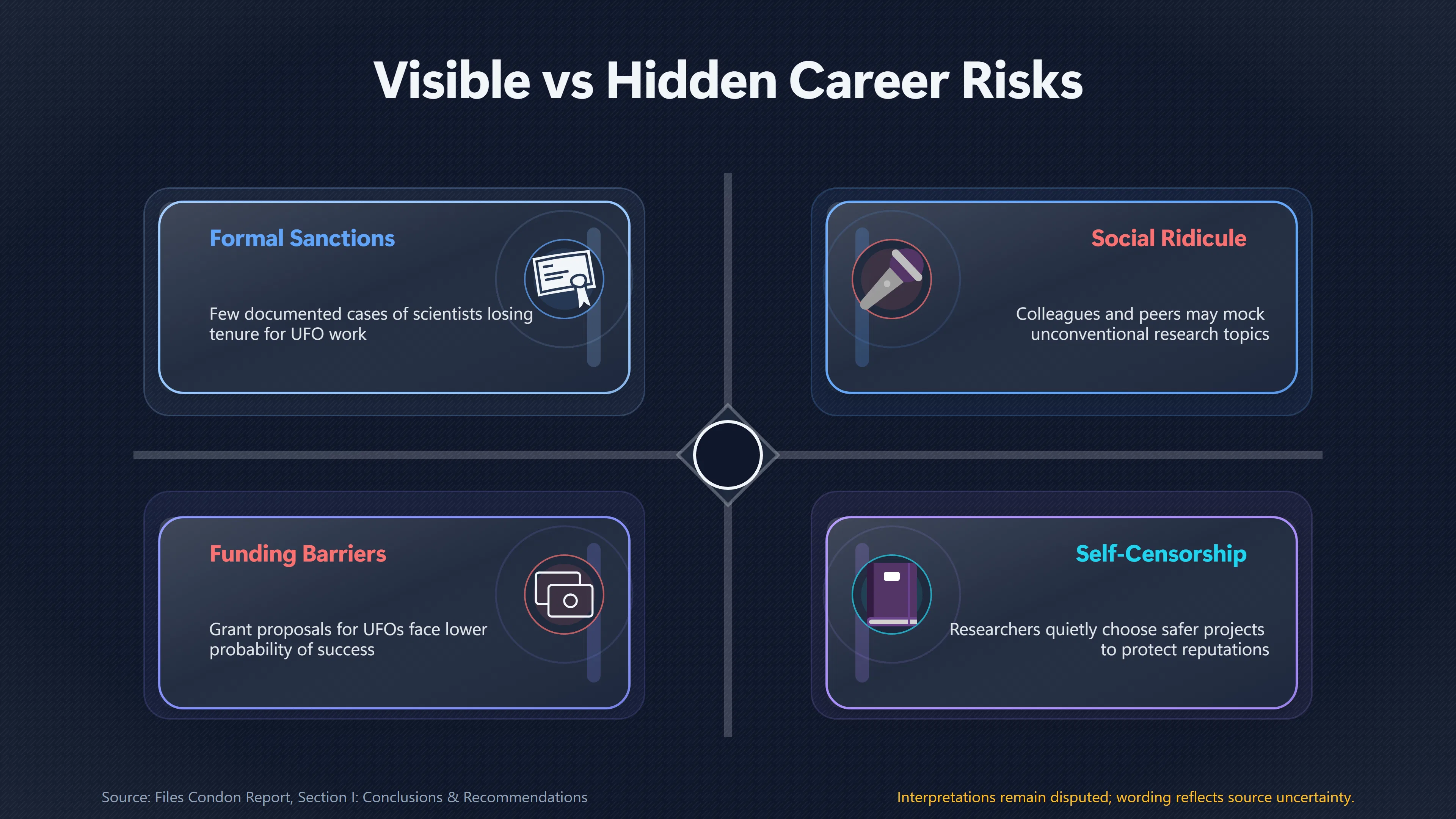
This reveals an important mechanism. A stigma does not have to produce frequent documented punishments to influence behaviour. Researchers make career decisions according to anticipated reactions. If a junior scientist believes that controversial work might count against them, avoiding the subject can be rational even when most colleagues would ultimately defend their academic freedom.
The authors consequently suggest that fear of professional sanctions may be more widespread than willingness actually to impose those sanctions. They also found greater concern about social repercussions — such as ridicule or colleagues giving researchers a hard time — than about formal professional punishment.[Nature]nature.comAcademic freedom and the unknown: credibility, criticism, and inquiry among the professoriate | Humanities and Social Sciences Comm…
That distinction helps explain why evidence of stigma can coexist with relatively few documented cases of scientists being denied tenure specifically for UFO research. The strongest deterrent may operate before any formal decision occurs. Researchers quietly choose different projects; students select safer dissertation subjects; senior academics keep an anomalous observation private; departments never have to vote on proposals that were never submitted.
NASA’s 2023 UAP Independent Study Team encountered a striking contemporary version of the problem. Its report said at least one scientist on the panel received hostile correspondence from colleagues because of participation, while members knew of researchers who had been warned away from work on extraterrestrial technosignatures because it might damage scientific credibility and promotion prospects. NASA argued that such stigma interferes with the scientific study of unusual phenomena.[NASA]nasa.govuap independent study team final report 0UNIDENTIFIED ANOMALOUS PHENOMENA Independent…
Unresolved UFO cases promised an uncertain academic payoff
Reputation was only part of the problem. UFO research also presented a difficult research design.
Much of the historical evidence arrived after an event had ended. Investigators often had witness recollections, photographs of uncertain quality or incomplete information about weather, aircraft, astronomical objects and sensor conditions. That makes the basic scientific task unusually inefficient. A researcher can spend considerable time investigating a puzzling report only to discover an ordinary explanation — or finish with an unresolved case simply because crucial information was never recorded.
The Condon study itself described attempts to dispatch field teams rapidly enough to obtain photographs, spectra, magnetic measurements and other instrumental evidence. In practice, getting scientists and equipment to the right place while an unpredictable phenomenon was occurring was extraordinarily difficult. The project ultimately stressed the limitations of anecdotal historical records and recommended against a major continuing scientific effort.[NCAS Files]files.ncas.orgFiles Condon Report, Section IINCAS FilesCondon Report, Section II: Summary of the Study…
Modern official assessments identify essentially the same data problem. NASA says most UAP observations contain such limited information that scientific conclusions about their nature are difficult to draw. The US All-domain Anomaly Resolution Office has likewise cited missing information about variables such as speed, altitude and size, alongside resource constraints, as obstacles encountered by previous investigations.[NASA Science]science.nasa.govScience UAP FAQsNASA ScienceUAP FAQs - NASA ScienceMay 8, 2026…
This produces an unattractive payoff structure for conventional academic research. If an investigation explains a report as a balloon, astronomical object or sensor artefact, the result may be scientifically correct but not particularly novel. If it cannot explain the report because the evidence is inadequate, “unresolved” does not automatically constitute a publishable discovery. And if extraordinary claims are made from weak evidence, the researcher’s credibility may suffer.
The problem therefore differs from the proposition that scientists were simply unwilling to contemplate unfamiliar phenomena. The practical question was whether UFO reports could be converted into reproducible observations, testable hypotheses and cumulative research programmes. For decades, many scientists evidently concluded that the expected return was too low.
Avoidance by established scientists reinforced the stigma
The incentive structure could become self-reinforcing.
If respected scientists avoid a controversial field, fewer strong research groups form around it. With fewer research groups come fewer specialist methods, datasets, conferences, graduate students and mainstream journal articles. That lack of infrastructure then makes the subject appear less scientifically mature, which gives the next generation of researchers another reason to stay away.
Peter Sturrock’s 1977 survey of members of the American Astronomical Society provides an interesting historical counterpoint to the idea that astronomers uniformly opposed investigation. The survey itself was substantial enough to become a 211-page Stanford University Institute for Plasma Research report. Later summaries of its results indicate that attitudes were considerably more mixed than the public image of universal scientific dismissal suggested: among 1,356 respondents, 23 per cent reportedly thought UFOs certainly deserved scientific study and another 30 per cent thought they probably did.[Google Books]books.google.comBooks Report on a Survey of the Membership of the American Astronomical SocietyBooks Report on a Survey of the Membership of the American Astronomical Society
Contemporary reporting captured the tension. In 1977, The Washington Post described reputable scientists interested in UFO reports as walking a professional tightrope between pursuing the subject and being regarded as foolish.[The Washington Post]washingtonpost.comThe Washington Post UFO Buffs Say Respect Is Replacing RidiculeThe Washington Post UFO Buffs Say Respect Is Replacing Ridicule
Nearly half a century later, the faculty survey found a similar signalling effect. The fact that 43.4 per cent of respondents said they would become more inclined to undertake UAP research if a reputable scholar in their own discipline did so suggests that legitimacy is partly social. One established researcher entering a field can reduce the perceived career risk for another; widespread avoidance can do the reverse.[Nature]nature.comFaculty perceptions of unidentified aerial phenomena | Humanities and Social Sciences CommunicationsMay 23, 2023…
The same feedback loop can affect evidence quality. The US intelligence community’s 2021 preliminary UAP assessment explicitly warned that disparagement associated with observing, reporting or discussing UAP could keep observers silent and thereby complicate scientific investigation. NASA later made essentially the same point: stigma depresses reporting, poorer reporting produces poorer datasets, and poor datasets make rigorous analysis harder.[ODNI]dni.govPrelimary Assessment UAP 20210625Prelimary Assessment UAP 20210625
That is a particularly important mechanism because it can create the appearance that avoidance is justified. Scientists stay away because the evidence is poor; stigma helps keep potentially useful observations from being reported systematically; the resulting evidence remains poor; and the weakness of the evidence further discourages scientists.
James McDonald showed what reputational exposure could look like
Atmospheric physicist James E. McDonald provides a concrete historical example without requiring stronger claims about what ultimately happened to him. McDonald was an established University of Arizona scientist rather than someone whose professional identity originated in UFO research. When he appeared before the US House Committee on Science and Astronautics in 1968, the published proceedings described his substantial scientific career before recording his argument for more serious investigation of UFO reports.[UFO Transparency]ufotransparency.comOpen source on ufotransparency.com.
His importance to the career-incentive question lies in the visibility of the choice he made. McDonald invested substantial professional time in challenging prevailing assessments of UFOs and publicly argued that existing investigations had been inadequate. That made his judgement about UFOs part of his public scientific identity.
Most researchers did not need to repeat his experience personally to recognise the potential cost. An academic deciding whether to spend several years developing expertise in a stigmatised field could observe that the subject attracted public controversy while offering no obvious corresponding system of grants, laboratories or mainstream publication opportunities.
McDonald therefore should not be treated as proof of a systematic campaign against scientists. He is more useful as an illustration of opportunity cost and reputational exposure: serious engagement with UFOs could consume time that otherwise went into an established speciality while making the researcher’s judgement itself a matter of controversy.
Stigma was real, but it does not prove suppression
The evidence supports a narrower conclusion than some narratives surrounding UFO and unconventional-propulsion researchers suggest.
Scientists had credible career reasons to avoid UFO research. The Condon Report explicitly characterised the field as unlikely to advance science; the underlying evidence was often difficult to turn into reproducible research; mainstream funding and publication opportunities were uncertain; and researchers could reasonably anticipate ridicule or reputational damage. Modern surveys and NASA’s own experience show that concerns about professional credibility have persisted well into the twenty-first century.[ncas.org]files.ncas.orgFiles Condon Report, Section I: Conclusions & RecommendationsNCAS FilesCondon Report, Section I: Conclusions & Recommendations…
But two qualifications matter.
First, scepticism was not necessarily irrational or merely sociological. NASA states that it has no data supporting the proposition that UAP are alien technology, and stresses that limited observations prevent firm conclusions in many cases. AARO’s historical review likewise reports that official and academic investigations have not confirmed extraterrestrial origins and that many unresolved cases suffer from inadequate data. Scientists therefore had methodological reasons, as well as reputational ones, for expecting low returns from the field.[NASA Science]science.nasa.govScience UAP FAQsNASA ScienceUAP FAQs - NASA ScienceMay 8, 2026…
Second, career discouragement is not evidence of physical suppression. A system in which researchers fear ridicule, struggle to secure funding and expect weak publication returns can substantially reduce scientific investigation without anyone ordering them to stop. Indeed, that is precisely why the career-incentive mechanism matters to the broader history of UFO research: it provides a documented explanation for at least part of the scarcity of mainstream academic work without requiring a conspiracy to account for that scarcity.
The resulting historical pattern is therefore more subtle than either “scientists proved UFOs were nonsense” or “scientists were prevented from discovering the truth”. Once UFO research became associated with uncertain data and professional stigma, ordinary academic incentives could do much of the discouraging themselves.
Amazon book picks
Further Reading
Books and field guides related to UFO Career Incentive. Use these as the next step if you want deeper reading beyond the article.
Mirage Men: A Journey into Disinformation, Paranoia and UFOs
Reveals the long history of UFOria and its parallels in little known tales from the murky worlds of espionage, psychological warfare and...
The Demon-Haunted World: Science as a Candle in the Dark
Rating: 4.5/5 from 43 Google Books ratings
NEW YORK TIMES BESTSELLER • From the renowned astronomer and author of Cosmos comes a “powerful [and] stirring defense of informed ration...
eBay marketplace picks
Marketplace Samples
Live-tested eBay searches with available results related to this page.
Selected fromUFO poster oneBay.co.uk.
Endnotes
1.
Source: files.ncas.org
Title: Files Condon Report, Section I: Conclusions & Recommendations
Link:https://files.ncas.org/condon/text/sec-i.htm
Source snippet
NCAS FilesCondon Report, Section I: Conclusions & Recommendations...
2.
Source: nasa.gov
Title: uap independent study team final report 0
Link:https://www.nasa.gov/wp-content/uploads/2023/09/uap-independent-study-team-final-report-0.pdf?emrc=680334153b4ea
Source snippet
UNIDENTIFIED ANOMALOUS PHENOMENA Independent...
3.
Source: nature.com
Link:https://www.nature.com/articles/s41599-024-03351-4
Source snippet
Academic freedom and the unknown: credibility, criticism, and inquiry among the professoriate | Humanities and Social Sciences Comm...
4.
Source: files.ncas.org
Title: Files NCAS presents the Condon Report, Title Page
Link:https://files.ncas.org/condon/text/
Source snippet
NCAS FilesNCAS presents the Condon Report, Title Page...
5.
Source: files.ncas.org
Title: Files Condon Report, Section II
Link:https://files.ncas.org/condon/text/sec-ii.htm
Source snippet
NCAS FilesCondon Report, Section II: Summary of the Study...
6.
Source: nature.com
Link:https://www.nature.com/articles/s41599-023-01746-3
Source snippet
Faculty perceptions of unidentified aerial phenomena | Humanities and Social Sciences CommunicationsMay 23, 2023...
Published: May 23, 2023
7.
Source: science.nasa.gov
Title: Science UAP FAQs
Link:https://science.nasa.gov/uap/faqs/
Source snippet
NASA ScienceUAP FAQs - NASA ScienceMay 8, 2026...
Published: May 8, 2026
8.
Source: aaro.mil
Title: Unclassified Final DSD AARO Historical Report
Link:https://www.aaro.mil/Portals/136/PDFs/AARO_Historical_Record_Report_Vol_1_2024.pdf?emci=622cd777-b774-f011-8dc9-6045bda9d96b&emdi=ea000000-0000-0000-0000-000000000001&sourceid=1070813
Source snippet
Unclassified Final DSD AARO Historical Report...
9.
Source: books.google.com
Title: Books Report on a Survey of the Membership of the American Astronomical Society
Link:https://books.google.com/books/about/Report_on_a_Survey_of_the_Membership_of.html?id=b2zxAAAAMAAJ
10.
Source: experts.arizona.edu
Link:https://experts.arizona.edu/en/publications/science-faculty-perceptions-of-the-promotion-and-tenure-process-a/
11.
Source: aaro.mil
Link:https://www.aaro.mil/Next-AARO-Home-redesign/Next-Parent/Next-UAP-Report-Documents/poster/dividLink/
12.
Source: science.nasa.gov
Link:https://science.nasa.gov/researchers/nac/science-advisory-committees/pac/
13.
Source: science.nasa.gov
Link:https://science.nasa.gov/uap/
14.
Source: aaro.mil
Link:https://www.aaro.mil/Next-AARO-Home-redesign/Next-Parent/Presidential-UAP-Transparency-Initiative/
15.
Source: nasa.gov
Title: Laine Havens: Melding Science and Storytelling
Link:https://www.nasa.gov/learning-resources/internships/laine-havens-melding-science-and-storytelling/
16.
Source: nasa.gov
Title: january 2025 transformer of the month rose weinstein
Link:https://www.nasa.gov/organizations/ocio/january-2025-transformer-of-the-month-rose-weinstein/
Published: january 2025
17.
Source: aaro.mil
Link:https://www.aaro.mil/Next-AARO-Home-redesign/Next-Parent/Presidential-UAP-Transparency-Initiative/videoid/1014101/dvpcc/false/
18.
Source: science.nasa.gov
Title: albert joey jefferson
Link:https://science.nasa.gov/people/albert-joey-jefferson/
19.
Source: science.nasa.gov
Title: vicky hamilton
Link:https://science.nasa.gov/people/vicky-hamilton/
20.
Source: aaro.mil
Link:https://www.aaro.mil/Next-AARO-Home-redesign/Next-Parent/Presidential-UAP-Transparency-Initiative/videoid/1006078/dvpcc/false/
21.
Source: ntrs.nasa.gov
Link:https://ntrs.nasa.gov/citations/20240007728
22.
Source: techport.nasa.gov
Link:https://techport.nasa.gov/projects/34479
23.
Source: nasa.gov
Link:https://www.nasa.gov/centers-and-facilities/stennis/ndeam/
24.
Source: nasa.gov
Title: UPDAT E: NASA Shares UAP Independent Study Report; Names Director
Link:https://www.nasa.gov/news-release/update-nasa-shares-uap-independent-study-report-names-director/
25.
Source: nasa.gov
Title: NAS A to Release, Discuss Unidentified Anomalous Phenomena Report
Link:https://www.nasa.gov/news-release/nasa-to-release-discuss-unidentified-anomalous-phenomena-report/
26.
Source: nature.com
Link:https://www.nature.com/articles/s41599-023-01829-1
27.
Source: nasa.gov
Title: NAS A Provides Coverage of Unidentified Anomalous Phenomena Meeting
Link:https://www.nasa.gov/news-release/nasa-provides-coverage-of-unidentified-anomalous-phenomena-meeting/
28.
Source: nature.com
Link:https://www.nature.com/articles/s41598-023-32445-3
29.
Source: nasa.gov
Title: NAS A Announces Unidentified Aerial Phenomena Study Team Members
Link:https://www.nasa.gov/general/nasa-announces-unidentified-aerial-phenomena-study-team-members/
30.
Source: astrobiology.nasa.gov
Link:https://astrobiology.nasa.gov/news/caps-study-on-the-community-report-from-the-biosignatures-standards-of-evidence-workshop/
31.
Source: nasa.gov
Title: The Marshall Star
Link:https://www.nasa.gov/centers-and-facilities/marshall/the-marshall-star-1/
32.
Source: nasa.gov
Title: NAS A to Discuss New Unidentified Aerial Phenomena Study Today
Link:https://www.nasa.gov/news-release/nasa-to-discuss-new-unidentified-aerial-phenomena-study-today/
33.
Source: nasa.gov
Title: Senior Communications Specialist Elizabeth Landau
Link:https://www.nasa.gov/image-article/senior-communications-specialist-elizabeth-landau/
34.
Source: techport.nasa.gov
Link:https://techport.nasa.gov/projects/23223
35.
Source: nasa.gov
Title: Women’s History Month, Jennifer Cole
Link:https://www.nasa.gov/aeronautics/womens-history-month-jennifer-cole/
36.
Source: ntrs.nasa.gov
Link:https://ntrs.nasa.gov/citations/20205007139
37.
Source: nasa.gov
Title: Mental Health with Shinedown
Link:https://www.nasa.gov/podcasts/houston-we-have-a-podcast/mental-health-with-shinedown/
38.
Source: time.com
Title: Aliens: Why Are People Starting to Believe in UFOs Again?
Link:https://time.com/4394618/people-believe-in-ufos/
39.
Source: lib.arizona.edu
Title: world ufo day july 2
Link:https://lib.arizona.edu/about/news/world-ufo-day-july-2
40.
Source: science.nasa.gov
Title: panel identifies three options for space telescope transition
Link:https://science.nasa.gov/missions/hubble/panel-identifies-three-options-for-space-telescope-transition/
41.
Source: condon.ncas.org
Link:https://condon.ncas.org/text/intro.htm
42.
Source: files.ncas.org
Link:https://files.ncas.org/condon/text/appndx-a.htm
43.
Source: ncas.org
Link:https://www.ncas.org/p/library.html
44.
Source: files.ncas.org
Link:https://files.ncas.org/mccarthy/chap05.html
45.
Source: files.ncas.org
Link:https://files.ncas.org/condon/text/contents.htm
46.
Source: nasa.gov
Title: News Release
Link:https://www.nasa.gov/news-release/page/91/
47.
Source: ufo.se
Title: 1042 mcdonald james edward 1920 1971
Link:https://www.ufo.se/index.php/fakta/lexikon/1042-mcdonald-james-edward
48.
Source: aaro.mil
Link:https://www.aaro.mil/Next-AARO-Home-redesign/Next-Parent/Next-Submit-a-Report-dup/
49.
Source: aaro.mil
Title: AAR O UAP Trends UAP REPORTING TRENDS
Link:https://www.aaro.mil/UAP-Cases/UAP-Reporting-Trends/
50.
Source: aaro.mil
Link:https://www.aaro.mil/Next-AARO-Home-redesign/Next-Parent/Next-AARO-UAP-Trends/
51.
Source: aaro.mil
Link:https://www.aaro.mil/Next-AARO-Home-redesign/Inactive-Parent/Next-AARO-UAP-DT-Records/
52.
Source: aaro.mil
Title: AAR O UAP Trends All-domain Anomaly Resolution Office UAP REPORTING TRENDS
Link:https://www.aaro.mil/UAP-Cases/UAP-Reporting-Trends/quot/
53.
Source: aaro.mil
Link:https://www.aaro.mil/FAQ/
54.
Source: aaro.mil
Link:https://www.aaro.mil/Next-AARO-Home-redesign/Next-Parent/Next-Index/
55.
Source: aaro.mil
Link:https://www.aaro.mil/Next-AARO-Home-redesign/Bruce-working/Next-AARO-UAP-Trends-Charts/
56.
Source: files.ncas.org
Link:https://files.ncas.org/condon/text/s5chap02.htm
57.
Source: files.ncas.org
Link:https://files.ncas.org/condon/text/preface.htm
58.
Source: files.ncas.org
Link:https://files.ncas.org/ufosymposium/ncasintro.html
59.
Source: files.ncas.org
Link:https://files.ncas.org/ufosymposium/mcdonald.html
60.
Source: files.ncas.org
Link:https://files.ncas.org/condon
61.
Source: files.ncas.org
Title: appndx u
Link:https://files.ncas.org/condon/text/appndx-u.htm
62.
Source: washingtonpost.com
Title: The Washington Post UFO Buffs Say Respect Is Replacing Ridicule
Link:https://www.washingtonpost.com/archive/politics/1977/04/27/ufo-buffs-say-respect-is-replacing-ridicule/f882f7f7-eaee-4c79-bdd4-fcbc38367f9e/
63.
Source: dni.gov
Title: Prelimary Assessment UAP 20210625
Link:https://www.dni.gov/files/ODNI/documents/assessments/Prelimary-Assessment-UAP-20210625.pdf?stream=science
64.
Source: ufotransparency.com
Link:https://ufotransparency.com/files/1968-07-29-house-symposium-on-ufos-committee-print-7-house-symposium-on-ufos-1968
65.
Source: ufotransparency.com
Link:https://ufotransparency.com/files/decade-2020s-nasa-uap-independent-study-report-2023-uap-independent-study-team-final-report
66.
Source: washingtonpost.com
Title: NAS A finds no evidence that UFOs have extraterrestrial origins
Link:https://www.washingtonpost.com/national-security/2023/09/14/nasa-ufo-report-uap-panel/
67.
Source: dni.gov
Title: reports publications 2021
Link:https://www.dni.gov/index.php/ncsc-how-we-work/ncsc-know-the-risk-raise-your-shield/ncsc-awareness-materials/cyber-training-series/443-newsroom/reports-publications/reports-publications-2021
68.
Source: dni.gov
Link:https://www.dni.gov/index.php/newsroom/reports-publications/reports-publications-2021/3550-preliminary-assessment-unidentified-aerial-phenomena?highlight=WyJvZiJd
69.
Source: dni.gov
Title: 3550 preliminary assessment unidentified aerial phenomena
Link:https://www.dni.gov/index.php/ncsc-how-we-work/ncsc-know-the-risk-raise-your-shield/ncsc-awareness-materials/cyber-training-series/443-newsroom/reports-publications/reports-publications-2021/3550-preliminary-assessment-unidentified-aerial-phenomena
70.
Source: dni.gov
Title: National Intelligence Council | Office of the Director of National Intelligence
Link:https://www.dni.gov/index.php/newsroom/press-releases/press-releases-2024/207-about/organization/mission-integration/national-intelligence-council?start=5
71.
Source: dni.gov
Title: mission integration
Link:https://www.dni.gov/index.php/nctc-newsroom/313-about/organization/mission-integration?start=10
72.
Source: dni.gov
Title: reports publications 2021
Link:https://www.dni.gov/index.php/newsroom/reports-publications/reports-publications-2021
73.
Source: dni.gov
Title: reports publications 2021
Link:https://www.dni.gov/index.php/newsroom/reports-publications/reports-publications-2021?start=0
74.
Source: dni.gov
Link:https://www.dni.gov/index.php/who-we-are/organizations/mission-integration/nic/nic-related-menus/nic-related-content/nic-publications?tmpl=component
75.
Source: dni.gov
Link:https://www.dni.gov/index.php/foia
76.
Source: dni.gov
Link:https://www.dni.gov/index.php/nctc-newsroom/425-newsroom/reports-publications?start=65
77.
Source: dni.gov
Link:https://www.dni.gov/index.php/what-we-do/foia-reading-room
78.
Source: dni.gov
Link:https://www.dni.gov/index.php/features/207-about/organization/mission-integration/national-intelligence-council?start=6
79.
Source: ouci.dntb.gov.ua
Link:https://ouci.dntb.gov.ua/en/works/40yyRG3l/
80.
Source: ufotransparency.com
Title: decade 1960s condon report 1968 ad0680975
Link:https://ufotransparency.com/files/decade-1960s-condon-report-1968-ad0680975
81.
Source: ufotransparency.com
Link:https://ufotransparency.com/files/decade-1960s-condon-report-1968-condon-report-full-text-ncas-archive
Additional References
82.
Source: doi.org
Link:https://doi.org/10.1057/s41599-023-01746-3
Source snippet
Faculty perceptions of unidentified aerial phenomena | Humanities and Social Sciences Communications...
83.
Source: youtube.com
Link:https://www.youtube.com/watch?v=FE_qLwa3hlg
Source snippet
Breaking the UAP Stigma: How the Galileo Project is Changing the Game - Abby White | Merged EP0106...
84.
Source: youtube.com
Title: NASA says more science, less stigma needed to understand UFOs
Link:https://www.youtube.com/watch?v=jjomvBHCGsk
Source snippet
Harvard's Professor Avi Loeb talks about UAPs, exoplanets and extraterrestrial life with Starviews...
85.
Source: youtube.com
Link:https://www.youtube.com/watch?v=MUQgQlWw5b4
Source snippet
NASA says more science, less stigma needed to understand UFOs...
86.
Source: youtube.com
Title: Wanted: A Science of UFOs | Alexander Wendt | TEDx Columbus
Link:https://www.youtube.com/watch?v=u_RquOChJuE
Source snippet
Inside NASA's UAP Report with Commission Chair David Spergel & Neil deGrasse Tyson...
87.
Source: defense.gov
Link:https://www.defense.gov/News/Releases/Release/Article/3700894/statement-by-pentagon-press-secretary-maj-gen-pat-ryder-on-the-historical-recor/
88.
Source: researchgate.net
Link:https://www.researchgate.net/publication/382796556_Academic_freedom_and_the_unknown_credibility_criticism_and_inquiry_among_the_professoriate
89.
Source: researchgate.net
Link:https://www.researchgate.net/publication/241275584_Report_on_a_Survey_of_the_Membership_of_the_American_Astronomical_Society_Concerning_the_UFO_Problem_Part_3%27%27
90.
Source: researchgate.net
Link:https://www.researchgate.net/publication/390980555_The_UAP_Assessment_Matrix_A_proposed_framework_for_evaluating_evidence_and_understanding_regarding_Unidentified_Anomalous_Phenomena
91.
Source: researchgate.net
Link:https://www.researchgate.net/publication/400348279_Science_in_a_Stigmatized_Field_Challenges_and_Opportunities_in_the_Emerging_Research_Domain_of_UAP