Within Death Lists
Why Unrelated Researchers Start Looking Connected
Terms like advanced aerospace and exotic propulsion can make unrelated careers appear connected to the same hidden program.
On this page
- How broad technical labels bridge separate fields
- Examples from aerospace, nuclear and propulsion research
- When occupational similarity stops being evidence of a shared project
Page outline Jump by section
Introduction
In lists of allegedly suspicious deaths and disappearances connected with UFOs, antigravity or suppressed technology, words such as “aerospace”, “advanced propulsion”, “nuclear”, “space research” and “classified technology” often do more work than the evidence itself. They are broad enough to describe people whose actual careers had very different purposes: an astronomer studying stellar streams, a plasma physicist studying fusion, a materials specialist developing rocket alloys, or a senior officer overseeing a large research organisation.
That breadth matters because a shared label can easily be mistaken for a shared project. The 2026 controversy over dead and missing US researchers illustrates the problem unusually clearly. PolitiFact traced 14 names circulating in the claims and found no evidence that nearly all had worked together; some were not scientists at all. The Associated Press likewise found no evidence establishing coordinated foul play.[PolitiFact]politifact.comOpen source on politifact.com.
The mechanism is therefore less mysterious than the resulting lists can appear: start with a very large technological umbrella, then treat membership beneath that umbrella as evidence of a narrower hidden connection.
How broad labels bridge separate fields
“Aerospace” sounds specialised, but institutionally it covers an enormous range of work. The US Bureau of Labor Statistics definition of aerospace engineering encompasses aircraft, spacecraft, missiles and their component systems, with possible specialisms including design, aerodynamics, materials and applied research.[Bureau of Labor Statistics]bls.govOpen source on bls.gov. NASA similarly describes space-travel technology as encompassing launch and in-space propulsion, cryogenic-fluid and thermal management, navigation and landing systems.[NASA]nasa.govOpen source on nasa.gov.
The organisations commonly invoked in researcher-death narratives are broader still. NASA’s Jet Propulsion Laboratory (JPL), despite its propulsion-centred name, describes a workforce containing scientists, engineers, technologists, developers, communicators, designers, safety specialists and business administrators. Its principal activities include robotic planetary exploration and Earth-observing spacecraft, not merely propulsion research.[NASA Jet Propulsion Laboratory]nasa.govOpen source on nasa.gov.
The Air Force Research Laboratory (AFRL) presents an even clearer example. AFRL conducts work across air, space and multiple other military technology domains at more than 40 locations. Its structure includes foundational science, materials and manufacturing, aerospace systems, munitions, sensors, directed energy, information technology, rocket propulsion, spacecraft and human-performance research.[Air Force Research Laboratory]af.milOpen source on af.mil.
Consequently, two people can both have an “AFRL connection” without having worked on the same technology, programme, directorate or even type of scientific problem. The same is true of “NASA-linked”, “space researcher” or “defence scientist”. Those descriptions can be factually correct while remaining almost useless as evidence of a specific relationship.
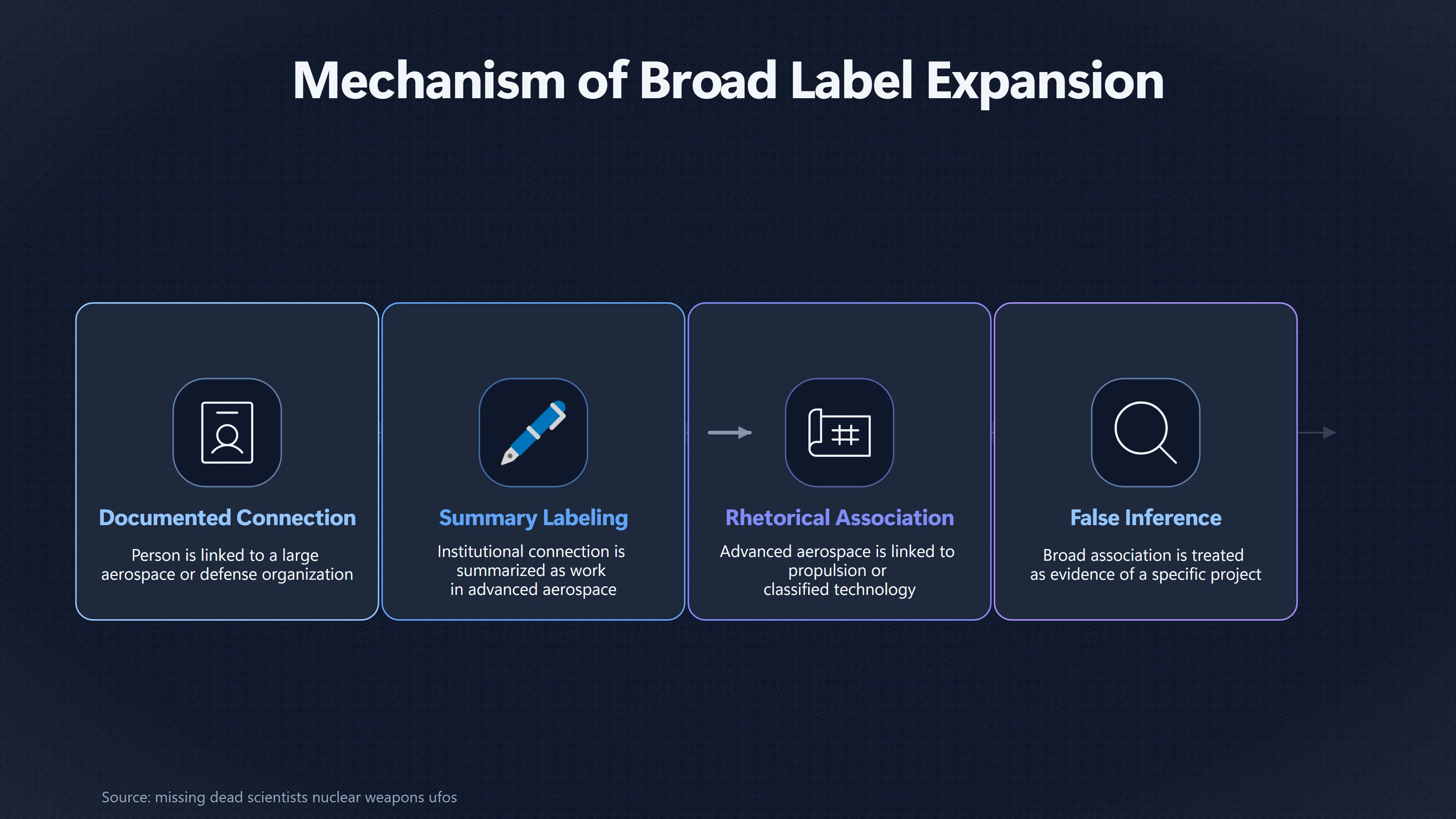
This produces a simple but powerful expansion mechanism:
- A person has a documented connection to a large aerospace or defence organisation.
- That institutional connection is summarised as work in “advanced aerospace”.
- “Advanced aerospace” is rhetorically associated with propulsion, classified technology or UFO programmes.
- The broad association is then treated as though it established participation in the same sensitive project as somebody else on the list.
At each step the wording may remain superficially plausible, yet the claim becomes progressively more specific than the underlying evidence.
“Advanced propulsion” is not one research programme
Propulsion terminology creates a similar bridge because radically different technologies can all legitimately be described as advanced propulsion.
NASA currently places nuclear thermal and nuclear electric propulsion within its space nuclear propulsion portfolio. Nuclear thermal propulsion uses fission to heat propellant, whereas nuclear electric propulsion uses nuclear-generated electricity to power an electric propulsion system. They share a high-level mission category but operate through different engineering architectures.[NASA]nasa.govOpen source on nasa.gov. NASA and DARPA’s DRACO work, for example, involved a nuclear thermal rocket intended to demonstrate a particular approach to faster deep-space transportation.[NASA]nasa.govOpen source on nasa.gov.
Move further towards speculative physics and the category widens dramatically. NASA’s Breakthrough Propulsion Physics project, which operated from 1996 to 2002, investigated whether radically new physics might someday enable propulsion without conventional propellant, extremely rapid travel or new spacecraft power sources. NASA’s retrospective assessment stressed that these goals were far from practical realisation and perhaps impossible; among the research tasks reviewed, some approaches were found non-viable while others remained unresolved.[NASA Technical Reports Server]nasa.govOpen source on nasa.gov.
Calling both nuclear thermal rockets and hypothetical spacetime engineering “advanced propulsion” is therefore linguistically defensible. It does not mean the researchers involved belonged to one technical enterprise.
That distinction becomes especially important in UFO-related material because official documents themselves sometimes employ extraordinarily broad aerospace terminology.
The AAWSAP papers show how wide the umbrella can become
The Defense Intelligence Agency’s records concerning the Advanced Aerospace Weapon System Applications Program (AAWSAP) provide a concrete demonstration of the problem. The DIA’s electronic reading room places under its UFO and exotic-technology archive documents covering subjects ranging from advanced nuclear propulsion and vacuum-based space propulsion to programmable matter, the Drake equation and aneutronic fusion.[Defense Intelligence Agency]dia.milOpen source on dia.mil.
The original AAWSAP solicitation was itself formally classified as “Special studies and analysis – not R&D” and sought engineering services.[Defense Intelligence Agency]dia.milOpen source on dia.mil. In other words, the presence of a subject within this documentary collection does not by itself demonstrate that the government was building the technology described, much less that every specialist whose field overlaps with one of those subjects participated in a common classified programme.
One DIA paper, Advanced Space Propulsion Based on Vacuum (Spacetime Metric) Engineering, discussed concepts including manipulation of the quantum vacuum, warp drives and traversable wormholes.[Defense Intelligence Agency]dia.milOpen source on dia.mil. NASA’s own earlier breakthrough-propulsion work likewise examined speculative possibilities concerning gravity, inertia and unconventional spaceflight.[NASA Technical Reports Server]nasa.govOpen source on nasa.gov.
This history creates an unusually effective bridge vocabulary. Once “advanced aerospace” is understood to encompass conventional rockets, nuclear propulsion, materials science, plasma physics, gravitational physics and speculative spacetime concepts, almost any researcher in a neighbouring high-technology discipline can potentially be placed one or two verbal steps from “antigravity” or UFO research.
The mistake is not recognising that these fields sometimes interact. They certainly can. The mistake is treating the possibility of technical overlap as proof of organisational overlap.

Aerospace, nuclear and propulsion cases can look closer than they are
The researchers drawn into the 2026 controversy show how dramatically professional differences can disappear when biographies are compressed into a few keywords.
Consider Carl Grillmair. His Caltech/IPAC profile identified his research interests as dark matter, Galactic structure, stellar populations and exoplanets. His institutional obituary described extensive work on stellar streams and extrasolar planets.[IPAC]caltech.eduOpen source on caltech.edu. Because IPAC supports astronomical and planetary-science missions and has NASA connections, however, a shortened description such as “NASA-linked space scientist” can place an astronomer inside the same apparent occupational category as a rocket engineer.
Nuno Loureiro presents a different case. MIT described him as a theoretical physicist whose research ranged across magnetic-confinement fusion, fundamental plasma physics and plasma astrophysics.[Plasma Science and Fusion Center]mit.eduOpen source on mit.edu. Fusion can potentially have propulsion applications, and “plasma” is also a term encountered in spacecraft propulsion. But Loureiro’s documented research included magnetic reconnection and plasma turbulence — scientific questions with applications extending through laboratory, fusion and astrophysical plasmas.[MIT Physics]mit.eduOpen source on mit.edu. Calling him an “advanced-energy scientist” is broadly reasonable; inferring from that description that he belonged to an aerospace or UFO technology programme is a separate proposition requiring separate evidence.
The difference is especially revealing because the investigation of Loureiro’s death eventually supplied evidence pointing away from the alleged common pattern. The broader 2026 list initially incorporated his homicide alongside deaths and disappearances from several other institutions. AP reported at the time that no evidence definitively connected the cases.[AP News]apnews.comOpen source on apnews.com.
This is precisely why occupational labels are weak linkage evidence. A scientist can be genuinely prominent, genuinely involved with technologically important research and genuinely die in disturbing circumstances without those three facts establishing a connection to another researcher’s death.
Institutional proximity can be mistaken for technical proximity
A second bridge occurs when a large institution substitutes for a project.
The House Oversight Committee’s April 2026 inquiry used cautious language that is important to preserve. It said it was investigating “unconfirmed public reporting” concerning people said to have connections to US nuclear secrets or rocket technology. Its summary itself ranged across former JPL personnel, Los Alamos personnel, an MIT fusion scientist, a pharmaceutical researcher and a contractor at a nuclear-weapons component facility.[Oversight Committee]oversight.house.govOpen source on house.gov.
That is already a heterogeneous population.
PolitiFact’s independent review sharpened the distinction. It traced 14 names being circulated and found that claims that nearly all had worked together were overstated. The people came from NASA, Los Alamos, the Air Force and other employers; the fact-check also found that they were not all scientists.[PolitiFact]politifact.comOpen source on politifact.com.
A useful comparison is AFRL itself. Materials and manufacturing research can feed propulsion systems, and propulsion research can feed spacecraft. The National Academies has documented how AFRL organisations concerned with basic research, materials and propulsion can interact in bringing new materials into propulsion systems.[National Academies]nationalacademies.orgOpen source on nationalacademies.org. Yet an organisational pathway between fields is not equivalent to every person in those fields working on the same programme.
This distinction can be expressed as three different levels of connection:
- Domain connection: both people worked somewhere within aerospace, nuclear science or defence technology.
- Institutional or technical connection: their organisations, research topics, contracts or technologies genuinely intersected.
- Project connection: records show that they participated in the same defined programme, shared work, exchanged information or depended on the same technical deliverable.
Researcher-death lists frequently begin with evidence at the first level and describe it in language that encourages readers to imagine the third.
Why the labels become stronger after a death
Biographies are multidimensional. A living researcher might accurately be described as an astronomer, computational scientist, university employee, NASA mission collaborator and specialist in Galactic structure. After that person enters a suspicious-death narrative, however, the biography can be compressed around whichever attribute best matches the existing list: NASA, space, defence, nuclear, propulsion, classified.
That selection process changes how the population looks without changing any underlying facts.
The 2026 list provides a visible example. AP reported that after McCasland disappeared, online researchers began identifying other scientists who had died or vanished, eventually reaching cases going back to 2022. The proposed common interests stretched across astrophysics, nuclear subjects and pharmaceuticals. AP quoted conspiracy-theory researcher Jen Golbeck noting that large numbers of people work at national laboratories, universities and government research centres, making it possible to collect deaths or disappearances and frame them as a sinister pattern.[AP News]apnews.comOpen source on apnews.com.
PolitiFact found the same expansion problem from another direction: the circulating claim was that the subjects were scientists connected with nuclear research and UFO secrets, yet closer examination showed different occupations, employers and circumstances.[PolitiFact]politifact.commissing dead scientists nuclear weapons ufosmissing dead scientists nuclear weapons ufos
Broad labels therefore function as retrospective filters. Researchers are not necessarily selected because evidence first demonstrates a common project. Instead, their biographies are searched for a feature that can be expressed in the vocabulary already defining the list.
That reverses the strongest evidential procedure. To test whether a hidden programme connects several people, investigators would ideally identify the programme independently and then establish who belonged to it. A bridge-label approach does the opposite: it identifies people first and then searches their careers for sufficiently broad similarities.
When occupational similarity stops being evidence
Occupational overlap is not meaningless. If two researchers worked in the same small laboratory, on the same contract, during the same period, using the same specialised technology, that could be important. Shared programme records, correspondence, patent co-authorship, security documentation, project reporting or a demonstrated chain of technical dependencies could make the relationship stronger still.
But the evidential value falls rapidly as the category widens.
“Both worked on the same propulsion test programme” is a relatively specific proposition. “Both worked on propulsion” is weaker. “Both worked in aerospace” is weaker again. “Both were associated with organisations involved in space or defence” can encompass an enormous population.
The distinction is especially important for alleged UFO and antigravity connections because real aerospace research already contains subjects that sound extraordinary. NASA genuinely investigated breakthrough-propulsion physics. DIA genuinely commissioned papers discussing vacuum engineering and unconventional propulsion. AFRL genuinely performs research ranging from materials and rockets to spacecraft and directed energy.[nasa.gov]nasa.govOpen source on nasa.gov. None of those facts is evidence that every researcher whose career can be verbally connected to those subjects participated in a hidden UFO programme.
Nor does an official investigation retroactively establish such a connection. The House Oversight Committee explicitly characterised the reporting that prompted its 2026 inquiry as unconfirmed and asked federal agencies for information to determine whether meaningful connections existed.[Oversight Committee]oversight.house.govOpen source on house.gov. AP similarly reported that, despite the federal attention the claims eventually attracted, no evidence had then definitively linked the cases or established coordinated foul play.[AP News]apnews.comOpen source on apnews.com.
The useful question is therefore not simply “Do these researchers have something in common?” With sufficiently broad labels, the answer will almost always be yes. The more discriminating questions are: How unusual is that commonality? How specifically does it connect their work? Was the connection identified before the deaths, or reconstructed afterwards? And is there independent evidence of a shared project?
Those tests explain why broad aerospace terminology can make a heterogeneous collection of researchers look unexpectedly coherent. The coherence may arise partly from the wording used to describe them rather than from the structure of their actual careers.
Amazon book picks
Further Reading
Books and field guides related to Why Unrelated Researchers Start Looking Connected. Use these as the next step if you want deeper reading beyond the article.
Calling Bullshit: The Art of Skepticism in a Data-Driven World
Bullshit isn’t what it used to be. Now, two science professors give us the tools to dismantle misinformation and think clearly in a world...
Spurious Correlations
"Spurious Correlations ... is the most fun you'll ever have with graphs."--Bustle Military intelligence analyst and Harvard Law student T...
The Data Detective: Ten Easy Rules to Make Sense of Statistics
From “one of the great (greatest?) contemporary popular writers on economics” (Tyler Cowen) comes a smart, lively, and encouraging rethin...
How to Lie with Statistics
'A great introduction to a crucial topic' Bill Gates 'Perhaps the most popular book on statistics ever published ... It's a marvel ... ga...
eBay marketplace picks
Marketplace Samples
Live-tested eBay searches with available results related to this page.
Selected fromspacecraft model oneBay.co.uk.
Endnotes
1.
Source: politifact.com
Title: missing dead scientists nuclear weapons ufos
Link:https://www.politifact.com/article/2026/apr/28/missing-dead-scientists-nuclear-weapons-ufos/
2.
Source: oversight.house.gov
Link:https://oversight.house.gov/release/comer-burlison-seek-information-on-missing-nuclear-and-rocket-scientists/
Additional References
3.
Source: youtube.com
Link:https://www.youtube.com/watch?v=NP_y9HJdmoM
Source snippet
12 U.S. Scientists Have Gone Missing or Died provides a detailed examination of how broad aerospace, defense, and nuclear umbrella labels...
4.
Source: youtube.com
Title: UFO mystery: Researcher deaths, disappearances unrelated, ex-FBI agent says
Link:https://www.youtube.com/watch?v=1Fm-0B0Gd9o
Source snippet
Father of 11th dead or [missing scientist]({{ 'missing-scientist/' | relative_url }}) rejects suspicions about her death...
5.
Source: youtube.com
Link:https://www.youtube.com/watch?v=1Hp02QoYzN4
Source snippet
UFO mystery: Researcher deaths, disappearances unrelated, ex-FBI agent says...
6.
Source: youtube.com
Title: Father of 11th dead or missing scientist rejects suspicions about her death
Link:https://www.youtube.com/watch?v=1d–WxTUkXE
Source snippet
The Plot To Eliminate Cold War Scientists...
7.
Source: youtube.com
Title: The Plot To Eliminate Cold War Scientists
Link:https://www.youtube.com/watch?v=-LUPnrL1b8M
Source snippet
Mysterious Deaths of UFO Researchers Date Back to 1940s, Fresh Claim Emerges...
8.
Source: reddit.com
Link:https://www.reddit.com/r/UFOB/comments/1svpnd6/updated_list_of_missingdead_scientists_other/