Within Hostility
How Ridicule Can Quiet UAP Research Without Violence
Ridicule can suppress participation without suppressing people physically, leaving unusual observations underreported and harder to study rigorously.
On this page
- Why scientists may avoid controversial subjects
- How self censorship can weaken the evidence base
- The boundary between social pressure and physical coercion
Page outline Jump by section
Introduction
Scientific stigma is a practical barrier to the study of unidentified anomalous phenomena (UAP), formerly usually called UFOs, because it can suppress the observations on which research depends. A pilot who decides that reporting an unusual object is professionally risky, or a scientist who concludes that UAP work could damage promotion prospects, does not need to be physically threatened for information to disappear from the scientific record. The result can be fewer reports, delayed reports, poorer metadata and a research literature skewed towards the small minority willing to accept reputational risk.
This mechanism is unusually well documented. The 1960s Colorado UFO study recognised fear of ridicule as a reason sightings went unreported; the US intelligence community said in 2021 that reputational risk was still keeping observers silent; and NASA’s 2023 independent study treated stigma as an obstacle to obtaining the high-quality data needed for scientific analysis.[ncas.org]files.ncas.orgFiles Condon Report, Section IINCAS FilesCondon Report, Section II: Summary of the Study…
That evidence supports a significant but limited conclusion within the wider history of alleged suppression surrounding UFO and unconventional aerospace research. Social and professional pressure can suppress participation and information without suppressing researchers physically. Establishing that a taboo or chilling effect exists does not establish that scientists have been murdered, disappeared or otherwise violently silenced.
Why scientists may avoid a controversial subject
Science is formally supposed to judge evidence rather than reputations, but scientific careers operate through institutions. Researchers compete for grants, posts, promotion, collaborators, students, journal space and professional credibility. A subject widely associated with sensational claims can therefore carry an opportunity cost even when nobody explicitly orders a researcher to stay away from it.
UAP research has historically carried precisely this problem. The 1969 Condon Report, produced by the University of Colorado project for the US Air Force, concluded that further extensive UFO study was unlikely to advance science. Whatever one thinks of individual cases in the report, that conclusion supplied a powerful institutional reason for scientists to allocate scarce research time elsewhere: a major sponsored investigation had declared the field scientifically unpromising.[NCAS Files]files.ncas.orgFiles Condon Report, Section I: Conclusions & RecommendationsNCAS FilesCondon Report, Section I: Conclusions & Recommendations…
Yet the Colorado study’s own discussion of reporting revealed another problem. It listed fear of ridicule among the reasons people did not report UFO observations, alongside apathy, uncertainty about where to report and the effort involved. Its researchers informally estimated that perhaps only about 10 per cent of sightings that people were subsequently willing to discuss had been reported at the time. That figure was explicitly described as a rough estimate from an uncontrolled sample, so it should not be treated as a reliable prevalence statistic. The important point is the mechanism the investigators themselves observed: potentially relevant observations were failing to enter the record.[NCAS Files]files.ncas.orgFiles Condon Report, Section IINCAS FilesCondon Report, Section II: Summary of the Study…
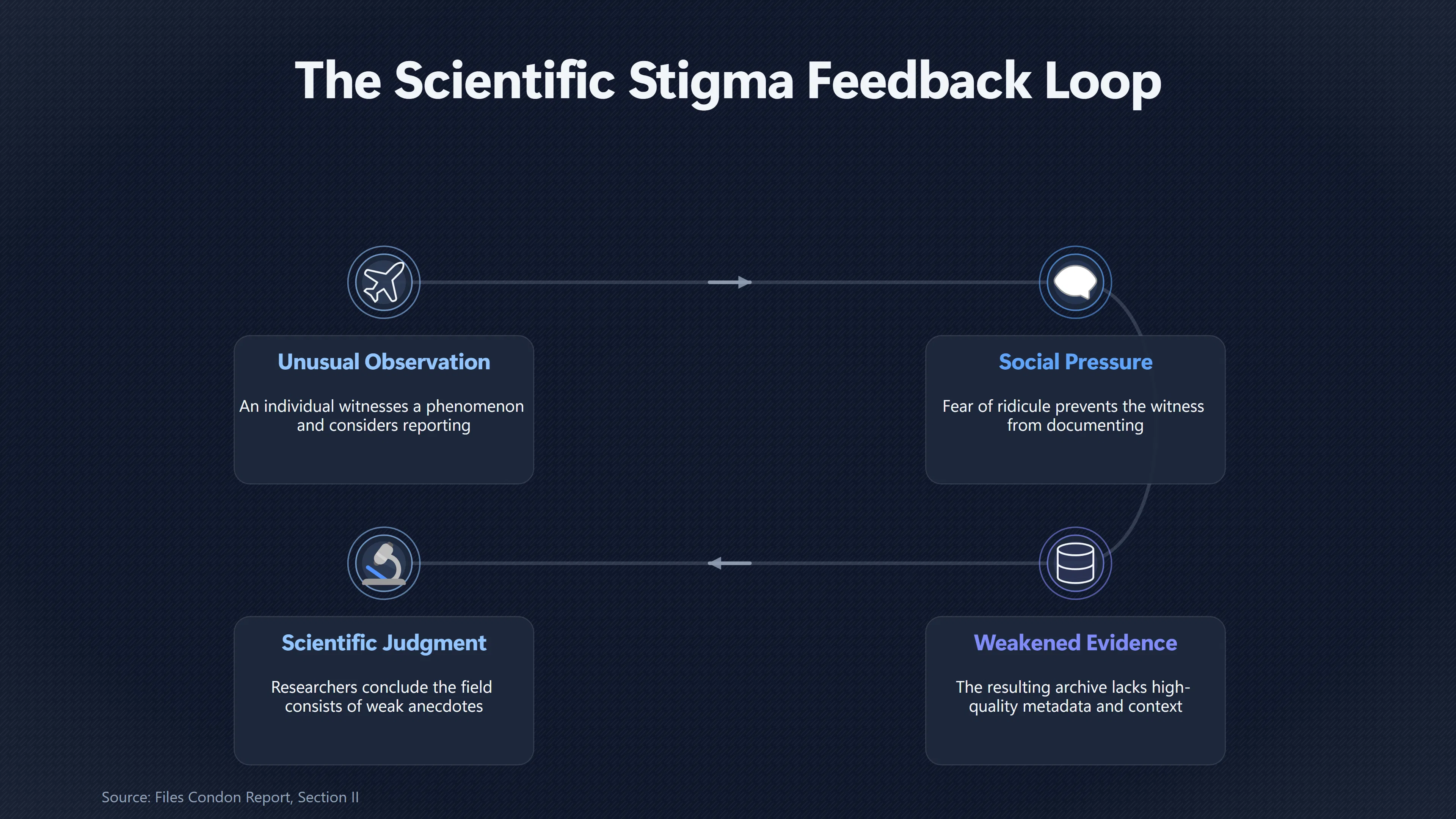
This creates an awkward feedback loop. Scientists reasonably hesitate to investigate a subject dominated by weak anecdotes; witnesses hesitate to create formal records because the subject is considered embarrassing; and the resulting shortage of good records reinforces the scientific judgement that the field consists mainly of weak anecdotes.
That does not make extraordinary interpretations of those anecdotes more likely to be true. It means only that selection effects have to be considered when judging the available dataset.
Self-censorship can weaken the evidence base
The strongest modern official acknowledgement of this mechanism came not from UFO campaigners but from the Office of the Director of National Intelligence (ODNI). Its June 2021 preliminary UAP assessment identified “sociocultural stigmas” alongside sensor limitations as obstacles to data collection. Aviators and intelligence analysts had described disparagement connected with seeing UAP, reporting them or even discussing them with colleagues. ODNI concluded that reputational risk might keep observers silent and thereby complicate scientific investigation.[ODNI]dni.govOpen source on dni.gov.
The same report exposed an important consequence. A standardised US Navy reporting mechanism had been introduced only in March 2019, with the Air Force adopting it in November 2020. The UAP task force also heard about observations that had never entered either formal or informal reporting systems. The dataset available for analysis was therefore not simply “everything that happened”; it was what survived the combined filters of observation, willingness to report, available procedures, classification and data collection.[UAP Records Archive]uap-archive.orgodni 2021 preliminary assessment uapUAP Records ArchiveODNI Preliminary Assessment on UAP (2021) | UAP Records ArchiveJune 25, 2021…
That distinction matters scientifically. Suppose 100 unusual observations occur but only a fraction are reported. If the decision to report were random, the surviving sample might still be reasonably representative. Stigma makes that assumption doubtful. People may preferentially report especially dramatic events, observations corroborated by instruments, or incidents for which they feel unusually confident. Others may wait until colleagues report similar experiences before admitting their own. The resulting archive can therefore be biased in ways that are difficult to reconstruct afterwards.
Delayed reporting creates another loss. Exact time, bearing, altitude, weather conditions, aircraft configuration, sensor settings and nearby traffic may no longer be recoverable. The longer an observer waits, the harder it becomes to compare the event with radar records, satellite passages, astronomical objects, balloons, drones or other ordinary candidates.
NASA’s 2023 independent study described essentially this broader data problem. UAP observations are usually incidental rather than collected through experiments designed for the purpose. Instruments may not be calibrated for the phenomenon, while essential metadata can be absent. NASA consequently judged many existing observations unsuitable for systematic scientific analysis.[NASA Science]smd-cms.nasa.govScience NASAUNIDENTIFIED ANOMALOUS PHENOMENA…
Stigma therefore matters even if every ultimately resolved UAP were mundane. A reporting culture that discourages prompt documentation makes mundane explanations harder to establish as well.
The pilot problem shows the mechanism clearly
Aviation provides an unusually useful test case because pilots are trained observers operating in an environment where unusual airborne objects can have safety significance regardless of their origin. Here the stigma problem is not merely about whether somebody believes in extraterrestrial visitors. The operational question is whether unexplained traffic or sensor observations are recorded well enough to identify what actually happened.
Former US Navy pilot Ryan Graves told Congress in 2023 that commercial aircrew were reluctant to discuss unusual observations over radio or through official company channels because they feared professional consequences. His testimony argued that the absence of a suitable reporting system produced a domain-awareness gap. These statements are witness testimony rather than independent proof of how widespread the problem is, but they closely match ODNI’s institutional finding about disparagement and silence within aviation communities.[Congress.gov]congress.govRyan Graves / Americans for Safe Aerospace Written TestimonyJuly 1, 2025…
A later congressional discussion involving David Spergel’s NASA UAP study team addressed the same structural issue from the reporting-system side. Michael Gold, another member of NASA’s independent team, told lawmakers that civilian pilots lacked a clear, well-publicised UAP reporting process and that stigma further reduced reporting. He pointed to NASA’s existing Aviation Safety Reporting System (ASRS), which is designed around voluntary, confidential and non-punitive safety reporting, as a model capable of lowering the barrier.[Congress.gov]congress.govUNIDENTIFIED ANOMALOUS PHENOMENA: EXPOSING THE TRUTH | Congress.gov | Library of CongressNovember 13, 2024…
That proposal illustrates what destigmatisation means when translated from rhetoric into research design. The goal is not to tell pilots that their interpretations are correct. It is to make reporting an observation professionally ordinary enough that investigators can acquire the information required to test those interpretations.
Germany’s University of Würzburg has taken a comparable approach with a dedicated pilot UAP reporting centre. Its stated purpose is to provide a professional, scientifically grounded platform that acknowledges historical stigma and lowers the threshold for an initial report, after which more detailed investigation can follow.[University of Würzburg]uni-wuerzburg.deUniversity of Würzburg UAP Reporting Center for PilotsUniversity of Würzburg UAP Reporting Center for Pilots
NASA reframed stigma as a data-quality problem
NASA’s involvement marked an important change because one of the world’s most recognisable scientific institutions explicitly separated taking reports seriously from accepting extraordinary explanations.
Its independent study did not find evidence that reported UAP were extraterrestrial. Instead, it argued that the existing evidence was generally too poor for strong conclusions and concentrated on how future observations could be made scientifically useful. The recommendations included calibrated multisensor observations, better data curation, machine-learning techniques and improved public reporting.[NASA Science]science.nasa.govScience NASAUNIDENTIFIED ANOMALOUS PHENOMENA Independent…
Within that programme, reducing stigma was not a public-relations extra. The panel argued that NASA’s participation itself could reduce the stigma attached to reporting and recommended exploring crowdsourced reporting systems. NASA subsequently said it would work with the public and commercial pilots to build a broader and more reliable dataset while helping to destigmatise UAP study.[NASA Science]science.nasa.govScience NASAUNIDENTIFIED ANOMALOUS PHENOMENA Independent…
The logic is straightforward:

- an unusual observation occurs;
- fear of ridicule or professional damage discourages reporting;
- investigators lose the opportunity to collect contemporaneous measurements and metadata;
- the surviving evidence is weaker;
- weak evidence makes rigorous identification harder;
- the resulting uncertainty helps preserve the subject’s reputation as scientifically unreliable.
Breaking that cycle does not require relaxing evidential standards. In fact, NASA’s approach implies the opposite: lower the social barrier to submitting observations while raising the technical standard applied to the resulting data.
That combination is important because destigmatisation without rigorous filtering could simply increase the volume of low-quality reports. Rigour without destigmatisation, however, can leave investigators with too few well-documented observations to analyse.
A scientific taboo need not look like censorship
Some scholars have treated the problem more broadly as a question of academic taboo. Political scientists Alexander Wendt and Raymond Duvall argued in 2008 that UFOs occupied an unusual position in which the subject was widely dismissed without receiving the systematic investigation that would ordinarily justify such certainty. Their argument was theoretical and controversial, extending well beyond simple reporting behaviour into questions about political authority and anthropocentrism. It should therefore not be mistaken for empirical proof of a coordinated campaign against UAP researchers.[Experts@Minnesota]experts.umn.eduExperts@Minnesota Sovereignty and the UFOExperts@Minnesota Sovereignty and the UFO
More revealing for the narrower question of stigma is what happened when Michael P. A. Murphy later examined the reception of their paper. His 2023 study used citation analysis to test the idea of a UFO taboo within international-relations scholarship. Murphy did not find definitive quantitative proof that taboo had suppressed the paper’s academic impact. Instead, he identified a subtler pattern: scholars often cited the work while avoiding substantive engagement with its specifically UFO-related argument.[PubMed]pubmed.ncbi.nlm.nih.govOpen source on nih.gov.
That is a useful warning against imagining scientific stigma solely as explicit censorship. Academic avoidance can operate through mundane choices: which grant proposal seems safest, which project a doctoral student is advised to pursue, which unusual observation is left out of a paper, which conference topic looks embarrassing, or which citation is used only for its more respectable theoretical implications.
None of these decisions requires a central authority. Collectively, however, they can determine which questions accumulate researchers, money and data.
There are signs that this boundary is becoming less rigid. Recent scholarly work has begun mapping UAP literature as an emerging interdisciplinary field, while instrument-based projects have attempted to replace anecdotal collections with systematic sensor observations. A 2025 review in Progress in Aerospace Sciences, for example, surveyed historical and contemporary UAP research programmes and argued for treating the subject as an empirical research problem rather than assuming a particular explanation in advance.[arXiv]arxiv.orgarXiv The New Science of Unidentified Aerospace-Undersea Phenomena (UAParXiv The New Science of Unidentified Aerospace-Undersea Phenomena (UAP
The important measure of progress is not whether academia becomes more accepting of claims about extraordinary craft. It is whether researchers can investigate ambiguous observations without their choice of subject being treated as evidence of poor judgement.
Less stigma does not automatically produce better evidence
There is an important counterweight to the argument for destigmatisation. UFO culture has accumulated decades of extraordinary claims, hoaxes, misidentifications, conspiracy theories and disputed evidence. Scientists have legitimate reasons to be cautious about associating themselves with claims that may lack reproducible data. Removing ridicule cannot mean treating every report as equally credible.
NASA’s report makes this distinction especially clear. Its call for destigmatisation appears alongside repeated demands for calibrated instruments, complete metadata, systematic collection and reproducible analysis. Current UAP observations are frequently unsuitable for those purposes precisely because they were not produced as scientific measurements.[NASA Science]science.nasa.govScience NASAUNIDENTIFIED ANOMALOUS PHENOMENA Independent…
Nor does underreporting tell us what the missing reports would show. It is tempting to reason that if stigma concealed many observations, the unseen cases might contain stronger evidence for extraordinary phenomena. The opposite could also be true. Unreported sightings might disproportionately consist of fleeting, ambiguous events that observers themselves suspected were ordinary. Without the missing data, their composition is unknowable.
The scientifically defensible conclusion is therefore narrower: stigma makes the dataset less complete and potentially more biased; it does not tell us what conclusion a complete dataset would support.
That distinction is particularly important in a subject surrounded by allegations of deliberate suppression. Evidence that researchers or witnesses feared ridicule demonstrates a social mechanism capable of producing silence. It cannot, without additional evidence, establish who caused a particular unexplained event, whether secrecy concealed extraordinary technology, or whether any reported UAP represented something beyond conventional aircraft, balloons, drones, astronomical objects, atmospheric effects or sensor artefacts.
Social pressure is not physical coercion
Within the wider history of alleged suspicious deaths and disappearances associated with UFO or antigravity research, scientific stigma deserves attention precisely because it offers a documented form of suppression that does not require violence.
There is strong evidence for several elements of this mechanism. The Colorado study recorded fear of ridicule as a reporting deterrent decades ago. ODNI later documented disparagement and reputational concerns among aviators and intelligence personnel. NASA independently concluded that stigma remained a barrier to obtaining useful UAP data and deliberately used its institutional credibility to encourage more scientifically structured reporting.[ncas.org]files.ncas.orgFiles Condon Report, Section IINCAS FilesCondon Report, Section II: Summary of the Study…
Those findings make it unnecessary to speculate about whether ridicule can silence people. It plainly can.
But they also sharpen the evidential boundary around more serious allegations. A documented case of a researcher losing professional standing, avoiding a subject, receiving hostile correspondence or choosing not to report an observation is evidence of institutional or social pressure. It is not evidence of assassination. A historical policy intended to discourage public fascination with UFOs may demonstrate information management; it does not by itself demonstrate a programme of physically eliminating researchers.
Confusing these categories actually weakens investigation of both. It turns well-supported evidence of stigma into supposed proof of much larger conspiracies, while making genuine professional pressures easier to dismiss as part of the same speculative package.
The more useful conclusion is also the more measurable one. UAP research can be hindered long before anyone is physically coerced. Ridicule changes what people report. Reputational incentives change which questions researchers choose. Missing reports reduce opportunities for corroboration. Poorly documented observations then weaken the evidence available to science.
That is why reducing stigma is compatible with scepticism rather than opposed to it. A scientific culture in which pilots and researchers can document unusual observations without embarrassment gives sceptical analysis more evidence to work with. The proper alternative to ridicule is not belief; it is collection, measurement and testing.
Amazon book picks
Further Reading
Books and field guides related to How Ridicule Can Quiet UAP Research Without Violence. Use these as the next step if you want deeper reading beyond the article.
The UFO Experience: A Scientific Inquiry
Cited by the New York Review of Books as "the best brief for visitation," this classic study presents an analysis of UFO reports and conc...
The Close Encounters Man: How One Man Made the World Believe...
Meet the astronomer who invented the concept of "Close Encounters" with aliens, inspired a classic sci-fi film, and made a nation want to...
UFOs: Generals, Pilots, and Government Officials Go on the Re...
NEW YORK TIMES BESTSELLER • Impeccably researched, this riveting journalistic investigation separates fact from fiction, and documents th...
UFOs and Government: A Historical Inquiry
Governments around the world have had to deal with the UFO phenomenon for a good part of a century. How and why they did so is the subjec...
eBay marketplace picks
Marketplace Samples
Live-tested eBay searches with available results related to this page.
Selected fromUFO poster oneBay.co.uk.

Endnotes
1.
Source: files.ncas.org
Title: Files Condon Report, Section II
Link:https://files.ncas.org/condon/text/sec-ii.htm
Source snippet
NCAS FilesCondon Report, Section II: Summary of the Study...
2.
Source: science.nasa.gov
Title: Science NASA
Link:https://science.nasa.gov/wp-content/uploads/2023/09/uap-independent-study-team-final-report.pdf
Source snippet
UNIDENTIFIED ANOMALOUS PHENOMENA Independent...
3.
Source: files.ncas.org
Title: Files Condon Report, Section I: Conclusions & Recommendations
Link:https://files.ncas.org/condon/text/sec-i.htm
Source snippet
NCAS FilesCondon Report, Section I: Conclusions & Recommendations...
4.
Source: smd-cms.nasa.gov
Title: Science NASA
Link:https://smd-cms.nasa.gov/wp-content/uploads/2023/09/uap-independent-study-team-final-report.pdf
Source snippet
UNIDENTIFIED ANOMALOUS PHENOMENA...
5.
Source: congress.gov
Title: Ryan Graves / Americans for Safe Aerospace Written Testimony
Link:https://www.congress.gov/118/meeting/house/116282/witnesses/HHRG-118-GO06-Wstate-GravesR-20230726.pdf
Source snippet
July 1, 2025...
Published: July 1, 2025
6.
Source: congress.gov
Link:https://www.congress.gov/event/118th-congress/house-event/116282/text
Source snippet
y of Congress...
7.
Source: congress.gov
Link:https://www.congress.gov/event/118th-congress/joint-event/LC73860/text
Source snippet
UNIDENTIFIED ANOMALOUS PHENOMENA: EXPOSING THE TRUTH | Congress.gov | Library of CongressNovember 13, 2024...
Published: November 13, 2024
8.
Source: congress.gov
Link:https://www.congress.gov/event/118th-congress/house-event/LC73681/text
9.
Source: nasa.gov
Title: UPDATE: NASA Shares UAP Independent Study Report; Names Director
Link:https://www.nasa.gov/news-release/update-nasa-shares-uap-independent-study-report-names-director/
10.
Source: arxiv.org
Title: arXiv The New Science of Unidentified Aerospace-Undersea Phenomena (UAP)
Link:https://arxiv.org/abs/2502.06794
11.
Source: science.nasa.gov
Link:https://science.nasa.gov/uap/faqs/
12.
Source: science.nasa.gov
Link:https://science.nasa.gov/uap/
13.
Source: congress.gov
Link:https://www.congress.gov/event/119th-congress/house-event/118584/text
14.
Source: congress.gov
Title: S. Rept. 119-39
Link:https://www.congress.gov/committee-report/119th-congress/senate-report/39/1
15.
Source: nasa.gov
Title: NAS A to Release, Discuss Unidentified Anomalous Phenomena Report
Link:https://www.nasa.gov/news-release/nasa-to-release-discuss-unidentified-anomalous-phenomena-report/
16.
Source: congress.gov
Title: S.Hrg. 118-648 — THE MISSION, ACTIVITIES, OVERSIGHT, AND BUDGET OF THE ALL
Link:https://www.congress.gov/event/118th-congress/senate-event/LC74346/text
17.
Source: nasa.gov
Title: NAS A Announces Unidentified Aerial Phenomena Study Team Members
Link:https://www.nasa.gov/general/nasa-announces-unidentified-aerial-phenomena-study-team-members/
18.
Source: congress.gov
Title: H. Rept. 117-397
Link:https://www.congress.gov/committee-report/117th-congress/house-report/397/1
19.
Source: colorado.edu
Link:https://www.colorado.edu/coloradan/2021/11/05/condon-report-cu-boulders-historic-ufo-study
20.
Source: history.com
Title: of UFOs
Link:https://www.history.com/articles/history-of-ufos
21.
Source: congress.gov
Title: S. Rept. 107-158,Volume 2
Link:https://www.congress.gov/committee-report/107th-congress/senate-report/158/2
22.
Source: congress.gov
Link:https://www.congress.gov/event/106th-congress/house-event/LC66603/text
23.
Source: time.com
Title: close encounters of the scientific kind
Link:https://time.com/archive/6920253/close-encounters-of-the-scientific-kind/
24.
Source: congress.gov
Title: S. Rept. 105-36,Volume 2
Link:https://www.congress.gov/committee-report/105th-congress/senate-report/36/2
25.
Source: ouci.dntb.gov.ua
Link:https://ouci.dntb.gov.ua/en/works/4NkJjZ6O/
26.
Source: files.ncas.org
Link:https://files.ncas.org/condon/text/contents.htm
27.
Source: files.ncas.org
Link:https://files.ncas.org/condon/text/s6chap03.htm
28.
Source: files.ncas.org
Link:https://files.ncas.org/condon/text/s6chap02.htm
29.
Source: dni.gov
Link:https://www.dni.gov/files/ODNI/documents/assessments/Prelimary-Assessment-UAP-20210625.pdf?stream=science
30.
Source: uap-archive.org
Title: odni 2021 preliminary assessment uap
Link:https://uap-archive.org/uap/records/odni-2021-preliminary-assessment-uap/
Source snippet
UAP Records ArchiveODNI Preliminary Assessment on UAP (2021) | UAP Records ArchiveJune 25, 2021...
Published: June 25, 2021
31.
Source: uni-wuerzburg.de
Title: University of Würzburg UAP Reporting Center for Pilots
Link:https://www.uni-wuerzburg.de/en/ifex/research-projects/uap-reporting-center-for-pilots/
32.
Source: experts.umn.edu
Title: Experts@Minnesota Sovereignty and the UFO
Link:https://experts.umn.edu/en/publications/sovereignty-and-the-ufo/
33.
Source: pubmed.ncbi.nlm.nih.gov
Link:https://pubmed.ncbi.nlm.nih.gov/38250482/
34.
Source: pmc.ncbi.nlm.nih.gov
Link:https://pmc.ncbi.nlm.nih.gov/articles/PMC12679345/
35.
Source: pubmed.ncbi.nlm.nih.gov
Link:https://pubmed.ncbi.nlm.nih.gov/39369726/
36.
Source: en.wikisource.org
Title: UAP Reporting
Link:https://en.wikisource.org/wiki/Fiscal_Year_2023_Consolidated_Annual_Report_on_Unidentified_Anomalous_Phenomena/UAP_Reporting
37.
Source: pmc.ncbi.nlm.nih.gov
Link:https://pmc.ncbi.nlm.nih.gov/articles/PMC10798873/
38.
Source: oversight.house.gov
Link:https://oversight.house.gov/release/hearing-wrap-up-lack-of-transparency-and-reporting-mechanisms-have-eroded-public-trust-on-governments-handling-of-uap-encounters%EF%BF%BC/
39.
Source: ruj.uj.edu.pl
Link:https://ruj.uj.edu.pl/entities/publication/d8d30f63-ec0a-49c6-8d8e-2f9e7a1c295b
40.
Source: documents.uow.edu.au
Link:https://documents.uow.edu.au/~bmartin/pubs/98jse.html
41.
Source: uni-wuerzburg.de
Title: UAP & SETI Research
Link:https://www.uni-wuerzburg.de/en/ifex/research-projects/uap-seti-research/
42.
Source: experts.umn.edu
Title: militant agnosticism and the ufo taboo a call for reason and resp
Link:https://experts.umn.edu/en/publications/militant-agnosticism-and-the-ufo-taboo-a-call-for-reason-and-resp
Additional References
43.
Source: youtube.com
Title: Public Meeting on Unidentified Anomalous Phenomena (Official NASA Broadcast)
Link:https://www.youtube.com/watch?v=bQo08JRY0iM
Source snippet
The Battle Between UAP Science & [UFO Stigma]({{ 'ufo-stigma/' | relative_url }}) | Kevin Knuth...
44.
Source: nature.com
Link:https://www.nature.com/articles/s41598-023-49527-x
45.
Source: nature.com
Link:https://www.nature.com/articles/s41599-023-01746-3
46.
Source: youtube.com
Title: Replay! NASA’s Release of the Unidentified Anomalous Phenomena Report
Link:https://www.youtube.com/watch?v=nuBMnluJfs0
Source snippet
Stanford's Garry Nolan on UAP Science and Scientific Stigma...
47.
Source: youtube.com
Title: Stanford’s Garry Nolan on UAP Science and Scientific Stigma
Link:https://www.youtube.com/watch?v=EEMJoZvN-dQ
Source snippet
Harvard's Professor Avi Loeb Talks About UAPs and Sociocultural Stigma...
48.
Source: youtube.com
Title: The Battle Between UAP Science & UFO Stigma | Kevin Knuth
Link:https://www.youtube.com/watch?v=UGoCFbONbQs
Source snippet
Replay! NASA's Release of the Unidentified Anomalous Phenomena Report...
49.
Source: defense.gov
Link:https://www.defense.gov/News/Transcripts/Transcript/Article/3575588/aaro-director-dr-sean-kirkpatrick-holds-an-off-camera-media-roundtable/
50.
Source: faa.gov
Link:https://www.faa.gov/air_traffic/publications/atpubs/foa_html/chap4_section_7.html
51.
Source: faa.gov
Link:https://www.faa.gov/air_traffic/publications/atpubs/aim_html/chap7_section_7.html
52.
Source: defense.gov
Link:https://www.defense.gov/News/News-Stories/Article/Article/3965403/dod-examining-unidentified-anomalous-phenomena/