Within Cold Fusion
Why the US Government Funded LENR Again
Federal funding for LENR projects shows that a stigmatised field can regain institutional support without its underlying claims being accepted as proven.
On this page
- What the ARPA E programme set out to test
- Why funding did not equal scientific endorsement
- How renewed support changes the suppression argument
Page outline Jump by section
Introduction
In 2023, the US Department of Energy’s Advanced Research Projects Agency–Energy (ARPA-E) put $10 million into eight projects investigating low-energy nuclear reactions (LENR), the field historically associated with “cold fusion”. The decision was significant precisely because ARPA-E did not declare cold fusion real. It framed the programme as an attempt to break a scientific stalemate: produce convincing evidence with modern instruments and reproducible methods, or establish more decisively that the claimed phenomena do not merit further pursuit.[ARPA-E]arpa-e.energy.govU.S. Department of Energy Announces $10 Million in Funding to Projects Studying Low-Energy Nuclear Reactions | ARPA-EFebruary 17, 2023…

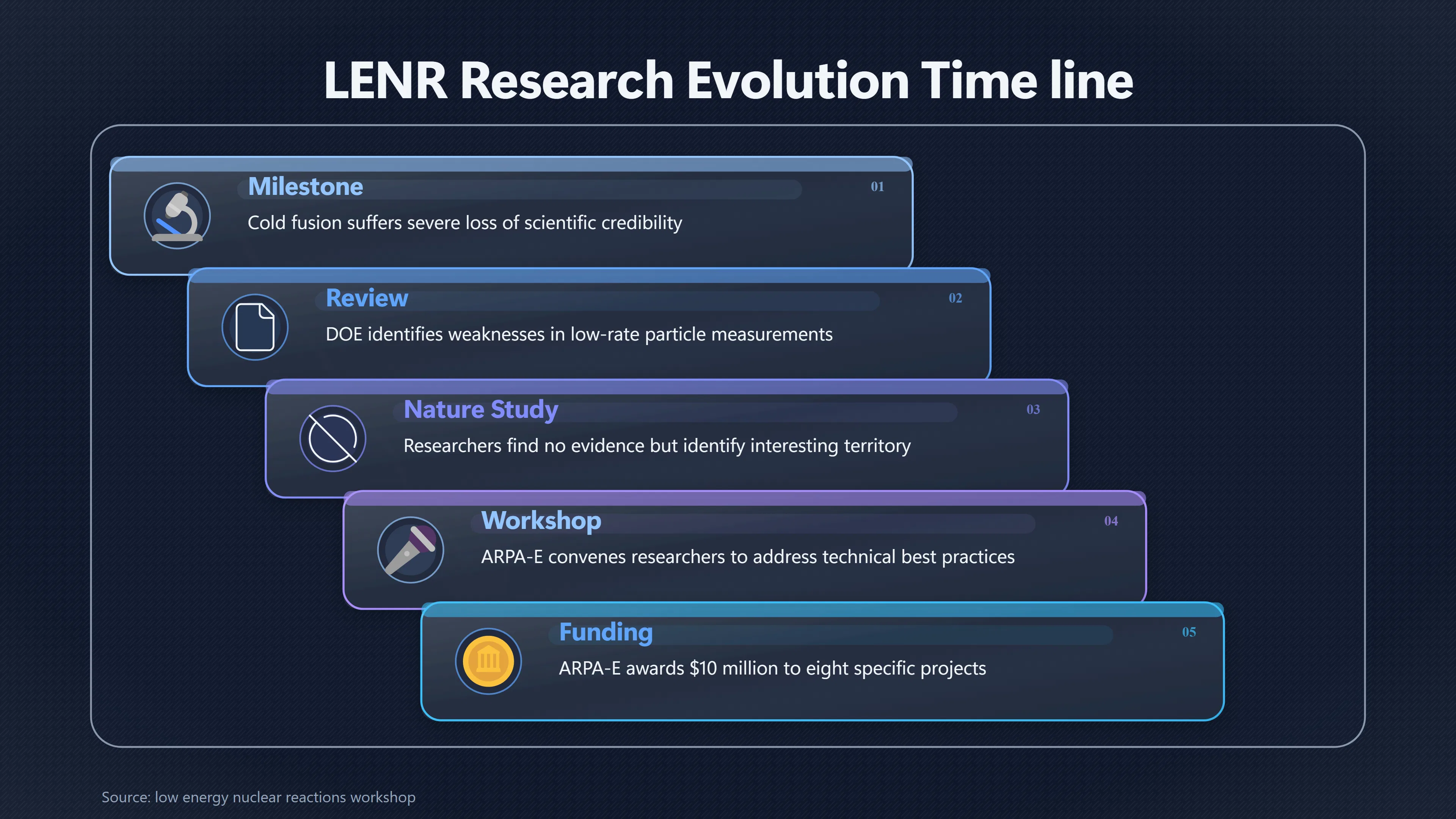
That distinction matters to the suppressed-scientist narrative surrounding unconventional energy research. Cold fusion undeniably suffered a severe loss of scientific credibility after 1989. Yet ARPA-E’s intervention shows that stigma is not necessarily permanent, nor does renewed government funding require officials to accept disputed claims in advance. A controversial subject can return through a mechanism much more ordinary than secret validation: carefully bounded, high-risk research designed to turn an entrenched argument into experiments capable of producing clearer answers.
What the ARPA-E programme set out to test
ARPA-E’s programme grew from an October 2021 workshop that brought together researchers working on LENR claims, materials science, calorimetry and radiation detection. The workshop devoted considerable attention not merely to proposed mechanisms but to reference experiments and technical best practices, including the difficult problem of detecting particles when any genuine signal might occur only slightly above background.[ARPA-E]arpa-e.energy.govlow energy nuclear reactions workshopLow-Energy Nuclear Reactions Workshop | ARPA-EOctober 21, 2021…
That emphasis reflected the central difficulty inherited from the cold-fusion controversy. The field contained claims of anomalous heat and nuclear products, but disagreement persisted over whether those observations represented nuclear reactions, measurement problems, materials effects or other causes. In its subsequent funding notice, ARPA-E explicitly sought “hypotheses-driven” approaches capable of producing diagnostic evidence persuasive to the wider scientific community. Its stated question was essentially binary: should LENR move forward as a potentially transformative energy field, or could rigorous investigation show that it did not have sufficient promise?[ARPA-E eXCHANGE]arpa-e-foa.energy.govARPA-E eXCHANGEDOE: ARPA-E eXCHANGE: Funding Opportunities…
The eight awards announced in February 2023 therefore did not constitute eight attempts to build commercial cold-fusion generators. They formed a portfolio of tests attacking different weak points in the evidence. The recipients included universities, a national laboratory, a research organisation and a small business, with awards ranging from about $296,000 to $2 million.[ARPA-E]arpa-e.energy.govU.S. Department of Energy Announces $10 Million in Funding to Projects Studying Low-Energy Nuclear Reactions | ARPA-EFebruary 17, 2023…
Several projects illustrate the programme’s mechanism particularly clearly. MIT received $2 million for experiments on laser-stimulated metal hydrides, looking for comparatively unambiguous nuclear indicators such as neutrons and unusual isotopic ratios rather than assuming that unexplained heat alone demonstrated fusion. Stanford’s roughly $1.5 million project used deuterated nanoparticles and sought detectable nuclear products under controlled stimulation. Lawrence Berkeley National Laboratory received $1.5 million to examine metal hydrides at excitation energies below 500 electron volts while systematically varying experimental conditions and measuring possible nuclear events with several diagnostic techniques.[ARPA-E]arpa-e.energy.govneutron emission laser stimulated metal hydridesNeutron Emission from Laser-Stimulated Metal Hydrides | ARPA-EJune 14, 2023…
Two University of Michigan projects addressed complementary problems. One, funded at $902,213, concentrated on the detection side: measuring hypothetical neutron, gamma-ray and ion emissions while applying modern methods for data acquisition, background characterisation and statistical interpretation. The other, awarded about $1.1 million, was designed to test claims of excess heat during deuteration of palladium-nickel nanocomposites, combining high-resolution calorimetry with radiation detectors, mass spectrometry and theoretical calculations.[ARPA-E]arpa-e.energy.govIonizing Radiation Detection for Exploratory Experiments In Low-Energy Nuclear Reactions | ARPA-EMay 16, 2023…
Texas Tech’s $1.15 million project added advanced materials fabrication, characterisation and nuclear-product detection, including support for other ARPA-E teams. Energetics Technology Center pursued palladium co-deposition experiments in which the experimental cathode was positioned close to a scintillation detector, reducing one obstacle to identifying possible reaction products. Amphionic’s smaller award explored whether controlling palladium nanoparticle geometry, separation and deuterium loading could create conditions associated with claimed LENR activity.[ARPA-E]arpa-e.energy.govadvanced materials characterization and nuclear product detection lenradvanced materials characterization and nuclear product detection lenr
The portfolio was therefore structured around an important methodological shift. Instead of asking researchers simply to reproduce the famous 1989 experiment, ARPA-E funded better calorimetry, better materials control, better radiation detection and experiments intended to connect any apparent energy anomaly with independently measurable nuclear products. That design matters because an anomalous temperature reading and evidence of a nuclear reaction are not the same thing.
Why funding did not equal scientific endorsement
Government funding can easily be misread as official confirmation, particularly when a subject has spent decades outside mainstream research. ARPA-E’s own language makes that interpretation difficult to sustain. Director Evelyn Wang said the projects were intended to establish whether the field showed promise or whether it could be shown conclusively not to. The agency described its goal as breaking a “knowledge impasse”, not commercialising a demonstrated source of nuclear power.[ARPA-E]arpa-e.energy.govU.S. Department of Energy Announces $10 Million in Funding to Projects Studying Low-Energy Nuclear Reactions | ARPA-EFebruary 17, 2023…
That approach is consistent with ARPA-E’s institutional role. The agency exists to investigate high-risk, potentially transformative energy technologies, including possibilities too uncertain for conventional private investment. A small exploratory award therefore means that an idea’s possible payoff and unresolved evidence justify an experiment; it does not mean that the underlying scientific proposition has already survived that experiment.[HigherGov]highergov.comOpen source on highergov.com.
There was also a clear precedent for making this distinction within the Department of Energy. When DOE reconsidered LENR evidence in 2004, two-thirds of reviewers addressing the central experimental question did not regard the presented evidence as conclusive. The review identified weaknesses in methods and interpretation, particularly for low-rate particle measurements. Yet the reviewers were nearly unanimous that funding agencies should still consider well-designed individual proposals addressing specific questions under normal peer-review standards. They specifically pointed towards modern materials characterisation and state-of-the-art searches for fusion events as worthwhile approaches.[Wikisource]en.wikisource.orgPage:DOE Report of the Review of Low Energy Nuclear Reactions.djvu/4Page:DOE Report of the Review of Low Energy Nuclear Reactions.djvu/4
In other words, “the evidence is not convincing” and “no one should fund another experiment” were never logically identical positions. Even the 2004 DOE assessment distinguished between establishing a dedicated federal LENR programme—which none of its reviewers recommended—and allowing specific, technically credible experiments to compete for support.[Wikisource]en.wikisource.orgPage:DOE Report of the Review of Low Energy Nuclear Reactions.djvu/5Page:DOE Report of the Review of Low Energy Nuclear Reactions.djvu/5
A further bridge to the 2023 programme came from a multi-institution investigation published in Nature in 2019. After three years of experiments revisiting cold-fusion claims, the researchers reported that they had found no evidence of the claimed cold-fusion effect. But they also concluded that work on highly hydrogen-loaded materials and nuclear reactions at unusually low energies had exposed scientifically interesting territory worth exploring with improved experiments. Several researchers associated with that work later appeared in ARPA-E-funded teams, including Yet-Ming Chiang at MIT and Thomas Schenkel at Berkeley Lab.[nature.com]nature.comRevisiting the cold case of cold fusion | NatureRevisiting the cold case of cold fusion | Nature
This history makes ARPA-E’s intervention less paradoxical than it initially appears. The programme did not reverse the scientific verdict of 1989 by administrative decree. It exploited improvements in instrumentation and materials science to ask whether old claims could now be subjected to tests that were harder to dispute.
The real significance of cold fusion’s return
For narratives about suppressed unconventional-energy research, the 2023 decision supports one proposition while weakening another. It supports the relatively modest claim that scientific stigma has consequences. A field that becomes associated with irreproducible results can struggle to attract researchers, journal attention and conventional funding. The 2019 Nature investigators themselves described cold fusion as having been effectively disqualified from further mainstream study after replication failures, even though they considered parts of the underlying experimental parameter space worth revisiting.[Nature]nature.comRevisiting the cold case of cold fusion | NatureRevisiting the cold case of cold fusion | Nature
But ARPA-E complicates the stronger proposition that institutional scepticism towards an unconventional energy claim necessarily indicates a permanent effort to suppress it. Here, a federal agency openly advertised the controversial subject, convened researchers, solicited applications, published the identities and funding levels of successful teams, and financed experiments whose explicit purpose included finding evidence strong enough to convince sceptical scientists.[energy.gov]arpa-e.energy.govlow energy nuclear reactions workshopLow-Energy Nuclear Reactions Workshop | ARPA-EOctober 21, 2021…
There is a particularly useful contrast with the history often invoked in suppression accounts. In 2004, DOE reviewers said that LENR had not been demonstrated conclusively, but they left the door open to individual rigorous experiments. In 2019, another intensive investigation again failed to find cold fusion but argued that the underlying materials and low-energy nuclear physics remained scientifically interesting. ARPA-E then moved from that limited opening to a coordinated exploratory portfolio in 2023.[wikisource.org]en.wikisource.orgPage:DOE Report of the Review of Low Energy Nuclear Reactions.djvu/5Page:DOE Report of the Review of Low Energy Nuclear Reactions.djvu/5
The result is not a story of vindication so much as one of institutional re-entry. LENR moved from being a subject widely regarded as professionally hazardous to one on which researchers at MIT, Stanford, the University of Michigan, Texas Tech and a Department of Energy national laboratory could receive federal support for explicitly labelled projects. ARPA-E’s current project pages show several of those projects continuing into 2026 or early 2027, meaning that the programme’s decisive scientific outcome cannot simply be inferred from the original funding announcement.[ARPA-E]arpa-e.energy.govneutron emission laser stimulated metal hydridesNeutron Emission from Laser-Stimulated Metal Hydrides | ARPA-EJune 14, 2023…
That is the most relevant lesson for the wider suppressed-scientist narrative. Institutional resistance and scientific suppression are not all-or-nothing categories. Reputation can influence which questions seem worth asking and which experiments receive resources. But institutions can also change course when new instruments, researchers or policy mechanisms make an old controversy experimentally tractable again.
What would actually count as vindication
The strongest interpretation of ARPA-E’s decision would be that federal scientists now believe LENR is a real nuclear energy phenomenon. The available documentation does not support that conclusion. The programme was designed precisely because the evidential question remained unresolved. Its success criteria centred on convincing diagnostics, reproducibility and publishable results rather than acceptance of a pre-selected theory.[ARPA-E eXCHANGE]arpa-e-foa.energy.govARPA-E eXCHANGEDOE: ARPA-E eXCHANGE: Funding Opportunities…
A genuinely consequential positive result would therefore require more than anomalous heat or an unexplained detector event. The programme’s architecture points towards the sort of evidence that would matter: controlled experiments showing repeatable anomalies; robust exclusion of chemical, instrumental and background explanations; nuclear products correlated with the claimed reaction; independent replication; and enough methodological disclosure for other laboratories to reproduce the work. MIT’s emphasis on neutrons and anomalous isotopic “ash”, Michigan’s combination of calorimetry and nuclear diagnostics, and Texas Tech’s focus on materials characterisation all reflect parts of that evidential chain.[ARPA-E]arpa-e.energy.govneutron emission laser stimulated metal hydridesNeutron Emission from Laser-Stimulated Metal Hydrides | ARPA-EJune 14, 2023…
A negative or null outcome would also be scientifically meaningful if the experiments tested well-specified claims under conditions proponents regarded as appropriate. That is why ARPA-E’s framing is more significant than simply saying that “the government funded cold fusion”. The intervention attempted to replace an argument about whether the subject deserved to be investigated with a portfolio designed to generate evidence capable of narrowing the dispute.
For the history of cold fusion, that represents a genuine return to institutional science. For claims of suppression, however, it is not evidence that the US government has secretly accepted cold fusion, nor evidence that earlier scepticism was necessarily manufactured. It shows something subtler: a stigmatised field can regain access to mainstream laboratories and federal money while its central claims remain unproven. The decisive question is no longer whether LENR was once treated as disreputable—it plainly was—but whether the renewed experiments can produce reproducible nuclear evidence that survives ordinary scientific scrutiny.[Nature]nature.comRevisiting the cold case of cold fusion | NatureRevisiting the cold case of cold fusion | Nature

Amazon book picks
Further Reading
Books and field guides related to Why the US Government Funded LENR Again. Use these as the next step if you want deeper reading beyond the article.

Too hot to handle : the race for cold fusion
First published 1990. Subjects: Cold fusion, Research, Utah, Fusion reactors, Nuclear fusion.
Fire from Ice: Searching for the Truth Behind the Cold Fusion...
Discusses the furor over the announcement that scientists had succeeded in producing controlled nuclear fusion at ordinary temperatures,...
Cold Fusion: The Scientific Fiasco of the Century
Professor Huizenga, Co-Chairman of the U.S. Department of Energy Cold Fusion Panel that investigated the claims of Pons and Fleischmann--...
eBay marketplace picks
Marketplace Samples
Live-tested eBay searches with available results related to this page.
Selected fromUFO poster oneBay.co.uk.




Endnotes
1.
Source: arpa-e.energy.gov
Link:https://arpa-e.energy.gov/news-and-events/news-and-insights/us-department-energy-announces-10-million-funding-projects-studying-low-energy-nuclear-reactions
Source snippet
U.S. Department of Energy Announces $10 Million in Funding to Projects Studying Low-Energy Nuclear Reactions | ARPA-EFebruary 17, 2023...
Published: February 17, 2023
2.
Source: arpa-e-foa.energy.gov
Link:https://arpa-e-foa.energy.gov/Default.aspx?Search=lenr&SearchType=
Source snippet
ARPA-E eXCHANGEDOE: ARPA-E eXCHANGE: Funding Opportunities...
3.
Source: arpa-e.energy.gov
Title: low energy nuclear reactions workshop
Link:https://arpa-e.energy.gov/news-and-events/events/low-energy-nuclear-reactions-workshop
Source snippet
Low-Energy Nuclear Reactions Workshop | ARPA-EOctober 21, 2021...
Published: October 21, 2021
4.
Source: arpa-e.energy.gov
Title: ARPA-ENew Technology for Metrology and LENR Measurements
Link:https://arpa-e.energy.gov/sites/default/files/migrated/2021LENR_workshop_Duncan.pdf
5.
Source: arpa-e-foa.energy.gov
Link:https://arpa-e-foa.energy.gov/Default.aspx?Search=focus
Source snippet
ARPA-E eXCHANGEDOE: ARPA-E eXCHANGE: Funding Opportunities...
6.
Source: arpa-e.energy.gov
Link:https://arpa-e.energy.gov/sites/default/files/2025-01/Project%20Descriptions_LENR.pdf
Source snippet
Low Energy Nuclear Reactions PROJECT DESCRI...
7.
Source: arpa-e.energy.gov
Title: neutron emission laser stimulated metal hydrides
Link:https://arpa-e.energy.gov/programs-and-initiatives/search-all-projects/neutron-emission-laser-stimulated-metal-hydrides
Source snippet
Neutron Emission from Laser-Stimulated Metal Hydrides | ARPA-EJune 14, 2023...
Published: June 14, 2023
8.
Source: arpa-e.energy.gov
Link:https://arpa-e.energy.gov/programs-and-initiatives/search-all-projects/nuclear-product-detection-deuterated-nanoparticles-under-phonon-stimulation
9.
Source: arpa-e.energy.gov
Link:https://arpa-e.energy.gov/programs-and-initiatives/search-all-projects/ionizing-radiation-detection-exploratory-experiments-low-energy-nuclear-reactions
Source snippet
Ionizing Radiation Detection for Exploratory Experiments In Low-Energy Nuclear Reactions | ARPA-EMay 16, 2023...
Published: May 16, 2023
10.
Source: arpa-e.energy.gov
Title: advanced materials characterization and nuclear product detection lenr
Link:https://arpa-e.energy.gov/programs-and-initiatives/search-all-projects/advanced-materials-characterization-and-nuclear-product-detection-lenr
11.
Source: highergov.com
Link:https://www.highergov.com/grant/DEAR0001740/
12.
Source: en.wikisource.org
Title: Page:DOE Report of the Review of Low Energy Nuclear Reactions.djvu/4
Link:https://en.wikisource.org/wiki/Page%3ADOE_Report_of_the_Review_of_Low_Energy_Nuclear_Reactions.djvu/4
13.
Source: en.wikisource.org
Title: Page:DOE Report of the Review of Low Energy Nuclear Reactions.djvu/5
Link:https://en.wikisource.org/wiki/Page%3ADOE_Report_of_the_Review_of_Low_Energy_Nuclear_Reactions.djvu/5
14.
Source: nature.com
Title: Revisiting the cold case of cold fusion | Nature
Link:https://www.nature.com/articles/s41586
15.
Source: nature.com
Link:https://www.nature.com/articles/s42256-024-00897-5
16.
Source: arpa-e.energy.gov
Link:https://arpa-e.energy.gov/news-and-events/news-and-insights/arpa-e-announces-40-million-develop-technologies-alleviate-impact-used-nuclear-fuel-storage
17.
Source: arpa-e.energy.gov
Link:https://arpa-e.energy.gov/programs-and-initiatives/view-all-programs/newton
18.
Source: arpa-e-foa.energy.gov
Link:https://arpa-e-foa.energy.gov/Default.aspx?Search=DE-FOA-0002784&SearchType=
19.
Source: nature.com
Link:https://www.nature.com/articles/s41467-024-47338-w
20.
Source: arpa-e.energy.gov
Link:https://arpa-e.energy.gov/news-and-events/news-and-insights/us-department-energy-announces-10-million-provide-flexible-rapid-support-transformational-energy-research
21.
Source: arpa-e.energy.gov
Link:https://arpa-e.energy.gov/news-and-events/news-and-insights/us-department-energy-announces-100-million-support-commercialization-clean-energy-technologies
22.
Source: arpa-e.energy.gov
Title: improved volatile and semi volatile radionuclide gas management
Link:https://arpa-e.energy.gov/programs-and-initiatives/search-all-projects/improved-volatile-and-semi-volatile-radionuclide-gas-management
23.
Source: arpa-e.energy.gov
Link:https://arpa-e.energy.gov/news-and-events/news-and-insights/us-department-energy-announces-42-million-develop-more-affordable-and-efficient-advanced-electric-vehicle-batteries-america
24.
Source: arpa-e.energy.gov
Link:https://arpa-e.energy.gov/news-and-events/news-and-insights/us-department-energy-awards-38-million-projects-leading-used-nuclear-fuel-recycling-initiative
25.
Source: arpa-e-foa.energy.gov
Link:https://arpa-e-foa.energy.gov/Default.aspx?foaId=818bc746-84d3-4afc-bd17-bc7a7f05fb2f
26.
Source: arpa-e.energy.gov
Title: us department energy announces 36 million reduce waste advanced nuclear reactors
Link:https://arpa-e.energy.gov/news-and-events/news-and-insights/us-department-energy-announces-36-million-reduce-waste-advanced-nuclear-reactors
27.
Source: energy.gov
Link:https://www.energy.gov/articles/doe-announces-175-million-novel-clean-energy-technology-projects
28.
Source: energy.gov
Link:https://www.energy.gov/articles/doe-announces-100-million-support-cutting-edge-clean-energy-technologies
29.
Source: arpa-e.energy.gov
Title: open 2021
Link:https://arpa-e.energy.gov/programs-and-initiatives/view-all-programs/open-2021
30.
Source: energy.gov
Link:https://www.energy.gov/node/4765906
31.
Source: energy.gov
Link:https://www.energy.gov/articles/doe-announces-additional-47-million-funding-commercial-scaling-transformational-energy
32.
Source: arpa-e.energy.gov
Title: arpa e innovating through unconventional ideas
Link:https://arpa-e.energy.gov/news-and-events/news-and-insights/arpa-e-innovating-through-unconventional-ideas
33.
Source: nature.com
Link:https://www.nature.com/nature/volumes/570/issues/7759
34.
Source: nature.com
Link:https://www.nature.com/articles/d41586-019-01716-3
35.
Source: nature.com
Title: Cold fusion is back at the American Chemical Society | Nature
Link:https://www.nature.com/articles/news070326-12.pdf
36.
Source: en.wikisource.org
Title: Page:DOE Report of the Review of Low Energy Nuclear Reactions.djvu
Link:https://en.wikisource.org/wiki/Page%3ADOE_Report_of_the_Review_of_Low_Energy_Nuclear_Reactions.djvu/1
37.
Source: en.wikisource.org
Title: File:DOE Report of the Review of Low Energy Nuclear Reactions.djvu
Link:https://en.wikisource.org/wiki/File%3ADOE_Report_of_the_Review_of_Low_Energy_Nuclear_Reactions.djvu
38.
Source: en.wikisource.org
Title: Page:DOE Report of the Review of Low Energy Nuclear Reactions.djvu
Link:https://en.wikisource.org/wiki/Page%3ADOE_Report_of_the_Review_of_Low_Energy_Nuclear_Reactions.djvu/3
39.
Source: en.wikisource.org
Title: Page:DOE Report of the Review of Low Energy Nuclear Reactions.djvu
Link:https://en.wikisource.org/wiki/Page%3ADOE_Report_of_the_Review_of_Low_Energy_Nuclear_Reactions.djvu/2
40.
Source: nature.com
Title: reviews and analysis
Link:https://www.nature.com/nature/reviews-and-analysis?type=perspective&year=2019
41.
Source: nature.com
Link:https://www.nature.com/nature/articles?page=116&searchType=journalSearch&sort=PubDate&type=&year=2019
42.
Source: nature.com
Link:https://www.nature.com/subjects/energy-and-society/nature
43.
Source: nature.com
Link:https://www.nature.com/subjects/energy-policy/nature
44.
Source: nature.com
Link:https://www.nature.com/nature/articles?page=7&searchType=journalSearch&sort=PubDate&type=perspective
45.
Source: nature.com
Link:https://www.nature.com/subjects/scientific-community-and-society/nature?page=196&searchType=journalSearch&sort=PubDate
46.
Source: nature.com
Link:https://www.nature.com/subjects/materials-science/nature?page=29&searchType=journalSearch&sort=PubDate
47.
Source: nature.com
Link:https://www.nature.com/subjects/materials-for-energy-and-catalysis/nature?page=4&searchType=journalSearch&sort=PubDate
48.
Source: nature.com
Link:https://www.nature.com/subjects/physics/nature?page=46&searchType=journalSearch&sort=PubDate
49.
Source: nature.com
Link:https://www.nature.com/subjects/experimental-nuclear-physics/nature?page=2&searchType=journalSearch&sort=PubDate
50.
Source: en.wikisource.org
Link:https://en.wikisource.org/wiki/Cold_Fusion_Research/Executive_Summary
51.
Source: en.wikisource.org
Title: Report of the Review of Low Energy Nuclear Reactions
Link:https://en.wikisource.org/wiki/Report_of_the_Review_of_Low_Energy_Nuclear_Reactions
52.
Source: en.wikisource.org
Title: Index:DOE Report of the Review of Low Energy Nuclear Reactions.djvu
Link:https://en.wikisource.org/wiki/Index%3ADOE_Report_of_the_Review_of_Low_Energy_Nuclear_Reactions.djvu
53.
Source: arpa-e.energy.gov
Title: news and insights
Link:https://arpa-e.energy.gov/news-and-events/news-and-insights
54.
Source: arpa-e.energy.gov
Title: annual reports
Link:https://arpa-e.energy.gov/about/arpa-e-at-a-glance/annual-reports
55.
Source: arpa-e-foa.energy.gov
Link:https://arpa-e-foa.energy.gov/Default.aspx?Search=e
56.
Source: arpa-e-foa.energy.gov
Link:https://arpa-e-foa.energy.gov/Default.aspx?foaId=521a7aa4-b255-4c3b-a211-b128d2a4a0e4
57.
Source: arpa-e.energy.gov
Link:https://arpa-e.energy.gov/news-and-events/events
58.
Source: arpa-e.energy.gov
Title: 2025 arpa e fusion programs annual review meeting
Link:https://arpa-e.energy.gov/news-and-events/events/2025-arpa-e-fusion-programs-annual-review-meeting
59.
Source: arpa-e-foa.energy.gov
Title: File Content.aspx
Link:https://arpa-e-foa.energy.gov/FileContent.aspx?FileID=ed42880f-184b-4d0e-ac9d-5b60b7706acc
60.
Source: arpa-e.energy.gov
Title: 2021LENR workshop Greco
Link:https://arpa-e.energy.gov/sites/default/files/migrated/2021LENR_workshop_Greco.pdf
61.
Source: arpa-e-foa.energy.gov
Link:https://arpa-e-foa.energy.gov/
62.
Source: arpa-e.energy.gov
Title: exploratory topics
Link:https://arpa-e.energy.gov/programs-and-initiatives/exploratory-topics
63.
Source: arpa-e-foa.energy.gov
Link:https://arpa-e-foa.energy.gov/Default.aspx?Search=RFI&SearchType=
64.
Source: arpa-e-foa.energy.gov
Link:https://arpa-e-foa.energy.gov/Default.aspx?Search=move&SearchType=
65.
Source: arpa-e-foa.energy.gov
Link:https://arpa-e-foa.energy.gov/Default.aspx?Search=focus&SearchType=
66.
Source: undsci.berkeley.edu
Title: cold fusion
Link:https://undsci.berkeley.edu/lessons/pdfs/cold_fusion.pdf
67.
Source: large.stanford.edu
Link:https://large.stanford.edu/courses/2015/ph241/chung2/
68.
Source: youtube.com
Title: Science’s Lost Breakthroughs: Trailblazers of Transmutation and LENR
Link:https://www.youtube.com/watch?v=moQfV5lQpGQ
Source snippet
ARPA-E low energy nuclear reactions LENR "Toward a LENR reference experiment" F. Metzler at the ARPA-E Low-Energy Nuclear Reactions Workshop...
69.
Source: sbir.gov
Title: Award | SBIR
Link:https://www.sbir.gov/awards/203870
70.
Source: ppt.ir
Title: مرجع دانلود پاورپوینت | همجوشی (گداخت) سرد (Coldfusion)
Link:https://ppt.ir/slide/%D9%87%D9%85%D8%AC%D9%88%D8%B4%DB%8C-%DA%AF%D8%AF%D8%A7%D8%AE%D8%AA-%D8%B3%D8%B1%D8%AF-coldfusion–gYNd0fQ9KU
71.
Source: lenr-news.com
Title: ARP A-e LENR Program Kickoff
Link:https://lenr-news.com/arpa-e-lenr-program-kickoff/
72.
Source: GOV.UK
Title: www.gov.uk Nuclear Fuel Fund successful projects
Link:https://www.gov.uk/government/publications/nuclear-fuel-fund-nff-projects-awarded-funding/nuclear-fuel-fund-successful-projects
73.
Source: GOV.UK
Title: www.gov.uk Nuclear Fuel Fund (NFF): projects awarded funding
Link:https://www.gov.uk/government/publications/nuclear-fuel-fund-nff-projects-awarded-funding
74.
Source: executivegov.com
Link:https://www.executivegov.com/articles/arpa-e-funds-8-projects-to-break-impasse-in-low-energy-nuclear-reactions-field
75.
Source: lenr-forum.com
Title: ARP A-E looking for “Teaming Partners” UPDATE
Link:https://www.lenr-forum.com/forum/thread/6821-arpa-e-looking-for-teaming-partners-update/?postID=201730
76.
Source: lenr-forum.com
Title: ARP A-E LENR funded projects news and updates
Link:https://www.lenr-forum.com/forum/thread/6675-arpa-e-lenr-funded-projects-news-and-updates/?pageNo=10
77.
Source: lenr-forum.com
Title: ARP A-E LENR funded projects news and updates
Link:https://www.lenr-forum.com/forum/thread/6675-arpa-e-lenr-funded-projects-news-and-updates/?postID=192872
78.
Source: osti.gov
Link:https://www.osti.gov/biblio/1820954
79.
Source: lenr-forum.com
Title: ARP A-E LENR funded projects news and updates
Link:https://www.lenr-forum.com/forum/thread/6675-arpa-e-lenr-funded-projects-news-and-updates/
80.
Source: lenr-forum.com
Title: ARP A-E LENR funded projects news and updates
Link:https://www.lenr-forum.com/forum/thread/6675-arpa-e-lenr-funded-projects-news-and-updates/?pageNo=16
81.
Source: Wikipedia
Title: Cold fusion
Link:https://en.wikipedia.org/wiki/Cold_fusion
82.
Source: ncmbc.us
Link:https://www.ncmbc.us/arpa-e-announces-up-to-10-million-to-study-low-energy-nuclear-reactions/
Additional References
83.
Source: youtube.com
Link:https://www.youtube.com/watch?v=Ec9OnfWvOjs
Source snippet
Intellectual dark matter? A reputation trap? The case of cold fusion, with Jonah Messinger...
84.
Source: youtube.com
Link:https://www.youtube.com/watch?v=DLS9Z3IFlgs
Source snippet
Science's Lost Breakthroughs: Trailblazers of Transmutation and LENR...
85.
Source: youtube.com
Link:https://www.youtube.com/watch?v=GUaXcWChpFE
Source snippet
Jonah Messinger and Helium 4 are excited by Cold Fusion...
86.
Source: youtube.com
Title: Jonah Messinger and Helium 4 are excited by Cold Fusion
Link:https://www.youtube.com/watch?v=G8PzvsvIPFA
Source snippet
Nuclear Energy, Climate Reality, and the Innovation Agenda — Carl Page at ARPA-E 2022...
87.
Source: atap.lbl.gov
Link:https://atap.lbl.gov/news/berkeley-lab-to-lead-arpa-e-low-energy-nuclear-reactions-project/
88.
Source: cuyahogacounty.gov
Link:https://cuyahogacounty.gov/executive/results/covid-19-federal-funding/american-rescue-plan-act
89.
Source: osti.gov
Link:https://www.osti.gov/biblio/6706803
90.
Source: debbiedingell.house.gov
Link:https://debbiedingell.house.gov/news/documentsingle.aspx?DocumentID=3931
91.
Source: osti.gov
Link:https://www.osti.gov/biblio/822084
92.
Source: linkedin.com
Link:https://www.linkedin.com/posts/research-commercialization-at-texas-tech-university_lenr-nuclearenergy-energy-activity-7036093927459868672-hrul