Within Field Drift
What NASA's Exotic Propulsion Research Actually Shows
NASA's frontier-physics programs show that studying exotic ideas can mean testing uncertain claims, not endorsing a hidden unified science.
On this page
- The range of ideas studied under breakthrough propulsion
- Why gravity anomaly experiments were framed as tests
- How institutional investigation differs from suppression list logic
Page outline Jump by section
Introduction
NASA’s speculative propulsion work is often cited in UFO and antigravity narratives as evidence that apparently fringe physics was taken seriously behind institutional doors. The first half of that claim is true: NASA deliberately investigated ideas including gravity–electromagnetism coupling, vacuum physics, propellantless “space drives”, warp metrics and wormholes. But the documentary record points to a more restrained conclusion. NASA’s Breakthrough Propulsion Physics (BPP) Project was explicitly designed to ask whether extraordinary possibilities could survive credible theoretical or experimental tests, not to certify that a hidden antigravity technology already existed.[NASA Technical Reports Server]ntrs.nasa.govTechnical Reports Server Breakthrough Propulsion Physics Research ProgramNASA Technical Reports ServerBreakthrough Propulsion Physics Research Program - NASA Technical Reports Server (NTRS)December 1, 1996…
That distinction matters to suppressed-scientist narratives. An institution can investigate a controversial claim precisely because it is uncertain. NASA’s published programme documents show researchers establishing tests, ranking evidence by reliability, recording null results and leaving some questions unresolved. That process is almost the reverse of the logic by which later suppression lists can turn participation in speculative research into evidence that researchers possessed dangerous or secret knowledge.[NASA Technical Reports Server]ntrs.nasa.govNASA Technical Reports ServerBreakthrough Propulsion Physics Project: Project Management Methods - NASA Technical Reports Server (NTRS)De…
The range of ideas NASA deliberately put on the table
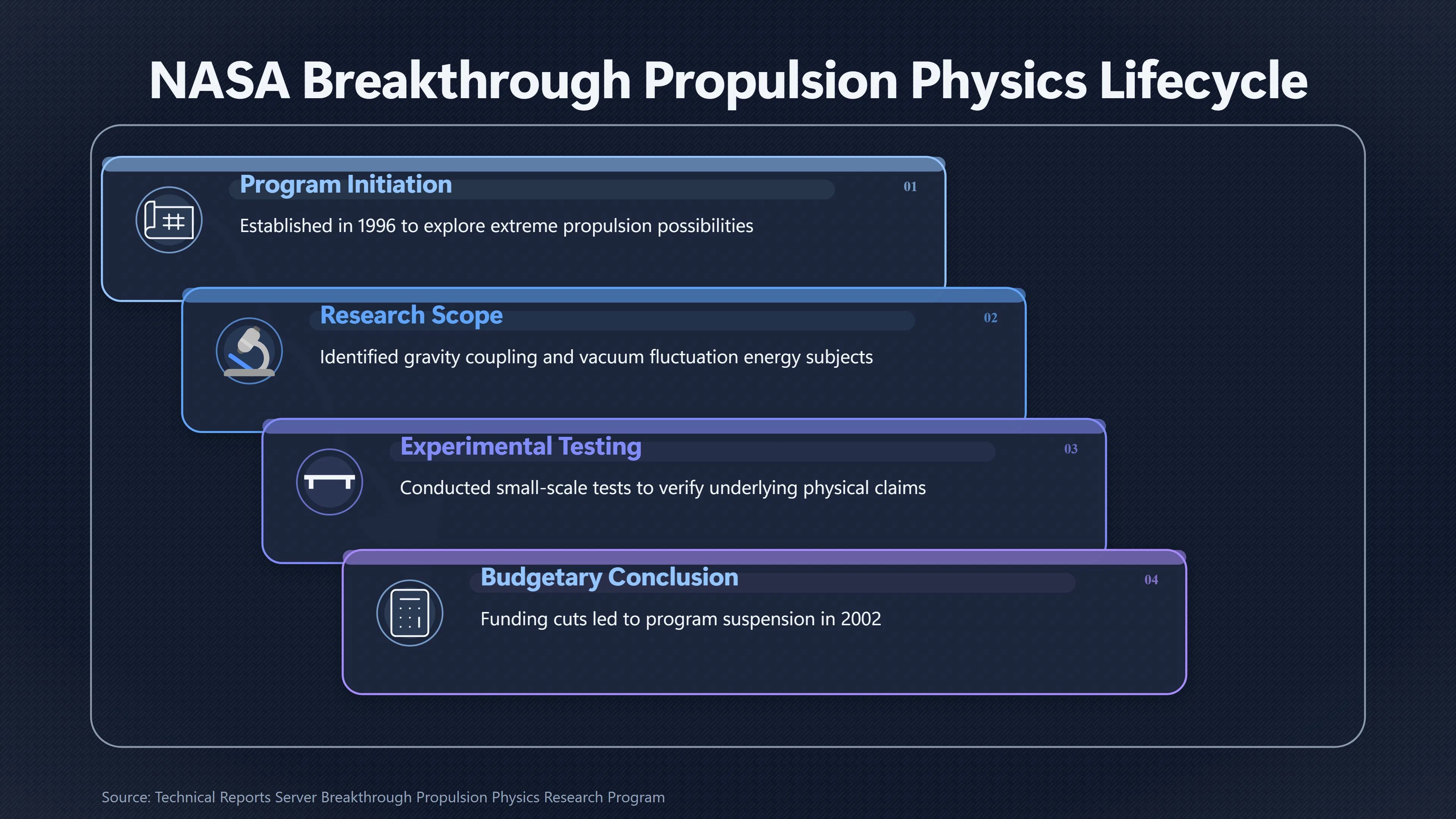
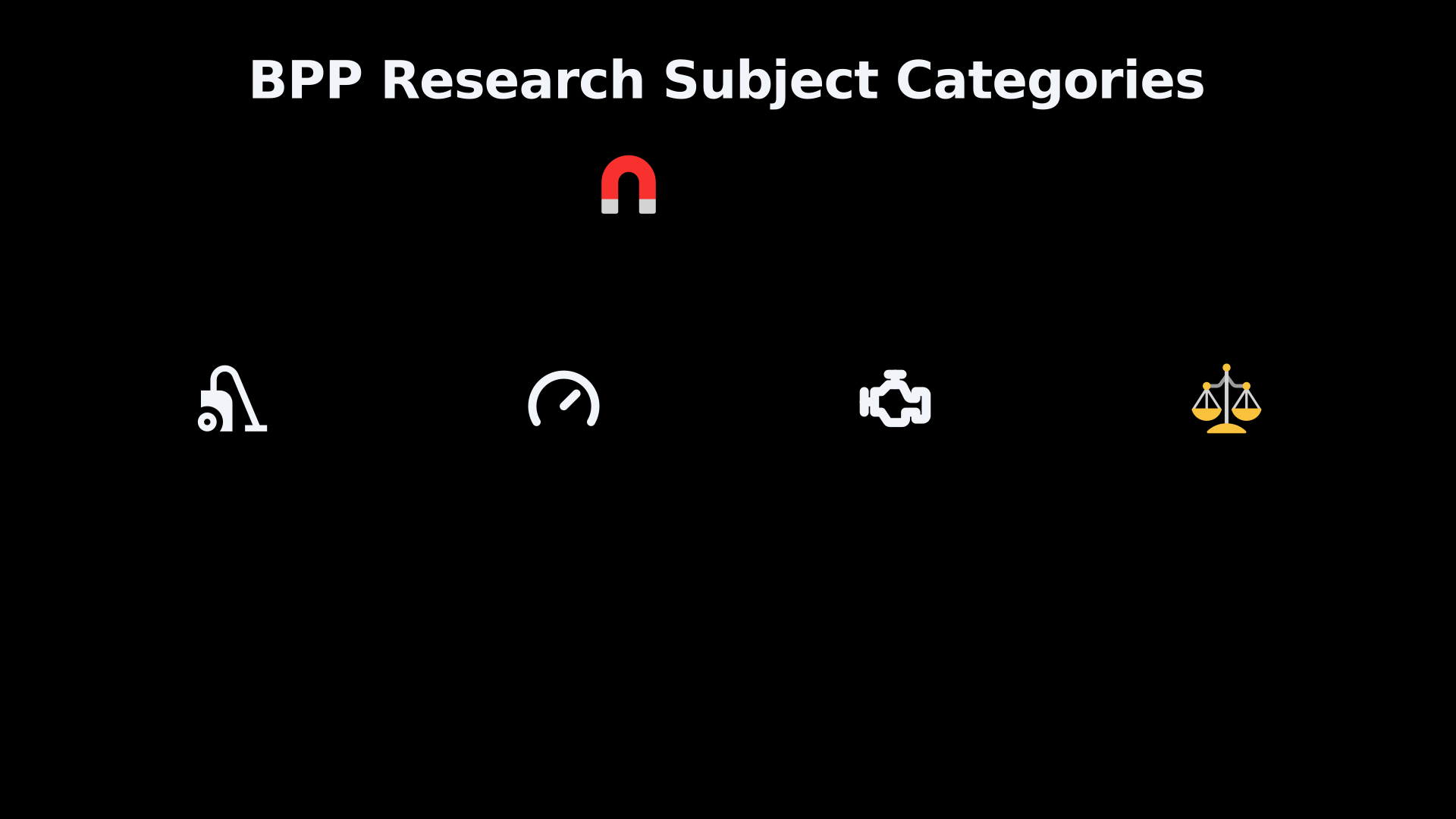
NASA established the BPP programme in 1996, managed through what was then Lewis Research Center, later renamed Glenn Research Center. Its three headline ambitions were deliberately extreme: propulsion without propellant, the maximum transit speeds permitted by nature — potentially including ways around conventional light-speed limitations — and radically improved energy sources capable of supporting such propulsion. NASA’s own descriptions stressed that these goals lay beyond established engineering and might require new physics.[NASA Technical Reports Server]ntrs.nasa.govTechnical Reports Server Breakthrough Propulsion Physics Research ProgramNASA Technical Reports ServerBreakthrough Propulsion Physics Research Program - NASA Technical Reports Server (NTRS)December 1, 1996…
The resulting research territory was unusually broad. NASA documents identify gravity–electromagnetism coupling, vacuum-fluctuation energy, warp drives, wormholes and superluminal quantum phenomena among the subjects considered. Marc Millis, the programme’s central NASA figure, also formulated hypothetical “space drives” as thought experiments for identifying what physics would actually have to change before propellantless propulsion became possible. Questions included whether inertia or gravity could somehow depend on electromagnetic interactions, whether vacuum fluctuations could be exploited asymmetrically and whether negative mass existed or could be simulated.[NASA Technical Reports Server]ntrs.nasa.govTechnical Reports Server The challenge to create the space driveNASA Technical Reports ServerThe challenge to create the space drive - NASA Technical Reports Server (NTRS)August 1, 1996…
Those subjects explain why BPP material travels so easily into antigravity and UFO literature. Its vocabulary genuinely overlaps with ideas frequently proposed as explanations for extraordinary craft: manipulated inertia, altered spacetime, gravity control and reactionless propulsion. The overlap is therefore not invented.
What changes the interpretation is the programme’s treatment of those concepts. NASA described the objectives as “presumably far from fruition”, and later assessments acknowledged that some might prove impossible. Rather than beginning with a working propulsion technology and developing it, BPP sought comparatively inexpensive experiments and theoretical studies that could decide smaller questions on which the grander concepts depended.[NASA Technical Reports Server]ntrs.nasa.govTechnical Reports Server Prospects for Breakthrough Propulsion From PhysicsNASA Technical Reports ServerProspects for Breakthrough Propulsion From Physics - NASA Technical Reports Server (NTRS)May 1, 2004…
That approach produced a mixture of outcomes rather than a breakthrough. Millis’s 2004 retrospective examined 16 incremental research tasks conducted by BPP or related sponsors: roughly a third had been found non-viable, about a quarter offered clear opportunities for further work, and the remainder were unresolved. A later assessment of 14 tasks categorised six as reaching null conclusions, four as unresolved and four as offering possible sequels.[NASA Technical Reports Server]ntrs.nasa.govTechnical Reports Server Assessing Potential Propulsion BreakthroughsNASA Technical Reports ServerAssessing Potential Propulsion Breakthroughs - NASA Technical Reports Server (NTRS)…
This is an important boundary for interpreting the historical record. “NASA researched warp drives” and “NASA demonstrated warp propulsion” are radically different propositions. The surviving programme literature supports the first and not the second.
Why gravity-anomaly experiments were tests, not confirmations
The superconducting-gravity work provides an especially useful example because it comes closest to the language of literal antigravity.
In the 1990s, Eugene Podkletnov reported that objects positioned above a rotating superconducting disc appeared to lose a small fraction of their weight. His published claim described reductions beginning around 0.3–0.5 per cent and reaching approximately 1.9–2.1 per cent under particular conditions. If reproducible, such an effect would plainly have been important for fundamental physics and potentially propulsion.[arXiv]arxiv.orgWeak gravitation shielding properties of composite bulk YBa_2Cu_3O_{7-x} superconductor below 70 K under e.m. fieldJanuary 10, 1997…
NASA-associated researchers therefore had a legitimate reason to test the underlying proposition. A 1997 Physica C paper involving Ning Li, David Noever, Tony Robertson, Ron Koczor and Whitt Brantley examined whether a gravitational force could be coupled to a type-II YBCO superconductor. The NASA Technical Reports Server records the work under Marshall Space Flight Center and describes its result not as the discovery of antigravity but as placing new limits on the proposed coupling’s strength and range.[NASA Technical Reports Server]ntrs.nasa.govOpen source on nasa.gov.
That difference is easy to lose when the episode is retold backwards from its technological implications. A laboratory can investigate “gravity shielding” because confirmation would be revolutionary, while simultaneously regarding the reported phenomenon as unconfirmed. The experiment is evidence that NASA considered the question worth resolving; it is not evidence that NASA accepted the answer claimed by the original experimenter.
BPP’s wider methodology makes that interpretation explicit. The programme deliberately tried not to reject proposals merely because their eventual technological implications sounded implausible. Instead, reviewers were asked whether a proposed experiment rested on sufficiently credible foundations and could produce a meaningful, reliable result. Crucially, NASA’s management paper says useful research could include experiments demonstrating that a proposed approach was not feasible.[NASA Technical Reports Server]ntrs.nasa.govNASA Technical Reports ServerBreakthrough Propulsion Physics Project: Project Management Methods - NASA Technical Reports Server (NTRS)De…
That is a subtle but important scientific-policy choice. If reviewers had been instructed to fund only concepts already judged technically feasible, a breakthrough-physics programme could scarcely investigate genuinely new physics. BPP instead separated two questions:
- Is the extraordinary final technology already credible? Often no, or impossible to determine.
- Can a specific underlying claim be tested credibly? Sometimes yes.
The distinction allowed NASA to investigate anomalous claims without converting institutional curiosity into institutional endorsement.
NASA built scepticism into the programme
The strongest counterpoint to a suppression interpretation is not that NASA avoided unconventional ideas. It plainly did not. It is that NASA constructed a public research framework for sorting them.
Millis’s later account of BPP project management says proposals were restricted to immediate unknowns, curious effects or critical issues rather than attempts to build entire speculative propulsion systems. Reviewers were instructed to give the reliability of an assertion greater importance than the magnitude of its implications. They were also asked to judge the credibility of the proposed research rather than prejudge whether the hoped-for phenomenon was physically feasible.[NASA Technical Reports Server]ntrs.nasa.govNASA Technical Reports ServerBreakthrough Propulsion Physics Project: Project Management Methods - NASA Technical Reports Server (NTRS)De…
This produced an unusually useful model for frontier research. A claim could have enormous consequences and still score poorly if the experiment could not distinguish the claimed effect from mundane alternatives. Conversely, a highly speculative idea could justify modest investigation if a well-designed experiment could settle an important uncertainty.
The programme also entertained theories only to discover constraints on them. Proceedings from the 1997 BPP workshop included discussion of zero-point-field models of inertia and gravitation, for example, but the same work argued against one proposed propulsion route involving negative inertial mass. The workshop record also noted theoretical difficulties with the Alcubierre warp concept rather than presenting a mathematically permitted spacetime geometry as an achievable spacecraft design.[NASA Technical Reports Server]ntrs.nasa.govOpen source on nasa.gov.
Vacuum physics followed a similarly incremental route. NASA-supported work examined measurable Casimir forces — genuine quantum effects between closely spaced surfaces — and developed instrumentation and theoretical models for investigating them. The existence of Casimir forces did not establish the much stronger proposition that usable spacecraft energy could simply be extracted from the vacuum. NASA’s archive distinguishes experimentally accessible vacuum physics from the speculative technologies that motivated interest in it.[NASA Technical Reports Server]ntrs.nasa.govTechnical Reports Server SearchTechnical Reports Server Search
The result was therefore neither blanket dismissal nor blanket acceptance. BPP occupied the less dramatic territory between them: formulate the extraordinary proposition, identify the smallest decisive question, design a measurement and accept that a null result is scientifically useful.
A programme ending is not evidence of suppression
BPP ran from 1996 through 2002. Its end can look suggestive when inserted into a narrative in which promising unconventional research repeatedly disappears from public view. Contemporary documentation, however, provides a much more ordinary institutional explanation.
In July 2002, a notice originating from NASA Glenn warned researchers that a planned solicitation had been put on hold because the project’s budget was being cut. It stated that future budgets were uncertain and that 21 per cent of funds already allocated for that year had been requested for withdrawal. The practical consequences included no further research solicitations and an inability to re-establish in-house BPP research.[SpaceRef]spaceref.comOpen source on spaceref.com.
Earlier budget documentation also shows BPP operating through identifiable appropriations rather than as an invisible programme. A fiscal-year 2001 congressional earmark included $1 million to continue BPP, alongside funding for other NASA activities.[SpaceRef]spaceref.comnasa fy 2001 budget congressional earmarksnasa fy 2001 budget congressional earmarks
None of this proves that every government activity involving advanced propulsion was public; such a conclusion would go beyond the evidence. It does show that the termination of this particular NASA programme does not require a suppression explanation. There is contemporaneous evidence for budgetary vulnerability, and NASA subsequently published technical retrospectives describing both what the programme attempted and how its research performed.[NASA Technical Reports Server]ntrs.nasa.govTechnical Reports Server Prospects for Breakthrough Propulsion From PhysicsNASA Technical Reports ServerProspects for Breakthrough Propulsion From Physics - NASA Technical Reports Server (NTRS)May 1, 2004…
Nor did unconventional propulsion disappear from institutional research once BPP ended. Later NASA-associated work again examined highly controversial propulsion claims. Johnson Space Center’s Eagleworks laboratory, led by Harold “Sonny” White, investigated advanced propulsion ideas including the EmDrive and warp-related concepts. A 2016 experiment initially appeared to detect tiny thrust from an EmDrive-like device, but independent investigations failed to establish a reproducible anomalous thrust, and specialists emphasised possible experimental artefacts.[WIRED]wired.comNASA's Em Drive Leader Has a New Interstellar ProjectNASA's Em Drive Leader Has a New Interstellar Project
The continuity is significant. Frontier topics can move between programmes, laboratories, grants and private research as funding priorities and technical judgements change. Administrative discontinuity by itself cannot establish that a successful technology was removed from public science.
How institutional investigation differs from suppression-list logic
NASA’s BPP record is especially valuable for understanding research field drift because it shows how genuinely related but scientifically distinct subjects can gather beneath one organisational umbrella.
A programme concerned with revolutionary spaceflight could reasonably discuss gravity modification, wormholes, quantum vacuum effects and propellantless drives because all might, if physically possible, overcome limitations of rockets. But organisational proximity does not make those ideas manifestations of a single phenomenon. Nor does it establish a technological connection to UFOs simply because similar concepts are invoked to explain reported UAP performance.
Suppression narratives often reverse that distinction. Once “antigravity researcher” becomes a broad retrospective category, a scientist working on superconductors, another studying vacuum forces and another considering theoretical spacetime metrics can appear to belong to the same technological project. If unusual deaths, disappearances, career setbacks or terminated funding are then collected from across that enlarged population, the resulting pattern can seem more coherent than the underlying research actually was.
NASA’s programme documents provide a useful control against that process because they show what a real umbrella programme looks like. It can deliberately place heterogeneous ideas next to one another while continuing to distinguish their evidential status. A workshop volume could contain superconducting-gravity experiments, Casimir-energy proposals, quantum tunnelling and spacetime concepts without asserting that all were facets of one discovered propulsion principle. The 1999 proceedings alone ran to hundreds of pages precisely because “breakthrough propulsion” functioned as a research question broad enough to accommodate competing and sometimes incompatible possibilities.[NASA Technical Reports Server]ntrs.nasa.govTechnical Reports Server SearchTechnical Reports Server Search
The programme’s results also cut against a simple binary in which unconventional scientists must either be vindicated or suppressed. Some investigated ideas failed tests. Others remained unresolved. Others generated narrower follow-up questions. NASA’s later assessments openly recorded that distribution.[NASA Technical Reports Server]ntrs.nasa.govTechnical Reports Server Assessing Potential Propulsion BreakthroughsNASA Technical Reports ServerAssessing Potential Propulsion Breakthroughs - NASA Technical Reports Server (NTRS)…
That middle category — worth investigating but not established — is crucial. It is often lost in retrospective narratives because it is less memorable than either “NASA proved antigravity” or “NASA refused to investigate antigravity”. The historical documentation supports neither extreme.
What NASA’s exotic propulsion research actually establishes
NASA’s involvement establishes something narrower, but still interesting: reputable scientific institutions have sometimes judged apparently exotic propulsion questions sufficiently important to investigate even when the proposed technology lay beyond accepted engineering and perhaps beyond physically achievable limits. BPP was intentionally structured to make room for such investigation.[NASA Technical Reports Server]ntrs.nasa.govTechnical Reports Server NASA Breakthrough Propulsion Physics ProgramNASA Technical Reports ServerNASA Breakthrough Propulsion Physics Program - NASA Technical Reports Server (NTRS)…
That fact should correct one common misconception in suppression narratives. A researcher’s interest in gravity modification, vacuum energy or propellantless propulsion does not by itself demonstrate exclusion from institutional science. NASA researchers and contractors publicly worked on precisely those subjects, held workshops about them and deposited reports in an openly accessible technical archive.
At the same time, institutional attention should not be upgraded into proof of the underlying claims. NASA’s own retrospective assessment said no propulsion breakthrough appeared imminent and recorded substantial numbers of null or non-viable outcomes alongside unresolved questions.[NASA Technical Reports Server]ntrs.nasa.govTechnical Reports Server Assessing Potential Propulsion BreakthroughsNASA Technical Reports ServerAssessing Potential Propulsion Breakthroughs - NASA Technical Reports Server (NTRS)…
For evaluating alleged connections between UFO research, antigravity scientists and suspicious deaths or disappearances, this supplies a practical evidential boundary. The relevant question is not simply whether a person worked on something that resembles a NASA frontier-physics topic. It is whether there is independent evidence that the researcher possessed a validated result, that the result threatened identifiable interests, that suppression actually occurred, and that any later death or disappearance was causally connected to it.
NASA’s speculative propulsion history demonstrates why those steps cannot safely be collapsed. Institutions sometimes investigate extraordinary claims because the potential payoff is enormous and a decisive test is affordable. They sometimes terminate programmes because budgets change. They publish null results alongside unresolved ones. And they can take an exotic possibility seriously enough to test it without believing that the extraordinary technology already exists. In a research landscape where “gravity”, “vacuum energy”, “warp propulsion” and “UFO technology” are easily blended into one retrospective category, that distinction is one of the most important safeguards against mistaking scientific exploration for evidence of suppression.[nasa.gov]ntrs.nasa.govNASA Technical Reports ServerBreakthrough Propulsion Physics Project: Project Management Methods - NASA Technical Reports Server (NTRS)De…
Amazon book picks
Further Reading
Books and field guides related to What NASA's Exotic Propulsion Research Actually Shows. Use these as the next step if you want deeper reading beyond the article.
The Hunt for Zero Point
The atomic bomb was not the only project to occupy government scientists during the 1940's. Antigravity technology, originally spearheade...
Physics of the Impossible
Physics of the Impossible takes us on a journey to the frontiers of science and beyond, giving us an exhilarating insight into what we ca...
Frontiers of Propulsion Science
Frontiers of Propulsion Science is the first-ever compilation of emerging science relevant to such notions as space drives, warp drives,...
The Physics of Star Trek
Introduces physics as it analyzes the science behind "Star Trek," explaining the intricacies of warp speed and showing the difference bet...
eBay marketplace picks
Marketplace Samples
Live-tested eBay searches with available results related to this page.
Selected fromNASA patch oneBay.co.uk.
Endnotes
1.
Source: ntrs.nasa.gov
Title: Technical Reports Server Breakthrough Propulsion Physics Research Program
Link:https://ntrs.nasa.gov/citations/19970009634
Source snippet
NASA Technical Reports ServerBreakthrough Propulsion Physics Research Program - NASA Technical Reports Server (NTRS)December 1, 1996...
Published: December 1, 1996
2.
Source: ntrs.nasa.gov
Title: Technical Reports Server NASA Breakthrough Propulsion Physics Program
Link:https://ntrs.nasa.gov/archive/nasa/casi.ntrs.nasa.gov/19980201240.pdf
Source snippet
NASA Technical Reports ServerNASA Breakthrough Propulsion Physics Program - NASA Technical Reports Server (NTRS)...
3.
Source: ntrs.nasa.gov
Link:https://ntrs.nasa.gov/citations/20050041926
Source snippet
NASA Technical Reports ServerBreakthrough Propulsion Physics Project: Project Management Methods - NASA Technical Reports Server (NTRS)De...
4.
Source: ntrs.nasa.gov
Title: Technical Reports Server Assessing Potential Propulsion Breakthroughs
Link:https://ntrs.nasa.gov/citations/20060000022
Source snippet
NASA Technical Reports ServerAssessing Potential Propulsion Breakthroughs - NASA Technical Reports Server (NTRS)...
5.
Source: ntrs.nasa.gov
Title: Technical Reports Server The challenge to create the space drive
Link:https://ntrs.nasa.gov/archive/nasa/casi.ntrs.nasa.gov/19960048672.pdf
Source snippet
NASA Technical Reports ServerThe challenge to create the space drive - NASA Technical Reports Server (NTRS)August 1, 1996...
Published: August 1, 1996
6.
Source: ntrs.nasa.gov
Title: Technical Reports Server Challenge to Create the Space Drive
Link:https://ntrs.nasa.gov/search.jsp?R=19980021277
Source snippet
NASA Technical Reports ServerChallenge to Create the Space Drive - NASA Technical Reports Server (NTRS)...
7.
Source: ntrs.nasa.gov
Title: Technical Reports Server Prospects for Breakthrough Propulsion From Physics
Link:https://ntrs.nasa.gov/search.jsp?R=20040070788
Source snippet
NASA Technical Reports ServerProspects for Breakthrough Propulsion From Physics - NASA Technical Reports Server (NTRS)May 1, 2004...
Published: May 1, 2004
8.
Source: ntrs.nasa.gov
Title: Technical Reports Server Search
Link:https://ntrs.nasa.gov/search?q=213082
Source snippet
NASA Technical Reports ServerSearch - NASA Technical Reports Server (NTRS)...
9.
Source: arxiv.org
Link:https://arxiv.org/abs/cond-mat/9701074
Source snippet
Weak gravitation shielding properties of composite bulk YBa_2Cu_3O_{7-x} superconductor below 70 K under e.m. fieldJanuary 10, 1997...
Published: January 10, 1997
10.
Source: ntrs.nasa.gov
Link:https://ntrs.nasa.gov/search.jsp?R=19990039542
11.
Source: ntrs.nasa.gov
Link:https://ntrs.nasa.gov/api/citations/20050041926/downloads/20050041926.pdf
12.
Source: ntrs.nasa.gov
Link:https://ntrs.nasa.gov/search.jsp?R=19990023211
13.
Source: ntrs.nasa.gov
Title: Technical Reports Server Search
Link:https://ntrs.nasa.gov/search?q=alcubierre
14.
Source: ntrs.nasa.gov
Title: Technical Reports Server Search
Link:https://ntrs.nasa.gov/search?q=Breakthrough+Propulsion+Physics
15.
Source: spaceref.com
Link:https://spaceref.com/status-report/nasa-grc-funding-in-jeopardy-for-breakthrough-propulsion-physics-bpp/
16.
Source: spaceref.com
Title: nasa fy 2001 budget congressional earmarks
Link:https://spaceref.com/status-report/nasa-fy-2001-budget-congressional-earmarks/
17.
Source: wired.com
Title: NASA’s Em Drive Leader Has a New Interstellar Project
Link:https://www.wired.com/story/nasas-emdrive-leader-has-a-new-interstellar-project
18.
Source: ntrs.nasa.gov
Title: Technical Reports Server Search
Link:https://ntrs.nasa.gov/search?q=%22space+drive%22
19.
Source: nasa.gov
Title: 1996 ames earth science publications
Link:https://www.nasa.gov/1996-ames-earth-science-publications/
20.
Source: techport.nasa.gov
Link:https://techport.nasa.gov/projects/95581
21.
Source: techport.nasa.gov
Link:https://techport.nasa.gov/projects/92617
22.
Source: nasa.gov
Title: The Future of Space Exploration
Link:https://www.nasa.gov/headquarters/library/find/bibliographies/the-future-of-space-exploration/
23.
Source: nasa.gov
Title: Nuclear Power in Outer Space
Link:https://www.nasa.gov/headquarters/library/find/bibliographies/nuclear-power-in-outer-space/
24.
Source: ntrs.nasa.gov
Link:https://ntrs.nasa.gov/search.jsp?R=20180006480
25.
Source: ntrs.nasa.gov
Link:https://ntrs.nasa.gov/citations/20160007780
26.
Source: ntrs.nasa.gov
Link:https://ntrs.nasa.gov/citations/20160008979
27.
Source: nasa.gov
Title: NAC A Publications
Link:https://www.nasa.gov/history/naca/pubs.html
28.
Source: cosmicopia.gsfc.nasa.gov
Title: qa gp gr
Link:https://cosmicopia.gsfc.nasa.gov/qa_gp_gr.html
29.
Source: spaceref.com
Link:https://spaceref.com/status-report/nasa-gsfc-solicitation-future-collaborative-research-and-education-opportunities/
30.
Source: ntrs.nasa.gov
Link:https://ntrs.nasa.gov/archive/nasa/casi.ntrs.nasa.gov/20060000022.pdf
31.
Source: nature.com
Title: Antigravity has feet of clay: Nature News
Link:https://www.nature.com/news/2005/050124/full/news050124-8.html
32.
Source: ntrs.nasa.gov
Link:https://ntrs.nasa.gov/archive/nasa/casi.ntrs.nasa.gov/20050041926.pdf
33.
Source: ntrs.nasa.gov
Link:https://ntrs.nasa.gov/search.jsp?R=20040171927&hterms=breakthrough+propulsion+physics
34.
Source: ntrs.nasa.gov
Link:https://ntrs.nasa.gov/archive/nasa/casi.ntrs.nasa.gov/20040070788.pdf
35.
Source: ntrs.nasa.gov
Link:https://ntrs.nasa.gov/citations/20020068834
36.
Source: ntrs.nasa.gov
Link:https://ntrs.nasa.gov/archive/nasa/casi.ntrs.nasa.gov/20020016600.pdf
37.
Source: spaceref.com
Title: hr4635 nasas fiscal year 2001 budget
Link:https://spaceref.com/uncategorized/hr4635-nasas-fiscal-year-2001-budget/
38.
Source: ntrs.nasa.gov
Link:https://ntrs.nasa.gov/archive/nasa/casi.ntrs.nasa.gov/19990023236.pdf
39.
Source: ntrs.nasa.gov
Link:https://ntrs.nasa.gov/citations/19990023204
40.
Source: ntrs.nasa.gov
Link:https://ntrs.nasa.gov/archive/nasa/casi.ntrs.nasa.gov/19990046249.pdf
41.
Source: ntrs.nasa.gov
Link:https://ntrs.nasa.gov/citations/19990068007
42.
Source: ntrs.nasa.gov
Link:https://ntrs.nasa.gov/citations/19990023209
43.
Source: ntrs.nasa.gov
Link:https://ntrs.nasa.gov/citations/19990104365
44.
Source: ntrs.nasa.gov
Link:https://ntrs.nasa.gov/search.jsp?R=19990047463
45.
Source: ntrs.nasa.gov
Link:https://ntrs.nasa.gov/search.jsp?R=19990023210
46.
Source: wired.com
Title: es warp
Link:https://www.wired.com/1998/07/es-warp/
47.
Source: wired.com
Link:https://www.wired.com/1998/03/antigravity/
48.
Source: ntrs.nasa.gov
Link:https://ntrs.nasa.gov/search.jsp?R=19990019627&hterms=superconducting+gravity
49.
Source: ntrs.nasa.gov
Link:https://ntrs.nasa.gov/citations/19990064220
50.
Source: wired.com
Title: motorola satellites set for chinese launch
Link:https://www.wired.com/1997/12/motorola-satellites-set-for-chinese-launch/
51.
Source: ntrs.nasa.gov
Link:https://ntrs.nasa.gov/citations/19980017317
52.
Source: ntrs.nasa.gov
Link:https://ntrs.nasa.gov/citations/19980021277
53.
Source: ntrs.nasa.gov
Link:https://ntrs.nasa.gov/search.jsp?R=19970009634
54.
Source: ntrs.nasa.gov
Link:https://ntrs.nasa.gov/citations/19960048672
55.
Source: ntrs.nasa.gov
Link:https://ntrs.nasa.gov/citations/19930044044
56.
Source: ntrs.nasa.gov
Link:https://ntrs.nasa.gov/archive/nasa/casi.ntrs.nasa.gov/19900010659.pdf
57.
Source: ntrs.nasa.gov
Link:https://ntrs.nasa.gov/citations/19900028351
58.
Source: techport.nasa.gov
Link:https://techport.nasa.gov/projects/10880
59.
Source: ntrs.nasa.gov
Link:https://ntrs.nasa.gov/search?q=Breakthrough+Propulsion+Physics+Workshop
60.
Source: nasa.gov
Link:https://www.nasa.gov/history/SP-4219/Chapter1.html
61.
Source: giss.nasa.gov
Link:https://www.giss.nasa.gov/pubs/year/1996.html
62.
Source: nasa.gov
Link:https://www.nasa.gov/earth-science-at-ames/earth-science-publications/archive/1996-2/
63.
Source: taskbook.nasa.gov
Link:https://taskbook.nasa.gov/tbp/index.cfm?action=bib_search
64.
Source: ntrs.nasa.gov
Link:https://ntrs.nasa.gov/citations/19650000295
65.
Source: youtube.com
Title: Marc Millis
Link:https://www.youtube.com/watch?v=StKLeD5h_Tw
Source snippet
Dr. Harold "Sonny" White - Eagleworks Laboratories: Advanced Propulsion...
66.
Source: en.ikwipedia.org
Title: Eugene Podkletnov
Link:https://en.ikwipedia.org/wiki/Eugene_Podkletnov
67.
Source: fcoiaa.it
Link:https://fcoiaa.it/nasa-breakthrough-propulsion/
68.
Source: zamandayolculuk.com
Link:https://www.zamandayolculuk.com/html-3/electrostatic_propulsion.htm
69.
Source: nypl.org
Link:https://www.nypl.org/research/research-catalog/browse/subjects/Spacecraft%20propulsion
70.
Source: nypl.org
Link:https://www.nypl.org/research/research-catalog/search?filters%5BcreatorLiteral%5D%5B0%5D=Millis%2C+Marc+G
71.
Source: ouci.dntb.gov.ua
Title: 9Zkj EPO7
Link:https://ouci.dntb.gov.ua/en/works/9ZkjEPO7/
72.
Source: ouci.dntb.gov.ua
Link:https://ouci.dntb.gov.ua/en/works/4OrJ6Gq7/
73.
Source: ouci.dntb.gov.ua
Title: 4YEJo M04
Link:https://ouci.dntb.gov.ua/en/works/4YEJoM04/
74.
Source: ouci.dntb.gov.ua
Link:https://ouci.dntb.gov.ua/en/works/4YXDvr67/
75.
Source: altpropulsion.com
Link:https://www.altpropulsion.com/superconductors/
Additional References
76.
Source: youtube.com
Title: Casimir Zero-Point Energy & Warp Drives | Harold “Sonny” White
Link:https://www.youtube.com/watch?v=atGD9dIgYgg
Source snippet
NASA Breakthrough Propulsion Physics Marc Millis 1 Marc Millis - Breakthrough Propulsion Study: Assessing Interstellar Flight Challenges...
77.
Source: youtube.com
Title: Dr. Harold “Sonny” White
Link:https://www.youtube.com/watch?v=Wokn7crjBbA
Source snippet
Killer Patents & Secret Science Vol. 1 | Free Energy & Anti-Gravity Cover-Ups...
78.
Source: youtube.com
Title: Killer Patents & Secret Science Vol. 1 | Free Energy & Anti-Gravity Cover-Ups
Link:https://www.youtube.com/watch?v=-ZRwlYtAMps
Source snippet
Anti-Gravity: The Secret Space Race | Weird Science...
79.
Source: science.gov
Link:https://www.science.gov/topicpages/a/ab-ramjet%2Bspace%2Bpropulsion
80.
Source: science.gov
Link:https://www.science.gov/topicpages/a/aneutronic%2Bfusion%2Bpropulsion
81.
Source: science.gov
Link:https://www.science.gov/topicpages/b/breakthrough%2Bheart%2Bscanner
82.
Source: science.gov
Link:https://www.science.gov/topicpages/c/concentration%2Bbreakthrough%2Bcurve
83.
Source: science.gov
Link:https://www.science.gov/topicpages/e/electromagnetic%2Bpropulsion%2Bsystem
84.
Source: science.gov
Link:https://www.science.gov/topicpages/e/evolving%2Bwormhole%2Bgeometries.html
85.
Source: science.gov
Link:https://www.science.gov/topicpages/g/gravity%2Bgradiometer%2Bbased