Within Blue Book
Was Project Blue Book Built for Serious Science?
McDonald described Blue Book in 1966 as a very small office whose scientific resources fell far short of the problem it claimed to investigate.
On this page
- Who staffed Blue Book during Mc Donald's visits
- How its mission differed from open ended research
- Why staffing limits mattered to Mc Donald's critique
Page outline Jump by section
Introduction
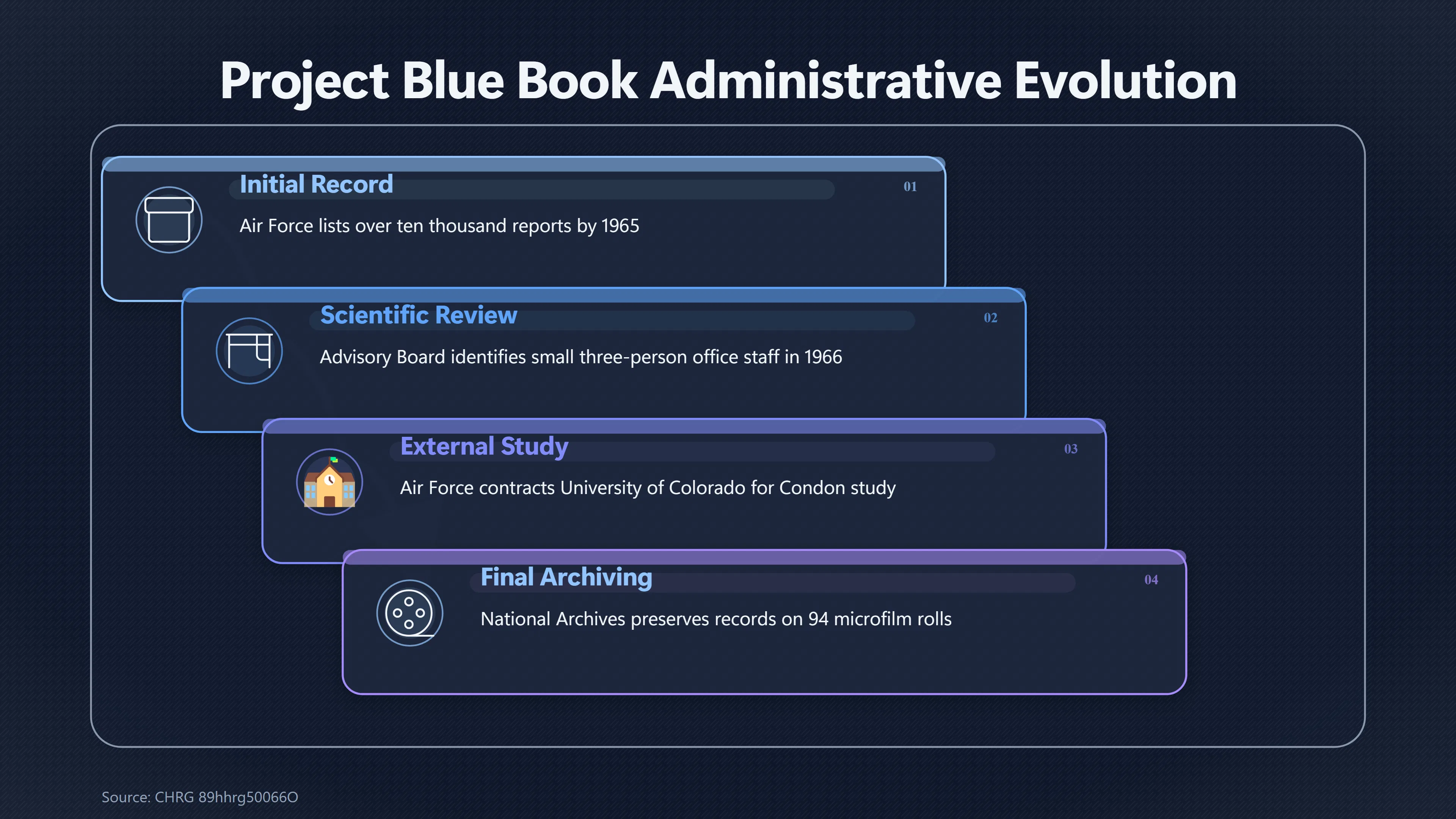
Project Blue Book was the US Air Force’s official clearing point for UFO reports, but by 1966 its permanent office was remarkably small: an officer, a sergeant and a secretary, supported by part-time scientific consultant J. Allen Hynek and by specialists elsewhere in the Air Force when required. This was not merely a later criticism from UFO advocates. The Air Force’s own Scientific Advisory Board recorded the three-person office and recommended adding university-based scientific teams capable of investigating selected sightings in depth.[UFO Transparency]ufotransparency.comHouse of Representatives (89th Congress, 2d Sess, No. 55), U.S. House Committee on Armed Services · 1966 · UFO TransparencyApril 5, 1966…
Atmospheric physicist James E. McDonald regarded that mismatch between Blue Book’s public scientific role and its day-to-day resources as fundamental. After three visits to Wright-Patterson Air Force Base in 1966, he argued that Blue Book was a low-priority operation without enough sustained scientific expertise or field investigation to support the impression of comprehensive scientific scrutiny. Yet an important qualification is often lost: Blue Book’s three permanent staff were not the whole Air Force investigative network. Its chief, Hector Quintanilla, said specialists across Wright-Patterson and other Air Force organisations could be called upon. The real dispute was therefore less about whether expertise existed somewhere in the system than about how consistently and deeply it was applied to individual UFO cases.[Saturday Night Uforia]saturdaynightuforia.comOpen source on saturdaynightuforia.com.
Who staffed Blue Book during McDonald’s visits
When McDonald began examining Blue Book files in 1966, Major Hector Quintanilla headed the project at Wright-Patterson. The Scientific Advisory Board’s review described the office itself as consisting of one officer, one sergeant and one secretary. Hynek, an astronomer at Northwestern University, served as Blue Book’s scientific consultant rather than as a full-time member of that three-person office.[UFO Transparency]ufotransparency.comHouse of Representatives (89th Congress, 2d Sess, No. 55), U.S. House Committee on Armed Services · 1966 · UFO TransparencyApril 5, 1966…
The scale matters because Blue Book was dealing with a substantial accumulated record. Air Force figures presented to Congress in April 1966 listed 10,147 reports through the end of 1965, including 646 then classified as unidentified. The eventual archive encompassed 12,618 reported sightings, 701 of which remained unidentified when the programme ended. Today, the National Archives describes roughly 37 cubic feet of chronological case files, two cubic feet of administrative records and three cubic feet connected with the Office of Special Investigations, preserved across 94 microfilm rolls.[UFO Transparency]ufotransparency.comHouse of Representatives (89th Congress, 2d Sess, No. 55), U.S. House Committee on Armed Services · 1966 · UFO TransparencyApril 5, 1966…
Those numbers do not mean three people personally conducted 10,000-plus field investigations. Blue Book operated within a much larger military system. Reports could originate at Air Force bases, and investigative work could involve local officers, the Office of Special Investigations and specialists elsewhere. Quintanilla told a public forum that although his immediate staff was small, he could draw on physicists, chemists, astronomers, meteorologists, aerodynamic engineers and photographic analysts within the Wright-Patterson complex. He also cited Hynek and other astronomers as sources of specialist advice.[Saturday Night Uforia]saturdaynightuforia.comOpen source on saturdaynightuforia.com.
That distinction prevents the staffing figure from becoming misleading. The strongest criticism is not simply that “three people investigated every UFO”. It is that the central office responsible for receiving, evaluating, classifying and publicly accounting for a large and technically varied body of reports had only three permanent staff, while specialist assistance was largely something it had to obtain from elsewhere.
McDonald’s criticism came from unusually direct exposure to that arrangement. In a 1967 presentation he said he had visited Project Blue Book three times, examined roughly 150 cases and spoken with its military and scientific personnel. He described Blue Book as a very low-priority operation within the Foreign Technology Division and said higher-level personnel he met at Wright-Patterson appeared to know surprisingly little about its work.[Saturday Night Uforia]saturdaynightuforia.comOpen source on saturdaynightuforia.com.
Blue Book was an Air Force programme, not an open-ended laboratory
The staffing question becomes clearer once Blue Book’s institutional mission is separated from the much broader scientific investigation McDonald wanted.
The Air Force described its responsibility in national-security terms. A September 1965 memorandum requesting a Scientific Advisory Board review said the service should continue investigating and analysing UFO reports to ensure that unidentified objects did not constitute a threat to national security. It assigned continuing responsibility to the Foreign Technology Division at Wright-Patterson.[Bluebook Files]files.bluebookfiles.orgBluebook Files Sub-Comitte HearingBluebook FilesSub-Comitte Hearing - March 1966April 14, 2026…
Blue Book’s own February 1966 publication similarly presented firm conclusions: investigated UFOs had shown no national-security threat, no evidence of technology beyond contemporary scientific knowledge and no evidence of extraterrestrial vehicles. It nevertheless stated that reports would continue to be investigated and that qualified scientists and technicians would be used when necessary.[Defense Logistics Agency]esd.whs.milPROJECT BLUE BOOK 1 FEBRUARY 1966.j…
McDonald was asking a different question. He wanted unidentified reports treated as a potentially important scientific phenomenon in their own right: witnesses re-interviewed, physical and meteorological conditions reconstructed, astronomical possibilities checked precisely, radar and aircraft information compared, and difficult cases subjected to sustained interdisciplinary analysis. From that perspective, access to an expert somewhere within Wright-Patterson was not equivalent to having a research team continuously engaged with the problem.
The Air Force’s own 1966 review provides unusually strong evidence that this distinction was real. Major General E. B. LeBailly requested an independent review of Blue Book’s “resources, methods, and findings”, noting that some unexplained reports had come from intelligent and technically qualified witnesses whose integrity could not simply be dismissed. The resulting Scientific Advisory Board committee included scientists and technical specialists, among them astronomer Carl Sagan.[GovInfo]govinfo.govCHRG 89hhrg50066O••11111111W, UNIDENTIFIED FLYING OBJECTS…
Its recommendation went substantially beyond Blue Book’s existing arrangements. Selected universities were to supply teams containing physical scientists and psychologists; geographically distributed Air Force investigators would work with them; and a university or non-profit organisation would coordinate the effort with Blue Book. The committee estimated that perhaps 100 sightings annually deserved this intensive treatment, requiring an average of about ten person-days for each case. It said such work could uncover scientifically valuable facts and provide a “far better basis” for deciding what long-term UFO programme was warranted.[NCAS Files]files.ncas.orgNCAS FilesCondon Report, Appendix A: 1966 Blue Book Review Committee Report…
That proposal is revealing because it came from an official Air Force scientific review, not from McDonald. Whatever one thinks of his conclusions about UFOs, the committee independently concluded that the existing programme should be supplemented by a much more substantial scientific apparatus.
Why the staffing limits mattered to McDonald’s critique
McDonald’s argument was ultimately about what conclusions could reasonably be drawn from Blue Book’s investigative process. He did not regard a large collection of reports followed by a high percentage of conventional identifications as equivalent to a large-scale scientific study.
His criticism centred on several connected limitations. The permanent staff was tiny; Blue Book was only one responsibility within a much larger Foreign Technology Division; project officers changed over time; scientific consultation was limited; and, according to McDonald, Blue Book personnel themselves conducted relatively little on-site investigation. He consequently characterised the post-1953 programme as superficial and conducted at a low level of scientific competence.[Saturday Night Uforia]saturdaynightuforia.comOpen source on saturdaynightuforia.com.
The Scientific Advisory Board’s proposed remedy shows what more rigorous investigation would have required in practical terms. A genuinely intensive programme would have needed rapid access to fresh sightings, trained investigators distributed geographically, scientists from relevant disciplines and enough labour to devote days rather than hours to selected cases. The committee even specified that the Air Force officers cooperating with university teams should be skilled investigators while acknowledging that they would not necessarily possess scientific training.[NCAS Files]files.ncas.orgNCAS FilesCondon Report, Appendix A: 1966 Blue Book Review Committee Report…
This matters because UFO reports were unusually dependent on evidence that deteriorated quickly. A witness’s memory could change; weather observations and aircraft movements had to be reconstructed; photographs needed technical examination; astronomical identifications depended on precise times, directions and viewing conditions. A central office capable of processing paperwork was therefore not necessarily equipped to conduct the kind of immediate, multidisciplinary inquiry required to determine what an unusual observation represented.
There was also an unavoidable selection problem. The proposed scientific programme contemplated intensive examination of perhaps 100 reports a year, while Blue Book was receiving considerably more reports than that in busy periods. The proposed ten person-days per selected case illustrate the gulf between administrative case processing and research-level investigation: 100 such investigations would themselves represent roughly 1,000 person-days of work annually.[NCAS Files]files.ncas.orgNCAS FilesCondon Report, Appendix A: 1966 Blue Book Review Committee Report…
The Air Force responded to the Scientific Advisory Board’s recommendation by seeking an outside university study. The CIA’s later historical account records that, following the O’Brien Committee review and congressional attention, the Air Force announced in August 1966 that it wanted a leading university to undertake intensive UFO investigations; the University of Colorado subsequently accepted the contract that produced the Condon study.[CIA]cia.govDOC 0005517742A Die-Hard IssueCIA’s Role in the Study of UFOs, 1947-90Gerald K. HainesAn extraordinary 95 percent of allMarch 25, 2026…
In other words, the Air Force itself effectively recognised that the standing Blue Book organisation was not the same thing as a full-scale scientific research programme.
The strongest counterpoint: Blue Book could call on a larger system
Any assessment based only on the “one officer, one sergeant, one secretary” figure is incomplete. Blue Book was embedded within the Air Force, and the surviving record demonstrates that investigative resources existed outside its office.
The Air Force Office of Special Investigations, for example, had long participated in UFO inquiries. Its historical account describes agents gathering detailed information about reported objects, witness credibility, flight direction, manoeuvres and other circumstances; in some instances investigators used technical equipment or sent physical material for laboratory analysis. The National Archives accordingly holds a separate body of Blue Book-related OSI records alongside the main case files. Office of the Secretary of the Air Force[osi.af.mil]osi.af.milOpen source on af.mil.
Quintanilla’s defence therefore had substance: a three-person headquarters did not necessarily imply that only three people were available for every investigation. Specialists could be consulted and local military organisations could gather evidence.
But this defence does not erase the criticism identified by the Scientific Advisory Board. Having experts available on request is different from maintaining multidisciplinary scientists whose principal job is to investigate anomalous reports. The Board’s recommendation for university teams indicates that it saw value in systematic expertise beyond the existing arrangements. Its estimate of ten person-days per carefully selected sighting also provides a useful benchmark for understanding how resource-intensive serious case investigation could become.[NCAS Files]files.ncas.orgNCAS FilesCondon Report, Appendix A: 1966 Blue Book Review Committee Report…
The fairest conclusion is therefore narrower than either extreme. Blue Book was neither literally three people attempting to investigate the skies of the entire United States unaided, nor the large, continuously staffed scientific observatory that its public prominence might suggest. It was a small coordinating and evaluating office able to draw intermittently upon a much larger military and technical establishment.
What this means for suppression claims
Within claims about the treatment of UFO researchers, Blue Book’s staffing history supports an institutional-failure explanation more directly than a researcher-suppression explanation.
McDonald himself made essentially that distinction. Although deeply critical of Blue Book, he rejected what he called the grand cover-up hypothesis and instead argued that he was seeing a “foulup”: a low-priority programme staffed and organised in a way that, in his judgement, could not adequately investigate the phenomenon. He specifically connected his view to what he had observed during his visits to Blue Book and conversations at Wright-Patterson.[Saturday Night Uforia]saturdaynightuforia.comOpen source on saturdaynightuforia.com.
That distinction is particularly important when his Blue Book experience is later placed alongside allegations of suspicious deaths, disappearances or deliberate suppression of UFO and advanced-propulsion researchers. Evidence that an agency devoted too few people, too little specialist attention or insufficient field work to a subject does not by itself demonstrate that researchers were being secretly targeted. Indeed, McDonald’s own interpretation of Blue Book pointed primarily towards bureaucratic weakness, low priority and scientific inadequacy rather than a hidden organisation possessing the answers and suppressing outsiders.
Nor does the archival scale resolve the scientific question retrospectively. The National Archives preserves tens of thousands of pages, photographs, recordings and associated material, but a large archive can document an investigation without proving that every case in it received equally rigorous treatment. Conversely, imperfect investigation does not make an unexplained report evidence of extraordinary technology. The Air Force’s final total of 701 unidentified cases means only that those reports were not satisfactorily identified within the programme; its official conclusion remained that none demonstrated extraterrestrial vehicles or technology beyond contemporary scientific knowledge.[National Archives]archives.govNational Archives Project BLUE BOOKNational ArchivesProject BLUE BOOK - Unidentified Flying Objects | National Archives…
The most durable point in McDonald’s criticism is therefore methodological. Blue Book’s small permanent staff is historically documented, and an Air Force scientific committee itself recommended a substantially more intensive system of university teams and trained investigators. That makes the programme’s scientific limitations a legitimate subject of historical scrutiny. It does not, without additional evidence, establish that those limitations were deliberately engineered to conceal extraordinary discoveries or to suppress the scientists who challenged official conclusions.
Amazon book picks
Further Reading
Books and field guides related to Was Project Blue Book Built for Serious Science?. Use these as the next step if you want deeper reading beyond the article.
The Report on Unidentified Flying Objects
The Report on Unidentified Flying Objects, written by Captain Edward Ruppelt in 1956, was the first serious, unbiased account written abo...
The UFO Experience: A Scientific Inquiry
Cited by the New York Review of Books as "the best brief for visitation," this classic study presents an analysis of UFO reports and conc...
UFOs and Government: A Historical Inquiry
Governments around the world have had to deal with the UFO phenomenon for a good part of a century. How and why they did so is the subjec...
The Hynek UFO Report
The ultimate guide to Project Blue Book by one of the lead astronomers for the US Air Force program to investigate UFO sightings—and feat...
eBay marketplace picks
Marketplace Samples
Live-tested eBay searches with available results related to this page.
Selected fromUFO poster oneBay.co.uk.



Endnotes
1.
Source: govinfo.gov
Title: CHRG 89hhrg50066O
Link:https://www.govinfo.gov/content/pkg/CHRG-89hhrg50066O/pdf/CHRG-89hhrg50066O.pdf
Source snippet
••11111111W, UNIDENTIFIED FLYING OBJECTS...
2.
Source: archives.gov
Title: National Archives Project BLUE BOOK
Link:https://www.archives.gov/research/military/air-force/ufos
Source snippet
National ArchivesProject BLUE BOOK - Unidentified Flying Objects | National Archives...
3.
Source: esd.whs.mil
Title: Defense Logistics Agency’
Link:https://www.esd.whs.mil/Portals/54/Documents/FOID/Reading%20Room/UFOsandUAPs/proj_b1.pdf?ver=2017-05-22-113513-837
Source snippet
PROJECT BLUE BOOK 1 FEBRUARY 1966.j...
Published: FEBRUARY 1966
4.
Source: files.ncas.org
Link:https://files.ncas.org/condon/text/appndx-a.htm
Source snippet
NCAS FilesCondon Report, Appendix A: 1966 Blue Book Review Committee Report...
5.
Source: cia.gov
Title: DOC 0005517742
Link:https://www.cia.gov/readingroom/docs/DOC_0005517742.pdf
Source snippet
A Die-Hard IssueCIA’s Role in the Study of UFOs, 1947-90Gerald K. HainesAn extraordinary 95 percent of allMarch 25, 2026...
Published: March 25, 2026
6.
Source: archives.gov
Title: Narrative Reporting | National Archives
Link:https://www.archives.gov/nhprc/administer/narrativereporting.html
7.
Source: archives.gov
Title: NAR A Electronic Reading Room/FOIA Library | National Archives
Link:https://www.archives.gov/foia/electronic-reading-room
8.
Source: archives.gov
Link:https://www.archives.gov/research/topics/uaps/publications
9.
Source: archives.gov
Link:https://www.archives.gov/research/catalog/catalog-bulk-downloads/uap-bulk-download
10.
Source: archives.gov
Title: Contributor Type Authority List | National Archives
Link:https://www.archives.gov/research/catalog/lcdrg/authority-lists/contributor-type
11.
Source: archives.gov
Title: Air Force Records | National Archives
Link:https://www.archives.gov/research/military/air-force
12.
Source: prologue.blogs.archives.gov
Title: saucers over washington the history of project blue book
Link:https://prologue.blogs.archives.gov/2019/12/19/saucers-over-washington-the-history-of-project-blue-book/
13.
Source: archives.gov
Link:https://www.archives.gov/news/articles/project-blue-book-50th-anniversary
14.
Source: archives.gov
Title: 50 Years Ago: Government stops investigating UFOs | National Archives
Link:https://www.archives.gov/press/press-releases/2020/nr20-19
15.
Source: prologue.blogs.archives.gov
Title: ufos natural explanations
Link:https://prologue.blogs.archives.gov/2018/04/16/ufos-natural-explanations/
16.
Source: archives.gov
Title: Do Records Show Proof of UFOs? | National Archives
Link:https://www.archives.gov/news/articles/do-records-show-proof-of-ufos
17.
Source: archives.gov
Title: ¿Registros muestran prueba de ovnis? | National Archives
Link:https://www.archives.gov/espanol/ovnis
18.
Source: archives.gov
Title: Project BLUE BOOK
Link:https://www.archives.gov/foia/ufos.html
19.
Source: cia.gov
Title: How To Investigate a Flying Saucer
Link:https://www.cia.gov/stories/story/how-to-investigate-a-flying-saucer/
20.
Source: unwritten-record.blogs.archives.gov
Title: project blue book looking to the film record
Link:https://unwritten-record.blogs.archives.gov/2013/09/30/project-blue-book-looking-to-the-film-record/
21.
Source: cia.gov
Title: cia rdp71r00140a000100070090 0
Link:https://www.cia.gov/readingroom/document/cia-rdp71r00140a000100070090-0
22.
Source: archives.gov
Link:https://www.archives.gov/research/guide-fed-records/groups/341.html
23.
Source: visit.archives.gov
Link:https://visit.archives.gov/search?page=1
24.
Source: files.ncas.org
Title: sec ii
Link:https://files.ncas.org/condon/text/sec-ii.htm
25.
Source: files.ncas.org
Link:https://files.ncas.org/condon/text/s5chap02.htm
26.
Source: files.ncas.org
Link:https://files.ncas.org/ufosymposium/mcdonald.html
27.
Source: cia.gov
Link:https://www.cia.gov/readingroom/document/cia-rdp79b01709a000100010024-5
28.
Source: cia.gov
Title: cia rdp78b04558a000600240008 2
Link:https://www.cia.gov/readingroom/document/cia-rdp78b04558a000600240008-2
29.
Source: cia.gov
Title: COMMITTE E ON OVERHEAD RECONNAISSANCE AGENDA | CIA FOIA (foia.cia.gov)
Link:https://www.cia.gov/readingroom/document/cia-rdp79b01709a000100010031-7
30.
Source: cia.gov
Title: OT R STAFF MEETING
Link:https://www.cia.gov/readingroom/document/cia-rdp78-06202a000200020007-2
31.
Source: cia.gov
Title: SURVE Y OF CIA INTELLIGENCE PUBLICATIONS | CIA FOIA (foia.cia.gov)
Link:https://www.cia.gov/readingroom/document/cia-rdp68b00969r000100040019-6
32.
Source: cia.gov
Link:https://www.cia.gov/readingroom/document/0005516065
33.
Source: cia.gov
Link:https://www.cia.gov/readingroom/document/cia-rdp71r00140a000100070038-8
34.
Source: cia.gov
Link:https://www.cia.gov/readingroom/document/cia-rdp78-04727a000300130049-3
35.
Source: cia.gov
Title: (UNTITLED) | CIA FOIA (foia.cia.gov)
Link:https://www.cia.gov/readingroom/document/cia-rdp71r00140a000100070103-5
36.
Source: cia.gov
Link:https://www.cia.gov/readingroom/document/cia-rdp82m00097r001400090008-0
37.
Source: youtube.com
Title: Project Blue Book: America’s Obsession with UFOs
Link:https://www.youtube.com/watch?v=Xu4oTBBI5UE
Source snippet
Project Blue Book...
38.
Source: youtube.com
Title: Project Blue Book
Link:https://www.youtube.com/watch?v=jjinS2lZAsY
Source snippet
Exposed (2020) [Documentary]...
39.
Source: ufotransparency.com
Link:https://ufotransparency.com/files/1966-04-05-house-armed-services-ufo-hearing-house-armed-services-ufo-hearing-1966
Source snippet
House of Representatives (89th Congress, 2d Sess, No. 55), U.S. House Committee on Armed Services · 1966 · UFO TransparencyApril 5, 1966...
Published: April 5, 1966
40.
Source: saturdaynightuforia.com
Link:https://www.saturdaynightuforia.com/html/articles/articlehtml/ost-macdonald.html
41.
Source: files.bluebookfiles.org
Title: Bluebook Files Sub-Comitte Hearing
Link:https://files.bluebookfiles.org/pdfs/1966.03%20-%2011884487%20-%20%5BBLANK%5D.pdf
Source snippet
Bluebook FilesSub-Comitte Hearing - March 1966April 14, 2026...
Published: April 14, 2026
42.
Source: ufotransparency.com
Title: decade 1960s [condon report]({{ ‘condon-report/’ | relative_url }}) 1968 ad0680975
Link:https://ufotransparency.com/files/decade-1960s-condon-report-1968-ad0680975
Source snippet
UFO TransparencyThe Condon Report (DTIC AD0680975), University of Colorado / U.S. Air Force (sponsor) · 1969 · UFO Transparency...
43.
Source: osi.af.mil
Link:https://www.osi.af.mil/News/Features/Display/Article/2302429/project-blue-book-part-1-ufo-reports/
44.
Source: ufotransparency.com
Link:https://ufotransparency.com/files/dow-uap-d092-department-of-the-air-force-committee-to-review-project-bluebook
45.
Source: ufotransparency.com
Title: Key Takeaways, War.gov
Link:https://ufotransparency.com/takeaways/dow-jun
46.
Source: GOV.UK
Title: www.gov.uk Draft code of practice (accessible)
Link:https://www.gov.uk/government/consultations/forensic-science-code-of-practice-version-2/draft-code-of-practice-accessible
47.
Source: enigmalabs.io
Title: Project Blue Book | Enigma Labs
Link:https://enigmalabs.io/library/7ddb2fd9-108d-4a15-bfe9-7be53a35cef8
48.
Source: af.mil
Link:https://www.af.mil/About-Us/Fact-Sheets/Indextitle/U/
49.
Source: af.mil
Title: Fact Sheets
Link:https://www.af.mil/About-Us/Fact-Sheets/?Page=2&Search=National+OR+Museum+OR+United+OR+States+OR+Air+OR+Force&Sort=Rank
50.
Source: af.mil
Title: Fact Sheets
Link:https://www.af.mil/About-Us/Fact-Sheets/?Page=10&Sort=rank
51.
Source: af.mil
Title: Fact Sheets
Link:https://www.af.mil/About-Us/Fact-Sheets/?Page=10
52.
Source: af.mil
Title: Fact Sheets
Link:https://www.af.mil/About-Us/Fact-Sheets/?Page=3&Search=arpc+OR+numbered+OR+af
53.
Source: osi.af.mil
Link:https://www.osi.af.mil/News/Photos/igphoto/2002471605.aspx
54.
Source: saturdaynightuforia.com
Link:https://www.saturdaynightuforia.com/html/libraryufospecialtymagazines.html
55.
Source: ufotransparency.com
Link:https://ufotransparency.com/files/1968-07-29-house-symposium-on-ufos-committee-print-7-house-symposium-on-ufos-1968
Additional References
56.
Source: youtube.com
Title: UFOs, the Air Force, and the Colorado Study (Ret. USAF Col. David Shea)
Link:https://www.youtube.com/watch?v=d2wfUiUodpM
Source snippet
Project Blue Book: America's Obsession with UFOs...
57.
Source: researchgate.net
Link:https://www.researchgate.net/publication/358408357_Analysis_of_HR_Development_Through_Undergraduate_Mandatory_Policy_of_POLRI_Investigators
58.
Source: researchgate.net
Link:https://www.researchgate.net/publication/375097337_Through_critical_eyes_of_the_public_Factors_influencing_professionalism_in_the_detective_service_in_the_Gauteng_Province
59.
Source: readmedium.com
Link:https://readmedium.com/a-history-of-denial-53c1e5acc551
60.
Source: scribd.com
Link:https://www.scribd.com/document/664911255/Alien-Identities
61.
Source: nodriza.us
Link:https://nodriza.us/desc/cia-uap-019-australian-dept-of-defense-scientific-and-intel-aspects-of-the-ufo-problem
62.
Source: cyagen.com
Link:https://www.cyagen.com/cn/zh-cn
63.
Source: bcajonline.org
Link:https://bcajonline.org/journal_year/2019/
64.
Source: uapbrowser.com
Link:https://uapbrowser.com/en/cases/cia-uap-007-current-status-of-unidentified-flying-objects-ufo-project
65.
Source: researchgate.net
Link:https://www.researchgate.net/publication/274167570_Criminal_Investigation_Filling_the_Skills_Gap_in_Leadership_Management_and_Supervision