Within Obituaries
Can an Obituary Prove a Researcher's Scientific Standing?
Memorial language can document how a researcher was remembered without independently validating disputed scientific claims.
On this page
- Why obituaries often use celebratory language
- How Ning Li's memorial illustrates the problem
- What evidence is needed to judge scientific claims independently
Page outline Jump by section
Introduction
An obituary can show how a researcher was remembered; it cannot, by itself, prove that the researcher’s disputed scientific claims were correct. That distinction is particularly important in accounts of UFO, unconventional-propulsion and antigravity researchers, where memorial descriptions such as “leading scientist”, “pioneer” or “brilliant physicist” can migrate into later narratives as though they were independent scientific assessments.
Ning Li provides a clear example. Her 2021 funeral-home obituary called her “one of the world’s leading scientists in super-conductivity anti-gravity” and credited her with constructing a 12-inch high-temperature superconducting disc.[Berryhill Funeral Home]berryhillfh.comBerryhill Funeral Home Ning Li ObituaryBerryhill Funeral HomeNing Li Obituary July 27, 2021 - Berryhill Funeral Home & CrematoryJuly 27, 2021… The notice is valuable evidence about how Li and her work were commemorated. But judging the scientific standing of her gravity claims requires a different evidence chain: her published papers, the experiments themselves, their quantitative results, independent testing and the subsequent research literature. Those sources paint a more qualified picture than the memorial wording alone.[aps.org]journals.aps.orgAPS JournalsGravitational effects on the magnetic attenuation of superconductors | Phys. Rev. BSeptember 1, 1992…
Why obituaries naturally favour praise
Obituaries perform a commemorative social function. Research on obituary practices describes them not merely as announcements of death but as ways for the living to shape how the deceased is remembered.[PubMed]pubmed.ncbi.nlm.nih.govRemembering the Dead: Shifting Forms of Commemoration and Immanent Understandings of Death in Obituaries - PubMedNovember 3, 2024… Funeral-home notices are especially close to family memorials: they commonly combine dates, relatives and service arrangements with positive descriptions of a person’s character, passions and achievements. FamilySearch likewise describes an obituary as a brief biography that may contain dates, family relationships, biographical details, burial information and memorial arrangements.[FamilySearch]familysearch.orgFamily Search Find obituaries on Family Search • Family SearchFind obituaries on FamilySearch • FamilySearchJuly 13, 2026…
That makes praise in an obituary meaningful, but meaningful in a particular way. “Respected colleague” can document reputation among colleagues. “Pioneering researcher” may document how a family, institution or professional community regarded someone’s career. Neither expression automatically demonstrates that a particular hypothesis survived experimental scrutiny.
This matters even more with extraordinary scientific claims. An obituary writer normally does not reproduce experimental methods, examine calibration errors, compare competing models, assess statistical uncertainty or commission an independent replication before describing the deceased’s accomplishments. Those are scientific-evaluation tasks rather than memorial ones.
Consequently, several propositions that may appear side by side in an obituary actually require different standards of evidence. A university affiliation can be checked against institutional and publication records. A claim that someone published research can be checked against the journal literature. A claim that the person was widely admired concerns reputation. But a statement implying that the researcher discovered a genuine new physical effect must ultimately be assessed against the scientific evidence for that effect.
The distinction also works in the other direction. A celebratory obituary is not evidence that the underlying research was bad. Memorial praise should neither validate nor discredit the science. It simply answers a different question.
Ning Li shows where the distinction matters
Li’s Berryhill Funeral Home obituary is unusually useful because it makes the evidentiary problem visible in a few sentences. It records her death on 27 July 2021, identifies surviving relatives and gives details of her funeral and burial. It then describes her in superlative scientific terms and refers specifically to her superconductivity-antigravity work.[Berryhill Funeral Home]berryhillfh.comBerryhill Funeral Home Ning Li ObituaryBerryhill Funeral HomeNing Li Obituary July 27, 2021 - Berryhill Funeral Home & CrematoryJuly 27, 2021…
Those statements subsequently attracted attention because Li had become difficult to trace publicly after her earlier research career. A 2023 Huntsville Business Journal investigation explicitly used the obituary as a new lead: the notice supplied her son’s name, allowing the reporter to locate and interview him.[Huntsville Business Journal]huntsvillebusinessjournal.comHuntsville Business JournalUncovering The Mystery Of Huntsville’s Brilliant Anti-gravity Scientist - Huntsville Business JournalJuly 30… In that sense, the obituary proved genuinely valuable to investigation. It connected an elusive public story to an identifiable family and provided a chronological anchor.
But the obituary’s description of Li as one of the world’s leading researchers in her speciality requires separate treatment from those biographical facts. There is good independent evidence that Li was a real physicist conducting serious research into proposed relationships between superconductivity and gravity. With Douglas Torr, she published a 1992 paper in the American Physical Society’s Physical Review B examining gravitational effects in superconductors. The journal record identifies both authors with the University of Alabama in Huntsville’s Center for Space Plasma and Aeronomic Research.[APS Journals]journals.aps.orgAPS JournalsGravitational effects on the magnetic attenuation of superconductors | Phys. Rev. BSeptember 1, 1992… Earlier work by Li and Torr on gravitomagnetic fields in superconductors also appeared in Physical Review D.[INSPIRE]inspirehep.netINSPIREFebruary 1, 2006…
Those records establish something stronger than an obituary can: Li participated in the conventional scientific publication system and worked on the subject attributed to her. They therefore support the basic career description behind the memorial.
They do not, however, establish a successful antigravity technology.
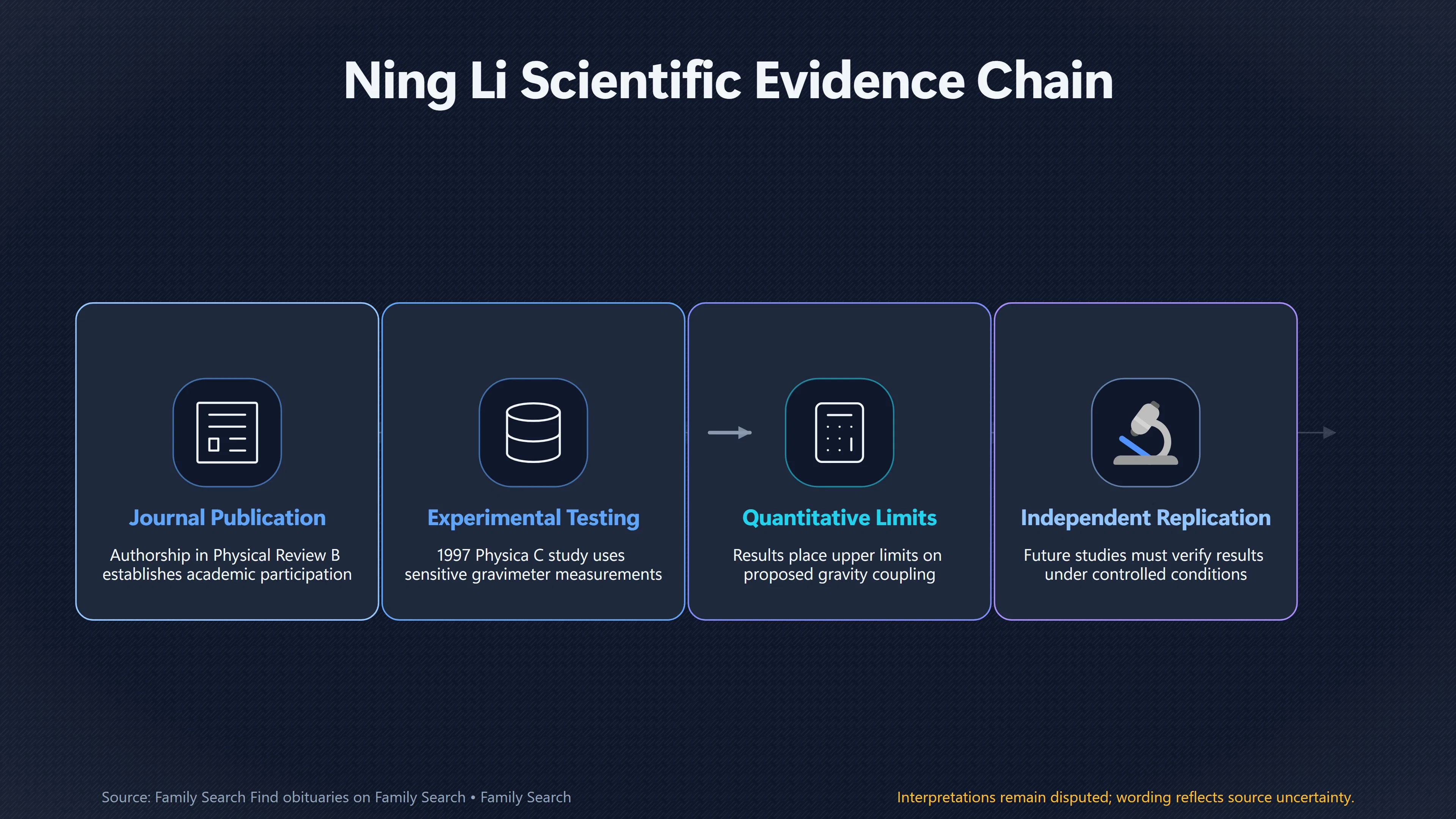
The difference becomes particularly clear in Li’s experimental work. In 1997, Li and colleagues published a Physica C paper testing proposed gravitational effects associated with type-II yttrium barium copper oxide superconductors. The experiment used a sensitive gravimeter. Rather than reporting a dramatic gravity-shielding effect, the authors found changes in acceleration below two parts in 108 of ordinary gravitational acceleration under the tested static conditions, thereby placing limits on the proposed coupling.[ScienceDirect]sciencedirect.comStatic test for a gravitational force coupled to type II YBCO superconductors - ScienceDirect…
That is an important piece of scientific context. A memorial phrase such as “leading scientist in super-conductivity anti-gravity” compresses an intricate research programme into an honourific description. The published literature contains hypotheses, calculations, experiments, limits and unresolved questions. Reading the obituary as though its wording represented a scientific verdict removes those distinctions.
Publication is stronger evidence, but still not proof
Replacing obituary praise with “she published peer-reviewed papers” improves the evidence considerably, but it still does not settle whether an extraordinary physical effect exists.
Peer-reviewed publication establishes that work entered the research literature after editorial and expert scrutiny; it does not transform every conclusion into established fact. Scientific confidence develops through the larger evidentiary record. The National Academies’ review of reproducibility and replicability describes replication as one of the key means by which researchers build confidence in scientific results: when new studies addressing the same question obtain consistent results, a claim becomes more credible. It also cautions that neither one successful replication guarantees correctness nor one failed replication automatically disproves the original result.[NCBI]ncbi.nlm.nih.govOpen source on nih.gov.
This distinction is especially relevant to gravity-superconductor research because small apparent forces can be difficult to interpret. Experimental artefacts, magnetic interactions, vibration, thermal effects and measurement sensitivity all become important when the claimed signal is extremely small. Even apparently repeatable observations must therefore be tested under conditions capable of separating the proposed phenomenon from ordinary physical effects.
Li’s 1997 experiment illustrates what that process looks like better than her obituary does. The published abstract identifies earlier reports of anomalous weight changes, states the conditions Li’s team tested and gives a quantitative upper limit from their gravimeter measurements.[ScienceDirect]sciencedirect.comStatic test for a gravitational force coupled to type II YBCO superconductors - ScienceDirect… That allows other researchers to ask meaningful questions about apparatus, sensitivity, controls and whether later experiments converge on the same result.
The National Academies accordingly recommends thinking in terms of an entire body of evidence rather than treating an individual experiment or replication as decisive.[NCBI]ncbi.nlm.nih.govOpen source on nih.gov. The same principle applies even more strongly to biographical praise. An obituary sits several steps further away from experimental verification than a research paper does.
Career standing and scientific correctness are separate questions
Disputed-researcher narratives often collapse two different questions:
- Was this person a genuine or accomplished scientist?
- Were this person’s most controversial scientific claims correct?
The answers need not be the same.
A researcher may have authentic academic affiliations, publish in recognised journals and make legitimate contributions while also advancing a hypothesis that ultimately remains unconfirmed. Conversely, later failure of a particular hypothesis does not retroactively make the researcher fictitious or incompetent. Science routinely advances through ideas that are tested, modified or rejected.
For Li, contemporary journal records are therefore more useful than either dismissive or celebratory labels. They show her authorship, institutional affiliation and the actual content of her research.[APS Journals]journals.aps.orgAPS JournalsGravitational effects on the magnetic attenuation of superconductors | Phys. Rev. BSeptember 1, 1992… Her obituary adds valuable evidence about her later identity, death and the way her family or memorial writers represented her legacy.[Berryhill Funeral Home]berryhillfh.comBerryhill Funeral Home Ning Li ObituaryBerryhill Funeral HomeNing Li Obituary July 27, 2021 - Berryhill Funeral Home & CrematoryJuly 27, 2021… Those sources complement one another only when they are asked questions they are capable of answering.
This also guards against a misleading inference common in disputed researcher-death stories: that if an obituary describes someone as eminent, any extraordinary claim associated with that person inherits the same authority. Scientific authority does not transfer in that way. Even an unquestionably eminent physicist’s novel experimental claim would still require evidence capable of being scrutinised independently.
What would actually establish scientific credibility?
For claims involving gravity modification or unconventional propulsion, a useful credibility assessment should move progressively away from reputation and towards independently testable evidence. The strongest case would normally combine several kinds of material:
- Primary research records: papers describing the theory, apparatus, methods and quantitative results.
- Accessible experimental detail: enough information for competent independent researchers to understand what was measured and how possible artefacts were controlled.
- Independent replication: new experiments by groups not dependent on the original researchers, producing compatible results under appropriately comparable conditions.
- Convergent evidence: different methods pointing towards the same physical phenomenon rather than one apparatus repeatedly producing the same anomaly.
- Critical scientific engagement: serious attempts to identify mundane explanations, measurement errors and theoretical problems, rather than counting favourable descriptions or citations.
- A developing body of evidence: subsequent research that strengthens, modifies or overturns the original interpretation.
Replication deserves particular weight without being treated mechanically. The National Academies distinguishes replicability — obtaining consistent results in new studies collecting their own data — from reproducibility using the same underlying data and computational procedures. It stresses that scientific confidence increases as results withstand such scrutiny and fit into a broader evidence network.[National Academies Publications]nap.nationalacademies.orgNational Academies Publications The National Academies PressNational Academies Publications The National Academies Press
This framework prevents two opposite mistakes. It avoids dismissing unconventional work merely because its subject sounds implausible, while also avoiding acceptance because an obituary, newspaper profile or admirer describes its author as brilliant.
What memorial praise can legitimately tell us
The right conclusion is therefore narrower than either believers or sceptics may want. An obituary is evidence, but the object of that evidence must be specified.
Li’s obituary provides direct evidence that a memorial published after her death represented her as an important antigravity researcher. It supports her date of death, family connections and funeral chronology, and it demonstrates that superconductivity-antigravity research remained central to the way her life was publicly commemorated.[Berryhill Funeral Home]berryhillfh.comBerryhill Funeral Home Ning Li ObituaryBerryhill Funeral HomeNing Li Obituary July 27, 2021 - Berryhill Funeral Home & CrematoryJuly 27, 2021… Later reporting shows that the notice also provided a practical lead that helped a journalist locate her son and investigate what had happened during Li’s long absence from public scientific discussion.[Huntsville Business Journal]huntsvillebusinessjournal.comHuntsville Business JournalUncovering The Mystery Of Huntsville’s Brilliant Anti-gravity Scientist - Huntsville Business JournalJuly 30…
It cannot establish that Li achieved gravity control, that a disputed experimental effect was real, or that the scientific community regarded such an effect as demonstrated. Those questions belong to the technical literature and its subsequent testing.
That evidentiary boundary is particularly important when obituaries appear in stories about allegedly suspicious deaths or disappearances. Memorial praise can preserve a valuable historical clue about reputation and self-understanding, but it should not be promoted into scientific verification. The most reliable reading keeps biography, reputation and experimental credibility separate: an obituary tells us how a researcher was remembered; science requires us to ask what the experiments actually showed.
Amazon book picks
Further Reading
Books and field guides related to Can an Obituary Prove a Researcher's Scientific Standing?. Use these as the next step if you want deeper reading beyond the article.
Calling Bullshit: The Art of Skepticism in a Data-Driven World
Bullshit isn’t what it used to be. Now, two science professors give us the tools to dismantle misinformation and think clearly in a world...

The Craft of Research
Rating: 4.3/5 from 6 Google Books ratings
Since 1995, students, researchers, and professionals have turned to The Craft of Research for clear and helpful guidance on how to conduc...
The Skeptics' Guide to the Universe: How to Know What's Reall...
An all-encompassing guide to skeptical thinking from podcast host and academic neurologist at Yale University School of Medicine Steven N...
The Demon-Haunted World: Science as a Candle in the Dark
Are we on the brink of a new Dark Age of irrationality and superstition? In this book, the writer shows how scientific thinking is necess...
eBay marketplace picks
Marketplace Samples
Live-tested eBay searches with available results related to this page.
Selected fromUFO poster oneBay.co.uk.


Endnotes
1.
Source: journals.aps.org
Link:https://journals.aps.org/prb/abstract/10.1103/PhysRevB.46.5489
Source snippet
APS JournalsGravitational effects on the magnetic attenuation of superconductors | Phys. Rev. BSeptember 1, 1992...
Published: September 1, 1992
2.
Source: sciencedirect.com
Link:https://www.sciencedirect.com/science/article/pii/S0921453497014627
Source snippet
Static test for a gravitational force coupled to type II YBCO superconductors - ScienceDirect...
3.
Source: ncbi.nlm.nih.gov
Link:https://www.ncbi.nlm.nih.gov/books/NBK547524/?report=printable
Source snippet
Reproducibility and Replicability in Science - NCBI Bookshelf...
4.
Source: familysearch.org
Title: Family Search Find obituaries on Family Search • Family Search
Link:https://www.familysearch.org/en/help/helpcenter/article/find-obituaries-on-familysearch
Source snippet
Find obituaries on FamilySearch • FamilySearchJuly 13, 2026...
Published: July 13, 2026
5.
Source: inspirehep.net
Link:https://inspirehep.net/literature/722115
Source snippet
INSPIREFebruary 1, 2006...
Published: February 1, 2006
6.
Source: ncbi.nlm.nih.gov
Link:https://www.ncbi.nlm.nih.gov/books/NBK547524/
7.
Source: familysearch.org
Title: British Newspaper Archives, Obituaries
Link:https://www.familysearch.org/sw/search/collection/2562508
8.
Source: community.familysearch.org
Title: united states obituary collection record hints
Link:https://community.familysearch.org/en/discussion/182303/united-states-obituary-collection-record-hints
9.
Source: familysearch.org
Link:https://www.familysearch.org/en/search/collection/5000184
10.
Source: familysearch.org
Title: How Family Tree decides if a person is living or dead • Family Search
Link:https://www.familysearch.org/en/help/helpcenter/article/how-does-family-tree-determine-whether-a-person-is-living-or-deceased
11.
Source: familysearch.org
Title: Determining in Source Linker if a source matches your ancestor • Family Search
Link:https://www.familysearch.org/en/help/helpcenter/article/determining-if-a-source-matches-your-ancestor
12.
Source: familysearch.org
Title: Top Tips to Find an Obituary for a Specific Person
Link:https://www.familysearch.org/en/blog/tips-to-find-obituary-specific-person/
13.
Source: familysearch.org
Title: 7 Types of England Death Records [With Examples]
Link:https://www.familysearch.org/en/blog/england-death-records
14.
Source: familysearch.org
Title: 5 Simple Ways to Add Details to Your Family Story
Link:https://www.familysearch.org/en/blog/5-simple-ways-to-add-details-to-your-family-story
15.
Source: familysearch.org
Title: Use Multiple Records to Verify Information
Link:https://www.familysearch.org/en/blog/use-multiple-records-to-verify-information
16.
Source: sciencedirect.com
Title: Static test for a gravitational force coupled to type II YBCO superconductors
Link:https://www.sciencedirect.com/science/article/abs/pii/S0921453497014627
17.
Source: sciencedirect.com
Link:https://www.sciencedirect.com/science/article/abs/pii/S0304422X16000164
18.
Source: sciencedirect.com
Link:https://www.sciencedirect.com/science/article/pii/S0304422X16000164
19.
Source: sciencedirect.com
Title: Trust in science amid a replication crisis
Link:https://www.sciencedirect.com/science/article/pii/S2352250X25002635
20.
Source: familysearch.org
Link:https://www.familysearch.org/en/rootstech/session/finding-and-using-u-s-obituaries-more-effectively
21.
Source: familysearch.org
Link:https://www.familysearch.org/en/gettingstarted/find-ancestors
22.
Source: legacy.com
Title: editorial standards
Link:https://www.legacy.com/memorial-writing/editorial-standards
23.
Source: berryhillfh.com
Title: Berryhill Funeral Home Ning Li Obituary
Link:https://www.berryhillfh.com/obituary/ning-li?lud=4CF765EE88E7526FCBA619C30101F7E6
Source snippet
Berryhill Funeral HomeNing Li Obituary July 27, 2021 - Berryhill Funeral Home & CrematoryJuly 27, 2021...
Published: July 27, 2021
24.
Source: pubmed.ncbi.nlm.nih.gov
Link:https://pubmed.ncbi.nlm.nih.gov/39491036/
Source snippet
Remembering the Dead: Shifting Forms of Commemoration and Immanent Understandings of Death in Obituaries - PubMedNovember 3, 2024...
Published: November 3, 2024
25.
Source: huntsvillebusinessjournal.com
Link:https://huntsvillebusinessjournal.com/news/2023/07/30/solving-the-mystery-of-huntsvilles-brilliant-scientist-disappearing/
Source snippet
Huntsville Business JournalUncovering The Mystery Of Huntsville’s Brilliant Anti-gravity Scientist - Huntsville Business JournalJuly 30...
26.
Source: nap.nationalacademies.org
Title: National Academies Publications The National Academies Press
Link:https://nap.nationalacademies.org/skim.php?chap=1-4&record_id=25303
27.
Source: nap.nationalacademies.org
Title: National Academies Publications The National Academies Press
Link:https://nap.nationalacademies.org/skim.php?chap=143-162&record_id=25303
28.
Source: wikidata.org
Title: Ning Li
Link:https://www.wikidata.org/wiki/Q11170087
29.
Source: ncbi.nlm.nih.gov
Link:https://www.ncbi.nlm.nih.gov/books/NBK621586/
30.
Source: pmc.ncbi.nlm.nih.gov
Link:https://pmc.ncbi.nlm.nih.gov/articles/PMC13287341/
31.
Source: pmc.ncbi.nlm.nih.gov
Link:https://pmc.ncbi.nlm.nih.gov/articles/PMC11290608/
32.
Source: pmc.ncbi.nlm.nih.gov
Link:https://pmc.ncbi.nlm.nih.gov/articles/PMC8651282/
33.
Source: berryhillfh.com
Title: Ning Li Obituary
Link:https://www.berryhillfh.com/obituary/ning-li/print
34.
Source: pmc.ncbi.nlm.nih.gov
Link:https://pmc.ncbi.nlm.nih.gov/articles/PMC7525033/
35.
Source: pmc.ncbi.nlm.nih.gov
Link:https://pmc.ncbi.nlm.nih.gov/articles/PMC7191707/
36.
Source: pmc.ncbi.nlm.nih.gov
Link:https://pmc.ncbi.nlm.nih.gov/articles/PMC7100931/
37.
Source: pubmed.ncbi.nlm.nih.gov
Link:https://pubmed.ncbi.nlm.nih.gov/32218571/
38.
Source: ncbi.nlm.nih.gov
Link:https://www.ncbi.nlm.nih.gov/books/NBK547535/
39.
Source: ncbi.nlm.nih.gov
Link:https://www.ncbi.nlm.nih.gov/books/NBK547531/
40.
Source: pmc.ncbi.nlm.nih.gov
Link:https://pmc.ncbi.nlm.nih.gov/articles/PMC6550262/
41.
Source: nationalacademies.org
Title: Read “Reproducibility and Replicability in Science” at NAP.edu
Link:https://www.nationalacademies.org/read/25303
42.
Source: nationalacademies.org
Title: Read “Reproducibility and Replicability in Science” at NAP.edu
Link:https://www.nationalacademies.org/read/25303/chapter/6
43.
Source: nap.nationalacademies.org
Link:https://nap.nationalacademies.org/skim.php?act=nap&chap=71-104&record_id=25303
44.
Source: pmc.ncbi.nlm.nih.gov
Link:https://pmc.ncbi.nlm.nih.gov/articles/PMC5856513/
45.
Source: pubmed.ncbi.nlm.nih.gov
Link:https://pubmed.ncbi.nlm.nih.gov/28622536/
46.
Source: pmc.ncbi.nlm.nih.gov
Link:https://pmc.ncbi.nlm.nih.gov/articles/PMC5245957/
47.
Source: pmc.ncbi.nlm.nih.gov
Link:https://pmc.ncbi.nlm.nih.gov/articles/PMC3762722/
48.
Source: zamandayolculuk.com
Link:https://www.zamandayolculuk.com/html-3/electrostatic_propulsion.htm
49.
Source: wired.com
Link:https://www.wired.com/1998/03/antigravity/
50.
Source: embed.celebrateally.com
Link:https://embed.celebrateally.com/legacy/obituary
51.
Source: pubmed.ncbi.nlm.nih.gov
Link:https://pubmed.ncbi.nlm.nih.gov/26168125/
52.
Source: pubmed.ncbi.nlm.nih.gov
Link:https://pubmed.ncbi.nlm.nih.gov/20361725/
53.
Source: nationalacademies.org
Link:https://www.nationalacademies.org/read/25303/chapter/3
54.
Source: nationalacademies.org
Link:https://www.nationalacademies.org/read/25303/chapter/4
55.
Source: nap.nationalacademies.org
Link:https://nap.nationalacademies.org/collection/89/reproducibility
56.
Source: nationalacademies.org
Link:https://www.nationalacademies.org/our-work/reproducibility-and-replicability-in-science?goal=0_96101de015-9578a7dc42-110837174
57.
Source: nationalacademies.org
Link:https://www.nationalacademies.org/projects/DBASSE-BBCSS-17-03/resources
58.
Source: nap.nationalacademies.org
Title: committee on reproducibility and replicability in science
Link:https://nap.nationalacademies.org/initiative/committee-on-reproducibility-and-replicability-in-science
59.
Source: nationalacademies.org
Link:https://www.nationalacademies.org/read/25303/chapter/1
60.
Source: nap.nationalacademies.org
Link:https://nap.nationalacademies.org/authors.php?author=COSEMPUP
61.
Source: nap.nationalacademies.org
Title: american geophysical union
Link:https://nap.nationalacademies.org/collection/53/american-geophysical-union
62.
Source: nap.nationalacademies.org
Link:https://nap.nationalacademies.org/resource/25303/interactive/quiz/quiz.html
63.
Source: nap.nationalacademies.org
Link:https://nap.nationalacademies.org/authors.php?author=CATS&n=10&start=0
64.
Source: nap.nationalacademies.org
Link:https://nap.nationalacademies.org/skim.php?chap=39-54&record_id=25303
65.
Source: nap.nationalacademies.org
Link:https://nap.nationalacademies.org/skim.php?act=nap&chap=21-26&record_id=25303
66.
Source: nap.nationalacademies.org
Link:https://nap.nationalacademies.org/skim.php?act=nap&chap=27-38&record_id=25303
67.
Source: nap.nationalacademies.org
Link:https://nap.nationalacademies.org/skim.php?act=nap&chap=5-20&record_id=25303
68.
Source: nap.nationalacademies.org
Link:https://nap.nationalacademies.org/resource/25303/interactive/
69.
Source: nap.nationalacademies.org
Link:https://nap.nationalacademies.org/skim.php?chap=209-220&record_id=25303
70.
Source: nap.nationalacademies.org
Link:https://nap.nationalacademies.org/skim.php?act=nap&chap=1-38&record_id=25094
71.
Source: uapmurders.com
Link:https://uapmurders.com/uaps/Details/Ning_Li/
72.
Source: ouci.dntb.gov.ua
Link:https://ouci.dntb.gov.ua/en/works/7nJwBNL7/
73.
Source: daviddarling.info
Link:https://www.daviddarling.info/encyclopedia/A/antigravity.html
Additional References
74.
Source: youtube.com
Title: The Scientist That “Discovered Antigravity” Then Disappeared Completely
Link:https://www.youtube.com/watch?v=eS_rEzKdzBA
Source snippet
5 Inventors With Mysterious Inventions Who Strangely Disappeared...
75.
Source: nature.com
Link:https://www.nature.com/articles/nn0206-149
76.
Source: nature.com
Link:https://www.nature.com/articles/d42473-019-00004-y
77.
Source: youtube.com
Title: The disappearance of America’s leading anti-gravity researcher
Link:https://www.youtube.com/watch?v=Qsbz8_G9WcU
Source snippet
The Scientist That "Discovered Antigravity" Then Disappeared Completely...
78.
Source: nature.com
Link:https://www.nature.com/articles/s41467-019-14203-0
79.
Source: nature.com
Title: The reproducibility crisis in the age of digital medicine | npj Digital Medicine
Link:https://www.nature.com/articles/s41746-019-0079-z
80.
Source: nature.com
Title: Investigating the replicability of the social and behavioural sciences | Nature
Link:https://www.nature.com/articles/s41586-025-10078-y
81.
Source: youtube.com
Title: Scientists Keep Disappearing
Link:https://www.youtube.com/watch?v=LitzZExKvKg
Source snippet
[Ning Li antigravity]({{ 'li-s-experiments/' | relative_url }}) death obituary Ning Li: The Scientist Who Tamed Gravity & Disappeared...
82.
Source: nature.com
Title: Replicating scientific results is tough — but essential | Nature
Link:https://www.nature.com/articles/d41586-021-03736-4
83.
Source: researchgate.net
Link:https://www.researchgate.net/publication/354521867_A_simple_investigation_of_Static_test_for_a_gravitational_force_coupled_to_type_II_YBCO_superconductors_by_Li_and_coworkers