Within Mc Donald
Did Mc Donald's UFO Battles Give Anyone a Motive?
McDonald's clashes with official UFO investigations explain why suspicions arose, but conflict alone does not establish a murder motive.
On this page
- His challenges to Project Blue Book and the Condon study
- Congressional testimony and institutional friction
- Why professional conflict is not evidence of homicide
Page outline Jump by section
Introduction
James E. McDonald’s clashes with the institutions that investigated UFOs give the murder theory surrounding his 1971 death an intuitively compelling starting point. He was not a marginal commentator: he was a University of Arizona atmospheric physicist who examined Project Blue Book files, attacked the quality of the US Air Force’s UFO investigations, challenged the University of Colorado’s Condon study and took his case to Congress and the American Association for the Advancement of Science (AAAS). His surviving papers document extensive correspondence with government, military and scientific figures.[University of Arizona Libraries]lib.arizona.eduOpen source on arizona.edu.

Those conflicts explain why later suspicions arose. They do not, however, establish a motive for murder in the evidential sense. The historical record shows bitter scientific disagreement, institutional embarrassment and damage to McDonald’s professional standing. It does not show that an identified official or organisation regarded killing him as necessary, ordered violence against him, threatened him with death or took operational steps to silence him. That distinction — between a plausible conspiracy narrative and evidence of homicidal motive — is the central problem with the foul-play argument.
Why Project Blue Book put McDonald in conflict with the Air Force
McDonald’s dispute with official UFO research was unusually direct because he did not simply criticise Project Blue Book from outside. He obtained and studied its material and re-investigated cases himself. The University of Arizona archive now holding his papers contains approximately 580 copies of Blue Book sighting reports, including reports by pilots and cases involving airborne or ground radar. It also preserves correspondence with government and military officials, case investigations, journals and more than 80 recordings relating to his UFO work.[University of Arizona Libraries]lib.arizona.eduOpen source on arizona.edu.
Project Blue Book was the US Air Force programme responsible for investigating UFO reports. McDonald came to believe that its procedures were inadequate for determining whether a small residue of difficult cases represented a genuinely unexplained phenomenon. His argument was more specific than the popular claim that every unexplained light was extraterrestrial: he maintained that most reports could be explained, but that the remaining high-quality cases involving credible witnesses deserved serious scientific investigation.
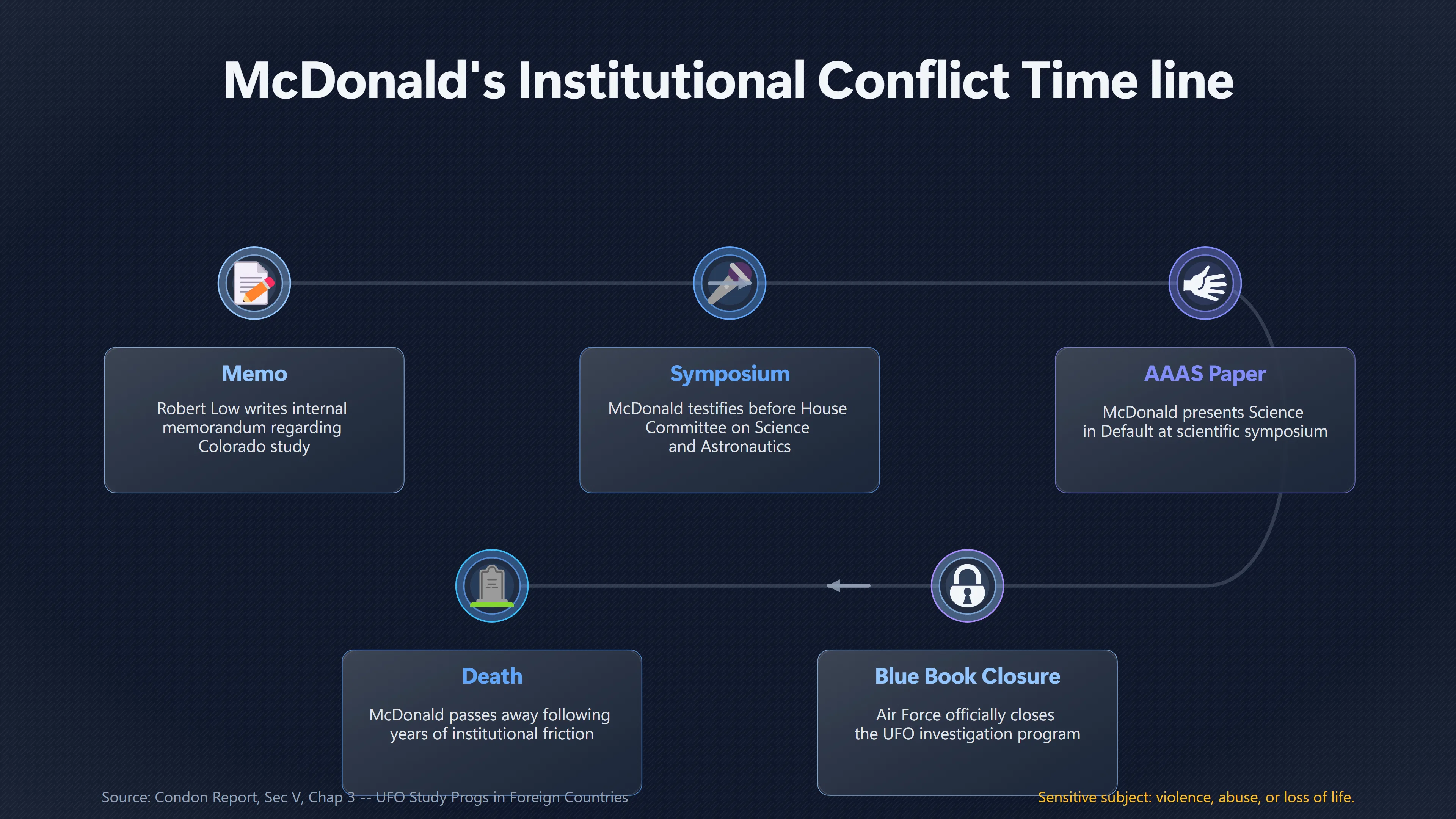
That position put him at odds with the institutional direction of the Air Force programme. In his July 1968 statement to the House Committee on Science and Astronautics, McDonald devoted substantial attention to cases he believed official investigations had handled inadequately and argued that the scientific community had prematurely dismissed the subject. The surviving congressional text shows that he presented himself not merely as an advocate for UFOs but as a critic of the investigative methods being used to dispose of difficult reports.[NCAS Files]files.ncas.orgNCAS FilesUFO Symposium 1968: McDonald Statement…
This matters to the motive theory because McDonald could undoubtedly be troublesome to officials defending the adequacy of earlier investigations. He possessed conventional scientific credentials, knew the case literature in detail and could challenge explanations case by case. His archive demonstrates that this was a sustained campaign rather than a passing interest.[University of Arizona Libraries]lib.arizona.eduOpen source on arizona.edu.
But institutional inconvenience is still several steps removed from homicidal motive. Project Blue Book itself was closed in December 1969, following the Air Force’s acceptance of the recommendation that further UFO investigation was unlikely to produce significant scientific results. By the time McDonald died in June 1971, the programme against which he had campaigned no longer existed. The motive argument therefore requires more than showing that he had embarrassed Blue Book: it requires evidence that someone still had something sufficiently consequential to protect from him that murder became a rational objective. The available historical record does not supply that missing link.[NCAS Files]files.ncas.orgNCAS FilesMcCarthy Dissertation: VI. THE 1969 AAAS UFO SYMPOSIUM…
The Condon dispute was the sharper institutional battle
McDonald’s confrontation with the University of Colorado UFO project provides stronger material for claims that he had acquired powerful adversaries. The project, directed by physicist Edward Condon and funded by the Air Force, was intended to provide an independent scientific assessment of the UFO problem. Its final report became enormously influential, supporting the judgement that further extensive study was unlikely to be scientifically productive.
McDonald believed the project was compromised both in approach and conclusion. His papers specifically preserve material concerning Condon’s study alongside his Blue Book research, and the University of Arizona describes his view that reports such as the Condon Report had been handled superficially.[University of Arizona Libraries]lib.arizona.eduOpen source on arizona.edu.
A particularly important controversy concerned an internal memorandum written in August 1966 by project administrator Robert Low, before the Colorado study had properly begun. The memo discussed how the university might undertake a UFO project while maintaining academic respectability and anticipated a study whose outcome would be sceptical. McDonald learnt of the memorandum during the project and confronted Condon about it. The document subsequently became central to accusations that the supposedly independent investigation had been predisposed towards a negative conclusion.
The episode produced genuine institutional turmoil. Two project researchers, David Saunders and Norman Levine, were dismissed amid the controversy, while the National Investigations Committee on Aerial Phenomena withdrew its cooperation with the Colorado project. The dispute reached the press and helped turn disagreements over UFO evidence into a public argument over whether the study itself had been scientifically impartial.[UAP Codex]uapcodex.orgUAP Codex Condon Report · USAF–University of Colorado study · UAP CodexUAP Codex Condon Report · USAF–University of Colorado study · UAP Codex
McDonald then attacked the final report on substantive grounds. At the December 1969 AAAS symposium he delivered his paper Science in Default, arguing that neither the Air Force nor the Colorado project had subjected the strongest UFO reports to adequate scientific examination. A modern review of the history of academic UAP research notes that McDonald emphasised that roughly a third of the Colorado study’s cases remained unexplained and analysed selected cases to argue that earlier investigative methods lacked sufficient rigour.[Galileo Project]galileo.hsites.harvard.eduGalileo ProjectOPEN ACCESSFebruary 12, 2026…
The dispute was personal as well as technical. Historical research into the organisation of the 1969 AAAS symposium records substantial friction surrounding Condon and McDonald. Condon opposed the symposium, objected to giving UFO proponents a prestigious AAAS platform and sought support from prominent scientists against it. Organisers at one point considered putting Condon and McDonald on different days to reduce the likelihood of confrontation. Condon ultimately wanted sufficient speaking time to counter McDonald and J. Allen Hynek and was concerned that the symposium could encourage attempts to obtain federal funding for further UFO research.[NCAS Files]files.ncas.orgNCAS FilesMcCarthy Dissertation: VI. THE 1969 AAAS UFO SYMPOSIUM…
That is meaningful evidence of antagonism. It demonstrates that McDonald was involved in a real institutional fight rather than one invented retrospectively by conspiracy writers. What it does not demonstrate is that the fight became violent. The documentary trail shows letters, lobbying, arguments over scientific legitimacy, attempts to shape conference participation and disputes over funding and credibility. None of those records, by themselves, indicates preparation for homicide.
Congress made McDonald harder to dismiss — and more exposed
McDonald also moved the UFO dispute beyond specialist organisations by taking it into political institutions. On 29 July 1968, the House Committee on Science and Astronautics held a symposium on unidentified flying objects. Its published proceedings identified McDonald as a senior physicist at the University of Arizona with a substantial conventional scientific career.[project1947.com]project1947.comSHG - UFO Symposium 1968: McDonald Statement…
His testimony was forceful. McDonald argued that a small but important residue of well-observed UFO reports remained unexplained and that scientific neglect, rather than successful investigation, accounted for the absence of firmer conclusions. He regarded an extraterrestrial explanation as a serious possibility, although the immediate policy point was that substantially better investigation was required.[NCAS Files]files.ncas.orgNCAS FilesUFO Symposium 1968: McDonald Statement…
That congressional appearance matters when reconstructing why a suppression theory can sound plausible. McDonald had acquired something UFO advocates rarely possessed: access to an elite political forum combined with recognised scientific credentials and detailed familiarity with official case files. He could criticise government investigations in their own documentary language rather than merely accuse authorities of hiding UFOs.
His campaign was also international. The Condon Report itself records that McDonald approached the United Nations regarding UFOs, although its account stresses that his submission generated no significant official UN interest. This is a useful corrective to later retellings: McDonald was energetic and unusually well connected, but gaining access to institutions did not necessarily mean that those institutions regarded his UFO claims as dangerous.[condon.ncas.org]condon.ncas.orgCondon Report, Sec V, Chap 3 – UFO Study Progs in Foreign CountriesCondon Report, Sec V, Chap 3 – UFO Study Progs in Foreign Countries
The larger picture is therefore one of institutional friction rather than demonstrated institutional fear. McDonald could secure hearings, contact officials and embarrass investigators. Yet the historical record also shows that his opponents could answer him publicly, reject his conclusions, deny further funding and ultimately close Blue Book without physically silencing him.
Professional ridicule strengthens one argument but weakens another
The most important distinction in the motive debate is between evidence that McDonald suffered because of his UFO advocacy and evidence that somebody wanted him dead because of it.
There is good support for the first proposition. The University of Arizona notes that his scientific UFO studies contributed to his disenfranchisement from the scientific community. His willingness to associate his professional reputation with a deeply stigmatised subject exposed him to criticism that extended beyond disagreements about individual cases.[University of Arizona Libraries]lib.arizona.eduUniversity of Arizona LibrariesWorld UFO Day, July 2 | University of Arizona LibrariesJune 30, 2015…
The consequences became especially visible when UFOs could be used against his credibility in unrelated scientific controversies. McDonald was also a prominent opponent of the proposed American supersonic transport, or SST, arguing from atmospheric science about possible environmental consequences. During congressional testimony on that subject, Representative Silvio Conte attacked McDonald’s credibility by invoking his UFO beliefs and ridiculing the idea of “little green men”. Contemporary biographical accounts describe the exchange as deeply humiliating for McDonald.[Wikipedia]WikipediaJames E. Mc DonaldJames E. Mc Donald
For a murder theory, that episode is double-edged.
On one hand, it demonstrates that McDonald had antagonists outside the UFO controversy and that his UFO research could be weaponised against him. He had become a public scientific campaigner whose interventions touched government policy, aerospace interests and environmental questions.
On the other hand, the episode demonstrates a readily available method for marginalising him that did not require murder. His opponents could challenge his credibility in public precisely because his UFO position was vulnerable to ridicule. Institutional actors could deny funding, reject his conclusions, criticise his methodology or portray him as an enthusiast for an unfashionable subject. A murder-motive argument must explain why those ordinary mechanisms of professional opposition suddenly became insufficient.
The strongest motive claim depends on an unproven secret
The foul-play hypothesis becomes substantially stronger only if an additional proposition is inserted: McDonald supposedly knew, or was close to discovering, information whose disclosure threatened a concealed UFO programme.
This is the crucial logical hinge. Without it, the known disputes supply hostility but no obvious reason to kill him.
McDonald certainly accumulated a remarkable quantity of UFO material. His archive contains hundreds of Blue Book reports, interviews, correspondence with officials, investigative journals, recordings and extensive case files.[University of Arizona Libraries]lib.arizona.eduOpen source on arizona.edu. That can easily be reframed in conspiratorial retellings as evidence that he was “getting too close”.
Yet the character of the surviving collection points towards a different interpretation. McDonald’s documented strength lay in reanalysis of reported sightings and criticism of investigative standards. His congressional presentation was built around cases, witnesses, physical and meteorological considerations and deficiencies in previous explanations. His public argument was essentially that the existing evidence was already interesting enough to justify much better science.[NCAS Files]files.ncas.orgNCAS FilesUFO Symposium 1968: McDonald Statement…
That is different from possessing direct evidence of a secret crash-retrieval programme, recovered extraterrestrial technology or a clandestine antigravity project. The available archival descriptions do not establish that McDonald had penetrated such a programme. Nor does his public work reveal an impending disclosure of that kind.
The distinction is particularly important within the broader literature about allegedly suspicious deaths connected to UFO or antigravity research. A researcher can be controversial, well connected and convinced that authorities are mishandling evidence without possessing a secret whose protection provides a concrete murder motive. McDonald clearly satisfies the first description. Evidence for the second is much thinner.
Conflict is not the same thing as motive
A useful way to test the murder argument is to ask what evidence would normally turn professional conflict into a homicide hypothesis.
One would expect at least some combination of identifiable threats, surveillance specifically linked to silencing his UFO research, evidence that McDonald intended to expose protected information, communications showing officials feared such disclosure, unexplained interference with his papers, testimony from participants describing a suppression operation, or forensic evidence inconsistent with the recorded manner of death.
The documented UFO disputes do not supply those elements. Instead, they establish three narrower points:
- McDonald challenged official competence. He believed Project Blue Book had failed to investigate important reports properly and said so publicly.[University of Arizona Libraries]lib.arizona.eduOpen source on arizona.edu.
- He challenged the credibility of a major government-funded study. The Condon controversy involved genuine arguments over predisposition, methodology and the relationship between the report’s broad conclusion and unresolved cases.[Galileo Project]galileo.hsites.harvard.eduGalileo ProjectOPEN ACCESSFebruary 12, 2026…
- Those disputes carried professional costs. UFO advocacy made McDonald vulnerable to ridicule and attacks on his credibility, including in controversies unrelated to UFOs.[University of Arizona Libraries]lib.arizona.eduUniversity of Arizona LibrariesWorld UFO Day, July 2 | University of Arizona LibrariesJune 30, 2015…
None is trivial. Together they explain why McDonald later became an attractive figure for narratives about scientists being silenced. But they establish opportunity for resentment, not evidence of an intention to kill.
There is also a historical-comparative problem with treating conflict itself as proof of motive. McDonald’s opponents were not behaving as though the disagreement had to remain secret. The Condon Report was published. McDonald criticised it publicly. Congress printed his UFO arguments. The AAAS hosted a symposium where competing scientific positions could be aired. The disagreements were often acrimonious, but they were conspicuous disagreements conducted through hearings, publications, correspondence, lobbying and professional institutions.[NCAS Files]files.ncas.orgNCAS FilesUFO Symposium 1968: McDonald Statement…
Why the motive theory remains persuasive in UFO lore
McDonald’s story contains almost all the ingredients needed for a compelling retrospective conspiracy narrative: a respected scientist, official UFO files, disputed government investigations, an internal memorandum raising questions about institutional objectivity, congressional testimony, professional ridicule and an early death.
The University of Arizona archive confirms that the underlying institutional struggle was real. McDonald spent years investigating UFO reports and challenging government and scientific responses; this is not a case in which later storytellers invented his confrontation with authority.[University of Arizona Libraries]lib.arizona.eduOpen source on arizona.edu.
What changes in the conspiracy version is the inference drawn from those facts. “McDonald fought powerful institutions” becomes “powerful institutions needed McDonald silenced”. “He possessed extensive UFO files” becomes “he possessed dangerous secrets”. “Officials resisted his conclusions” becomes “officials had a motive to kill him”.
Each transition requires additional evidence.
Indeed, McDonald’s conflicts can support a very different interpretation of the pressures surrounding the end of his life. A scientist whose UFO work exposed him to ridicule, damaged his standing and could be invoked against his credibility in unrelated scientific debates had powerful reasons to experience professional distress. The same facts cited to establish enemies therefore cannot automatically be treated as evidence that those enemies caused his death.
Did McDonald’s UFO battles give anyone a motive?
In the broad everyday sense of “motive” — resentment, embarrassment or a desire to stop criticism — McDonald certainly created institutional friction. His attacks on Project Blue Book and the Condon study were sustained, public and unusually credible because they came from an established atmospheric scientist who had immersed himself in the primary case material. His congressional and AAAS appearances ensured that the dispute could not simply be confined to UFO enthusiast circles.[arizona.edu]lib.arizona.eduOpen source on arizona.edu.
In the stronger sense required by a murder allegation, however, the evidence falls short. The surviving record does not identify a person or institution shown to have decided that McDonald possessed information so dangerous that he had to be killed. Nor does it provide the missing bridge from scientific hostility to an operational plot.
That makes McDonald’s UFO battles important primarily as an explanation for why foul-play suspicions developed, rather than as evidence that foul play occurred. The conflicts were genuine; the leap from those conflicts to a murder motive remains unsubstantiated.
Amazon book picks
Further Reading
Books and field guides related to Did Mc Donald's UFO Battles Give Anyone a Motive?. Use these as the next step if you want deeper reading beyond the article.
The UFO Experience: A Scientific Inquiry
Cited by the New York Review of Books as "the best brief for visitation," this classic study presents an analysis of UFO reports and conc...
The Report on Unidentified Flying Objects
The Report on Unidentified Flying Objects, written by Captain Edward Ruppelt in 1956, was the first serious, unbiased account written abo...
UFOs and Government: A Historical Inquiry
Governments around the world have had to deal with the UFO phenomenon for a good part of a century. How and why they did so is the subjec...
eBay marketplace picks
Marketplace Samples
Live-tested eBay searches with available results related to this page.
Selected fromUFO poster oneBay.co.uk.


Endnotes
1.
Source: lib.arizona.edu
Link:https://lib.arizona.edu/special-collections/collections/james-e-mcdonald-papers
2.
Source: files.ncas.org
Link:https://files.ncas.org/ufosymposium/mcdonald.html
Source snippet
NCAS FilesUFO Symposium 1968: McDonald Statement...
3.
Source: files.ncas.org
Link:https://files.ncas.org/mccarthy/chap06.html
Source snippet
NCAS FilesMcCarthy Dissertation: VI. THE 1969 AAAS UFO SYMPOSIUM...
4.
Source: project1947.com
Link:https://www.project1947.com/shg/symposium/mcdonald.html
Source snippet
SHG - UFO Symposium 1968: McDonald Statement...
5.
Source: condon.ncas.org
Title: Condon Report, Sec V, Chap 3 – UFO Study Progs in Foreign Countries
Link:https://condon.ncas.org/text/s5chap03.htm
6.
Source: lib.arizona.edu
Link:https://lib.arizona.edu/about/news/world-ufo-day-july-2
Source snippet
University of Arizona LibrariesWorld UFO Day, July 2 | University of Arizona LibrariesJune 30, 2015...
Published: June 30, 2015
7.
Source: Wikipedia
Title: James E. Mc Donald
Link:https://en.wikipedia.org/wiki/James_E._McDonald
8.
Source: conspiracy.wiki
Title: The Mantell Incident | Conspiracy Wiki
Link:https://www.conspiracy.wiki/wiki/mantell-incident
9.
Source: project1947.com
Link:https://www.project1947.com/shg/shglinks.html
10.
Source: history.com
Title: Project Blue Book
Link:https://www.history.com/articles/project-blue-book
11.
Source: project1947.com
Title: SH G: Announcement of New Documents and Materials
Link:https://www.project1947.com/shg/shgdocs.html
12.
Source: ufos.wiki
Title: James E. Mc Donald
Link:https://ufos.wiki/figure/james-e-mcdonald/
13.
Source: project1947.com
Link:https://www.project1947.com/shg/articles/swordscc.html
14.
Source: files.ncas.org
Link:https://files.ncas.org/condon/text/contents.htm
15.
Source: condon.ncas.org
Link:https://condon.ncas.org/text/intro.htm
16.
Source: files.ncas.org
Link:https://files.ncas.org/condon/text/sec-i.htm
17.
Source: files.ncas.org
Link:https://files.ncas.org/condon/text/s3chap02.htm
18.
Source: files.ncas.org
Title: sec ii
Link:https://files.ncas.org/condon/text/sec-ii.htm
19.
Source: ncas.org
Link:https://www.ncas.org/p/library.html
20.
Source: everything.explained.today
Link:https://everything.explained.today/Condon_Committee/
21.
Source: files.ncas.org
Link:https://files.ncas.org/condon/text/s5chap02.htm
22.
Source: files.ncas.org
Link:https://files.ncas.org/condon/text/covrletr.htm
23.
Source: uapcodex.org
Title: UAP Codex Condon Report · USAF–University of Colorado study · UAP Codex
Link:https://uapcodex.org/cases/condon-report-1968/
24.
Source: galileo.hsites.harvard.edu
Link:https://galileo.hsites.harvard.edu/sites/g/files/omnuum6371/files/galileo/files/s2251171723400068.pdf
Source snippet
Galileo ProjectOPEN ACCESSFebruary 12, 2026...
Published: February 12, 2026
25.
Source: wikidisc.org
Title: Condon Report | Wiki Disc
Link:https://www.wikidisc.org/wiki/Condon_Report
26.
Source: archives.gov
Title: Project BLUE BOOK
Link:https://www.archives.gov/research/military/air-force/ufos
27.
Source: daviddarling.info
Link:https://www.daviddarling.info/encyclopedia/U/UFOs.html
28.
Source: encyclopedia.com
Link:https://www.encyclopedia.com/science/encyclopedias-almanacs-transcripts-and-maps/condon-report
29.
Source: cia.gov
Link:https://www.cia.gov/readingroom/document/07083374
Additional References
30.
Source: youtube.com
Title: The Blue Book Fail, Dr James Mc Donald, Science In Default, AAAS
Link:https://www.youtube.com/watch?v=xYpjSMdG4b4
Source snippet
James E McDonald UFO Project Blue Book Condon Report Ep. 9: Blue Book: The Trick | The trick was the word. The leak. The letter. The miss...
31.
Source: gla.ac.uk
Title: University of Glasgow
Link:https://www.gla.ac.uk/schools/bohvm/research/about/publications/
Source snippet
(doi: 10.1111/jfb.15591) (PMID:37843923) Limwagu, Alex J., Msugupakulya, Betwel J., Kilalangongono, Masoud M., Mwalugelo, Yohana A., Okum...
32.
Source: youtube.com
Title: Dr. James E. Mc Donald lecture: UFOs: A Case Study in Public Mis-information
Link:https://www.youtube.com/watch?v=gzCQvC0cTKI
Source snippet
The Blue Book Fail, Dr James McDonald, Science In Default, AAAS...
33.
Source: youtube.com
Title: World In Action, with Professor James E. Mc Donald & the Condon Committee
Link:https://www.youtube.com/watch?v=ut65ifaenvs
Source snippet
Science In Default by Professor James E. McDonald...
34.
Source: cia.gov
Link:https://www.cia.gov/readingroom/docs/DOC_0000838057.pdf
35.
Source: cia.gov
Link:https://www.cia.gov/readingroom/document/cia-rdp81r00560r000100010011-9
36.
Source: archives.gov
Link:https://www.archives.gov/research/alic/periodicals/nara-citations/genealogy.html
37.
Source: cia.gov
Link:https://www.cia.gov/readingroom/docs/CIA-RDP75-00149R000500070003-0.pdf
38.
Source: cia.gov
Link:https://www.cia.gov/readingroom/document/cia-rdp75-00149r000500070003-0
39.
Source: cia.gov
Link:https://www.cia.gov/readingroom/docs/CIA-RDP81R00560R000100010010-0.pdf