Within UFO Research Deaths
What Did Peer Review Actually Validate in Gravity Research?
Peer-reviewed publication can validate that research was scientifically posed without validating every later claim associated with it.
On this page
- Ning Li's published superconducting work
- What peer review does and does not certify
- How later claims can outrun published results
Page outline Jump by section
Introduction
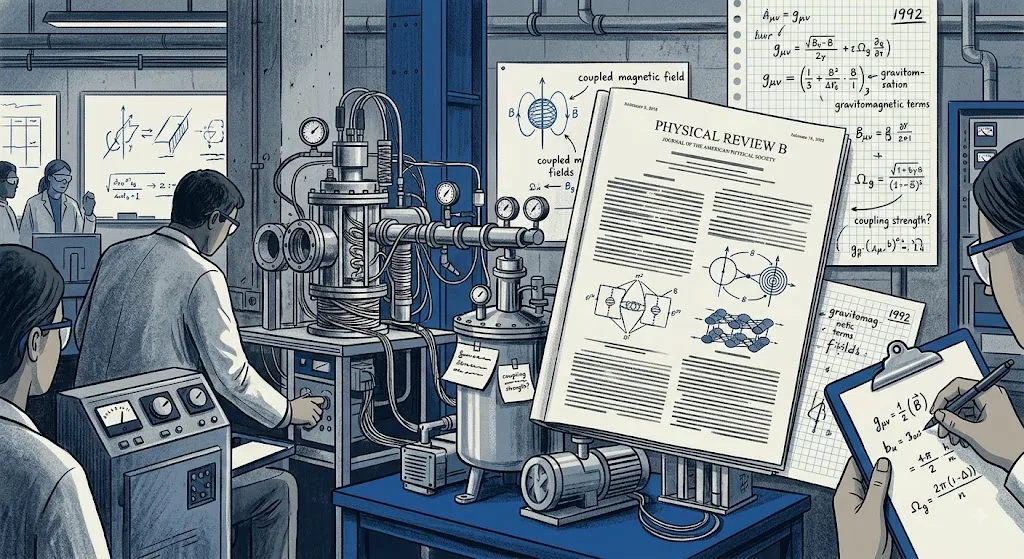
The strongest scientific fact behind Ning Li’s controversial gravity research is also the easiest one to overstate: some of it really did pass peer review. Li and Douglas G. Torr published theoretical papers on gravity–superconductor coupling in Physical Review D and Physical Review B, two established American Physical Society journals, and later extended the argument in Foundations of Physics Letters. In 1997, Li and collaborators at NASA’s Marshall Space Flight Center published an experimental test in Physica C.[aps.org]journals.aps.orgPhys Rev D.43.457Physical Review JournalsEffects of a gravitomagnetic field on pure superconductors | Phys. Rev. DJanuary 15, 1991…
That publication record establishes that technically qualified editors and referees considered the questions scientifically discussable and the manuscripts worthy of entering the research literature. It does not establish that Li demonstrated antigravity, built a gravity-control device, or overturned general relativity. Indeed, the same peer-reviewed record contains substantial criticism of the magnitude of the effects she and Torr predicted, while Li’s own 1997 experiment placed a stringent upper limit on one proposed static gravitational anomaly.[PubMed]pubmed.ncbi.nlm.nih.govPub Med Gravitomagnetism and magnetic permeability in superconductorsGravitomagnetism and magnetic permeability in superconductors - PubMedJanuary 1, 1994…
For understanding later claims about secret antigravity programmes, missing researchers or suppressed breakthroughs, this distinction is crucial. A legitimate physics paper can be evidence that an unconventional idea was genuinely investigated without being evidence that the most dramatic interpretation of that idea was correct.
Ning Li’s published superconducting work
Li’s early programme began with a respectable theoretical question rather than a claim that gravity had been switched off. In weak-field general relativity, moving mass can produce effects loosely analogous to magnetism, usually called gravitomagnetism. Li and Torr explored whether the collective quantum behaviour of superconductors might alter the way such extremely weak gravitational effects appeared inside superconducting matter.
Their 1991 paper, “Effects of a gravitomagnetic field on pure superconductors”, appeared in Physical Review D. The paper treated magnetic and gravitomagnetic fields together and derived coupled internal fields for a pure superconductor. It predicted, within the authors’ model, a small residual magnetic field and mutual induction between magnetic and gravitomagnetic components. The important point is that this was a theoretical calculation: the paper did not report a laboratory antigravity device or measured reduction in an object’s weight.[Physical Review Journals]journals.aps.orgPhys Rev D.43.457Physical Review JournalsEffects of a gravitomagnetic field on pure superconductors | Phys. Rev. DJanuary 15, 1991…
The follow-up paper, “Gravitational effects on the magnetic attenuation of superconductors”, was published in Physical Review B in September 1992. Li and Torr proposed that gravitational terms might connect two familiar idealisations of superconductivity — perfect electrical conductivity and perfect diamagnetism — through their model of magnetic and gravitomagnetic response. Their abstract cautiously described the result as suggesting a “possible importance” of gravitational effects in understanding superconductivity.[Physical Review Journals]journals.aps.orgOpen source on aps.org.
A third paper, “Gravitoelectric-electric coupling via superconductivity”, appeared in Foundations of Physics Letters in 1993. It extended the argument towards the possibility that coherent behaviour in a superconductor could make ordinarily negligible gravitational effects detectable. That step is where the work acquired much of its later antigravity reputation: a calculation involving gravitationally analogous fields can easily become, in secondary retellings, a claim that a superconductor can generate a useful repulsive gravitational force. The published paper itself remained a theoretical proposal requiring experimental confirmation.[Ouci]ouci.dntb.gov.uaOuci Gravitoelectric-electric coupling via superconductivityOuci Gravitoelectric-electric coupling via superconductivity
The experimental record is especially revealing. In 1997, Li joined David Noever, Tony Robertson, Ron Koczor and Whitt Brantley on “Static test for a gravitational force coupled to type II YBCO superconductors”, published in Physica C: Superconductivity. YBCO — yttrium barium copper oxide — is a high-temperature ceramic superconductor that had become central to claims of anomalous gravitational effects. Their sensitive gravimeter experiment found changes in acceleration smaller than two parts in 108 of ordinary gravitational acceleration. Rather than announcing antigravity, the paper said the measurement placed new limits on the strength and range of the proposed static coupling.[ScienceDirect]sciencedirect.comStatic test for a gravitational force coupled to type II YBCO superconductors - ScienceDirect…
That result is easy to miss in popular accounts of Li. Her publication history was not a simple progression from theory to successful gravity control. It included a peer-reviewed experimental null constraint.
What peer review actually validated
Peer review is best understood as a quality-control stage in scientific argument, not a certificate that the conclusion has become a fact of nature. The American Physical Society says its peer-review system is intended to assess validity, novelty, importance and presentation. Manuscripts considered suitable are evaluated by experts, while editors make the publication decision. APS also explicitly treats reproducibility and later independent verification as continuing scientific responsibilities after publication.[Physical Review Journals]journals.aps.orgPhysical Review Journals APS JournalsPhysical Review JournalsAPS Journals - Editorial Policies and PracticesMarch 2, 2025…
Applied to Li and Torr, publication therefore supports several limited but important conclusions.
The work was genuinely part of the scientific literature. The 1991 and 1992 papers were not anonymous internet documents or merely patent claims; they appeared in established physics journals with identifiable authors, institutional affiliations, dates, volumes and DOIs. The 1991 article was published in Physical Review D, while the 1992 article appeared in Physical Review B.[Physical Review Journals]journals.aps.orgPhys Rev D.43.457Physical Review JournalsEffects of a gravitomagnetic field on pure superconductors | Phys. Rev. DJanuary 15, 1991…
The questions were considered sufficiently coherent to review and publish. Referees and editors evidently did not dismiss the gravity–superconductor calculations as meaningless on their face. That matters historically because it rebuts the opposite exaggeration: Li was not simply a fringe figure making wholly disconnected “antigravity” assertions outside professional physics.
Publication did not certify the predicted magnitude. Physics journals routinely publish models that are later corrected, narrowed or contradicted. Indeed, Physical Review B subsequently published Mark Kowitt’s critique, “Gravitomagnetism and magnetic permeability in superconductors”, in 1994. Kowitt argued that Li and Torr had grossly overestimated the gravitomagnetic effect because they had misinterpreted the magnetic permeability used to describe the Meissner effect in bulk superconductors.[PubMed]pubmed.ncbi.nlm.nih.govPub Med Gravitomagnetism and magnetic permeability in superconductorsGravitomagnetism and magnetic permeability in superconductors - PubMedJanuary 1, 1994…
This is scientific self-correction operating through the same publishing system that accepted the original work. Peer review gave Li and Torr’s calculations a place in the debate; it did not insulate those calculations from later attack.
A second published criticism came from physicist Edward G. Harris in Foundations of Physics Letters. His 1999 comment directly addressed Torr and Li’s gravitoelectric-coupling paper. Bibliographic records confirm that the criticism appeared in the same journal family in which the original 1993 proposal had been published.[Utah FTP Math]ftp.math.utah.eduFTP Mathfoundphyslett.dviFTP Mathfoundphyslett.dvi
A later US Defense Intelligence Agency technical survey of superconductor gravity research summarised the dispute by noting that Harris’s analysis reduced the predicted external gravitoelectric effect by roughly 20 orders of magnitude relative to the earlier estimate. That document is a secondary assessment rather than a peer-reviewed adjudication, but it illustrates why the phrase “published physics” cannot safely be converted into “confirmed antigravity”.[UFO Transparency]ufotransparency.comOpen source on ufotransparency.com.
The experiment changed the evidential balance
The strongest way to evaluate an unconventional theory is not to count how prestigious its publication venues were, but to ask what happened when measurable consequences were sought.
Li’s 1997 Physica C paper is particularly important because it moved from theoretical amplification mechanisms to an actual gravitational measurement. The authors referenced earlier reports of apparent weight changes near superconductors but used a gravimeter while bulk YBCO superconductors were stably levitated in a direct-current magnetic field. They detected no change larger than two parts in 108 of normal gravitational acceleration.[ScienceDirect]sciencedirect.comStatic test for a gravitational force coupled to type II YBCO superconductors - ScienceDirect…
That experiment did not test every configuration later associated with “antigravity”: it was static, and therefore did not reproduce all the rotation and radio-frequency conditions claimed in Eugene Podkletnov’s more famous experiments. It nevertheless matters because it shows Li participating in a conventional falsification process. Where the apparatus could set a bound, the published result was a bound rather than a breakthrough claim.
Independent work on closely related rotating-superconductor allegations also moved predominantly towards null results. A 2003 Physica C paper by George Hathaway, Brian Cleveland and Yao Bao attempted to reproduce the claimed Podkletnov gravity-like force using the published descriptions and additional communications. The researchers reported no evidence for a gravity-like force within the sensitivity of their equipment.[ScienceDirect]sciencedirect.comOpen source on sciencedirect.com.
A NASA review published in 2004 characterised that replication as having sensitivity around 50 times better than the original Podkletnov setup and consequently treated the rotating, radio-frequency-pumped superconductor approach as non-viable. NASA’s own earlier attempts to construct a full replication had not reached a completed experimental configuration.[NASA Technical Reports Server]ntrs.nasa.govOpen source on nasa.gov.
These later tests do not technically disprove every possible gravity–superconductor interaction. Conventional general relativity already predicts extremely weak gravitomagnetic phenomena, and condensed-matter systems can legitimately be studied for unusual coupling effects. What the experiments undermine is the much stronger proposition that the peer-reviewed literature had already established a practically useful, readily detectable gravitational shielding or propulsion effect.

How published science became “antigravity technology”
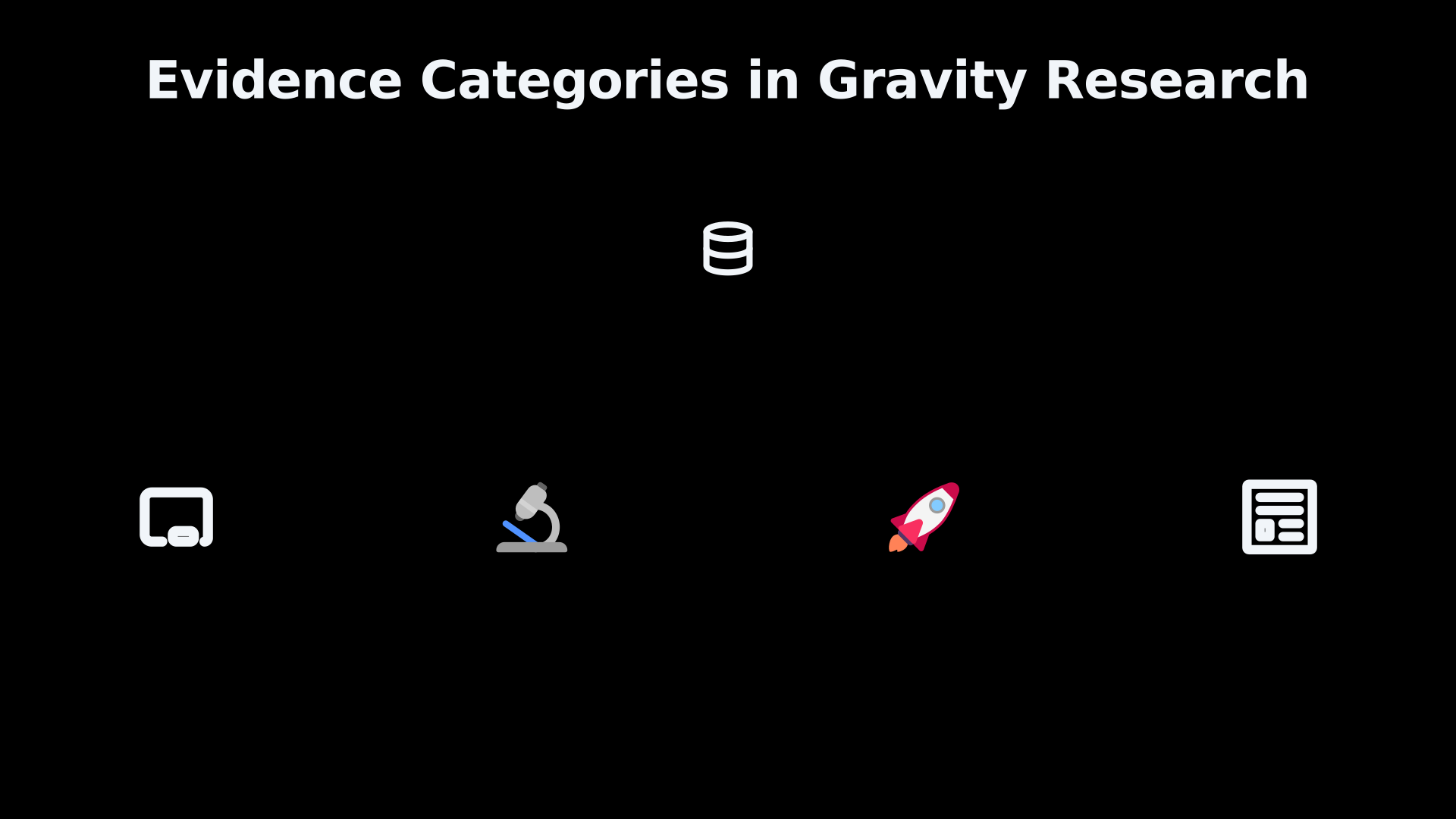
The gap between Li’s papers and later retellings grew because several different evidential categories became compressed into a single story.
The first category was established physics used as a starting point: superconductivity, the Meissner effect, general relativity and weak-field gravitomagnetism are genuine areas of physics.
The second was a speculative theoretical extension: Li and Torr proposed that superconducting coherence could amplify gravitationally related effects to unusual levels. Those calculations were serious enough to be published, but their quantitative assumptions became subjects of peer-reviewed criticism.[Physical Review Journals]journals.aps.orgPhys Rev D.43.457Physical Review JournalsEffects of a gravitomagnetic field on pure superconductors | Phys. Rev. DJanuary 15, 1991…
The third was experimental testing. Li’s 1997 team did not report the dramatic static anomaly that broader antigravity narratives might suggest; it instead established a small upper limit under the conditions tested. Other laboratories subsequently failed to reproduce prominent rotating-superconductor gravity claims.[ScienceDirect]sciencedirect.comStatic test for a gravitational force coupled to type II YBCO superconductors - ScienceDirect…
The fourth category was technological extrapolation: claims that such effects could provide propulsion, gravity shielding or practical control of weight. Those claims require vastly more evidence than showing that a theoretical gravity–superconductor coupling can be written down mathematically.
This hierarchy is central when Li’s career is discussed alongside UFO or advanced-propulsion narratives. The existence of her Physical Review papers demonstrates that scientists did examine unconventional gravitational consequences of superconductivity. It does not establish that classified programmes subsequently possessed working antigravity technology. Those are separate propositions with very different evidential burdens.
Peer review is strongest when criticism is included
One misleading way to present Li’s record is to say: “Her antigravity research was peer reviewed, therefore mainstream physics confirmed it.” An equally misleading response is: “The idea was controversial, therefore the papers were not real science.”
The documentary record supports a more precise conclusion. Li and Torr published genuine theoretical physics in recognised journals. Other physicists then criticised crucial quantitative assumptions through recognised journals. Li later co-authored a peer-reviewed experimental paper that found no detectable static gravitational anomaly above a stringent threshold. That sequence — proposal, criticism, experiment and constraint — is more representative of science than either the breakthrough narrative or the dismissal narrative.[aps.org]journals.aps.orgPhys Rev D.43.457Physical Review JournalsEffects of a gravitomagnetic field on pure superconductors | Phys. Rev. DJanuary 15, 1991…
It also illustrates why replication carries a different evidential weight from publication. A referee can determine that an argument is interesting, technically developed and worth exposing to the community. Referees cannot prospectively guarantee that every approximation is sound or that every predicted effect will survive later experimentation. APS’s own current policies explicitly treat reproducibility and independent verification as part of the continuing scientific process.[Physical Review Journals]journals.aps.orgPhysical Review Journals APS JournalsPhysical Review JournalsAPS Journals - Editorial Policies and PracticesMarch 2, 2025…
The existence of published comments correcting earlier papers reinforces rather than weakens that system. Kowitt’s critique appeared in the same Physical Review B literature that contained Li and Torr’s 1992 work. Harris’s later criticism likewise became part of the formal record. Scientific credibility therefore resides less in the fact that one paper passed review than in how an idea performs across the entire subsequent chain of criticism and testing.[Physical Review Journals]journals.aps.orgPhysical Review Journals Physical Review BPhysical Review Journals Physical Review B
What the record supports — and what it does not
Within the wider history of alleged UFO and antigravity research, Ning Li is unusual because there is no need to speculate about whether she really worked on gravity-related superconducting physics. She did. The papers exist, their institutional affiliations are identifiable, and several appeared in recognised peer-reviewed journals.[Physical Review Journals]journals.aps.orgPhys Rev D.43.457Physical Review JournalsEffects of a gravitomagnetic field on pure superconductors | Phys. Rev. DJanuary 15, 1991…
What remains unsupported is the much larger inference often built on top of that fact. Peer-reviewed publication does not show that Li achieved gravity shielding, demonstrated a propulsion system or produced a technologically useful gravitomagnetic field. Her early predictions encountered published criticism over their magnitude, and the accessible peer-reviewed experimental record did not deliver the kind of reproducible macroscopic antigravity effect required to substantiate those claims.[researchgate.net]researchgate.netOpen source on researchgate.net.
The scientifically defensible takeaway is therefore narrower, but more interesting than either extreme. Li’s work shows that unconventional gravity research can enter mainstream scientific channels when it is formulated in sufficiently concrete theoretical and experimental terms. Peer review validated the legitimacy of asking and analysing certain questions. It did not validate every answer subsequently attributed to the research.
For investigations that connect gravity research to UFO technology, secrecy or suspicious events surrounding researchers, this distinction should be treated as an evidential firewall. A published paper establishes what was proposed, calculated or measured. Claims about hidden engineering breakthroughs require their own independent evidence.
Amazon book picks
Further Reading
Books and field guides related to What Did Peer Review Actually Validate in Gravity Research?. Use these as the next step if you want deeper reading beyond the article.
The Antigravity Enigma: Fiction, Fringe Science, and Modern P...
From magic carpets to hoverboards and space drives, the human imagination has always seen antigravity as the ultimate aspirational symbol...
The Knowledge Machine: How Irrationality Created Modern Science
• Why is science so powerful? • Why did it take so long—two thousand years after the invention of philosophy and mathematics—for the huma...

Science Fictions: How Fraud, Bias, Negligence, and Hype Under...
First published 2020. Subjects: Science, Fraud in science, Scientific Errors.
The Demon-Haunted World: Science as a Candle in the Dark
Are we on the brink of a new Dark Age of irrationality and superstition? In this book, the writer shows how scientific thinking is necess...
eBay marketplace picks
Marketplace Samples
Live-tested eBay searches with available results related to this page.
Selected fromgravity physics poster oneBay.co.uk.

Endnotes
1.
Source: journals.aps.org
Title: Phys Rev D.43.457
Link:https://journals.aps.org/prd/abstract/10.1103/PhysRevD.43.457
Source snippet
Physical Review JournalsEffects of a gravitomagnetic field on pure superconductors | Phys. Rev. DJanuary 15, 1991...
Published: January 15, 1991
2.
Source: journals.aps.org
Link:https://journals.aps.org/prb/abstract/10.1103/PhysRevB.46.5489
3.
Source: sciencedirect.com
Link:https://www.sciencedirect.com/science/article/abs/pii/S0921453497014627
Source snippet
Static test for a gravitational force coupled to type II YBCO superconductors - ScienceDirect...
4.
Source: sciencedirect.com
Link:https://www.sciencedirect.com/science/article/pii/S0921453497014627
Source snippet
Static test for a gravitational force coupled to type II YBCO superconductors - ScienceDirect...
5.
Source: journals.aps.org
Title: Physical Review Journals APS Journals
Link:https://journals.aps.org/authors/editorial-policies
Source snippet
Physical Review JournalsAPS Journals - Editorial Policies and PracticesMarch 2, 2025...
Published: March 2, 2025
6.
Source: journals.aps.org
Title: Physical Review Journals Physical Review Letters
Link:https://journals.aps.org/prl/referees/guidelines-for-referees
Source snippet
Physical Review JournalsPhysical Review Letters - Guidelines for Referees...
7.
Source: researchgate.net
Link:https://www.researchgate.net/publication/298460654_Gravity-Superconductors_interactions_Theory_and_experiment
8.
Source: ftp.math.utah.edu
Title: FTP Mathfoundphyslett.dvi
Link:https://ftp.math.utah.edu/pub/tex/bib/foundphyslett.pdf
9.
Source: sciencedirect.com
Link:https://www.sciencedirect.com/science/article/pii/S0921453402022840
10.
Source: ntrs.nasa.gov
Link:https://ntrs.nasa.gov/api/citations/20040070788/downloads/20040070788.pdf?attachment=true
11.
Source: journals.aps.org
Title: Physical Review Journals Physical Review B
Link:https://journals.aps.org/prb/issues/49/1
12.
Source: nature.com
Title: Papers with open peer-review reports are less likely to be retracted | Nature
Link:https://www.nature.com/articles/d41586-026-02282-1
13.
Source: aps.org
Title: AP S Open Science publishes its first papers
Link:https://www.aps.org/about/news/2026/04/open-science-publishes-first-papers
14.
Source: nature.com
Title: Peer review in the time of artificial intelligence | Nature Nanotechnology
Link:https://www.nature.com/articles/s41565-026-02177-2
15.
Source: aps.org
Title: AP S Ethics Standards | American Physical Society
Link:https://www.aps.org/about/governance/policies-procedures/ethics-standards
16.
Source: meetings.aps.org
Link:https://meetings.aps.org/Meeting/FWS24/Session/H03.2
17.
Source: aps.org
Link:https://www.aps.org/apsnews/2023/09/scholarly-peer-review-changing
18.
Source: nature.com
Title: Fact and fiction in peer review | Nature Human Behaviour
Link:https://www.nature.com/articles/s41562-022-01338-2
19.
Source: physics.aps.org
Link:https://physics.aps.org/articles/v14/169
20.
Source: researchgate.net
Link:https://www.researchgate.net/publication/346408561_Fisher_information_and_the_weak_equivalence_principle_of_a_quantum_particle_in_a_gravitational_wave
21.
Source: nature.com
Title: The reproducibility crisis in the age of digital medicine | npj Digital Medicine
Link:https://www.nature.com/articles/s41746-019-0079-z
22.
Source: nature.com
Title: Peer review is not broken | Nature Microbiology
Link:https://www.nature.com/articles/s41564
23.
Source: physics.aps.org
Link:https://physics.aps.org/articles/v9/106
24.
Source: researchgate.net
Title: (PDF) Null-Results of a Superconducting Gravity-Impulse-Generator
Link:https://www.researchgate.net/publication/305635303_Null-Results_of_a_Superconducting_Gravity-Impulse-Generator
25.
Source: nature.com
Link:https://www.nature.com/articles/nature12786
26.
Source: journals.aps.org
Title: policies and practices physical review letters july 2013
Link:https://journals.aps.org/prl/authors/publish/policies-and-practices-physical-review-letters-july-2013
Published: july 2013
27.
Source: journals.aps.org
Title: policies and practices physical review b july 2013
Link:https://journals.aps.org/prb/authors/publish/policies-and-practices-physical-review-b-july-2013
Published: july 2013
28.
Source: researchgate.net
Title: (PDF) On the possibility of strong coupling between electricity and gravitation
Link:https://www.researchgate.net/publication/287041399_On_the_possibility_of_strong_coupling_between_electricity_and_gravitation
29.
Source: aps.org
Title: Letters to the Editor | American Physical Society
Link:https://www.aps.org/apsnews/2012/11/letters-to-the-editor
30.
Source: researchgate.net
Title: (PDF) Gravity-Superconductors Interactions: Historical Background
Link:https://www.researchgate.net/publication/281439915_Gravity-Superconductors_Interactions_Historical_Background
31.
Source: researchgate.net
Title: (PDF) Experimental considerations in superconductor gravity experiments
Link:https://www.researchgate.net/publication/288399413_Experimental_considerations_in_superconductor_gravity_experiments
32.
Source: researchgate.net
Title: (PDF) Reverse Engineering Podkletnov’s Experiments
Link:https://www.researchgate.net/publication/251709923_Reverse_Engineering_Podkletnov%27s_Experiments
33.
Source: aps.org
Title: Letters to the Editors | American Physical Society
Link:https://www.aps.org/apsnews/2011/06/letters-to-the-editors
34.
Source: blogs.nature.com
Title: peer review and scientific con
Link:https://blogs.nature.com/blog/peer_review_and_scientific_con/
35.
Source: cosmicopia.gsfc.nasa.gov
Title: qa gp gr
Link:https://cosmicopia.gsfc.nasa.gov/qa_gp_gr.html
36.
Source: blogs.nature.com
Title: quality and value the true pur
Link:https://blogs.nature.com/blog/quality_and_value_the_true_pur/
37.
Source: researchgate.net
Link:https://www.researchgate.net/publication/222897740_Gravity_modification_experiment_using_a_rotating_superconducting_disk_and_radio_frequency_fields
38.
Source: ntrs.nasa.gov
Link:https://ntrs.nasa.gov/citations/20020068834
39.
Source: researchgate.net
Title: Gravity modification by high-temperature superconductors
Link:https://www.researchgate.net/publication/269216231_Gravity_modification_by_high-temperature_superconductors
40.
Source: ntrs.nasa.gov
Link:https://ntrs.nasa.gov/search.jsp?R=20020016600
41.
Source: nature.com
Title: Language bias discredits the peer-review system | Nature
Link:https://www.nature.com/articles/17194
42.
Source: ntrs.nasa.gov
Link:https://ntrs.nasa.gov/archive/nasa/casi.ntrs.nasa.gov/19990046249.pdf
43.
Source: researchgate.net
Title: (PDF) On the Mechanism for a Gravity Effect using Type II Superconductors
Link:https://www.researchgate.net/publication/383610375_On_the_Mechanism_for_a_Gravity_Effect_using_Type_II_Superconductors
44.
Source: aps.org
Title: Letters | American Physical Society
Link:https://www.aps.org/apsnews/1997/03/letters
45.
Source: journals.aps.org
Link:https://journals.aps.org/prb/issues/46/9
46.
Source: aps.org
Title: Guidelines for Professional Conduct | American Physical Society
Link:https://www.aps.org/about/governance/statements/guidelines-professional-conduct
47.
Source: journals.aps.org
Link:https://journals.aps.org/prd/issues/43/2
48.
Source: journals.aps.org
Link:https://journals.aps.org/prl/issues/64/11
49.
Source: journals.aps.org
Link:https://journals.aps.org/prb/recent?ei=ntuwkjqa&page=8577
50.
Source: journals.aps.org
Title: editorial policies practices
Link:https://journals.aps.org/prresearch/authors/editorial-policies-practices
51.
Source: journals.aps.org
Link:https://journals.aps.org/prl/referees
52.
Source: journals.aps.org
Title: editorial policies practices physical review applied
Link:https://journals.aps.org/authors/editorial-policies-practices-physical-review-applied
53.
Source: journals.aps.org
Link:https://journals.aps.org/prl/authors
54.
Source: journals.aps.org
Link:https://journals.aps.org/pre/authors
55.
Source: journals.aps.org
Title: guidelines for referees
Link:https://journals.aps.org/rmp/referees/guidelines-for-referees
56.
Source: journals.aps.org
Link:https://journals.aps.org/prresearch/authors
57.
Source: journals.aps.org
Link:https://journals.aps.org/pra/edannounce/PhysRevA.76.030001
58.
Source: journals.aps.org
Link:https://journals.aps.org/apsos/authors
59.
Source: journals.aps.org
Link:https://journals.aps.org/prl/edannounce/PhysRevLett.100.170001
60.
Source: techport.nasa.gov
Link:https://techport.nasa.gov/projects/10880
61.
Source: researchgate.net
Link:https://www.researchgate.net/publication/234969235_Review_of_Claims_of_Interaction_Between_Gravitation_and_High-Temperature_Superconductors
62.
Source: researchgate.net
Link:https://www.researchgate.net/publication/277311313_Gravitoelectromagnetic_Theories_and_Their_Applications_to_Advanced_Science_and_Technology
63.
Source: researchgate.net
Link:https://www.researchgate.net/publication/386695026_Superconductor_in_a_weak_static_gravitational_field
64.
Source: researchgate.net
Link:https://www.researchgate.net/profile/Mark-Kowitt
65.
Source: researchgate.net
Link:https://www.researchgate.net/publication/228659858_Gravitational_Wave_GW_Radiation_Pattern_at_the_Focus_of_a_High-Frequency_GW_HFGW_Generator_and_Aerospace_Applications
66.
Source: researchgate.net
Link:https://www.researchgate.net/publication/234929198_High-Frequency_Gravitational_Wave_HFGW_Generation_by_Means_of_X-ray_Lasers_and_Detection_by_Coupling_Linearized_GW_to_EM_Fields
67.
Source: nature.com
Link:https://www.nature.com/nature/editorial-policies/peer-review
68.
Source: nature.com
Title: ni0403 297
Link:https://www.nature.com/articles/ni0403-297
69.
Source: nature.com
Link:https://www.nature.com/articles/nnano.2010.171
70.
Source: ouci.dntb.gov.ua
Title: Ouci Gravitoelectric-electric coupling via superconductivity
Link:https://ouci.dntb.gov.ua/en/works/7nJwBNL7/
71.
Source: pubmed.ncbi.nlm.nih.gov
Title: Pub Med Gravitomagnetism and magnetic permeability in superconductors
Link:https://pubmed.ncbi.nlm.nih.gov/10009347
Source snippet
Gravitomagnetism and magnetic permeability in superconductors - PubMedJanuary 1, 1994...
Published: January 1, 1994
72.
Source: ufotransparency.com
Link:https://ufotransparency.com/files/decade-2020s-aatip-dird-documents-2018-2019-dird-14-dird-the-role-of-superconductors-in-gravity-rese
73.
Source: en.ikwipedia.org
Title: Eugene Podkletnov
Link:https://en.ikwipedia.org/wiki/Eugene_Podkletnov
74.
Source: wiki-gateway.eudic.net
Title: Gravitational shielding
Link:https://wiki-gateway.eudic.net/wikipedia_en/Gravitational_shielding.html
75.
Source: zamandayolculuk.com
Link:https://www.zamandayolculuk.com/html-3/electrostatic_propulsion.htm
77.
Source: wired.com
Link:https://www.wired.com/1998/03/antigravity/
78.
Source: pubmed.ncbi.nlm.nih.gov
Link:https://pubmed.ncbi.nlm.nih.gov/10013404/
79.
Source: deepdyve.com
Link:https://www.deepdyve.com/lp/american-physical-society-aps/effects-of-a-gravitomagnetic-field-on-pure-superconductors-6alMKHnwD6
80.
Source: altpropulsion.com
Link:https://www.altpropulsion.com/superconductors/
81.
Source: wikidata.org
Title: Gravitoelectric-electric coupling via superconductivity
Link:https://www.wikidata.org/wiki/Q55922207
82.
Source: uapmurders.com
Link:https://uapmurders.com/uaps/Details/Ning_Li/
83.
Source: a.osmarks.net
Title: Gravitational shielding
Link:https://a.osmarks.net/content/wikipedia_en_all_maxi_2020-08/A/Gravitational_shielding
84.
Source: ouci.dntb.gov.ua
Link:https://ouci.dntb.gov.ua/en/works/4OrJ6Gq7/
85.
Source: ouci.dntb.gov.ua
Link:https://ouci.dntb.gov.ua/en/works/9ZkjEPO7/
Additional References
86.
Source: osti.gov
Link:https://www.osti.gov/biblio/5986002
Source snippet
Effects of a gravitomagnetic field on pure superconductors (Journal Article) | OSTI.GOV...
87.
Source: youtube.com
Title: Gravito-Electromagnetic Effects In Superconductor Experiments | Nathan Inan
Link:https://www.youtube.com/watch?v=eyyioOxj2jk
Source snippet
This video on America's leading anti-gravity researcher directly explores the peer-reviewed papers published by Dr. Ning Li and the subse...
88.
Source: youtube.com
Title: Eugene Podkletnov on Gravitational Shielding in Rotating Superconductors
Link:https://www.youtube.com/watch?v=blXEtLPVE9g
Source snippet
Martin Tajmar on Gravitomagnetism in Superconductors...
89.
Source: youtube.com
Title: Martin Tajmar on Gravitomagnetism in Superconductors
Link:https://www.youtube.com/watch?v=irOFjNHR8L4
Source snippet
Gravito-Electromagnetic Effects In Superconductor Experiments | Nathan Inan...
90.
Source: youtube.com
Title: Superconductors & Gravity Control | Gary Stephenson
Link:https://www.youtube.com/watch?v=msrhrssRmCE
Source snippet
Eugene Podkletnov on Gravitational Shielding in Rotating Superconductors...
91.
Source: youtube.com
Title: The disappearance of America’s leading anti-gravity researcher
Link:https://www.youtube.com/watch?v=Qsbz8_G9WcU
Source snippet
Superconductors & Gravity Control | Gary Stephenson...
92.
Source: deepdyve.com
Link:https://www.deepdyve.com/lp/springer-journals/comments-on-gravitoelectric-electric-coupling-via-superconductivity-by-2QiSKtiNoe
93.
Source: scribd.com
Link:https://www.scribd.com/document/964115557/Ebook-Gravity-superconductors-Interactions-by-Giovanni-Modanese-Glen-A-Robertson-ISBN-9781608053995-1608053997-available-all-format
94.
Source: frontiersin.org
Link:https://www.frontiersin.org/journals/physics/articles/10.3389/fphy.2022.823592/full
95.
Source: bibliotecapleyades.net
Link:https://www.bibliotecapleyades.net/ciencia/secret_projects/project124.htm