Within Antigravity
Did Podkletnov Really Detect Gravity Shielding?
Podkletnov reported measurable weight loss above a superconducting disc, but later replication found no gravity-like force.
On this page
- What the original superconducting experiment claimed
- How large the reported weight reductions were
- Why the later replication failed to confirm the effect
Page outline Jump by section
Introduction
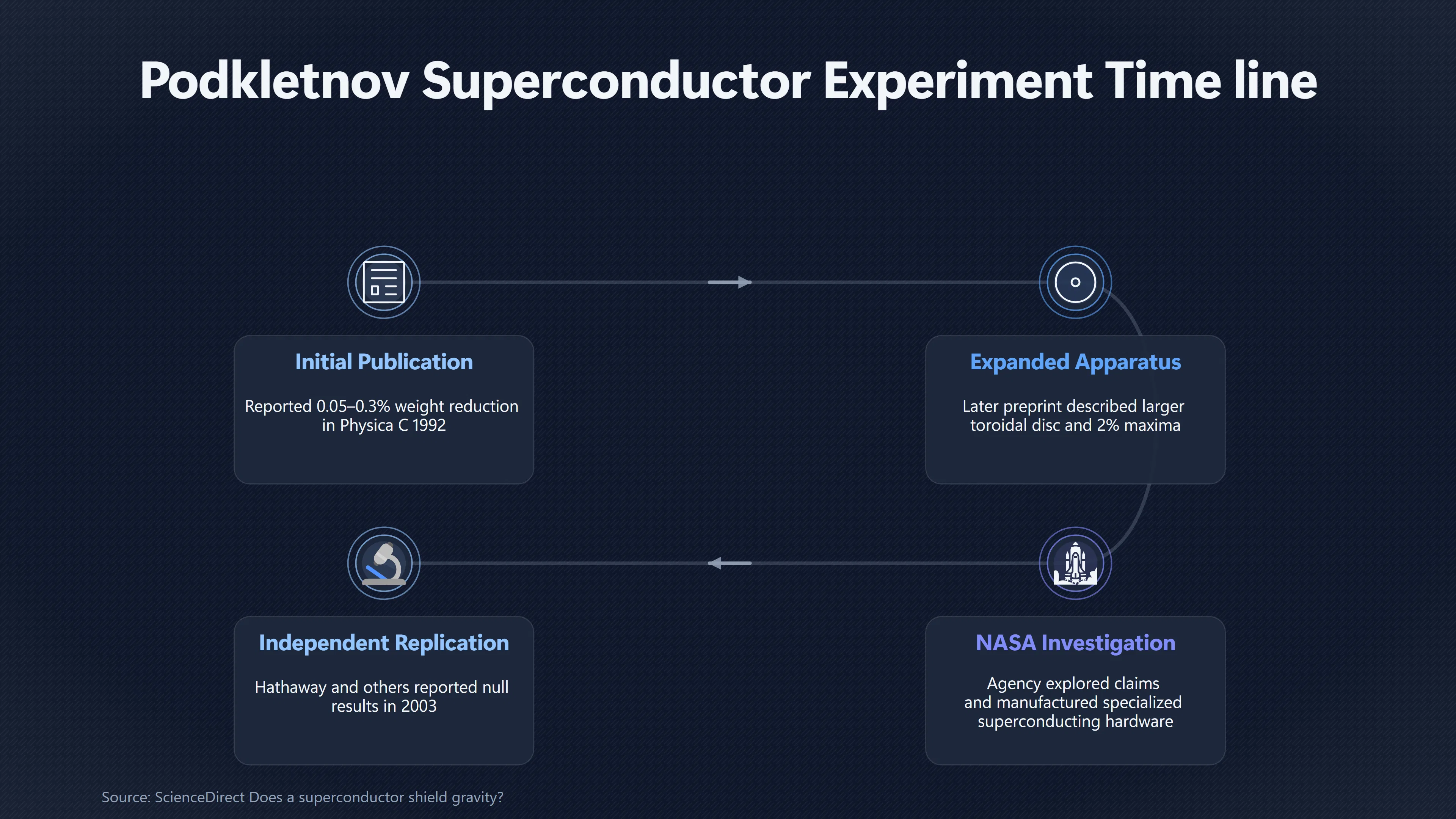
Eugene Podkletnov’s superconducting-disc experiments became one of the most famous laboratory claims of “gravity shielding”: objects suspended above a cold superconducting disc were reported to weigh slightly less. The original peer-reviewed 1992 experiment reported reductions of roughly 0.05–0.3%, while a later, more elaborate version claimed typical reductions of 0.3–0.5% and brief maxima approaching 2%.[ScienceDirect]sciencedirect.comA possibility of gravitational force shielding by bulk YBa2Cu3O7−x superconductor - ScienceDirectDecember 10, 1992…
The decisive problem is replication. Independent experiments did not establish the claimed effect. C. S. Unnikrishnan reported no evidence for shielding in preliminary static tests and argued that Podkletnov’s observations were internally inconsistent with ordinary gravitational shielding. A much closer replication by George Hathaway, Blair Cleveland and Yaocheng Bao likewise detected no gravity-like force; a NASA technical review later noted that its sensitivity was about 50 times better than that available to Podkletnov and consequently regarded this particular rotating-superconductor approach as non-viable.[ScienceDirect]sciencedirect.comScienceDirect Does a superconductor shield gravity?Does a superconductor shield gravity? - ScienceDirectJuly 20, 1996…
That history makes the Podkletnov case useful in discussions of antigravity and UFO-related technology precisely because it separates an extraordinary experimental claim from the much stronger requirement of independently reproducible evidence.
What the original superconducting experiment claimed
Podkletnov and R. Nieminen published their first report in Physica C in December 1992. Their apparatus used yttrium-barium-copper-oxide, or YBCO, a high-temperature ceramic superconductor. A small non-magnetic, electrically non-conducting test object weighing 5.48 grams was positioned above a levitating superconducting disc and monitored with an electro-optical balance. The researchers reported that the object apparently lost between 0.05% and 0.3% of its weight, with the magnitude depending on the disc’s rotational speed.[ScienceDirect]sciencedirect.comA possibility of gravitational force shielding by bulk YBa2Cu3O7−x superconductor - ScienceDirectDecember 10, 1992…
The paper did not merely report an unexplained balance anomaly. It explicitly interpreted the observation as a possible partial shielding of gravitational force. Podkletnov and Nieminen speculated that an unusual energy state within the superconducting material might modify the interaction responsible for the measured weight. That interpretation was extraordinary because neither Newtonian gravity nor general relativity provides an ordinary analogue of electromagnetic shielding in which a material screen simply blocks part of Earth’s gravitational field.[ScienceDirect]sciencedirect.comA possibility of gravitational force shielding by bulk YBa2Cu3O7−x superconductor - ScienceDirectDecember 10, 1992…
The experimental configuration also mattered. This was not simply a test of whether an ordinary piece of superconducting ceramic became lighter when cooled. The claimed anomaly involved a superconducting disc operating under unusual conditions involving magnetic levitation, rotation and electromagnetic excitation. A later review describes the 1992 disc as about 145 mm in diameter and 6 mm thick, operated below roughly 60 K, with trials involving radio-frequency excitation and rotation at thousands of revolutions per minute.[Frontiers]frontiersin.orgOpen source on frontiersin.org.
That complexity subsequently became central to the replication dispute. A negative experiment using a small stationary YBCO sample could be criticised for not recreating Podkletnov’s alleged operating conditions; conversely, the more specialised those conditions became, the harder it was for another laboratory to perform a genuinely independent and exact replication.
How the claimed weight reduction grew
The numbers associated with the “Podkletnov effect” can be confusing because they come from different versions of the experiment. The published 1992 paper reported a relatively modest anomaly: 0.05–0.3% weight reduction.[ScienceDirect]sciencedirect.comA possibility of gravitational force shielding by bulk YBa2Cu3O7−x superconductor - ScienceDirectDecember 10, 1992…
Podkletnov subsequently described a considerably more elaborate apparatus using a much larger composite YBCO disc. His later account, deposited as a preprint after controversy prevented the intended journal publication, described a toroidal disc roughly 27 cm across, with a specially prepared two-layer structure, operated below about 70 K. Two solenoids levitated and drove the disc, while electromagnetic excitation was applied to the superconducting system.[arXiv]arxiv.orgOpen source on arxiv.org.
In this later experiment, Podkletnov reported 0.3–0.5% apparent weight reductions above the rotating disc. When its rotational speed was reduced under particular operating conditions, he claimed that the effect increased sharply, reaching approximately 1.9–2.1% at maximum.[arXiv]arxiv.orgOpen source on arxiv.org.
Those percentages are large by the standards of precision gravitational physics. A repeatable 2% alteration of an object’s response to Earth’s gravity would not be a marginal correction to known physics; it would demand a major new physical mechanism and should, once the necessary apparatus was understood, provide a conspicuous experimental target.
Podkletnov also reported characteristics that appeared difficult to reconcile with a mundane gravitational field. Different materials allegedly showed approximately the same fractional weight change, while the affected region was described as extending vertically above the disc with a relatively well-defined boundary. A later technical review summarising the experiment describes the reported “shielding cylinder” as having a boundary only about 2 cm wide.[Frontiers]frontiersin.orgOpen source on frontiersin.org.
This geometry was one reason critics questioned whether “shielding Earth’s gravity” was actually an adequate interpretation even if the balance readings themselves were accepted. Unnikrishnan examined the experimental claims in 1996 and argued that Podkletnov’s own data were inconsistent with the gravitational-shielding hypothesis. His preliminary experiments in the static configuration also found no evidence for the reported phenomenon.[ScienceDirect]sciencedirect.comScienceDirect Does a superconductor shield gravity?Does a superconductor shield gravity? - ScienceDirectJuly 20, 1996…
Why replication became the decisive test
Podkletnov’s experiment posed an unusually difficult replication problem because its alleged effect depended on much more than superconductivity alone. Disc composition, crystal structure, temperature, electromagnetic excitation, levitation and rotation were all potentially relevant. Later accounts therefore distinguish between experiments that simply tested superconductors for gravitational anomalies and attempts that tried to reproduce the specialised rotating apparatus.[Frontiers]frontiersin.orgOpen source on frontiersin.org.
NASA’s Marshall Space Flight Center and the University of Alabama in Huntsville investigated the claim. Superconducting discs were fabricated as part of that effort, and Podkletnov himself was reportedly engaged as a consultant during the programme. However, NASA did not complete a full working replication of the complete Podkletnov configuration within the available resources. A later NASA assessment states that the effort ran from roughly 1995 to 2002 but did not produce the complete test hardware required for the intended full replication.[NASA Technical Reports Server]ntrs.nasa.govNASA Technical Reports ServerNASA/TM—2004-213082…
This distinction is important. It would be inaccurate to say that NASA built an exact duplicate of Podkletnov’s machine and conclusively demonstrated that nothing happened. The NASA programme encountered substantial engineering difficulties, particularly in producing and operating the specialised superconducting discs. NASA documentation nevertheless records the subsequent independent replication that supplied a much stronger null test.[NASA Technical Reports Server]ntrs.nasa.govNASA Technical Reports ServerConsequences of Coupled Electromagnetic-Gravitational Fields - NASA Technical Reports Server (NTRS)July 1, 2002…
That experiment was performed by Hathaway, Cleveland and Bao and eventually published in Physica C in 2003. The researchers explicitly set out to replicate the alleged gravity-like force using information from Podkletnov’s publications and personal communications with him. They constructed a rotating-superconductor experiment with radio-frequency fields and reported no evidence of a gravity-like force within their apparatus’s sensitivity.[ScienceDirect]sciencedirect.comGravity modification experiment using a rotating superconducting disk and radio frequency fields - ScienceDirect…
A later review notes that their apparatus was not identical to Podkletnov’s: among other differences, the disc was mechanically supported and rotated, and operating parameters differed. Nevertheless, its measurement reached the 0.001% level without detecting the claimed weight modification.[Frontiers]frontiersin.orgOpen source on frontiersin.org.
NASA’s 2004 review of breakthrough-propulsion research put the comparison even more sharply. It stated that the Hathaway experiment had sensitivity approximately 50 times better than Podkletnov’s and concluded that the rotating, radio-frequency-driven superconducting approach should therefore be regarded as non-viable.[NASA Technical Reports Server]ntrs.nasa.govNASA Technical Reports ServerNASA/TM—2004-213082…

Could the replications simply have missed the required conditions?
This is the strongest qualification to the simple statement that “Podkletnov was disproved”. Some attempted replications plainly did not duplicate every reported feature of his apparatus.
For example, a 2001 experiment discussed in a later review used superconducting discs no larger than about three inches. Its authors acknowledged that several conditions Podkletnov regarded as important — including aspects of the material structure and the levitating and rotating system — had not been reproduced. The Hathaway experiment came considerably closer, but important engineering differences remained.[Frontiers]frontiersin.orgOpen source on frontiersin.org.
This creates a genuine experimental limitation but not positive evidence for gravity shielding. When an effect appears only under an increasingly narrow set of conditions, those conditions need to be specified well enough that independent researchers can reproduce them. Otherwise almost any negative result can retrospectively be attributed to an unspecified difference in apparatus.
The original experiment also lacked the kind of documentation that would make reconstruction easier. A 2022 review of gravity-superconductor experiments notes that no photographs or video of Podkletnov’s original apparatus are available, describing this absence as an obstacle to replication.[Frontiers]frontiersin.orgOpen source on frontiersin.org.
More importantly, no independent experiment has produced the central result at anything resembling Podkletnov’s reported magnitude under sufficiently comparable and controlled conditions. Even NASA’s public explanation of the case concluded that other scientists had been unable to replicate the claimed effect and that this failure made the result highly suspect.[Cosmicopia]cosmicopia.gsfc.nasa.govCosmicopia NASA's Cosmicopia – Ask UsNASA's Cosmicopia – Ask Us - General Physics - GravityMarch 6, 2007…
The scientifically careful conclusion is therefore slightly narrower than saying an absolutely identical machine proved Podkletnov wrong: the reported gravity-shielding effect has never been independently established, while increasingly sensitive replication attempts have returned null results.
Why a balance anomaly would not by itself prove gravity shielding
There is another evidential gap that sometimes disappears in retellings of the story. Even if Podkletnov’s original balances genuinely registered a small reduction, that would establish an anomalous force or measurement change before it established a modification of gravity.
The apparatus combined precisely the ingredients capable of making extraordinarily small force measurements difficult: powerful magnetic fields, superconducting currents, cryogenic temperatures, rotating machinery, radio-frequency excitation, mechanical vibration and sensitive balances. Any extraordinary interpretation therefore has to survive controls for electromagnetic coupling, air movement, thermal effects, vibration, changes in the balance system and other ordinary interactions.
Unnikrishnan’s 1996 analysis made this distinction explicit. Rather than merely objecting that gravity shielding was theoretically impossible, he argued that difficulties in the experimental interpretation had to be eliminated before a reliable result could be claimed and that the observations themselves did not behave as expected for shielding of Earth’s gravity.[ScienceDirect]sciencedirect.comScienceDirect Does a superconductor shield gravity?Does a superconductor shield gravity? - ScienceDirectJuly 20, 1996…
This is why replication matters more than whether a proposed theoretical explanation can be constructed after the fact. Numerous speculative models have been proposed for interactions between superconductors and gravity, but a theoretical mechanism cannot convert an unreplicated measurement into an established physical phenomenon. The experimental effect has to be demonstrated first.
What the case actually establishes
Podkletnov’s work occupies an unusual position in the history of antigravity research. It was not merely an internet rumour: the initial claim appeared as a peer-reviewed paper in a specialist superconductivity journal, and the experiment attracted enough interest to prompt serious replication work. Tampere University’s research database continues to catalogue the 1992 Physica C paper as a refereed scientific article.[Tampere University Research Portal]researchportal.tuni.fiTampere University Research PortalA Possibility of Gravitation Force Shielding by Bulk YBa2Cu3O7-x Superconductor - Tampere University Re…
Nor is it accurate to imply that established institutions simply refused to investigate the idea. NASA-related researchers explored the possibility, superconducting hardware was manufactured, and an independent group constructed a substantial experimental replication. The strongest published replication then produced a null result.[NASA Technical Reports Server]ntrs.nasa.govOpen source on nasa.gov.
What has not emerged is the evidence that would turn the Podkletnov effect into accepted gravitational physics: independently reproduced percentage-level weight reduction, demonstrated under controlled conditions and convincingly attributable to gravity rather than another force or systematic error.
That distinction is especially important when the experiment is invoked in UFO or unconventional-propulsion narratives. The historical record shows genuine scientific interest in an extraordinary claim, not demonstrated possession of gravity-control technology. The original measurements remain an interesting disputed anomaly, but the experimentally important result is that the claimed macroscopic gravity shielding did not survive independent confirmation.[ScienceDirect]sciencedirect.comGravity modification experiment using a rotating superconducting disk and radio frequency fields - ScienceDirect…
Amazon book picks
Further Reading
Books and field guides related to Did Podkletnov Really Detect Gravity Shielding?. Use these as the next step if you want deeper reading beyond the article.
The Antigravity Enigma: Fiction, Fringe Science, and Modern P...
From magic carpets to hoverboards and space drives, the human imagination has always seen antigravity as the ultimate aspirational symbol...
Bad Science
Rating: 5.0/5 from 5 Google Books ratings
Have you ever wondered how one day the media can assert that alcohol is bad for us and the next unashamedly run a story touting the benef...
Superconductivity: A Very Short Introduction
Superconductivity is one of the most exciting areas of research in physics today. Outlining the history of its discovery, and the race to...
The Demon-Haunted World: Science as a Candle in the Dark
Are we on the brink of a new Dark Age of irrationality and superstition? In this book, the writer shows how scientific thinking is necess...
eBay marketplace picks
Marketplace Samples
Live-tested eBay searches with available results related to this page.
Selected fromantigravity poster oneBay.co.uk.




Endnotes
1.
Source: sciencedirect.com
Link:https://www.sciencedirect.com/science/article/pii/092145349290055H
Source snippet
A possibility of gravitational force shielding by bulk YBa2Cu3O7−x superconductor - ScienceDirectDecember 10, 1992...
Published: December 10, 1992
2.
Source: arxiv.org
Link:https://arxiv.org/abs/cond-mat/9701074
3.
Source: sciencedirect.com
Title: ScienceDirect Does a superconductor shield gravity?
Link:https://www.sciencedirect.com/science/article/pii/0921453496003401
Source snippet
Does a superconductor shield gravity? - ScienceDirectJuly 20, 1996...
Published: July 20, 1996
4.
Source: sciencedirect.com
Link:https://www.sciencedirect.com/science/article/pii/S0921453402022840
Source snippet
Gravity modification experiment using a rotating superconducting disk and radio frequency fields - ScienceDirect...
5.
Source: ntrs.nasa.gov
Link:https://ntrs.nasa.gov/api/citations/20040070788/downloads/20040070788.pdf?attachment=true
Source snippet
NASA Technical Reports ServerNASA/TM—2004-213082...
6.
Source: ntrs.nasa.gov
Link:https://ntrs.nasa.gov/citations/20020068834
Source snippet
NASA Technical Reports ServerConsequences of Coupled Electromagnetic-Gravitational Fields - NASA Technical Reports Server (NTRS)July 1, 2002...
Published: July 1, 2002
7.
Source: cosmicopia.gsfc.nasa.gov
Title: Cosmicopia NASA’s Cosmicopia – Ask Us
Link:https://cosmicopia.gsfc.nasa.gov/qa_gp_gr.html
Source snippet
NASA's Cosmicopia -- Ask Us - General Physics - GravityMarch 6, 2007...
Published: March 6, 2007
8.
Source: ntrs.nasa.gov
Link:https://ntrs.nasa.gov/search.jsp?R=19990019627&hterms=superconducting+gravity
9.
Source: ntrs.nasa.gov
Link:https://ntrs.nasa.gov/citations/20250005979
10.
Source: ntrs.nasa.gov
Link:https://ntrs.nasa.gov/citations/20080015666
11.
Source: sciencedirect.com
Link:https://www.sciencedirect.com/science/article/abs/pii/S0921453402022840
12.
Source: sciencedirect.com
Link:https://www.sciencedirect.com/journal/physica-c-superconductivity-and-its-applications/vol/385/issue/4
13.
Source: ntrs.nasa.gov
Link:https://ntrs.nasa.gov/archive/nasa/casi.ntrs.nasa.gov/19990046249.pdf
14.
Source: ntrs.nasa.gov
Link:https://ntrs.nasa.gov/search.jsp?R=19990047463
15.
Source: ntrs.nasa.gov
Link:https://ntrs.nasa.gov/citations/19990023209
16.
Source: ntrs.nasa.gov
Link:https://ntrs.nasa.gov/citations/19990104365
17.
Source: ntrs.nasa.gov
Link:https://ntrs.nasa.gov/citations/19990068007
18.
Source: ntrs.nasa.gov
Link:https://ntrs.nasa.gov/citations/19990064220
19.
Source: ntrs.nasa.gov
Link:https://ntrs.nasa.gov/search.jsp?R=19990039542
20.
Source: sciencedirect.com
Link:https://www.sciencedirect.com/science/article/abs/pii/092145349290055H
21.
Source: sciencedirect.com
Link:https://www.sciencedirect.com/science/article/pii/092145349290055H/pdf?md5=bfc751b87889117434dec5c029c2d522&pid=1-s2.0-092145349290055H-main.pdf
22.
Source: ntrs.nasa.gov
Link:https://ntrs.nasa.gov/citations/19870065753
23.
Source: ntrs.nasa.gov
Link:https://ntrs.nasa.gov/citations/19870039926
24.
Source: ntrs.nasa.gov
Link:https://ntrs.nasa.gov/citations/19870039394
25.
Source: sciencedirect.com
Title: Reverse Engineering Podkletnov’s Experiments
Link:https://www.sciencedirect.com/science/article/pii/S1875389211005803
26.
Source: sciencedirect.com
Link:https://www.sciencedirect.com/author/7004744470/c-s-unnikrishnan
27.
Source: techport.nasa.gov
Link:https://techport.nasa.gov/projects/10880
28.
Source: researchportal.tuni.fi
Link:https://researchportal.tuni.fi/en/publications/a-possibility-of-gravitation-force-shielding-by-bulk-yba2cu3o7-x-/
Source snippet
Tampere University Research PortalA Possibility of Gravitation Force Shielding by Bulk YBa2Cu3O7-x Superconductor - Tampere University Re...
29.
Source: frontiersin.org
Link:https://www.frontiersin.org/journals/physics/articles/10.3389/fphy.2022.941858/full
30.
Source: en.ikwipedia.org
Title: Eugene Podkletnov
Link:https://en.ikwipedia.org/wiki/Eugene_Podkletnov
31.
Source: justapedia.org
Title: Eugene Podkletnov
Link:https://justapedia.org/wiki/Eugene_Podkletnov
32.
Source: zamandayolculuk.com
Link:https://zamandayolculuk.com/html-3/electrostatic_propulsion.htm
33.
Source: wired.com
Link:https://www.wired.com/1998/03/antigravity/
34.
Source: researchgate.net
Link:https://www.researchgate.net/profile/George-Hathaway
35.
Source: researchgate.net
Link:https://www.researchgate.net/profile/Blair-Cleveland
36.
Source: researchportal.tuni.fi
Link:https://researchportal.tuni.fi/fi/publications/a-possibility-of-gravitation-force-shielding-by-bulk-yba2cu3o7-x-/
37.
Source: ffden-2.phys.uaf.edu
Title: weight reduction
Link:https://ffden-2.phys.uaf.edu/113.web.stuff/travis/weight_reduction.html
38.
Source: altpropulsion.com
Link:https://www.altpropulsion.com/superconductors/
39.
Source: a.osmarks.net
Title: Gravitational shielding
Link:https://a.osmarks.net/content/wikipedia_en_all_maxi_2020-08/A/Gravitational_shielding
40.
Source: a.osmarks.net
Title: Eugene Podkletnov
Link:https://a.osmarks.net/content/wikipedia_en_all_maxi_2020-08/A/Eugene_Podkletnov
Additional References
41.
Source: youtube.com
Title: Eugene Podkletnov on Gravitational Shielding in Rotating Superconductors
Link:https://www.youtube.com/watch?v=blXEtLPVE9g
Source snippet
APEC 8/28, Part #6 - Mark Sokol - Superconductor Gravity Shield Demo...
42.
Source: osti.gov
Link:https://www.osti.gov/pages/biblio/1637388
43.
Source: osti.gov
Link:https://www.osti.gov/pages/biblio/2440825
44.
Source: osti.gov
Link:https://www.osti.gov/biblio/1657524
45.
Source: osti.gov
Link:https://www.osti.gov/pages/biblio/2550640
46.
Source: osti.gov
Link:https://www.osti.gov/pages/biblio/2440635
47.
Source: osti.gov
Link:https://www.osti.gov/biblio/21409787
48.
Source: osti.gov
Link:https://www.osti.gov/biblio/5896213
49.
Source: osti.gov
Link:https://www.osti.gov/biblio/2526590
50.
Source: youtube.com
Title: Superconductors & Gravity Control | Gary Stephenson
Link:https://www.youtube.com/watch?v=msrhrssRmCE
Source snippet
Eugene Podkletnov on Gravitational Shielding in Rotating Superconductors...