Within Antigravity
When a Weight Change Is Not Gravity
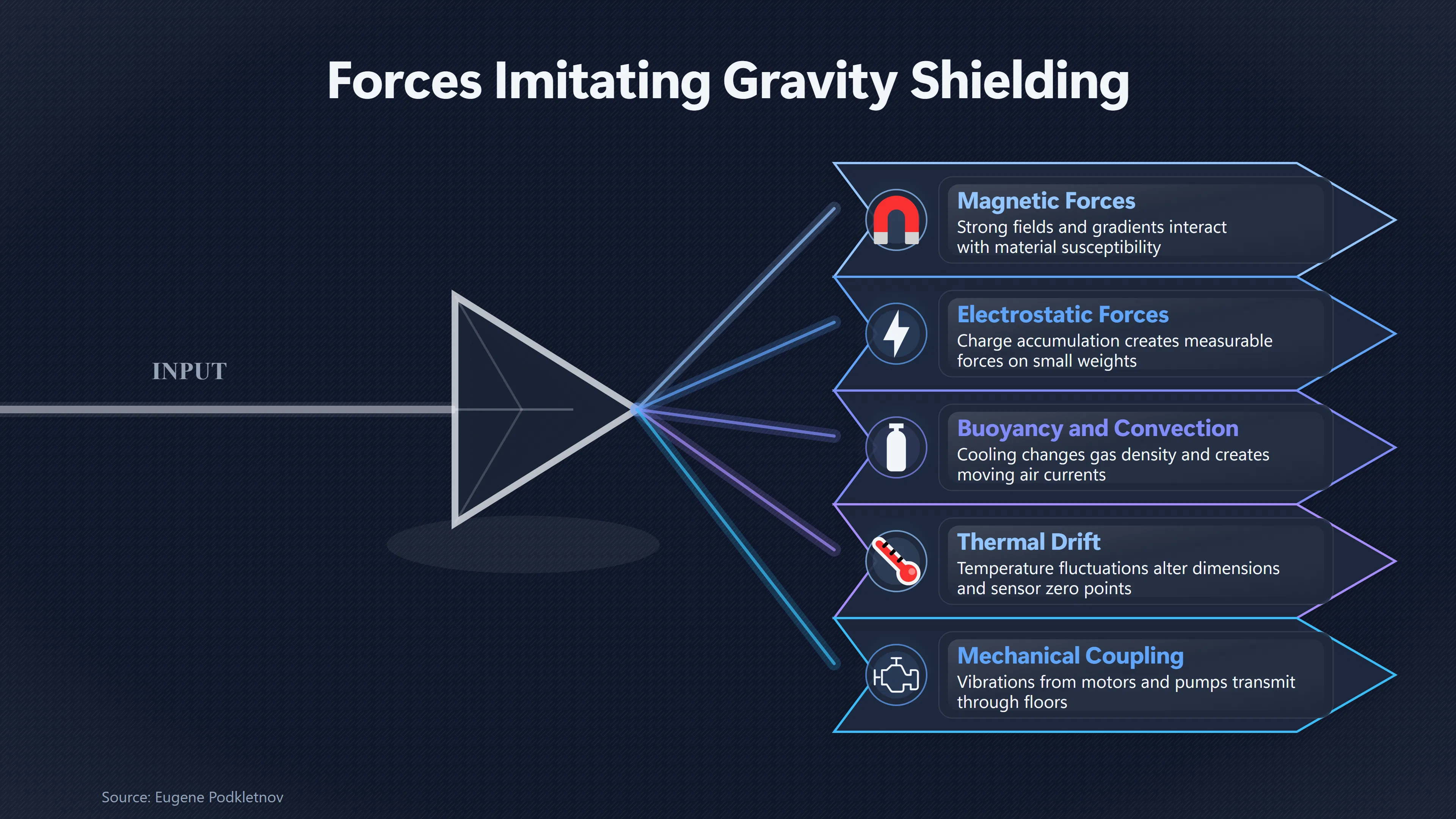
A changing balance reading near an antigravity apparatus is not enough because electromagnetic, thermal, mechanical, and instrumental forces can mimic weight
On this page
- Why laboratory gravity measurements are unusually vulnerable
- Which ordinary forces can imitate a gravity anomaly
- What controls are needed before claiming gravity shielding
Page outline Jump by section
Introduction
A changing balance reading near an alleged antigravity apparatus is not, by itself, evidence that gravity has changed. A balance measures the net vertical force transmitted through its mechanism. Magnetic attraction or repulsion, electrostatic forces, air buoyancy, convection, vibration, thermal drift and mechanical coupling can therefore appear as a gain or loss of weight even when the object’s gravitational interaction is completely unchanged. In precision mass metrology, an unsuspected vertical magnetic force is explicitly treated as a weighing error because the instrument will interpret that force as an apparent change in mass.[PubMed Central (PMC)]nih.govOpen source on nih.gov.

This distinction is particularly important for superconducting “gravity shielding” claims associated with UFO and unconventional-propulsion narratives. Their apparatus tends to combine precisely the conditions that make force measurements difficult: powerful magnetic fields, cryogenic cooling, rapidly changing temperatures, rotating machinery and electrical excitation. Historical replication work has consequently shifted the decisive question away from whether a balance ever moved and towards whether the movement survives systematic removal of ordinary forces. On that standard, the best-known superconducting weight-loss claims have not produced reproducible evidence of gravitational shielding.[NASA Technical Reports Server]nasa.govOpen source on nasa.gov.
Why gravity measurements are unusually vulnerable
The basic experimental problem is deceptively simple. Near Earth’s surface, a stationary object’s ordinary weight is approximately mg, but a laboratory balance does not have a special ability to identify gravity. It responds to the total force along its measurement axis. If some additional upward force F acts on the object, the balance can report an apparent weight reduction corresponding to F/g. The source might be new gravitational physics, but it might equally be magnetism, electrostatics or moving air.
Professional mass metrology illustrates how seriously this ambiguity is treated. NIST work on kilogram-scale magnetic-suspension comparators explicitly investigates systematic errors arising from magnetic interactions with the surroundings. NIST’s research on Kibble balances likewise identifies several magnetic and thermal effects capable of introducing systematic errors into high-precision weighing.[NIST]nist.govOpen source on nist.gov.
At still smaller force scales, environmental disturbances become conspicuous. NIST’s electrostatic force balance deliberately generates known electrostatic forces for metrology, demonstrating that electricity can exert precisely measurable forces comparable to very small weights. The instrument is sufficiently sensitive that vibrations from road traffic can appear in its data.[NIST]nist.govOpen source on nist.gov.
This creates a particularly severe burden of proof for antigravity apparatus. If switching on a magnet, radio-frequency source, cryogenic system or rotor coincides with a balance change, the experiment has changed several ordinary physical variables at the same moment. A correlation between “apparatus on” and “weight down” cannot identify which one produced the force.
The problem becomes sharper rather than weaker as the claimed anomaly becomes smaller. A one-milligram apparent loss corresponds to only about ten micronewtons of upward force. Forces on that scale are not exotic laboratory phenomena: NIST deliberately produces and measures electrostatic forces in the micronewton range.[NIST]nist.govOpen source on nist.gov.
Which ordinary forces can imitate gravity shielding?
Several contamination mechanisms are especially relevant to superconducting and electromagnetic antigravity experiments. They need not reproduce every feature of a reported anomaly individually. The experimental requirement is the reverse: each plausible ordinary mechanism must be excluded before the residual force can reasonably be assigned to new gravitational physics.
Magnetic forces. Superconducting experiments are an unusually hostile environment for a conventional balance because strong magnetic fields and field gradients are often intrinsic to the apparatus. A supposedly non-magnetic test object is not necessarily magnetically invisible: real materials possess magnetic susceptibility, and metal components may carry residual magnetisation. In precision mass measurement, these properties can generate an unwanted vertical force that is read as a mass difference.[PubMed Central (PMC)]nih.govOpen source on nih.gov.
The geometry matters as much as field strength. A spatially uniform field does not behave like a strong field gradient, and cables, fasteners, balance components and nearby structural materials can respond differently. Consequently, merely changing the test mass from one substance to another is a weaker control than mapping the magnetic field and its gradients at the actual measurement location and testing the complete measuring system for magnetic coupling.
Electrostatic forces. Cryogenic apparatus, insulating supports, moving components and high-voltage or radio-frequency systems create obvious routes for charge accumulation and capacitive coupling. Electrostatic force is not merely a hypothetical nuisance: it is sufficiently predictable that NIST uses it as the reference force in precision balances capable of weighing milligram-scale objects.[NIST]nist.govOpen source on nist.gov.
A convincing gravity experiment therefore needs electrical shielding, grounding and explicit tests in which charge and voltage conditions are changed independently of the alleged gravity-producing state. If an anomaly follows electric-field configuration rather than the purported gravitational variable, gravity is not needed to explain it.
Buoyancy and convection. Cryogenic experiments face an especially mundane but powerful problem: cooling changes the density and movement of surrounding gas. An object weighed in air already experiences buoyancy. Add liquid nitrogen, cold surfaces and evaporating gas, and both static buoyancy and convective forces can change with time.
This issue reached the heart of the original superconducting gravity controversy. In 1995, Michael de Podesta and Martyn Bull published an alternative analysis of the Podkletnov-Nieminen weighing procedure and concluded that the reported gravitational-screening phenomenon could be understood through a buoyancy correction.[ScienceDirect]sciencedirect.comOpen source on sciencedirect.com.
Later experiments made elimination of that ambiguity an explicit design goal. Tajmar, Plesescu and Seifert developed a magnetic-suspension balance that allowed superconducting samples to be cooled while their weight was determined in what they described as a buoyancy-free environment. They found no anomalous superconducting-transition weight effect of the previously claimed magnitude and placed much tighter limits on possible temperature-dependent weight changes.[ResearchGate]researchgate.netOpen source on researchgate.net.
That progression is instructive. The scientifically important development was not simply that one laboratory obtained a null result. It was that the experimental architecture was changed to remove a known mechanism capable of turning temperature changes into apparent weight changes.
Thermal drift. Temperature can affect far more than air density. It changes dimensions, material properties, electrical resistance, magnetic behaviour and sensor zero points. NIST’s analysis of compact Kibble balances, for example, identifies thermal effects among the systematic uncertainties associated with their magnetic systems and notes that thermal effects become increasingly important as those systems are scaled down.[NIST]nist.govOpen source on nist.gov.
In an antigravity experiment this means that a signal appearing as a superconductor warms through its critical temperature is not automatically evidence that superconductivity altered gravity. The temperature transition must be separated experimentally from ordinary temperature-dependent behaviour of the balance, mount, magnetic system and surrounding gas.
Vibration and mechanical coupling. A rotating superconducting disc adds another complication: the apparatus can mechanically shake its environment. Bearings, motors, pumps, cryogenic systems and electromagnetic excitation can transmit vibration through floors, supports, wiring and air. Sensitive balances can respond to disturbances far removed from the weighing pan; NIST’s small-force balance, for example, detects environmental vibration associated with nearby road traffic.[NIST]nist.govOpen source on nist.gov.
For a spinning-disc claim, therefore, a stationary control is not enough. The experiment needs a mechanically equivalent “dummy” condition in which rotation, vibration, cooling and electrical power remain but the supposedly gravity-active material or state does not. Otherwise rotation speed can correlate simultaneously with the claimed effect and with the amplitude or spectrum of mechanical disturbance.
The superconducting cases show why controls decide the issue
The Podkletnov experiments became famous because they reportedly indicated an apparent weight reduction above a rotating type-II YBCO superconductor. A later NASA-associated paper summarised reported effects ranging from about 0.05 to 2.1 per cent, while its own static experiment with bulk YBCO found changes smaller than two parts in 108 of normal gravitational acceleration.[NASA Technical Reports Server]nasa.govOpen source on nasa.gov.
That static test did not reproduce every feature of the original rotating configuration, so it could not by itself settle every version of the claim. A more direct replication effort by George Hathaway, Blair Cleveland and Y. Bao subsequently constructed a rotating superconducting-disc experiment based on published descriptions and communications with Podkletnov. Their 2003 paper reported no evidence of a gravity-like force within the sensitivity of their apparatus.[ScienceDirect]sciencedirect.comOpen source on sciencedirect.com.
A NASA review published the following year described the Hathaway replication as having sensitivity about 50 times better than that available in the claimed experiment and concluded that the rotating, radio-frequency-pumped superconducting approach was non-viable on the evidence then available.[NASA Technical Reports Server]nasa.govOpen source on nasa.gov.
There were also claims that superconductors themselves changed weight while cooling or passing through their superconducting transition. Frederic Rounds, for example, reported unexpected variations while weighing YBCO together with a magnet, target mass and evaporating liquid nitrogen. That configuration illustrates the interpretive difficulty unusually clearly: the measured system simultaneously contained magnetic interactions, rapidly changing cryogenic conditions and evaporating coolant.[arXiv]arxiv.orgOpen source on arxiv.org.
Tajmar and colleagues subsequently tested YBCO and BSCCO superconductors across their critical temperatures, as well as rotating YBCO and BSCCO exposed to extremely-low-frequency radiation. They reported no anomalous weight effect within their measurement accuracy and stated that their phase-transition measurements improved on earlier accuracy by roughly two orders of magnitude.[arXiv]arxiv.orgOpen source on arxiv.org.
These experiments do not prove that every conceivable coupling between superconductivity and gravity is impossible. They establish something narrower but highly relevant: the prominent laboratory weight-loss effects that motivated gravity-shielding claims have not remained robust as experimental controls and sensitivity improved.
What controls are needed before claiming gravity shielding?
A credible gravity-shielding experiment has to do more than obtain a repeatable-looking balance trace. It needs an experimental design in which ordinary forces either disappear, are measured independently or predict a different signature from the proposed gravitational effect. Work specifically examining minimum experimental standards for laboratory gravity searches has emphasised detailed apparatus descriptions, balance specifications, boundary conditions and error analysis as prerequisites for distinguishing anomalies from artefacts.[ResearchGate]researchgate.netOpen source on researchgate.net.
For superconducting weight-loss claims, several controls are particularly decisive:
- Operate in vacuum where practical. This greatly reduces air buoyancy, convection and aerodynamic coupling. Precision balances used in fundamental metrology commonly employ vacuum systems precisely because environmental effects otherwise complicate the measurement; the BIPM Kibble balance, for example, operates inside a vacuum enclosure.[BIPM]bipm.orgOpen source on bipm.org.
- Map electromagnetic fields at the detector. Magnetic-field strength and gradients should be measured with the apparatus both active and inactive, while electrostatic potential and grounding conditions should be controlled independently.
- Use non-superconducting dummy samples. The dummy should reproduce geometry, temperature, rotation, electrical loading and mechanical behaviour as closely as possible. A signal that survives only when the material becomes superconducting is more interesting than one that simply follows motor power or cooling.
- Reverse the relevant geometry. Reversing current, field direction, rotor direction or detector position can distinguish candidate mechanisms because electromagnetic and mechanical artefacts often change predictably under reversal. A genuine proposed gravitational effect should have a specified transformation of its own.
- Separate the source mechanically from the detector. Independent foundations, vibration monitoring and remote detection make it harder for motor or cryogenic vibration to masquerade as force.
- Use more than one detection principle. A conventional balance, torsion pendulum, accelerometer or gravimeter has different systematic vulnerabilities. Agreement between independent instruments is far stronger evidence than multiple readings from the same balance architecture.
- Blind or automate the measurement sequence. Randomised source-on/source-off sequences reduce the opportunity for operator expectations, manual timing or slow instrumental drift to correlate accidentally with the experimental condition.
- Report null tests as carefully as positive runs. Raw time histories, temperature, pressure, magnetic field, rotor speed, electrical power and vibration should be recorded together so that apparent weight changes can be compared against environmental variables rather than interpreted after the fact.
- Require independent replication. The most important protection against an unknown laboratory-specific systematic is reproduction by another group using independently built equipment.
These are not unusually sceptical requirements invented for antigravity research. They are extensions of ordinary precision-force metrology. Modern small-force experiments routinely quantify seismic motion, thermal noise, electrostatic forces and instrumental uncertainties because those effects become comparable to the signals being sought.[arXiv]arxiv.orgOpen source on arxiv.org.
A force anomaly is not yet a gravity anomaly
There is an important intermediate category that is sometimes lost in arguments over antigravity: an experiment could reveal a genuine unexplained force without demonstrating that the force is gravitational. That distinction should govern interpretation from the first anomalous data point.
Suppose an independently reproduced experiment found that an object above a superconducting apparatus became apparently lighter. The next questions would concern how the force scales. Does it follow the object’s total mass, magnetic susceptibility, electrical conductivity, surface area or charge? Does it decrease with distance according to a gravitational model? Does the same field accelerate electrically neutral objects in free fall? Does shielding electromagnetic fields remove it? Does rotating the entire detector orientation preserve the effect relative to gravity or relative to the apparatus?
Those tests identify mechanism. Calling the original balance change “gravity shielding” before performing them reverses the proper order of inference.
This distinction also explains why composition independence, sometimes presented as evidence for gravity, is suggestive at most. Gravity does couple universally to ordinary matter to extremely high precision, so a composition-independent effect would be compatible with that expectation. But compatibility is not identification: an artefact acting through the common suspension, balance mechanism, airflow or apparatus frame can also appear largely independent of the test object’s composition.
The historical record reinforces this caution. NASA’s static YBCO test placed a stringent limit on the proposed effect; the later rotating-disc replication reported no gravity-like force; controlled measurements of superconductors passing through their transitions likewise failed to reproduce claimed weight anomalies.[nasa.gov]nasa.govOpen source on nasa.gov. Meanwhile, mainstream metrology demonstrates independently that magnetic, electrostatic, thermal and environmental forces are entirely capable of producing measurable apparent-weight changes.[PubMed Central (PMC)]nih.govOpen source on nih.gov.
The evidential threshold for an antigravity claim
Within the broader debate over antigravity and unconventional UFO propulsion, weight-loss experiments are valuable mainly because they expose the difference between an observation and its interpretation. A balance deflection is an observation. “An additional force acted on the measuring system” is a cautious physical inference. “Gravity was weakened” is a much stronger claim requiring experiments specifically capable of distinguishing gravitation from every plausible competing force.
The superconducting cases have repeatedly encountered that hierarchy. The original reports were striking enough to motivate serious tests, including NASA-associated research and independent replication attempts. But better-controlled experiments did not establish the claimed gravitational effect, while specific conventional mechanisms — notably buoyancy in cryogenic weighing — were shown to be capable of imitating at least some reported behaviour.[sciencedirect.com]sciencedirect.comOpen source on sciencedirect.com.
That has a direct consequence for narratives linking antigravity research to UFO technology or to alleged suspicious events involving researchers. Evidence that a scientist investigated an anomalous balance reading is not evidence that the scientist possessed functioning gravity-control technology. Before such a connection can carry physical weight, the underlying laboratory phenomenon itself has to clear the much earlier hurdle of demonstrating a reproducible force that survives electromagnetic, thermal, mechanical, buoyancy and instrumental controls. On the published evidence for the best-known superconducting weight-loss claims, that hurdle has not been cleared.
Amazon book picks
Further Reading
Books and field guides related to When a Weight Change Is Not Gravity. Use these as the next step if you want deeper reading beyond the article.
Gravity: How the Weakest Force in the Universe Shaped Our Lives
A history of gravity, and a study of its importance and relevance to our lives, as well as its influence on other areas of science. Physi...
Bad Science
Rating: 5.0/5 from 5 Google Books ratings
Have you ever wondered how one day the media can assert that alcohol is bad for us and the next unashamedly run a story touting the benef...
Calling Bullshit: The Art of Skepticism in a Data-Driven World
Bullshit isn’t what it used to be. Now, two science professors give us the tools to dismantle misinformation and think clearly in a world...
The Demon-Haunted World: Science as a Candle in the Dark
Are we on the brink of a new Dark Age of irrationality and superstition? In this book, the writer shows how scientific thinking is necess...
eBay marketplace picks
Marketplace Samples
Live-tested eBay searches with available results related to this page.
Selected fromgravity physics poster oneBay.co.uk.

Endnotes
1.
Source: nasa.gov
Link:https://www.nasa.gov/image-article/what-gravity-probe-b/
Additional References
2.
Source: youtube.com
Link:https://www.youtube.com/watch?v=7Xhxml67glM
Source snippet
Eugene Podkletnov - 2020 Gravity Modification Research Tim Ventura · 4.2K views Gravity Modification 2025 | Eugene Podkletnov...
3.
Source: youtube.com
Title: Eugene Podkletnov
Link:https://www.youtube.com/watch?v=Ol3K_mXhJ9U
Source snippet
on Gravitational Shielding in Rotating Superconductors...
4.
Source: youtube.com
Link:https://www.youtube.com/watch?v=FpHY96b1ny0
Source snippet
Eugene Podkletnov: Antigravity, Superconductors & Gravitational Impulse Force Beams...
5.
Source: youtube.com
Title: Eugene Podkletnov
Link:https://www.youtube.com/watch?v=hNGFu_hKUng
Source snippet
Gravity Modification 2025...
6.
Source: youtube.com
Title: Eugene Podkletnov on Gravitational Shielding in Rotating Superconductors
Link:https://www.youtube.com/watch?v=blXEtLPVE9g
Source snippet
Eugene Podkletnov 2020 Experiments...
7.
Source: journals.aps.org
Link:https://journals.aps.org/prl/abstract/10.1103/PhysRevLett.129.121102
8.
Source: nature.com
Link:https://www.nature.com/articles/s41586-023-06527-1