Within Motive Evidence
Does Mallove's Murder Support a Suppression Theory?
Mallove's killing shows how a dramatic research-suppression theory must compete with specific witnesses, property disputes and conduct tied to the homicide.
On this page
- Why Mallove's energy work invites a suppression hypothesis
- The rental property conflict and homicide evidence
- What the retrial ruling changes and what it does not
Page outline Jump by section
Introduction
Eugene Mallove’s 2004 murder is one of the stronger cases for testing claims that controversial energy researchers have been deliberately silenced, precisely because the killing was real, brutal and initially difficult to solve. Mallove was an outspoken champion of cold fusion who believed powerful scientific institutions had unfairly suppressed the field. His death therefore supplied an intuitively compelling suppression narrative.

But the homicide evidence points in a different direction. Investigators eventually developed witnesses, admissions and crime-scene evidence connecting the killing to people associated with tenants recently evicted from the Norwich, Connecticut, property where Mallove was attacked. Chad Schaffer pleaded guilty to manslaughter; Mozzelle Brown was convicted of murder and conspiracy. Brown’s convictions were subsequently vacated after a Connecticut appellate court found a constitutional disclosure violation concerning a crucial prosecution witness and ordered a new trial. That ruling seriously affects confidence in Brown’s particular conviction, but it does not establish that Mallove was killed because of his research.[Connecticut Judicial Branch]jud.ct.govConnecticut Judicial Branch HomeConnecticut Judicial BranchHome - CT Judicial Law Libraries' NewsLogJanuary 24, 2025…
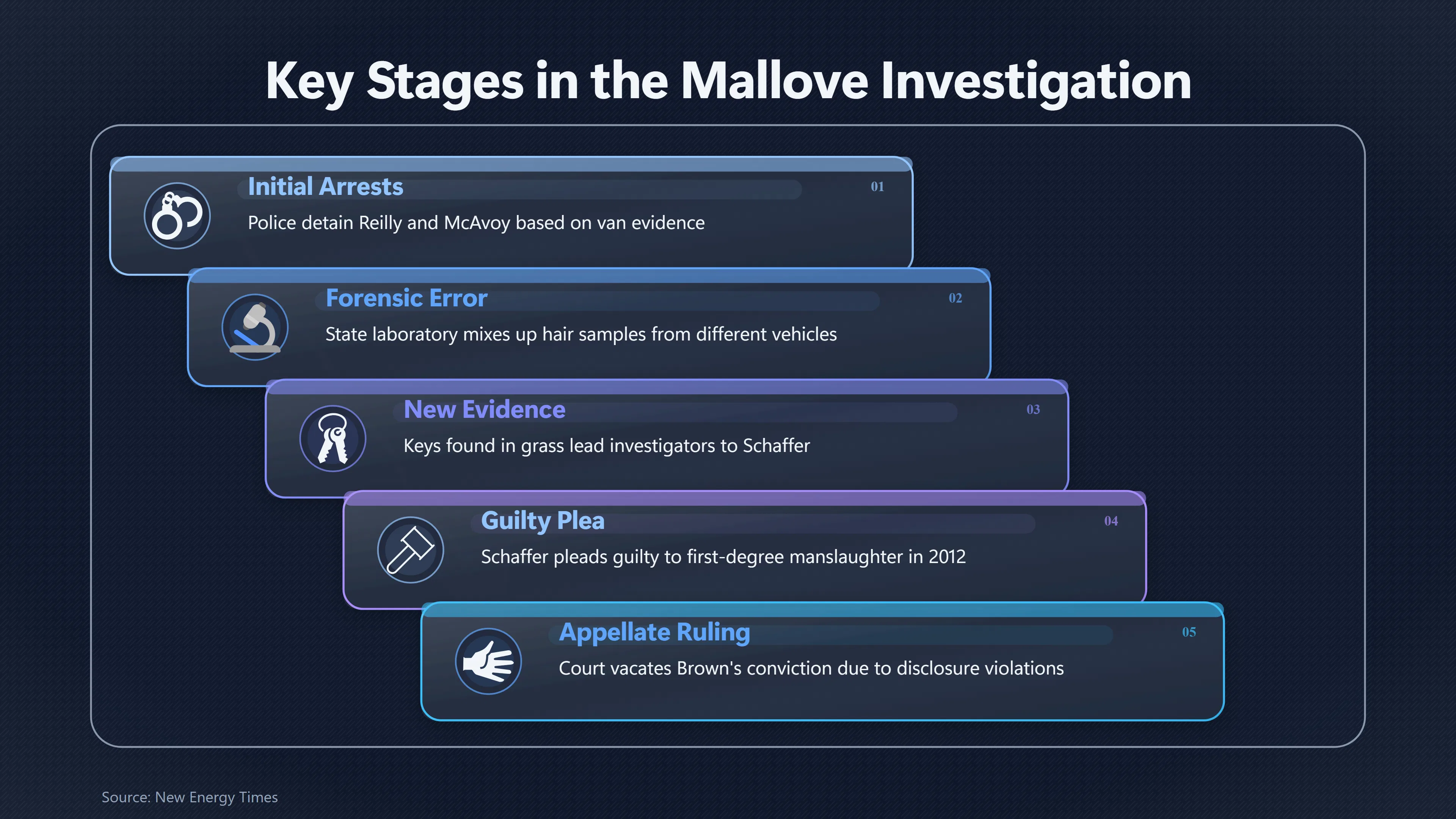
The distinction is important. The Mallove case contains genuine problems in the investigation and prosecution, including an early wrongful investigative direction, a forensic-laboratory error and, later, a Brady disclosure violation. Those failures justify caution about individual accusations. They do not, by themselves, supply evidence for an energy-suppression plot.
Why Mallove’s work invites a suppression hypothesis
Mallove was unusually well positioned to become the subject of such a theory. An MIT-trained engineer and former chief science writer at the Massachusetts Institute of Technology’s news office, he became one of America’s most prominent advocates of cold fusion after the controversial 1989 announcement by Martin Fleischmann and Stanley Pons. He argued that experiments had produced anomalous excess heat and that the scientific establishment had dismissed the phenomenon prematurely.[Foreign Policy]foreignpolicy.comForeign Policy The Coldest Case – Foreign PolicyForeign PolicyThe Coldest Case – Foreign PolicyJuly 7, 2016…
His dispute with MIT was particularly important. After examining laboratory material connected with experiments at MIT’s Plasma Fusion Center, Mallove concluded that data had been altered in a way that made the cold-fusion results appear less favourable. He eventually accused the centre of scientific misconduct and suspected that researchers whose funding depended on conventional fusion had an institutional incentive to discredit the rival approach. MIT did not accept his allegations, and Mallove resigned from its news office in 1991. He subsequently made the controversy central to his book Fire from Ice and to his broader campaign for unconventional energy research.[Foreign Policy]foreignpolicy.comForeign Policy The Coldest Case – Foreign PolicyForeign PolicyThe Coldest Case – Foreign PolicyJuly 7, 2016…
That history matters because “Mallove believed cold fusion was being suppressed” and “Mallove was murdered to suppress cold fusion” can easily become fused into a single story. They are actually separate propositions. The first is extensively documented: Mallove publicly alleged institutional resistance and misconduct. The second requires evidence connecting whoever killed him to that scientific dispute.
The timing also gave supporters reasons to wonder. Shortly before his death, the US Department of Energy had agreed to reconsider evidence concerning cold fusion, something Mallove welcomed enthusiastically after years of campaigning. His colleagues regarded him as a central public advocate for unconventional energy research. Even an immediate tribute published within that community stressed his struggle against what its authors regarded as denial and obstruction of cold fusion. Yet significantly, that same May 2004 account acknowledged that preliminary information suggested robbery or a landlord-tenant dispute and explicitly stated that there was then no evidence of a political connection to the murder.[New Energy Times]newenergytimes.comNew Energy TimesNew Energy Times - Plotkin and Whitford Tribute to MalloveMay 15, 2004…
So the suppression hypothesis did not arise from nowhere. Mallove really had made enemies in an intellectual sense, really believed powerful interests were obstructing cold fusion, and really was murdered at an important point in his campaign. What it lacked was the next evidential step: an identifiable research-related adversary connected to the people or events surrounding his death.
The rental-property conflict produced a concrete motive
The competing explanation begins not in Mallove’s laboratory or publishing work but at 119 Salem Turnpike in Norwich, his family’s rental property and his childhood home.
Mallove had recently evicted tenants Roy and Patricia Anderson and travelled from New Hampshire to clean the property. Chad Schaffer, Patricia Anderson’s son, and Schaffer’s girlfriend Candace Foster had also lived there. The later court record states that on 14 May 2004 Schaffer learnt from his mother that someone at the property was throwing possessions into a skip. According to Foster’s later testimony, Schaffer was angry because he had intended to retrieve belongings from the house.[Justia Law]law.justia.comJustia LawBrown v. Commissioner of Correction:: 2025:: Connecticut Appellate Court Decisions:: Connecticut Case Law:: Connecticut Law…
This is qualitatively different from the suppression motive. A research-suppression theory can propose that unnamed interests disliked Mallove’s advocacy. The property evidence places identifiable people with an immediate grievance at the precise location and time of the homicide.
The prosecution’s eventual reconstruction became still more specific. Foster testified that Schaffer left after hearing what was happening at the property and later returned with visible blood on his clothes. Evidence recorded in the subsequent appellate proceedings also included another witness who said she had seen Schaffer’s bloody clothing, while a further witness told police that Schaffer had admitted assaulting Mallove with Brown and taking possessions to make the crime appear to be a robbery.[Justia Law]law.justia.comJustia LawBrown v. Commissioner of Correction:: 2025:: Connecticut Appellate Court Decisions:: Connecticut Case Law:: Connecticut Law…
Foster eventually admitted her own involvement. According to the judicial record, she said that she returned to the property with Schaffer and Brown while Mallove was still alive. She described Mallove asking for help, the removal of his possessions, further blows and kicks, the use of a pipe and an attempt to suffocate him. She also admitted driving Mallove’s minivan and leaving it at Foxwoods casino. The vehicle had indeed been found there the day after the killing.[Justia Law]law.justia.comJustia LawBrown v. Commissioner of Correction:: 2025:: Connecticut Appellate Court Decisions:: Connecticut Case Law:: Connecticut Law…
Investigative reporting later described another small but significant piece of corroboration. Detective James Curtis revisited photographs showing the skip Mallove had been filling. A set of keys bearing the name “Brittany” appeared on grass that had already been cut; unlike surrounding objects, the keys were not covered in clippings. Foster identified them as Schaffer’s, explaining that Brittany was the name of one of his children. That clue helped investigators revisit Schaffer after the original case had gone badly wrong.[David Kushner]davidkushner.comDavid Kushner The Coldest Case – David KushnerDavid KushnerThe Coldest Case – David KushnerJuly 7, 2016…
The resulting prosecution was not simply a theory that “robbers must have done it”. It developed a sequence involving a recent eviction, anger over discarded possessions, people connected to the former tenants, witness accounts, allegedly bloodied clothing, statements attributed to Schaffer, his presence at the property and efforts to stage the aftermath as a robbery. Schaffer ultimately pleaded guilty to first-degree manslaughter; reporting on his 2012 sentencing recorded a 16-year prison term.[Norwalk Hour]thehour.comNorwalk Hour Man gets 16 years in prison for killing scientistNorwalk HourMan gets 16 years in prison for killing scientistJune 28, 2012…
That evidential chain is why Mallove’s death is difficult to use as affirmative evidence of research suppression. A suppression explanation has to do more than show that Mallove had controversial ideas. It has to explain why the documented property dispute, the participants’ conduct and the witnesses pointing towards that dispute are less persuasive than an alternative motive for which comparable case-specific links have not emerged.

The investigation’s mistakes deserve weight — but not unlimited weight
There is nevertheless a reason to resist presenting the official case as a seamless success. Norwich police initially pursued the wrong men.
Joseph Reilly and Gary McAvoy were arrested after evidence appeared to connect them with Mallove’s stolen vehicle. Among other things, a witness had identified Reilly as a possible driver of a green van near a casino. A hair sample was also reported as connecting McAvoy to Mallove’s van. But the supposed forensic link collapsed: the state laboratory had mixed up the origin of the hair. It had come not from Mallove’s van but from a different vehicle associated with McAvoy. Prosecutors ultimately abandoned the homicide charges.[Foreign Policy]foreignpolicy.comForeign Policy The Coldest Case – Foreign PolicyForeign PolicyThe Coldest Case – Foreign PolicyJuly 7, 2016…
That episode demonstrates a real investigative failure. It also provides a useful warning against treating an arrest, a forensic claim or even a probable-cause finding as conclusive. The later judicial record confirms that Reilly and McAvoy were eliminated as sources of DNA profiles connected with Mallove’s death and that the state dropped the charges against them.[Justia Law]law.justia.comJustia LawBrown v. Commissioner of Correction:: 2025:: Connecticut Appellate Court Decisions:: Connecticut Case Law:: Connecticut Law…
Yet this failure does not inherently strengthen the suppression hypothesis. It establishes that the first prosecution was unreliable. The later case against Schaffer, Foster and Brown arose from a different evidential trail, including information from people associated with them and admissions or statements concerning events at the property.
Even sources sympathetic to Mallove’s energy work recognised weaknesses in the later prosecution. In 2010, New Energy Times noted that the probable-cause case against Schaffer depended heavily on statements rather than physical evidence and raised questions about the alleged decision to return to the scene and stage a robbery.[New Energy Times - News Site]news.newenergytimes.netNew Energy TimesNews SiteMallove Murder Case Moves Along – New Energy Times – News SiteJune 24, 2010… Those are legitimate questions about reliability and reconstruction. They are not evidence identifying an outside scientific, industrial or government sponsor.
This distinction is crucial. Evidence against one explanation is not automatically evidence for another. Showing that police made serious mistakes, or that a witness changed her story, can reduce confidence in a prosecution. To turn that uncertainty into evidence of suppression requires additional facts linking the homicide to Mallove’s research.
The 2025 retrial ruling changes the legal picture
The most important qualification to older accounts of the Mallove case came in January 2025. The Connecticut Appellate Court ruled that Mozzelle Brown was entitled to a new trial and directed that his 2014 convictions for murder and conspiracy to commit murder be vacated.[Connecticut Judicial Branch]jud.ct.govCONNECTICUT LAW JOURNAL January 28, 2025 2February 4, 2026…
The reason matters enormously when interpreting what the ruling means.
Brown’s challenge concerned Candace Foster, whose testimony had been central to the state’s case. At Brown’s trial, Foster denied having a deal with prosecutors but acknowledged hoping that her cooperation would help her own criminal case. She later received substantially more favourable treatment, ultimately pleading guilty to hindering prosecution and tampering with physical evidence.[Justia Law]law.justia.comJustia LawBrown v. Commissioner of Correction:: 2025:: Connecticut Appellate Court Decisions:: Connecticut Case Law:: Connecticut Law…
The appellate court concluded that the state had suppressed material information indicating an informal understanding with Foster. Under Brady v. Maryland, prosecutors must disclose material evidence favourable to the defence, including evidence that can be used to challenge the credibility or incentives of an important prosecution witness. The court found that statements concerning the prosecution’s practice of giving consideration to cooperating witnesses should have been disclosed and that there was a reasonable probability the trial outcome could have been different had the defence received them.[Justia Law]law.justia.comJustia LawBrown v. Commissioner of Correction:: 2025:: Connecticut Appellate Court Decisions:: Connecticut Case Law:: Connecticut Law…
That is a substantial constitutional defect, not a technicality. It means Brown’s 2014 verdict cannot properly be cited today as though it remains an unqualified judicial confirmation of the prosecution’s reconstruction. The appellate court ordered the convictions vacated and a new trial.[Justia Law]law.justia.comJustia LawBrown v. Commissioner of Correction:: 2025:: Connecticut Appellate Court Decisions:: Connecticut Case Law:: Connecticut Law…
But the ruling also has a clear boundary. It did not find that Mallove’s cold-fusion activities caused his death. It did not identify an energy company, government agency, scientific institution or other research-related actor behind the killing. Nor did it invalidate Schaffer’s guilty plea. The decision concerned the fairness of Brown’s trial and the prosecution’s disclosure obligations regarding Foster’s credibility and expected treatment.[Connecticut Judicial Branch]jud.ct.govConnecticut Judicial Branch HomeConnecticut Judicial BranchHome - CT Judicial Law Libraries' NewsLogJanuary 24, 2025…
That makes the updated assessment more nuanced than either “the murder was completely solved” or “the conviction collapsed, therefore the suppression theory is vindicated”. Neither follows from the present record.
Does Mallove’s murder support a suppression theory?
Mallove’s murder remains genuinely unusual in the history of unconventional-energy advocacy: a prominent critic of mainstream treatment of cold fusion was violently killed while still actively campaigning for the subject. His own history of alleging suppression understandably made the homicide fertile ground for speculation.[Foreign Policy]foreignpolicy.comForeign Policy The Coldest Case – Foreign PolicyForeign PolicyThe Coldest Case – Foreign PolicyJuly 7, 2016…
The decisive comparison, however, is between the specificity of the competing explanations.
For a research-suppression theory, the established facts show that Mallove advocated controversial energy research, accused MIT researchers of mishandling cold-fusion evidence and believed institutional interests had obstructed the field. What has not emerged is a documented threat tied to the murder, a payment, communication, surveillance record, intermediary, research-related meeting, suspicious transfer of Mallove’s technical material or other evidence connecting an adversary in the energy dispute to the Norwich attack.
For the property-dispute explanation, the record contains a recent eviction at the exact murder scene; discarded possessions; an angry relative of the former tenants; witnesses describing bloodied clothing and incriminating statements; Foster’s detailed account of the participants’ actions; Schaffer’s admission of involvement and guilty plea; and evidence that the removal of Mallove’s property was intended to make the attack resemble a robbery.[Justia Law]law.justia.comJustia LawBrown v. Commissioner of Correction:: 2025:: Connecticut Appellate Court Decisions:: Connecticut Case Law:: Connecticut Law…
There are important weaknesses in that record. Foster gave differing accounts, had participated in the events herself and had an obvious incentive to obtain favourable treatment. The 2025 appellate decision established that information bearing on that incentive was improperly withheld from Brown’s defence. The earlier Reilly-McAvoy prosecution also shows that investigators were capable of pursuing an erroneous theory on apparently persuasive evidence. Those facts make scepticism about particular claims appropriate.[Justia Law]law.justia.comJustia LawBrown v. Commissioner of Correction:: 2025:: Connecticut Appellate Court Decisions:: Connecticut Case Law:: Connecticut Law…
They still leave a large evidential gap between doubt about parts of the prosecution case and positive evidence of research suppression. Nothing in the appellate ruling fills that gap.
Mallove’s case therefore illustrates a broader problem in claims about suspicious deaths among UFO, antigravity and unconventional-energy researchers. A person’s controversial work can make a suppression motive imaginable, and failures by police or prosecutors can make an official narrative less secure. But neither establishes who actually acted or why. In Mallove’s murder, the strongest surviving evidence remains centred on a violent conflict arising at the rental property. The suppression hypothesis remains possible in the abstract, but on the publicly documented evidence it has not developed the case-specific connections needed to outperform that competing explanation.
Amazon book picks
Further Reading
Books and field guides related to Does Mallove's Murder Support a Suppression Theory?. Use these as the next step if you want deeper reading beyond the article.
Fire from Ice: Searching for the Truth Behind the Cold Fusion...
Discusses the furor over the announcement that scientists had succeeded in producing controlled nuclear fusion at ordinary temperatures,...
Bad Science: The Short Life and Weird Times of Cold Fusion
Documents the bizarre 1989 episode of 2 scientists who announced they had created a sustained nuclear-fusion reaction at room temperature...
The Demon-Haunted World
Rating: 4.5/5 from 43 Google Books ratings
NEW YORK TIMES BESTSELLER • From the renowned astronomer and author of Cosmos comes a “powerful [and] stirring defense of informed ration...

Cold Fusion: The Scientific Fiasco of the Century
First published 1992. Subjects: Cold fusion, History, Kalte Kernfusion, Koude kernfusie, Science, moral and ethical aspects.
eBay marketplace picks
Marketplace Samples
Live-tested eBay searches with available results related to this page.
Selected fromenergy science poster oneBay.co.uk.


Endnotes
1.
Source: law.justia.com
Link:https://law.justia.com/cases/connecticut/court-of-appeals/2025/ac46658.html
Source snippet
Justia LawBrown v. Commissioner of Correction:: 2025:: Connecticut Appellate Court Decisions:: Connecticut Case Law:: Connecticut Law...
2.
Source: news.newenergytimes.net
Title: New Energy Times
Link:https://news.newenergytimes.net/2010/06/24/mallove-murder-case-plods-along/
Source snippet
News SiteMallove Murder Case Moves Along – New Energy Times – News SiteJune 24, 2010...
Published: June 24, 2010
3.
Source: law.justia.com
Link:https://law.justia.com/cases/new-york/appellate-division-second-department/2025/2023-05736.html
4.
Source: docs.justia.com
Link:https://docs.justia.com/cases/federal/district-courts/ohio/ohsdce/2%3A2012cv00511/155043/19
5.
Source: docs.justia.com
Link:https://docs.justia.com/cases/federal/district-courts/new-york/nysdce/1%3A2013cv00827/407576/29
6.
Source: docs.justia.com
Link:https://docs.justia.com/cases/federal/appellate-courts/ca2/09-4991/920110105
7.
Source: docs.justia.com
Link:https://docs.justia.com/cases/federal/district-courts/new-jersey/njdce/3%3A2008cv06314/223327/21
8.
Source: law.justia.com
Link:https://law.justia.com/cases/michigan/court-of-appeals-unpublished/2001/20010316-c227381-29-227381-opn.html
9.
Source: law.justia.com
Link:https://law.justia.com/cases/federal/district-courts/california/caedce/2025/?page=3
10.
Source: dockets.justia.com
Title: noscat 11
Link:https://dockets.justia.com/browse/state-washington/court-wawdce/noscat-11?page=39
11.
Source: jud.ct.gov
Title: Connecticut Judicial Branch Home
Link:https://jud.ct.gov/lawlib/lawlibnews/Posts/Post.aspx?Id=6178
Source snippet
Connecticut Judicial BranchHome - CT Judicial Law Libraries' NewsLogJanuary 24, 2025...
Published: January 24, 2025
12.
Source: foreignpolicy.com
Title: Foreign Policy The Coldest Case – Foreign Policy
Link:https://foreignpolicy.com/2016/07/07/the-coldest-case-cold-fusion-eugene-mallove-mit-infinite-energy/
Source snippet
Foreign PolicyThe Coldest Case – Foreign PolicyJuly 7, 2016...
Published: July 7, 2016
13.
Source: newenergytimes.com
Link:https://newenergytimes.com/v2/news/Mallove/DrEugeneMallove-MPMW.shtml
Source snippet
New Energy TimesNew Energy Times - Plotkin and Whitford Tribute to MalloveMay 15, 2004...
Published: May 15, 2004
14.
Source: davidkushner.com
Title: David Kushner The Coldest Case – David Kushner
Link:https://davidkushner.com/article/the-coldest-case/
Source snippet
David KushnerThe Coldest Case – David KushnerJuly 7, 2016...
Published: July 7, 2016
15.
Source: thehour.com
Title: Norwalk Hour Man gets 16 years in prison for killing scientist
Link:https://www.thehour.com/news/article/Man-gets-16-years-in-prison-for-killing-scientist-8163651.php
Source snippet
Norwalk HourMan gets 16 years in prison for killing scientistJune 28, 2012...
Published: June 28, 2012
16.
Source: newenergytimes.com
Link:https://newenergytimes.com/v2/news/2008/NET30-jgk39gh12f.shtml
17.
Source: jud.ct.gov
Link:https://www.jud.ct.gov/lawjournal/Docs/Appellate/2025/5/ap230_8631.pdf
Source snippet
CONNECTICUT LAW JOURNAL January 28, 2025 2February 4, 2026...
Published: January 28, 2025
18.
Source: sro.vic.gov.au
Link:https://www.sro.vic.gov.au/index.php/about-us/laws-legal-cases-and-rulings/legal-cases/steven-graham-jo-anne-faye-brown-v-commissioner-state-revenue-unreported
19.
Source: jud.ct.gov
Link:https://jud.ct.gov/lawlib/lawlibnews/Default.aspx?ArchMY=202501
20.
Source: e-catworld.com
Title: Foreign Policy Article on Cold Fusion and the Life and Death of Eugene Mallove
Link:https://e-catworld.com/2016/07/17/foreign-policy-article-on-cold-fusion-and-the-life-and-death-of-eugene-mallove/
21.
Source: thehour.com
Title: Man convicted of killing physicist gets 58 years in prison
Link:https://www.thehour.com/news/article/Man-convicted-of-killing-physicist-gets-58-years-7977379.php
22.
Source: thehour.com
Title: Trial wraps up in killing of physicist
Link:https://www.thehour.com/news/article/Trial-wraps-up-in-killing-of-physicist-8080746.php
23.
Source: newenergytimes.com
Title: New Energy Times
Link:https://newenergytimes.com/v2/news/2010/35/3524scienceenergynews.shtml
24.
Source: newenergytimes.com
Title: New Energy Times
Link:https://newenergytimes.com/v2/news/2010/34/346tragicevent.shtml
25.
Source: newenergytimes.com
Link:https://newenergytimes.com/v2/news/2008/NET31.shtml
27.
Source: newenergytimes.com
Title: NET29 8dd54geg.shtml
Link:https://newenergytimes.com/v2/news/2008/NET29-8dd54geg.shtml
28.
Source: newenergytimes.com
Link:https://newenergytimes.com/v2/news/2007/NET22.shtml
29.
Source: newenergytimes.com
Link:https://www.newenergytimes.com/v2/news/2005/NET11.shtml
30.
Source: newenergytimes.com
Title: New Energy Times
Link:https://newenergytimes.com/v2/news/2004/DrEugeneMallove.shtml
32.
Source: newenergytimes.com
Title: New Energy Times
Link:https://www.newenergytimes.com/v2/sen/2011.shtml
33.
Source: newenergytimes.com
Title: New Energy Times
Link:https://www.newenergytimes.com/v2/news/Mallove/DrEugeneMallove-SK.shtml
34.
Source: newenergytimes.com
Link:https://www.newenergytimes.com/
35.
Source: infinite-energy.com
Link:https://www.infinite-energy.com/resources/unusual-suspects.html
36.
Source: uapmurders.com
Link:https://uapmurders.com/uaps/Details/Eugene_Mallove/
37.
Source: hcourt.gov.au
Link:https://www.hcourt.gov.au/cases-and-judgments/special-leave/dispositions?page=24
38.
Source: conspira.fi
Title: cold fusion
Link:https://conspira.fi/topic/cold-fusion
39.
Source: everything.explained.today
Title: Eugene Mallove
Link:https://everything.explained.today/Eugene_Mallove/
Additional References
40.
Source: youtube.com
Title: 6 Banned Inventions That Were Too Dangerous to Continue
Link:https://www.youtube.com/watch?v=sNkhK4qm8YY
Source snippet
This video directly explores the cold fusion controversy surrounding Eugene Mallove and addresses theories regarding suppressed technolog...
41.
Source: youtube.com
Title: Court for man charged with scientist’s murder
Link:https://www.youtube.com/watch?v=V2q8nvRL2kc
Source snippet
Eugene Mallove's Missing Shoes Are Clue In His Murder | An Unexpected Killer Highlights...
42.
Source: youtube.com
Link:https://www.youtube.com/watch?v=w2OxNZEyKGs
Source snippet
The "Conspiracy" to Kill Cold Fusion...
43.
Source: uapmurders.com
Link:https://uapmurders.com/uaps/books/
44.
Source: vecteezy.com
Link:https://www.vecteezy.com/editorial/news/chad-schaffer-trial-155843/chad-schaffer-listens-65263214
45.
Source: conspira.fi
Link:https://conspira.fi/conviction/463a1f40-a6af-4d77-9e3b-75ae79396d26
46.
Source: vettingroom.org
Link:https://vettingroom.org/tag/district-of-connecticut/
47.
Source: eugenemallove.com
Link:https://www.eugenemallove.com/emwords_CV.html
48.
Source: thecinemaholic.com
Link:https://thecinemaholic.com/dr-eugene-mallove-murder-where-are-candace-foster-chad-schaffer-and-mozzelle-brown-now/
49.
Source: en-academic.com
Link:https://en-academic.com/dic.nsf/enwiki/347127